אף אחד לעולם לא ראה בתוך אטום. הוא קטן מדי — אטום בודד דק פי מיליון משערמונית. עם זאת, אנו יודעים בדיוק איך…
English narration · English + 中文 subtitles burned in · קריאת קול באנגלית · תרגום אנגלי + סינית שרוף בתוך הסרטון
1.1
What an atom is made of · מא着什么 עשוי אטום
Syllabus · סיילבוס
English
understand that atoms are mostly empty space surrounding a very small, dense nucleus that contains protons and neutrons; electrons are found in shells in the empty space around the nucleus
identify and describe protons, neutrons and electrons in terms of their relative charges and relative masses
understand the terms atomic and proton number; mass and nucleon number
describe the distribution of mass and charge within an atom
describe the behaviour of beams of protons, neutrons and electrons moving at the same velocity in an electric field
determine the numbers of protons, neutrons and electrons present in both atoms and ions given atomic or proton number, mass or nucleon number and charge
state and explain qualitatively the variations in atomic radius and ionic radius across a period and down a group
עברית
הבנת העובדה שאטומים הם בעיקר ריק, המקיף גרעין קטן וצפוף מאוד המכיל פרוטונים ונטרונים; אלקטרונים נמצאים במעגלים בחלל הריק סביב הגרעין
זיהוי ותיאור פרוטונים, נטרונים ואלקטרונים לפי מטעניהם היחסיים ומסותיהם היחסיות
הבנת המונחים מספר אטומי ומספר פרוטוני; מסה ומספר נוכלון
תיאור חלוקת המסה והמטען בתוך אטום
תיאור התנהגות קרנות פרוטונים, נטרונים ואלקטרונים הנעים באותה מהירות בשדה חשמלי
קביעת מספר הפרוטונים, הנטרונים והאלקטרונים הנמצאים באטומים וביונים נתון מספר אטומי או פרוטוני, מספר מסה או נוכלון ומטען
ניסוח והסבר איכותי של השינויים במשער האטום ובמשער היון לאורך מחזור ולפי קבוצה
Source: Cambridge International syllabus · מקור: הסיילבוס הבינלאומי של קמבריד'ג'
English
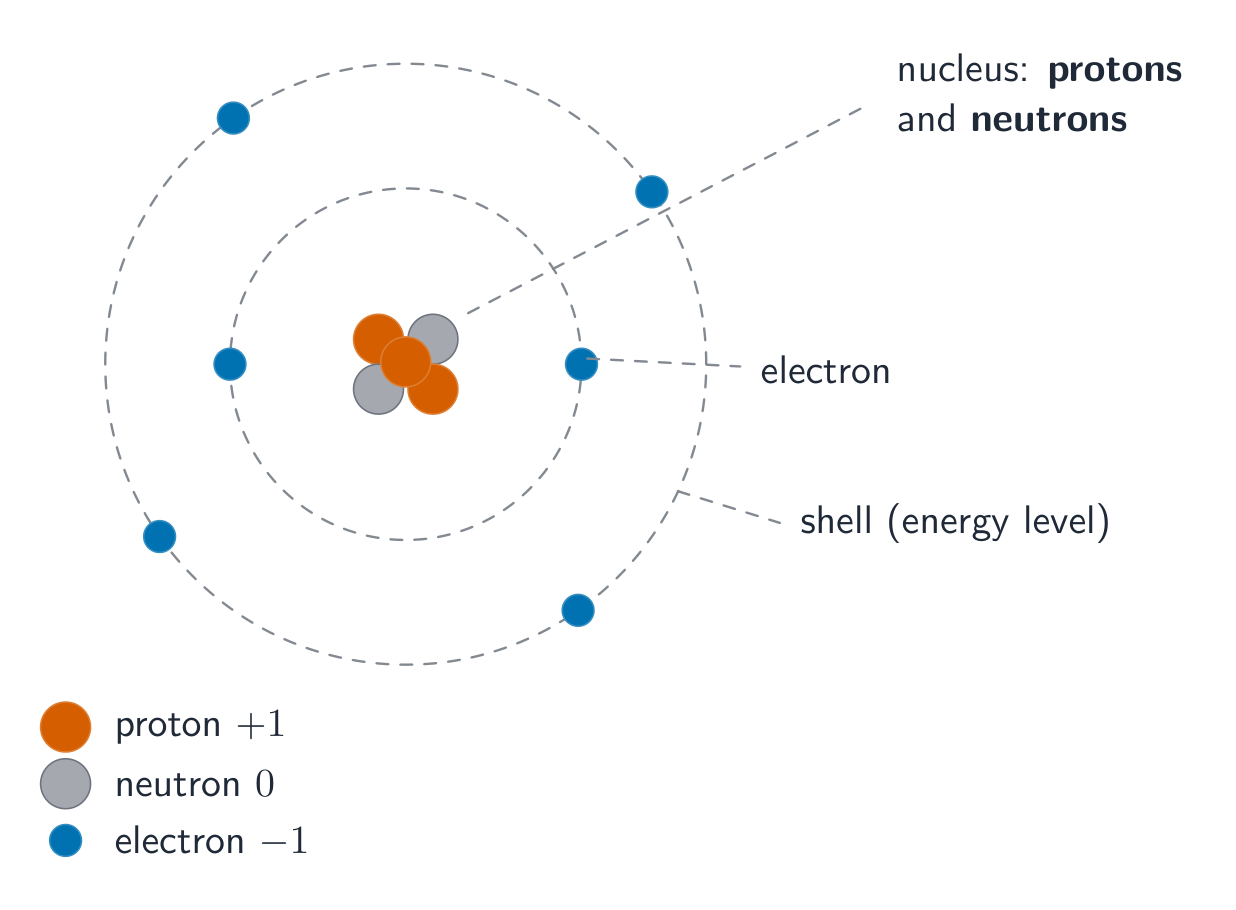
Everything is made of atoms 原子. An atom is mostly empty space. At its centre is a tiny, heavy nucleus 原子核. The nucleus holds two kinds of particle: protons 质子 and neutrons 中子. Around the nucleus, in the empty space, move the electrons 电子. The electrons stay in shells 壳层 — layers at set distances from the nucleus.
The nucleus is very small but holds almost all the mass. The electrons take up almost all the space but have almost no mass.
Relative charge and relative mass
We compare the three particles using relative charge 相对电荷 and relative mass 相对质量. These are simple numbers, not real units.
Particle
Relative charge
Relative mass
proton
$+1$
$1$
neutron
$0$
$1$
electron
$-1$
$\tfrac{1}{1836}$ (about $0$)
A proton and a neutron have almost the same mass. An electron is about 1836 times lighter. The proton is positive, the electron is negative, and the neutron has no charge — it is neutral 中性.
Proton number and nucleon number
Two numbers describe the nucleus:
the proton number 质子数 (also called the atomic number 原子序数), symbol $Z$ — the number of protons.
the nucleon number 核子数 (also called the mass number 质量数), symbol $A$ — the total number of protons and neutrons. Protons and neutrons are both nucleons 核子.
So the number of neutrons is $A - Z$.
Counting particles in an atom or ion
For a neutral atom, the number of electrons equals the number of protons, which equals $Z$.
An ion 离子 is an atom that has lost or gained electrons, so it has a charge:
a positive ion has fewer electrons than protons.
a negative ion has more electrons than protons.
Example: $^{27}_{13}\text{Al}^{3+}$ has $13$ protons, $27 - 13 = 14$ neutrons, and $13 - 3 = 10$ electrons (it lost 3 electrons to become $3+$).
How mass and charge are spread out
Almost all the mass sits in the nucleus, because protons and neutrons are heavy and electrons are very light. All the positive charge is in the nucleus (the protons). The negative charge is spread out in the shells (the electrons).
Beams of particles in an electric field
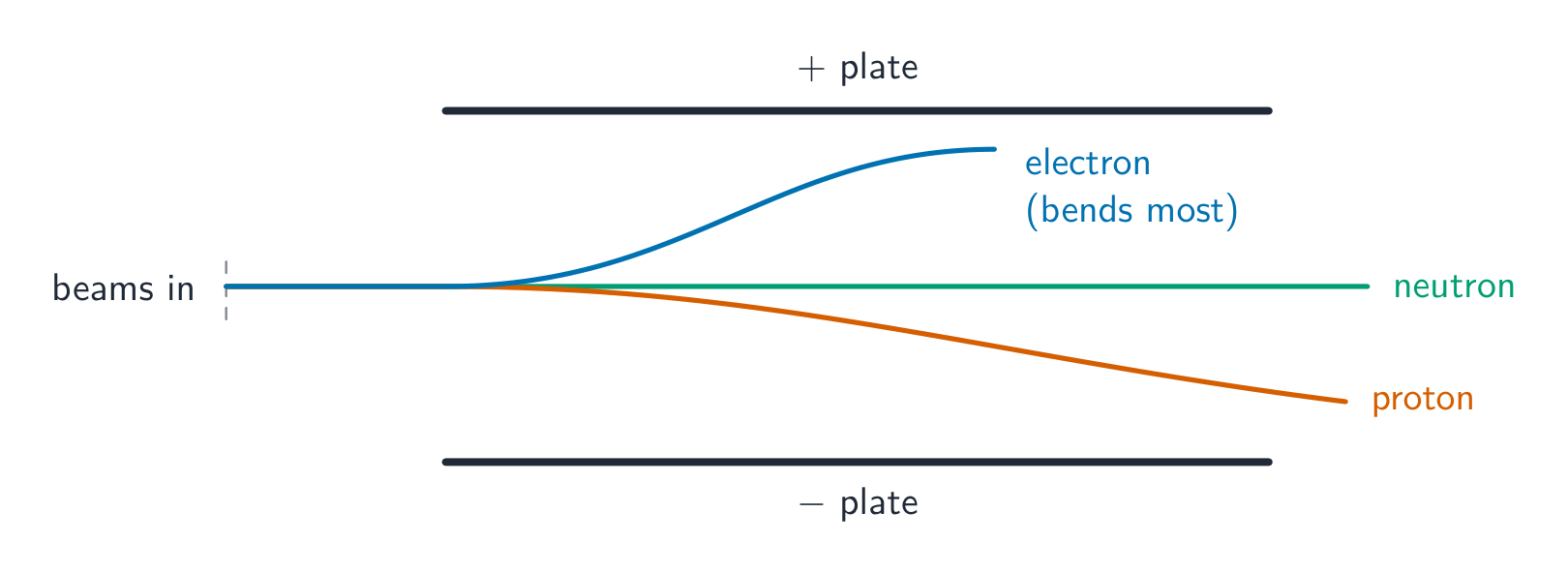
Imagine beams of protons, neutrons and electrons moving at the same speed into an electric field 电场 between two charged plates:
the proton beam bends towards the negative plate (protons are positive).
the electron beam bends the other way, towards the positive plate. It bends much more, because the electron is far lighter — the same force gives a bigger deflection 偏转 to a smaller mass.
the neutron beam goes straight through. It has no charge, so the field gives it no force.
Atomic radius and ionic radius
The atomic radius 原子半径 is the size of an atom. The ionic radius 离子半径 is the size of an ion.
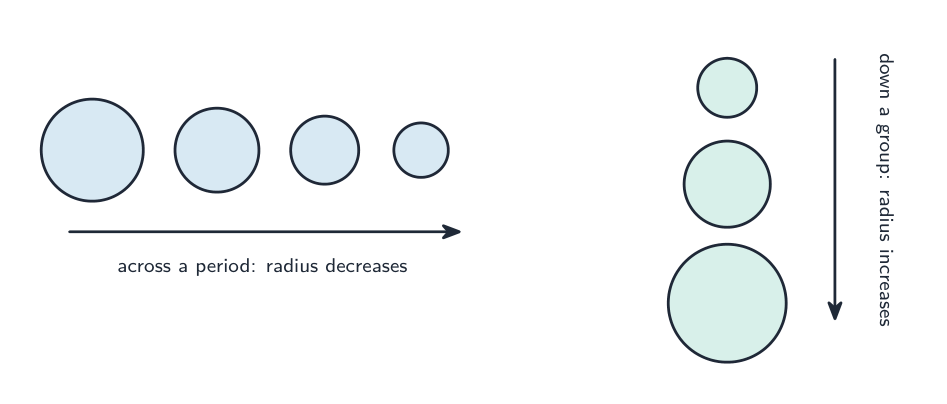
Across a period 周期 (left to right), the atomic radius gets smaller. The nuclear charge 核电荷 (the pull from the protons) rises, but the electrons go into the same outer shell, so the shielding 屏蔽 by inner shells stays about the same. The stronger pull draws the outer shell inwards.
Down a group 族 (top to bottom), the atomic radius gets larger. Each step down adds a new shell, so the outer electrons are further out and feel more shielding from the nucleus.
For ions:
a positive ion (cation 阳离子) is smaller than its atom. It has lost its outer shell, and the electrons that remain feel a stronger pull each.
a negative ion (anion 阴离子) is larger than its atom. It has gained electrons, so there is more repulsion 排斥 between the electrons.
among ions that have the same number of electrons, the one with more protons is smaller.
עברית
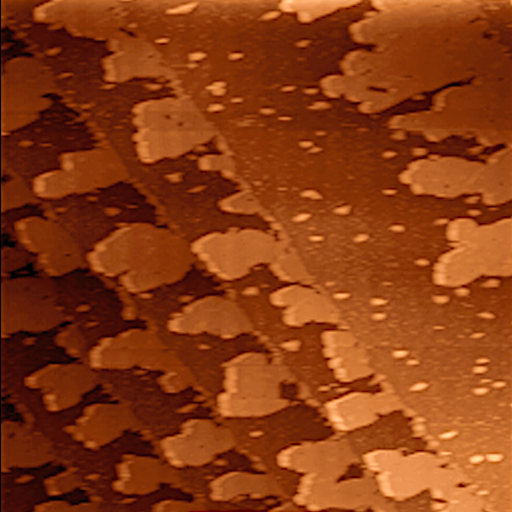
מיקרוסקופ סריכה באפקט המנהרה יכול לצלם אטומים בודדים.
הכל עשוי מאטומים. אטום מורכב ברובו מחלל ריק. במרכזו נמצא גרעין קטן וכבד. הגרעין מכיל שני סוגי חלקיקים: פרוטונים וניטרונים. סביב הגרעין, בחלל הריק, נעים האלקטרונים. האלקטרונים נשארים במעטפות — שכבות במרחקים קבועים מהגרעין.
הגרעין קטן מאוד אך מכיל כמעט כל המסה. האלקטרונים תופסים כמעט כל החלל אך יש להם כמעט אין מסה.
אטום מורכב ברובו מחלל ריק: פרוטונים וניטרונים יושבים בגרעין המרכזי הקטן, בעוד אלקטרונים נעים במעטפות סביבו
מטען יחסי ומסה יחסית
אנו משווים בין שלושת החלקיקים באמצעות מטען יחסי ומסה יחסית. אלו מספרים פשוטים, לא יחידות אמיתיות.
חלקיק
מטען יחסי
מסה יחסית
פרוטון
$+1$
$1$
ניטרון
$0$
$1$
אלקטרון
$-1$
$\tfrac{1}{1836}$ (כ-$0$)
לפרוטון ולניטרון יש כמעט אותה מסה. האלקטרון קל פי 1836 לערך. הפרוטון טעון בטעון חיובי, האלקטרון בטעון שלילי, והניטרון אינו טעון — הוא ניטרלי.
מספר פרוטון ומספר נוקלאון
שני מספרים מתארים את הגרעין:
מספר הפרוטונים (כונה גם מספר אטומי), סממן $Z$ — מספר הפרוטונים.
מספר הנוקליונים (כונה גם מספר המסה), סממן $A$ — הסך הכולל של פרוטונים ונוטרונים. פרוטונים ונוטרונים הם שניהם נוקליונים.
לכן, מספר הנוטרונים הוא $A - Z$.
ספירת חלקיקים באטום או ביון
באטום ניטרלי, מספר האלקטרונים שווה למספר הפרוטונים, מה ששווה ל$Z$.
יון הוא אטום שאיבד או רכש אלקטרונים, ולכן יש לו מטען:
יון חיובי יש לו פחות אלקטרונים מאשר פרוטונים.
יון שלילי יש לו יותר אלקטרונים מאשר פרוטונים.
דוגמה: $^{27}_{13}\text{Al}^{3+}$ יש לו $13$ פרוטונים, $27 - 13 = 14$ נוטרונים, ו$13 - 3 = 10$ אלקטרונים (איבד 3 אלקטרונים כדי להפוך ל$3+$).
איך מסת ומטען מחולקים
מעט几乎 כל המסה נמצאת בגרעין, כי פרוטונים ונוטרונים כבדים ואלקטרונים קלים מאוד. כל המטען החיובי נמצא בגרעין (הפרוטונים). המטען השלילי מפוזר בשכבות (האלקטרונים).
קרני חלקיקים בשדה חשמלי
דמיינו קרניים של פרוטונים, נוטרונים ואלקטרונים הנעות באותה מהכה אל שדה חשמלי בין שתי צלעות טעונות:
קרן הפרוטונים מתכופפת לכיוון הצלע השלילית (פרוטונים חיוביים).
קרן האלקטרונים מתכופפת בכיוון ההפוך, לכיוון הצלע החיובית. היא מתכופפת הרבה יותר, כי האלקטרון קל משמעותית — אותו כוח גורם לסטייה גדולה יותר לגוף בעל מסה קטנה יותר.
קרן הנוטרונים עוברת ישר דרך. אין לה מטען, ולכן השדה לא מפעיל עליה כוח.
בשדה חשמלי הפרוטון מתכופף לכיוון הצלעת $-$ והאלקטרון מתכופף בכיוון ההפוך ובצורה משמעותית יותר (הוא קל משמעותית); הנוטרון עובר ישר
רדיוס אטומי ורדיוס יוני
הרדיוס האטומי הוא גודלו של אטום. הרדיוס היוני הוא גודלו של יון.
בכל תקופה (מימין לשמאל), הרדיוס האטומי הופך לקטן יותר. המטען הגרעיני (המשיכה מהפרוטונים) עולה, אך האלקטרונים נכנסים לאותו מעטפת חיצונית, כך שהחסימה על ידי שכבות פנימיות נשארת בערך זהה. המשיכה החזקה יותר מושכת את המעטפת החיצונית פנימה.
לאורך קבוצה (מלמעלה למטה), הרדיוס האטומי הופך לגדול יותר. כל צעד למטה מוסיף שכבה חדשה, ולכן האלקטרונים החיצוניים נמצאים רחוק יותר ומרגישים יותר חסימה מהגרעין.
לאורך תקופה האטומים מתכווצים (משיכה גרעינית חזקה יותר על אותה מעטפת חיצונית); לאורך קבוצה הם גדלים (כל צעד מוסיף שכבה)
עבור יונים:
יון חיובי (קטיאן) הוא קטן יותר מאטומו. הוא איבד את המעטפת החיצונית שלו, והאלקטרונים שנותרו מרגישים משיכה חזקה יותר כל אחד.
יון שלילי (אניון) הוא גדול יותר מאטומו. הוא רכש אלקטרונים, ולכן יש יותר דחייה בין האלקטרונים.
בקרב יונים בעלי אותו מספר אלקטרונים, זה עם יותר פרוטונים הוא קטן יותר.
Explore · חקור
Explore the atom · חקור את האטום
Tap each part. A tiny dense nucleus of protons and neutrons holds the mass; light electrons orbit it in shells. · לחץ על כל חלק. גרעין קטן וצפוף של פרוטונים וניטרונים מחזיק את המסה; אלקטרונים קלים מקיפים אותו בשכבות.
Atomic radius falls across a period (rising nuclear charge pulls the same shell in) and rises down a group (an extra shell each time). Step across Period 3 to see it. · רדיוס אטומי יורד לאורך מחזור (מטען גרעיני עולה מושך את אותה מעטפת פנימה) ועולה למטה במחלקה (מעטפת נוספת בכל פעם). צעדו לאורך המחזור 3 כדי לראות זאת.
define the term isotope in terms of numbers of protons and neutrons
understand the notation $_y^x\text{A}$ for isotopes, where $x$ is the mass or nucleon number and $y$ is the atomic or proton number
state that and explain why isotopes of the same element have the same chemical properties
state that and explain why isotopes of the same element have different physical properties, limited to mass and density
עברית
הגדרת המונח איזוטופ לפי מספר פרוטונים ונטרונים
הבנת הסימון $_y^x\text{A}$ לאיזוטופים, כאשר $x$ הוא מספר המסה או הנוכלון ו$y$ הוא המספר האטומי או הפרוטוני
ניסוח והסבר מדוע לאיזוטופים של אותו יסוד יש את אותם תכונות כימיות
ניסוח והסבר מדוע לאיזוטופים של אותו יסוד יש תכונות פיזיקליות שונות, מוגבלות למסה ולצפיפות
Source: Cambridge International syllabus · מקור: הסיילבוס הבינלאומי של קמבריד'ג'
English
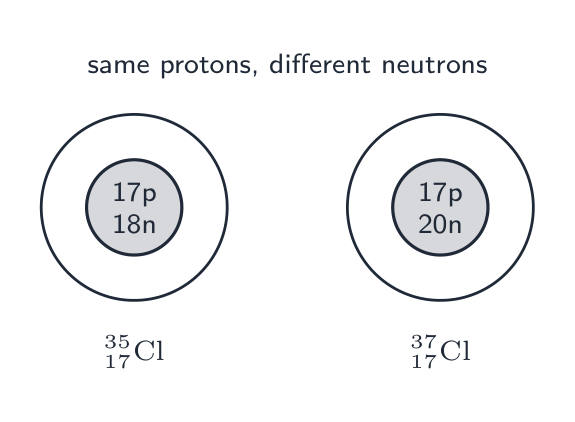
Isotopes 同位素 are atoms of the same element with the same number of protons but a different number of neutrons. So isotopes have the same proton number $Z$ but a different nucleon number $A$.
We write an isotope as $^{A}_{Z}\text{X}$: the nucleon number $A$ on top, the proton number $Z$ below. For example, chlorine has two main isotopes, $^{35}_{17}\text{Cl}$ and $^{37}_{17}\text{Cl}$.
Same chemical properties
Chemical properties 化学性质 depend on the electrons, especially the outer electrons. Isotopes of one element have the same number of electrons arranged in the same way. So they react in exactly the same way — they have the same chemical properties.
Different physical properties
Some physical properties 物理性质 depend on mass, so they differ between isotopes. A heavier isotope has more neutrons, so more mass, and therefore a higher density 密度. (The syllabus limits this difference to mass and density.)
עברית
איזוטופים הם אטומים של אותו יסוד עם אותו מספר פרוטונים אך מספר שונה של נייטרונים. לכן לאיזוטופים יש אותו מספר פרוטונים $Z$ אך מספר נוקלאוני שונה $A$.
שני איזוטופי כלור: אותו מספר פרוטונים, מספר שונה של נאוטרונים
אנו כותבים איזוטופ כ$^{A}_{Z}\text{X}$: מספר הנוקלאונים $A$ בחלק העליון, ומספר הפרוטונים $Z$ בחלק התחתון. לדוגמה, לכלור יש שני איזוטופים עיקריים, $^{35}_{17}\text{Cl}$ ו$^{37}_{17}\text{Cl}$.
תכונות כימיות זהות
תכונות כימיות תלו באלקטרונים, במיוחד באלקטרונים החיצוניים. לאיזוטופים של אותו יסוד יש אותו מספר אלקטרונים המסודרים באותו אופן. לכן הם מגיבים בדיוק באותו אופן — להם יש תכונות כימיות זהות.
תכונות פיזיקליות שונות
חלק מהתכונות הפיזיקליות תלו במסה, ולכן הן שונות בין איזוטופים. איזוטופ כבד יותר יש בו יותר נייטרונים, ולכן יותר מסה, ולכן צפיפות גבוהה יותר. (התוכנית לימודית מגבילה הבדל זה למסה ולצפיפות.)
Explore · חקור
Isotope lab · מעבדת איזוטופים
Classify isotope facts by what changes and what stays the same. · מיינוס עובדות על איזוטופים לפי מה משתנה ומה נשאר ללא שינוי.
Electrons, energy levels and orbitals · אלקטרונים, רמות אנרגיה ואורביטלים
Syllabus · סיילבוס
English
understand the terms: shells, sub-shells and orbitals; principal quantum number (n); ground state, limited to electronic configuration
describe the number of orbitals making up s, p and d sub-shells, and the number of electrons that can fill s, p and d sub-shells
describe the order of increasing energy of the sub-shells within the first three shells and the 4s and 4p sub-shells
describe the electronic configurations to include the number of electrons in each shell, sub-shell and orbital
explain the electronic configurations in terms of energy of the electrons and inter-electron repulsion
determine the electronic configuration of atoms and ions given the atomic or proton number and charge, using either of the following conventions: e.g. for Fe: $1\text{s}^2 2\text{s}^2 2\text{p}^6 3\text{s}^2 3\text{p}^6 3\text{d}^6 4\text{s}^2$ (full electronic configuration) or [Ar] $3\text{d}^6 4\text{s}^2$ (shorthand electronic configuration)
understand and use the electrons in boxes notation
describe and sketch the shapes of s and p orbitals
describe a free radical as a species with one or more unpaired electrons
עברית
הבנת המונחים: קליפות, תת-קליפות ומסלולים; מספר קוונטי ראשי (n); מצב בסיס, בהתייחס רק לקונפיגורציה האלקטרונית
תיאור מספר המסלולים המרכיבים את תת-הקליפות s, p וd, ומספר האלקטרונים שיכולים למלא אותן
תיאור סדר העלייה באנרגיה של תת-הקליפות בתוך השלוש קליפות הראשונות ותת-הקליפות 4s ו-4p
תיאור הקונפיגורציות האלקטרוניות כולל מספר האלקטרונים בכל קליפה, תת-קליפה ומסלול
הסבר הקונפיגורציות האלקטרוניות על בסיס אנרגיית האלקטרונים והדחייה בין-אלקטרונית
קביעת הקונפיגורציה האלקטרונית של אטומים ויונים בהינתן המספר האטומי או מספר הפרוטונים והמטען, באחת מהנהוגות הבאות: לדוגמה עבור Fe: $1\text{s}^2 2\text{s}^2 2\text{p}^6 3\text{s}^2 3\text{p}^6 3\text{d}^6 4\text{s}^2$ (קונפיגורציה אלקטרונית מלאה) או [Ar] $3\text{d}^6 4\text{s}^2$ (קונפיגורציה אלקטרונית מקוצרת)
הבנה ושימוש בסימון אלקטרונים בקופסאות
תיאור ושרטוט צורות המסלולים s ו-p
תיאור רדיקל חופשי כמינים בעל אלקטרון אחד או יותר שאינו זוגי
Source: Cambridge International syllabus · מקור: הסיילבוס הבינלאומי של קמבריד'ג'
English
Electrons are arranged in shells, sub-shells and orbitals.
Shells and the principal quantum number
Each shell is labelled by the principal quantum number 主量子数$n = 1, 2, 3, \dots$ A larger $n$ means a shell that is further from the nucleus and higher in energy.
Sub-shells and orbitals
Each shell is split into sub-shells 亚层, named s, p and d. Each sub-shell is built from orbitals 轨道. An orbital is a small region that can hold up to two electrons.
Sub-shell
Number of orbitals
Maximum electrons
s
1
2
p
3
6
d
5
10
So an s sub-shell holds 2 electrons, a p sub-shell holds 6, and a d sub-shell holds 10.
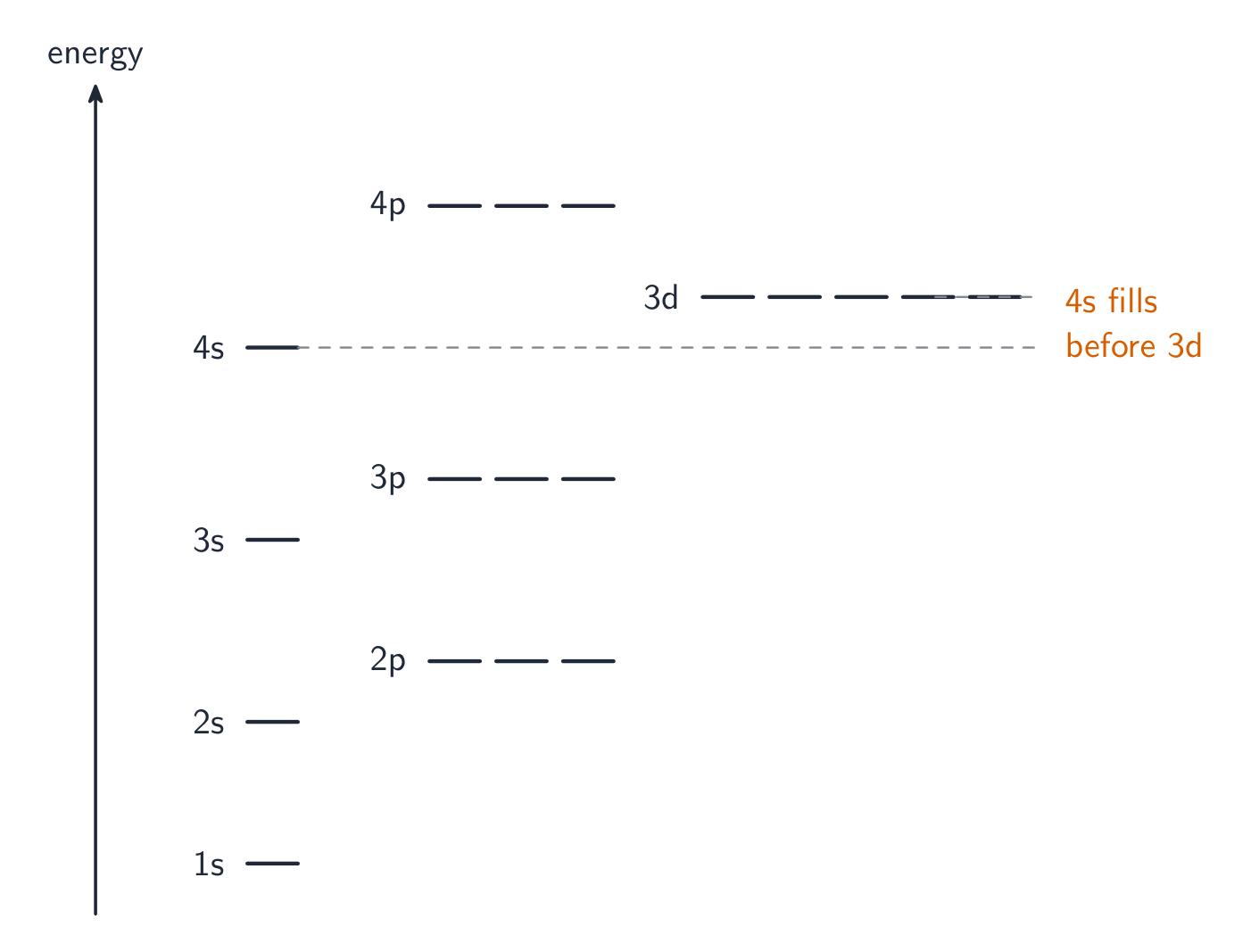
Order of increasing energy
Electrons fill the lowest-energy sub-shell first. For the first three shells, plus 4s and 4p, the order of rising energy is:
You can write a shorthand using the nearest noble gas 稀有气体 in square brackets:
$$[\text{Ar}]\,3\text{d}^6\,4\text{s}^2$$
Here $[\text{Ar}]$ stands for the full configuration of argon.
For ions, you add or remove electrons. One key rule: when a transition metal forms a positive ion, it loses its 4s electrons before its 3d electrons. So $\text{Fe}^{3+}$ is $[\text{Ar}]\,3\text{d}^5$.
Electrons in boxes
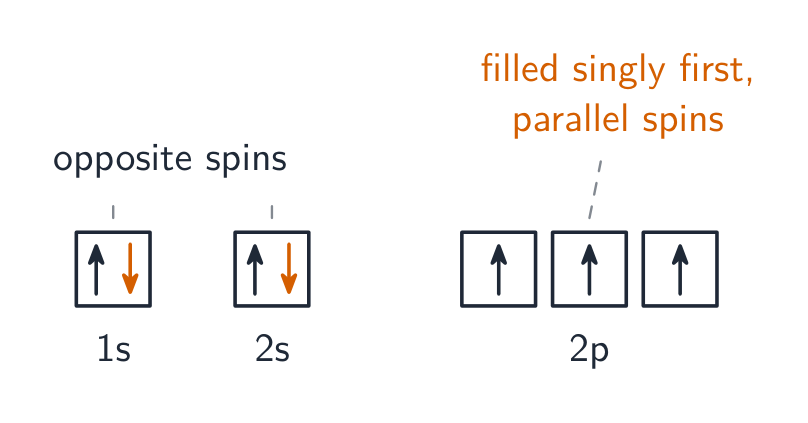
The electrons in boxes notation draws each orbital as a box and each electron as an arrow. Two electrons in the same orbital must point opposite ways, because each electron has a property called spin 自旋, and a shared orbital needs opposite spins.
Within a sub-shell, electrons fill empty orbitals one at a time, with parallel arrows, before any orbital gets a second electron. Spreading out like this keeps the electrons apart and lowers the repulsion between them.
Why the configuration takes this shape
Electrons fill from low energy to high energy because that gives the most stable (lowest-energy) atom. Within a sub-shell they spread out singly first to reduce the repulsion between the negative electrons.
Shapes of s and p orbitals
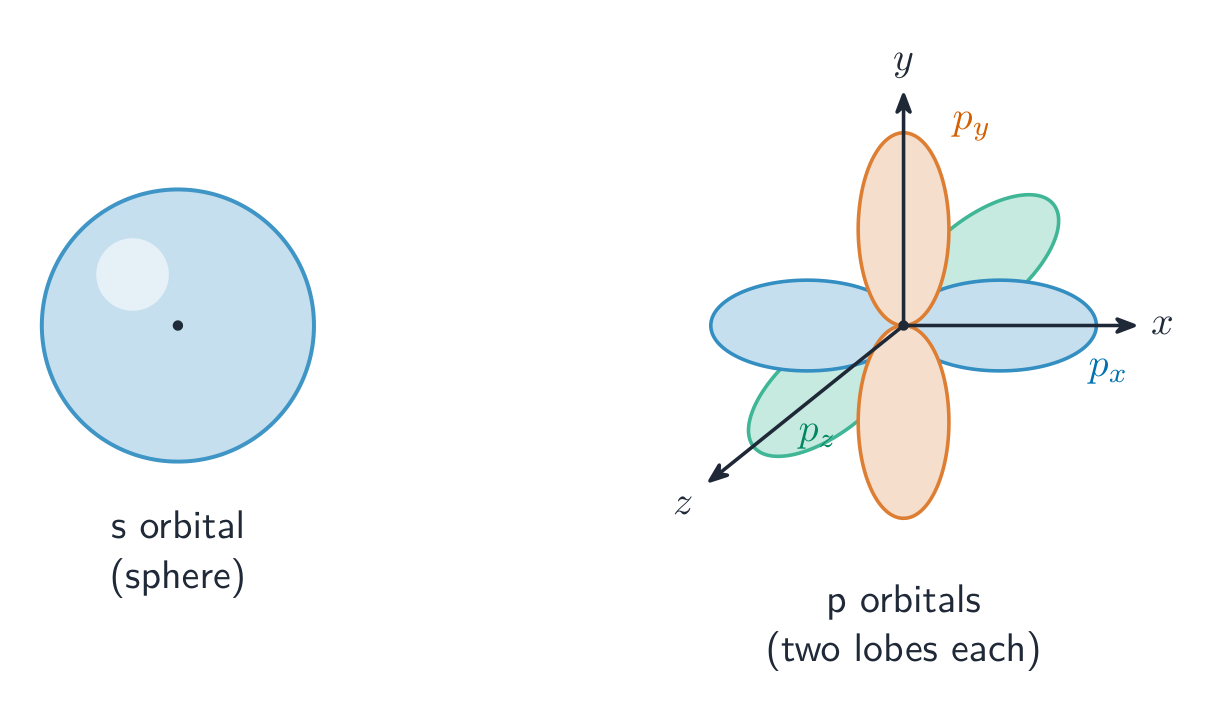
an s orbital is a sphere 球形 centred on the nucleus.
a p orbital has two lobes, like a dumbbell, pointing along one axis. The three p orbitals point along three directions at right angles (the $x$, $y$ and $z$ axes).
Free radicals
A free radical 自由基 is a species with one or more unpaired electrons 未成对电子. Free radicals are very reactive.
עברית
מימן פולט אור רק בגלאי אורך גל דיסקרטיים ואופייניים לו — ספקטרום הפליטה הקווי שלו.
אלקטרונים מסודרים בשכבות, תת-שכבות ואורביטלים.
שכבות ומספר הקוונטי הראשי
כל שכבה מסומנת על ידי מספר הקוונטי הראשי$n = 1, 2, 3, \dots$. ערך גדול יותר ל$n$ מציין שכבה הנמצאת רחוקה יותר מהגרעין ובעלת אנרגיה גבוהה יותר.
תת-שכבות ואורביטלים
כל שכבה מחולקת לתת-שכבות, המכונות s, p ו-d. כל תת-שכבה בנויה מאורביטלים. אורביטל הוא אזור קטן שיכול להכיל עד שני אלקטרונים.
תת-שכבה
מספר אורביטלים
מקסימום אלקטרונים
s
1
2
p
3
6
d
5
10
לכן, תת-שכבת s מכילה 2 אלקטרונים, תת-שכבת p מכילה 6, ותת-שכבת d מכילה 10.
סדר העלייה באנרגיה
אלקטרונים ממלאים תחילה את תת-השכבה בעלת האנרגיה הנמוכה ביותר. עבור השלוש שכבות הראשונות, כמו גם 4s ו-4p, סדר עליית האנרגיה הוא:
ניתן לכתוב סיכום באמצעות הגז האציל הקרוב ביותר בסוגריים מרובעים:
$$[\text{Ar}]\,3\text{d}^6\,4\text{s}^2$$
כאן $[\text{Ar}]$ מייצג את הקונפיגורציה המלאה של ארגון.
ליונים, מוסיפים או מורידים אלקטרונים. חוק מרכזי אחד: כאשר מתכת מעבר יוצרת יון חיובי, היא מאבדת את האלקטרונים ב-4s לפני האלקטרונים ב-3d. לכן $\text{Fe}^{3+}$ הופך ל$[\text{Ar}]\,3\text{d}^5$.
אלקטרונים בקופסאות
הסימון אלקטרונים בקופסאות מצייר כל אורביטל כקופסה וכל אלקטרון כחץ. שני אלקטרונים באותו אורביטל חייבים להיות מכוונים לכיוונים הפוכים, משום שכל אלקטרון possesses תכונה הנקראת ספין, והאורביטל המשותף דורש ספינים הפוכים.
בתוך תת-קליפה, אלקטרונים ממלאים אורביטלים ריקים אחד לאחד, בחיצים מקבילים, לפני שכל אורביטל מקבל אלקטרון נוסף. התפזרות כזו משאירה את האלקטרונים מרוחקים זה מזה ומצמצמת את הדחייה ביניהם.
אלקטרונים ממלאים מאנרגיה נמוכה לגבוהה כי כך מתקבל האטום היציב ביותר (בעל אנרגיה מינימלית). בתוך תת-קליפה הם מתפזרים בודד תחילה כדי להפחית את הדחייה בין האלקטרונים השליליים.
צורות של אורביטלי s ו-p
אורביטל s הוא כדור הממוקם במרכז הגרעין.
אורביטל p יש לו שני פתחים, כמו משקולת דמיונית, המצויים לאורך ציר אחד. שלושת אורביטלי ה-p מצויים לאורך שלושה כיוונים הנמצאים בזווית ישרה (צירי $x$, $y$ ו$z$).
אורביטל s הוא כדור; כל אורביטל p הוא משקולת דמיונית, ושלושת אורביטלי ה-p מצויים לאורך צירי $x$, $y$ ו$z$
רדיקלים חופשיים
רדיקל חופשי הוא מין בעל אלקטרון אחד או יותר בלתי זוגיים. רדיקלים חופשיים הם מאוד תגובתיים.
Explore · חקור
Filling the electron shells · מילוי מעטפות אלקטרונים
Change the atomic number Z and watch the electrons fill the shells (2, 8, 8, …) — the pattern that builds the Periodic Table. · שנה את מספר האטומי Z והצפה האלקטרונים ממלאים את המעטפות (2, 8, 8, …) — הדפוס בונה את טבלת המחזוריות.
define and use the term first ionisation energy, IE
construct equations to represent first, second and subsequent ionisation energies
identify and explain the trends in ionisation energies across a period and down a group of the Periodic Table
identify and explain the variation in successive ionisation energies of an element
understand that ionisation energies are due to the attraction between the nucleus and the outer electron
explain the factors influencing the ionisation energies of elements in terms of nuclear charge, atomic/ionic radius, shielding by inner shells and sub-shells and spin-pair repulsion
deduce the electronic configurations of elements using successive ionisation energy data
deduce the position of an element in the Periodic Table using successive ionisation energy data
עברית
הגדרה ושימוש במונח אנרגיית יוניזציה ראשונה, IE
בניית משוואות לייצוג אנרגיות יוניזציה ראשונה, שנייה ואחרות
זיהוי והסבר מגמות באנרגיות יוניזציה לאורך תקופה ולמטה בחבורה בטבלה המחזורית
זיהוי והסבר השינוי באנרגיות יוניזציה עוקבות של יסוד
הבנה כי אנרגיות יוניזציה נובעות מהמשיכה בין הגרעין לאלקטרון החיצוני
הסבר הגורמים המשפיעים על אנרגיות יוניזציה של יסודים בהתייחס למטען גרעיני, רדיוס אטומי/יוני, הצללה על ידי קליפות ותת-קליפות פנימיות ודחיית זוגות סיבוביים
מסקנת הקונפיגורציות האלקטרונית של יסודים באמצעות נתוני אנרגיות יוניזציה עוקבות
מסקנת מיקום יסוד בטבלה המחזורית באמצעות נתוני אנרגיות יוניזציה עוקבות
Source: Cambridge International syllabus · מקור: הסיילבוס הבינלאומי של קמבריד'ג'
English
First ionisation energy
The first ionisation energy 第一电离能 (IE) is the energy needed to remove one electron from each atom in one mole of gaseous atoms, forming one mole of gaseous $+1$ ions.
We use gaseous atoms so there are no forces between the particles. The unit is $\text{kJ mol}^{-1}$. As an equation, for an element X:
You can keep going. These are the successive ionisation energies 逐级电离能. Each is larger than the one before, because every electron is pulled away from a more positive ion.
What ionisation energy depends on
Ionisation energy comes from the attraction between the positive nucleus and the outer electron. Three main factors set how strong that attraction is:
nuclear charge: more protons pull the electrons more strongly, so the ionisation energy is higher.
atomic radius: the further the outer electron sits from the nucleus, the weaker the pull, so the ionisation energy is lower.
shielding: inner shells block some of the pull on the outer electron. More inner shells mean more shielding and a lower ionisation energy.
There is a smaller effect too — spin-pair repulsion 自旋成对排斥. When two electrons share one orbital, they push each other a little, so one is easier to remove.
Trends in first ionisation energy
Across a period, the first ionisation energy generally rises. The nuclear charge grows while shielding stays about the same, so the outer electrons are held more tightly.
Down a group, the first ionisation energy falls. Lower elements have more shells, so more shielding and a larger radius, and the outer electron is easier to remove.
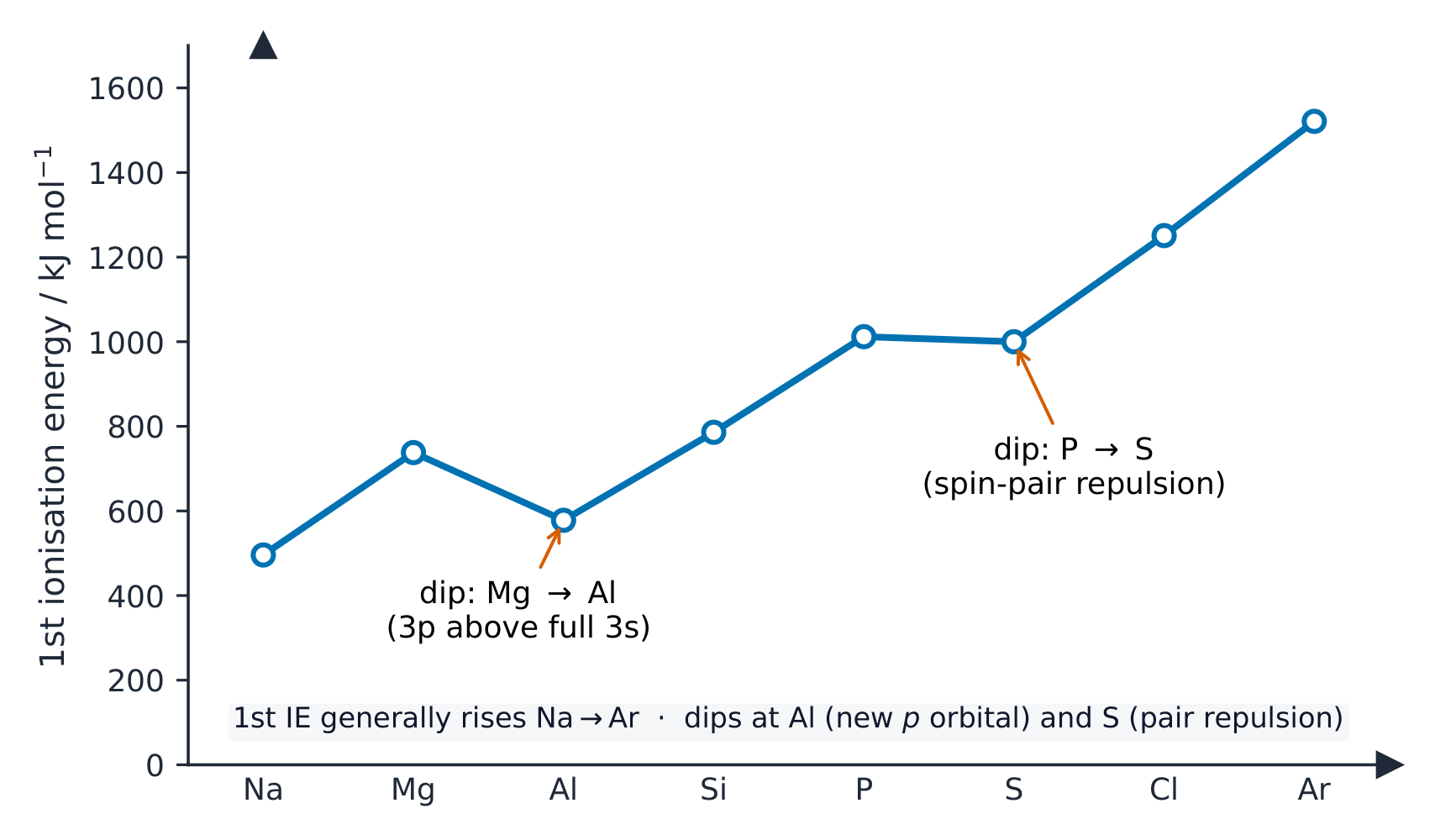
The dips are evidence for sub-shells
The rise across a period is not smooth. Two small dips appear, and you should be able to explain both:
Group 2 to Group 13 (for example Mg to Al): the electron removed from Al comes from a 3p sub-shell, which is higher in energy than the full 3s sub-shell in Mg. A 3p electron is easier to remove, so the value dips.
Group 15 to Group 16 (for example P to S): in S, one 3p orbital now holds a pair of electrons. Spin-pair repulsion makes one of them easier to remove, so the value dips.
These dips are evidence that sub-shells exist.
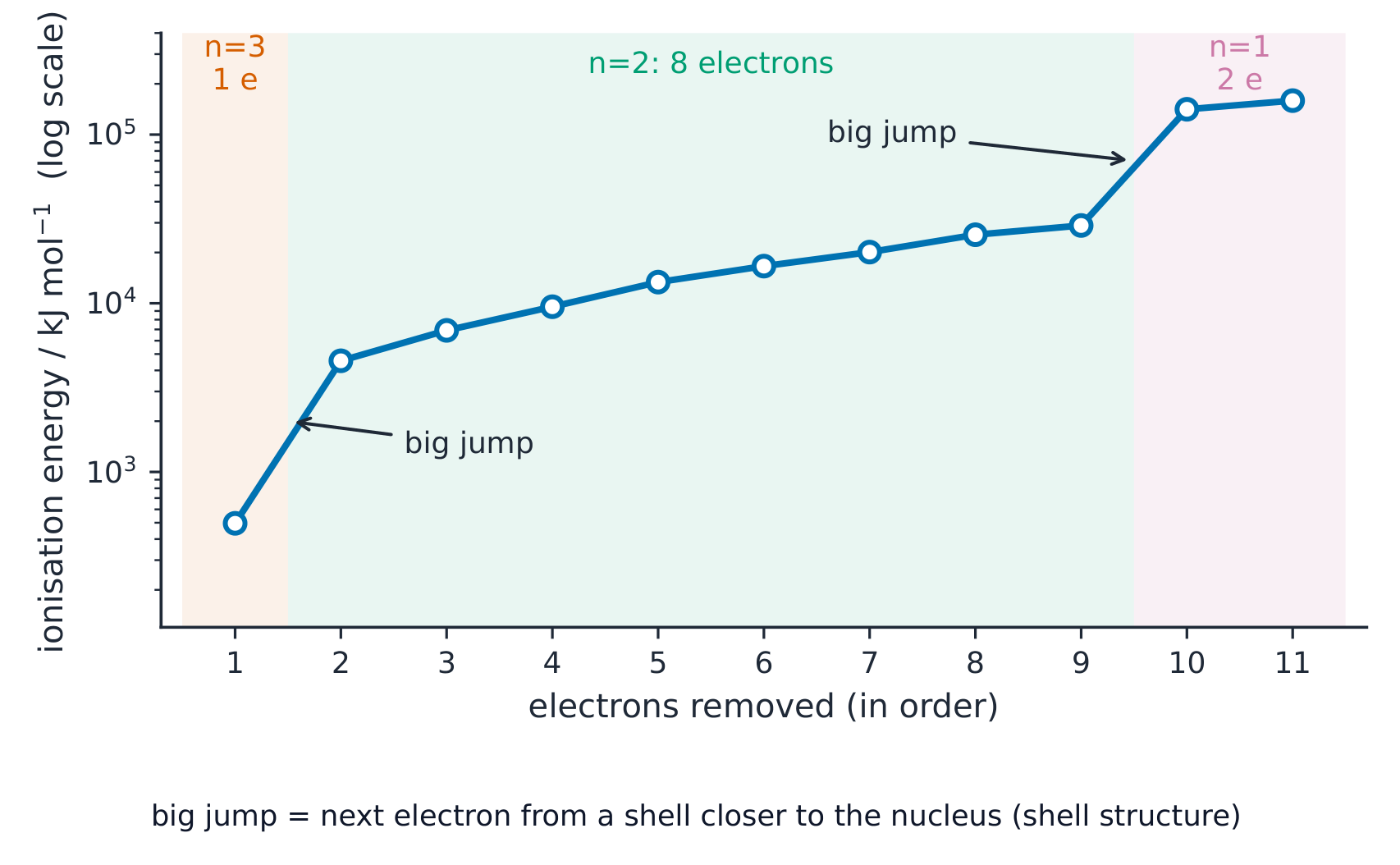
Successive ionisation energies are evidence for shells
If you plot the successive ionisation energies of one element, the values rise, with big jumps at certain points. A big jump happens when the next electron must come from a shell closer to the nucleus.
Count how many electrons come off easily before the first big jump — that is the number of electrons in the outer shell, which tells you the group the element is in. You can also use the pattern to work out the electronic configuration and the position of the element in the Periodic Table.
Electrons removed before the first big jump
Group
1
Group 1
2
Group 2
3
Group 13
Worked example. The first five successive ionisation energies of an element are $590$, $1150$, $4940$, $6480$ and $8120\ \text{kJ}\,\text{mol}^{-1}$. Which group is it in? Look for the big jump, not the biggest number. From the 1st to the 2nd the value roughly doubles, which is a normal rise. From the 2nd ($1150$) to the 3rd ($4940$) it more than quadruples: that is the jump. So two electrons come off easily before it, the outer shell holds 2 electrons, and the element is in Group 2. Count the electrons removed before the jump, and explain the jump properly: the next electron is being pulled from a shell closer to the nucleus, not from a different element.
עברית
אנרגיית יוניזציה ראשונה
אנרגיית יוניזציה ראשונה (IE) היא האנרגיה הנדרשת להוצאת אלקטרון אחד מכל אטום באחד מול של אטומים גזיים, תוך היווצרות של מול אחד של יונים גזיים $+1$.
אנו משתמשים באטומים גזיים כדי שלא יהיו כוחות בין החלקיקים. היחידה היא $\text{kJ mol}^{-1}$. כמשוואה, עבור יסוד X:
ניתן להמשיך. אלו הן אנרגיות יוניזציה עוקבות. כל אחת מהן גדולה מהקודמת שלה, כי כל אלקטרון מושך הרחק מיון בעל מטען חיובי גדול יותר.
על מה תלויה אנרגיית יוניזציה
אנרגיית יוניזציה נובעת מהמשיכה בין הגרעין החיובי לבין האלקטרון החיצוני. שלושה גורמים עיקריים קובעים את חוזק המשיכה הזו:
טענת גרעין: ככל שיש יותר פרוטונים, הם מושכים את האלקטרונים חזק יותר, ולכן אנרגיית היוניזציה גבוהה יותר.
רדיוס אטומי: ככל שהאלקטרון החיצוני רחוק יותר מהגרעין, המשיכה חלשה יותר, ולכן אנרגיית היוניזציה נמוכה יותר.
מסך: מערכות פנימיות חוסמות חלק ממשיכת האלקטרון החיצוני. ככל שיש יותר מערכות פנימיות, כך יש מסך גדול יותר ואנרגיית יוניזציה נמוכה יותר.
יש גם השפעה קטנה יותר — דחיית זוג סpin. כאשר שני אלקטרונים משתפים אורביטלי אחד, הם דוחים זה את זה מעט, ולכן אחד מהם קל יותר להוצאה.
מגמות באנרגיית יוניזציה ראשונה
במהלך תקופה, אנרגיית היוניזציה הראשונה בדרך כלל עולה. הטענת הגרעין גדלה בעוד המסך נשאר בערך אותו דבר, ולכן האלקטרונים החיצוניים נתפסים חזק יותר.
לאורך מחלקה, אנרגיית היוניזציה הראשונה יורדת. אלמנטים תחתונים יש להם יותר מערכות, ולכן מסך גדול יותר ורדיוס גדול יותר, והאלקטרון החיצוני קל יותר להוצאה.
הנפילות הן עדות לתת-מערכות
העלייה במהלך תקופה אינה חלקה. מופיעות שתי נפילות קטנות, ועליך להיות מסוגל להסביר את שתיהן:
ממחלקה 2 למחלקה 13 (למשל Mg ל-Al): האלקטרון המושלם מ-Al מגיע מתת-מערכת 3p, שהיא בגובה אנרגטי גבוה יותר מאשר תת-מערכת 3s המלאה ב-Mg. אלקטרון 3p קל יותר להוצאה, ולכן הערך נופל.
ממחלקה 15 למחלקה 16 (למשל P ל-S): ב-S, אורביטלי 3p אחד מכיל כעת זוג אלקטרונים. דחיית זוג הסpin גורמת לאחד מהם להיות קל יותר להוצאה, ולכן הערך נופל.
נפילות אלו הן עדות לקיום תת-מערכות.
אנרגיית יוניזציה ראשונה עולה לאורך תקופה 3 אך נופלת ב-Al וב-S — עדות לקיום תת-מערכות
אנרגיות יוניזציה עוקבות הן עדות למערכות
אם תצייר את אנרגיות היוניזציה העוקבות של אלמנט אחד, הערכים יעלו, עם קפיצים גדולים בנקודות מסוימות. קפיץ גדול מתרחש כאשר האלקטרון הבא חייב להתפרק ממערכת הקרובה יותר לגרעין.
ספור כמה אלקטרונים משתחררים בקלות לפני הקפיץ הגדול הראשון — זהו מספר האלקטרונים במערכת החיצונית, שמספר לך את המחלקה בה נמצא האלמנט. ניתן גם להשתמש בדפוס כדי לחשב את הקונפיגורציה האלקטרונית ואת מיקום האלמנט בטבלה המחזורית.
*אנרגיות יינון עוקבות של נתרן (סולם לוגריתמי): הקפיצות הגדולות חושפות את מבנה $2,8,1$
אלקטרונים שנשלפו לפני הקפיצה הגדולה הראשונה
קבוצה
1
קבוצה 1
2
קבוצה 2
3
קבוצה 13
דוגמה מופת. חמש אנרגיות היינון העוקבות הראשונות של יסוד הן $590$, $1150$, $4940$, $6480$ ו$8120\ \text{kJ}\,\text{mol}^{-1}$. באיזו קבוצה הוא נמצא? חפש את הקפיצה הגדולה, לא את המספר הגדול ביותר. מה-1 ל-2 הערך מכפיל בערך פי שניים, זהו עלייה רגילה. מה-2 ($1150$) ל-3 ($4940$) הוא מעלה פי ארבעה: זוהי הקפיצה. לכן שני אלקטרונים נשלפים בקלות לפני כן, הקליפה החיצונית מכילה 2 אלקטרונים, והיסוד נמצא ב-קבוצה 2. ספור את האלקטרונים שנשלפו לפני הקפיצה, והסבר את הקפיצה נכון: האלקטרון הבא נמשך מקליפה קרובה יותר לגרעין, ולא מאלמנט אחר.
Explore · חקור
The ionisation-energy trend — and its dips · המגמה באנרגיית היוניזציה — ונקודות הנפילה בה
First ionisation energy generally rises across a period, but DIPS where a new p sub-shell starts and where a p-orbital pair first forms. Step across to find the two tell-tale dips. · אנרגיית יוניזציה ראשונה עולה לרוב לאורך מחזור, אך קיימות נפילות כאשר מתחיל תת-קליפה p חדשה וכאשר נוצר לראשונה זוג ב-orbital p. מעבר למעלה כדי למצוא שתי נפילות המאפיין את הדבר.
Define isotopes in full: atoms of the same element with the same number of protons but a different number of neutrons — the mark scheme wants both halves.
4s fills before 3d, but electrons are removed from 4s first when forming ions, so $\text{Fe}^{3+}$ is $[\text{Ar}]3\text{d}^5$ (not $[\text{Ar}]3\text{d}^3 4\text{s}^2$).
In successive ionisation energies, a big jump marks the start of a new (inner) shell — use the jumps to place the element in its group.
Explain every ionisation-energy trend with the same three factors: nuclear charge, distance and shielding, plus sub-shell effects for the small dips.
Learn the exact reason first ionisation energy of oxygen is below nitrogen: oxygen's paired 2p electrons repel, so one is easier to remove.
עברית
הגדר איזוטופים במלואם: אטומים של אותו יסוד עם אותה מספר פרוטונים אך מספר שונה של נייטרונים — תוכנית ההערכה דורשת את שני החלקים.
4s מתמלא לפני 3d, אך אלקטרונים נשלפים מ-4s תחילה בעת יצירת יונים, כך ש$\text{Fe}^{3+}$ הוא $[\text{Ar}]3\text{d}^5$ (ולא $[\text{Ar}]3\text{d}^3 4\text{s}^2$).
באנרגיות יינון עוקבות, קפיצה גדולה מסמנת את תחילת קליפה חדשה (פנימית) — השתמש בקפיצות כדי למקם את היסוד בקבוצתו.
הסבר כל מגמת אנרגיית יינון באמצעות שלושת הגורמים: מטען גרעיני, מרחק ומסך, בנוסף להשפעות תת-קליפה עבור הנפילות הקטנות.
למד את הסיבה המדויקת לכך שאנרגיית הינון ראשונה של חמצן היא מתחת לזו של חנקן: אלקטרונים זוגיים ב-2p של החמצן דוחים זה את זה, ולכן אחד מהם נשלף בקלות.
Interactive lessons on this topic · שיעורים אינטראקטיביים בנושא זה
Work through it step by step, with instant-check exercises. · לעבור על הדברים צעד אחר צעד, עם תרגילים לבדיקה מיידית.
Pick one and the site follows you — notes, papers, videos and practice all open on it. · בחרו נושא אחד והאתר יעקוב אחריו — הערות, מסמכים, וידאו ותרגולים פתוחים בו.
Type to search notes, lessons, code, vocabulary and past-paper questions across every subject. · הקלד כדי לחפש הערות, שיעורים, קוד, אוצר מילים ושאלות מבחנים בכל הנושאים.


 *אנרגיות יינון עוקבות של נתרן (סולם לוגריתמי): הקפיצות הגדולות חושפות את מבנה