Acid–base titrations · Titrages acido-basiques
| English | Français |
|---|---|
| titration/taɪˈtreɪʃn/ | titrage |
| burette/bjʊəˈret/ | burette |
| pipette/pɪˈpet/ | pipette |
| end point/end pɔɪnt/ | point final |
| titre/ˈtɪtə/ | volume titre |
Measuring exactly how much
- How do you find the exact concentration of an acid or alkali? With a precise technique called a titration 滴定.
- It finds exactly when an acid and alkali have neutralised each other.
Mesurer exactement combien
- Comment trouver la concentration exacte d'un acide ou d'une base ? Avec une technique précise appelée titrage 滴定.
- Il permet de déterminer précisément quand un acide et une base se sont neutralisés.
In a titration, the piece of apparatus that delivers an exact, measured volume is the: · Dans un titrage, l'appareil qui délivre un volume exact et mesuré est le :
The burette delivers a precise, variable volume. · La burette délivre un volume précis et variable.
The apparatus
- A burette 滴定管 delivers an exact, measured volume of one solution.
- A pipette 移液管 measures a fixed volume of the other into a flask.
A titration finds the exact volume of one solution that reacts with another
Le matériel
- Une burette 滴定管 délivre un volume exact et mesuré d'une solution.
- Une pipette 移液 mesure un volume fixe de l'autre solution dans un bécher.
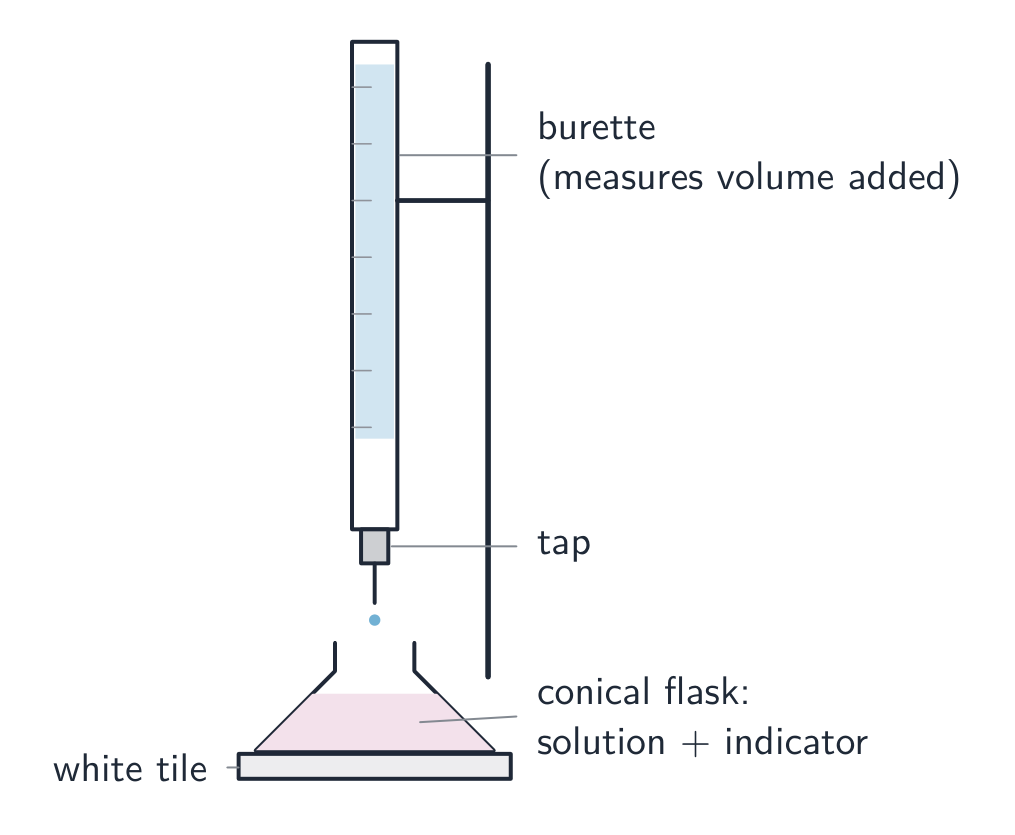
Un titrage trouve le volume exact d'une solution qui réagit avec une autre
Acid–base titrations · Titrages acido-basiques
pH jumps at the equivalence point · Sauts de pH au point d'équivalence
Track the pH as base is added — it leaps through neutral at the equivalence point · point d'équivalence. · Suivez le pH alors que la base est ajoutée — il saute brutalement à travers la neutralité au point d'équivalence.
The end point of a titration is shown by: · Le point final d'un titrage est indiqué par :
The indicator changes colour at neutralisation. · L'indicateur change de couleur lors de la neutralisation.
The volume of solution added from the burette is called the ______. · Le volume de solution ajouté depuis la burette est appelé le ______.
The titre is read from the burette. · Le volume titre est lu sur la burette.
The end point 终点
- An indicator changes colour at the end point — when neutralisation is complete.
- You record the volume of solution added from the burette (the titre 滴定量).
Solution is run from the burette into the flask until the indicator changes colour
Point final 终点
- Un indicateur change de couleur au point final — lorsque la neutralisation est complète.
- Vous notez le volume de solution ajouté depuis la burette (le titre 滴定量).
La solution est versée de la burette vers le bécher jusqu'à ce que l'indicateur change de couleur
How many moles are in 20 cm³ of acid of concentration 0.5 mol/dm³? (moles = conc × volume in dm³) · Combien de moles y a-t-il dans 20 cm³ d'acide de concentration 0.5 mol/dm³ ? (moles = conc × volume en dm³)
0.5 × (20 ÷ 1000) = 0.01 mol.
If 0.01 mol of alkali is in 25 cm³, what is its concentration (mol/dm³)? · Si 0.01 mol d'alcali est dans 25 cm³, quelle est sa concentration (mol/dm³)?
0.01 ÷ (25 ÷ 1000) = 0.4 mol/dm³.
Using the result
- From the volumes and one known concentration, you calculate the unknown concentration.
- Use moles = concentration × volume and the equation's mole ratio.
Worked example. 25 cm³ of alkali is neutralised by 20 cm³ of acid of concentration 0.5 mol/dm³ (1:1 ratio). Moles of acid = 0.5 × (20 ÷ 1000) = 0.01 mol. So moles of alkali = 0.01, and its concentration = 0.01 ÷ (25 ÷ 1000) = 0.4 mol/dm³.
Utiliser le résultat
- À partir des volumes et d'une concentration connue, vous calculez la concentration inconnue.
- Utilisez moles = concentration × volume et le rapport stœchiométrique de l'équation.
Exemple résolu. 25 cm³ d'alcali sont neutralisés par 20 cm³ d'acide de concentration 0.5 mol/dm³ (1:1 ratio). Moles d'acide = 0.5 × (20 ÷ 1000) = 0.01 mol. Donc moles d'alcali = 0.01, et sa concentration = 0.01 ÷ (25 ÷ 1000) = 0.4 mol/dm³.
You've got it
- a titration finds an unknown concentration by neutralising acid with alkali
- a burette delivers a measured volume; an indicator marks the end point
- calculate using moles = concentration × volume and the mole ratio
Vous avez compris
- un titrage trouve une concentration inconnue en neutralisant un acide avec une base
- une burette délivre un volume mesuré ; un indicateur marque le point final
- calculer avec moles = concentration × volume et le rapport molaire