Circuits with Capacitors and Inductors (LC Circuits) · Circuits avec condensateurs et inducteurs (circuits LC)
| English | Français |
|---|---|
| oscillate/ˈɒsɪleɪt/ | osciller |
| resonance/ˈrezənəns/ | résonance |
Energy sloshing back and forth — an electrical pendulum
- Charge a capacitor, connect it to an inductor, and something surprising happens.
- The energy doesn't just drain away — it swings back and forth.
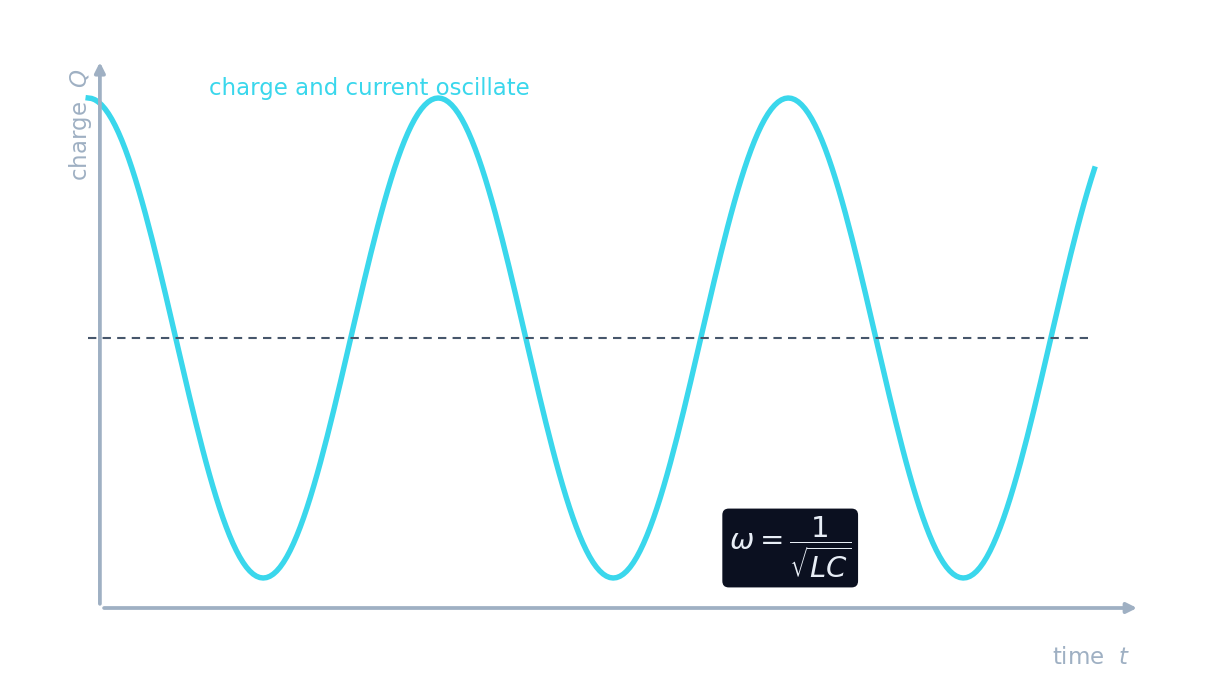
- The charge and current oscillate 振荡, like a pendulum swinging.
- A capacitor and inductor together make an LC circuit — the heart of a radio.
L'énergie qui oscille — un pendule électrique
- Chargez un condensateur, connectez-le à une bobine, et quelque chose d'inattendu se produit.
- L'énergie ne se dissipe pas simplement — elle oscille d'avant en arrière.
- La charge et le courant oscillent 振荡, comme un pendule qui balanse.
- Un condensateur et une bobine forment ensemble un circuit LC — le cœur d'une radio.
Energy trades between C and L
- The capacitor starts full: all the energy is in its electric field.
- It discharges through the inductor, driving a current.
- Now the energy is in the inductor's magnetic field.
- The inductor keeps the current going, recharging the capacitor the other way — and it repeats.
L'énergie alterne entre C et L
- Le condensateur commence plein : toute l'énergie est dans son champ électrique.
- Il se décharge à travers la bobine, générant un courant.
- Maintenant, l'énergie est dans le champ magnétique de la bobine.
- La bobine maintient le courant, rechargant le condensateur dans le sens opposé — et cela se répète.
In an LC circuit, energy trades between: · Dans un circuit LC, l'énergie est échangée entre :
Energy sloshes between the capacitor's E field and the inductor's B field. · L'énergie alterne entre le champ E du condensateur et le champ B de l'inducteur.
The oscillation frequency
- The charge swings sinusoidally at angular frequency $\omega = \dfrac{1}{\sqrt{LC}}$.
- A bigger $L$ or $C$ means slower oscillation (a lower frequency).
- With no resistance the oscillation, in principle, never dies out.
- The current is largest just as the capacitor is empty, and vice versa.
La fréquence d'oscillation
- La charge oscille sinusoïdalement à une pulsation $\omega = \dfrac{1}{\sqrt{LC}}$.
- Un $L$ ou $C$ plus grand signifie une oscillation plus lente (une fréquence plus basse).
- Sans résistance, l'oscillation ne s'éteint théoriquement jamais.
- Le courant est maximal lorsque le condensateur est vide, et vice versa.
The angular frequency of an LC circuit is: · La pulsation d'un circuit LC est :
$\omega = 1/\sqrt{LC}$ sets the oscillation rate. · $\omega = 1/\sqrt{LC}$ définit la fréquence des oscillations.
An LC circuit has $L = 4\ \text{H}$ and · et $C = 1\ \text{F}$. Find $\omega$ (in rad/s). · Un circuit LC a $L = 4\ \text{H}$ et $C = 1\ \text{F}$. Trouvez $\omega$ (en rad/s).
$\omega = 1/\sqrt{LC} = 1/\sqrt{4} = 0.5\ \text{rad/s}$.
Just like a mass on a spring
- The LC circuit is the exact electrical twin of a mass–spring oscillator.
- Charge $Q$ plays the role of position; current $I$ plays the role of velocity.
- Inductance $L$ is like mass (inertia); $1/C$ is like the spring constant.
- Both obey the same equation, so both give simple harmonic motion.
Comme une masse sur un ressort
- Le circuit LC est le jumeau électrique exact d'un oscillateur masse-ressort.
- La charge $Q$ joue le rôle de la position ; le courant $I$ joue le rôle de la vitesse.
- L'inductance $L$ est comme une masse (inertie) ; $1/C$ est comme la constante de raideur du ressort.
- Les deux obéissent à la même équation, produisant donc un mouvement harmonique simple.
LC circuit oscillations · oscillations du circuit LC
In an LC circuit energy sloshes between the capacitor and the inductor - the electrical version of simple harmonic motion. · Dans un circuit LC, l'énergie alterne entre le condensateur et l'inducteur - la version électrique du mouvement harmonique simple.
An LC circuit is the electrical analogue of a mass oscillating on a spring. · Un circuit LC est l'analogie électrique d'une masse oscillant sur un ressort.
Charge ~ position, current ~ velocity, L ~ mass, 1/C ~ spring constant. · Charge ~ position, courant ~ vitesse, L ~ masse, 1/C ~ constante de raideur.
Select all · tout true statements about LC circuits. · Sélectionnez toutes les affirmations vraies concernant les circuits LC.
Oscillation, ω = 1/√(LC), SHM analogy. An ideal LC loses no energy — it just swaps. · Oscillation, ω = 1/√(LC), analogie MHS. Un circuit LC idéal ne perd aucune énergie — il fait simplement des échanges.
Why it matters: tuning a radio
- Every radio station broadcasts at its own frequency.
- An LC circuit resonates 共振 strongly at $\omega = 1/\sqrt{LC}$ and ignores the rest.
- Turning the tuning dial changes $C$, shifting which station you pick up.
- LC resonance is how a receiver plucks one signal from the air.
Pourquoi c'est important : accorder une radio
- Chaque station de radio diffuse à sa propre fréquence.
- Un circuit LC résonne 共振 fortement à $\omega = 1/\sqrt{LC}$ et ignore les autres.
- Tourner le bouton de réglage change $C$, décalant la station que vous captez.
- La résonance LC permet au récepteur de prélever un seul signal dans l'air.
A radio uses an LC circuit's strong ____ at one frequency to pick a station. · Une radio utilise la forte ____ d'un circuit LC à une fréquence donnée pour capter une station.
LC resonance at $\omega = 1/\sqrt{LC}$ selects one station. · La résonance LC à $\omega = 1/\sqrt{LC}$ sélectionne une station.
An LC circuit has $L = 1\ \text{H}$ and $C = 0.25\ \text{F}$. Find its angular frequency.
- $\omega = \dfrac{1}{\sqrt{LC}} = \dfrac{1}{\sqrt{1 \times 0.25}} = \dfrac{1}{0.5}$.
- $\omega = 2\ \text{rad/s}$.
Un circuit LC a $L = 1\ \text{H}$ et $C = 0.25\ \text{F}$. Trouvez sa pulsation.
- $\omega = \dfrac{1}{\sqrt{LC}} = \dfrac{1}{\sqrt{1 \times 0.25}} = \dfrac{1}{0.5}$.
- $\omega = 2\ \text{rad/s}$.
In an ideal LC circuit the energy is never lost — it just swaps between the capacitor and inductor forever. The current is largest when the capacitor is empty (all magnetic energy), not when it is full. Line up energy and charge carefully.
Dans un circuit LC idéal, l'énergie n'est jamais perdue — elle échange indéfiniment entre le condensateur et la bobine. Le courant est maximal lorsque le condensateur est vide (toute l'énergie magnétique), et non lorsqu'il est plein. Alignez soigneusement l'énergie et la charge.
An LC circuit oscillates as energy trades between the capacitor's electric field and the inductor's magnetic field, at $\omega = 1/\sqrt{LC}$. It is the electrical twin of a mass on a spring (SHM), and its resonance is how a radio tunes to one station.
Un circuit LC oscille alors que l'énergie alterne entre le champ électrique du condensateur et le champ magnétique de la bobine, à $\omega = 1/\sqrt{LC}$. C'est le jumeau électrique d'une masse sur un ressort (MHS), et sa résonance permet à une radio de s'accorder sur une station.