Motion of a projectile · Mouvement d'un projectile
| English | Français |
|---|---|
| horizontal/ˌhɒrɪˈzɒntl/ | horizontale |
| vertical/ˈvɜːtɪkl/ | verticale |
| gravity/ˈɡrævɪti/ | gravité |
| projectile/prəˈdʒektaɪl/ | projectile |
| parabola/pəˈræbələ/ | parabole |
| range/reɪndʒ/ | range |
| greatest height/ˈɡreɪtɪst haɪt/ | hauteur maximale |
The cannonball problem
- Fire a ball at an angle and it traces a smooth arch, then lands. Where, and how high?
- Galileo's insight: treat the horizontal 水平 and vertical 竖直 motions completely separately — they only share the clock.
Le problème du boulet de canon
- Tirez une balle à un angle et elle trace un arc fluide, puis atterrit. Où, et à quelle hauteur ?
- L'intuition de Galilée : traiter les mouvements horizontal 水平 et vertical 竖直 complètement séparément — ils ne partagent que l'horloge.
Two independent motions
- Launched at speed $u$ and angle $\alpha$:
- Horizontal: constant velocity $u\cos\alpha$ (no force sideways).
- Vertical: gravity 重力 only, acceleration $g$ downward.
Water jets follow parabolic paths, the classic projectile 抛射体 motion under gravity
Deux mouvements indépendants
- Lancée à la vitesse $u$ et à l'angle $\alpha$ :
- Horizontal : vitesse constante $u\cos\alpha$ (pas de force latérale).
- Vertical : gravité 重力 uniquement, accélération $g$ vers le bas.

Les jets d'eau suivent des trajectoires paraboliques, le mouvement classique de projectile 抛射体 sous l'effet de la gravité
Launch a projectile · Lancer un projectile
Fire the ball, then change the angle and speed. The horizontal motion is steady while gravity pulls it down — together they trace a parabola. Find the angle for the longest range, and try the Moon. · Tirez la balle, puis changez l'angle et la vitesse. Le mouvement horizontal est régulier tandis que la gravité l'attire vers le bas — ensemble ils tracent une parabole. Trouvez l'angle pour la portée maximale, et essayez la Lune.
During the flight, the horizontal velocity of a projectile (ignoring air resistance): · Pendant le vol, la vitesse horizontale d'un projectile (en négligeant la résistance de l'air) :
There is no horizontal force, so u cos α is constant throughout. · Il n'y a aucune force horizontale, donc u cos α reste constant tout au long.
The initial horizontal velocity of a projectile launched at speed u and angle α is u ______ α. · La vitesse horizontale initiale d'un projectile lancé à la vitesse u et à l'angle α est u ______ α.
Horizontal component = u cos α; vertical = u sin α. · Composante horizontale = u cos α ; verticale = u sin α.
The parabola 抛物线
- Eliminating $t$ leaves $y$ as a quadratic in $x$ — so the path is a parabola.
Horizontal speed stays constant; gravity bends the vertical motion into a parabola.
La parabole 抛物线
- En éliminant $t$, il reste $y$ comme un quadratique en $x$ — donc le chemin est une parabole.
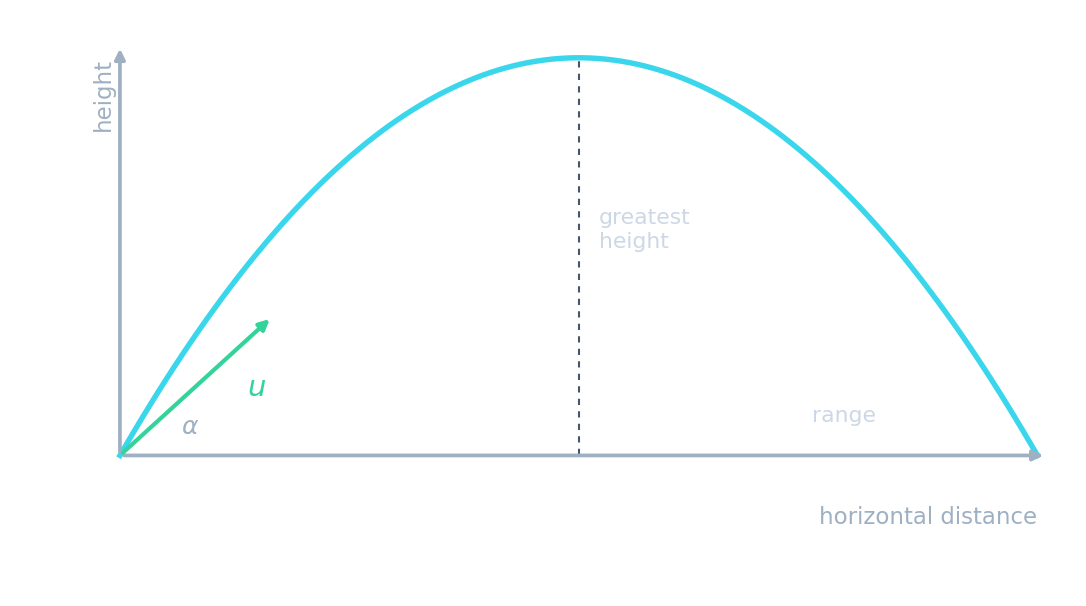
La vitesse horizontale reste constante ; la gravité courbe le mouvement vertical en une parabole.
The path of a projectile (no air resistance) is a: · La trajectoire d'un projectile (sans résistance de l'air) est une :
Eliminating t gives y as a quadratic in x — a parabola. · L'élimination de t donne y comme un quadratique en x — une parabole.
Range 射程 and greatest height 最大高度
- At the top, the vertical velocity is momentarily zero. The key results:
Worked example. $u = 20\ \tfrac{\text{m}}{\text{s}}$, $\alpha = 30^\circ$, $g = 10$. Greatest height $= \dfrac{400 \times 0.25}{20} = 5\ \text{m}$.
Portée 射程 et hauteur maximale 最大高度
- Au sommet, la vitesse verticale est momentanément nulle. Les résultats clés :
Exemple résolu. $u = 20\ \tfrac{\text{m}}{\text{s}}$, $\alpha = 30^\circ$, $g = 10$. Hauteur maximale $= \dfrac{400 \times 0.25}{20} = 5\ \text{m}$.
A ball is thrown at u = 20 m/s at 30°. Using height = u²sin²α/(2g) with g = 10, find the greatest height (m). · Une balle est lancée à u = 20 m/s à 30°. En utilisant hauteur = u²sin²α/(2g) avec g = 10, trouvez la hauteur maximale (m).
400 × sin²30° / 20 = 400 × 0.25 / 20 = 5 m.
At what launch angle (degrees) is the range greatest? · À quel angle de lancement (degrés) la portée est-elle maximale ?
Range ∝ sin 2α, which is largest when 2α = 90°, i.e. α = 45°. · Portée ∝ sin 2α, ce qui est maximal lorsque 2α = 90°, c'est-à-dire α = 45°.
At the highest point of the flight, the vertical component of velocity is zero. · Au point le plus haut du vol, la composante verticale de la vitesse est nulle.
Vertical velocity decreases to zero at the top, then becomes negative (downward). · La vitesse verticale diminue jusqu'à zéro au sommet, puis devient négative (vers le bas).
Common trap
Range is maximised at $45^\circ$, not $90^\circ$. $\sin 2\alpha$ peaks when $2\alpha = 90^\circ$. Firing straight up gives zero range — all the speed goes into height.
- Eliminating time gives the Cartesian equation of the path; all trajectories lie under a bounding parabola.
Piège courant
La portée est maximisée à $45^\circ$, pas à $90^\circ$. $\sin 2\alpha$ atteint son pic lorsque $2\alpha = 90^\circ$. Tirer tout droit vers le haut donne une portée nulle — toute la vitesse va vers la hauteur.
- Éliminer le temps donne l'équation cartésienne du chemin ; toutes les trajectoires sont sous une parabole enveloppe.
You've got it
- resolve into horizontal ($u\cos\alpha$, constant) and vertical ($u\sin\alpha$, gravity) parts
- the path is a parabola
- range $= \dfrac{u^2\sin 2\alpha}{g}$ (max at $45^\circ$); greatest height $= \dfrac{u^2\sin^2\alpha}{2g}$
Vous avez compris
- résoudre en composantes horizontales ($u\cos\alpha$, constant) et verticales ($u\sin\alpha$, gravité)
- le chemin est une parabole
- portée $= \dfrac{u^2\sin 2\alpha}{g}$ (max à $45^\circ$) ; hauteur maximale $= \dfrac{u^2\sin^2\alpha}{2g}$