Roots of polynomial equations · Racines des équations polynomiales
| English | Français |
|---|---|
| quadratic/kwɒˈdrætɪk/ | quadratique |
| root/ruːt/ | racine |
| coefficient/ˌkəʊɪˈfɪʃənt/ | coefficient |
| cubic/ˈkjuːbɪk/ | cubique |
| substitution/ˌsʌbstɪˈtjuːʃn/ | substitution |
The secret hidden in every equation
- Every quadratic 二次 equation hides two numbers — its roots 根. You can find their sum and product without solving the equation at all.
- These relationships between roots and coefficients 系数 unlock problems that would otherwise require messy algebra.
Le secret caché dans chaque équation
- Chaque équation quadratique 二次 cache deux nombres — ses racines 根. Vous pouvez trouver leur somme et leur produit sans résoudre l'équation du tout.
- Ces relations entre racines et coefficients 系数 résolvent des problèmes qui nécessiteraient autrement une algèbre fastidieuse.
Roots of a quadratic
- For $ax^2 + bx + c = 0$ with roots $\alpha, \beta$:
Worked example. $2x^2 - 7x + 3 = 0$. Sum of roots $= \dfrac{7}{2}$, product $= \dfrac{3}{2}$. Check: roots are $3$ and $\dfrac{1}{2}$: sum $= 3.5$ ✓, product $= 1.5$ ✓.
The roots of a quadratic and how they relate to its coefficients
Racines d'une équation quadratique
- Pour $ax^2 + bx + c = 0$ avec racines $\alpha, \beta$ :
Exemple résolu. $2x^2 - 7x + 3 = 0$. Somme des racines $= \dfrac{7}{2}$, produit $= \dfrac{3}{2}$. Vérification : les racines sont $3$ et $\dfrac{1}{2}$ : somme $= 3.5$ ✓, produit $= 1.5$ ✓.
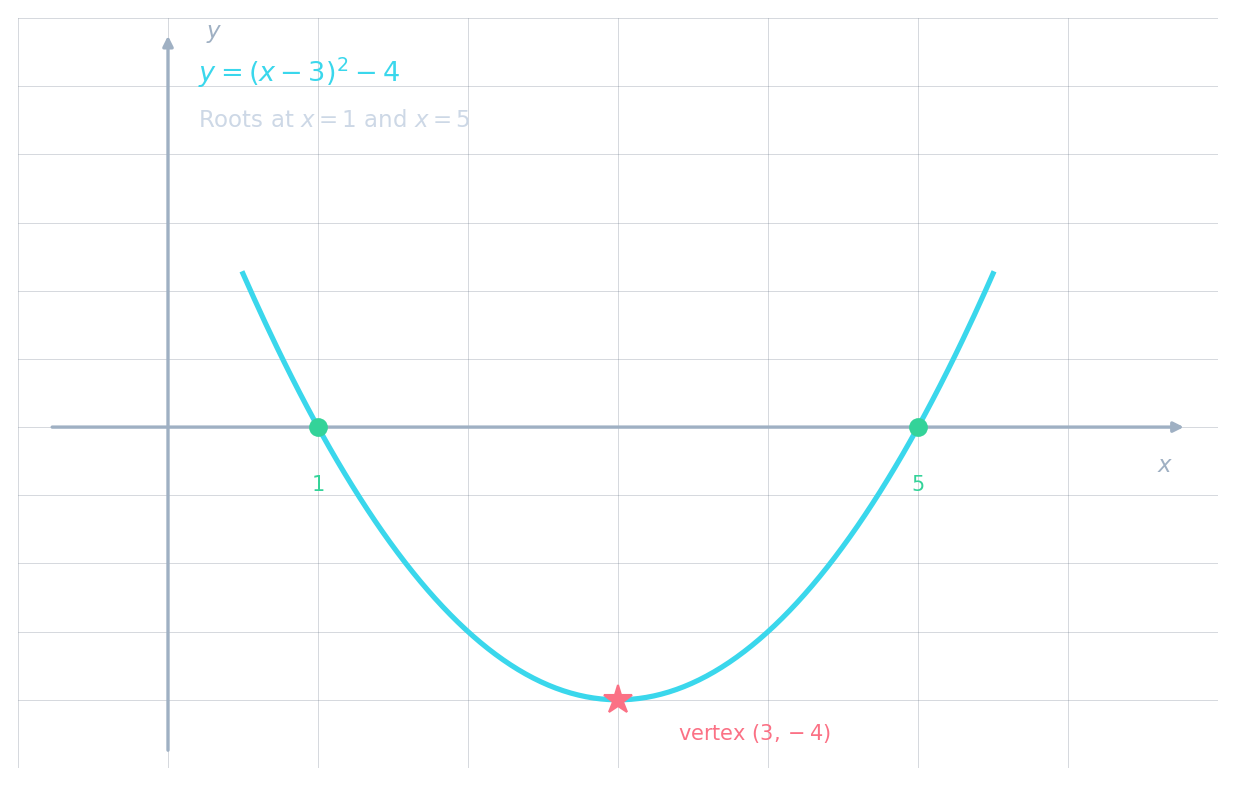
Les racines d'une équation quadratique et comment elles se rapportent à ses coefficients
Roots of a polynomial · Racines d'un polynôme
y = ax³ + bx² + cx + d
The · Le roots · racines are where the curve meets the x-axis — their sum and product link to the coefficients. · Les racines sont là où la courbe rencontre l'axe x — leur somme et produit lient aux coefficients.
For x² − 5x + 6 = 0, what is the sum of the roots α + β = −b/a? · Pour x² − 5x + 6 = 0, quelle est la somme des racines α + β = −b/a ?
α + β = −b/a = −(−5)/1 = 5.
For x² − 5x + 6 = 0, what is the product αβ = c/a? · Pour x² − 5x + 6 = 0, quel est le produit αβ = c/a ?
αβ = c/a = 6/1 = 6.
Roots of a cubic 三次
- For a cubic $ax^3 + bx^2 + cx + d = 0$ with roots $\alpha, \beta, \gamma$:
- $\sum\alpha = -\dfrac{b}{a}$, $\sum\alpha\beta = \dfrac{c}{a}$, $\alpha\beta\gamma = -\dfrac{d}{a}$.
Watch the signs. The sum of roots is $-\dfrac{b}{a}$ (negative), and the product of three roots is $-\dfrac{d}{a}$ (also negative). Getting the signs wrong is the most common error.
Racines d'une équation cubique 三次
- Pour une cubique $ax^3 + bx^2 + cx + d = 0$ avec racines $\alpha, \beta, \gamma$ :
- $\sum\alpha = -\dfrac{b}{a}$, $\sum\alpha\beta = \dfrac{c}{a}$, $\alpha\beta\gamma = -\dfrac{d}{a}$.
Surveillez les signes. La somme des racines est $-\dfrac{b}{a}$ (négative), et le produit de trois racines est $-\dfrac{d}{a}$ (aussi négatif). Se tromper sur les signes est l'erreur la plus fréquente.
For x³ − 6x² + 11x − 6 = 0, the sum of roots Σα = −b/a. Find it. · Pour x³ − 6x² + 11x − 6 = 0, la somme des racines Σα = −b/a. Trouvez-la.
Σα = −(−6)/1 = 6. (Roots are 1, 2, 3: sum = 6.) · Σα = −(−6)/1 = 6. (Les racines sont 1, 2, 3 : somme = 6.)
For ax³ + bx² + cx + d = 0, the product of roots αβγ = d/a. · Pour ax³ + bx² + cx + d = 0, le produit des racines αβγ = d/a.
The product of three roots is αβγ = −d/a (negative), not d/a. · Le produit de trois racines est αβγ = −d/a (négatif), pas d/a.
Match each root relationship to its formula (leading coefficient a). · Associez chaque relation de racine à sa formule (coefficient directeur a).
Quadratic: α+β = −b/a, αβ = c/a. Cubic: Σα = −b/a, αβγ = −d/a (sign alternates with degree). · Quadratique : α+β = −b/a, αβ = c/a. Cubique : Σα = −b/a, αβγ = −d/a (signe alterne avec le degré).
Transforming roots
- To find an equation whose roots are changed simply, use a substitution 代换 (e.g. $w = \alpha + 1$).
- Example: $x^2 - 5x + 6 = 0$ ($\alpha+\beta=5$, $\alpha\beta=6$) → roots $\alpha+1,\beta+1$ give sum $7$, product $12$, so $x^2 - 7x + 12 = 0$.
Transformer les racines
- Pour trouver une équation dont les racines changent simplement, utilisez une substitution 代换 (par ex. $w = \alpha + 1$).
- Exemple : $x^2 - 5x + 6 = 0$ ($\alpha+\beta=5$, $\alpha\beta=6$) → racines $\alpha+1,\beta+1$ donnent somme $7$, produit $12$, donc $x^2 - 7x + 12 = 0$.
With α + β = 5 and αβ = 6, what is the product (α+1)(β+1)? · Avec α + β = 5 et αβ = 6, quel est le produit (α+1)(β+1) ?
(α+1)(β+1) = αβ + α + β + 1 = 6 + 5 + 1 = 12.
Worked example — finding $\alpha^2 + \beta^2$
- Given $x^2 - 5x + 6 = 0$: $\alpha + \beta = 5$, $\alpha\beta = 6$.
- $\alpha^2 + \beta^2 = (\alpha + \beta)^2 - 2\alpha\beta = 25 - 12 = 13$.
- Sums like $\sum\alpha$ are symmetric functions of the roots.
Exemple résolu — trouver $\alpha^2 + \beta^2$
- Étant donné $x^2 - 5x + 6 = 0$ : $\alpha + \beta = 5$, $\alpha\beta = 6$.
- $\alpha^2 + \beta^2 = (\alpha + \beta)^2 - 2\alpha\beta = 25 - 12 = 13$.
- Des sommes comme $\sum\alpha$ sont des fonctions symétriques des racines.
For x² − 5x + 6 = 0, α² + β² = (α+β)² − 2αβ. Find it. · Pour x² − 5x + 6 = 0, α² + β² = (α+β)² − 2αβ. Trouvez-le.
(α+β)² − 2αβ = 25 − 12 = 13.
You've got it
- quadratic: $\alpha+\beta = -\dfrac{b}{a}$, $\alpha\beta = \dfrac{c}{a}$
- cubic: $\sum\alpha = -\dfrac{b}{a}$, $\sum\alpha\beta = \dfrac{c}{a}$, $\alpha\beta\gamma = -\dfrac{d}{a}$
- transform roots with a substitution
Vous avez compris
- quadratique : $\alpha+\beta = -\dfrac{b}{a}$, $\alpha\beta = \dfrac{c}{a}$
- cubique : $\sum\alpha = -\dfrac{b}{a}$, $\sum\alpha\beta = \dfrac{c}{a}$, $\alpha\beta\gamma = -\dfrac{d}{a}$
- transformer les racines avec une substitution