Alcohols with acyl chlorides · Alcools avec chlorures d'acyle
| English | Français |
|---|---|
| ester/ˈestə/ | ester |
| acyl chloride/əˈkɪl ˈklɔːraɪd/ | chlorure d'acyle |
| esterification/ˌestəˌrɪfɪˈkeɪʃn/ | estérification |
| by-product/baɪ ˈprɒdʌkt/ | sous-produit |
A faster way to esters 酯
- At A Level, an alcohol gains one more reaction.
- It reacts with an acyl chloride 酰氯 to make an ester.
- This works faster and more completely than using a carboxylic acid.
Une voie plus rapide vers les esters 酯
- Au niveau A Level, un alcool acquiert une réaction supplémentaire.
- Il réagit avec un chlorure d'acyle 酰氯 pour former un ester.
- Cela fonctionne plus rapidement et plus complètement qu'avec un acide carboxylique.
Acyl chloride with alcohol route · Voie chlorure d'acyle avec alcool
Follow nucleophilic acyl substitution to an ester. · Suivez la substitution acylique nucléophile jusqu'à un ester.
An alcohol reacting with an acyl chloride gives: · Un alcool réagissant avec un chlorure d'acyle donne :
The alcohol's –OH reacts with the acyl chloride to form an ester, releasing HCl. · Le –OH de l'alcool réagit avec le chlorure d'acyle pour former un ester, libérant HCl.
An acyl chloride reacts with an alcohol to form an ______. · Un chlorure d'acyle réagit avec un alcool pour former un ______.
Releasing hydrogen chloride gas. · Libération de gaz chlorhydrique.
Acyl chlorides are more reactive than carboxylic acids. · Les chlorures d'acyle sont plus réactifs que les acides carboxyliques.
The chlorine is a good leaving group. · Le chlore est un bon groupe partant.
The reaction
- An alcohol + an acyl chloride → an ester (plus fumes of $\text{HCl}$).
- It is faster and more complete than esterification 酯化 with a carboxylic acid.
- E.g. ethanol + ethanoyl chloride → ethyl ethanoate + HCl.
An acyl chloride reacts with an alcohol to form an ester
La réaction
- Un alcool + un chlorure d'acyle → un ester (plus des vapeurs de $\text{HCl}$).
- C'est plus rapide et plus complet que l'estérification 酯化 avec un acide carboxylique.
- Ex. éthanol + chlorure d'éthanoyl → éthanoate d'éthyle + HCl.
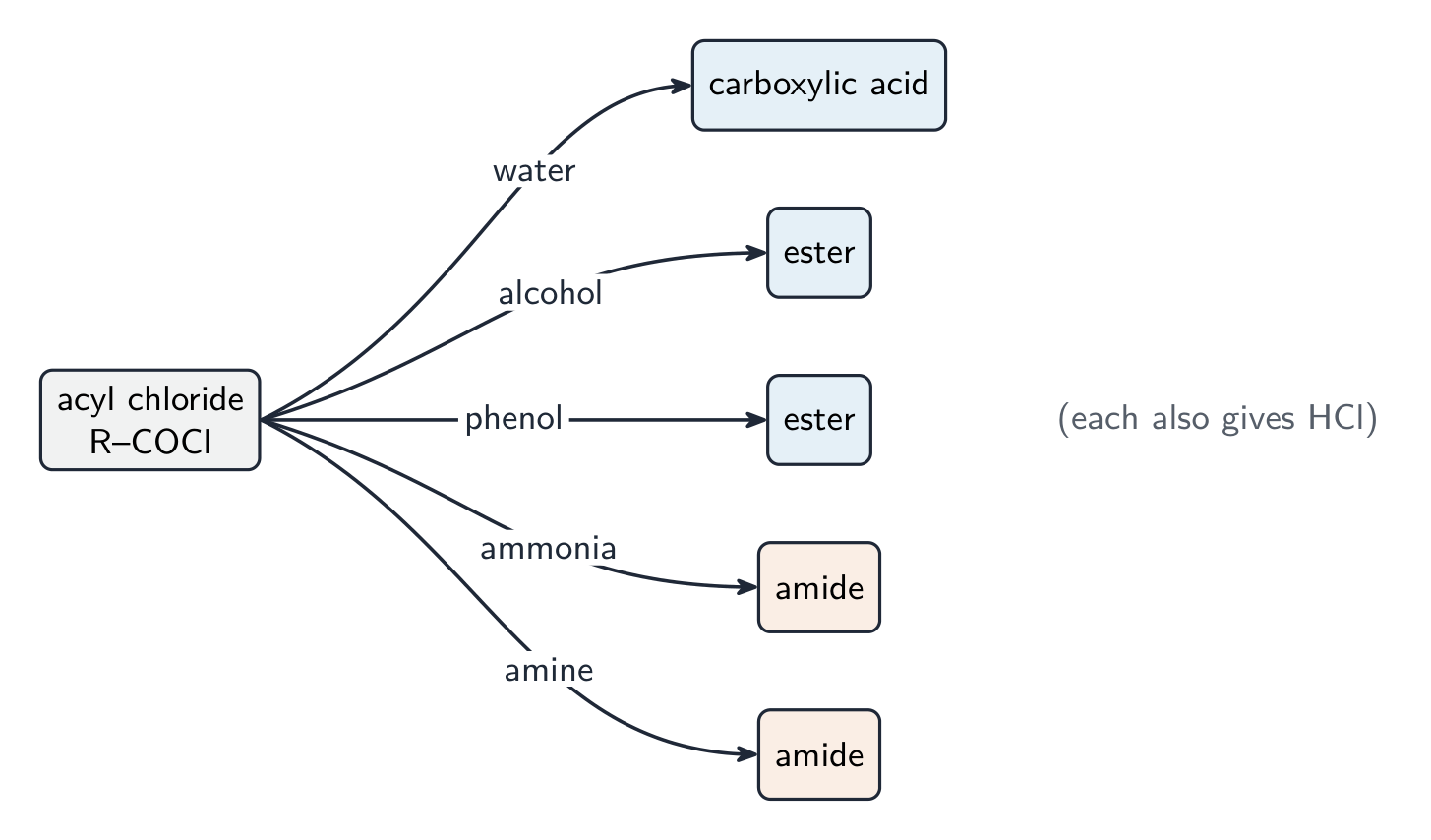
Un chlorure d'acyle réagit avec un alcool pour former un ester
Compared with using a carboxylic acid, making an ester from an acyl chloride is: · Par rapport à l'utilisation d'un acide carboxylique, faire un ester à partir d'un chlorure d'acyle est :
Acyl chlorides are very reactive, so esterification with them is fast and goes essentially to completion. · Les chlorures d'acyle sont très réactifs, donc l'estérification avec eux est rapide et va essentiellement à complétion.
Ethanol + ethanoyl chloride gives: · Éthanol + chlorure d'éthanoyl donne :
The ester ethyl ethanoate forms, along with HCl fumes. · L'ester éthanoate d'éthyle se forme, avec des fumées de HCl.
A cleaner esterification
- Acyl chlorides react rapidly with alcohols to give esters, with no catalyst needed.
- The only by-product 副产物 is hydrogen chloride gas.
Une estérification propre
- Les chlorures d'acyle réagissent rapidement avec les alcools pour donner des esters, sans catalyseur nécessaire.
- Le seul sous-produit 副产物 est le gaz chlorure d'hydrogène.
Handle with care
- Acyl chlorides react violently with water and fume in moist air.
- They are far more reactive than the corresponding carboxylic acids.
À manipuler avec précaution
- Les chlorures d'acyle réagissent violemment avec l'eau et dégagent des fumées dans l'air humide.
- Ils sont beaucoup plus réactifs que les acides carboxyliques correspondants.
You've got it
- an alcohol + acyl chloride → ester (+ HCl)
- this is faster and more complete than using a carboxylic acid
- e.g. ethanol + ethanoyl chloride → ethyl ethanoate
Vous avez compris
- un alcool + chlorure d'acyle → ester (+ HCl)
- c'est plus rapide et plus complet qu'avec un acide carboxylique
- ex. éthanol + chlorure d'éthanoyl → éthanoate d'éthyle