Enthalpies of solution and hydration · Enthalpies de solution et d'hydratation
| English | Français |
|---|---|
| enthalpy of solution/enˈθælpi ɒv səˈluːʃn/ | enthalpie de solution |
| enthalpy of hydration/enˈθælpi ɒv haɪˈdreɪʃn/ | enthalpie d'hydratation |
| exothermic/eɡzəˈðɜːmɪk/ | exothermique |
| lattice energy/ˈlætɪs ˈenədʒi/ | énergie réticulaire |
Dissolving, energetically
- Dissolving an ionic solid involves two enthalpy steps.
- Hydration releases energy; pulling the lattice apart costs it.
- A cycle links them to the enthalpy of solution 溶解焓.
Dissoudre, énergétiquement
- La dissolution d'un solide ionique implique deux étapes d'enthalpie.
- L'hydratation libère de l'énergie ; briser le réseau coûte de l'énergie.
- Un cycle les relie à l'enthalpie de solution 溶解焓.
Enthalpy of solution lab · Laboratoire sur l'enthalpie de solution
deltaHsol = lattice + hydration terms · deltaHsol = énergie réticulaire + termes d'hydratation
Change hydration strength and see solution enthalpy shift. · Faire varier la force d'hydratation et observer le déplacement de l'enthalpie de solution.
The enthalpy change when one mole of gaseous ions dissolves in water is the enthalpy of ______. · La variation d'enthalpie lors de la dissolution d'une mole d'ions gazeux dans l'eau est l'enthalpie de ______.
More negative for smaller, more highly charged ions. · Plus négative pour les ions plus petits et plus chargés.
Enthalpy of solution can be found from lattice energy and hydration enthalpies using Hess's law. · L'enthalpie de solution peut être trouvée à partir de l'énergie réticulaire et des enthalpies d'hydratation en utilisant la loi de Hess.
A Hess cycle links them. · Un cycle de Hess les relie.
The two changes
- enthalpy of hydration 水合焓 $\Delta H_{\text{hyd}}$: change when one mole of gaseous ions is surrounded by water (exothermic 放热).
- enthalpy of solution $\Delta H_{\text{sol}}$: change when one mole of solute fully dissolves.
Dissolving energy cycle links lattice energy 晶格能, hydration and solution
Les deux changements
- enthalpie d'hydratation 水合焓 $\Delta H_{\text{hyd}}$ : changement lorsqu'une mole d'ions gazeux est entourée d'eau (exothermique 放热).
- enthalpie de solution $\Delta H_{\text{sol}}$ : changement lorsqu'une mole de soluté se dissout entièrement.
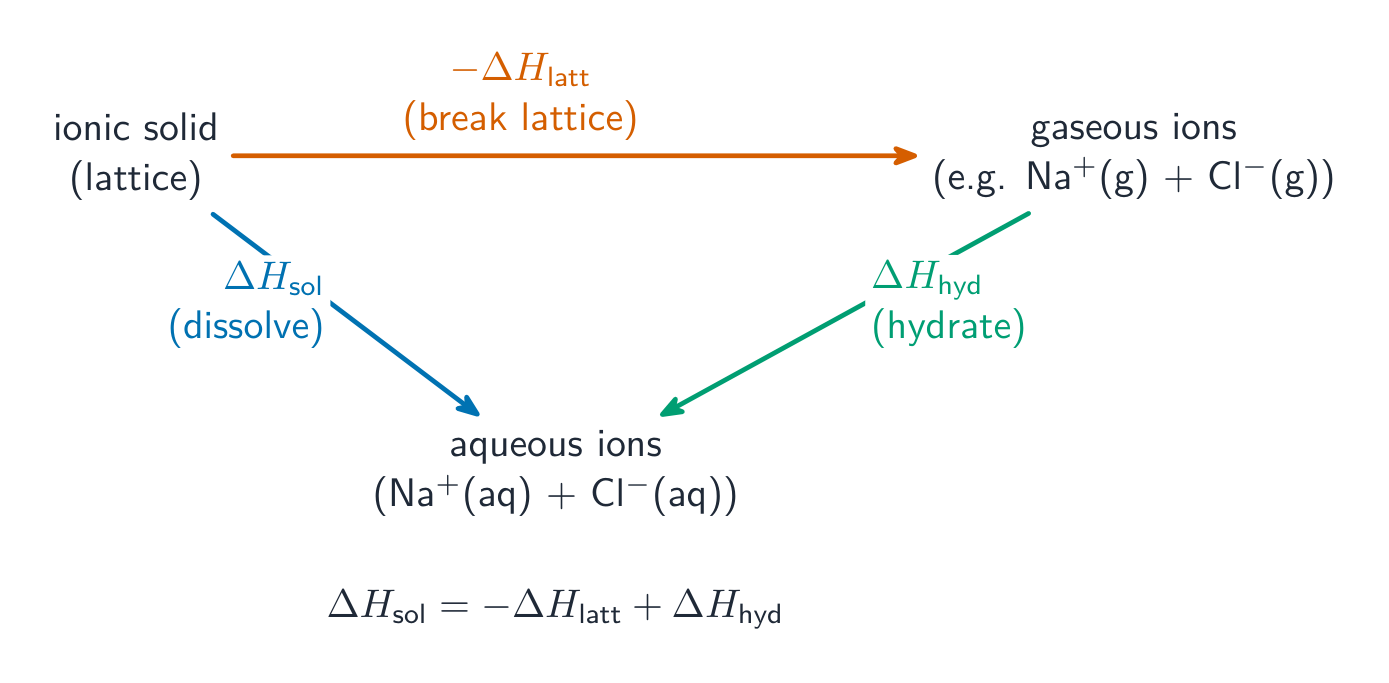
Le cycle énergétique de dissolution relie l'énergie réticulaire 晶格能, l'hydratation et la solution
The enthalpy change of hydration is: · La variation d'enthalpie d'hydratation est :
Water molecules are attracted to the ions, releasing energy, so hydration is exothermic. · Les molécules d'eau sont attirées par les ions, libérant de l'énergie, donc l'hydratation est exothermique.
The dissolving cycle
To dissolve, you first pull the lattice apart, then hydrate the ions:
- Like lattice energy, $\Delta H_{\text{hyd}}$ is more exothermic for ions of higher charge and smaller radius.
Le cycle de dissolution
Pour dissoudre, vous devez d'abord briser le réseau, puis hydrater les ions :
- Comme l'énergie réticulaire, $\Delta H_{\text{hyd}}$ est plus exothermique pour des ions de charge plus élevée et de rayon plus petit.
The enthalpy of solution is given by: · L'enthalpie de solution est donnée par :
You reverse the lattice energy (to separate the ions) then add the hydration enthalpy. · Vous inversez l'énergie réticulaire (pour séparer les ions) puis ajoutez l'enthalpie d'hydratation.
The enthalpy of hydration is more exothermic for ions with: · L'enthalpie d'hydratation est plus exothermique pour les ions avec :
Higher charge and smaller radius pull the water molecules in more strongly, releasing more energy. · Une charge plus élevée et un rayon plus petit attirent plus fortement les molécules d'eau, libérant plus d'énergie.
Linking the enthalpies
- Enthalpy of solution = (−lattice energy) + enthalpies of hydration of the ions.
- A Hess cycle links the three quantities.
Relier les enthalpies
- Enthalpie de solution = (−énergie réticulaire) + enthalpies d'hydratation des ions.
- Un cycle de Hess relie les trois quantités.
You've got it
- hydration $\Delta H_{\text{hyd}}$ (exothermic): gaseous ions surrounded by water
- solution $\Delta H_{\text{sol}}$: one mole of solute dissolves
- the cycle: $\Delta H_{\text{sol}} = -\Delta H_{\text{latt}} + \Delta H_{\text{hyd}}$
- $\Delta H_{\text{hyd}}$ is more exothermic for higher charge and smaller radius
Vous avez compris
- hydratation $\Delta H_{\text{hyd}}$ (exothermique) : ions gazeux entourés d'eau
- solution $\Delta H_{\text{sol}}$ : une mole de soluté se dissout
- le cycle : $\Delta H_{\text{sol}} = -\Delta H_{\text{latt}} + \Delta H_{\text{hyd}}$
- $\Delta H_{\text{hyd}}$ est plus exothermique pour une charge plus élevée et un rayon plus petit