Addition polymerisation · Polymérisation par addition
| English | Français |
|---|---|
| addition polymerisation/əˈdɪʃn ˌpɒlɪməraɪˈzeɪʃn/ | polymérisation par addition |
| monomer/ˈmɒnəʊmə/ | monomère |
| polymer/ˈpɒlɪmə/ | polymère |
| repeat unit/rɪˈpiːt ˈjuːnɪt/ | unité répétitive |
| non-biodegradable/nɒn ˌbaɪəʊdɪˈɡreɪdəbl/ | non biodégradable |
Plastics from double bonds
- In addition polymerisation 加成聚合, many small molecules join into one long chain — with no other product.
- Each small molecule is a monomer 单体; it must have a C=C double bond.
- The long chain is the polymer 聚合物.
Plastiques à partir de doubles liaisons
- Dans la polymérisation par addition 加成聚合, de nombreuses petites molécules se joignent pour former une longue chaîne — sans autre produit.
- Chaque petite molécule est un monomère 单体 ; il doit posséder une double liaison C=C.
- La longue chaîne est le polymère 聚合物.
Addition polymerisation route · Voie de polymérisation par addition
Watch alkene monomers join by opening their double bonds.
In addition polymerisation, the monomers must have:
The C=C double bond opens up to let the monomers link into a long chain, with no other product.
Addition polymers are made from monomers containing a C=C ______ bond.
The double bond opens to join the units.
Repeat units 重复单元
- The repeat unit is the small part copied along the chain. To find it: change the C=C to a single C–C and draw bonds out at each end.
$$n\,\text{CH}_2{=}\text{CH}_2 \rightarrow -(\text{CH}_2{-}\text{CH}_2)_n-$$
- Examples: poly(ethene) from ethene; poly(chloroethene) (PVC) from chloroethene.
Most addition polymers are non-biodegradable 不可生物降解, so they build up as waste.
Poly(alkene) waste is non-biodegradable and burning PVC gives toxic HCl
Unités répétitives 重复单元
- L'unité répétitive est la petite partie copiée le long de la chaîne. Pour la trouver : changer la C=C en simple liaison C–C et dessiner des liaisons sortantes à chaque extrémité.
$$n\,\text{CH}_2{=}\text{CH}_2 \rightarrow -(\text{CH}_2{-}\text{CH}_2)_n-$$
- Exemples : poly(éthène) à partir d'éthène ; poly(chloroéthène) (PVC) à partir de chloroéthène.
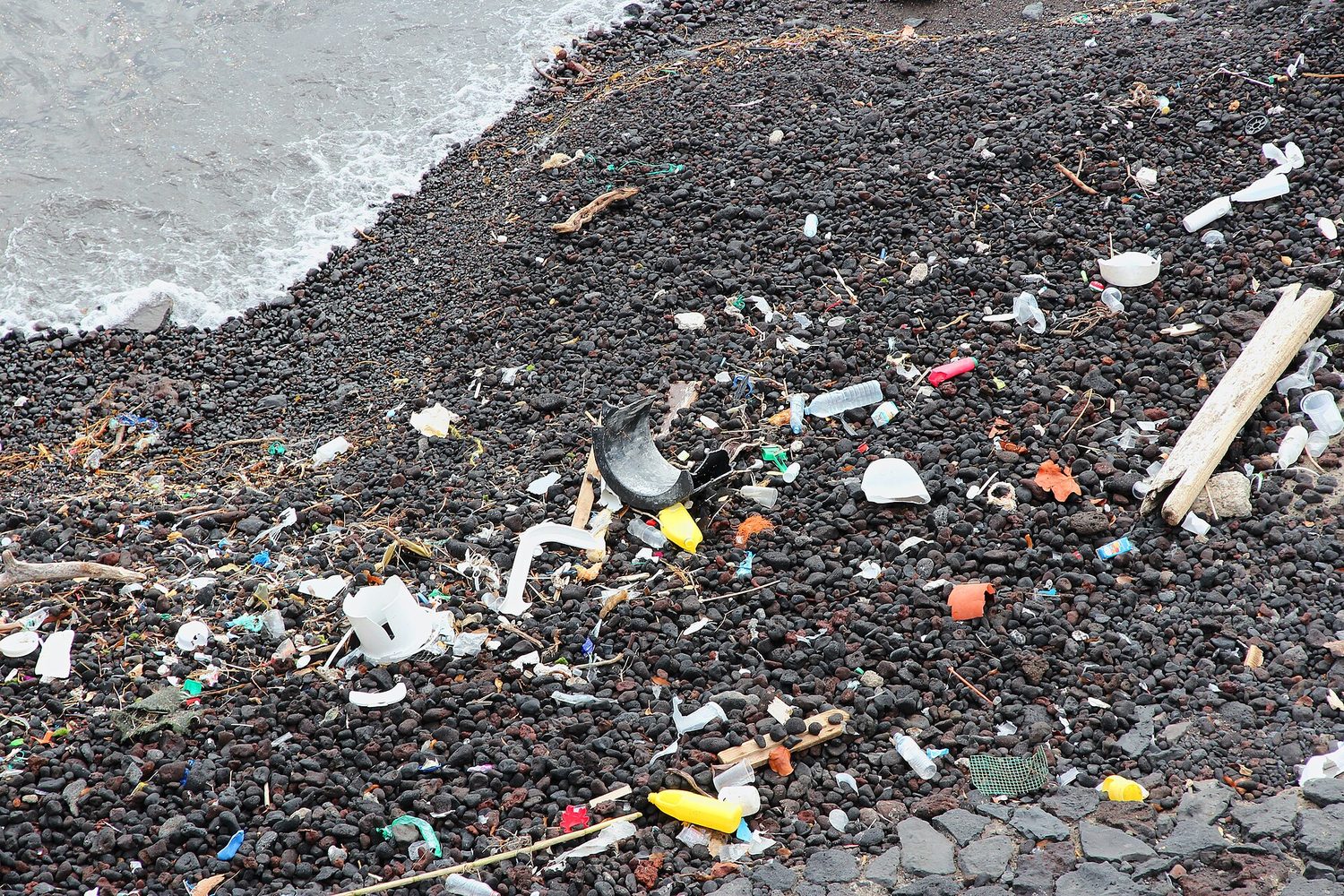
La plupart des polymères par addition ne sont pas biodégradables 不可生物降解, ils s'accumulent donc en déchets.
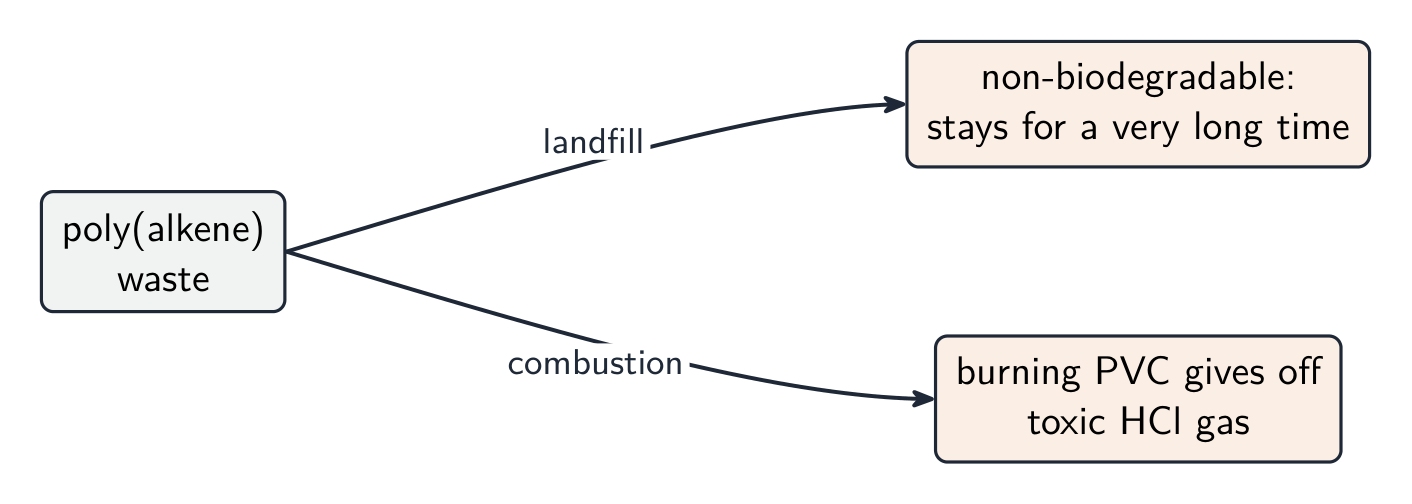
Les déchets de poly(alcène) ne sont pas biodégradables et la combustion du PVC dégage du HCl toxique
To draw the repeat unit from a monomer, you:
Open the double bond (C=C → C–C) and put a bond out at each end to show the chain continues.
Match each addition-polymer fact.
Each item links the term to its correct meaning.
Making poly(ethene) by addition polymerisation also produces water.
The monomer atoms all enter the polymer. Addition polymerisation has no small-molecule by-product.
Finding the monomer
- Go the other way: take one repeat unit and put the C=C double bond back.
- That gives you the monomer.
Poly(ethene) is supplied as tiny pellets a few millimetres across, which are then melted and moulded into bottles, bags and other products
Trouver le monomère
- Faire l'inverse : prendre une unité répétitive et remettre la double liaison C=C.
- Cela vous donne le monomère.
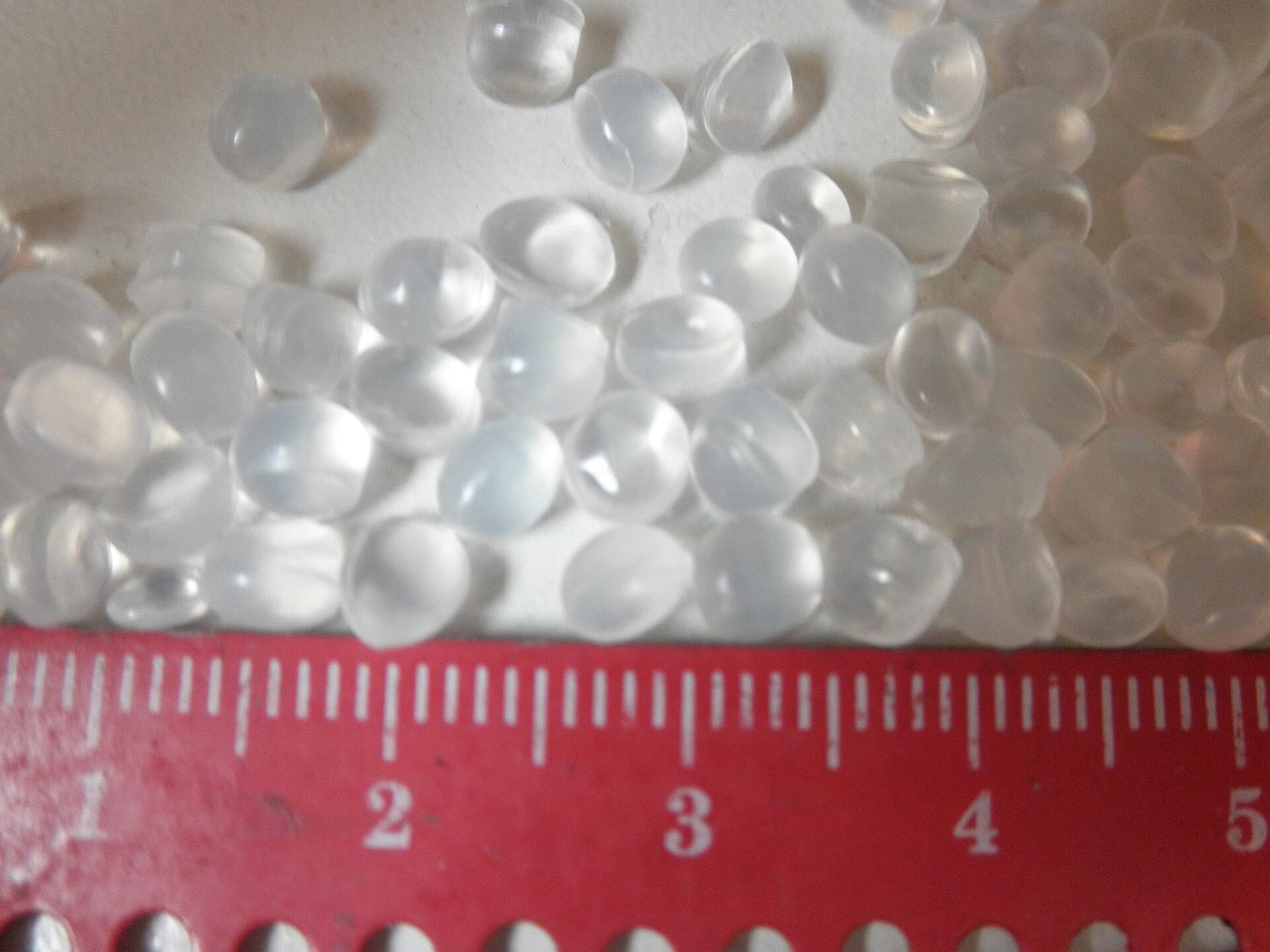
Le poly(éthène) est fourni sous forme de petits granulés de quelques millimètres de diamètre, qui sont ensuite fondus et moulés en bouteilles, sacs et autres produits
To find the monomer from a polymer's repeat unit, you:
Reversing the process, restore the C=C double bond in one repeat unit to get the monomer.
The repeat unit –CH₂–CH(CH₃)– comes from the monomer ____.
Restore the C=C between the two backbone carbons: CH₂=CHCH₃, which is propene.
The repeat unit –CH₂–CH(CH₃)– contains how many carbon atoms?
Two carbons form the backbone and one is in the methyl side group: three in total.
The disposal problem
- Poly(alkene)s are non-biodegradable — microbes can't break them down, so they linger for a very long time.
- Burning them can release harmful gases — e.g. burning PVC gives off toxic hydrogen chloride.
Monomer and repeat unit for PVC
Le problème de l'élimination
- Les poly(alcènes) sont non biodégradables — les micro-organismes ne peuvent pas les décomposer, ils persistent donc très longtemps.
- Leur combustion peut libérer des gaz nocifs — par exemple, brûler du PVC dégage du chlorure d'hydrogène toxique.
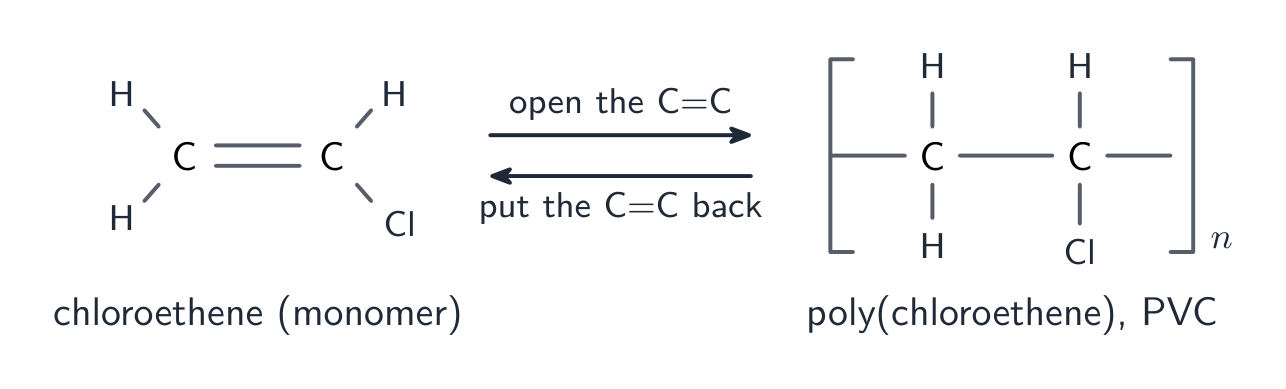
Monomère et unité répétitive pour le PVC
Why are poly(alkene)s hard to dispose of?
Microbes cannot break them down (non-biodegradable); burning PVC releases toxic hydrogen chloride.
You've got it
- addition polymerisation: many C=C monomers join into one polymer (no other product)
- repeat unit: change the C=C to a single bond, bonds out at each end
- find the monomer by putting the C=C back
- poly(alkene)s are non-biodegradable; burning PVC releases toxic HCl
Vous avez compris
- polymérisation par addition : de nombreux monomères C=C se joignent pour former un polymère (aucun autre produit)
- unité répétitive : changer la C=C en simple liaison, liaisons sortantes à chaque extrémité
- trouver le monomère en remettant la C=C
- les poly(alcènes) sont non biodégradables ; la combustion du PVC libère du HCl toxique