Elimination and SN1/SN2 mechanisms · Élimination et mécanismes SN1/SN2
| English | Français |
|---|---|
| elimination/ɪˌlɪmɪˈneɪʃn/ | élimination |
| transition state/trænˈsɪʃn steɪt/ | état de transition |
| carbocation/ˌkɑːbəˈkeɪʃn/ | carbocation |
| bond energy/bɒnd ˈenədʒi/ | énergie de liaison |
Elimination 消去 and the SN1/SN2 mechanisms
- The same halogenoalkane can substitute or eliminate.
- Nucleophilic substitution follows one of two mechanisms.
- And the C–X bond strength sets the reactivity.
Élimination 消去 et les mécanismes SN1/SN2
- Le même halogénure d'alkyle peut subir une substitution ou une élimination.
- La substitution nucléophile suit l'un de deux mécanismes.
- Et la force de la liaison C–X détermine la réactivité.
An SN1 mechanism goes via a carbocation intermediate. · Un mécanisme SN1 passe par un intermédiaire carbocation.
SN2 is a one-step concerted mechanism. · SN2 est un mécanisme concerté en une seule étape.
Substitution vs elimination
- $\text{NaOH}$ in water → nucleophilic substitution → an alcohol.
- $\text{NaOH}$ in ethanol, heated → elimination → an alkene:
$$\text{C}_2\text{H}_5\text{Br} + \text{NaOH} \rightarrow \text{C}_2\text{H}_4 + \text{NaBr} + \text{H}_2\text{O}$$
SN2 is one step through a transition state 过渡态; SN1 is two steps via a carbocation 碳正离子
Substitution vs élimination
- $\text{NaOH}$ dans l'eau → substitution nucléophile → un alcool.
- $\text{NaOH}$ dans l'éthanol, chauffé → élimination → un alcène :
$$\text{C}_2\text{H}_5\text{Br} + \text{NaOH} \rightarrow \text{C}_2\text{H}_4 + \text{NaBr} + \text{H}_2\text{O}$$
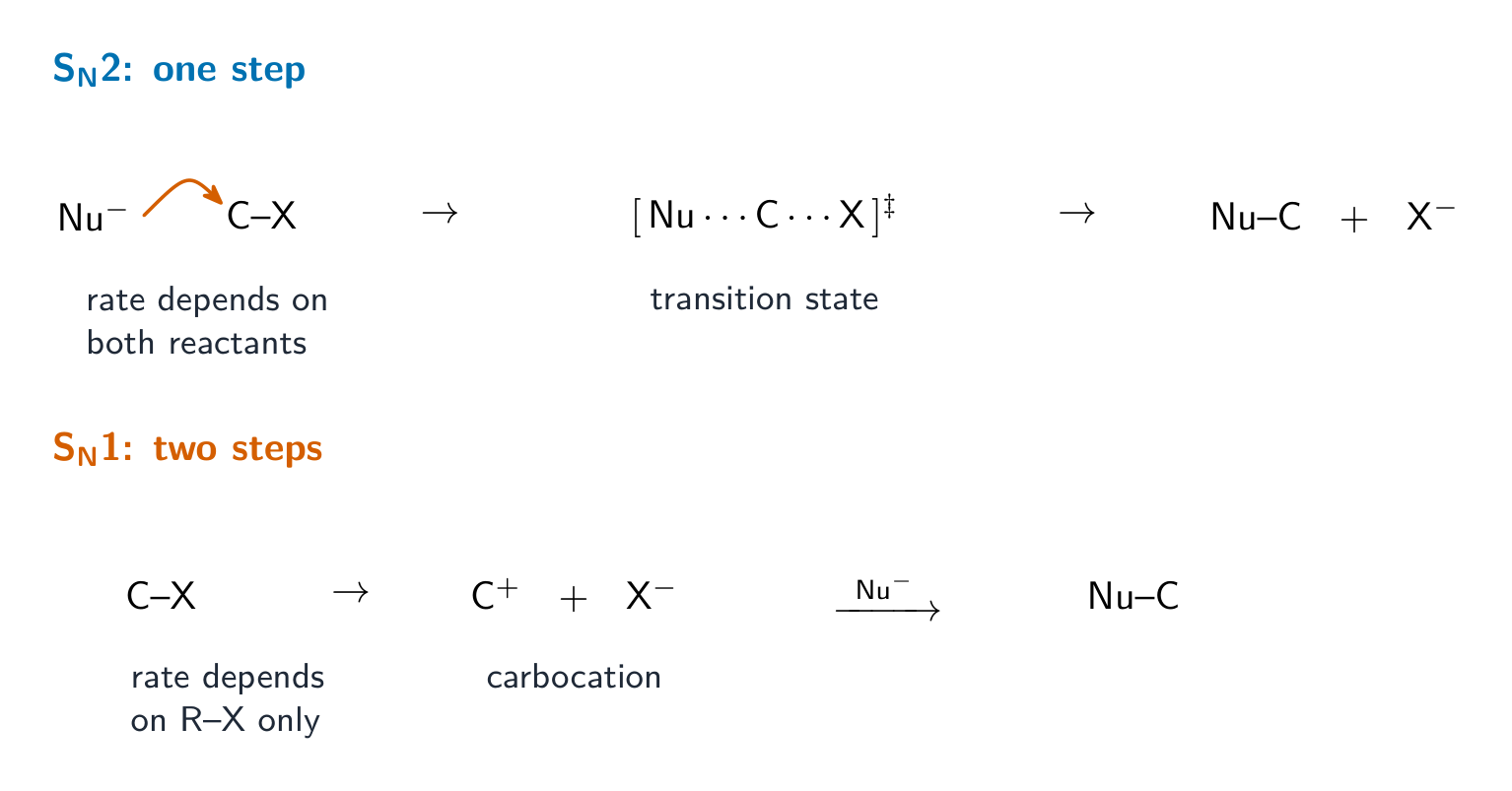
SN2 est une étape via un état de transition 过渡态 ; SN1 est deux étapes via un carbocation 碳正离子
The SN2 mechanism, step by step · Le mécanisme SN2, étape par étape
Step through nucleophilic substitution. The nucleophile attacks from behind as the halide leaves — all in one smooth step, flipping the molecule inside-out. · Étape par étape de la substitution nucléophile. Le nucléophile attaque par l'arrière pendant que le halogène part — tout cela en une seule étape fluide, inversant la molécule comme un parapluie au vent.
Heating a halogenoalkane with NaOH dissolved in ethanol gives: · Chauffer un halogénure d'alchyle avec NaOH dissous dans l'éthanol donne :
NaOH in ethanol with heat favours elimination of HX to form an alkene; NaOH in water favours substitution. · NaOH dans l'éthanol avec chaleur favorise l'élimination de HX pour former un alcène ; NaOH dans l'eau favorise la substitution.
Match each mechanism to its description. · Associez chaque mécanisme à sa description.
Each item links the term to its correct meaning. · Chaque élément relie le terme à sa signification correcte.
SN1 and SN2
- SN2: one step — the nucleophile attacks as the halogen leaves, through a crowded transition state. Rate depends on both reactants.
- SN1: two steps — the C–X bond breaks to a carbocation first, then the nucleophile attacks. Rate depends only on the halogenoalkane.
- Primary → mostly SN2; tertiary → mostly SN1 (its carbocation is well stabilised); secondary uses both.
The weaker the C-X bond, the faster the halogenoalkane reacts
SN1 et SN2
- SN2 : une étape — le nucléophile attaque pendant que l'halogène part, via un état de transition encombré. La vitesse dépend des deux réactifs.
- SN1 : deux étapes — la liaison C–X se brise d'abord en un carbocation, puis le nucléophile attaque. La vitesse dépend uniquement de l'halogénure d'alkyle.
- primaire → principalement SN2 ; tertiaire → principalement SN1 (son carbocation est bien stabilisé) ; secondaire utilise les deux.
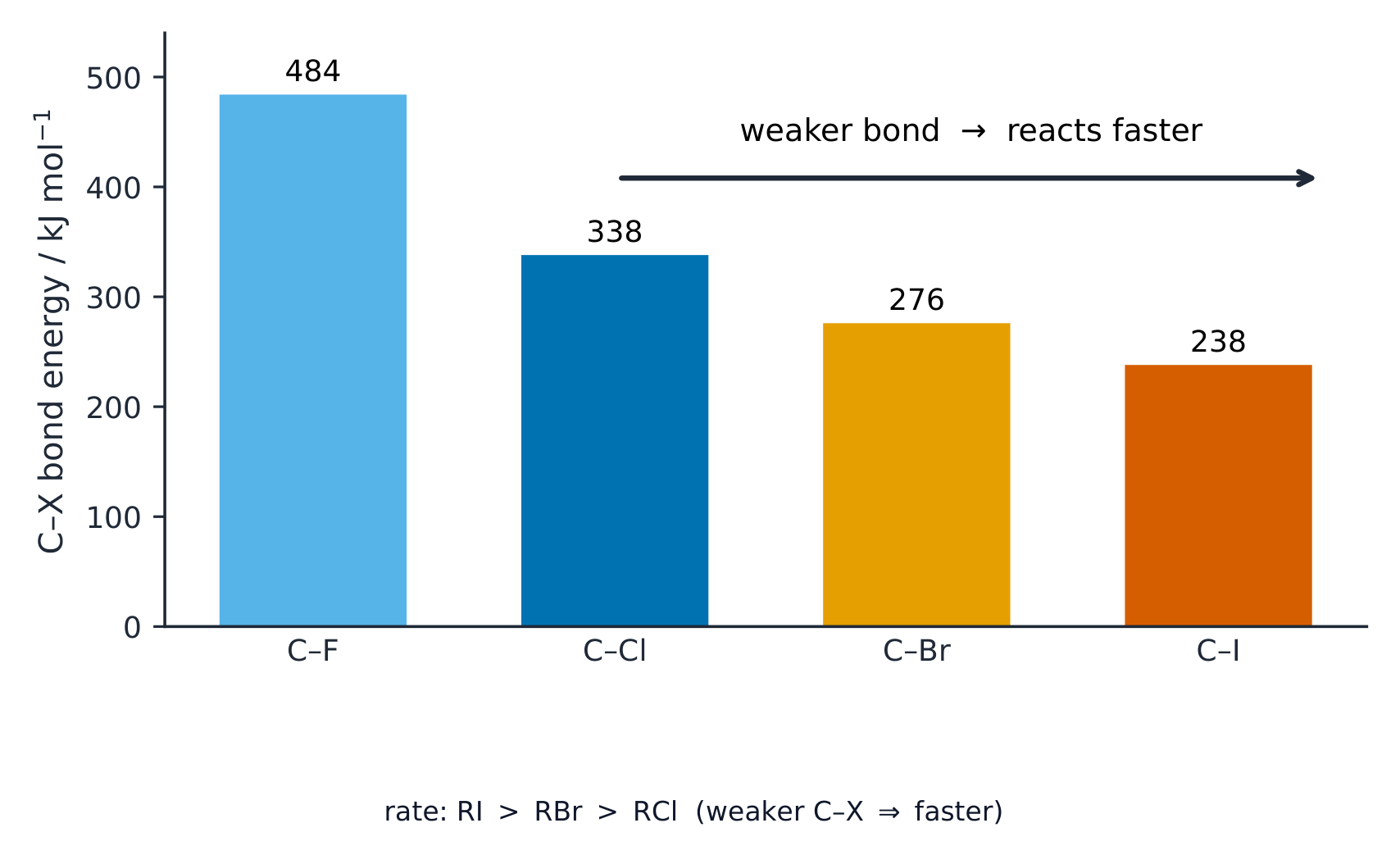
Plus la liaison C-X est faible, plus l'halogénure d'alkyle réagit vite
The SN1 mechanism: · Le mécanisme SN1 :
SN1: C–X breaks first to a carbocation, then the nucleophile attacks; tertiary halogenoalkanes favour it. · SN1 : la liaison C–X se rompt d'abord pour former un carbocation, puis le nucléophile attaque ; les halogénures tertiaires le favorisent.
The SN2 mechanism: · Le mécanisme SN2 :
SN2 is a single concerted step; primary halogenoalkanes favour it and its rate depends on both species. · SN2 est une étape concertée unique ; les halogénures primaires le favorisent et sa vitesse dépend des deux espèces.
Reactivity and the C–X bond
- Reactivity depends on the C–X bond strength (bond energy 键能).
- C–I is weakest → iodoalkanes react fastest; C–Cl is strongest → chloroalkanes slowest.
Réactivité et la liaison C–X
- La réactivité dépend de la force de la liaison C–X (énergie de liaison 键能).
- C–I est la plus faible → les iodoalcanes réagissent le plus vite ; C–Cl est la plus forte → chloroalcanes les plus lents.
Which halogenoalkane reacts fastest? · Quel halogénure d'alchyle réagit le plus vite ?
The weaker the C–X bond, the faster the reaction, so C–I (weakest) reacts fastest and C–Cl slowest. · Plus la liaison C–X est faible, plus la réaction est rapide ; ainsi C–I (la plus faible) réagit le plus vite et C–Cl le plus lentement.
You've got it
- NaOH in water → substitution (alcohol); NaOH in ethanol + heat → elimination (alkene)
- SN2 = one step, rate depends on both; SN1 = two steps via a carbocation, rate depends on the halogenoalkane only
- primary → SN2, tertiary → SN1; iodoalkanes react fastest (weakest C–X bond)
Vous avez compris
- NaOH dans l'eau → substitution (alcool) ; NaOH dans l'éthanol + chaleur → élimination (alcène)
- SN2 = une étape, vitesse dépend des deux ; SN1 = deux étapes via un carbocation, vitesse dépend uniquement de l'halogénure d'alkyle
- primaire → SN2, tertiaire → SN1 ; iodoalcanes réagissent le plus vite (liaison C–X la plus faible)