Conditional probability · Probabilidad condicional
| English | Español |
|---|---|
| conditional probability/kənˈdɪʃənl ˌprɒbəˈbɪlɪti/ | probabilidad condicional |
| two-way table/tuː weɪ ˈteɪbl/ | tabla de contingencia |
| dependent/dɪˈpendənt/ | dependiente |
The detective's question
- You know someone studies French. What's the chance they also study German?
- This isn't the same as "what's the chance someone studies both?" — you've narrowed the group to just the French students.
- That's conditional probability 条件概率: the chance of $B$ given that $A$ has already happened.
La pregunta del detective
- Sabes que alguien estudia francés. ¿Cuál es la probabilidad de que también estudie alemán?
- Esto no es lo mismo que "¿cuál es la probabilidad de que alguien estudie ambos?". Has reducido el grupo a solo los estudiantes de francés.
- Eso es probabilidad condicional: la probabilidad de $B$ dado que $A$ ya ha ocurrido.
How to read it
- $\text{P}(B \mid A)$ means "the probability of $B$ given $A$".
- Look only at the part that matches the condition — on a Venn diagram, two-way table 双向表, or tree.
In a class of $30$, $18$ study French. Of those $18$, $7$ also study German. $\text{P}(\text{German} \mid \text{French}) = \dfrac{7}{18}$.
On a tree diagram, multiply probabilities along the branches; here two reds give $\tfrac38\times\tfrac38=\tfrac{9}{64}$
Cómo interpretarlo
- $\text{P}(B \mid A)$ significa "la probabilidad de $B$ dado $A$".
- Mirar solo la parte que coincide con la condición — en un diagrama de Venn, tabla de doble entrada o árbol.
En una clase de $30$, $18$ estudian francés. De esos $18$, $7$ también estudian alemán. $\text{P}(\text{German} \mid \text{French}) = \dfrac{7}{18}$.

En un diagrama de árbol, se multiplican las probabilidades a lo largo de las ramas; aquí dos rojas dan $\tfrac38\times\tfrac38=\tfrac{9}{64}$
Conditional probability · Probabilidad condicional
P(A | B) = P(A ∩ B) ÷ P(B)
When one event affects another, conditional probabilities change — and Bayes reverses them. · Cuando un evento afecta a otro, las probabilidades condicionales cambian — y Bayes las invierte.
Of 18 French students, 7 also study German. P(German | French) = 7/a. What is a? · De 18 estudiantes de francés, 7 también estudian alemán. P(Alemán | Francés) = 7/a. ¿Cuál es a?
Given they are French, the total to divide by is the 18 French students. · Dado que son franceses, el total para dividir es los 18 estudiantes de francés.
Conditional probability is the probability of an event: · La probabilidad condicional es la probabilidad de un evento:
It is the probability of B given that A has occurred. · Es la probabilidad de B dado que A ha ocurrido.
Of 100 people, 40 are female; of those, 10 are left-handed. P(left-handed | female) as a decimal is? · De 100 personas, 40 son mujeres; de esas, 10 son zurdas. P(zurda | mujer) como decimal es?
10/40 = 0.25.
The formula (Extended)
The denominator changes. In conditional probability, the total you divide by is only the group that meets the condition — not the whole population. This is the most common error.
La fórmula (Ampliado)
El denominador cambia. En la probabilidad condicional, el total sobre el que divides es solo el grupo que cumple la condición, no toda la población. Este es el error más común.
P(B | A) = P(A and B) / P(). · P(B | A) = P(A y B) / P().
P(B|A) = P(A ∩ B) / P(A). The denominator is the probability of the condition. · P(B|A) = P(A ∩ B) / P(A). El denominador es la probabilidad de la condición.
On a two-way table
- To find $\text{P}(B \mid A)$: look at the row (or column) for $A$, and find the fraction that is also $B$.
- The row total is the denominator, not the grand total.
En una tabla de doble entrada
- Para encontrar $\text{P}(B \mid A)$: mira la fila (o columna) correspondiente a $A$ y busca la fracción que también sea $B$.
- El total de la fila es el denominador, no el total general.
Of 20 students, 12 like tea; of those, 3 also like coffee. P(coffee | tea) = 3/a. What is a? · De 20 estudiantes, 12 les gusta el té; de esos, 3 también les gusta el café. P(Café | Té) = 3/a. ¿Cuál es a?
Condition on the 12 tea-drinkers, so a = 12. · Condicionar sobre los 12 bebedores de té, entonces a = 12.
Independent vs dependent 相依的
- If $\text{P}(B \mid A) = \text{P}(B)$, the events are independent — knowing $A$ happened doesn't change the chance of $B$.
- If they differ, the events are dependent.
Conditional probability restricts attention to the group matching the condition — like looking only inside one region of a Venn diagram.
Independiente vs dependiente
- Si $\text{P}(B \mid A) = \text{P}(B)$, los eventos son independientes: saber que ocurrió $A$ no cambia la probabilidad de $B$.
- Si difieren, los eventos son dependientes.
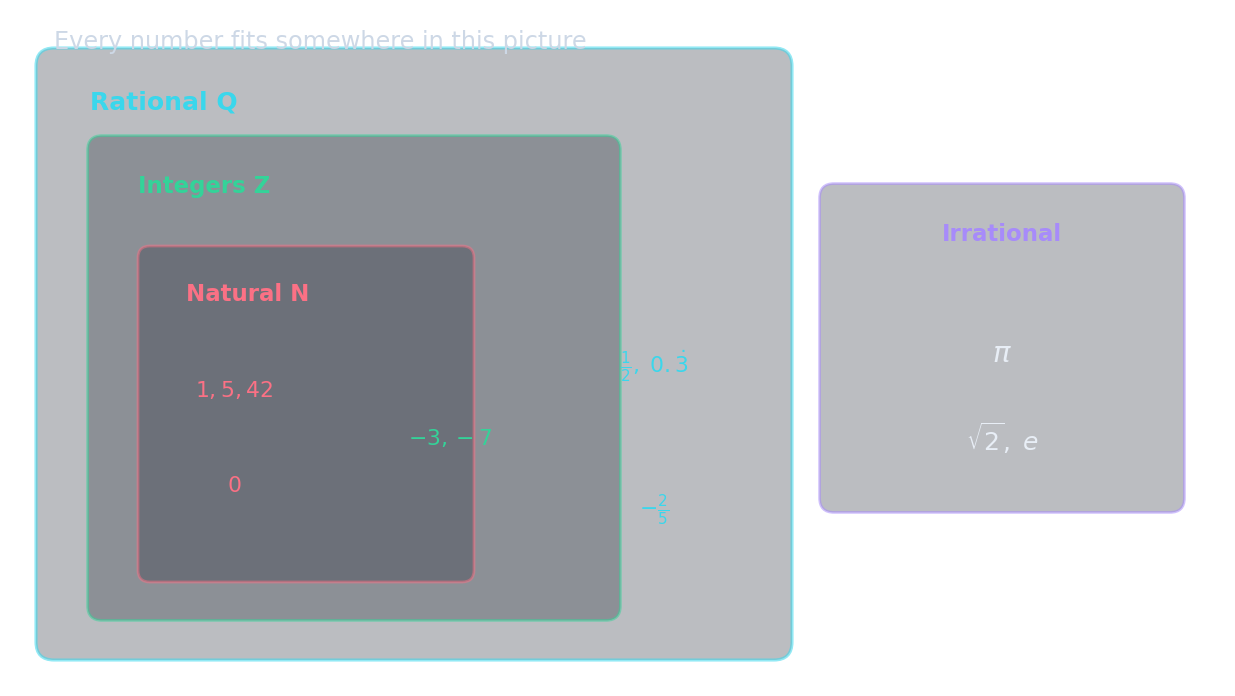
La probabilidad condicional restringe la atención al grupo que cumple la condición, como mirar solo dentro de una región de un diagrama de Venn.
If P(B | A) = P(B), then events A and B are independent. · Si P(B | A) = P(B), entonces los eventos A y B son independientes.
Independence means knowing A happened does not change the probability of B. · La independencia significa que saber que A ocurrió no cambia la probabilidad de B.
Condition on the smaller group
- Of 30 students, 18 study French and 7 of these study German. Given French, use $p=7/18$, not $7/30$; the condition selects only 18 students.
- Suppose 12 students in the full class study German. Then $P(G)=12/30=0.4$ differs from $P(G\mid F)=7/18$. The two events are not independent for these data.
Condicionar sobre el grupo más pequeño
- De 30 estudiantes, 18 estudian francés y 7 de estos estudian alemán. Dado francés, usar $p=7/18$, no $7/30$; la condición selecciona solo 18 estudiantes.
- Supongamos que 12 estudiantes en toda la clase estudian alemán. Entonces $P(G)=12/30=0.4$ difiere de $P(G\mid F)=7/18$. Los dos eventos no son independientes para estos datos.
Among 18 French students, 9 also study German. Find P(German | French). · Entre 18 estudiantes de francés, 9 también estudian alemán. Encuentra P(Alemán | Francés).
Restrict the denominator to French students: 9/18 = 0.5. · Restringe el denominador a los estudiantes de francés: 9/18 = 0.5.
You've got it
- conditional probability $=$ chance of $B$ given $A$ already happened
- restrict your attention to just the group that meets the condition
- $\text{P}(\text{German} \mid \text{French}) = \dfrac{7}{18}$ (out of the French students only)
Lo has entendido
- probabilidad condicional $=$ probabilidad de $B$ dado que $A$ ya ocurrió
- limita tu atención solo al grupo que cumple la condición
- $\text{P}(\text{German} \mid \text{French}) = \dfrac{7}{18}$ (solo entre los estudiantes de francés)