Pythagoras and trigonometry in 3D · Pitágoras y trigonometría en 3D
| English | Español |
|---|---|
| space diagonal/speɪs daɪˈæɡənl/ | diagonal del espacio |
| base diagonal/beɪs daɪˈæɡənl/ | diagonal de la base |
The diagonal through a room
- How long is the longest pole that fits inside a box? It's the space diagonal 空间对角线 — running from one corner to the far opposite corner.
- 3D Pythagoras and trig reduce this to a flat triangle hidden inside the solid.
La diagonal a través de una habitación
- ¿Cuál es la longitud del palo más largo que cabe dentro de una caja? Es la diagonal espacial — que va desde una esquina hasta la esquina opuesta más lejana.
- El Pitágoras 3D y la trigonometría reducen esto a un triángulo plano oculto dentro del sólido.
The strategy: find a triangle inside
- Every 3D problem becomes a 2D problem: spot a right-angled triangle inside the solid, then use Pythagoras or trig on it.
- Often you find a base diagonal 底面对角线 first, then bring in the height to form a second triangle.
La estrategia: encontrar un triángulo dentro
- Todo problema 3D se convierte en un problema 2D: identifica un triángulo rectángulo dentro del sólido, luego aplica Pitágoras o trigonometría sobre él.
- A menudo encuentras primero una diagonal de la base, luego agregas la altura para formar un segundo triángulo.
Pythagoras' theorem · Teorema de Pitágoras
In a right-angled triangle a² + b² = c². The same idea, applied twice, gives lengths inside 3-D solids. · En un triángulo rectángulo a² + b² = c². La misma idea, aplicada dos veces, da longitudes dentro de sólidos 3-D.
A box has a base 6 cm by 8 cm. Find the length of the base diagonal (cm). · Una caja tiene una base de 6 cm por 8 cm. Encuentra la longitud de la diagonal de la base (cm).
√(6² + 8²) = √100 = 10 cm.
In a 3-D problem you look for a right-angled triangle inside the solid to work with. · En un problema 3-D buscas un triángulo rectángulo dentro del sólido para trabajar con él.
The whole 3-D method is to reduce it to a flat right-angled triangle. · Todo el método 3-D se reduce a un triángulo rectángulo plano.
In 3D problems, you often find the ______ diagonal first, then use it with the height. · En problemas 3D, a menudo encuentras primero la diagonal ______, luego la usas con la altura.
The base diagonal (found using 2D Pythagoras) becomes one side of a second right triangle with the height. · La diagonal de la base (encontrada usando Pitágoras 2D) se convierte en un lado de un segundo triángulo rectángulo con la altura.
Worked example — box diagonal
- A box has base $6\text{ cm} \times 8\text{ cm}$, height $5\text{ cm}$.
- Step 1 — base diagonal: $\sqrt{6^2 + 8^2} = \sqrt{100} = 10\text{ cm}$.
- Step 2 — space diagonal: $\sqrt{10^2 + 5^2} = \sqrt{125} = 11.2\text{ cm}$.
Ejemplo resuelto — diagonal de caja
- Una caja tiene base $6\text{ cm} \times 8\text{ cm}$, altura $5\text{ cm}$.
- Paso 1 — diagonal de la base: $\sqrt{6^2 + 8^2} = \sqrt{100} = 10\text{ cm}$.
- Paso 2 — diagonal espacial: $\sqrt{10^2 + 5^2} = \sqrt{125} = 11.2\text{ cm}$.
A box has dimensions 6, 8 and 5 cm. The space diagonal is √(6² + 8² + 5²). Find it (1 dp). · Una caja tiene dimensiones 6, 8 y 5 cm. La diagonal espacial es √(6² + 8² + 5²). Encuéntrala (1 dp).
√(36 + 64 + 25) = √125 ≈ 11.2 cm.
A cube has side 3 cm. Its space diagonal is √(3² + 3² + 3²) = √27. Find it (2 dp). · Un cubo tiene lado 3 cm. Su diagonal espacial es √(3² + 3² + 3²) = √27. Encuéntrala (2 dp).
√27 = 3√3 ≈ 5.20 cm.
Worked example — angle to the base
- The base diagonal ($10$) and height ($5$) form a right triangle.
- $\tan\theta = \dfrac{5}{10} = 0.5$, so $\theta = \tan^{-1}(0.5) = 26.6^{\circ}$.
3D Pythagoras shortcut. The space diagonal of a box $l \times w \times h$ is $\sqrt{l^2 + w^2 + h^2}$. For our box: $\sqrt{36 + 64 + 25} = \sqrt{125} = 11.2$ cm.
Two steps, not one. For the angle, you need the base diagonal AND the height to form the second triangle. Using the space diagonal as a side gives the wrong angle.
Ejemplo resuelto — ángulo con la base
- La diagonal de la base ($10$) y la altura ($5$) forman un triángulo rectángulo.
- $\tan\theta = \dfrac{5}{10} = 0.5$, por lo tanto $\theta = \tan^{-1}(0.5) = 26.6^{\circ}$.
Atajo del Pitágoras 3D. La diagonal espacial de una caja $l \times w \times h$ es $\sqrt{l^2 + w^2 + h^2}$. Para nuestra caja: $\sqrt{36 + 64 + 25} = \sqrt{125} = 11.2$.
Dos pasos, no uno. Para el ángulo, necesitas la diagonal de la base Y la altura para formar el segundo triángulo. Usar la diagonal espacial como lado dará el ángulo incorrecto.
The base diagonal is 10 cm and the box height is 5 cm. The angle to the base has tan θ = 5/10. Find θ (degrees, 1 dp). · La diagonal de la base es 10 cm y la altura de la caja es 5 cm. El ángulo con la base tiene tan θ = 5/10. Encuentra θ (grados, 1 dp).
θ = tan⁻¹(0.5) = 26.6°.
Where 3D trig appears
- Architecture: the angle of a roof rafter, the diagonal of a room.
- Engineering: the length of a support strut, the angle of a crane arm.
3D Pythagoras is just 2D Pythagoras applied twice — first on the base, then with the height.
Dónde aparece la trigonometría 3D
- Arquitectura: el ángulo de una viga de techo, la diagonal de una habitación.
- Ingeniería: la longitud de un puntal de soporte, el ángulo de un brazo de grúa.
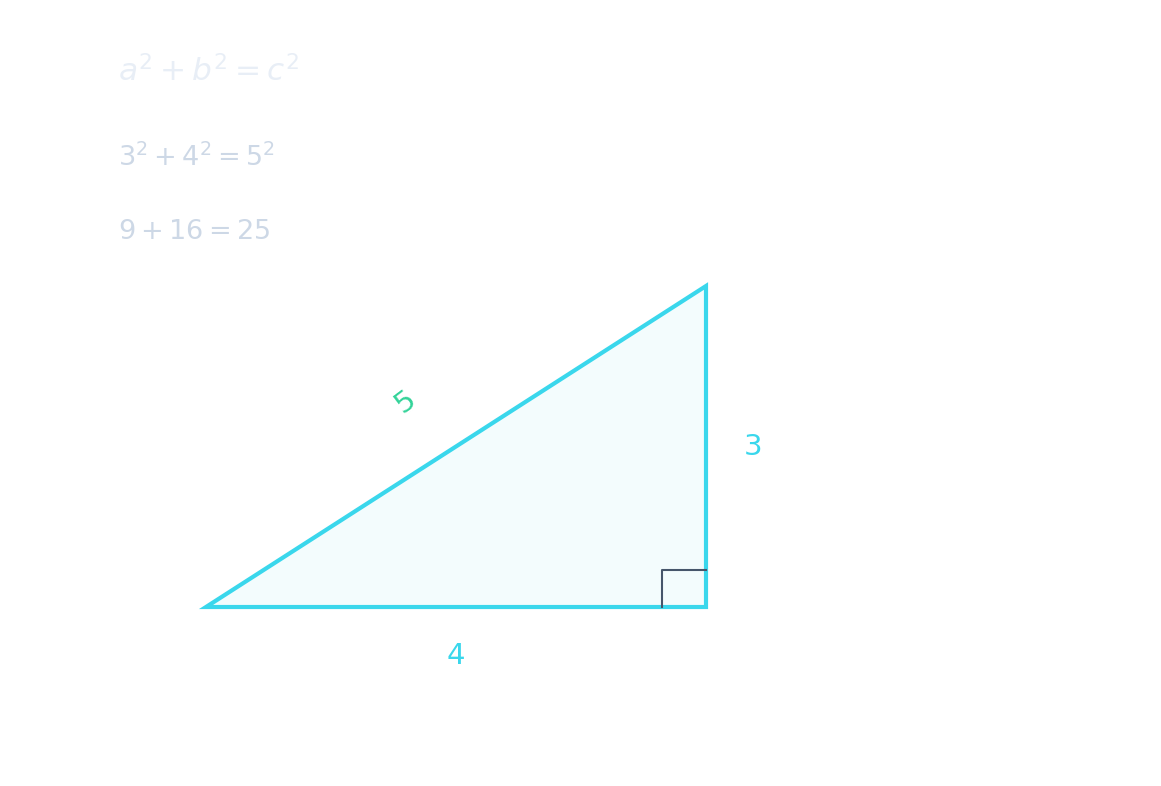
El Pitágoras 3D es simplemente el Pitágoras 2D aplicado dos veces — primero sobre la base, luego con la altura.
You've got it
- in 3D, spot a right-angled triangle inside the solid, then use Pythagoras/trig
- often find a base diagonal first, then bring in the height
- box $6 \times 8 \times 5$: base diagonal $10$, space diagonal $\sqrt{125} \approx 11.2$, angle $26.6^{\circ}$
Lo has logrado
- En 3D, localiza un triángulo rectángulo dentro del sólido, luego aplica Pitágoras/trigonometría
- A menudo encuentra primero una diagonal de la base, luego agrega la altura
- Caja $6 \times 8 \times 5$: diagonal de base $10$, diagonal espacial $\sqrt{125} \approx 11.2$, ángulo $26.6^{\circ}$