Functions · Funciones
| English | Español |
|---|---|
| function/ˈfʌŋkʃn/ | función |
| domain/dəˈmeɪn/ | dominio |
| range/reɪndʒ/ | range |
| inverse function/ɪnˈvɜːs ˈfʌŋkʃn/ | función inversa |
| composite function/ˈkɒmpəzɪt ˈfʌŋkʃn/ | función compuesta |
A machine with an input and an output
- A vending machine: you put in a code (input), it gives you a snack (output). A function 函数 works the same way — each input produces exactly one output.
- $f(x) = 3x - 5$ is a function: put in $x = 2$, get out $f(2) = 1$.
Una máquina con entrada y salida
- Una máquina expendedora: introduces un código (entrada), te da un snack (salida). Una función 函数 funciona de la misma manera — cada entrada produce exactamente una salida.
- $f(x) = 3x - 5$ es una función: introduce $x = 2$, obtienes $f(2) = 1$.
Evaluating functions
- $f(x) = 3x - 5$: $\;f(2) = 3(2) - 5 = 1$; $\;f(0) = -5$; $\;f(-1) = -8$.
- The domain 定义域 is the set of allowed inputs. The range 值域 is the set of possible outputs.
$f(x) = \sqrt{x}$ has domain $x \geq 0$ (can't square-root a negative) and range $f(x) \geq 0$.
Evaluación de funciones
- $f(x) = 3x - 5$: $\;f(2) = 3(2) - 5 = 1$; $\;f(0) = -5$; $\;f(-1) = -8$.
- El dominio 定义域 es el conjunto de entradas permitidas. El rango 值域 es el conjunto de salidas posibles.
$f(x) = \sqrt{x}$ tiene dominio $x \geq 0$ (no se puede extraer raíz cuadrada de un número negativo) y rango $f(x) \geq 0$.
Functions · Funciones
y = f(x)
A function turns each input · entrada into exactly one output · salida — watch its shape. · Una función convierte cada entrada en exactamente una salida — observa su forma.
For f(x) = 3x − 5, what is f(2)? · Para f(x) = 3x − 5, ¿cuál es f(2)?
f(2) = 3(2) − 5 = 6 − 5 = 1.
For f(x) = x² + 1, what is f(3)? · Para f(x) = x² + 1, ¿cuál es f(3)?
f(3) = 3² + 1 = 9 + 1 = 10.
Inverse functions 反函数
- The inverse $f^{-1}$ undoes $f$: if $f$ turns $2$ into $1$, then $f^{-1}$ turns $1$ back into $2$.
- Method: write $y = f(x)$, swap $x$ and $y$, then make $y$ the subject.
- $f(x) = 3x - 5$: $y = 3x - 5$, swap: $x = 3y - 5$, solve: $y = \dfrac{x+5}{3}$.
- So $f^{-1}(x) = \dfrac{x+5}{3}$. Check: $f^{-1}(1) = \dfrac{6}{3} = 2$ ✓.
$f^{-1}$ is NOT $f$ to the power $-1$. The notation $f^{-1}(x)$ means "the inverse of $f$", not "$\dfrac{1}{f(x)}$". These are completely different.
Funciones inversas 反函数
- La inversa $f^{-1}$ deshace a $f$: si $f$ convierte $2$ en $1$, entonces $f^{-1}$ convierte $1$ de vuelta en $2$.
- Método: escribe $y = f(x)$, intercambia $x$ e $y$, luego despeja $y$.
- $f(x) = 3x - 5$: $y = 3x - 5$, intercambia: $x = 3y - 5$, despeja: $y = \dfrac{x+5}{3}$.
- Por lo tanto, $f^{-1}(x) = \dfrac{x+5}{3}$. Verificación: $f^{-1}(1) = \dfrac{6}{3} = 2$ ✓.
$f^{-1}$ NO ES $f$ elevado a la potencia $-1$. La notación $f^{-1}(x)$ significa "la inversa de $f$", no "$\dfrac{1}{f(x)}$". Son completamente diferentes.
The inverse of f(x) = 3x − 5 is f⁻¹(x) = (x + 5)/3. What is f⁻¹(1)? · La inversa de f(x) = 3x − 5 es f⁻¹(x) = (x + 5)/3. ¿Cuál es f⁻¹(1)?
f⁻¹(1) = (1 + 5)/3 = 6/3 = 2.
To find the inverse of f(x), write y = f(x), swap x and y, then make ______ the subject. · Para encontrar la inversa de f(x), escribe y = f(x), intercambia x e y, luego haz que ______ sea el tema.
After swapping, solve for y — that gives you f⁻¹(x). · Después de intercambiar, despeja y — eso te da f⁻¹(x).
Composite functions 复合函数
- $gf(x)$ means "do $f$ first, then apply $g$ to the result".
- $f(x) = 2x$, $g(x) = x + 3$: $gf(x) = g(2x) = 2x + 3$.
- $fg(x) = f(x+3) = 2(x+3) = 2x + 6$. Order matters!
Funciones compuestas 复合函数
- $gf(x)$ significa "aplica $f$ primero, luego aplica $g$ al resultado".
- $f(x) = 2x$, $g(x) = x + 3$: $gf(x) = g(2x) = 2x + 3$.
- $fg(x) = f(x+3) = 2(x+3) = 2x + 6$. ¡El orden importa!
If f(x) = 2x and g(x) = x + 3, what is gf(x) at x = 5? (gf means do f first) · Si f(x) = 2x y g(x) = x + 3, ¿cuál es gf(x) en x = 5? (gf significa aplicar f primero)
gf(5) = g(f(5)) = g(10) = 10 + 3 = 13.
For f(x) = 2x and g(x) = x + 3, gf(x) and fg(x) give the same result. · Para f(x) = 2x y g(x) = x + 3, gf(x) y fg(x) dan el mismo resultado.
gf(x) = 2x + 3, but fg(x) = 2(x+3) = 2x + 6. The order matters. · gf(x) = 2x + 3, pero fg(x) = 2(x+3) = 2x + 6. El orden importa.
Fun fact
- The identity function $I(x) = x$ leaves everything unchanged. For any function, $f \circ f^{-1} = I$ — composing a function with its inverse gives back the original input.
Every curve here is a function: for each input $x$, there's exactly one output $y$.
Dato curioso
- La función identidad $I(x) = x$ deja todo sin cambios. Para cualquier función, $f \circ f^{-1} = I$ — componer una función con su inversa devuelve la entrada original.
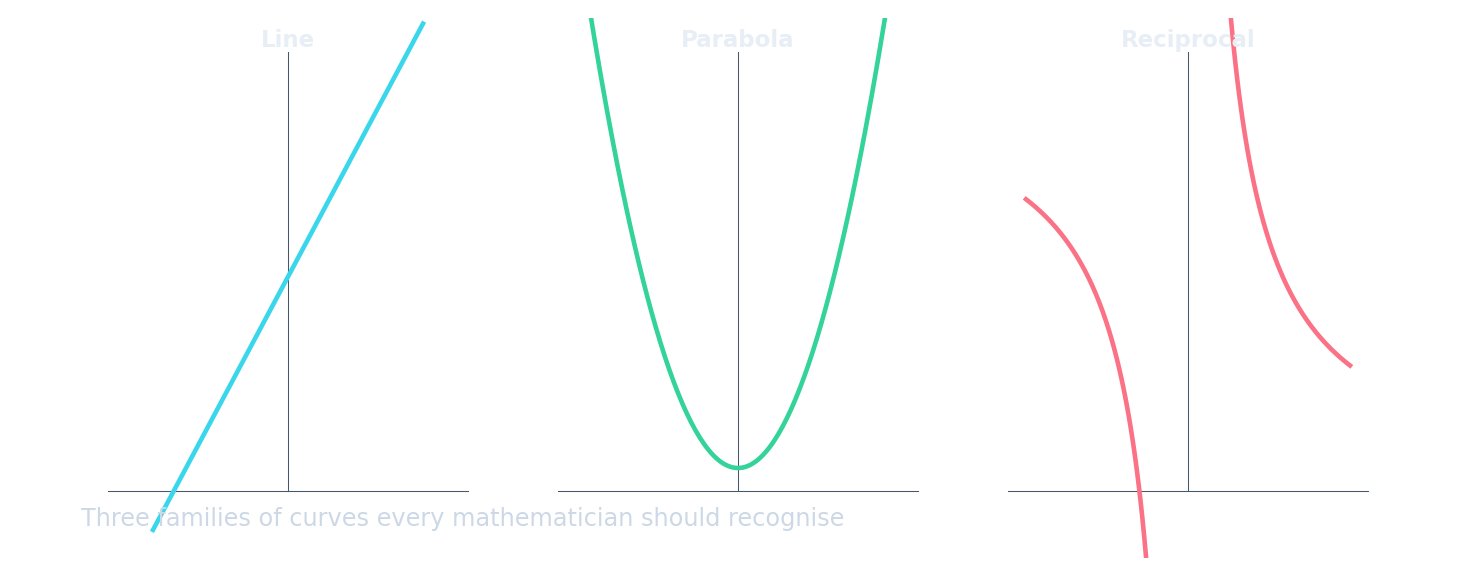
Cada curva aquí es una función: para cada entrada $x$, hay exactamente una salida $y$.
You've got it
- $f(x) = 3x - 5 \Rightarrow f(2) = 1$; domain = inputs, range = outputs
- inverse $f^{-1}$ undoes $f$: swap $x$ and $y$, then solve for $y$
- composite $gf(x)$ = do $f$ first, then $g$; order matters ($gf \neq fg$)
Ya lo tienes
- $f(x) = 3x - 5 \Rightarrow f(2) = 1$; dominio = entradas, rango = salidas
- inversa $f^{-1}$ deshace a $f$: intercambia $x$ e $y$, luego despeja $y$
- compuesta $gf(x)$ = aplica $f$ primero, luego $g$; el orden importa ($gf \neq fg$)