Inequalities · Desigualdades
| English | Español |
|---|---|
| inequality/ɪniːˈkwɒlɪti/ | la desigualdad |
| intervals/ˈɪntəvlz/ | intervalos |
| number line/ˈnʌmbə laɪn/ | recta numérica |
| region/ˈriːdʒn/ | región |
Speed limits and number ranges
- A road sign says "Speed ≤ 30 mph". That's an inequality 不等式 — a range of allowed values, not a single answer.
- Inequalities describe intervals 区间: a set of values, not one value. Solving them is like solving equations, with one crucial twist.
Límites de velocidad y rangos numéricos
- Una señal de tráfico indica "Velocidad ≤ 30 mph". Eso es una desigualdad —un rango de valores permitidos, no una única respuesta.
- Las desigualdades describen intervalos: un conjunto de valores, no uno solo. Resolverlas es similar a resolver ecuaciones, con un matiz crucial.
Solving inequalities (Extended) (Extended)
- Solve exactly like an equation — but reverse the sign ($<$ becomes $>$, and vice versa) if you multiply or divide by a negative number.
Solve $3x + 1 < 10$: subtract 1 → $3x < 9$ → divide by 3 → $x < 3$.
The sign flip. Solve $-2x > 6$: divide by $-2$ and flip → $x < -3$ (not $x > -3$). Forgetting to flip is the most common mistake.
$-\tfrac13 \leqslant x < 3$: a closed circle includes the end value, an open circle excludes it
Resolución de desigualdades (Ampliado) (Ampliado)
- Resuélvalas exactamente como una ecuación — pero invierta el signo ($<$ pasa a ser $>$, y viceversa) si multiplica o divide por un número negativo.
Resuelva $3x + 1 < 10$: reste 1 → $3x < 9$ → divida entre 3 → $x < 3$.
El cambio de signo. Resuelva $-2x > 6$: divida entre $-2$ e invierta el signo → $x < -3$ (no $x > -3$). Olvidar invertir el signo es el error más común.

$-\tfrac13 \leqslant x < 3$: un círculo relleno incluye el valor extremo, un círculo hueco lo excluye
Inequalities · Desigualdades
y = ax + b
An inequality asks where the line is above or below a value.
You must reverse the inequality sign when you:
Multiplying or dividing by a negative flips < to > (and vice versa).
Solve 3x + 1 < 10. What is the upper bound for x?
3x < 9 → x < 3. The upper bound is 3 (not included).
Solving −2x > 6 gives x > −3.
Dividing by −2 and flipping gives x < −3, not x > −3.
Solving double inequalities (Extended)
- $-3 \leq 3x - 2 < 7$: apply the same operation to all three parts.
- Add 2: $-1 \leq 3x < 9$. Divide by 3: $-\dfrac{1}{3} \leq x < 3$.
Resolución de doble desigualdad (Ampliado)
- $-3 \leq 3x - 2 < 7$: aplique la misma operación a las tres partes.
- Sume 2: $-1 \leq 3x < 9$. Divida entre 3: $-\dfrac{1}{3} \leq x < 3$.
Solve −3 ≤ 3x − 2 < 7. The solution is −1/3 ≤ x < ? What is the upper bound?
Add 2: −1 ≤ 3x < 9; divide by 3: −1/3 ≤ x < 3.
On a number line 数轴
- Open circle (○) for $<$ or $>$ — the end value is not included.
- Closed circle (●) for $\leq$ or $\geq$ — the end value is included.
Closed circle at $-\frac{1}{3}$ (included), open circle at $3$ (excluded). The shaded region 区域 is the solution.
En una recta numérica
- Círculo hueco (○) para $<$ o $>$ — el valor extremo no está incluido.
- Círculo relleno (●) para $\leq$ o $\geq$ — el valor extremo sí está incluido.
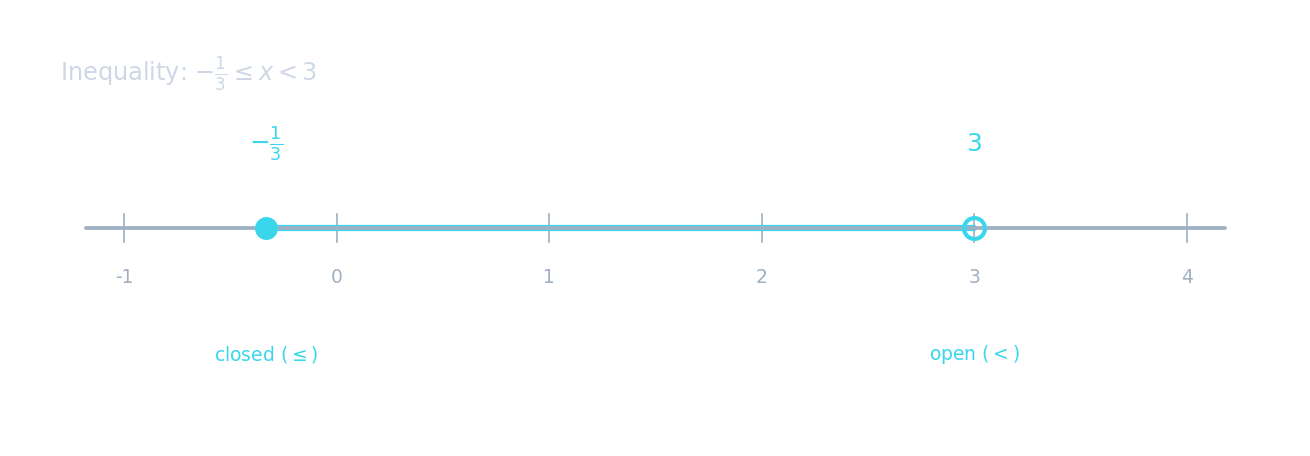
Círculo cerrado en $-\frac{1}{3}$ (incluido), círculo abierto en $3$ (excluido). La región sombreada es la solución.
On a number line, the symbol ≤ is drawn with a:
≤ and ≥ include the end value, shown by a closed circle; < and > use an open circle.
Match each inequality symbol to its number-line drawing.
< and > use open circles (end value excluded); ≤ and ≥ use closed circles (included).
Inequality regions (Extended)
- An inequality in two variables ($y > 2x + 1$) shades a region on the coordinate plane.
- Broken (dashed) boundary line for strict inequalities ($<$ or $>$).
- Solid boundary line for $\leq$ or $\geq$.
Regiones de desigualdad (Ampliado)
- Una desigualdad con dos variables ($y > 2x + 1$) sombrea una región en el plano cartesiano.
- Límite roto (punteado) para desigualdades estrictas ($<$ o $>$).
- Límite sólido para $\leq$ o $\geq$.
Core: interpret before solving
- For $-3\le x<2$, mark a filled circle at $-3$, an open circle at 2 and shade between. The integer values are $-3,-2,-1,0,1$.
- A parcel rule $2\le m<5$ kg includes 2 kg but excludes 5 kg. Core questions ask you to interpret and represent such ranges; solving algebraic inequalities belongs to Extended.
Fundamental: interprete antes de resolver
- Para $-3\le x<2$, marque un círculo relleno en $-3$, un círculo abierto en 2 y sombreé entre ellos. Los valores enteros son $-3,-2,-1,0,1$.
- Una regla de paquete $2\le m<5$ kg incluye 2 kg pero excluye 5 kg. Las preguntas fundamentales le piden interpretar y representar tales rangos; resolver desigualdades algebraicas corresponde al nivel ampliado.
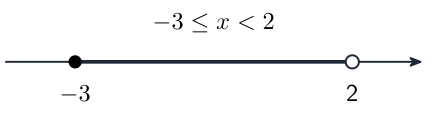
How many integers satisfy −3 ≤ x < 2?
The integers are −3, −2, −1, 0 and 1.
You've got it
- solve like an equation, but flip the sign when multiplying/dividing by a negative
- $-3 \leq 3x - 2 < 7 \Rightarrow -\dfrac{1}{3} \leq x < 3$
- number line: open circle excludes, closed circle includes the end
- 2-variable inequalities shade a region (dashed boundary for strict, solid otherwise)
Lo has entendido
- resuelva como una ecuación, pero invierta el signo al multiplicar/dividir por un negativo
- $-3 \leq 3x - 2 < 7 \Rightarrow -\dfrac{1}{3} \leq x < 3$
- recta numérica: el círculo hueco excluye, el círculo relleno incluye el extremo
- las desigualdades de 2 variables sombrean una región (límite punteado para estrictas, sólido en los demás casos)