Fractions, decimals, percentages and operations · Fracciones, decimales, porcentajes y operaciones
| English | Español |
|---|---|
| fraction/ˈfrækʃn/ | fracción |
| decimal/ˈdesɪml/ | decimal |
| percentage/pəˈsentɪdʒ/ | porcentaje |
| reciprocal/rɪˈsɪprəkl/ | recíproco |
| common denominator/ˈkɒmən dɪˈnɒmɪneɪtə/ | denominador común |
| order of operations/ˈɔːdə ɒv ˌɒpəˈreɪʃnz/ | orden de operaciones |
Half a pizza, 50% of a pizza, 0.5 of a pizza
- They are the same thing — just three ways of writing the same number.
- Fractions 分数, decimals 小数, and percentages 百分比 are interchangeable. The skill is picking the right form and converting quickly.
Number form lab · Laboratorio de formas numéricas
Classify equivalent number forms and operations. · Clasificar formas numéricas equivalentes y operaciones.
Fractions to decimals and back
- Fraction → decimal: divide the top by the bottom. $\dfrac{3}{8} = 3 \div 8 = 0.375$.
- Decimal → fraction: write the decimal over the appropriate power of 10, then simplify.
- $0.6 = \dfrac{6}{10} = \dfrac{3}{5}$.
Memorise the common ones. $\dfrac{1}{4} = 0.25 = 25\%$; $\dfrac{1}{3} = 0.\dot{3} = 33.\dot{3}\%$; $\dfrac{1}{5} = 0.2 = 20\%$; $\dfrac{3}{4} = 0.75 = 75\%$.

Shops use percentages for discounts, sales tax and profit margins
Write 3/8 as a decimal. · Escribe 3/8 como decimal.
3 ÷ 8 = 0.375.
Decimals to percentages
- Decimal → percentage: multiply by 100. $0.375 \times 100 = 37.5\%$.
- Percentage → decimal: divide by 100. $45\% = 0.45$.

One value three ways: a fraction, a decimal and a percentage
Convert 45% to a decimal. · Convierte 45% a decimal.
45% = 45 ÷ 100 = 0.45.
Multiplying and dividing fractions
- Multiply · Multiplicar: tops × tops, bottoms × bottoms. $\dfrac{2}{3} \times \dfrac{4}{5} = \dfrac{8}{15}$.
- Divide · Dividir: multiply by the reciprocal · recíproco 倒数 of the second fraction. $\dfrac{2}{3} \div \dfrac{4}{5} = \dfrac{2}{3} \times \dfrac{5}{4} = \dfrac{10}{12} = \dfrac{5}{6}$.
- Add/subtract: find a common denominator 公分母 first.
Never add tops to tops. $\dfrac{1}{3} + \dfrac{1}{4} \neq \dfrac{2}{7}$. Find a common denominator: $\dfrac{4}{12} + \dfrac{3}{12} = \dfrac{7}{12}$.
What is 2/3 × 4/5? · ¿Cuál es 2/3 × 4/5?
Multiply tops and bottoms: (2×4)/(3×5) = 8/15. · Multiplica numeradores y denominadores: (2×4)/(3×5) = 8/15.
1/3 + 1/4 = 2/7.
1/3 + 1/4 = 4/12 + 3/12 = 7/12, not 2/7. You must find a common denominator before adding. · 1/3 + 1/4 = 4/12 + 3/12 = 7/12, no 2/7. Debes encontrar un denominador común antes de sumar.
Order of operations · Orden de operaciones 运算顺序 (BIDMAS)
- Brackets → Indices → Division/Multiplication (left to right) → Addition/Subtraction (left to right).
- $-6 \times -3 + 7 \times 2 = 18 + 14 = 32$ (multiply before adding).
Using the order of operations, work out −6 × −3 + 7 × 2. · Usando el orden de las operaciones, resuelve −6 × −3 + 7 × 2.
Multiply first: −6×−3 = 18 and 7×2 = 14; then 18 + 14 = 32. · Multiplica primero: −6×−3 = 18 y 7×2 = 14; luego 18 + 14 = 32.
Ordering mixed numbers
- To order a list mixing fractions, decimals, and percentages: convert everything to decimals first, then compare.
- $\dfrac{2}{3}=0.666\ldots$, $65\%=0.65$, and $0.6\dot6=0.666\ldots$. The two recurring forms are equal; 0.667 is only an approximation (recurring notation is Extended).
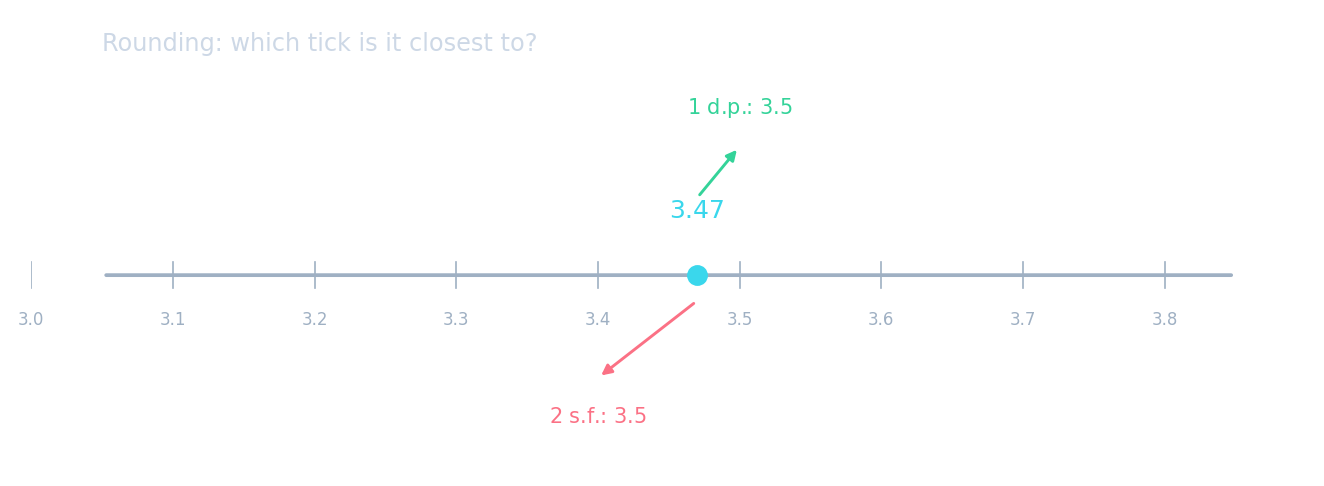
Number lines make comparisons obvious — plot each value as a decimal and read left to right.
Put these in order from smallest to largest: 2/3, 65%, 0.7, 7/10. · Ordena estos valores de menor a mayor: 2/3, 65%, 0.7, 7/10.
2/3 ≈ 0.667, 65% = 0.65, 0.7 = 0.7, 7/10 = 0.7. Order: 0.65, 0.667, 0.7, 0.7. · 2/3 ≈ 0.667, 65% = 0.65, 0.7 = 0.7, 7/10 = 0.7. Orden: 0.65, 0.667, 0.7, 0.7.
Mixed numbers and negative comparisons
- Convert a mixed number before arithmetic: $2\frac13=(2\times3+1)/3=7/3$. Then $2\frac13-\frac56=14/6-5/6=9/6=1\frac12$.
- Convert unlike forms to compare: $-1\frac14=-1.25<-1.2$. On a number line the more negative number is further left; $\le$ includes the endpoint while $<$ excludes it.
Calculate 2⅓ − ⅚ as a decimal. · Calcular 2⅓ − ⅚ como decimal.
Convert to sixths: 14/6 − 5/6 = 9/6 = 1.5. · Convertir a sextos: 14/6 − 5/6 = 9/6 = 1.5.
You've got it
- fraction → decimal: divide top by bottom ($\dfrac{3}{8} = 0.375$)
- decimal → percentage: ×100; percentage → decimal: ÷100
- multiply fractions: tops × tops, bottoms × bottoms; divide: × the reciprocal · recíproco
- order of operations: BIDMAS (brackets, indices, ÷×, +−)