Preparing soluble salts · Preparación de sales solubles
| English | Español |
|---|---|
| salt/sɒlt/ | sal |
| filter/ˈfɪltə/ | filter |
| evaporate/ɪˈvæpəreɪt/ | se evaporan |
| crystallise/ˈkrɪstəlaɪz/ | cristalizar |
Making salts 盐 you can dissolve
- A salt forms when the hydrogen of an acid is replaced by a metal.
- For soluble salts, there's a reliable way to make and collect them.
Obtención de sales disolubles
- Una sal se forma cuando el hidrógeno de un ácido es reemplazado por un metal.
- Para obtener sales solubles, existe un método fiable para prepararlas y recogerlas.
Why is an excess of the base added to the acid? · ¿Por qué se añade un exceso de base al ácido?
Excess base ensures complete reaction of the acid. · El exceso de base asegura la reacción completa del ácido.
A salt forms when the hydrogen of an acid is replaced by a ______. · Una sal se forma cuando el hidrógeno de un ácido es reemplazado por un ______.
A metal (or ammonium) ion replaces the acid's hydrogen. · Un ion metálico (o amonio) reemplaza el hidrógeno del ácido.
The method
- React an acid with an excess of an insoluble base, metal or carbonate.
- The excess ensures all the acid is used up; then filter 过滤 off the leftover solid.
Making a soluble salt: react with excess solid, filter, evaporate 蒸发, then crystallise 结晶
El método
- Hacer reaccionar un ácido con una cantidad excesiva de una base, metal o carbonato insoluble.
- El exceso asegura que todo el ácido se consuma; a continuación, filtrar el sólido sobrante.
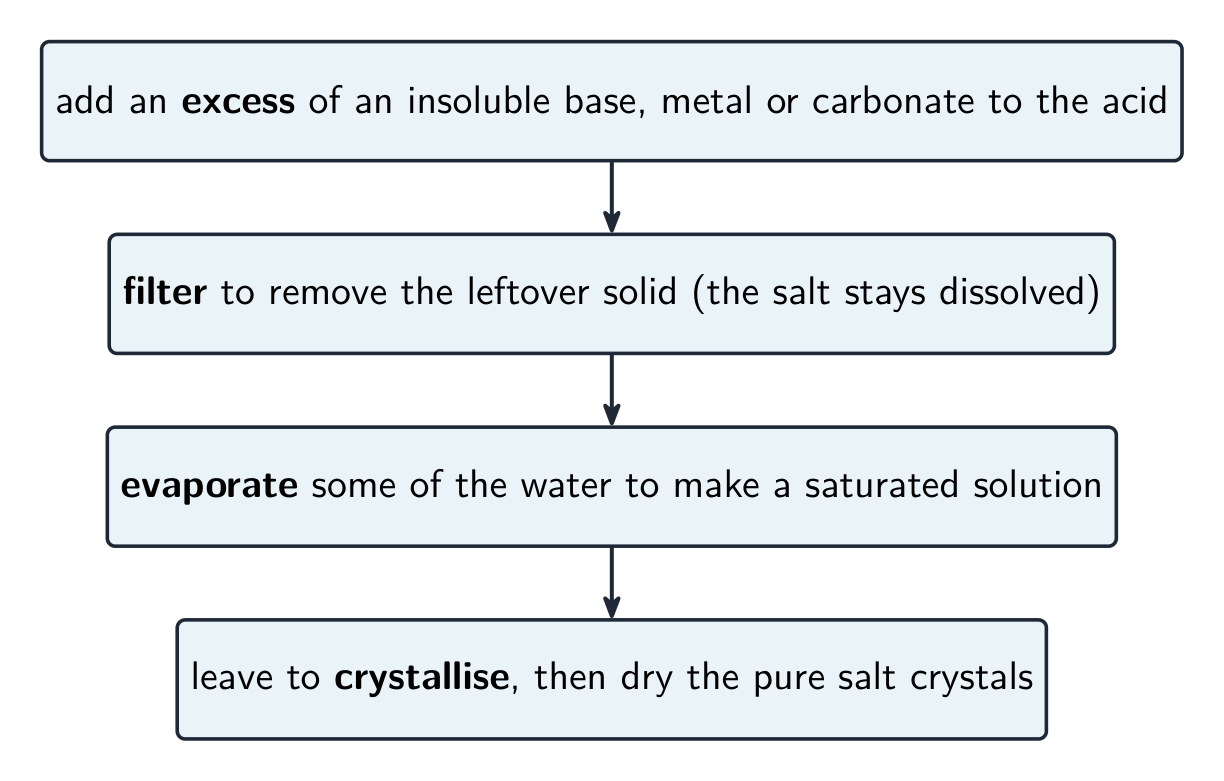
Preparación de una sal soluble: reaccionar con exceso de sólido, filtrar, evaporar y luego cristalizar
Preparing a soluble salt · Preparación de una sal soluble
Step through the method. React an acid with excess insoluble base, filter off what's left over, then evaporate and crystallise to get pure salt crystals. · Siga el método. Reaccione un ácido con una base insoluble en exceso, filtre lo sobrante, luego evapore y cristalice para obtener cristales puros de sal.
After the reaction, the leftover excess solid is removed by: · Después de la reacción, el exceso sólido sobrante se elimina mediante:
Filtration removes the undissolved excess. · La filtración elimina el exceso no disuelto.
Pure salt crystals are obtained by: · Los cristales puros de sal se obtienen mediante:
Slow crystallisation gives pure crystals. · La cristalización lenta produce cristales puros.
Getting the crystals
- The filtered solution contains the dissolved salt.
- Evaporate some water, then leave it to crystallise — the salt forms pure crystals.
Obtención de los cristales
- La solución filtrada contiene la sal disuelta.
- Evaporar parte del agua y dejar reposar para que cristalice; la sal formará cristales puros.
Put the soluble-salt preparation steps in order. · Ordene los pasos de preparación de sales solubles.
React → filter → evaporate → crystallise. · Reaccionar → filtrar → evaporar → cristalizar.
The full sequence
-
- Add excess base to warm acid. 2. Filter off the excess.
-
- Evaporate to concentrate. 4. Crystallise and dry the crystals.
Worked example. To make copper sulfate: warm sulfuric acid, add excess copper oxide until no more dissolves, filter off the leftover oxide, then evaporate and crystallise the blue solution.
Secuencia completa
-
- Añadir exceso de base al ácido tibia. 2. Filtrar el exceso.
-
- Evaporar para concentrar. 4. Cristalizar y secar los cristales.
Ejemplo resuelto. Para preparar sulfato de cobre: calentar ácido sulfúrico, añadir exceso de óxido de cobre hasta que ya no se disuelva más, filtrar el óxido sobrante y, finalmente, evaporar y cristalizar la solución azul.
You've got it
- a soluble salt is made by reacting acid with excess base/metal/carbonate
- filter off the excess solid, then evaporate and crystallise
- using an excess ensures all the acid reacts
Lo has logrado
- Una sal soluble se prepara haciendo reaccionar un ácido con exceso de base/metal/carbonato
- Filtrar el exceso de sólido, luego evaporar y cristalizar
- Usar un exceso garantiza que todo el ácido reacciona