Rates of Change · Tasas de Cambio
| English | Español |
|---|---|
| rate of change/reɪt ɒv tʃeɪndʒ/ | tasa de cambio |
| average rate of change/ˈævrɪdʒ reɪt ɒv tʃeɪndʒ/ | tasa promedio de cambio |
| interval/ˈɪntəvl/ | intervalo |
| slope/sləʊp/ | pendiente |
| secant line/ˈsiːkənt laɪn/ | recta secante |
| constant/ˈkɒnstənt/ | constante |
How fast, exactly?
- A car's speedometer answers a question the odometer cannot: not how far, but how fast right now.
- "How fast is the output changing?" is the central question of this whole course.
- The answer is a number called a rate of change 变化率.
- This lesson measures it two ways: over a stretch, and at a single instant.
¿Qué tan rápido, exactamente?
- El velocímetro de un automóvil responde a una pregunta que el odómetro no puede: no cuánto ha recorrido, sino qué tan rápido va en este momento.
- "¿Cómo está cambiando la salida?" es la pregunta central de todo este curso.
- La respuesta es un número llamado tasa de cambio 变化率.
- Esta lección lo mide de dos formas: sobre un tramo y en un instante único.
Average rate of change
- Over an interval 区间 from $x = a$ to $x = b$, compare how much the output changed to how much the input changed.
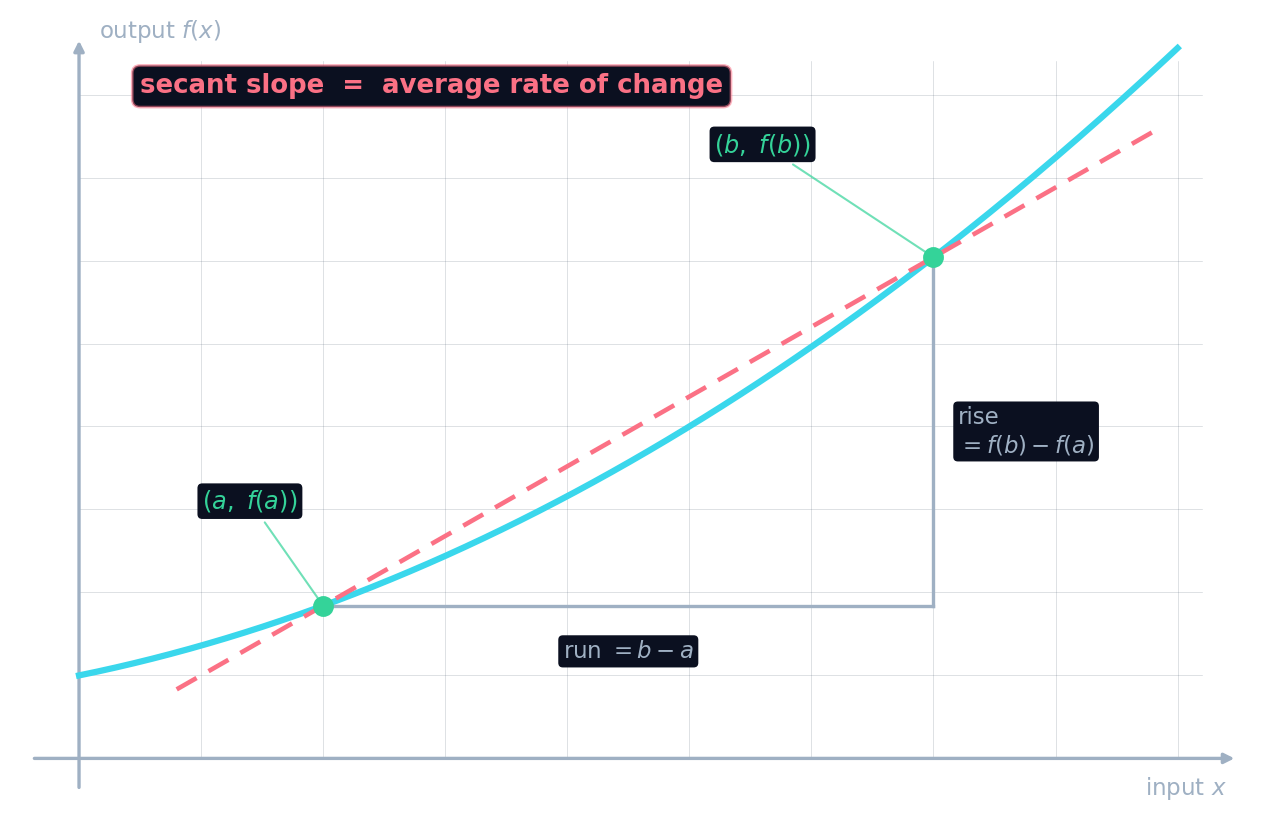
- The average rate of change 平均变化率 is $\dfrac{f(b) - f(a)}{b - a}$ — change in output over change in input.
- It is a ratio, so it always carries units: metres per second, dollars per year, °C per minute.
- Example in words: if temperature rose 12°C over 4 hours, the average rate was 3°C per hour.
Tasa de cambio promedio
- Sobre un intervalo 区间 desde $x = a$ hasta $x = b$, compara cuánto cambió la salida con respecto a cuánto cambió la entrada.
- La tasa de cambio promedio 平均变化率 es $\dfrac{f(b) - f(a)}{b - a}$ — cambio en la salida dividido por el cambio en la entrada.
- Al ser una razón, siempre lleva unidades: metros por segundo, dólares por año, °C por minuto.
- Ejemplo en palabras: si la temperatura subió 12°C en 4 horas, la tasa promedio fue de 3°C por hora.
The · El average rate of change of $f$ over the interval $[a, b]$ equals… · La tasa promedio de cambio de $f$ sobre el intervalo $[a, b]$ es igual a…
It is the change in output divided by the change in input — a ratio, so it carries units of output per unit of input. · Es el cambio en la salida dividido por el cambio en la entrada — una razón, por lo que lleva unidades de salida por unidad de entrada.
It is the slope of a secant line
- Draw the straight line joining the two endpoints $(a, f(a))$ and $(b, f(b))$: that is the secant line 割线.
- Its slope 斜率 — rise over run — is exactly the average rate of change.
- Steeper secant → faster average change; a downhill secant → a negative rate.
Es la pendiente de una recta secante
- Dibuja la línea recta que une los dos puntos extremos $(a, f(a))$ y $(b, f(b))$: esa es la recta secante 割线.
- Su pendiente 斜率 — elevación sobre avance — es exactamente la tasa de cambio promedio.
- Una secante más inclinada → cambio promedio más rápido; una secante descendente → una tasa negativa.
A runner's distance is $f(t)$ metres. If $f(2) = 10$ and · y $f(5) = 40$, what is the average speed over $[2, 5]$? · La distancia de un corredor es $f(t)$ metros. Si $f(2) = 10$ y $f(5) = 40$, ¿cuál es la velocidad promedio sobre $[2, 5]$?
Average speed $= \dfrac{40 - 10}{5 - 2} = \dfrac{30}{3} = 10$ m/s — the secant slope over that interval. · Velocidad promedio $= \dfrac{40 - 10}{5 - 2} = \dfrac{30}{3} = 10$ m/s — la pendiente de la secante sobre ese intervalo.
On a graph, the average rate of change over $[a, b]$ is the slope of the… · En una gráfica, la tasa promedio de cambio sobre $[a, b]$ es la pendiente de la…
The · El secant line joins $(a, f(a))$ and · y $(b, f(b))$; its slope is exactly the average rate of change. · La recta secante une $(a, f(a))$ y $(b, f(b))$; su pendiente es exactamente la tasa promedio de cambio.
The rate at a single point
- A secant needs two points. To get the rate at just one point, shrink the interval.
- Take average rates over smaller and smaller intervals around the point.
- As the interval closes toward zero, the secant tips over into a tangent — its slope is the rate at that exact point.
- This "rate at an instant" is the idea that grows into calculus next year.
La tasa en un solo punto
- Una secante necesita dos puntos. Para obtener la tasa en solo un punto, reduce el intervalo.
- Calcula tasas promedio sobre intervalos cada vez más pequeños alrededor del punto.
- A medida que el intervalo se cierra hacia cero, la secante se inclina para convertirse en una tangente; su pendiente es la tasa en ese punto exacto.
- Esta "tasa en un instante" es la idea que dará origen al cálculo el próximo año.
Shrink the interval until the secant becomes a tangent · Encoge el intervalo hasta que la secante se convierta en tangente
f(x) = 0.5x²
Drag the point to read the slope at a single spot — this is the limit of the average rate of change as the interval shrinks to zero. · Arrastra el punto para leer la pendiente en un lugar único: este es el límite de la tasa promedio de cambio a medida que el intervalo se contrae a cero.
To estimate the rate of change at a single point, average rates are taken over very ____ intervals around it. · Para estimar la tasa de cambio en un punto único, las tasas promedios se toman sobre intervalos muy ____ alrededor de él.
As the interval shrinks toward zero, the secant slope approaches the slope at that exact point. · A medida que el intervalo se contrae hacia cero, la pendiente de la secante se aproxima a la pendiente en ese punto exacto.
Sign, size, and units
- A positive rate means the output is rising; a negative rate means it is falling; zero means no change.
- A bigger number (ignoring sign) means faster change.
- For a straight line the rate is the same everywhere — it is constant 常数.
- Always state the units: a rate of change with no units is only half an answer.
Signo, magnitud y unidades
- Una tasa positiva significa que la salida está aumentando; una tasa negativa significa que está disminuyendo; cero significa que no hay cambio.
- Un número mayor (ignorando el signo) indica un cambio más rápido.
- Para una línea recta, la tasa es la misma en todas partes — es constante 常数.
- Siempre especifica las unidades: una tasa de cambio sin unidades es solo medio de la respuesta.
A negative · negativa average rate of change means the output decreased over the interval. · Una tasa promedio de cambio negativa significa que la salida disminuyó durante el intervalo.
A negative ratio means the output ended lower than it started — the function fell, on average, across the interval. · Una razón negativa significa que la salida terminó más baja de donde comenzó — la función descendió, en promedio, a través del intervalo.
Select all · todos true statements about average rate of change. · Selecciona todas las afirmaciones verdaderas sobre la tasa promedio de cambio.
It can be positive, negative, or zero. Everything else is true: it is a slope, it carries units, and it approximates a point rate over small intervals. · Puede ser positiva, negativa o cero. Todo lo demás es verdadero: es una pendiente, lleva unidades y aproxima una tasa puntual sobre intervalos pequeños.
Average rate of change is about the two endpoints only — it ignores everything in between. A hiker who climbs then descends back to the same height has an average rate of zero, even though they were moving the whole time.
La tasa de cambio promedio se refiere únicamente a los dos puntos extremos — ignora todo lo que ocurre entre ellos. Un senderista que asciende y luego desciende hasta la misma altura tiene una tasa promedio de cero, aunque se haya movido durante todo el trayecto.
A car travels 150 km between 1:00 and 3:00.
- Average speed $= \dfrac{150 \text{ km}}{2 \text{ h}} = 75$ km/h.
- That is the secant slope of the distance–time graph over those two hours.
- The car's actual speed changed constantly — 75 km/h is just the average.
Un automóvil recorre 150 km entre la 1:00 y las 3:00.
- Velocidad promedio $= \dfrac{150 \text{ km}}{2 \text{ h}} = 75$ km/h.
- Esa es la pendiente de la secante de la gráfica de distancia–tiempo durante esas dos horas.
- La velocidad real del automóvil cambió constantemente; 75 km/h es solo el promedio.
The average rate of change over $[a, b]$ is $\dfrac{f(b) - f(a)}{b - a}$, the slope of the secant line through the endpoints. Shrink the interval toward zero and it becomes the rate at a single point. Always report the units.
La tasa de cambio promedio sobre $[a, b]$ es $\dfrac{f(b) - f(a)}{b - a}$, la pendiente de la recta secante que pasa por los puntos extremos. Al reducir el intervalo hacia cero, se convierte en la tasa en un punto único. Siempre reporta las unidades.