New organic mechanisms · Nuevos mecanismos orgánicos
| English | Español |
|---|---|
| electrophilic substitution/ɪˌlektrəʊˈfɪlɪk ˌsʌbstɪˈtjuːʃn/ | sustitución electrofílica |
| electrophile/ɪˌlektrəʊˈfaɪl/ | electrófilo |
| delocalised/dɪˈlɒkəlaɪzd/ | deslocalizado |
| nitration/naɪˈtreɪʃn/ | nitración |
| nitrobenzene/ˌnaɪtrəʊˈbenziːn/ | nitrobenceno |
Two new mechanisms
- A Level adds two reaction mechanisms to the ones you already know.
- Electrophilic substitution 亲电取代 is how benzene reacts.
- Addition–elimination appears with carbonyls and acyl chlorides.
Dos nuevos mecanismos
- A Level añade dos mecanismos de reacción a los que ya conoces.
- Sustitución electrofílica es la forma en que reacciona el benceno.
- Adición–eliminación aparece con carbonilos y cloruros de acilo.
Electrophilic substitution is when: · La sustitución electrofílica es cuando:
Benzene reacts by electrophilic substitution, keeping its stable ring while swapping an H for the electrophile. · El benceno reacciona por sustitución electrofílica, manteniendo su anillo estable mientras intercambia un H por el electrófilo.
Benzene reacts mainly by: · El benceno reacciona principalmente por:
Substitution keeps the stable delocalised ring intact, unlike addition which would destroy it. · La sustitución mantiene el anillo deslocalizado estable intacto, a diferencia de la adición que lo destruiría.
Benzene undergoes electrophilic ______ rather than addition. · El benceno experimenta electrophilic ______ en lugar de adición.
This preserves the stable ring. · Esto preserva el anillo estable.
Reduction adds hydrogen (or removes oxygen) to a molecule. · La reducción añade hidrógeno (o elimina oxígeno) a una molécula.
The opposite of oxidation. · Lo opuesto a la oxidación.
Electrophilic substitution
- An electrophile 亲电试剂 replaces a hydrogen atom on a benzene ring.
- This is the characteristic way benzene reacts — the stable delocalised 离域 ring is kept.
- Benzene won't do addition (that would destroy the ring), so it substitutes instead.
Benzene: sigma framework plus a delocalised pi system
Sustitución electrofílica
- Un electrófilo reemplaza un átomo de hidrógeno en un anillo de benceno.
- Esta es la forma característica en que el benceno reacciona — se mantiene el anillo estable deslocalizado.
- El benceno no realiza adiciones (eso destruiría el anillo), por lo que prefiere sustituirse.
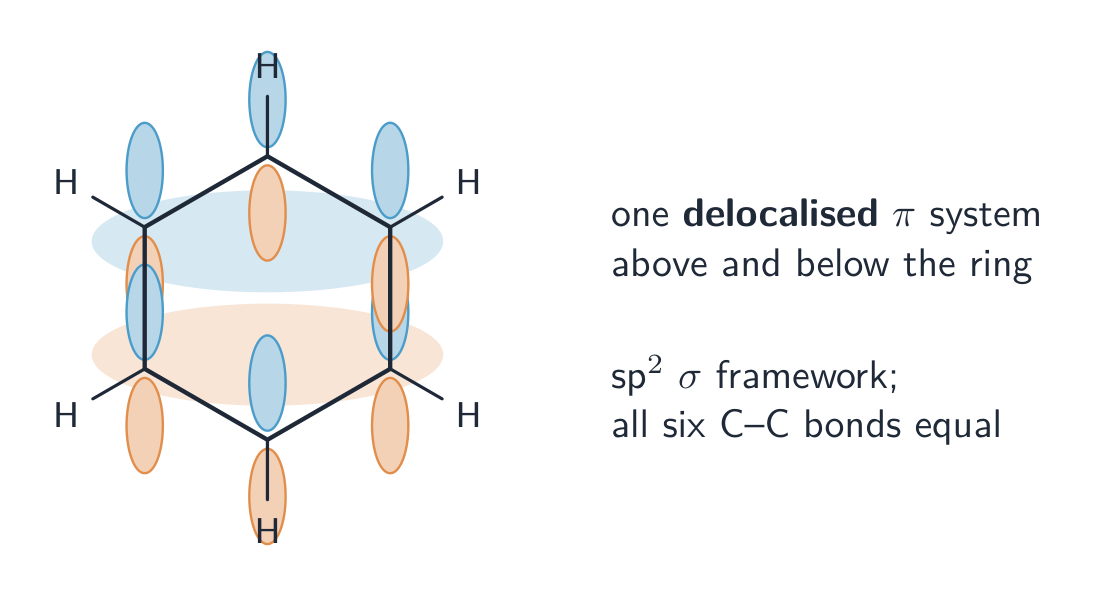
Benceno: esqueleto sigma más un sistema pi deslocalizado
Electrophilic substitution on benzene · Sustitución electrofílica en benceno
Step through how benzene reacts. An electrophile swaps for a hydrogen — keeping the stable ring — instead of adding across it. · Paso a paso de cómo reacciona el benceno. Un electrófilo sustituye a un hidrógeno — manteniendo el anillo estable — en lugar de añadirse sobre él.
In an addition–elimination reaction: · En una reacción de adición–eliminación:
Addition–elimination (e.g. with 2,4-DNPH or acyl chlorides) adds then eliminates a small molecule. · Adición–eliminación (p.ej. con 2,4-DNPH o cloruros de acilo) añade y luego elimina una pequeña molécula.
Match each term to its meaning. · Relaciona cada término con su significado.
Each item links the term to its correct meaning. · Cada elemento vincula el término con su significado correcto.
Addition–elimination
- A molecule first adds on, then a small molecule is removed.
- Seen with 2,4-DNPH (with carbonyls) and with acyl chlorides (which lose HCl).
Two aromatic mechanisms: electrophilic substitution and addition-elimination
Adición–eliminación
- Una molécula primero se une, luego se elimina una molécula pequeña.
- Se observa con 2,4-DNPH (con carbonilos) y con cloruros de acilo (que pierden HCl).

Dos mecanismos aromáticos: sustitución electrofílica y adición-eliminación
Worked example: nitration 硝化
Nitrating benzene (concentrated HNO₃ + H₂SO₄, 50 °C) — an electrophilic substitution:
- The acids react to make the electrophile, NO₂⁺.
- NO₂⁺ takes two electrons from the ring → an unstable intermediate.
- The intermediate loses H⁺, restoring the stable ring.
- Product: nitrobenzene 硝基苯 — one H has been swapped for NO₂, ring intact.
- The same pattern (make electrophile → attack ring → lose H⁺) covers halogenation and Friedel–Crafts.
Ejemplo resuelto: Nitración
Nitración del benceno (HNO₃ concentrado + H₂SO₄, 50 °C) — una sustitución electrofílica:
- Los ácidos reaccionan para formar el electrófilo, NO₂⁺.
- NO₂⁺ toma dos electrones del anillo → un intermediario inestable.
- El intermediario pierde H⁺, restaurando el anillo estable.
- Producto: nitrobenceno — un H ha sido intercambiado por NO₂, anillo intacto.
- El mismo patrón (formar electrófilo → atacar el anillo → perder H⁺) cubre la halogenación y la reacción de Friedel-Crafts.
You've got it
- electrophilic substitution: an electrophile replaces an H on the benzene ring (how benzene reacts)
- it keeps the stable delocalised ring — benzene substitutes rather than adds
- worked: nitration → NO₂⁺ attacks, loses H⁺, gives nitrobenzene
- addition–elimination: a molecule adds on, then a small molecule is removed (2,4-DNPH, acyl chlorides)
Lo has entendido
- sustitución electrofílica: un electrófilo reemplaza un H en el anillo de benceno (cómo reacciona el benceno)
- mantiene el anillo estable deslocalizado — el benceno sustituye en lugar de añadir
- ejemplo resuelto: nitración → NO₂⁺ ataca, pierde H⁺, produce nitrobenceno
- adición–eliminación: una molécula se une, luego se elimina una molécula pequeña (2,4-DNPH, cloruros de acilo)