Reactions of the halide ions · Reacciones de los iones haluro
| English | Español |
|---|---|
| halide/ˈhælaɪd/ | haluro |
| reducing agent/rɪˈdjuːsɪŋ ˈeɪdʒənt/ | agente reductor |
| precipitate/prɪˈsɪpɪteɪt/ | precipitado |
| silver nitrate/ˈsɪlvə ˈnaɪtreɪt/ | nitrato de plata |
Spotting a halide 卤离子
- A halide ion can give away an electron — so it is a reducing agent 还原剂.
- This power increases down the group.
- Two key tests identify which halide is present.
Identificación de un haluro 卤离子
- Un ion haluro puede ceder un electrón, por lo que actúa como un agente reductor 还原剂.
- Este poder aumenta al descender en el grupo.
- Dos pruebas clave identifican qué haluro está presente.
Halide ion test lab · Laboratorio de prueba de ion haluro
Match halide ion evidence to the ion present. · Relacionar la evidencia del ion haluro con el ion presente.
The reducing power of the halide ions increases down the group because: · El poder reductor de los iones haluro aumenta hacia abajo en el grupo porque:
Reducing means losing an electron; bigger ions lose theirs more easily, so reducing power rises down the group. · Reducir significa perder un electrón; los iones más grandes pierden el suyo con mayor facilidad, por lo que el poder reductor aumenta hacia abajo en el grupo.
Silver nitrate solution is used to test for ______ ions. · La solución de nitrato de plata se utiliza para detectar iones ______.
Different halides give different coloured precipitates. · Diferentes haluros producen precipitados de diferentes colores.
Reducing power
- A halide ion ($\text{Cl}^{-}$, $\text{Br}^{-}$, $\text{I}^{-}$) acts as a reducing agent (it loses an electron).
- This power increases down the group, because a larger ion holds its outer electron less tightly.
Silver halide precipitate 沉淀 colours and their solubility in ammonia identify the halide
Poder reductor
- Un ion haluro ($\text{Cl}^{-}$, $\text{Br}^{-}$, $\text{I}^{-}$) actúa como un agente reductor (pierde un electrón).
- Este poder aumenta hacia abajo en el grupo, porque un ion más grande mantiene su electrón externo menos firmemente.
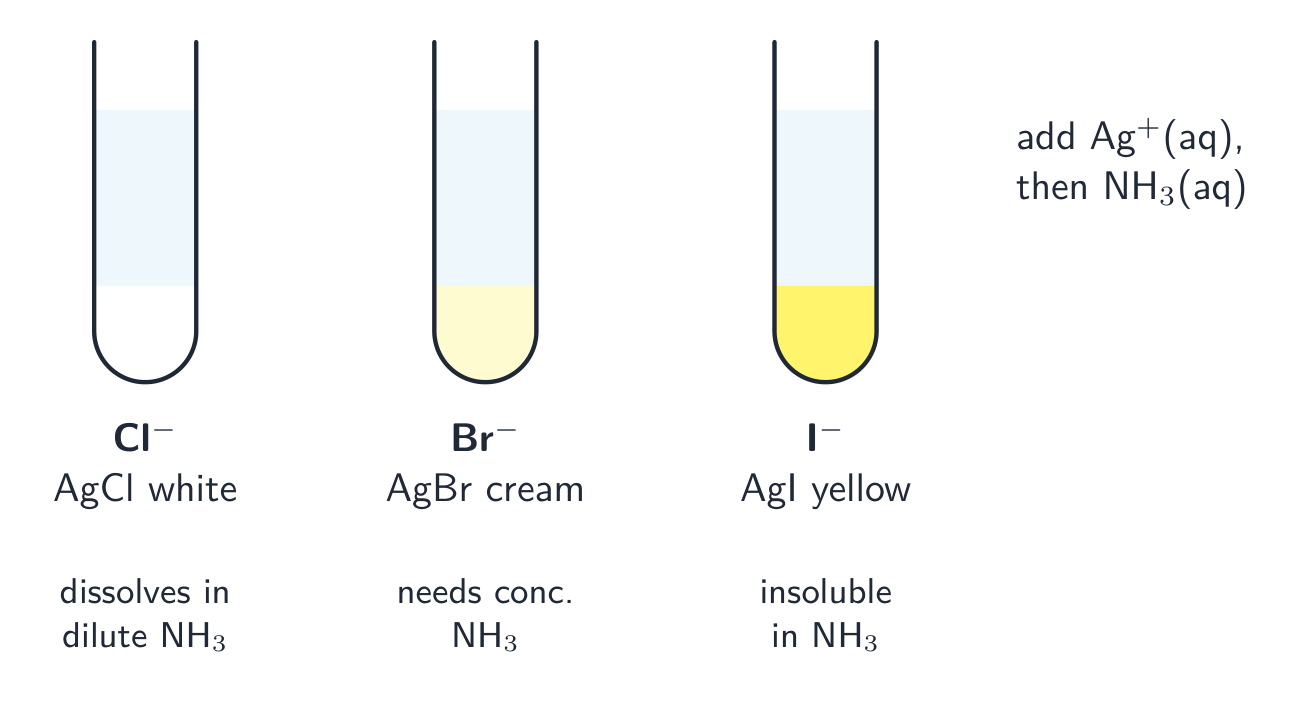
Los precipitados de haluros de plata 沉淀 y su solubilidad en amoníaco identifican al haluro
Match each halide to its silver halide precipitate colour. · Asocia cada haluro con el color de su precipitado de haluro de plata.
AgCl is white, AgBr cream, AgI yellow; ammonia solubility confirms (Cl dissolves in dilute, I insoluble). · AgCl es blanco, AgBr color crema, AgI amarillo; la solubilidad en amoníaco confirma (Cl se disuelve en diluido, I insoluble).
Silver iodide (AgI) is: · El yoduro de plata (AgI) es:
AgI is yellow and does not dissolve in ammonia, distinguishing it from AgCl (white) and AgBr (cream). · AgI es amarillo y no se disuelve en amoníaco, diferenciándolo de AgCl (blanco) y AgBr (color crema).
Silver nitrate 硝酸银 test
Add silver nitrate, then ammonia, and read the precipitate:
| Halide | Precipitate | In ammonia |
|---|---|---|
| $\text{Cl}^{-}$ | white | dissolves in dilute ammonia |
| $\text{Br}^{-}$ | cream | dissolves in concentrated ammonia |
| $\text{I}^{-}$ | yellow | insoluble |
Prueba de nitrato de plata 硝酸银
Añada nitrato de plata, luego amoníaco, y lea el precipitado:
| Haluro | Precipitado | En amoníaco |
|---|---|---|
| $\text{Cl}^{-}$ | blanco | se disuelve en amoníaco diluido |
| $\text{Br}^{-}$ | crema | se disuelve en amoníaco concentrado |
| $\text{I}^{-}$ | amarillo | insoluble |
With concentrated sulfuric acid, iodide gives I₂ plus H₂S because: · Con ácido sulfúrico concentrado, el yoduro produce I₂ más H₂S porque:
I⁻ is the strongest reducer, so it reduces the sulfuric acid all the way to H₂S (and forms I₂); Cl⁻ only gives HCl. · I⁻ es el reductor más fuerte, por lo que reduce el ácido sulfúrico completamente a H₂S (y forma I₂); Cl⁻ solo produce HCl.
With concentrated sulfuric acid
- All give the hydrogen halide first; the lower halides are then oxidised (they are stronger reducing agents):
- chloride: only $\text{HCl}$ (no redox).
- bromide: also brown $\text{Br}_2$ and $\text{SO}_2$.
- iodide: $\text{I}_2$ plus smelly $\text{H}_2\text{S}$ and $\text{SO}_2$ ($\text{I}^{-}$ is the strongest reducing agent).
Con ácido sulfúrico concentrado
- Todos producen primero el hidrógeno haluro; los haluros inferiores son entonces oxidados (son agentes reductores más fuertes):
- cloruro: solo $\text{HCl}$ (sin redox).
- bromuro: también marrón $\text{Br}_2$ y $\text{SO}_2$.
- yoduro: $\text{I}_2$ más oloroso $\text{H}_2\text{S}$ y $\text{SO}_2$ ($\text{I}^{-}$ es el agente reductor más fuerte).
You've got it
- halide ions are reducing agents; power increases down the group (larger ion, electron held loosely)
- silver nitrate test: AgCl white, AgBr cream, AgI yellow (confirm with ammonia solubility)
- conc. H₂SO₄: Cl⁻ → HCl only; Br⁻ → Br₂ + SO₂; I⁻ → I₂ + H₂S + SO₂ (strongest reducer)
Lo has entendido
- Los iones haluro son agentes reductores; el poder aumenta hacia abajo en el grupo (ion más grande, electrón retenido débilmente)
- prueba de nitrato de plata: AgCl blanco, AgBr crema, AgI amarillo (confirmar con la solubilidad en amoníaco)
- H₂SO₄ conc.: Cl⁻ → solo HCl; Br⁻ → Br₂ + SO₂; I⁻ → I₂ + H₂S + SO₂ (reductor más fuerte)