Investigation of limiting factors · Investigación de factores limitantes
| English | Español |
|---|---|
| limiting factor/ˈlɪmɪtɪŋ ˈfæktə/ | factor limitante |
| light intensity/laɪt ɪnˈtensɪti/ | intensidad de luz |
| denature/ˈdenətʃə/ | desnaturalizar |
| greenhouse/ˈɡriːnhaʊs/ | invernadero |
What holds photosynthesis back?
- The rate of photosynthesis depends on conditions.
- A limiting factor 限制因素 is the one in shortest supply that holds the rate back.
- The three main ones: light intensity 光照强度, CO₂ concentration, and temperature.
¿Qué limita la fotosíntesis?
- La velocidad de la fotosíntesis depende de las condiciones.
- Un factor limitante es aquel que se encuentra en menor cantidad y determina el ritmo máximo.
- Los tres principales son: intensidad luminosa, concentración de CO₂ y temperatura.
A limiting factor is: · Un factor limitante es:
The limiting factor is whichever requirement is in shortest supply, capping the overall rate. · El factor limitante es el requisito que se encuentra en menor cantidad, estableciendo un tope a la tasa general.
Adding carbon dioxide can raise the rate of photosynthesis when CO₂ is the limiting factor. · Añadir dióxido de carbono puede aumentar la tasa de fotosíntesis cuando el CO₂ es el factor limitante.
Only the factor in shortest supply limits the rate, so increasing it speeds things up. · Solo el factor en menor cantidad limita la tasa, por lo que aumentarlo acelera el proceso.
Reading the graph
- Raising light speeds photosynthesis — until another factor becomes limiting.
- Raising CO₂ speeds it — until another factor becomes limiting.
- Raising temperature speeds it — but only to an optimum; too hot and the enzymes denature 变性.
- While the line rises, light is limiting. Where it levels off, something else (CO₂ or temperature) is.
Interpretación de la gráfica
- Aumentar la luz acelera la fotosíntesis — hasta que otro factor se vuelve limitante.
- Aumentar el CO₂ acelera el proceso — hasta que otro factor se vuelve limitante.
- Aumentar la temperatura lo acelera — pero solo hasta un punto óptimo; si hace demasiado calor, las enzimas se desnaturalizan.
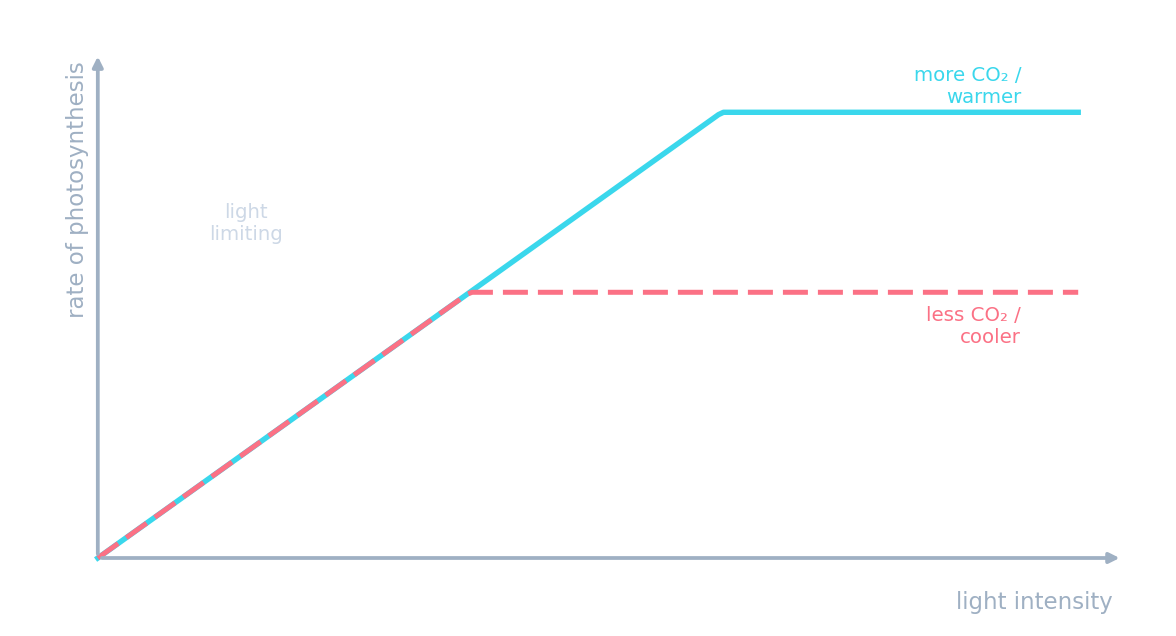
- Mientras la línea asciende, la luz es el factor limitante. Donde se estabiliza, otro factor (CO₂ o temperatura) es el limitante.
Limiting factors · Factores limitantes
rate rises, then plateaus · la tasa aumenta y luego se estabiliza
Drag the sliders. More light speeds photosynthesis — until CO₂ or temperature caps it (the plateau). · Arrastra los deslizadores. Más luz acelera la fotosíntesis — hasta que CO₂ o temperatura lo limitan (el plateau).
On a graph of rate against light intensity, where the line levels off: · En una gráfica de tasa frente a intensidad luminosa, donde la línea se nivela:
While the rate rises, light limits it; once it plateaus, light is plentiful and something else limits the rate. · Mientras la tasa aumenta, la luz la limita; una vez que se estabiliza, la luz es abundante y otro factor limita la tasa.
Why does raising temperature only speed photosynthesis up to a point? · ¿Por qué elevar la temperatura solo acelera la fotosíntesis hasta cierto punto?
Higher temperature speeds the enzyme reactions until the optimum; beyond it, the enzymes denature and the rate falls. · Una mayor temperatura acelera las reacciones enzimáticas hasta el óptimo; más allá de este punto, las enzimas se desnaturalizan y la tasa disminuye.
Match each factor to its role in photosynthesis. · Relaciona cada factor con su papel en la fotosíntesis.
Light powers the light reactions, CO₂ feeds the Calvin cycle, temperature controls the enzymes — the scarcest one caps the rate. · La luz impulsa las reacciones luminosas, el CO₂ alimenta el ciclo de Calvin, la temperatura controla las enzimas — el más escaso establece el tope a la tasa.
Measuring the rate
- Use a redox indicator (DCPIP / methylene blue) with a suspension of chloroplasts: the dye loses colour as they work — test different light intensities or wavelengths.
- With a whole aquatic plant, count the oxygen bubbles given off to compare conditions.
Medición de la velocidad
- Utilice un indicador redox (DCPIP / azul de metileno) con una suspensión de cloroplastos: el colorante pierde su colorización a medida que los cloroplastos actúan; esto permite probar diferentes intensidades de luz o longitudes de onda.
- Con una planta acuática entera, cuente las burbujas de oxígeno liberadas para comparar distintas condiciones.
One simple way to measure the rate of photosynthesis is to count the ______ bubbles given off by an aquatic plant. · Una forma sencilla de medir la tasa de fotosíntesis es contar las ______ expulsadas por una planta acuática.
Oxygen is a product of photosynthesis; counting (or collecting) the bubbles tracks the rate. · El oxígeno es un producto de la fotosíntesis; contar (o recolectar) las burbujas sigue la tasa.
Using limiting factors commercially
- Growers raise yields by removing the limiting factor in greenhouses 温室: adding light, warmth and extra CO₂.
Worked example. On a bright warm day, CO₂ is often limiting. A grower pipes extra CO₂ into the greenhouse, and the rate of photosynthesis — and the crop yield — rises.
Aplicación comercial de los factores limitantes
- Los productores aumentan los rendimientos eliminando el factor limitante en invernaderos: aportando luz, calor y CO₂ adicional.
Ejemplo resuelto. En un día cálido y soleado, el CO₂ suele ser limitante. Un productor introduce CO₂ extra en el invernadero, lo que incrementa tanto la velocidad de la fotosíntesis como el rendimiento del cultivo.
You've got it
- a limiting factor = the factor in shortest supply that caps the rate
- three factors: light intensity, CO₂ concentration, temperature
- on a rate-vs-light graph: rising = light limiting; plateau = another factor; too hot → enzymes denature
- measure with DCPIP/methylene blue + chloroplasts, or count O₂ bubbles from an aquatic plant
Has entendido el tema
- un factor limitante = el factor más escaso que fija el límite de la velocidad
- tres factores: intensidad luminosa, concentración de CO₂, temperatura
- en una gráfica de velocidad vs. luz: ascenso = luz limitante; meseta = otro factor; exceso de calor → enzimas desnaturalizadas
- medir con DCPIP/azul de metileno + cloroplastos, o contar burbujas de O₂ procedentes de plantas acuáticas