Respiratory substrates and RQ · Sustratos respiratorios y RQ
| English | Español |
|---|---|
| respiratory substrate/rɪˈspɪrətəri ˈsʌbstreɪt/ | sustrato respiratorio |
| aerobic respiration/eəˈrəʊbɪk ˌrespɪˈreɪʃn/ | respiración aeróbica |
| respiratory quotient/rɪˈspɪrətəri ˈkwəʊʃənt/ | cociente respiratorio |
| respirometer/rɪspɪˈrɒmɪtə/ | respirómetro |
Burning more than just sugar
- A respiratory substrate 呼吸底物 is a molecule broken down to release energy.
- Different substrates release different amounts of energy.
- The gases they use tell us which one is being respired.
Quemando más que solo azúcar
- Un sustrato respiratorio 呼吸底物 es una molécula que se descompone para liberar energía.
- Diferentes sustratos liberan diferentes cantidades de energía.
- Los gases que utilizan nos indican cuál está siendo respirado.
Respiratory quotient lab · Laboratorio de cociente respiratorio
RQ = CO2 produced / O2 used · RQ = CO₂ producido / O₂ usado
Change oxygen use and see how RQ compares fuels. · Cambiar el uso de oxígeno y ver cómo RQ compara los combustibles.
The respiratory quotient (RQ) is the ratio of CO₂ produced to: · El cociente respiratorio (RQ) es la relación entre el CO₂ producido y:
RQ = CO₂ produced ÷ O₂ used. · RQ = CO₂ producido ÷ O₂ usado.
Which respiratory substrate releases the most energy per gram? · ¿Qué sustrato respiratorio libera más energía por gramo?
Lipids release the most energy per gram (most hydrogen); then proteins, then carbohydrates. · Los lípidos liberan más energía por gramo (más hidrógeno); luego las proteínas, y después los carbohidratos.
Energy per gram
- Per gram, lipids release the most energy (they have the most hydrogen).
- Proteins are next.
- Carbohydrates release the least.
The four stages of aerobic respiration 有氧呼吸 and where they happen
Energía por gramo
- Por gramo, los lípidos liberan la mayor cantidad de energía (tienen más hidrógeno).
- Los proteínas están a continuación.
- Los carbohidratos liberan la menor cantidad.
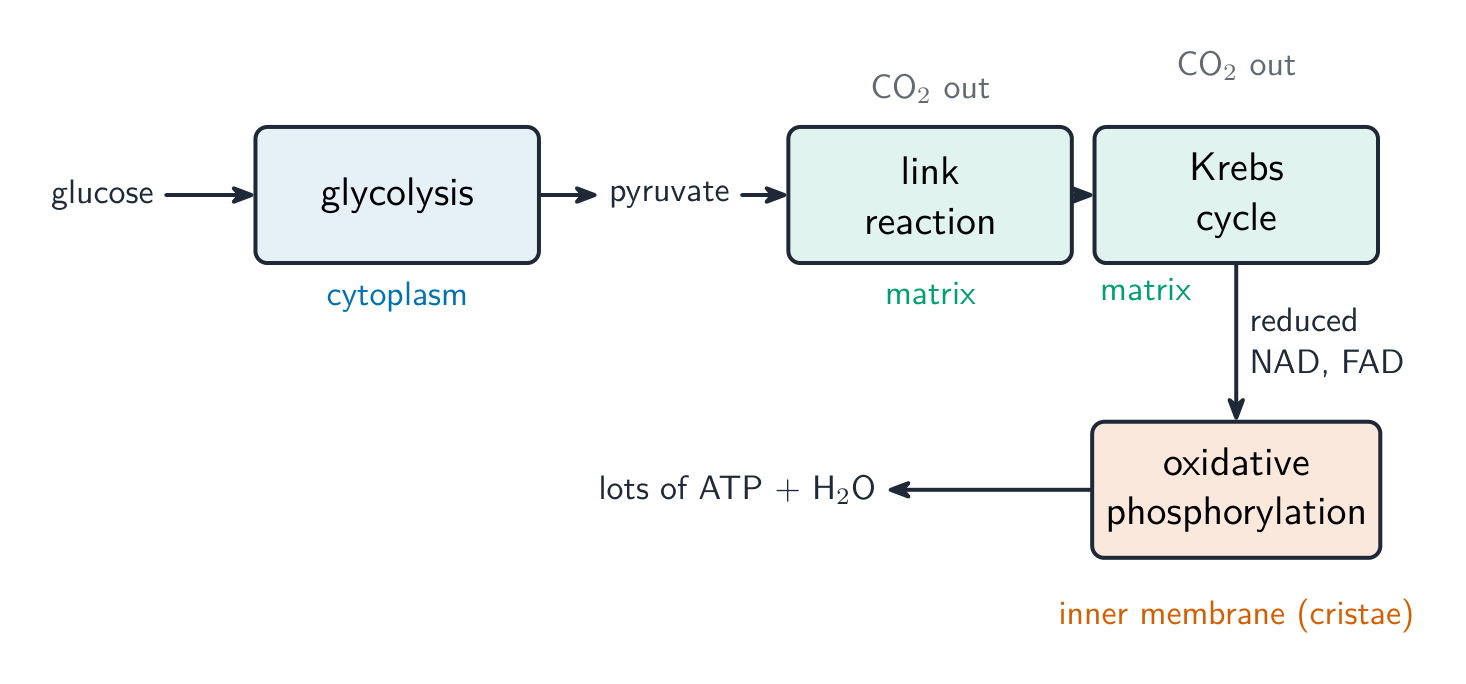
Las cuatro etapas de la respiración aeróbica 有氧呼吸 y dónde ocurren
The respiratory quotient 呼吸商 (RQ)
- Typical values: carbohydrate ≈ 1.0, lipid ≈ 0.7, protein ≈ 0.9.
- You can work out RQ from a respiration equation.
El cociente respiratorio 呼吸商 (CR)
- Valores típicos: carbohidrato ≈ 1.0, lipidio ≈ 0.7, proteína ≈ 0.9.
- Puedes calcular el CR a partir de una ecuación de respiración.
An organism produces 4 molecules of CO₂ and takes in 5 molecules of O₂. What is its RQ? · Un organismo produce 4 moléculas de CO₂ y absorbe 5 moléculas de O₂. ¿Cuál es su RQ?
RQ = CO₂ produced ÷ O₂ taken in = 4 ÷ 5 = 0.8. · RQ = CO₂ producido ÷ O₂ absorbido = 4 ÷ 5 = 0.8.
An organism makes 7 molecules of CO₂ and uses 10 molecules of O₂. What is its RQ? · Un organismo produce 7 moléculas de CO₂ y usa 10 moléculas de O₂. ¿Cuál es su RQ?
RQ = 7 ÷ 10 = 0.7 — a value near 0.7 suggests it is respiring lipid. · RQ = 7 ÷ 10 = 0.7 — un valor cercano a 0.7 sugiere que está respirando lípidos.
Match each substrate to its typical RQ. · Empareja cada sustrato con su RQ típico.
Carbohydrate gives RQ ≈ 1.0, protein ≈ 0.9, lipid ≈ 0.7 — and lipid also releases the most energy per gram. · El carbohidrato da RQ ≈ 1.0, la proteína ≈ 0.9, el lipidio ≈ 0.7 — y el lipidio también libera más energía por gramo.
RQ = carbon dioxide produced ÷ oxygen ______. · RQ = dióxido de carbono producido ÷ oxígeno ______.
You measure CO₂ given out and O₂ taken in (e.g. with a respirometer) and divide. · Mides el CO₂ liberado y el O₂ absorbido (p. ej., con un respirómetro) y divides.
The respirometer 呼吸计
- A respirometer measures the oxygen taken in by living things — e.g. germinating seeds or small invertebrates.
- From the gases exchanged, you can find their RQ, or test how temperature changes the rate of oxygen uptake.
A respirometer measures the oxygen taken in by small organisms; the coloured liquid moves as oxygen is used
El respirómetro 呼吸计
- Un respirómetro mide el oxígeno absorbido por organismos vivos —por ejemplo, semillas germinadas o pequeños invertebrados—.
- A partir de los gases intercambiados, puedes determinar su CR o probar cómo los cambios de temperatura afectan la tasa de absorción de oxígeno.
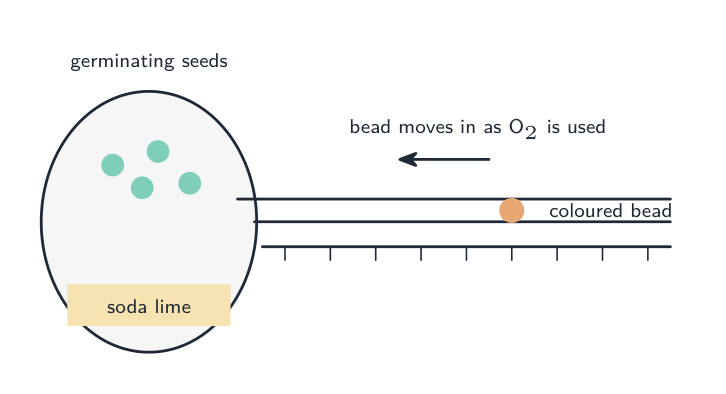
Un respirómetro mide el oxígeno absorbido por organismos pequeños; el líquido coloreado se mueve a medida que se consume el oxígeno
A respirometer is used to measure: · Un respirómetro se usa para medir:
A respirometer measures oxygen uptake (e.g. of germinating seeds or invertebrates), used to find RQ. · Un respirómetro mide la captación de oxígeno (p. ej., de semillas germinadas o invertebrados), usado para hallar RQ.
You've got it
- respiratory substrate = molecule broken down for energy; per gram lipid > protein > carbohydrate
- $\text{RQ} = \dfrac{\text{CO}_2 \text{ produced}}{\text{O}_2 \text{ used}}$
- RQ values: carbohydrate ≈ 1.0, lipid ≈ 0.7, protein ≈ 0.9
- a respirometer measures oxygen uptake (germinating seeds / invertebrates) to find RQ
Ya lo tienes
- sustrato respiratorio = molécula descompuesta para obtener energía; por gramo lipidio > proteína > carbohidrato
- $\text{RQ} = \dfrac{\text{CO}_2 \text{ produced}}{\text{O}_2 \text{ used}}$
- Valores de CR: carbohidrato ≈ 1.0, lipidio ≈ 0.7, proteína ≈ 0.9
- un respirómetro mide la absorción de oxígeno (semillas germinadas / invertebrados) para hallar el CR