Transport of oxygen · Transporte de oxígeno
| English | Español |
|---|---|
| haemoglobin/ˌhiːməˈɡləʊbɪn/ | hemoglobina |
| oxygen dissociation curve/ˈɒksɪdʒn dɪˌsəʊsɪˈeɪʃn kɜːv/ | curva de disociación de la oxihemoglobina |
| saturation/ˌsætʃəˈreɪʃn/ | saturación |
| partial pressure/ˈpɑːʃl ˈpreʃə/ | presión parcial |
| Bohr shift/ˈbəʊə ʃɪft/ | efecto Bohr |
| fetal haemoglobin/ˈfiːtl ˌhiːməˈɡləʊbɪn/ | hemoglobina fetal |
| affinity/əˈfɪnɪti/ | afinidad |
Carrying oxygen
- Oxygen is carried by haemoglobin 血红蛋白 in red blood cells.
- How tightly haemoglobin holds oxygen depends on how much oxygen is around.
- The oxygen dissociation curve 氧解离曲线 captures this in one S-shaped graph.
Transporte de oxígeno
- El oxígeno es transportado por la hemoglobina 血红蛋白 en los glóbulos rojos.
- La fuerza con que la hemoglobina retiene el oxígeno depende de la cantidad de oxígeno presente.
- La curva de disociación del oxígeno 氧解离曲线 captura esto en una sola gráfica con forma de S.
Loading and unloading
- The curve plots % saturation 饱和度 (how full of oxygen) against the partial pressure 分压 of oxygen.
- Where oxygen is high (the lungs), haemoglobin loads up and becomes almost fully saturated.
- Where oxygen is low (respiring tissues), haemoglobin unloads its oxygen for the cells.
Carga y descarga
- La curva representa la saturación % 饱和度 (qué tan llena está de oxígeno) frente a la presión parcial 分压 de oxígeno.
- Donde el oxígeno es alto (los pulmones), la hemoglobina se carga y se vuelve casi totalmente saturada.
- Donde el oxígeno es bajo (los tejidos respiradores), la hemoglobina libera su oxígeno para las células.
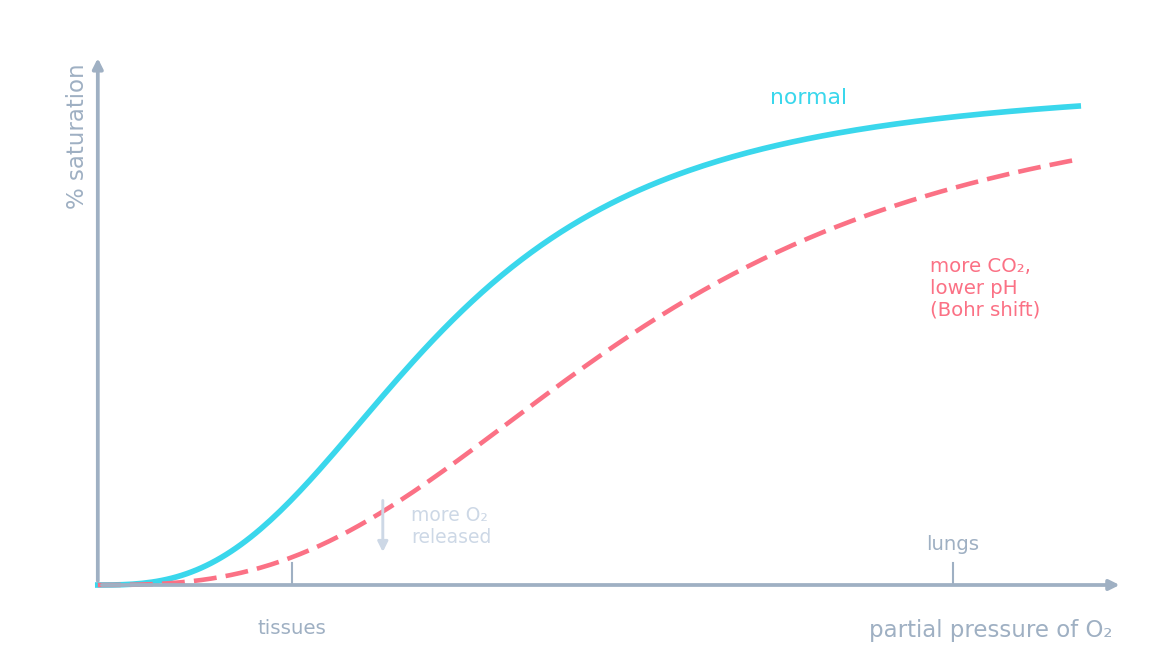
How blood carries oxygen · Cómo la sangre transporta el oxígeno
Haemoglobin picks up oxygen where there is lots of it (the lungs) and releases it where there is little (the tissues). · La hemoglobina capta oxígeno donde hay mucho (los pulmones) y lo libera donde hay poco (los tejidos).
Where the partial pressure of oxygen is high (the lungs), haemoglobin: · Donde la presión parcial de oxígeno es alta (los pulmones), la hemoglobina:
At high oxygen partial pressure (lungs), haemoglobin loads up and becomes nearly fully saturated. · A alta presión parcial de oxígeno (pulmones), la hemoglobina se carga y se satura casi completamente.
In respiring tissues, where oxygen is low, haemoglobin: · En los tejidos respiratorios, donde el oxígeno es bajo, la hemoglobina:
At low oxygen partial pressure (tissues), haemoglobin releases oxygen to the cells. · A baja presión parcial de oxígeno (tejidos), la hemoglobina libera oxígeno a las células.
The oxygen dissociation curve is S-shaped (sigmoid). · La curva de disociación del oxígeno tiene forma de S (sigmoidea).
It is S-shaped: binding one oxygen makes the next bind more easily, giving the characteristic sigmoid curve. · Tiene forma de S: la unión de una molécula de oxígeno facilita la unión de la siguiente, dando lugar a la característica curva sigmoidea.
The Bohr shift 波尔位移
- Active tissues release more carbon dioxide, which lowers the pH.
- This makes haemoglobin release oxygen more easily — the curve shifts to the right.
- So oxygen is given up exactly where it is needed most. This is the Bohr shift — the right-shifted curve above.
Desplazamiento de Bohr 波尔位移
- Los tejidos activos liberan más dióxido de carbono, lo que disminuye el pH.
- Esto hace que la hemoglobina libere oxígeno más fácilmente — la curva se desplaza hacia la derecha.
- Así, el oxígeno se entrega exactamente donde más se necesita. Este es el desplazamiento de Bohr — la curva desplazada a la derecha arriba.
Match each situation to what haemoglobin does. · Relacione cada situación con lo que hace la hemoglobina.
Hb loads in the lungs, unloads in tissues; high CO₂ shifts the curve right; fetal Hb grabs oxygen from the mother. · La Hb se carga en los pulmones, descarga en los tejidos; la alta CO₂ desplaza la curva a la derecha; la Hb fetal capta oxígeno de la madre.
The Bohr shift describes how: · El desplazamiento de Bohr describe cómo:
More CO₂ lowers pH, shifting the curve right so haemoglobin releases more oxygen where tissues need it. · Más CO₂ disminuye el pH, desplazando la curva a la derecha para que la hemoglobina libere más oxígeno donde los tejidos lo necesitan.
The rightward shift of the curve when CO₂ rises, releasing more oxygen to active tissues, is the ______ shift. · El desplazamiento hacia la derecha de la curva cuando aumenta la CO₂, liberando más oxígeno a los tejidos activos, es el desplazamiento ______.
The Bohr shift means active tissues (high CO₂, low pH) get more oxygen unloaded to them. · El desplazamiento de Bohr significa que los tejidos activos (alta CO₂, bajo pH) reciben más oxígeno descargado.
Fetal haemoglobin 胎儿血红蛋白
- A fetus must take oxygen from its mother's blood, so its fetal haemoglobin has a higher affinity 亲和力 for oxygen.
- Its dissociation curve lies to the left of the adult curve — it loads oxygen where adult haemoglobin would unload it.
Hemoglobina fetal 胎儿血红蛋白
- Un feto debe tomar oxígeno de la sangre de su madre, por lo que su hemoglobina fetal tiene una mayor afinidad 亲和力 por el oxígeno.
- Su curva de disociación se sitúa a la izquierda de la curva adulta — carga oxígeno allí donde la hemoglobina adulta lo liberaría.
You've got it
- haemoglobin carries oxygen; the dissociation curve is S-shaped
- high oxygen (lungs) → loads / saturated; low oxygen (tissues) → unloads
- Bohr shift: more CO₂ → lower pH → curve moves right → more oxygen released
- the Bohr shift delivers oxygen where active tissues need it most
Lo has entendido
- La hemoglobina transporta oxígeno; la curva de disociación es en forma de S
- oxígeno alto (pulmones) → carga / saturada; oxígeno bajo (tejidos) → libera
- Desplazamiento de Bohr: más CO₂ → menor pH → la curva se mueve a la derecha → se libera más oxígeno
- el desplazamiento de Bohr entrega oxígeno donde los tejidos activos más lo necesitan