Water potential and living cells · Potencial del agua y células vivas
| English | Español |
|---|---|
| water potential/ˈwɔːtə pəˈtenʃl/ | potencial hídrico |
| solute/ˈsɒljuːt/ | soluto |
| turgid/ˈtɜːdʒɪd/ | túrgida |
| plasmolysis/plæzˈmɒləsɪs/ | plasmólisis |
| haemolysis/hiːˈmɒləsɪs/ | hemólisis |
Which way will water move?
- Water potential 水势 measures how likely water is to leave a solution.
- It decides which way water moves by osmosis.
- It explains why a wilted plant perks up in water — and why a cell can burst.
¿Hacia dónde se moverá el agua?
- Potencial hídrico 水势 mide qué tan probable es que el agua salga de una solución.
- Determina la dirección del movimiento del agua por ósmosis.
- Explica por qué una planta marchita revive al sumergirla en agua —y por qué una célula puede reventar.
What changes water potential
- Pure water has the highest water potential.
- Adding a solute 溶质 (a dissolved substance) lowers it.
- Water always moves by osmosis from higher to lower water potential.
- To estimate the water potential of plant tissue: soak pieces in sucrose solutions; the one causing no change in mass/length matches the tissue.
How plant and animal cells respond to solutions of different water potential
Factores que alteran el potencial hídrico
- El agua pura tiene el mayor potencial hídrico.
- La adición de un soluto 溶质 (una sustancia disuelta) lo disminuye.
- El agua siempre se mueve por ósmosis desde un potencial hídrico mayor hacia uno menor.
- Para estimar el potencial hídrico de tejidos vegetales: sumerger trozos en soluciones de sacarosa; aquella que provoque ningún cambio en masa/longitud corresponde al tejido.
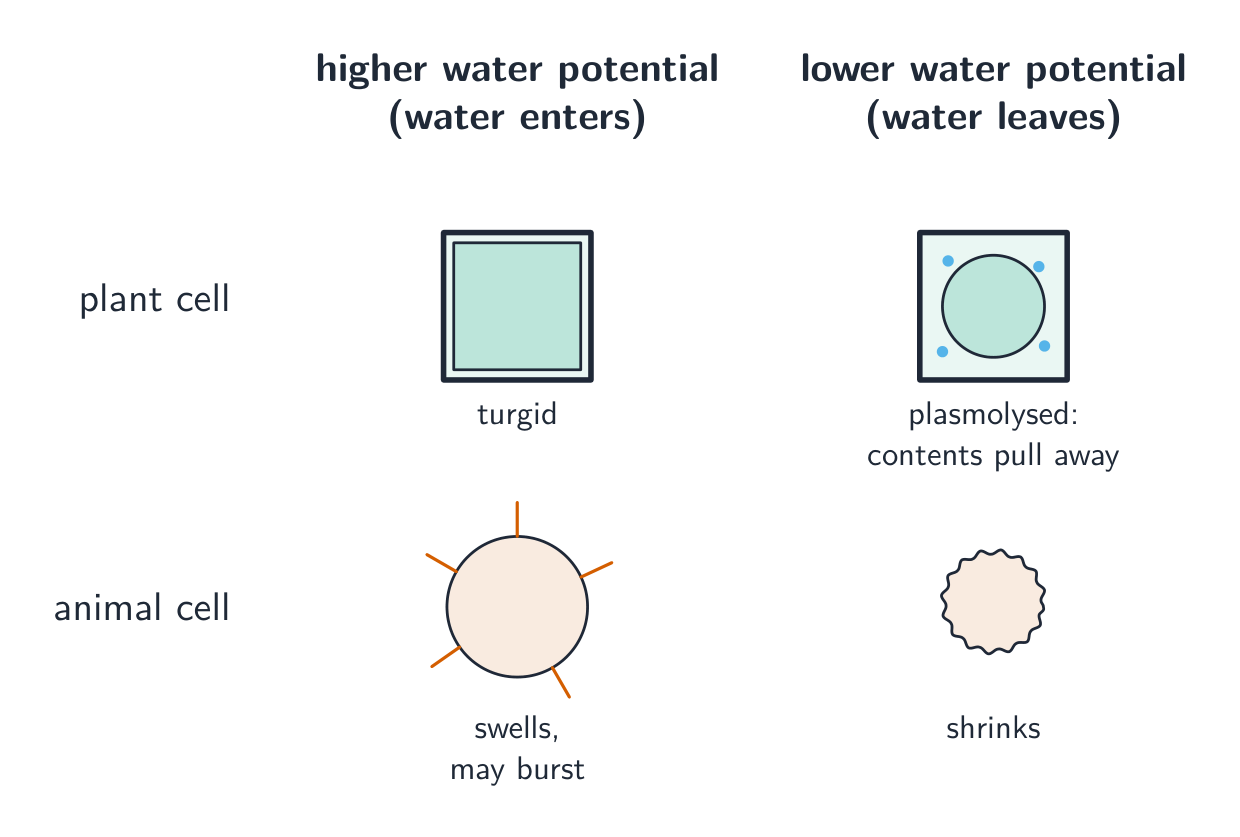
Respuesta de células vegetales y animales a soluciones con diferente potencial hídrico
Water potential · Potencial del agua
water follows the gradient · el agua sigue el gradiente
Drag the concentrations. A water-potential gradient drives net movement — it stops only when the two sides match. · Arrastra las concentraciones. Un gradiente de potencial del agua impulsa un movimiento neto — solo se detiene cuando ambos lados coinciden.
Adding a solute to pure water: · Añadir un soluto al agua pura:
Pure water has the highest water potential; dissolving a solute lowers it. · El agua pura tiene el mayor potencial del agua; disolver un soluto lo disminuye.
Pure water has the highest possible water potential, which is defined as zero. · El agua pura tiene el potencial del agua más alto posible, que se define como cero.
Pure water is defined as having a water potential of 0 kPa; adding solute makes it negative (lower). · El agua pura se define con un potencial del agua de 0 kPa; añadir soluto lo hace negativo (más bajo).
When estimating the water potential of plant tissue, the matching solution causes ______ change in mass or length. · Al estimar el potencial del agua de un tejido vegetal, la solución correspondiente causa ______ cambio en la masa o longitud.
No net osmosis (no mass/length change) means the solution and tissue have the same water potential. · Ninguna ósmosis neta (sin cambio de masa/longitud) significa que la solución y el tejido tienen el mismo potencial del agua.
Plant cells
- In a higher water potential (e.g. distilled water): water enters, the cell swells and becomes turgid 膨胀 — the strong cell wall stops it bursting.
- In a lower water potential: water leaves, the contents shrink and the membrane pulls away from the wall — plasmolysis 质壁分离.
A potato osmometer: sugar solution rises up the tube as water enters by osmosis.
Células vegetales
- En un potencial hídrico mayor (ej. agua destilada): el agua entra, la célula se hincha y se vuelve turgente 膨胀 —la fuerte pared celular evita que reviente.
- En un potencial hídrico menor: el agua sale, el contenido se contrae y la membrana se separa de la pared — plasmólisis 质壁分离.
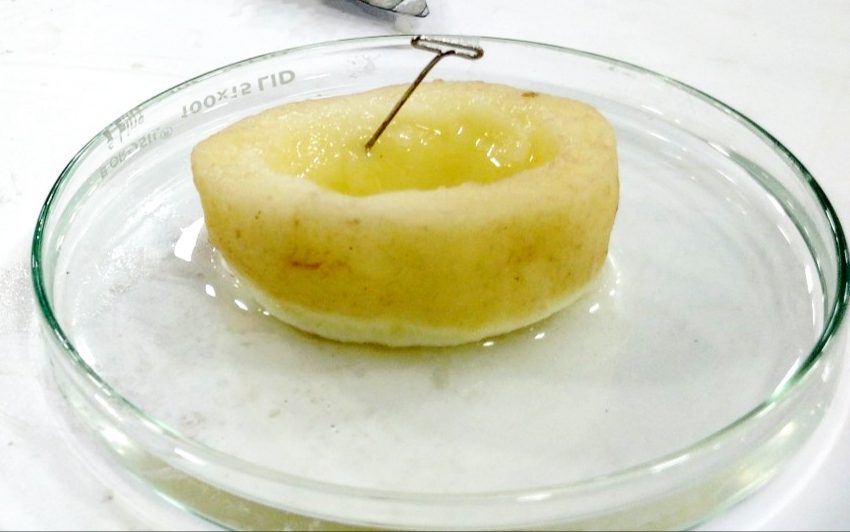
Osmómetro de patata: la solución azucarada asciende por el tubo a medida que entra agua por ósmosis.
A plant cell placed in distilled water becomes turgid rather than bursting because: · Una célula vegetal colocada en agua destilada se vuelve turgente en lugar de reventar porque:
Water enters (higher water potential outside), but the rigid cell wall stops the cell bursting — it becomes turgid. · El agua entra (mayor potencial del agua afuera), pero la pared celular rígida evita que la célula reviente — se vuelve turgente.
Plasmolysis happens when a plant cell is in a solution of LOWER water potential, because: · La plasmólisis ocurre cuando una célula vegetal está en una solución de MENOR potencial del agua, porque:
Water leaves down the water-potential gradient; the contents shrink and the membrane peels away from the wall. · El agua sale siguiendo el gradiente de potencial del agua; el contenido se encoge y la membrana se desprende de la pared.
Animal cells
- Animal cells have no cell wall to protect them.
- In a higher water potential: water enters and the cell may burst — in a red blood cell this is haemolysis 溶血.
- In a lower water potential: water leaves and the cell shrinks.
Osmosis: water crosses a partially permeable membrane to the lower water potential
Células animales
- Las células animales no tienen pared celular que las proteja.
- En un potencial hídrico mayor: el agua entra y la célula puede reventar; en un glóbulo rojo esto se denomina hemólisis 溶血.
- En un potencial hídrico menor: el agua sale y la célula se contrae.
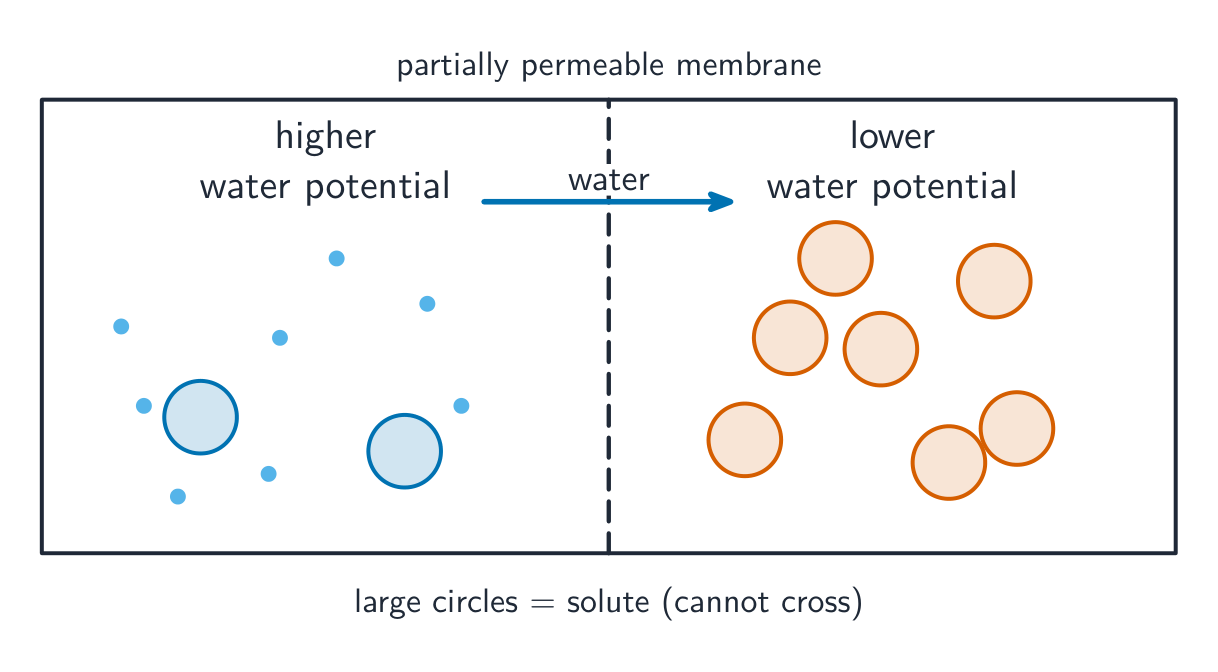
Ósmosis: el agua atraviesa una membrana semipermeable hacia el menor potencial hídrico
Match each cell and solution to what happens. · Asocia cada célula y solución con lo que sucede.
The wall protects plant cells; without one, a red blood cell bursts in pure water and shrinks in a concentrated solution. · La pared protege las células vegetales; sin ella, un glóbulo rojo revienta en agua pura y se encoge en una solución concentrada.
A red blood cell placed in pure water may undergo haemolysis. This is because it: · Un glóbulo rojo colocado en agua pura puede sufrir hemólisis. Esto se debe a que:
With no protective wall, water entering by osmosis swells the cell until the membrane bursts (haemolysis). · Sin una pared protectora, el agua que entra por ósmosis hincha la célula hasta que la membrana revienta (hemólisis).
You've got it
- pure water = highest water potential; solute lowers it; water moves higher → lower
- estimate tissue water potential by the no-change solution (mass/length)
- plant cell: turgid (high WP, wall protects) ↔ plasmolysis (low WP)
- animal cell (no wall): bursts/haemolysis (high WP) ↔ shrinks (low WP)
Lo has entendido
- agua pura = mayor potencial hídrico; el soluto lo disminuye; el agua se mueve de mayor → menor
- estimar el potencial hídrico del tejido mediante la solución de sin cambios (masa/longitud)
- célula vegetal: turgente (alto PH, pared protectora) ↔ plasmólisis (bajo PH)
- célula animal (sin pared): revienta/hemólisis (alto PH) ↔ se contrae (bajo PH)