لماذا نحتجز الذهب من الأرض على شكل كتل لامعة، بينما نحصل على الحديد فقط على شكل صخر باهت صدئ؟ ولماذا لا يصدأ علبة المشروبات الغازية أبداً، بينما الصدأ يصيب مسماراً حديدياً؟ إن…
English narration · English + 中文 subtitles burned in · سرد باللغة الإنجليزية · ترجمة مدمجة بالإنجليزية + الصينية
9.1
Properties of metals · خصائص المعادن
Syllabus · المنهج
English
Core
Supplement
1 Compare the general physical properties of metals and non-metals, including: (a) thermal conductivity (b) electrical conductivity (c) malleability and ductility (d) melting points and boiling points
2 Describe the general chemical properties of metals, limited to their reactions with: (a) dilute acids (b) cold water and steam (c) oxygen
العربية
أساسي
تكميلي
1 قارن الخواص الفيزيائية العامة للفلزات واللافلزات، بما في ذلك: (أ) التوصيل الحراري (ب) التوصيل الكهربائي (ج) المطيلية والسحابة (د) نقاط الانصهار والغليان
2 صف الخواص الكيميائية العامة للفلزات، مقصورة على تفاعلاتها مع: (أ) الأحماخ المخففة (ب) الماء البارد وبخار الماء (ج) الأكسجين
Source: Cambridge International syllabus · المصدر: منهج كامبريدج الدولي
English
Physical properties
Metals 金属 and non-metals 非金属 behave very differently:
Property
Metals
Non-metals
thermal conductivity 导热性 (conducting heat)
good
poor
electrical conductivity 导电性
good
poor (except graphite)
malleability 展性 and ductility 延性
malleable and ductile
brittle 易碎 (they snap)
melting point 熔点 and boiling point 沸点
usually high
usually low
Chemical properties
Metals react in three main ways:
with dilute acids 酸 → a salt 盐 + hydrogen 氢气
with cold water or steam 蒸汽 → a metal hydroxide (or oxide) + hydrogen
with oxygen 氧气 → a metal oxide 氧化物
العربية
الخصائص الفيزيائية
المعادن واللافلزات تتصرف بشكل مختلف تمامًا:
الخاصية
المعادن
اللافلزات
التوصيل الحراري (نقل الحرارة)
جيد
سيء
التوصيل الكهربائي
جيد
سيء (باستثناء الجرافيت)
الطرق والسحب
مطروقة وقابلة للسحب
هشة (تنكسر)
درجة الانصهار ودرجة الغليان
عادة مرتفعة
عادة منخفضة
الخصائص الكيميائية
تتفاعل المعادن بثلاث طرق رئيسية:
مع الأحماخ المخففة ← ملح + هيدروجين
مع الماء البارد أو البخار ← هيدروكسيد (أو أكسيد) معدني + هيدروجين
Positive ions sit in a sea of delocalised electrons — that is why metals conduct and bend. Push the layers and the bond holds. · تقع الأيونات الموجبة في بحر من الإلكترونات غير المتمركزة — ولهذا السبب توصل المعادن وتُثَنَّى. عند دفع الطبقات، تظل الروابط متماسكة.
Explore · استكشف
Metal property lab · مختبر خصائص المعادن
Link metal properties to the particle model. · ربط خصائص المعادن بالنموذج الجزيئي.
1 Describe the uses of metals in terms of their physical properties, including: (a) aluminium in the manufacture of aircraft because of its low density (b) aluminium in the manufacture of overhead electrical cables because of its low density and good electrical conductivity (c) aluminium in food containers because of its resistance to corrosion (d) copper in electrical wiring because of its good electrical conductivity and ductility
العربية
أساسي
تكميلي
1 صف استخدامات الفلزات من حيث خواصها الفيزيائية، بما في ذلك: (أ) الألمنيوم في صناعة الطائرات بسبب كثافته المنخفضة (ب) الألمنيوم في صناعة الكابلات الكهربائية العلوية بسبب كثافته المنخفضة وتوصيله الكهربائي الجيد (ج) الألمنيوم في حاويات الطعام بسبب مقاومته للتآكل (د) النحاس في الأسلاك الكهربائية بسبب توصيله الكهربائي الجيد ومطيليته
Source: Cambridge International syllabus · المصدر: منهج كامبريدج الدولي
English
A metal is chosen for a job because of its physical properties.
Aluminium 铝 is used to make aircraft because of its low density 密度 (it is light).
Aluminium is used for overhead electrical cables because of its low density and good electrical conductivity.
Aluminium is used for food containers because it resists corrosion 腐蚀.
Copper 铜 is used for electrical wiring because of its good electrical conductivity and its ductility (it can be drawn into wires).
العربية
يُختار المعدن لعمل معين بسبب خصائصه الفيزيائية.
يُستخدم الألمنيوم لصنع الطائرات بسبب انخفاض كثافته (هو خفيف).
يُستخدم الألمنيوم لكابلات الكهرباء العلوية بسبب انخفاض كثافته وجيدة توصيله الكهربائي.
يُستخدم الألمنيوم لأوعية الطعام لأنه يقاوم التآكل.
يُستخدم النحاس للأسلاك الكهربائية بسبب جودته في التوصيل الكهربائي وقابليته للسحب (يمكن رسمه إلى أسلاك).
أجسام الطائرات تستخدم الكثير من الألمنيوم: إنه قوي لكن كثافته منخفضة، لذا يبقى الطائرة خفيفة
Explore · استكشف
Metal use lab · مختبر استخدام المعادن
Choose the property that explains each metal use. · اختر الخاصية التي تفسر كل استخدام معدني.
1 Describe an alloy as a mixture of a metal with other elements, including: (a) brass as a mixture of copper and zinc (b) stainless steel as a mixture of iron and other elements such as chromium, nickel and carbon
2 State that alloys can be harder and stronger than the pure metals and are more useful
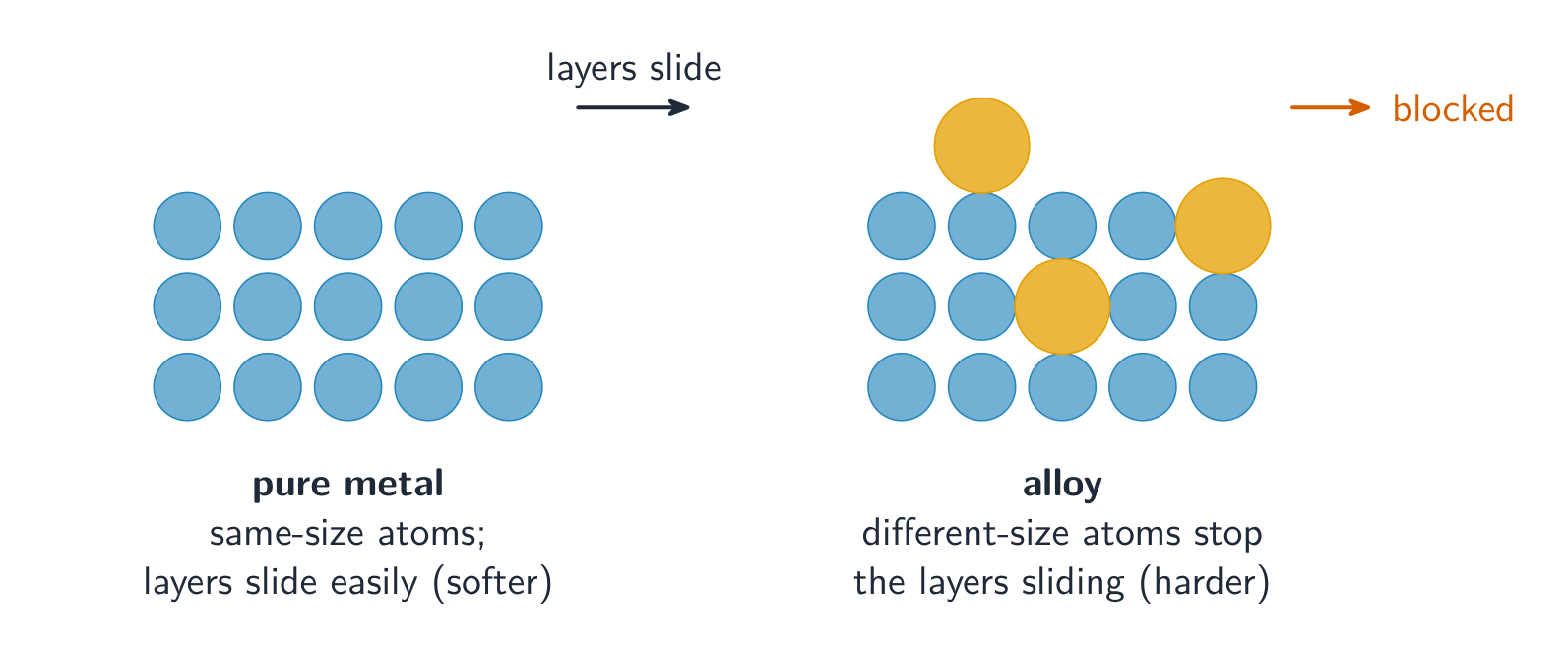
5 Explain in terms of structure how alloys can be harder and stronger than the pure metals because the different sized atoms in alloys mean the layers can no longer slide over each other
3 Describe the uses of alloys in terms of their physical properties, including stainless steel in cutlery because of its hardness and resistance to rusting
4 Identify representations of alloys from diagrams of structure
العربية
أساسي
تكميلي
1 صف السبيكة بأنها خليط من فلز مع عناصر أخرى، بما في ذلك: (أ) النحاس الأصفر كخليط من النحاس والزنك (ب) الفولاذ المقاوم للصدأ كخليط من الحديد وعناصر أخرى مثل الكروم والنيكل والكربون
2 بيّن أن السبائك يمكن أن تكون أكثر صلابة وقوة من الفلزات النقية وهي أكثر فائدة
5 اشرح من حيث البنية كيف يمكن للسبائك أن تكون أكثر صلابة وقوة من الفلزات النقية لأن ذرات ذات أحجام مختلفة في السبائك تعني أن الطبقات لم تعد تستطيع الانزلاق فوق بعضها البعض
3 صف استخدامات السبائك من حيث خواصها الفيزيائية، بما في ذلك الفولاذ المقاوم للصدأ في أدوات المائدة بسبب صلابته ومقاومته للصدأ
4 حدد تمثيلات السبائك من مخططات البنية
Source: Cambridge International syllabus · المصدر: منهج كامبريدج الدولي
English
An alloy 合金 is a mixture 混合物 of a metal with one or more other elements.
Brass 黄铜 is a mixture of copper and zinc 锌.
Stainless steel 不锈钢 is a mixture of iron 铁 with other elements such as chromium 铬, nickel 镍 and carbon 碳.
Alloys are usually harder and stronger than the pure metals, which makes them more useful. For example, stainless steel is used for cutlery because it is hard and does not rust.
Why alloys are harder. In a pure metal, the atoms 原子 are all the same size, so the layers 层 can slide over each other easily. In an alloy, the different-sized atoms stop the layers from sliding, so the alloy is harder and stronger.
العربية
السبيكة هي خليط من معدن مع عنصر واحد أو أكثر.
النحاس الأصفر هو خليط من النحاس والخارصين.
الفولاذ المقاوم للصدأ هو خليط من الحديد مع عناصر أخرى مثل الكروم والنيكل والكربون.
السبائك عادة ما تكون أصلب وأقوى من المعادن الخالصة، مما يجعلها أكثر فائدة. على سبيل المثال، يُستخدم الفولاذ المقاوم للصدأ لأدوات المائدة لأنه صلب ولا يصدأ.
لماذا السبائك أكثر صلابة. في المعدن النقي، تكون جميع الذرات من نفس الحجم، لذا يمكن للـ طبقات الانزلاق فوق بعضها البعض بسهولة. أما في السبائك، فإن ذرات مختلف الأحجام تمنع الطبقات من الانزلاق، مما يجعل السبيكة أكثر صلابة وقوة.
في السبيكة، تمنع ذرات مختلف الأحجام انزلاق الطبقات فوق بعضها البعض، لذلك تكون السبيكة أكثر صلابة من المعدن النقي
Explore · استكشف
Alloy property lab · مختبر خصائص السبائك
See why mixing atoms changes metal properties. · انظر لماذا تغيير ذرات المختلط يغير خصائص المعدن.
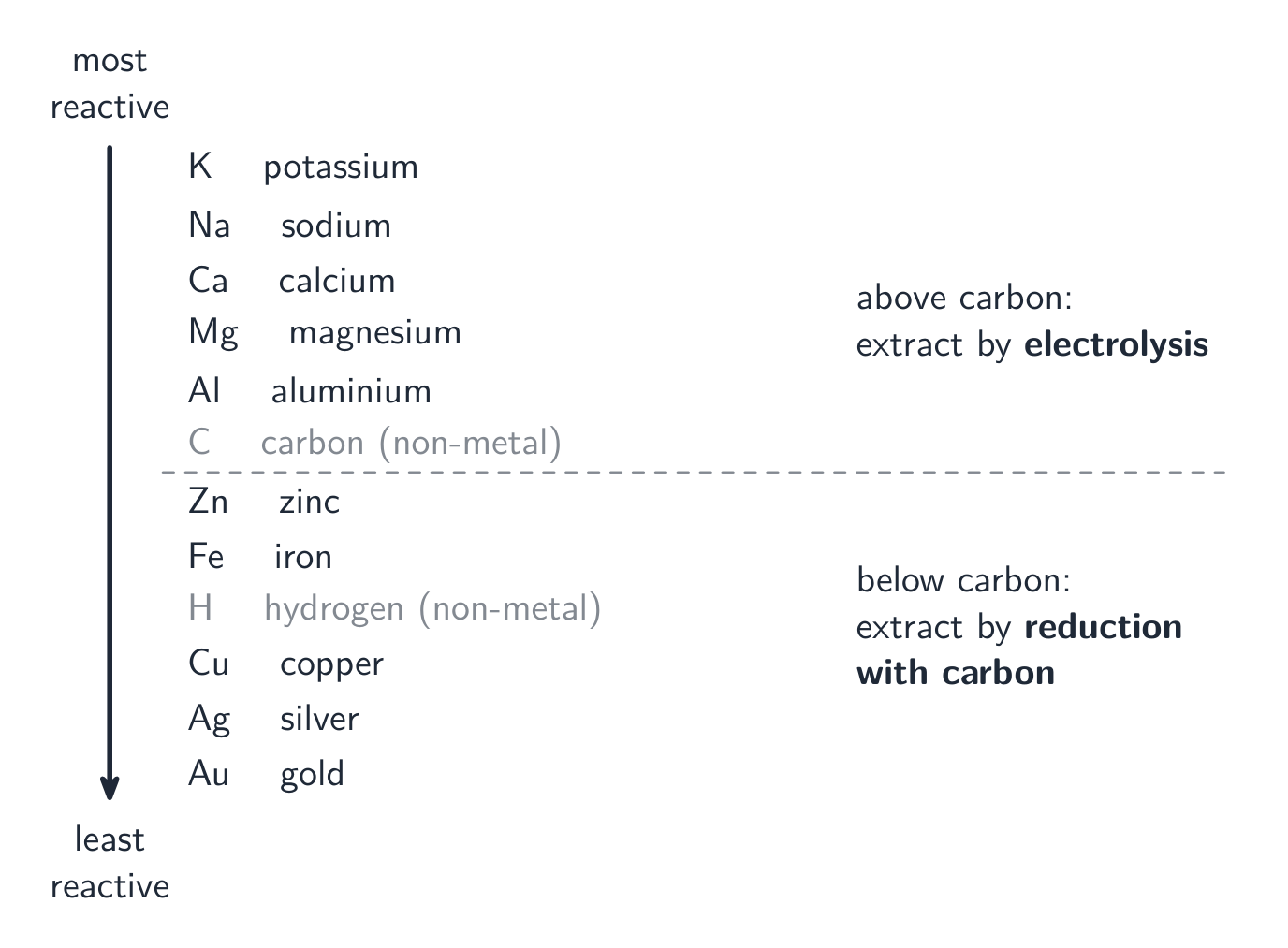
1 State the order of the reactivity series as: potassium, sodium, calcium, magnesium, aluminium, carbon, zinc, iron, hydrogen, copper, silver, gold
4 Describe the relative reactivities of metals in terms of their tendency to form positive ions, by displacement reactions, if any, with the aqueous ions of magnesium, zinc, iron, copper and silver
2 Describe the reactions, if any, of: (a) potassium, sodium and calcium with cold water (b) magnesium with steam (c) magnesium, zinc, iron, copper, silver and gold with dilute hydrochloric acid and explain these reactions in terms of the position of the metals in the reactivity series
5 Explain the apparent unreactivity of aluminium in terms of its oxide layer
3 Deduce an order of reactivity from a given set of experimental results
العربية
أساسي
تكميلي
1 اذكر ترتيب متسلسلة النشاط الكيميائي كالتالي: البوتاسيوم، الصوديوم، الكالسيوم، المغنيسيوم، الألمنيوم، الكربون، الزنك، الحديد، الهيدروجين، النحاس، الفضة، الذهب
4 صف التفاعلات النسبية للمعادن من حيث ميلها لتكوين أيونات موجبة، عبر تفاعلات الإزاحة، إن وجدت، مع الأيونات المائية للمغنيسيوم والزنك والحديد والنحاس والفضة
2 صف التفاعلات، إن وجدت، لكل مما يلي: (أ) البوتاسيوم والصوديوم والكالسيوم مع الماء البارد (ب) المغنيسيوم مع البخار (ج) المغنيسيوم والزنك والحديد والنحاس والفضة والذهب مع حمض الهيدروكلوريك المخفف واشرح هذه التفاعلات بناءً على موقع المعادن في متسلسلة النشاط الكيميائي
5 اشرح غير التفاعل الظاهري للألمنيوم من خلال طبقة أكسيدته
3 استنتج ترتيباً للتفاعلية من مجموعة معطيات تجريبية معطاة
Source: Cambridge International syllabus · المصدر: منهج كامبريدج الدولي
English
The reactivity series 金属活动性顺序 lists metals in order of how reactive they are. Carbon and hydrogen are included for comparison:
(most reactive at the top, least reactive at the bottom)
The higher a metal is, the more easily it forms positive ions 离子. This explains its reactions:
potassium, sodium and calcium react with cold water.
magnesium reacts with steam (but only very slowly with cold water).
magnesium, zinc and iron react with dilute hydrochloric acid; copper, silver and gold do not.
Displacement reactions
A more reactive metal will displace a less reactive metal from a solution of its ions (a displacement reaction 置换反应). For example, zinc displaces copper from copper(II) sulfate solution, because zinc is more reactive than copper:
Be ready to say what you would see, because those are separate marks:
the blue colour of the solution fades - the blue $\text{Cu}^{2+}$ ions are being used up (zinc sulfate is colourless).
a pink-brown solid coats the zinc - that is the displaced copper.
the grey zinc dissolves and gets smaller.
the mixture warms up - displacement is exothermic.
Metal-and-acid reactions have their own list: effervescence 泡腾 (the hydrogen escaping) and the solid dissolves. With copper(II) oxide or carbonate and acid, add that the solution turns blue. Never write "hydrogen is given off" as an observation - you cannot see the gas, only the bubbles, so write effervescence.
Worked example. Zinc and aluminium are both found as oxides. Which can be extracted by heating with carbon, and why? Find each metal's place relative to carbon in the reactivity series. Zinc sits below carbon, so carbon is the more reactive of the two and can take the oxygen away from it: zinc oxide is reduced by heating with carbon. Aluminium sits above carbon, so carbon is not reactive enough to displace it, and aluminium must be extracted by electrolysis instead - which is why aluminium costs far more to extract. The line in the series that decides the method is carbon's, not the top of the list.
The special case of aluminium
Aluminium seems less reactive than its position suggests. This is because it is covered by a thin, strong oxide layer 氧化层 that stops other substances reaching the metal underneath.
العربية
تدرج سلسلة التفاعل المعادن حسب درجة تفاعليتها. تم تضمين الكربون والهيدروجين للمقارنة:
(الأكثر تفاعلاً في الأعلى، الأقل تفاعلاً في الأسفل)
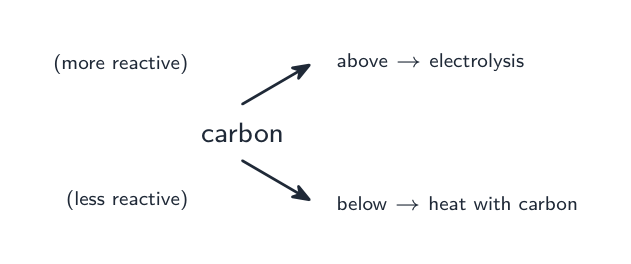
يتم استخلاص المعادن التي تقع فوق الكربون عن طريق التحليل الكهربائي؛ بينما يمكن استخلاص تلك التي تقع تحت الكربون بالتسخين مع الكربون
كلما كانت المعادن أعلى في السلسلة، كان تكوين أيونات موجبة أبسط. وهذا يفسر تفاعلاتها:
يتفاعل البوتاسيوم والصوديوم والكالسيوم مع الماء البارد.
يتفاعل المغنيسيوم مع البخار (لكن ببطء شديد جداً مع الماء البارد).
يتفاعل المغنيسيوم والزنك والحديد مع حمض الهيدروكلوريك المخفف؛ بينما لا يتفاعل النحاس والفضة والذهب.
تفاعلات الإزاحة
المعدن الأكثر تفاعلاً سيحل محل معدن أقل تفاعلاً من محلول أيونه (وهو ما يسمى تفاعل الإزاحة). على سبيل المثال، يحل الزنك محل النحاس من محلول كبريتات النحاس(II)، لأن الزنك أكثر تفاعلاً من النحاس:
يزول اللون الأزرق للمحلول - لأن أيونات $\text{Cu}^{2+}$ الزرقاء تُستهلك (كبريتات الزنك عديمة اللون).
يترسب صلب وردي-بني على سطح الزنك - وهو النحاس المُزال.
يذوب الزنك الرمادي ويصغر حجمه.
ترتفع حرارة الخليط - تفاعل الإزاحة طارد للحرارة.
تفاعلات المعادن والأحماض لها قائمة خاصة: الفوران (خروج الهيدروجين) وذوبان الصلب. بالنسبة لأكسيد النحاس(II) أو كربونات النحاس مع الحمض، أضف أن المحلول يصبح أزرق. تجنب كتابة "يتصاعد الهيدروجين" كتجربة رصدية - لأنك لا ترى الغاز بل الفقاعات فقط، لذا اكتب الفوران.
مثال محلل. يوجد كل من الزنك والألمنيوم في صورة أكاسيد. أيهما يمكن استخراجه بالتسخين مع الكربون ولماذا؟ حدد مكان كل معدن بالنسبة لـ الكربون في سلسلة التفاعل. يقع الزنك تحت الكربون، لذا فالكربون هو الأكثر تفاعلاً بين الاثنين ويمكنه سحب الأكسجين منه: يتم اختزال أكسيد الزنك بالتسخين مع الكربون. يقع الألمنيوم فوق الكربون، لذا فالكربون ليس نشطاً بما يكفي لإزاحته، ويجب استخلاص الألمنيوم عن طريق التحليل الكهربائي بدلاً منه - ولهذا السبب يكون استخلاص الألمنيوم أغلى بكثير. الخط في السلسلة الذي يحدد الطريقة هو خط الكربون، وليس بداية القائمة.
الحالة الخاصة للألمنيوم
يبدو الألمنيوم أقل تفاعلاً مما تشير إليه موقعه. والسبب في ذلك أنه مغطى بطبقة رقيقة وقوية من الأكسيد تمنع المواد الأخرى من الوصول إلى المعدن الموجود تحتها.
Explore · استكشف
Displacement and the reactivity series · الإزاحة وسلسلة التفاعل
Step through a displacement. A more reactive metal pushes a less reactive one out of its compound — which is exactly what the reactivity series predicts. · مرحلة بخطوات عملية الإزاحة. المعدن الأكثر تفاعلاً يطرد المعدن الأقل تفاعلاً من مركبه — وهو بالضبط ما تتنبأ به سلسلة التفاعل.
1 State the conditions required for the rusting of iron and steel to form hydrated iron(III) oxide
2 State some common barrier methods, including painting, greasing and coating with plastic
4 Describe the use of zinc in galvanising as an example of a barrier method and sacrificial protection
3 Describe how barrier methods prevent rusting by excluding oxygen or water
5 Explain sacrificial protection in terms of the reactivity series and in terms of electron loss
العربية
أساسي
تكميلي
1 اذكر الشروط اللازمة لصدأ الحديد والفولاذ لتكوين أكسيد حديد(III) المائي
2 اذكر بعض طرق الحواجز الشائعة، بما في ذلك الطلاء والتزييت والطلاء بالبلاستيك
4 صف استخدام الزنك في الجلفنة كمثال على طريقة الحاجز والحماية التضحية
3 صف كيف تمنع طرق الحاجر الصدأ عن طريق استبعاد الأكسجين أو الماء
5 اشرح الحماية التضحية من خلال متسلسلة النشاط الكيميائي ومن خلال فقدان الإلكترونات
Source: Cambridge International syllabus · المصدر: منهج كامبريدج الدولي
English
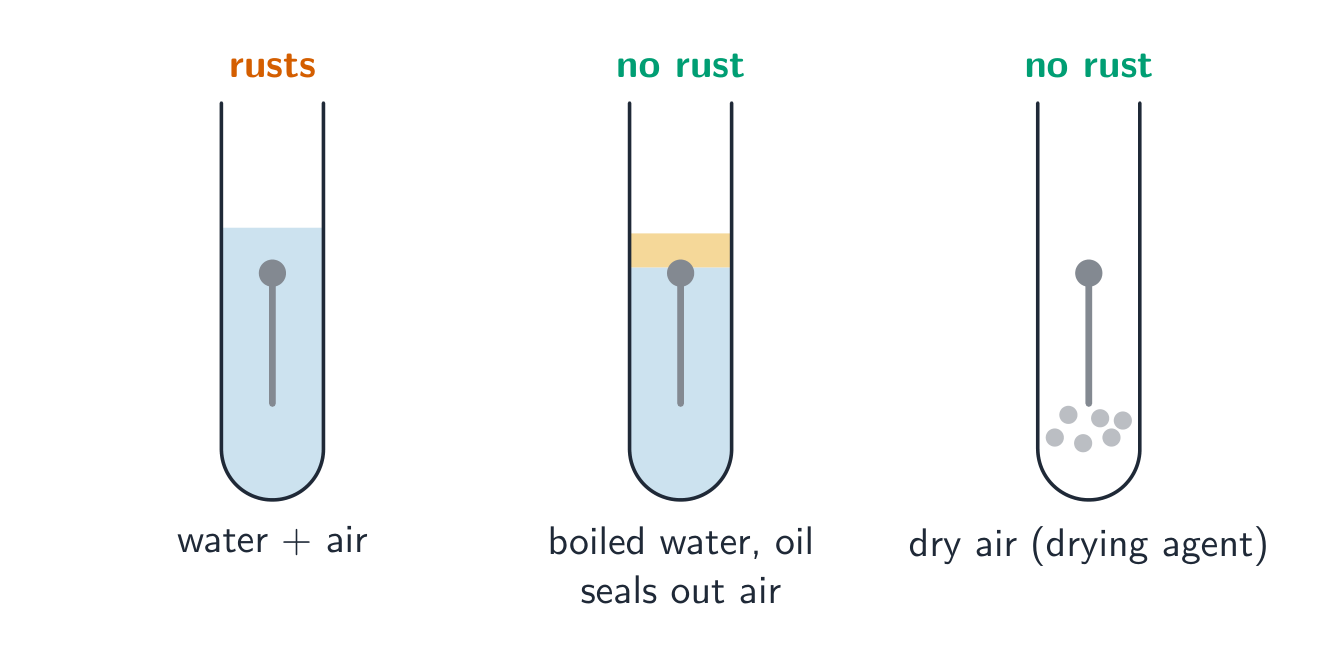
Rusting 生锈 is the corrosion of iron and steel. Two things are needed for rusting: oxygen (from the air) and water. The rust 铁锈 formed is hydrated iron(III) oxide.
Stopping rust
Barrier methods 隔离法 keep oxygen and water away from the iron:
painting, greasing (covering with oil), and coating with plastic.
Galvanising 镀锌 means coating iron with a layer of zinc. This works in two ways:
it is a barrier (the zinc keeps out air and water);
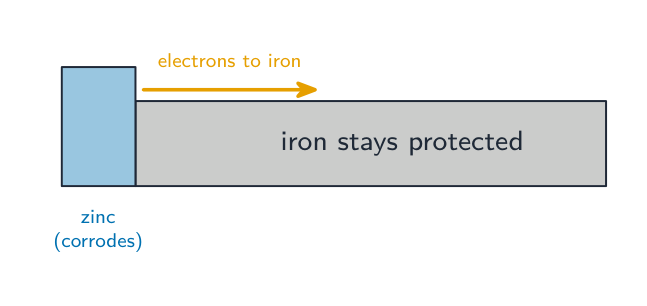
it gives sacrificial protection 牺牲保护. Because zinc is more reactive than iron, the zinc loses electrons 电子 and corrodes instead of the iron — even if the surface is scratched.
العربية
يأكل التآكل المعدن غير المحمي ببطء.
الصدأ هو تآكل الحديد والفولاذ. هناك شيئان مطلوبة للصدأ: الأكسجين (من الهواء) والماء. الراسب الناتج هو أكسيد الحديد(III) المائي.
المياه المالحة والهواء تسببا في صدأ هذا السلسلة الحديدية بشدة — الراسب هو أكسيد الحديد(III) المائيالصدأ يتطلب وجود الماء والأكسجين معاً — المسمار يصدأ فقط في الأنبوب الذي يحتوي على كليهما
منع الصدأ
طرق الحواجز تبقي الأكسجين والماء بعيداً عن الحديد:
يعني الجلفنة طلاء الحديد بطبقة من الزنك. وتعمل هذه الطريقة بطريقتين:
تعمل كحاجز (الزنك يمنع وصول الهواء والماء);
توفر حماية تضحية. لأن الزنك أكثر تفاعلاً من الحديد، يفقد الزنك الإلكترونات ويتآكل بدلاً من الحديد — حتى لو تم خدش السطح.
الزنك الأكثر تفاعلاً يتآكل ويعطي إلكتروناته للحديد، لذلك يكون الحديد محمياً حتى حيث الخدوش في السطح
Explore · استكشف
Why iron rusts — and how to stop it · لماذا صدأ الحديد — وكيفية الوقاية منه
Step through rusting. Iron needs BOTH water and oxygen, and once it starts the rust flakes off to expose fresh metal — which is why we protect iron. · مرحلة بخطوات الصدأ. يحتاج الحديد كلاً من الماء والأكسجين، وبمجرد بدء العملية، يتساقط الصدأ ليكشف عن معدن جديد — ولهذا نصنع حماية للحديد.
1 Describe the ease in obtaining metals from their ores, related to the position of the metal in the reactivity series
2 Describe the extraction of iron from hematite in the blast furnace, limited to: (a) the burning of carbon (coke) to provide heat and produce carbon dioxide (b) the reduction of carbon dioxide to carbon monoxide (c) the reduction of iron(III) oxide by carbon monoxide (d) the thermal decomposition of calcium carbonate/limestone to produce calcium oxide (e) the formation of slag Symbol equations are not required
4 State the symbol equations for the extraction of iron from hematite (a) $\text{C} + \text{O}_2 \rightarrow \text{CO}_2$ (b) $\text{C} + \text{CO}_2 \rightarrow 2\text{CO}$ (c) $\text{Fe}_2\text{O}_3 + 3\text{CO} \rightarrow 2\text{Fe} + 3\text{CO}_2$ (d) $\text{CaCO}_3 \rightarrow \text{CaO} + \text{CO}_2$ (e) $\text{CaO} + \text{SiO}_2 \rightarrow \text{CaSiO}_3$
3 State that the main ore of aluminium is bauxite and that aluminium is extracted by electrolysis
5 Describe the extraction of aluminium from purified bauxite/aluminium oxide, including: (a) the role of cryolite (b) why the carbon anodes need to be regularly replaced (c) the reactions at the electrodes, including ionic half-equations Details of the purification of bauxite are not required
العربية
أساسي
تكميلي
1 صف سهولة الحصول على المعادن من خاماتها، وذلك مرتبطاً بموقع المعدن في متسلسلة النشاط الكيميائي
2 صف استخراج الحديد من الهيماتيت في الفرن العالي، مقتصراً على: (أ) احتراق الكربون (الكوك) لتوفير الحرارة وإنتاج ثاني أكسيد الكربون (ب) اختزال ثاني أكسيد الكربون إلى أول أكسيد الكربون (ج) اختزال أكسيد الحديد(III) بواسطة أول أكسيد الكربون (د) التحلل الحراري لكربونات الكالسيوم/الحجر الجيري لإنتاج أكسيد الكالسيوم (هـ) تكوين الخبث لا تُطلَب المعادلات الرمزية
3 اذكر أن الخام الرئيسي للألمنيوم هو البوكسيت وأن الألمنيوم يُستخرج بالتحليل الكهربائي
5 صف استخراج الألمنيوم من البوكسيت المنقى/أكسيد الألمنيوم، بما في ذلك: (أ) دور الكريوليت (ب) سبب الحاجة إلى استبدال الأنودات الكربونية بانتظام (ج) التفاعلات عند الأقطاب، بما في ذلك معادلات نصف الأيونات تفصيلات تنقية البوكسيت غير مطلوبة
Source: Cambridge International syllabus · المصدر: منهج كامبريدج الدولي
English
How a metal is taken from its ore 矿石 depends on its place in the reactivity series. Metals below carbon can be extracted by heating with carbon (which removes the oxygen). Metals above carbon are too reactive for this and must be extracted by electrolysis 电解.
Iron from the blast furnace
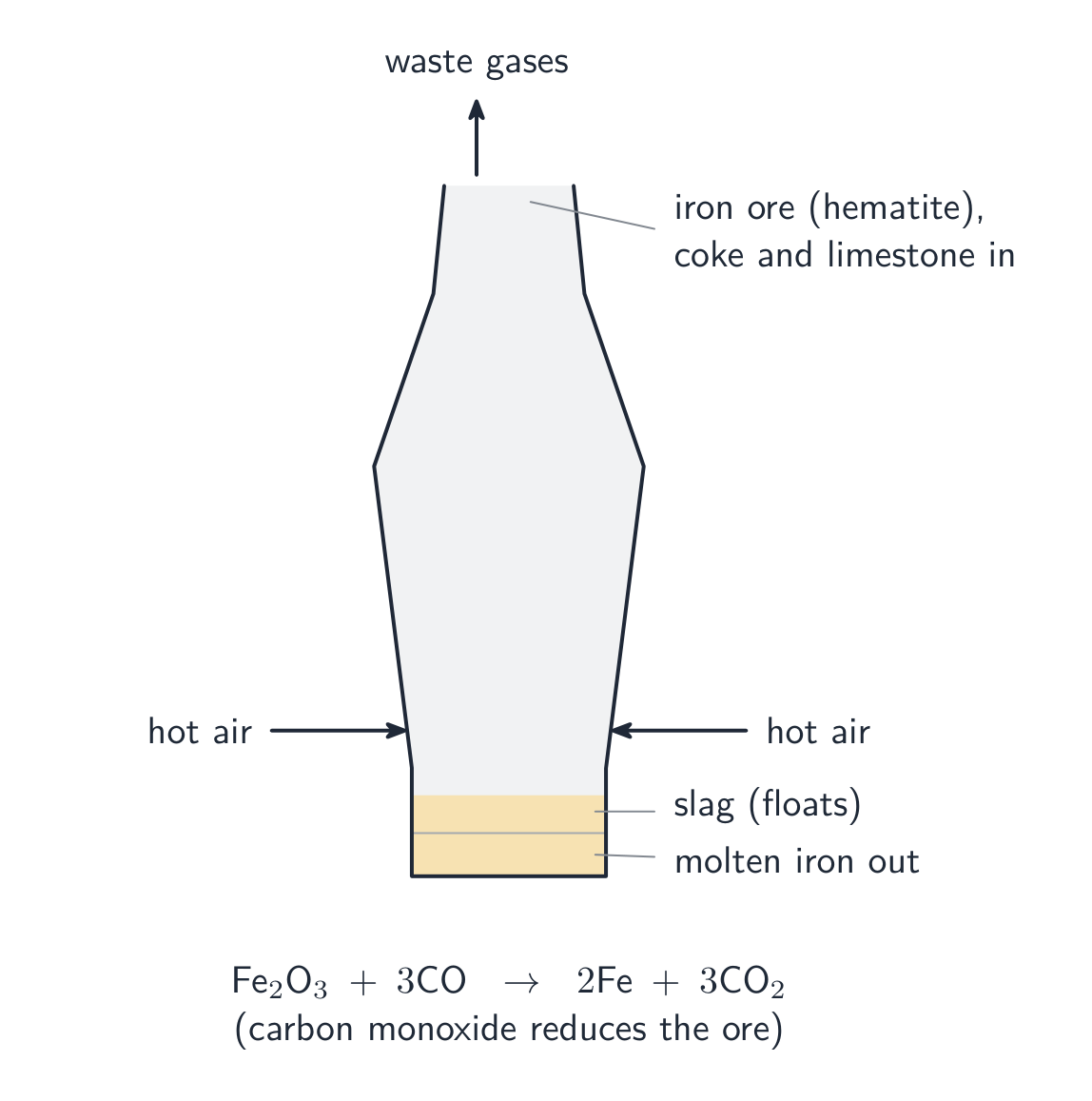
Iron is extracted from its ore hematite 赤铁矿 (iron(III) oxide) in a blast furnace 高炉:
Carbon (coke) burns in hot air to give carbon dioxide and lots of heat.
This carbon dioxide 二氧化碳 reacts with more carbon to form carbon monoxide 一氧化碳.
The carbon monoxide reduces the iron(III) oxide to iron (this is reduction 还原).
Limestone 石灰石 (calcium carbonate) breaks down in the heat to form calcium oxide 氧化钙.
The calcium oxide reacts with sandy impurities to form slag 炉渣, which is removed.
Aluminium by electrolysis
Aluminium is extracted from its ore bauxite 铝土矿 (purified to aluminium oxide) by electrolysis:
The aluminium oxide is dissolved in molten cryolite 冰晶石 to lower its melting point and save energy.
At the cathode 阴极, aluminium ions gain electrons to form aluminium metal.
At the anode 阳极, oxygen is formed. This oxygen reacts with the hot carbon anodes and burns them away, so they must be replaced regularly.
العربية
يعتمد كيفية استخراج المعدن من معدنه الخام على موقعه في سلسلة التفاعل. يمكن استخلاص المعادن التي تقع تحت الكربون بالتسخين مع الكربون (الذي يزيل الأكسجين). أما المعادن التي تقع فوق الكربون فهي شديدة التفاعل لهذه الطريقة ويجب استخلاصها عن طريق التحليل الكهربائي.
المعادن فوق الكربون تحتاج التحليل الكهربائي؛ التي أسفلها تُسخّن بالكربون
الحديد من الفرن العالي
يتم استخلاص الحديد من معدنه الهيماتيت (أكسيد الحديد(III)) في فرن عالي:
يحترق الكربون (الكوك) في الهواء الساخن ليعطي ثاني أكسيد الكربون وكثير من الحرارة.
يتفاعل هذا ثاني أكسيد الكربون مع المزيد من الكربون لتكوين أول أكسيد الكربون.
يقوم أول أكسيد الكربون بـ اختزال أكسيد الحديد(III) إلى حديد (هذا هو الاختزال).
الحجر الجيري (كربونات الكالسيوم) يتحلل بالحرارة لتكوين أكسيد الكالسيوم.
يتفاعل أكسيد الكالسيوم مع الشوائب الرملية لتكوين الخردة (الشلاغ)، والتي يتم إزالتها.
في الفرن العالي، يقوم أول أكسيد الكربون باختزال خام الحديد، ويستخدم الحجر الجيري لإزالة الشوائب الرملية على شكل خردة
الألمنيوم عن طريق التحليل الكهربائي
يُستخرج الألمنيوم من خامه البوكسيت (المُنقّى إلى أكسيد الألمنيوم) عن طريق التحليل الكهربائي:
يُذاب أكسيد الألمنيوم في الكريوليت السائل لتخفيض درجة انصهاره وتوفير الطاقة.
عند الكاثود، تكتسب أيونات الألمنيوم إلكترونات لتكوين فلز الألمنيوم.
عند الأنود، يتكون الأكسجين. يتفاعل هذا الأكسجين مع أنodes الكربون الساخنة ويحرقها، لذا يجب استبدالها بانتظام.
Explore · استكشف
Extracting iron in the blast furnace · استخراج الحديد في الفرن العالي
Iron is below carbon in reactivity, so carbon can reduce its ore to the metal. · الحديد أقل تفاعلاً من الكربون، لذا يمكن للكربون اختزال فله إلى المعدن.
Learn the reactivity series (potassium → gold). A more reactive metal displaces a less reactive one from a solution of its ions.
Metals above carbon are extracted by electrolysis; those below carbon (like iron) can be extracted by heating with carbon.
Rusting needs both water and oxygen. Barrier methods (paint, oil) keep them out; galvanising also gives sacrificial protection, because the more reactive zinc corrodes instead of the iron.
Alloys are harder than pure metals because the different-sized atoms stop the layers of ions sliding over each other.
العربية
احفظ سلسلة النشاط الكيميائي (البوتاسيوم ← الذهب). يحلّ الفلز الأكثر نشاطاً محل الأقل نشاطه من محلول أيونه.
تُستخرج الفلزات أعلى الكربون بـالتحليل الكهربائي؛ أما تلك التي أسفل الكربون (مثل الحديد) فتستخرج بالتسخين مع الكربون.
يحتاج الصدأ إلى كلا الماء والأكسجين. تحجب طرق الحواجز (الدهان، الزيت) وصولهما؛ كما يمنح التجليد حماية تضحيةً، لأن الزنك الأكثر نشاطاً يصدأ بدلاً من الحديد.
السبائك أصلب من الفلزات النقية لأن ذرات ذات أحجام مختلفة تمنع طبقات الأيونات من الانزلاق فوق بعضها البعض.
Interactive lessons on this topic · دروس تفاعلية حول هذا الموضوع
Work through it step by step, with instant-check exercises. · ا-working عليه خطوة بخطوة، مع تمارين تحقق فوري.
Pick one and the site follows you — notes, papers, videos and practice all open on it. · اختر واحدًا وسيتبعك الموقع — الملاحظات، الأوراق، الفيديوهات والتدريب جميعها تفتح عليه.
Type to search notes, lessons, code, vocabulary and past-paper questions across every subject. · اكتب للبحث عن ملاحظات، دروس، أكواد، مفردات وأسئلة امتحانات سابقة عبر جميع المواد.