يمكن للكهرباء أن تفعل شيئاً مذهلاً:它可以 tear a compound apart. Pass a current through a melted or dissolved compound, and it splits into its elements.…
English narration · English + 中文 subtitles burned in · سرد باللغة الإنجليزية · ترجمة مدمجة بالإنجليزية + الصينية
4.1
Electrolysis · التحليل الكهربائي
Syllabus · المنهج
English
Core
Supplement
1 Define electrolysis as the decomposition of an ionic compound, when molten or in aqueous solution, by the passage of an electric current
8 Describe the transfer of charge during electrolysis to include: (a) the movement of electrons in the external circuit (b) the loss or gain of electrons at the electrodes (c) the movement of ions in the electrolyte
2 Identify in simple electrolytic cells: (a) the anode as the positive electrode (b) the cathode as the negative electrode (c) the electrolyte as the molten or aqueous substance that undergoes electrolysis
3 Identify the products formed at the electrodes and describe the observations made during the electrolysis of: (a) molten lead(II) bromide (b) concentrated aqueous sodium chloride (c) dilute sulfuric acid using inert electrodes made of platinum or carbon/graphite
9 Identify the products formed at the electrodes and describe the observations made during the electrolysis of aqueous copper(II) sulfate using inert carbon/graphite electrodes and when using copper electrodes
4 State that metals or hydrogen are formed at the cathode and that non-metals (other than hydrogen) are formed at the anode
5 Predict the identity of the products at each electrode for the electrolysis of a binary compound in the molten state
10 Predict the identity of the products at each electrode for the electrolysis of a halide compound in dilute or concentrated aqueous solution
11 Construct ionic half-equations for reactions at the anode (to show oxidation) and at the cathode (to show reduction)
6 State that metal objects are electroplated to improve their appearance and resistance to corrosion
7 Describe how metals are electroplated
العربية
أساسي
تكميلي
1عرّف التحليل الكهربائي بأنه تحلل مركب أيوني، عند انصهاره أو في محلول مائي، بمرور تيار كهربائي
8 صف انتقال الشحنة أثناء التحليل الكهربائي لتشمل: (أ) حركة الإلكترونات في الدائرة الخارجية (ب) فقدان أو اكتساب الإلكترونات عند الأقطاب (ج) حركة الأيونات في المحلول الإلكتروليتي
2 حدد في الخلايا الكهربائية البسيطة: (أ) الأنود كمصعد موجب (ب) الكاثود كمصعد سالب (ج) المحلول الإلكتروليتي كمادة منصهرة أو مائية تخضع للتحليل الكهربائي
3 حدد النواتج المتشكلة عند الأقطاب وصف الملاحظات التي تمت خلال تحليل: (أ) بروميد الرصاص(II) المنصهر (ب) كلوريد الصوديوم المائي المركز (ج) حمض الكبريتيك المخفف باستخدام أقطاب خاملة مصنوعة من البلاتين أو الكربون/الجرافيت
9 حدد النواتج المتشكلة عند الأقطاب وصف الملاحظات التي تمت خلال تحليل كبريتات النحاس(II) المائية باستخدام أقطاب خاملة من الكربون/الجرافيت وعند استخدام أقطاب من النحاس
4 نصّ على أن المعادن أو الهيدروجين تتشكل عند الكاثود وأن اللافلزات (غير الهيدروجين) تتشكل عند الأنود
5 تنبأ بهوية النواتج عند كل مصعد لتحليل مركب ثنائي في الحالة المنصهرة
10 تنبأ بهوية النواتج عند كل مصعد لتحليل مركب هاليد في محلول مائي مخفف أو مركز
11 كوّن معادلات نصف أيونية للتفاعلات عند الأنود (لتوضيح الأكسدة) وعند الكاثود (لتوضيح الاختزال)
6 نصّ على أن الأشياء المعدنية تُطلى كهربائيًا لتحسين مظهرها ومقاومتها للتآكل
7 صف كيفية الطلاء الكهربائي للمعادن
Source: Cambridge International syllabus · المصدر: منهج كامبريدج الدولي
English
Electrolysis: ions discharge at the electrodes
Electrolysis 电解 is the breaking down (decomposition 分解) of an ionic compound 离子化合物 — when it is molten 熔融 or in aqueous 水溶液 solution — by passing an electric current 电流 through it.
It only works when the substance is molten or dissolved, because then the ions 离子 are free to move and carry the charge. A solid ionic compound cannot be electrolysed because its ions are locked in place.
The electrolytic cell
The set-up is called an electrolytic cell 电解池. Two electrodes 电极 (solid conductors) dip into the electrolyte 电解质 — the molten or aqueous substance being broken down.
The anode 阳极 is the positive ($+$) electrode.
The cathode 阴极 is the negative ($-$) electrode.
The electrodes are often inert 惰性 (they do not react), such as platinum 铂 or carbon/graphite 石墨.
What is formed at each electrode
There is a simple rule:
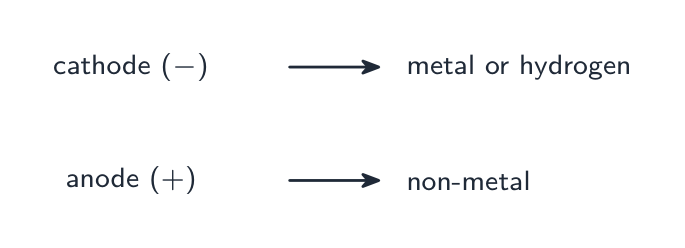
Metals 金属 or hydrogen 氢气 are formed at the cathode.
Non-metals 非金属 (other than hydrogen) are formed at the anode.
For aqueous solutions, the product can depend on whether the solution is dilute 稀 or concentrated 浓. Here are the three Core examples:
Electrolyte
At the cathode ($-$)
At the anode ($+$)
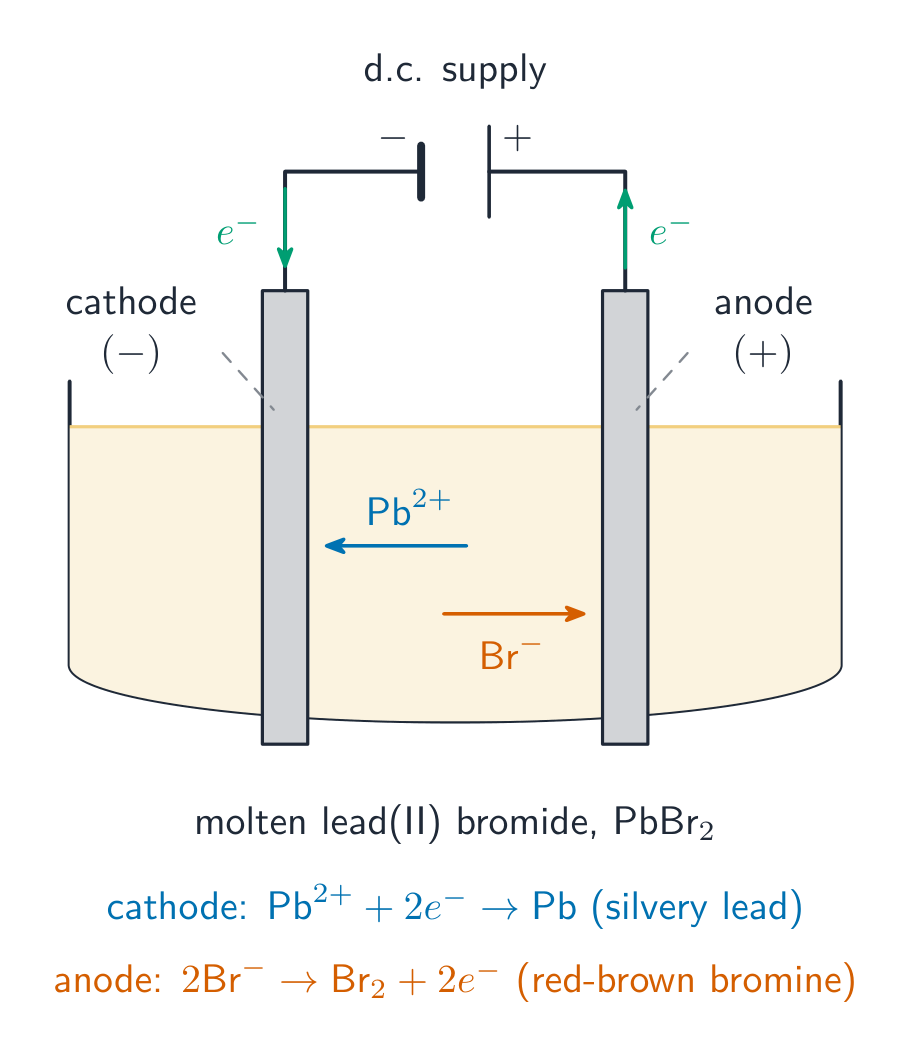
molten lead(II) bromide, $\text{PbBr}_2$
lead 铅 (silvery liquid)
bromine 溴 (red-brown vapour)
concentrated aqueous sodium chloride
hydrogen (bubbles of gas)
chlorine 氯气 (pale green gas)
dilute sulfuric acid 硫酸
hydrogen (bubbles of gas)
oxygen 氧气 (bubbles of gas)
Worked example. Predict the products of electrolysing molten zinc chloride, $\text{ZnCl}_2$. Because it is molten, only zinc ions and chloride ions are present - there is no water to complicate things. Zinc is a metal, so it forms at the cathode: $\text{Zn}^{2+}$ ions gain electrons and silvery zinc appears. Chlorine is a non-metal, so it forms at the anode: pale green chlorine gas bubbles off. Always check the state first. A molten compound simply gives you its own two elements, while an aqueous one brings water into the competition - which is why concentrated sodium chloride solution gives hydrogen at the cathode rather than sodium.
How the charge moves
During electrolysis:
Electrons 电子 move through the wires (the external circuit 外电路) from the power supply.
At the cathode, positive ions gain electrons. Gaining electrons is reduction 还原.
At the anode, negative ions lose electrons. Losing electrons is oxidation 氧化.
Inside the electrolyte, the ions move: positive ions go to the cathode and negative ions go to the anode.
You can write a half-equation 半反应式 for each electrode. For molten lead(II) bromide:
The product at the anode depends on the electrode:
With inert carbon electrodes: copper 铜 forms at the cathode and oxygen forms at the anode. The blue colour of the solution slowly fades as copper is removed.
With copper electrodes: copper forms at the cathode, while the anode itself dissolves into the solution. The blue colour stays the same. This is used to purify copper.
Electroplating
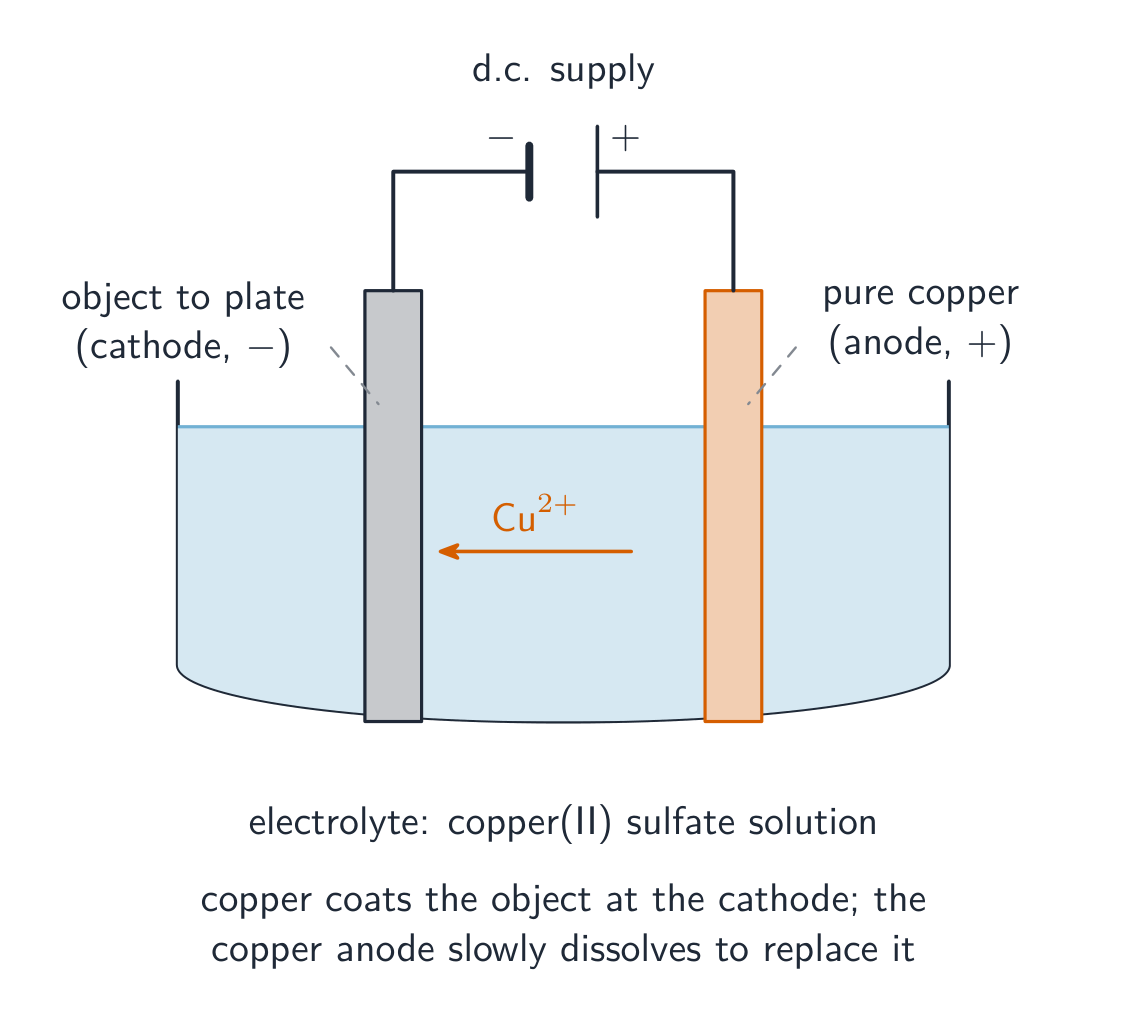
Electroplating 电镀 means covering a metal object with a thin layer of another metal. This improves its appearance and its resistance to corrosion 腐蚀 (rusting and wearing away).
To electroplate an object:
the object to be coated is made the cathode;
the plating metal is made the anode;
the electrolyte is a solution containing ions of the plating metal.
العربية
التحليل الكهربائي: تفريغ الأيونات عند الأقطاب
التحليل الكهربائي هو تكسير (تحلل) مركب أيوني — عندما يكون مسلاً أو في محلول مائي — عن طريق مرور تيار كهربائي خلاله.
خلية التحليل الكهربائي تفصل المركب باستخدام تيار كهربائي.
لا يعمل إلا عندما تكون المادة مسلة أو مذابة، لأن حينها تكون الأيونات حرة الحركة وتحمل الشحنة. لا يمكن تحليل المركب الأيوني الصلب كهربائياً لأن أيونه مقفولة في أماكنها.
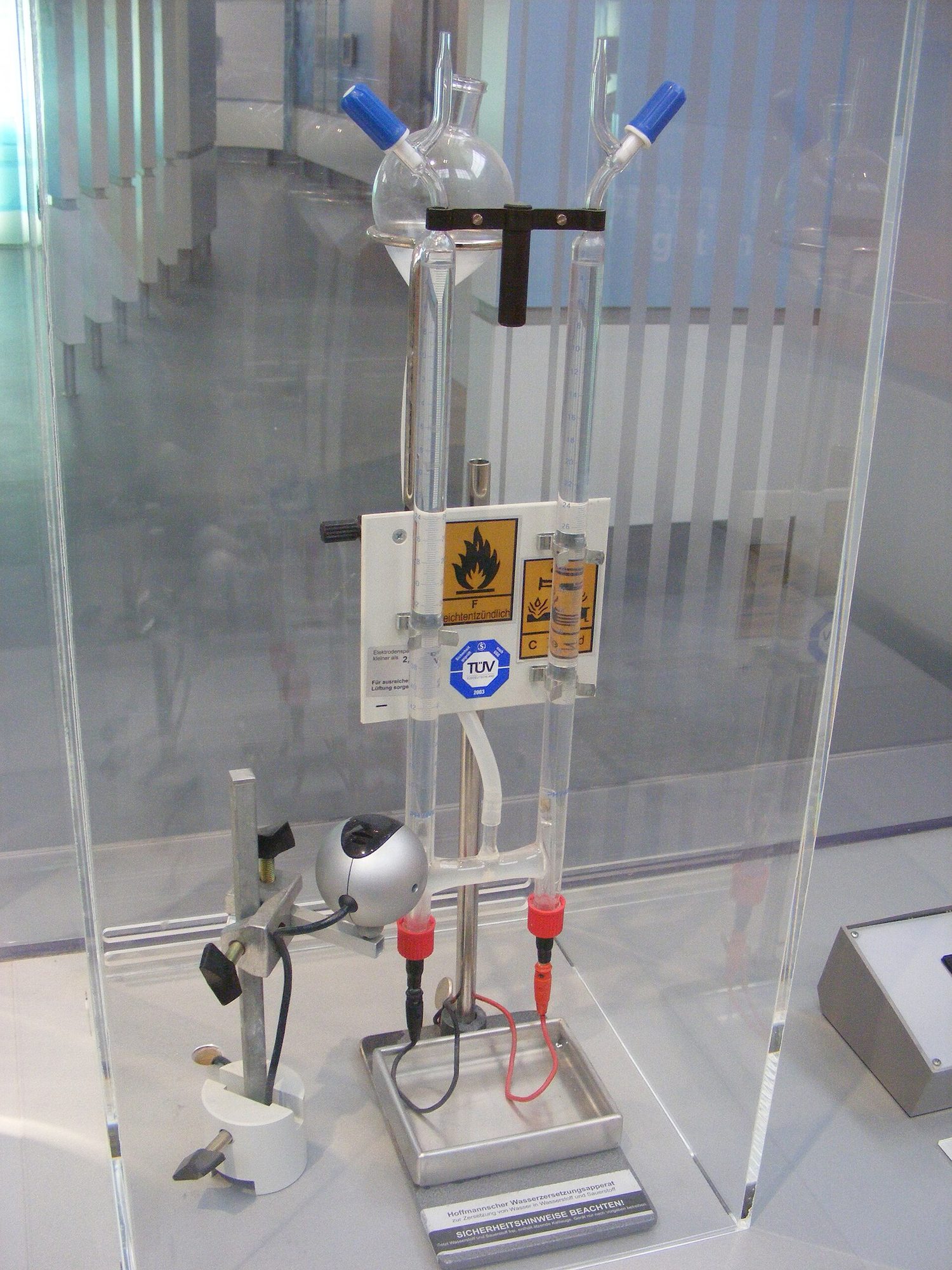
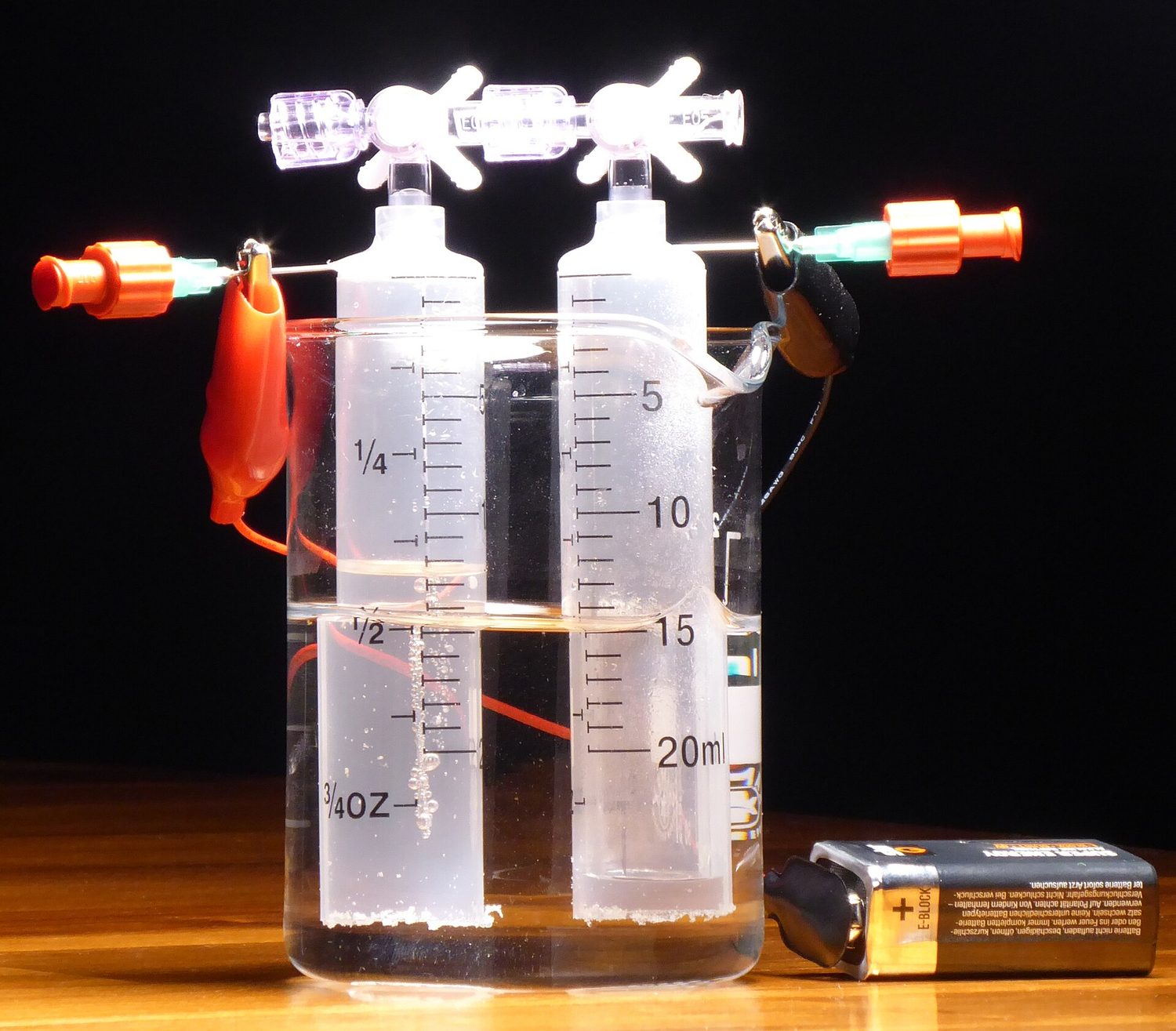
تحليل كهربائي للماء: تخرج فقاعات الغاز عند كل قطب وتتجمع في الأنابيب العلوية، مع وجود حوالي ضعف كمية الهيدروجين مقارنة بالأكسجين
الخلية الكهربائية
يُسمى هذا الترتيب الخلية الكهربائية. غوص قطبان (موصلات صلبة) في الإلكتروليت — وهو المادة المصهورة أو المائية التي يتم تفكيكها.
الأنود هو القطب الموجب ($+$).
الكاثود هو القطب السالب ($-$).
غالباً ما تكون الأقطاب خاملة (لا تتفاعل)، مثل البلاتين أو الكربون/الجرافيت.
ما يتكون عند كل قطب
هناك قاعدة بسيطة:
تتشكل المعادن والهيدروجين عند المهبط؛ اللافلزات عند المصعد
تتكون المعادن أو الهيدروجين عند الكاثود.
تتكون غير المعادن (ما عدا الهيدروجين) عند الأنود.
بالنسبة للمحاليل المائية، قد يعتمد الناتج على ما إذا كان المحلول مخففًا أم مركزًا. إليك الأمثلة الأساسية الثلاثة:
الإلكتروليت
عند الكاثود ($-$)
عند الأنود ($+$)
بروميد الرصاص(II) المذاب، $\text{PbBr}_2$
رصاص (سائل فضي اللون)
بروم (بخار أحمر بني)
محلول ملحي مركز
هيدروجين (فقاعات غاز)
كلور (غاز أخضر فاتح)
حمض كبريتيكي مخفف
هيدروجين (فقاعات غاز)
أكسجين (فقاعات غاز)
مثال محلل. تنبأ بنواتج تحليل كلوريد الزنك المذاب، $\text{ZnCl}_2$. بما أنه مذاب، فإن أيونات الزنك وأيونات الكلوريد فقط هي الموجودة - لا يوجد ماء يعقد الأمور. الزنك معدن، لذا يتكون عند الكاثود: أيونات $\text{Zn}^{2+}$ تكتسب إلكترونات ويظهر رصاص فضي اللون. الكلور غير معدني، لذا يتكون عند الأنود: تخرج فقاعات غاز الكلور الأخضر الفاتح. تحقق دائمًا من الحالة أولاً. المركب المذاب يعطيك عناصره المكونة فقط، بينما المركب المائي يُدخل الماء في المنافسة - ولهذا السبب يعطي محلول كلوريد الصوديوم المركز هيدروجين عند الكاثود بدلاً من الصوديوم.
كيف تنتقل الشحنة
أثناء التحليل الكهربائي:
تتحرك الإلكترونات عبر الأسلاك (الدائرة الخارجية) من مصدر الطاقة.
عند الكاثود، تكتسب الأيونات الموجبة إلكترونات. اكتساب الإلكترونات هو اختزال.
عند الأنود، تفقد الأيونات السالبة إلكترونات. فقدان الإلكترونات هو أكسدة.
داخل الإلكتروليت، تتحرك الأيونات: تذهب الأيونات الموجبة إلى الكاثود وتذهب الأيونات السالبة إلى الأنود.
يمكنك كتابة معادلة نصفية لكل قطب. بالنسبة لبروميد الرصاص(II) المذاب:
في بروميد الرصاص(II) المذاب، $\text{Pb}^{2+}$ يتحرك نحو الكاثود و$\text{Br}^-$ نحو الأنود، حيث يتم تفريغ كل منهما
التحليل الكهربائي لكبريتات النحاس(II)
يعتمد الناتج عند الأنود على نوع القطب:
باستخدام أقطاب كربون خاملة: يتكون النحاس عند الكاثود ويتكون الأكسجين عند الأنود. يتلاشى اللون الأزرق للمحلول ببطء مع إزالة النحاس.
باستخدام أقطاب النحاس: يتكون النحاس عند الكاثود، بينما يذوب الأنود نفسه في المحلول. يبقى اللون الأزرق كما هو. يُستخدم هذا لتنقية النحاس.
الطلاء الكهربائي
الطلاء الكهربائي يعني تغطية جسم معدني بطبقة رقيقة من معدن آخر. يحسن هذا مظهره ومقاومته للتآكل (التآكل والصدأ والتلف).
لتطبيق الطلاء الكهربائي على جسم:
يُجعل الجسم المراد طلائه الكاثود;
يُجعل المعدن المُطلّي الأنود;
يكون الإلكتروليت محلولًا يحتوي على أيونات المعدن المُطلّي.
للتطليق الكهربائي، اجعل الجسم مهبطاً ومعدن الطلاء مصعداً، في محلول أيونات معدن الطلاء
Explore · استكشف
Inside an electrolysis cell · داخل خلية التحليل الكهربائي
Pick an electrolyte and watch ions move: positive ions to the cathode, negative ions to the anode. · اختر إلكتروليت وراقب حركة الأيونات: الأيونات الموجبة نحو الكاثود، والأنيونات نحو الأنود.
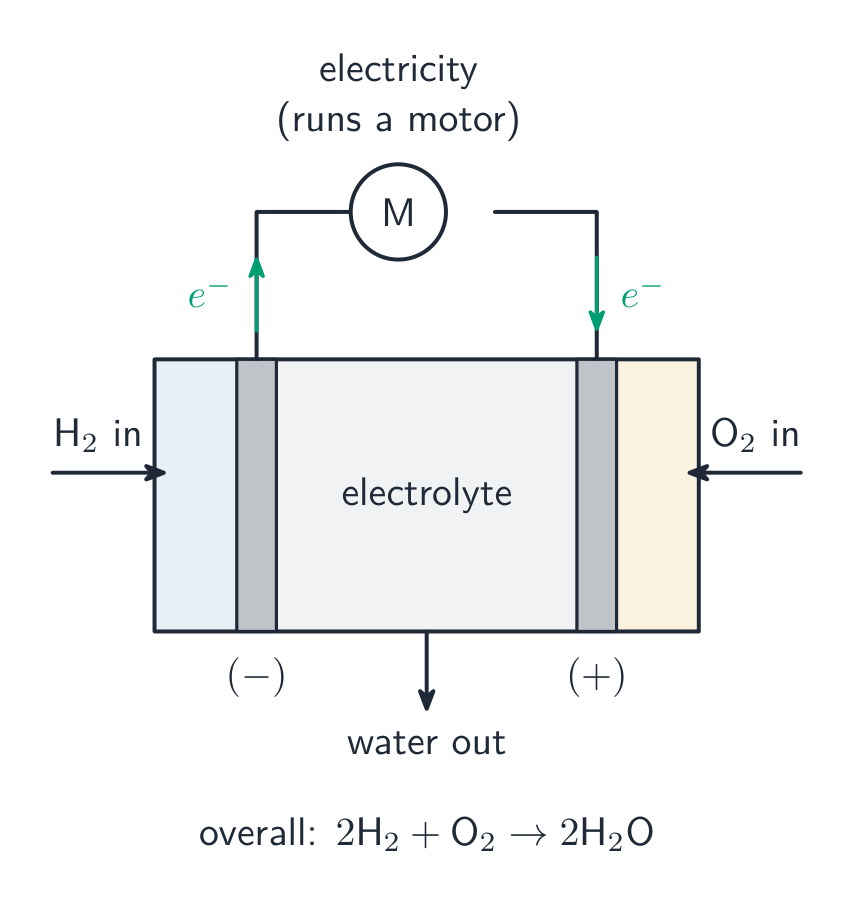
It is useful to compare a fuel cell with a normal petrol (gasoline) engine in a vehicle.
Hydrogen–oxygen fuel cell
Petrol engine
Main product
water only
carbon dioxide and pollutants 污染物
Effect on air
clean
adds to air pollution
Fuel storage
hydrogen is hard and dangerous to store (flammable, needs high pressure)
petrol is easy to store
Source
hydrogen may be made using fossil fuels
made from crude oil
Advantages of the fuel cell: the only product is water, so it does not pollute the air, and it changes chemical energy into electricity efficiently. Disadvantages: hydrogen is hard to store and transport safely, and producing the hydrogen can still use energy from fossil fuels.
العربية
تستخدم خلية الوقود الهيدروجين والأكسجين لإنتاج الكهرباء مباشرة. المنتج الكيميائي الوحيد هو الماء.
*تحوّل خلية الوقود الهيدروجين-الأكسجين الطاقة الكيميائية مباشرة إلى كهرباء، مع كون الماء هو المنتج الوحيد
من المفيد مقارنة خلية الوقود بمحرك بنزين (وقود) عادي في مركبة.
خلية الوقود الهيدروجين-الأكسجين
محرك البنزين
المنتج الرئيسي
ماء فقط
ثاني أكسيد الكربون والملوثات
تأثير على الهواء
نظيف
يزيد من تلوث الهواء
تخزين الوقود
الهيدروجين صعب وخطير التخزين (قابل للاشتعال، يحتاج ضغطًا عاليًا)
البنزين سهل التخزين
المصدر
يمكن تصنيع الهيدروجين باستخدام الوقود الأحفوري
مصنوع من النفط الخام
مزايا خلية الوقود: المنتج الوحيد هو الماء، لذا فهي لا تلوث الهواء، وتحويل الطاقة الكيميائية إلى كهرباء بكفاءة. عيوب: الهيدروجين صعب التخزين والنقل الآمن، وإنتاج الهيدروجين قد لا يزال يستخدم طاقة من الوقود الأحفوري.
Explore · استكشف
Inside a hydrogen–oxygen fuel cell · داخل خلية الوقود الهيدروجين-الأكسجين
Step through a fuel cell. Hydrogen and oxygen combine to make water, and the energy of that reaction is released as electricity — with no carbon dioxide. · مرحباً بخلايا الوقود. يتحد الهيدروجين والأكسجين لتكوين الماء، وتتم إطلاق طاقة هذا التفاعل على شكل كهرباء — بدون ثاني أكسيد الكربون.
At the cathode (negative) you get a metal or hydrogen; at the anode (positive) you get a non-metal. Positive ions move to the cathode, negative ions to the anode.
A molten compound just gives its two elements. An aqueous solution can give something different (concentrated sodium chloride gives hydrogen and chlorine, not sodium).
Reduction is gain of electrons (at the cathode); oxidation is loss of electrons (at the anode). Remember OIL RIG.
In a half-equation the atoms and the charges must balance, with the electrons on the correct side: $\text{Pb}^{2+} + 2e^- \rightarrow \text{Pb}$ (cathode).
To electroplate an object, make it the cathode, make the plating metal the anode, and use a solution containing ions of the plating metal.
العربية
عند الكاثود (السالب) تحصل على معدن أو هيدروجين؛ عند الأنود (الموجب) تحصل على غير معدني. تهاجر الأيونات الموجبة إلى الكاثود، والأيونات السالبة إلى الأنود.
المركب المصهور يُعطي عندها عنصرينه فقط. أما المحلول المائي فقد يعطي منتجات مختلفة (فمثلاً محلول كلوريد الصوديوم المركز يعطي الهيدروجين والكلور، وليس الصوديوم).
الاختزال هو كسب الإلكترونات (عند الكاثود)؛ والأكسدة هي فقدان الإلكترونات (عند الأنود). تذكر قاعدة OIL RIG.
في معادلة النصف، يجب أن تتساوى الذرات والشحنات، مع وضع الإلكترونات على الجانب الصحيح: $\text{Pb}^{2+} + 2e^- \rightarrow \text{Pb}$ (عند الكاثود).
لـالكهرباء الطلاءية لجسم ما، اجعله كاثوداً، واجعل معدن الطلاء أنوداً، واستخدم محلولاً يحتوي على أيونات هذا المعدن.
Interactive lessons on this topic · دروس تفاعلية حول هذا الموضوع
Work through it step by step, with instant-check exercises. · ا-working عليه خطوة بخطوة، مع تمارين تحقق فوري.
Pick one and the site follows you — notes, papers, videos and practice all open on it. · اختر واحدًا وسيتبعك الموقع — الملاحظات، الأوراق، الفيديوهات والتدريب جميعها تفتح عليه.
Type to search notes, lessons, code, vocabulary and past-paper questions across every subject. · اكتب للبحث عن ملاحظات، دروس، أكواد، مفردات وأسئلة امتحانات سابقة عبر جميع المواد.