A battery, a stretched spring and warm water all store طاقة 能量. Energy can be transferred and stored, but never created or destroyed. This reference covers AQA GCSE Physics 8463, topic 4.1 Energy.
Each paper is 100 marks and 1 h 45 min; energy ideas occur across both papers.
AQA currently supplies a Physics Equations Sheet 物理公式表. Check your series’ insert; practise choosing and rearranging equations and converting units.
Show the equation, substitution and answer with units. Follow the question’s precision instructions; marks depend on the question and scheme.
النظام هو جسم أو مجموعة أجسام؛ وعند تغير النظام، يتغير طريقة تخزين الطاقة.
وصف جميع التغيرات في طريقة تخزين الطاقة لكل مما يلي: جسم يُقذف لأعلى؛ جسم متحرك يصطدم بعائق؛ جسم يُسرّع بقوة ثابتة؛ مركبة تبطئ سرعتها؛ غلي الماء في غلاية كهربائية.
حساب التغيرات في الطاقة عند تغيير النظام عن طريق التسخين، أو الشغل المبذول بواسطة القوى، أو الشغل المبذول عند مرور تيار كهربائي.
استخدام الحسابات لإظهار على مقياس مشترك كيف يتم إعادة توزيع الطاقة الكلية في النظام عند تغييره.
المصدر: منهج كامبريدج الدولي
A system 系统 is an object, or a group of objects, that you choose to think about. When a system changes, energy moves between energy stores 能量储存. The stores you must name are:
Store
ماذا يعني ذلك
مثال
kinetic
energy of a moving object
a rolling ball
gravitational potential
energy stored by an object above the ground
water behind a dam
elastic potential
energy stored in a stretched or compressed spring
a drawn bow
thermal (internal)
energy in a hot object
warm soup
chemical
energy stored in bonds
food, petrol, batteries
nuclear
energy stored in an atomic nucleus
uranium fuel
electrostatic
energy stored by separated charges
a charged cloud
magnetic
energy associated with interacting magnets
magnets attracting or repelling
Use the store name requested, such as thermal, gravitational potential or elastic potential. The June 2024 scheme accepts certain symbols in particular parts; this is not a rule that every symbol is accepted in every naming question.
Say which store fills and which store empties.
Describing a change
Energy leaves one store and enters another. Say both halves. Practise these situations, which the specification names:
An object projected upwards: the kinetic store decreases and the gravitational potential store of the object–Earth system increases. For a vertical launch, speed is zero at the highest point.
A moving object hitting an obstacle: kinetic store empties; thermal stores of the object and the obstacle increase; sound can carry energy away.
An object accelerated by a constant force: a source store (for example, the chemical store of a battery) decreases; work transfers energy to the vehicle’s kinetic store. Electrical work is a transfer pathway, not an electrical store.
A vehicle slowing down: kinetic store empties; thermal store of the brakes fills.
Bringing water to the boil in an electric kettle: chemical energy in the power station's fuel (or another resource) ends in the thermal store of the water.
Energy can enter a system three ways: by heating 加热 (a temperature difference drives it), by work done by forces 力做的功 (a force moves something), and by work done when a current flows 电流做的功 (an electrical device transfers energy). Electricity is covered in topic 4.2.
Sankey diagrams
A Sankey diagram 桑基图 shows energy on a common scale. The width of each arrow is drawn in proportion to the energy it carries. The left arrow is the input; it splits into a useful output and wasted outputs.
Width, not length, shows the energy.
The total width out always equals the width in. Energy is conserved.
"Wasted" energy is not destroyed. It is stored in less useful ways, usually thermal.
Guided practice: naming stores and conserving energy
Starter — teacher-written. A motor transfers 60 J in 3.0 s. What is its power?
Worked reasoning. Power is the rate of energy transfer. The equation is $P=E/t$. Substituting gives $P=E/t=60\ \mathrm{J}/(3.0\ \mathrm{s})=20\ \mathrm{W}$. This means 20 joules each second; it does not establish efficiency or useful output.
Exam transfer — adapted from AQA June 2024 Paper 1H Q01.1, Q01.2 and Q06.1. Name the increasing store when water is heated, water is raised into a reservoir, and bungee cords are stretched. Try before checking: thermal/internal, gravitational potential, elastic potential. Explain each name using the temperature, height or extension change. Electrical work may transfer energy into these systems, but electrical is not an energy store.
Teacher-written motor balance. Input is 100 J and useful kinetic energy is 80 J. All the remainder reaches thermal stores. Calculate this remainder and draw proportional Sankey arrows before checking the diagram.
Worked reasoning. Conservation gives $E_{\mathrm{dissipated}}=E_{\mathrm{input}}-E_{\mathrm{useful}}$. Substitution gives $E_{\mathrm{dissipated}}=E_{\mathrm{input}}-E_{\mathrm{useful}}=100\ \mathrm{J}-80\ \mathrm{J}=20\ \mathrm{J}$. Input/useful/dissipated shaft widths have ratio 100:80:20 = 5:4:1. Energy is conserved; the dissipated part is less useful, not destroyed. Arrow lengths and arrowhead sizes do not represent energy.
work done when a current flows/wɜːk dʌn wen ə ˈkʌrənt fləʊz/
الشغل المبذول عند مرور تيار كهربائي
Sankey diagram/ˈsæŋki ˈdaɪəɡræm/
مخطط سانكي
1.2
Calculating changes in energy
المنهج
تغيرات الطاقة (عبارة AQA 8463 4.1.1.2).
حساب الطاقة الحركية لجسم متحرك باستخدام Ek = 0.5 m v^2.
حساب الطاقة الكامنة المرنة المخزنة في نابض مشدود باستخدام Ee = 0.5 k e^2، بافتراض عدم تجاوز حد التناسب.
حساب الطاقة الكامنة الثقالية المكتسبة لجسم يُرفع فوق مستوى الأرض باستخدام Ep = m g h، مع إعطاء قيمة g.
ربط هذه المعادلات لإيجاد كمية منتقلة (على سبيل المثال، طاقة النابض إلى السرعة، أو طاقة الحبل إلى الارتفاع).
المصدر: منهج كامبريدج الدولي
Choose the equation for the store that changes. Use mass in kg, speed in m/s, extension and height change in m, and the question’s gravitational field strength $g$ in N/kg.
$$E_k = \tfrac{1}{2} m v^2 \qquad E_e = \tfrac{1}{2} k e^2 \qquad E_p = m g h$$
$E_k$الطاقة الحركية 动能 in J; $m$ mass in kg; $v$ speed in m/s.
$E_e$elastic potential energy 弹性势能 in J; $k$spring constant 劲度系数 in N/m; $e$تمدد 伸长量 in m.
$E_p$gravitational potential energy 重力势能 in J; $h$ height increase in m; $g$gravitational field strength 重力场强度 in N/kg.
Two warnings the exam tests:
Extension is the change in length: stretched length minus original length. A "7.5 m extension" already means the extra length.
$E_e = \tfrac{1}{2}ke^2$ needs the limit of proportionality 极限伸长量 not exceeded: below it, doubling the extension quadruples the stored energy.
Teacher-written practice — extension and units. A proportional spring is 10 cm long unstretched and 22 cm long stretched, with $k=50$ N/m. Find the extension and stored energy; predict the effect of doubling this extension while the spring remains proportional.
Worked reasoning.$e=L-L_0=22\ \mathrm{cm}-10\ \mathrm{cm}=12\ \mathrm{cm}=0.12\ \mathrm{m}$. Then $E_e=\tfrac12ke^2=\tfrac12\times50\ \mathrm{N/m}\times(0.12\ \mathrm{m})^2=0.36\ \mathrm{J}$. Doubling extension gives $E_{e,2}=\tfrac12k(2e)^2=4E_e=4\times0.36\ \mathrm{J}=1.44\ \mathrm{J}$.
Teacher-written worked example. A 0.020 kg toy plane is launched horizontally by a proportional spring with $k = 50$ N/m and extension $e = 0.12$ m. The spring relaxes to its natural length. Assume no height change and all released elastic energy becomes the plane’s kinetic energy. Find the ideal launch speed.
Known: spring data and mass. At launch the elastic store empties into the kinetic store. For maximum speed, assume all of it arrives.
لماذا $E_k = E_e$: the stated ideal model excludes energy transferred to other stores. In a real launch, thermal transfers can leave less kinetic energy and a lower speed.
$$E_k = \tfrac{1}{2} m v^2 \quad\Rightarrow\quad v = \sqrt{\frac{2 E_k}{m}} = \sqrt{\frac{2 \times 0.36\ \text{J}}{0.020\ \text{kg}}} = 6.0\ \text{m/s}$$
Check: unit is m/s because $\sqrt{\text{J}/\text{kg}} = \sqrt{\text{m}^2/\text{s}^2}$.
Exam transfer: two cords and height
Adapted from AQA June 2024 Paper 1H Q06.2–06.3. A 240 kg pod is released upwards by two cords behaving as springs, each with $k=735$ N/m and extension 8.0 m. Calculate the ideal height gain ($g=9.8$ N/kg), assuming all initial elastic energy becomes gravitational potential energy. Explain why the actual height is lower.
Known: two identical cords, so the stored energy doubles.
In this ideal model all initial elastic energy becomes gravitational potential energy at the highest point, where vertical speed is zero:
$$E_p = m g h \quad\Rightarrow\quad h = \frac{E_p}{m g} = \frac{47\,040\ \mathrm{J}}{240\ \mathrm{kg}\times9.8\ \mathrm{N/kg}} = 20\ \text{m}$$
Air resistance opposes the upward motion. Some initial elastic energy is transferred to the surroundings instead of increasing gravitational potential energy, so the actual height gain is smaller. “Energy is wasted” alone does not explain the transfer; energy is conserved.
Keep the physical assumption and each calculation stage visible; the allocation of marks depends on the particular question.
gravitational field strength/ˌɡrævɪˈteɪʃənl fiːld streŋθ/
شدة الحقل الجاذبي
limit of proportionality/ˈlɪmɪt ɒv prəˌpɔːʃəˈnælɪti/
حد التناسب
1.3
Energy changes in systems: specific heat capacity
المنهج
التغيرات الطاقة في الأنظمة (عبارة AQA 8463 4.1.1.3؛ أيضاً 4.3.2.2).
حساب كمية الطاقة المخزنة في النظام أو المنبعثة منه عند تغير درجة حرارته باستخدام dE = m c d(theta).
نص تعريف السعة الحرارية النوعية واستخدام وحدتها، J/kg °C.
إعادة ترتيب المعادلة لإيجاد الكتلة، أو السعة الحرارية النوعية، أو التغير في درجة الحرارة، مع تحويل الكيلو جول إلى جول أولاً.
عملي مطلوب 1: وصف التحقيق لتحديد السعة الحرارية النوعية لمادة واحدة أو أكثر، بما في ذلك قياس الطاقة الموردة، وعزل المكعب، وتقييم الأخطاء.
المصدر: منهج كامبريدج الدولي
Warm an object and its thermal store grows. The energy needed depends on the mass, the material, and the temperature rise:
$$\Delta E = m\, c\, \Delta\theta$$
$\Delta E$ change in thermal energy in J; $m$ mass in kg; $\Delta\theta$ temperature change in °C.
$c$specific heat capacity 比热容 in J/kg °C: the energy needed to raise the temperature of one kilogram of a substance by one degree Celsius.
For equal masses gaining equal thermal energy, a material with higher $c$ has a smaller temperature rise. Water has $c$ about 4200 J/kg °C; copper about 385 J/kg °C. A spoon’s heating rate also depends on its mass and energy transfer through contact; specific heat capacity alone does not establish the rate.
Teacher-written worked example. A 2.0 kg metal block gains 26 kJ (26 000 J) of thermal energy. The block's temperature rises from 22 °C to 50 °C. Find $c$.
Known: energy, mass, and temperatures. The temperature التغير is what enters the equation: $\Delta\theta = 50 - 22 = 28$ °C.
Keep units consistent: 10.5 kJ must become 10 500 J; a time in minutes must become seconds; a mass in grams must become kg; a power in kW must become W. Write the conversion as its own line.
Exam transfer: rearranging for temperature change
Adapted from AQA June 2024 Paper 1H Q08.3. Air gains 0.0130 J; its mass is $2.60\times10^{-8}$ kg and $c=1.01$ kJ/kg °C. Find the temperature change before checking.
This is the rise, not the final reading; finding final temperature also needs the initial temperature.
Required practical 1: specific heat capacity
You must know this investigation from memory — the exam asks you to describe or evaluate it at a desk.
The block is lagged to reduce transfer to the surroundings; supplied electrical energy is not automatically all gained by the block.
Method:
Measure the mass $m$ of the metal block with a balance.
Put a little water in the thermometer hole for good thermal contact, and insert the heater and thermometer.
Record the starting temperature. Switch on the power supply.
Record the current $I$ and potential difference $V$, and the time $t$ for which the heater runs. The heater power is $P = VI$ (given in topic 4.2; some questions just give you $P$).
The energy supplied is $\Delta E = P t$.
Record temperature at regular intervals and calculate supplied energy for each time. Plot temperature against supplied energy; the initial part may curve because of thermal lag.
Calculate $c = \dfrac{\Delta E}{m\Delta\theta}$.
Measurement reasoning:
Insulate the block (lagging) to reduce energy transferred to the surroundings. If some supplied energy heats the surroundings, using all the supplied energy as the block’s thermal-energy increase overestimates $c$.
Wait for the thermometer to settle before reading the starting temperature (thermal contact takes time).
Use the straight region of temperature against supplied energy after the initial thermal lag. In the ideal model its gradient is $1/(mc)$. Repeats help assess variation but do not remove systematic heat loss.
State how the error changes the measured energy, mass or temperature rise. Poor thermometer contact alone does not establish an error direction; an underestimated temperature rise gives an overestimated $c$ if energy and mass are unchanged.
RP1 error check: calculate before predicting
Teacher-written. A 1.0 kg block gains 6000 J and warms by 12 °C. Calculate its $c$. A student records only a 10 °C rise with the same energy and mass. Calculate the resulting estimate and explain the direction of the error.
The smaller recorded rise gives a smaller denominator and an overestimate of $c$. Diagnose the recorded temperature change; do not assign an error direction from “poor contact” alone.
عرّف القدرة بأنها معدل انتقال الطاقة أو معدل انجام الشغل.
استخدم القدرة = الطاقة المنقولة / الزمن والقدرة = الشغل المبذول / الزمن.
قُل إن انتقال طاقة قدره 1 جول لكل ثانية يساوي قدرة قدرها 1 واط.
قدّم أمثلة توضح تعريف القدرة، مثل مقارنة بين محركين كهربائيين يرفعان نفس الوزن إلى نفس الارتفاع لكن أحدهما يقوم بذلك بسرعة أكبر.
المصدر: منهج كامبريدج الدولي
Two motors can lift the same load through the same height. The faster one is more powerful 功率强的. القدرة 功率 is the rate of energy transfer, or the rate of doing work:
$$P = \frac{E}{t} \qquad P = \frac{W}{t}$$
$P$ power in W; $E$ energy transferred in J; $W$work done 做的功 in J; $t$ time in s.
An energy transfer of 1 J per second is a power of 1 watt 瓦特, W.
Conversions to keep at hand: 1 kW = 1000 W, 1 MW = $10^6$ W, 1 GW = $10^9$ W, 1 kJ = 1000 J, 1 MJ = $10^6$ J.
Teacher-written worked example. A 60.0 kg athlete climbs a vertical height of 175 cm in 1.40 s ($g$ = 9.8 N/kg). Find the average useful power associated with gravitational potential gain.
Known: mass, height, time. Height must be converted: $175\ \text{cm} = 1.75\ \text{m}$.
Her gain of gravitational potential energy is the useful energy transferred.
$$E_p = m g h = 60.0\ \mathrm{kg} \times 9.8\ \mathrm{N/kg} \times 1.75\ \mathrm{m} = 1029\ \text{J}$$
Check: this is the rate of gravitational potential gain, not total chemical-energy transfer. Heating and other transfers mean more chemical energy is transferred than the useful gain.
An energy transfer stated per second is already a power: 0.343 J of gravitational potential energy gained each second is 0.343 W of useful power. A value per second is not automatically useful output; read which transfer is described.
Power comparison and exam transfer
Teacher-written practice. Motors A and B each lift 20 kg through 2.0 m ($g=10$ N/kg). A takes 2.0 s; B takes 4.0 s. Find their useful power outputs before checking.
A transfers the same useful energy in half the time: twice the useful power. Efficiency cannot be compared without input data.
Adapted from AQA June 2024 Paper 1H Q02.2–02.3. A power station has output 500 MW. Find its energy output in 3600 s, in joules. Here $P=500\ \mathrm{MW}=5.00\times10^8\ \mathrm{W}$, and $P=E/t$ rearranges to $E=Pt$.
قُل إنه يمكن نقل الطاقة بشكل مفيد أو تخزينها أو تشتتها، لكنها لا تُخلق ولا تُفنى.
صف، مع الأمثلة، عمليات نقل الطاقة في نظام مغلق مبيناً عدم وجود تغيير صافي في إجمالي الطاقة.
صف كيف تتشتت الطاقة في تغيرات النظام بحيث تُخزن بطرق أقل فائدة.
اشرح طرق تقليل انتقالات الطاقة غير المرغوب فيها، بما في ذلك التزييت والعزل الحراري.
استخدم فكرة أن كلما زاد التوصيل الحراري للمادة، زادت معدل انتقال الطاقة بالتوصيل عبرها، وصف كيف يعتمد معدل تبريد مبنى على سماكة جدرانه والتوصيل الحراري لها.
عملي مطلوب 2 (الفيزياء فقط): تحقيق فعالية مواد مختلفة كعوازل حرارية والعوامل المؤثرة على خصائص العزل الحراري للمادة.
المصدر: منهج كامبريدج الدولي
Energy can be transferred usefully, stored, or dissipated 耗散, but never created or destroyed. Dissipated energy is stored in less useful ways. It is often called "wasted", but it still exists — usually spread into thermal stores of the surroundings.
For this energy balance, a closed system 封闭系统 exchanges no energy with its outside, so its total energy does not change. Name the objects included: gravitational potential energy belongs to the object–Earth interaction, not the ball alone. An ideal fall with negligible resistance transfers gravitational potential energy to kinetic energy; a vacuum by itself does not define the system boundary.
Follow energy through a fall and impact
Teacher-written model. Include a ball, Earth, floor and nearby surroundings. Assume no energy crosses this system’s boundary and ignore air resistance during the fall. The ball starts at rest with 20 J of gravitational potential energy relative to the floor. When that store is 5 J, what is the kinetic energy? After impact and settling, where is the energy?
, وهو محسوب لكليهما — لذا يحصل كل منهما على غلاف خارجي كامل. هذا الزوج المشترك هو الرابطة التساهمية.
Gravitational / J
Kinetic / J
Thermal gain / J
ابدأ
20
0
0
During fall
5
15
0
After settling
0
0
20
Each row totals 20 J. After impact, energy is spread into thermal stores in this simplified model; sound may carry energy within the chosen surroundings before dissipating. Counting the ball alone gives a different system, which can exchange energy with the Earth and floor. Energy that leaves one object has not disappeared.
Explaining a "lower than calculated" answer
Exam questions love this shape: "the real height/speed/temperature is lower than your answer. Explain why." The credited reasoning:
Name the cause: air resistance, friction between moving parts, or energy transferred to the surroundings by heating.
State the consequence: some energy from the input store is dissipated into thermal stores instead of the intended store.
Conclude: so less energy arrives in the useful store.
Reducing unwanted energy transfers
Lubrication 润滑 reduces friction between moving parts, so less energy is dissipated by heating.
Thermal insulation 热绝缘 reduces energy transfer by heating. Thick walls, walls made of a material with low thermal conductivity 热导率, or cavity insulation all slow the cooling of a building.
Compare one factor at a time. With equal wall area, thickness and temperature difference, a higher thermal conductivity gives faster transfer by conduction. With the same material and other conditions, a thicker wall reduces this rate. If both thickness and conductivity change in opposing directions, their descriptions alone do not establish the ranking.
Replotted from the AQA practical handbook’s technician data (PDF page 12, printed page 11). Initial readings are 85 °C for zero layers and 86 °C for the covered runs; check temperature falls and comparison limits.
Investigate the effectiveness of different materials as thermal insulators:
Put a fixed volume of hot water in a beaker with a lid.
Wrap the beaker in one material (bubble wrap, newspaper, foil, cotton wool).
Record the temperature as it cools for a fixed time (or the time to fall by a fixed amount).
Repeat for equal measured thicknesses and covered areas of different materials; equal layer counts need not give equal thicknesses.
Part 2: repeat for different thicknesses (layers) of one material.
Controls: same water volume, starting temperature, beaker, lid, surroundings, covered area and measurement times. Repeat to judge variation. A smaller temperature fall over a fixed time indicates less cooling under those conditions. Keep material fixed when investigating thickness; keep thickness fixed when comparing materials.
RP2: interpret recorded readings
The figure uses the AQA practical handbook, PDF page 12. Points are recorded values joined by lines, not a fitted cooling law. In 15 min, the zero-layer run changes from 85 to 57 °C, two layers from 86 to 62 °C, and six layers from 86 to 66 °C. Calculate the falls before checking.
Six layers cool 4 °C less than two layers over the same time, from the same initial temperature. This supports less cooling with greater newspaper thickness here. The zero-layer run starts 1 °C cooler. Subtracting initial temperatures does not remove all effects of unequal starting conditions; standardise them in a fresh investigation. These runs compare thickness, not different materials.
Teacher-written evaluation. Water in a beaker covered with 20 mm of cotton starts at 90 °C and finishes at 75 °C after 10 min. Water in a beaker covered with 2 mm of foil starts at 80 °C and finishes at 70 °C. Which material is the better insulator? Explain the limits and improve the method before checking.
Reasoning. Cotton falls $90-75=15$ °C; foil falls $80-70=10$ °C. Material, thickness and initial temperature all differ, so neither final readings nor temperature falls isolate the material effect. Use equal measured thickness and covered area, the same starting temperature, water volume, apparatus and surroundings; record at the same times and repeat. Conclude for the tested conditions, taking variation into account.
احسب كفاءة الطاقة باستخدام: الكفاءة = نقل الطاقة المفيدة الناتجة / إجمالي نقل الطاقة المدخلة.
احسب الكفاءة باستخدام: الكفاءة = القدرة المفيدة الخارجة / إجمالي القدرة الداخلة.
استخدم قيم الكفاءة كعدد عشري أو كنسبة مئوية.
(للمستوى المتقدم فقط) صف طرق زيادة كفاءة انتقال الطاقة المقصود.
المصدر: منهج كامبريدج الدولي
The fraction of input energy that ends up somewhere useful is the الكفاءة 效率:
$$\text{efficiency} = \frac{\text{useful output energy transfer}}{\text{total input energy transfer}} \qquad \text{efficiency} = \frac{\text{useful power output}}{\text{total power input}}$$
Efficiency can be a decimal (0 to 1) or a percentage (0 % to 100 %). The exam may ask for either; a decimal above 1 or a percentage above 100 % is impossible — check your answer against this.
Teacher-written worked example. A lamp takes 4.0 W of electrical power and is 0.85 efficient for useful light transfer. Find its useful light power and the remaining power.
Known: total input and efficiency as a decimal. Rearrange before substituting.
The remainder is $P_{\mathrm{other}}=P_{\mathrm{input}}-P_{\mathrm{useful}}=4.0\ \mathrm{W}-3.4\ \mathrm{W}=0.6\ \mathrm{W}$. Outputs add to input; no energy is destroyed. Efficiency is a ratio without a unit.
Exam transfer — adapted from AQA June 2024 Paper 1H Q01.3. Method A heats water by 80 °C, storing 33 600 kJ per 100 kg, and wastes 40%; installation is possible anywhere in the question. Method B pumps water uphill by 500 m, storing 490 kJ per 100 kg, wastes 25%, and requires high mountains. Compare useful fractions, useful energy and practical constraints before checking.
Method B has useful fraction $f_B=1-0.25=0.75$ and useful energy $E_{\mathrm{useful,B}}=f_BE_B=0.75\times490\ \mathrm{kJ}=367.5\ \mathrm{kJ}$. It is more efficient than A (75% versus 60%), but A provides much more useful energy per 100 kg (20 160 kJ versus 367.5 kJ). Explain both quantities, the stated location restriction and the need to insulate heated water. Use numerical evidence alongside the stated constraints.
Efficiency: compare a clearly defined useful transfer
Teacher-written. Lifting devices A and B each take 2000 W of electrical input. Their useful mechanical outputs are 1700 W and 1500 W. Find both efficiencies and their difference in percentage points.
The gap is $85\%-75\%=10$ percentage points. A transfers a greater fraction to useful lifting; the ratio’s units cancel. Do not confuse a percentage-point difference with a relative percentage change.
Higher Tier reasoning. Lubrication reduces frictional dissipation in a lifting motor; insulation reduces unwanted thermal transfer from hot-water storage. At fixed input, reduced unwanted transfers can leave more useful output and a greater efficiency. At fixed useful output, $E_{\mathrm{input}}=E_{\mathrm{useful}}/\eta$, so greater efficiency means less required input. “Useful” depends on the intended task: heating is useful for warming a room and may be unwanted in a lifting motor.
الموارد الوطنية والعالمية للطاقة (بيان AQA 8463 4.1.3).
صف المصادر الرئيسية للطاقة المتاحة للاستخدام على الأرض: الوقود الأحفوري (الفحم والنفط والغاز)، الوقود النووي، الوقود الحيوي، الرياح، الطاقة الكهرومائية، الطاقة الحرارية الأرضية، المد والجزر، الشمس وموجات الماء.
التمييز بين مصادر الطاقة المتجددة وغير المتجددة، باستخدام التعريف الذي ينص على أن المورد المتجدد هو مورد يتم تجديده (أو يمكن تجديده) أثناء استخدامه.
مقارنة الطرق التي تُستخدم بها مختلف مصادر الطاقة: النقل، وتوليد الكهرباء، والتدفئة.
فهم سبب اعتمادية بعض مصادر الطاقة أكثر من غيرها.
وصف الآثار البيئية الناتجة عن استخدام مختلف مصادر الطاقة.
شرح الأنماط والاتجاهات في استخدام مصادر الطاقة.
النظر في القضايا البيئية الناشئة عن استخدام مصادر الطاقة ومناقشة أسباب ارتباط التعامل معها باعتبارات سياسية أو اجتماعية أو أخلاقية أو اقتصادية.
المصدر: منهج كامبريدج الدولي
The main energy resources are fossil fuels 化石燃料 (coal, oil, gas), nuclear fuel 核燃料, bio-fuel, wind, hydroelectricity, geothermal, tides, the Sun and water waves.
A renewable 可再生的 resource is replenished as it is used. Fossil and nuclear fuels are non-renewable 不可再生的 on a human timescale. Replenishment, availability when needed, and environmental impact are different questions. Renewable does not mean continuous or harmless. Compare uses in transport, electricity generation and heating. Descriptions of generating machinery are not required here.
Fuel resources: uses and trade-offs
Coal, oil and gas: electricity or heating; oil-derived fuels are widely used in transport. Generation depends on fuel supply and maintenance. Combustion releases carbon dioxide; sulfur in fuel can produce sulfur dioxide, contributing to acid rain.
Nuclear fuel: electricity, using a finite fuel. Maintenance and outages affect availability. There is no fuel-combustion CO$_2$ during generation, but radioactive waste needs safe management.
Bio-fuel: transport, heating or electricity. Its biological source can be replaced, but production takes land and time. Burning releases CO$_2$. Regrowth can absorb CO$_2$, but the overall balance also depends on cultivation, processing and land-use change; carbon neutrality is not automatic.
Six other renewable resources
Resource
Availability / example use
wind
electricity; variable wind
Sun
electricity or heating; daylight and clouds matter
hydroelectricity
electricity; stored water helps, but supply is limited
geothermal
heating or electricity; suitable sites matter
tides
electricity; predictable timing, variable output
water waves
electricity; variable sea conditions
Wind turbines can affect wildlife and cause noise; solar installations need space and materials. Reservoirs can flood land and alter river habitats. Geothermal development involves local drilling. Tidal and wave installations can affect marine habitats and are costly to build and maintain. Distinguish environmental impacts from technical constraints and economic costs. Claims about no fuel-combustion emissions during operation do not mean zero impact over manufacture, construction and disposal.
Worked example: actual operating time
AQA GCSE Physics June 2024 Paper 1H Q02.5 gives one nuclear station generating for 92% of a 365-day year. With $f$ the generating fraction:
About 336 days (this question's scheme accepts 335 or 336). The station did not generate all year; do not generalise its percentage to every station. This time fraction alone gives neither electrical energy output nor efficiency.
Interpret a trend: attempt, then check
Teacher-written fictional data, with only two categories contributing to each total:
الفترة
Fossil / TWh
Renewable / TWh
A
80
20
B
90
60
TWh is an energy unit. Find each total and fossil-fuel share. Did the amount of fossil energy fall?
The share fell by 20 percentage points, but fossil energy rose by 10 TWh. A decreasing share alone cannot establish decreasing emissions.
Make a decision with evidence
Teacher-written task: a clinic needs electricity all night. Solar panels produce no output at night; a maintained gas generator can run when fuel is supplied. Solar generation has no fuel-combustion CO$_2$; gas combustion releases CO$_2$. Explain the trade-off, propose a possible supply and identify missing evidence.
Check: solar alone does not meet the night-time requirement. Solar with charged storage or another backup could work if power and stored energy meet demand. Gas can supply power at night, with fuel and maintenance, but releases CO$_2$. Check demand, storage capacity, charging conditions, fuel supply, costs and the site before choosing. Funding is an economic constraint; access to reliable care is a social concern. Planning rules are political constraints, and sharing costs and benefits fairly raises ethical questions. Science identifies and measures problems; decisions also depend on these constraints. A conclusion should follow the evidence and stated priorities; no stock final sentence guarantees credit.
Teacher-written: a motor takes 5.0 J in 2.0 s. It starts a 0.50 kg cart from rest on a level track. The cart gains 4.0 J of kinetic energy; the remainder heats the system and surroundings. Find final speed, efficiency for accelerating the cart, mean input power, and the remaining energy transfer. Attempt before checking.
Check: because the initial speed is zero, final kinetic energy is 4.0 J.
That 1.0 J is transferred by heating. Energy is conserved.
Retrieval 2: diagnose three claims
RP1: all heater input is used as the block's energy gain, though some heats the room. With mass and measured temperature rise fixed, what happens to calculated specific heat capacity?
RP2: both insulation layers and water volume change. Why is the conclusion about layers insecure? State controls.
Solar panels are called a guaranteed night-time supply because solar is renewable. What is wrong and what extra provision is needed?
Check:
$c=E_{\rm gained}/(m\Delta\theta)$. Using the larger input overestimates $c$ in the stated case.
Two changed variables confound the result. Keep volume, container, starting temperature, timing and surroundings fixed; repeat measurements and compare temperature falls over the same time.
Replenishment does not ensure power when needed. Adequate charged storage or another supply is required at night.
Use the terms requested, show equations and units, and follow the question's precision instruction. A cause and its physical consequence are more useful than a memorised checklist.
Press a switch and a lamp lights. Behind that instant is a chain: charge pushed by a potential difference, through wires and components, transferring energy from power station to bulb. This reference covers AQA GCSE Physics 8463, topic 4.2 Electricity.
Start with a simple question: a cell, switch and lamp form a series loop. Why does opening the switch stop sustained current? When it is closed, does the lamp use up charge?
The switch must complete a conducting path, and the cell provides a potential difference 电势差. In a steady series loop the current is the same before and after the lamp. The lamp transfers energy; charge is not consumed. Later calculations link $Q=It$, $E=QV$, $P=VI$ و $E=Pt$.
This reference uses standard circuit symbols 电路符号 and the Physics Equations Sheet 物理公式表 when supplied for the examination. Use the sheet issued for your examination series; practise choosing and rearranging equations rather than assuming every future paper has the same support. AQA uses “potential difference” in questions and accepts correct use of “voltage”. Static electricity and electric fields are physics-only content.
رموز الدوائر الكهربائية والشحنة الكهربائية والتيار (مواصفات AQA 8463 4.2.1.1-4.2.1.2).
رسم وقراءة مخططات الدوائر الكهربائية باستخدام الرموز القياسية.
التوضيح بأن الشحنة الكهربائية تتدفق فقط عندما تكون الدائرة مغلقة وتتضمن مصدرًا لفرق الجهد.
استخدام معادلة تدفق الشحنة = التيار × الزمن (Q = It)، مع قياس الزمن بالثواني.
استحضار أن التيار الكهربائي هو تدفق للشحنة وأن التيار يكون متساويًا عند كل نقطة في حلقة مغلقة واحدة.
المصدر: منهج كامبريدج الدولي
A circuit diagram uses standard symbols. Know these: cell, battery, switch (open, closed), lamp, resistor, variable resistor, ammeter, voltmeter, diode, LED, thermistor, LDR and fuse. Ammeters sit in series 串联; voltmeters sit in parallel 并联 across the component.
Use repeated long/short plate pairs for a battery; light arrows enter an LDR and leave an LED.
For charge to flow, the circuit must be مغلقة and include a source of potential difference. تيار كهربائي 电流 is a flow of electrical شحنته 电荷, and its size is the rate of flow:
$$Q = It$$
$Q$ charge flow in coulombs, C; $I$ current in amperes, A; $t$ time in seconds, s.
Current has the same value at every point of a single series loop.
Conventional current flows from + to −; electrons flow the opposite way.
Worked reasoning: charge is not current
Teacher-written: 4.0 C passes a point in 2.0 s in a steady series circuit. Current is charge flow per second:
One ampere means one coulomb per second. The same 4.0 C passes another point of that steady loop in the same 2.0 s. If the same charge takes 4.0 s instead:
Doubling the time for the same charge halves the current.
Charge-flow practice: attempt before checking
Teacher-written: a charger supplies a constant 0.90 A for 25 minutes. Find charge in coulombs, then predict the effect of doubling the time at the same current.
Check: use seconds, because amperes measure coulombs per second.
This agrees with the official scheme. Teacher extension: treating 400 ms as 400 s would make the denominator 1000 times too large and current 1000 times too small. Check the time unit before substituting.
Current, resistance and potential difference (AQA 8463 statement 4.2.1.3).
State that the current through a component depends on its resistance and the potential difference across it.
Use potential difference = current x resistance (V = IR) in all directions.
Recall that the greater the resistance, the smaller the current for a given potential difference.
Required practical 3: investigate how the resistance of a wire depends on its length at constant temperature, including meter placement, R = V/I, the proportional graph, zero error and keeping the wire cool.
المصدر: منهج كامبريدج الدولي
The current through a component depends on both the potential difference across it and its المقاومة 电阻:
$$V = IR$$
$V$ potential difference in volts, V; $I$ current in amperes, A; $R$ resistance in ohms, Ω.
The greater the resistance, the smaller the current for a given potential difference.
Worked example. A 0.45 V potential difference drives 0.0075 A through a coin. Find the coin's resistance.
Required practical 3: resistance of a wire and resistor combinations
Attach a resistance wire (nichrome or constantan) along a metre rule. Measure the selected length between the actual contact points of a fixed clip and a movable clip. The ammeter is in series with that length; the voltmeter is connected across the same two contact points.
Use a low potential difference and switch off between readings to limit heating. Change length only: keep the wire material, cross-sectional area and temperature constant. For each length record the measured potential difference and current, then calculate $R = V/I$. Repeat readings and investigate inconsistent results.
For example, these teacher-written ideal data illustrate the calculation; they are not experimental measurements:
Length / cm
Potential difference / V
Current / A
Resistance / Ω
20
0.60
0.30
2.0
40
0.80
0.20
4.0
60
0.90
0.15
6.0
At constant temperature, for the same material and cross-sectional area, resistance is directly proportional to wire length. Plot calculated resistance against length; a straight line through the origin supports this relationship. The measured potential difference need not be identical at each length, so calculate each resistance from its own paired readings.
A non-zero intercept needs investigation. Check that length was measured between the contact points; contact and lead resistance can also affect results. Do not force the graph through the origin or subtract every intercept as a zero error without identifying its cause.
In the second part of this practical, connect two equal resistors in series, then in parallel. With the ammeter measuring total current and the voltmeter across the whole combination, measure total potential difference and current and calculate total resistance. Compare with one resistor: series has greater total resistance; parallel has smaller total resistance. For two identical 10 Ω resistors, ideal totals are 20 Ω in series and 5 Ω in parallel. The parallel result can be explained from the doubled total current at the same potential difference, without needing a reciprocal-resistance formula.
التوضيح أنه بالنسبة لبعض المقاومات تظل المقاومة ثابتة بينما تتغير في others مع تغير التيار.
وصف المنحنى البياني للتيار-الجهد لموصل أومي عند درجة حرارة ثابتة، وصمام ثنائي، ومصباح خيطي.
شرح منحنى المصباح الخيطي: حيث يسخن الخيط تيارًا كهربائيًا، فتزداد مقاومته.
اذكر أن مقاومة المقياس الحراري تقل مع ارتفاع درجة الحرارة، واذكر تطبيقه في منظم الحرارة.
اذكر أن مقاومة المقياس الضوئي تقل مع زيادة شدة الضوء، واذكر تطبيقه في تشغيل الأضواء آلياً عند الظلام.
العملي المطلوب 4: استقصاء خصائص التيار والجهد لمكونات الدائرة، بما في ذلك تغيير فرق الجهد، وعكس مصدر التغذية، وحماية الديود.
المصدر: منهج كامبريدج الدولي
Required practical 4 measures current through a resistor, filament lamp and diode at a range of measured potential differences across each component. Connect an ammeter in series and a voltmeter in parallel with the component. Vary the pd using a variable dc supply, or a variable resistor in series. Start at zero and stay within component ratings. Record paired readings across a suitable range; repeat and investigate inconsistent readings. Switch off before reversing the supply connections to obtain negative values, using meters that can read the reversed polarity. Plot current vertically against potential difference horizontally.
For the lamp investigation in AQA June 2023 8463/1H Q06.1, Figure 6 covers −6 V to +6 V with readings at 1 V intervals. Collect positive values, then reverse the supply to obtain the negative values; these settings belong to that lamp investigation, rather than every possible component.
For a diode, use a suitable protective resistor in series to limit current and a milliammeter to measure the small current. The protective resistor, not the milliammeter, protects the diode. Measure pd across the diode alone, excluding the protective resistor. Keep the ohmic resistor near constant temperature; the lamp's changing filament temperature is part of the effect being investigated.
Qualitative shapes, not numerical measurement graphs. Current is the vertical axis in all three panels.
Ohmic conductor 欧姆导体 (fixed resistor at constant temperature): current is directly proportional to potential difference; resistance is constant. Straight line through the origin.
مصباح خيطي 白炽灯: resistance increases as its filament temperature rises. The current increases less than proportionally with pd, so the I–V curve flattens away from the origin in both directions.
دايود 二极管: conducts in the forward direction; reverse current is negligible in this model, so reverse resistance is very high. Do not assume every diode has exactly the same forward voltage.
At a chosen operating point, calculate resistance using $R=V/I$. On a current-against-voltage graph, resistance is not the gradient. For a straight line through the origin, the gradient is $I/V=1/R$; for a curved characteristic use the coordinates of the chosen point, rather than a tangent gradient.
Worked example, adapted from AQA June 2023 8463/1H Q06.2. At +3.0 V, the official lamp graph gives approximately 0.16 A:
The larger resistance is consistent with a hotter filament: increased lattice vibrations make electron motion more difficult. Current still increases, but by a smaller proportion than pd.
المقياس الحراري 热敏电阻: in the type required here, resistance falls as temperature rises — used as a temperature sensor in a thermostat.
LDR 光敏电阻: resistance falls as light intensity rises — used as a light sensor in an automatic lighting circuit.
These are resistance-versus-environment graphs, not I–V characteristics.
A sensor does not by itself specify when an appliance switches on. For example, a controller set to switch a lamp on when LDR resistance is high will turn it on in darkness. A cooling controller can be arranged to switch on as thermistor resistance falls with rising temperature. State the given controller rule and trace the change through it. Only for the same pd across the sensor does falling resistance imply rising current by $I=V/R$; a fixed supply does not guarantee fixed sensor pd in a series circuit.
الدوائر المتسلسلة والموازية (عبارة AQA 8463 4.2.2).
للمكونات المتسلسلة: اذكر أن التيار ثابت، وفرق الجهد يتوزع بين المكونات، وأن المقاومة الكلية تساوي مجموع المقاومات.
للمكونات الموازية: اذكر أن فرق الجهد ثابت عبر كل فرع، والتيار الكلي يساوي مجموع تيارات الفروع، ومقاومتان متصلتان على التوازي تكون مقاومتها الكلية أقل من أصغر مقاومة فردية فيها.
اشرح نوعياً لماذا يؤدي توصيل مقاومات على التوالي إلى زيادة المقاومة الكلية، بينما يؤدي توصيلها على التوازي إلى تقليلها.
احسب التيارات وفرق الجهد والمقاومات في دوائر التيار المستمر المتسلسلة باستخدام المقاومة المكافئة.
المصدر: منهج كامبريدج الدولي
In series, the components share one unbranched loop. In parallel, components are connected on separate branches between the same two junctions. Trace these paths in the diagram before applying the current and potential-difference rules.
Same components, very different rules.
For components in التوالي:
the current is the same through each component;
the supply potential difference is مشترك between components;
total resistance is the المجموع: $R_{total} = R_1 + R_2$.
For components in التوازي:
the potential difference across each component is the نفسه;
the total current is the المجموع of the branch currents;
the total resistance of two resistors is less than the smallest single one.
You must explain both directions: adding resistors in series puts extra opposition in the same unbranched conducting path, so total resistance rises; in parallel each resistor opens an extra path for charge, so more current flows for the same potential difference and the total resistance falls.
You are ليس required to calculate the combined resistance of two parallel resistors — only to compare and explain.
Worked example. A 6.0 V battery drives a lamp in series with a variable resistor set to 6.0 Ω. The lamp has a resistance of 12 Ω at this operating point.
Known: supply pd and both resistances at this operating point. Keep the unrounded current when finding the voltage shares.
The shares add to 6.0 V. Equal shares occur only for equal resistances at the operating point; series components do not always share voltage equally.
Teacher-written comparison with fixed resistors. Two 8.0 Ω resistors are connected to an ideal 12 V supply. In series, $R_{total}=R_1+R_2=16\ \Omega$ و $I=V/R_{total}=0.75\ \text{A}$; each resistor has $V=IR=6.0\ \text{V}$. In parallel, each branch has 12 V, so each branch current is $I=V/R=1.5\ \text{A}$ و $I_{total}=I_1+I_2=3.0\ \text{A}$. Adding another parallel resistor gives another current path and increases total current at the same supply pd. No reciprocal-resistance formula is needed here.
For independent parallel branches on an ideal fixed-pd supply, opening one branch stops current in that branch; the other branch still has the same pd. Opening the only series path stops current through both components. If the supply pd changes under load, do not assume the other branch's current is unchanged.
Integrated worked example, adapted from AQA June 2024 8463/1H Q05.5. At 20 °C the question's thermistor graph gives about 80 Ω. It is in series with a 400 Ω resistor across 12 V. Find the pd across the thermistor.
The fixed resistor has the remaining 10 V. This example uses the graph reading supplied above; the complete exam question also requires reading that resistance from the graph. A fixed supply pd does not make the thermistor pd equal to the supply pd.
2.5
Domestic uses and safety
المنهج
Domestic uses and safety (AQA 8463 statement 4.2.3).
State that mains electricity is an ac supply with frequency 50 Hz and potential difference about 230 V in the UK.
Explain the difference between direct and alternating potential difference.
Identify the live, neutral and earth wires by insulation colour and state the job of each.
Explain why a live wire may be dangerous even when a switch in the mains circuit is open.
Explain the dangers of providing any connection between the live wire and earth.
المصدر: منهج كامبريدج الدولي
The UK mains supply is alternating 交流 (ac): the potential difference repeatedly changes polarity. Its frequency is 50 Hz, meaning 50 complete cycles per second, and its quoted potential difference is about 230 V. Batteries provide direct 直流 (dc) potential difference with one polarity. A dc potential difference need not be perfectly constant in magnitude; its direction does not reverse.
Qualitative voltage scale: the curve does not plot 230 V as its peak. One complete 50 Hz cycle lasts 20 ms.
Actual exam recall: AQA June 2024 8463/1H Q05.1 asks for UK mains frequency and pd: 50 Hz and 230 V respectively. Fifty cycles per second does not mean only fifty direction changes per second: a sinusoidal cycle includes a positive and a negative half-cycle.
The insulation colours are named on the leaders.
Wire
Insulation colour
Normal role and potential
live
brown
Supplies alternating pd; about 230 V relative to earth.
متعادل
زرقاء
Completes the normal circuit; at or near earth potential, about 0 V.
أرضي
green and yellow stripes
Protective connection to an exposed metal case; near 0 V in the normal model, carrying no normal load current.
Neutral and earth have different jobs despite both normally being near earth potential. Neutral carries normal load current; the protective earth provides a fault-current path.
Why an open switch does not make all live wiring harmless
The open switch stops the lamp current in this ideal circuit. Point A remains connected to the live supply, at about 230 V relative to earth. A person making a conducting connection from that live point to earth can receive an electric shock. Do not infer from an unlit appliance that every part of the circuit is isolated. This does not mean that point B after a correctly wired open live switch must also remain live.
The danger depends on the current through the body, its path and duration. A human body is not a zero-resistance wire, but a current much smaller than a typical appliance fuse rating can still cause severe injury. An appliance fuse does not guarantee protection against touching live wiring.
Protective earth and fuse in a metal-case fault
For the classroom fault model, suppose the live wire touches an exposed metal case that has a sound protective-earth connection. The earth conductor supplies a low-resistance fault path; the resulting large current heats and melts a suitably rated fuse in the live wire, breaking the live supply. Without that earth connection, a case can become live without enough current to operate the fuse. A fuse's protection against excessive current is different from a claim that every possible shock current will blow it.
Evaluate a broken-neutral fault
Teacher-written ideal model: a lamp is connected to a single-phase live and neutral supply. The neutral connection breaks between the lamp and the supply. The downstream neutral terminal remains connected to live through the lamp; there is no other return path. No normal load current flows, but that downstream terminal can be at live potential.
Condition
Live-to-earth pd
Load-side neutral-to-earth pd
Pd across lamp
العادي
about 230 V
about 0 V
about 230 V
neutral return broken
about 230 V
about 230 V
about 0 V
This ideal model explains an unlit lamp with a dangerous downstream terminal. Both lamp terminals are at approximately the same potential, so the lamp pd is near zero; either can still have a large pd relative to earth. It is inconsistent to assign 230 V both across this unlit ideal lamp and from each of its terminals to earth in the stated single-phase model.
Power and energy transfers in appliances (AQA 8463 statements 4.2.4.1-4.2.4.2).
Use power = potential difference x current (P = VI) and power = current squared x resistance (P = I^2 R).
Explain how the power transfer in a device relates to the potential difference across it, the current through it, and the energy transferred over time.
Use energy transferred = power x time (E = Pt) and energy transferred = charge flow x potential difference (E = QV), with time in seconds.
Describe how domestic appliances transfer energy to kinetic energy, heating or light, and relate power ratings to changes in stored energy in use.
المصدر: منهج كامبريدج الدولي
Electrical appliances transfer energy from batteries or the mains. A motor transfers energy mechanically to moving objects; a heater transfers energy to the thermal store of its surroundings. Power is the rate of energy transfer: 1 W means 1 J each second. A rating states this rate at the specified working potential difference; it is not the total energy used.
Known quantities
Equation
Target
pd and current
$P=VI$
power in W
current and resistance
$P=I^2R$
resistive power in W
power and time
$E=Pt$
energy in J
charge and pd
$E=QV$
energy in J
Use seconds with watts to obtain joules. Use amperes, volts, ohms and coulombs with these equations. For a resistive model, substituting $V=IR$ إلى $P=VI$ gives $P=(IR)I=I^2R$. If current is unknown, rearrange $I^2=P/R$ and take the square root: $I=\sqrt{P/R}$, not $P/R$.
Worked example — AQA June 2023 8463/1H Q06.3. A lamp carries 0.21 A at 6.0 V for 30 minutes. Calculate the energy transferred. Current and pd give power; power and time give energy.
Both routes agree and are accepted in the official scheme. Retain intermediate values until the final answer; write J for energy, not W.
Worked example — AQA June 2025 8463/1H Q09.2. The question gives pump-motor power 4.86 W and resistance 6.0 Ω and asks for charge flow in 30 minutes. Use the question's prescribed $P=I^2R$ model; this is not a general statement that all electrical input to a real running motor is resistance heating. Power and resistance give current; current and time give charge.
Compare power ratings — teacher-written. Two devices transfer the same 120 kJ of input energy at constant powers 1.0 kW and 2.0 kW. Convert 120 kJ to 120 000 J and kW to W before using $t=E/P$.
The steeper line transfers energy faster. The endpoints show equal energy, with different times.
At the same run time, the 2.0 kW device transfers twice the energy. For the stated equal input energy, it takes half the time. A greater rating alone does not prove a greater total energy use or total cost for a job: duration and, for useful output, efficiency matter. For the same material and amount of water, a larger useful heating power raises temperature faster when losses are comparable.
2.7
The National Grid
المنهج
The National Grid (AQA 8463 statement 4.2.4.3).
Describe the National Grid as a system of cables and transformers linking power stations to consumers.
State that step-up transformers increase the transmission potential difference and step-down transformers decrease it for domestic use.
Explain why the National Grid is an efficient way to transfer energy, using P = VI and the cable power loss P = I^2 R.
المصدر: منهج كامبريدج الدولي
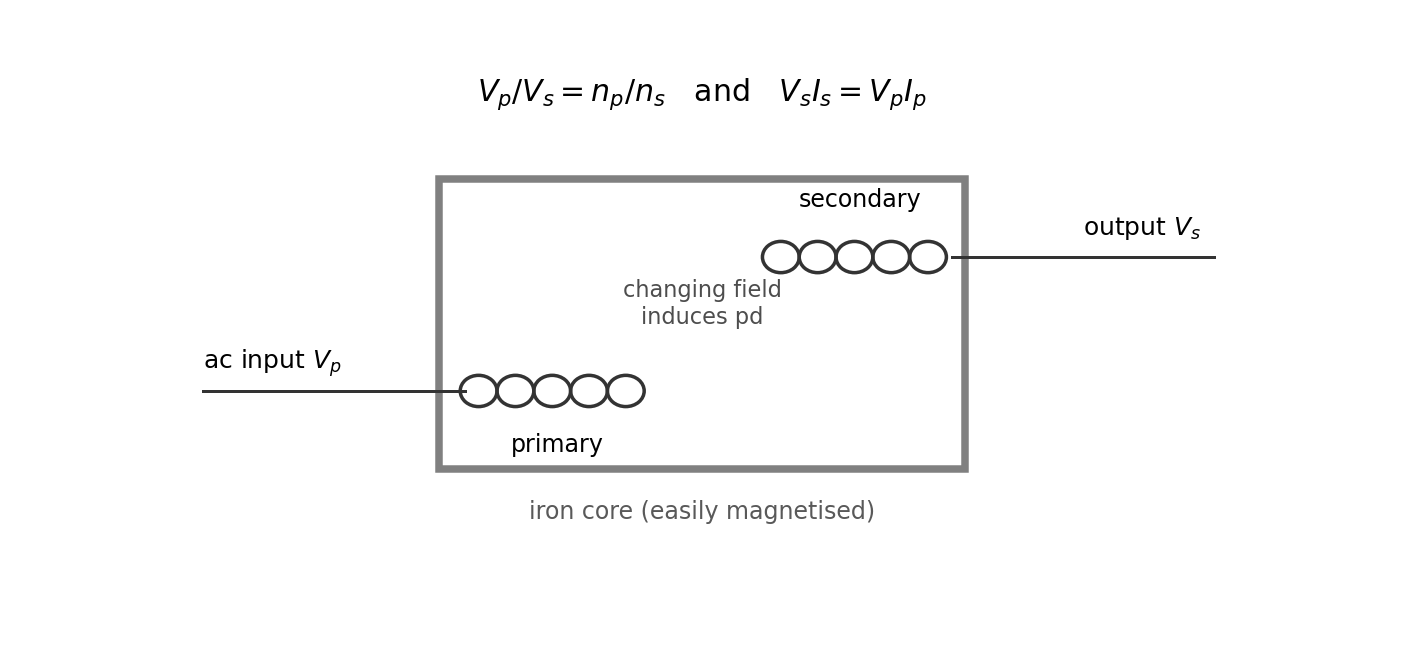
العنصر National Grid 国家电网 transfers electrical energy from power stations to consumers through cables and transformers.
Arrows show the system's energy-transfer route, not individual circuit wires.
A step-up transformer 升压变压器 raises the pd before transmission. For the same power entering the line, a higher sending-end pd means a smaller current: $I=P_{\text{in}}/V$. With the same cable resistance, heating loss $P_{\text{loss}}=I^2R$ is smaller. More of the input energy reaches consumers, so efficiency increases. Loss is reduced, not eliminated.
A step-down transformer 降压变压器 lowers the transmission pd for consumers; UK domestic appliances use about 230 V. This is a lower and more suitable value than transmission pd; it can still cause a dangerous electric shock. Transformer construction and operation are taught in topic 4.7; this section explains their system-level roles.
Actual exam explanation — AQA June 2022 8463/1H Q06.1–06.2. The paper places transformer X before the overhead transmission cables and Y before consumers. X raises pd, reduces current, reduces heating transfer to surroundings and increases transmission efficiency. Y lowers pd to a safer value for consumers. Do not replace the X explanation with only “it is more efficient”: state the physical chain.
Compare two sending potential differences
Teacher-written simplified comparison. Hold sending-end input power at 500 kW and total cable resistance at 2.0 Ω. Compare sending-end pd 10 kV with 20 kV. Use a simplified single-line resistive model and ideal transformers; this is not a calculation of the real three-phase UK network. Convert kW and kV to W and V.
Twice the sending pd gives half the current and one quarter of the cable loss. Input power is unchanged; output power increases because less is lost. A current-and-resistance calculation gives the loss, but cannot by itself give efficiency: total input power or energy is also needed.
Sheet2.7 comparison. At 2000 A through 40 Ω, $P_{\text{loss}}=I^2R=(2000\ \text{A})^2\times40\ \Omega=1.6\times10^8\ \text{W}$. At 500 A through the same resistance, $P_{\text{loss}}=I^2R=(500\ \text{A})^2\times40\ \Omega=1.0\times10^7\ \text{W}$. Current is one quarter, so loss is one sixteenth. Without a stated input, do not claim these losses are a small percentage of the total.
Actual efficiency calculation — AQA June 2023 8463/1H Q01.5. Input energy is 34.2 GJ and efficiency is 0.992. Use $\eta=E_{\text{useful}}/E_{\text{in}}$ and rearrange before substituting. Both energies use GJ here, so the ratio needs no conversion to J.
الكهرباء الساكنة، الفيزياء فقط (عبارة AQA 8463 4.2.5).
اشرح أن فرك المواد العازلة ينقل الإلكترونات، مما يترك شحنات متساوية ومعاكسة للإشارة.
صف القوى بين الأجسام المشحونة: الشحنات المتشابهة تتنافر والشحنات المختلفة تتجاذب، كقوة غير تلامسية.
صف عملية إنتاج الكهرباء الساكنة والشرارات الناتجة عن فرك الأسطح.
ارسم نمط المجال الكهربائي لكرة مشحونة معزولة.
اشرح مفهوم المجال الكهربائي وكيف يفسر القوة غير التلامسية بين الشحنات وظاهرة الشرار.
المصدر: منهج كامبريدج الدولي
When two insulating materials are rubbed together, الإلكترونات — negative charges — are rubbed off one and onto the other:
the material gaining electrons becomes negatively charged;
the material losing electrons is left with an equal positive charge.
Charged objects exert forces without contact: like charges repel; unlike charges attract — a non-contact force. A large potential difference can create a strong electric field 电场 across a small air gap. If the field is strong enough, the air becomes conducting (electrical breakdown), and charge flows briefly across the gap as a spark. An earthed conductor can receive a spark; earthing does not remove a nearby high-voltage source.
A charged object creates an electric field around itself: a region where another charge feels a force.
Electrons move; the field tells the force. The field is strongest close to the object and weaker further away.
You must draw the field pattern for an isolated charged sphere: straight radial lines pointing away from a positive charge (or towards a negative one), spaced wider as they get further from the sphere.
Link the explanation to real exam questions
AQA June2022 8463/1H Q05.1: electrons move from cloth to rod; electrons are negative, so the cloth is left with excess positive charge. Do not describe positive charge transferring. Q05.4: the large pd can cause air breakdown; electrons flow through the air from the negative rod to the earthed conductor.
AQA June2024 8463/1H Q04.1–04.3: electrons transfer to the student, her hairs gain the same negative charge, and like charges repel. The electric field is a region where another charged object experiences a force; its strength decreases with distance.
Q04.4: a spark transfers 0.60 J with 2.0 microcoulombs of charge. Convert $Q=2.0\times10^{-6}\ \mathrm{C}$. Choose $E=QV$ and rearrange:
Neutral-object extension for sheet2.8. A charged rod can attract neutral paper because it slightly separates positive and negative charge within the paper. The nearer opposite charges feel stronger attraction than the repulsion of the further like charges. In an insulating wall, bound charges shift slightly; do not assume electrons flow freely through it. Attraction alone does not prove opposite net charges. In the sheet's rod question, all rods are stated to be charged, so the unlike-charge rule applies.
Why does a metal spoon sink while a huge ship floats? Why does sweat cool you down? Both answers live in the particle model. This reference covers AQA GCSE Physics 8463, topic 4.3 Particle model of matter.
How the exam treats this topic:
Paper 1 (4.1–4.4) carries this topic. Practise choosing and rearranging $\rho = m/V$, $\Delta E = mc\Delta\theta$, $E = mL$ و $pV = \text{constant}$. Use the Physics Equations Sheet supplied for your examination series when one is provided.
Pressure in gases and doing work on a gas are physics only (work on a gas also Higher Tier).
You must interpret heating and cooling graphs that include changes of state.
You must distinguish specific heat capacity from specific latent heat in words and in calculations.
3.1
Density of materials
المنهج
كثافة المواد (عبارة AQA 8463 4.3.1.1).
استخدم الكثافة = الكتلة / الحجم بالوحدات kg/m3 و g/cm3، وقم بالتحويل بينها.
استخدم النموذج الجزيئي لتفسير حالات المادة المختلفة والفروقات في كثافتها.
اعرف ورسم مخططات بسيطة تمثّل المواد الصلبة والسائلة والغازية.
العملي المطلوب 5: حدد كثافات الأجسام الصلبة المنتظمة وغير المنتظمة والسوائل باستخدام الأبعاد والميزان وتقنية الإزاحة.
المصدر: منهج كامبريدج الدولي
$$\rho = \frac{m}{V}$$
$\rho$الكثافة 密度 in kg/m³; $m$ mass in kg; $V$ volume in m³.
Use consistent units. To express a result in kg/m³, convert g/cm³. $1\ \text{g/cm}^3 = 1000\ \text{kg/m}^3$ (multiply by 1000: a cm³ is a millionth of a m³ and a gram is a thousandth of a kg).
The particle model explains the states of matter:
Pattern, contact, spacing.
الحالة
الترتيب
الحركة
صلب
close, regular
vibrate about fixed positions
سائل
close, irregular
move past each other
غاز
far apart
random; straight paths between collisions
Solids and liquids have similar densities because their particles are similarly packed; a gas is mostly empty space.
Ice is unusual: water expands on freezing, so ice is slightly less dense than water.
Worked example. A ring has mass 9.46 g and volume 0.44 cm³. Find its density in kg/m³.
This is the volume passing in each second. AQA June 2024 Q07.5 reverses the ring example: given density 21500 kg/m³ and volume 0.44 cm³, calculate mass. Convert the volume, then use $m=\rho V=21500\ \mathrm{kg/m^3}\times4.4\times10^{-7}\ \mathrm{m^3}=0.00946\ \mathrm{kg}$.
Teacher-written liquid example. The empty cylinder is 42 g; cylinder plus 60 cm³ of liquid is 90 g. Subtract $m=90\ \mathrm{g}-42\ \mathrm{g}=48\ \mathrm{g}$, then $\rho=m/V=48\ \mathrm{g}/60\ \mathrm{cm^3}=0.80\ \mathrm{g/cm^3}$.
Required practical 5: density
Regular shapes from dimensions; irregular shapes by displacement.
Regular solid: measure length, width and thickness with a ruler (or micrometer/Vernier callipers), multiply for $V$; find $m$ on a balance; $\rho = m/V$.
Irregular solid: fill a displacement (eureka) can to the spout, wait for dripping to stop, lower the object in on thin string; the volume of water collected in a measuring cylinder equals the object's volume.
سائل: find the mass of an empty measuring cylinder, then the mass with a known volume inside; subtract for $m$.
Accuracy points: read the measuring cylinder at eye level on a flat surface (avoid parallax); use thin string so it displaces almost no water; repeat and average.
AQA June 2022 8463/1H Q02.1–02.4: describe a complete rock-density method, then interpret $2.55\pm0.10$g/cm³ as the interval 2.45–2.65 g/cm³. Repeated readings allow a mean and reduce random-error effects; they do not remove a systematic calibration error. In a cylinder-displacement method, subtract initial volume from final volume, fully submerge the rock and avoid trapped bubbles.
التغيرات في الحالة والطاقة الداخلية (عبارات AQA 8463 4.3.1.2-4.3.2.1).
صف الانصهار والتجمد والغلي والتبخر والتكاثف والتسامي، وأنّ الكتلة تُحفظ خلال هذه العمليات.
اشرح أن التغيرات في الحالة هي تغيرات فيزيائية تستعيد الخصائص الأصلية عند عكسها.
عرّف الطاقة الداخلية بأنها مجموع الطاقة الحركية والطاقة الكامنة لجميع الجسيمات في النظام.
اشرح أن التسخين قد يرفع درجة الحرارة أو يُحدث تغييراً في الحالة.
المصدر: منهج كامبريدج الدولي
When a substance melts, freezes, boils, evaporates, condenses or sublimates 升华:
الكتلة محفوظة in a closed system: the number of particles does not change. If vapour leaves an open container, the remaining material loses mass, but the total including the escaped vapour is conserved.
Changes of state are physical changes 物理变化: reverse the change and the material recovers its original properties. (A chemical change makes new substances; melting does not.)
الطاقة الداخلية 内能 is the total kinetic and potential energy of all the particles that make up a system. Heating a system increases the particles' energy, and that energy goes one of two ways:
it raises the temperature — the particles' kinetic energy grows;
it produces melting or boiling — the particles' potential energy increases as their arrangement changes. For a pure substance changing state at constant pressure, temperature stays constant. During freezing or condensation, energy is released and potential energy decreases.
Teacher-written heating-pad example. A 0.20 kg pad with $c=900\ \mathrm{J/(kg\,{}^{\circ}C)}$ warms from 22 °C to 46 °C. First find $\Delta\theta=46-22=24\,{}^{\circ}\mathrm{C}$, then:
الحرارة الكامنة النوعية والرسوم البيانية للتسخين (عبارة AQA 8463 4.3.2.3).
استخدم الطاقة لتغير الحالة = الكتلة × الحرارة الكامنة النوعية (E = mL).
عرّف الحرارة الكامنة النوعية وفرق بين الانصهار والتبخر.
فسّر الرسوم البيانية للتسخين والتبريد التي تتضمن تغيرات الحالة.
فرّق بين السعة الحرارية النوعية والحرارة الكامنة النوعية.
المصدر: منهج كامبريدج الدولي
For a pure substance melting or boiling at constant pressure, temperature remains constant while energy enters. Freezing and condensation release energy at constant temperature under the same conditions. The energy needed is called الحرارة الكامنة 潜热:
$$E = mL$$
$E$ energy for the change of state in J; $m$ mass that changes state in kg; $L$specific latent heat 比潜热 in J/kg.
الحرارة الكامنة النوعية is the energy needed to change the state of one kilogram of a substance with no change of temperature.
Fusion 熔化: solid to liquid. Vaporisation 汽化: liquid to vapour. These are different changes, with different values of $L$. For water, the specific latent heat of vaporisation is much greater than that of fusion; use the value for the stated material and change.
A and C warm single phases; B is melting; D is boiling; E warms the gas. The temperatures are for this generic substance, not water.
Reading the graph:
Rising sections: energy goes into kinetic energy — the temperature climbs ($\Delta E = mc\Delta\theta$).
Flat sections: energy goes into potential energy — the state is changing ($E = mL$). For the same material, change of state and constant net heating power, a longer plateau means more mass changed state. If $L$ or heating power differs, time alone does not identify the mass.
Cooling has the reverse sequence of state changes: flat while a pure substance freezes or condenses at constant pressure, releasing latent heat. Rates and durations need not mirror the heating graph.
Distinguishing the two: specific heat capacity involves a temperature change; specific latent heat involves a change of state at constant temperature.
Teacher-written worked example. A 30 W heater runs for 11 minutes and boils off $6.6\times10^{-3}$ kg of water already at its boiling point. Estimate $L$ assuming all heater energy reaches the boiling water, then explain the effect of heat loss.
During boiling, potential energy increases while average kinetic energy and temperature remain constant; internal energy increases.
AQA June 2022 Q08.3–08.5: beaker-and-water mass falls from 0.080 kg to 0.071 kg while the heater transfers 25200 J. The evaporated mass is 0.009 kg, so $L=E/m=25200\ \mathrm{J}/0.009\ \mathrm{kg}=2.8\times10^6\ \mathrm{J/kg}$. Heat transferred to the surroundings makes the heater-energy estimate of $L$ too high. Conversely, including water lost before boiling overstates the mass associated with the measured boiling energy and makes the estimate too low. Identify which measured quantity is biased before predicting the result.
حركة الجسيمات في الغازات (عبارة AQA 8463 4.3.3.1).
صف جزيئات الغاز بأنها في حركة عشوائية مستمرة.
ربط درجة حرارة الغاز بالطاقة الحركية المتوسطة لجزيئاتها.
اشرح ضغط الغاز بدلالة تصادمات الجزيئات بجدران الوعاء.
اشرح كيف يتغير ضغط حجم ثابت من الغاز مع درجة الحرارة بشكل نوعي.
المصدر: منهج كامبريدج الدولي
The molecules of a gas are in constant random motion. Its temperature is related to the average kinetic energy of the molecules: hotter gas, faster particles.
Explain gas pressure using the particle model:
The force on the wall is perpendicular to it; molecules can approach obliquely.
the moving molecules collide with the container walls;
each collision exerts a force at right angles to the wall;
pressure is force per unit area — the total of many tiny collisions spread over the wall.
Temperature up (constant volume) → pressure up: the molecules move faster on average, so they hit the walls more often و harder (larger force each impact), so the force per unit area rises.
Actual explanation — AQA June 2025 8463/1H Q08.3: after the nitrogen has boiled, its gas temperature rises in the sealed fixed-volume container. Mean kinetic energy and mean speed increase; collisions exert greater force and occur more frequently, so pressure increases. State the fixed-volume condition.
3.6
Pressure in gases (physics only)
المنهج
ضغط الغازات والشغل المبذول على الغاز، فيزياء فقط (عبارات AQA 8463 4.3.3.2-4.3.3.3).
استخدم الضغط × الحجم = ثابت لكتلة ثابتة من الغاز عند درجة حرارة ثابتة.
احسب الضغط الجديد أو الحجم عندما يتغير أحدهما.
استخدم نموذج الجسيمات لشرح كيف يؤدي زيادة حجم الغاز إلى انخفاض ضغطه.
(للطلاب المتقدمين فقط) اشرح كيف يؤدي بذل شغل على غاز إلى زيادة طاقته الداخلية ورفع حرارته، مثل مضخة الدراجة الهوائية.
المصدر: منهج كامبريدج الدولي
A gas can be compressed or expanded by pressure changes. For a fixed mass of gas at constant temperature:
$$pV = \text{constant}$$
$p$ pressure in pascals, Pa; $V$ volume in m³.
Before/after form: $p_1V_1 = p_2V_2$.
The particle explanation of each direction:
Volume up → pressure down (constant temperature): at the same average speed, molecules collide with each unit area of wall less frequently, so force per unit area falls.
Volume down → pressure up: at the same average speed, molecules collide with each unit area of wall more frequently, so force per unit area rises.
Worked example. A syringe holds 50 cm³ of air at 100 kPa. It is compressed to 20 cm³ at constant temperature.
Convert or keep consistent: volumes in cm³ cancel; pressures must be consistent.
ضغط الغازات والشغل المبذول على الغاز، فيزياء فقط (عبارات AQA 8463 4.3.3.2-4.3.3.3).
استخدم الضغط × الحجم = ثابت لكتلة ثابتة من الغاز عند درجة حرارة ثابتة.
احسب الضغط الجديد أو الحجم عندما يتغير أحدهما.
استخدم نموذج الجسيمات لشرح كيف يؤدي زيادة حجم الغاز إلى انخفاض ضغطه.
(للطلاب المتقدمين فقط) اشرح كيف يؤدي بذل شغل على غاز إلى زيادة طاقته الداخلية ورفع حرارته، مثل مضخة الدراجة الهوائية.
المصدر: منهج كامبريدج الدولي
Work is the transfer of energy by a force. In a rapid compression with little heat transfer to the surroundings, work done on the gas increases its internal energy and can raise its temperature.
The credited chain (bicycle pump): pushing the pump's handle does work on the trapped gas → energy is transferred to the gas's particles → their average kinetic energy rises → the temperature of the gas increases (the pump feels warm).
A gas doing work on its surroundings can cool if energy is not replaced by heating. Compression or expansion does not always change temperature: sufficiently slow changes with heat exchange can be approximately isothermal. Do not apply $pV=\text{constant}$ to a rapid compression that heats the gas unless constant temperature is stated or justified.
3.6
Checklist before you call this topic done
Convert g/cm³ to kg/m³, and cm³ to m³, before using $\rho = m/V$.
Describe RP5 for regular solids, displacement and liquids, with accuracy points.
State that mass is conserved in changes of state and that they are physical changes.
Define internal energy as total kinetic plus potential energy of the particles.
Choose between $\Delta E = mc\Delta\theta$ (temperature changes) and $E = mL$ (state changes).
Radioactivity is over a century old, yet it still treats cancer, powers grids and demands strict safety rules. This reference covers AQA GCSE Physics 8463, topic 4.4 Atomic structure.
How the exam treats this topic:
Paper 1 (4.1–4.4) carries this topic. Equation-sheet support depends on the examination series. Practise notation, balanced equations, graphs and explanations as well as calculations.
Background radiation, half-life hazards, uses and fission/fusion are physics only.
Net-decline ratios after several half-lives are Higher Tier.
You must write balanced nuclear equations for single alpha and beta decay (balance atomic numbers and mass numbers; daughter naming not required).
4.1
The structure of an atom; isotopes
المنهج
بنية الذرة؛ العدد الكتلي والنظائر (عبارات AQA 8463 4.4.1.1-4.4.1.2).
صف بنية الذرة كنواة موجبة من البروتونات والنيوترونات محاطة بإلكترونات على مستويات طاقة مختلفة.
تذكر الرتبة المقدارة لنصف قطر الذرة وأن النواة أقل من 1/10 000 منها، وتحمل معظم الكتلة.
استخدم العدد الذري والعدد الكتلي لإيجاد البروتونات والنيوترونات والإلكترونات.
عرّف النظائر على أنها ذرات للعنصر نفسه ذات أعداد نيوترون مختلفة، واشرح الأيونات الموجبة على أنها ذرات فقدت إلكتروناتها الخارجية.
المصدر: منهج كامبريدج الدولي
An atom is very small: radius about $1\times10^{-10}$ m. Its structure:
النواة: positively charged, with protons and neutrons; most of the atom's mass, but a radius less than 1/10 000 of the atom's.
Electrons: negative, arranged in energy levels. Absorbing electromagnetic radiation moves an electron to a higher level, further from the nucleus; emission moves it to a lower level, الأقرب.
Notation: $\ ^{A}_{Z}X$ where $Z$ = atomic number (protons) and $A$ = mass number (protons + neutrons). In a neutral atom, electrons = protons; atoms have no overall charge.
النظائر 同位素: atoms of the same element (same $Z$) with different numbers of neutrons (different $A$).
Neutrons in the nucleus = $A - Z$.
Atoms that lose one or more outer electrons become أيونات موجبة.
صف التسلسل: الكرات غير القابلة للتجزئة، نموذج كعكة الزبيب، النموذج النووي، مدارات بور، البروتونات، النيوترونات.
اشرح لماذا أدت أدلة تشتت ألفا إلى النموذج النووي.
صف الفرق بين نموذج كعكة الزبيب والنموذج النووي.
المصدر: منهج كامبريدج الدولي
New experimental evidence can change or replace a scientific model:
Before the electron's discovery: atoms were tiny spheres that could not be divided.
Electron discovered → the plum pudding model: a ball of positive charge with negative electrons embedded in it.
Alpha scattering (Rutherford): most alpha particles passed straight through, a few bounced back → the mass and positive charge must be concentrated in a tiny centre → the nuclear model replaced the plum pudding model.
Bohr adapted it: electrons orbit at specific distances; his calculations agreed with observations.
Further work showed the positive charge comes in whole-number units — the بروتون; Chadwick's experiments (about 20 years later) proved the نيوترون.
Explain the evidence that changed the model: if the pudding were right, alpha particles should all pass through with small deflections (B1); some bounced almost straight back (B1), which is only possible if the mass and positive charge sit in a tiny, dense, positive nucleus (B1).
4.3
Radioactive decay and nuclear radiation
المنهج
التحلل الإشعاعي والإشعاع النووي (عبارة AQA 8463 4.4.2.1).
صف التحلل الإشعاعي كعملية عشوائية تتحرر فيها الأنوية غير المستقرة إشعاعات.
عرّف النشاط (بيكريل) ومعدل العد.
حدد طبيعة إشعاعات ألفا وبيتا وجاما والنيوترونات، مع ذكر القدرة على الاختراق والمدى في الهواء وقوة التأين.
طبق الخصائص لاختيار المصدر الأمثل لاستخدام معين.
المصدر: منهج كامبريدج الدولي
Some nuclei are unstable. They give out radiation as they change to become more stable — a random process called radioactive decay 放射性衰变.
Activity 放射性活度: the rate at which a source decays; unit becquerel 贝克勒尔 (Bq).
Count-rate 计数率: detector counts per second, after allowing for background where needed. A detector usually records only some emissions: its count rate is not automatically the source activity in Bq.
Radiation
Identity
Ionising power
Shielding
alpha α
helium nucleus
قوي
paper / skin
beta β
fast electron
الوسط
mm of aluminium
gamma γ
EM radiation
ضعيف
thick lead reduces it
Alpha contains two protons and two neutrons and travels only a few centimetres in air. Beta is emitted when a neutron changes into a proton; its range in air is longer. Gamma has the greatest range of these three and is reduced, not completely stopped, by thick lead or concrete. A nucleus can also emit a neutron; detailed neutron properties are not required here.
Choose a source for a use by matching these properties: alpha for ionisation smoke alarms (smoke reduces the ionisation current); beta for thickness control (partly absorbed by the sheet); gamma for tracers (escapes the body) and sterilising (penetrates packaging and damages microorganisms). A sealed source reduces contamination risk; it does not justify ignoring handling precautions.
Activity from a graph. On a graph of the number of undecayed nuclei against time, draw a tangent at the stated time. Its downward gradient is the rate of decrease in the number of nuclei; activity is the positive magnitude, in Bq. Read two widely separated points on the tangent, not two arbitrary points on the curve.
Worked example (teacher-written). The approximate tangent passes through $(0\ \text{s},68000)$ و $(200\ \text{s},12000)$.
$$\text{activity} = \frac{\text{decrease in number of nuclei}}{\text{time interval}} = \frac{68000-12000}{200\ \text{s}-0\ \text{s}} = 280\ \text{Bq}$$
This is an estimate from a drawn tangent. AQA June 2024 8463/1H Q09.5 requires the same method on its own graph at 300 s; its official answer is $7.1\times10^{20}$ Bq. Those are different graphs and data.
Check both rows balance ✓ (the daughter's name is not required).
4.4
Half-lives and the random nature of decay
المنهج
المعادلات النووية، عمر النصف والطبيعة العشوائية للتحلل (عبارات AQA 8463 4.4.2.2-4.4.2.3).
اكتب المعادلات النووية الموزونة لتحلل ألفا وبيتا المفرد، مع موازنة الأعداد الذرية والكتلية.
عرّف عمر النصف بأنه الوقت اللازم لنصف عدد الأنوية أو معدل العد.
حدد عمر النصف من معلومات معطاة أو من رسم بياني.
(للمستوى المتقدم فقط) احسب الانخفاض الصافي، معبراً عنه كنسبة، بعد عدد محدد من أعمار النصف.
المصدر: منهج كامبريدج الدولي
Decay is random: it cannot be predicted for any one nucleus; only the average behaviour of many is predictable.
العمر النصفي 半衰期: the time for (a) the number of nuclei of the isotope in a sample to halve, or (b) the net count rate / activity to fall to نصفه its initial level. Subtract background from detector readings first and keep the detector geometry unchanged.
From a graph: read the time for the count rate to halve — repeat over several halvings and average.
After $n$ half-lives, the fraction remaining is $1/2^n$ (HT: express as a ratio).
Worked example. A sample's activity falls from 800 Bq to 200 Bq in 12 years.
Actual AQA demand, June 2025 8463/1H Q07.4: polonium-210 has a half-life of 138 days. The number of atoms falls from 256 000 to 16 000: four halvings, so the time is $4 \times 138 = 552$ days. Q07.5 compares equal numbers of Po-209 and Po-210 atoms: the longer-lived Po-209 has lower activity. The equal-population condition matters.
عرّف التلوث الإشعاعي والتعرض للإشعاع، وأشر إلى أن الأجسام المعرضة للإشعاع لا تصبح مشعة.
قارن مخاطر التلوث الإشعاعي والتعرض للإشعاع.
صف التدابير الوقائية المناسبة ضد مخاطر المصادر المشعة.
اشرح أهمية نشر ودراسة المراجعات الأقرانية لأبحاث تأثيرات الإشعاع.
المصدر: منهج كامبريدج الدولي
Contamination 污染: unwanted radioactive atoms on or inside an object or person. The hazard lasts as long as the atoms are there, decaying on or in the body.
Irradiation 辐照: exposing an object to radiation. The irradiated object does not become radioactive.
Contamination can continue to irradiate tissue while the radioactive atoms remain. Exposure from an external source ends when that source is removed or effectively shielded. Compare the source activity, radiation type, distance, exposure time and whether material is inside the body; contamination is not always the larger dose. External alpha has low penetration and is stopped by skin, but internally its strong ionisation can damage nearby living tissue.
Precautions: hold sources with tongs, keep them at a المسافة, limit الزمن near them, point them away from people, store in lead-lined boxes. Findings on radiation effects are published and peer-reviewed so they can be checked.
Half-life hazards and uses of radiation (physics only)
المنهج
الإشعاع الخلفي، ومخاطر نصف العمر والاستخدامات (بيانات AQA 8463 4.4.3.1-4.4.3.3، الفيزياء فقط).
صف المصادر الطبيعية والصناعية للإشعاع الخلفي.
حدد أن الجرعة تعتمد على المهنة والموقع، وطرح الإشعاع الخلفي من القياسات.
اشرح كيف تختلف المخاطر وفقاً لنصف العمر.
صف وقوّم استخدامات الإشعاع النووي في الطب لاستكشاف الأعضاء الداخلية وتدمير الأنسجة غير المرغوب فيها.
المصدر: منهج كامبريدج الدولي
Half-life and hazard: for equal numbers of unstable nuclei, a shorter half-life means greater activity. Amount and exposure conditions also matter. A long-lived source may require secure storage for many years. A medical tracer should remain active long enough for the investigation, then decay quickly to reduce further dose. A smoke-alarm source must remain useful for years.
Medical uses (each = exploration or destruction):
Exploration: a gamma-emitting tracer (e.g. technetium-99m) injected so organs show on a scan; gamma escapes the body; a suitable short half-life limits dose after the scan.
Destruction: focused gamma beams or implanted sources kill cancer cells (radiotherapy); beta for skin conditions.
Evaluating risk: compare the dose and consequence of the procedure against the risk of the illness — with numbers from the question.
4.7
Nuclear fission and fusion (physics only)
المنهج
الانشطار والاندماج النووي (بيانات AQA 8463 4.4.4.1-4.4.4.2، الفيزياء فقط).
صف الانشطار النووي: امتصاص نيوترون بواسطة نواة كبيرة غير مستقرة، والنواتج، والطاقة المنبعثة.
اشرح التفاعلات المتسلسلة والفرق بين الإصدارات المُنظَّمة (المفاعل) وغير المُناظَمة (السلاح).
ارسم وقوِّم المخططات التي تمثل الانشطار والتفاعلات المتسلسلة.
صف الاندماج النووي كاندماج نواتين خفيفتين مع تحول الكتلة إلى طاقة إشعاعية.
المصدر: منهج كامبريدج الدولي
Fission 核裂变: the splitting of a large, unstable nucleus (uranium-235, plutonium-239).
Spontaneous fission is rare: the nucleus usually absorbs a neutron first.
It splits into two smaller nuclei of roughly equal size, releasing two or three neutrons و gamma rays; energy is released and all products carry kinetic energy.
The released neutrons can cause further fissions — a chain reaction. A reactor controls it (control rods absorb neutrons); a weapon's explosion is an uncontrolled chain.
You must draw or interpret the diagram: neutron in → two fragments + neutrons out → branching chain.
Fusion 核聚变: two light nuclei join to form a heavier nucleus; some mass converts into the energy of radiation. To join, the positive nuclei must approach closely despite their electrical repulsion. Do not describe fusion as chemical bonding or claim that every fusion system is waste-free.
A bridge, a brake, a bungee cord, a planet in orbit: engineers analyse them all with forces. This reference covers AQA GCSE Physics 8463, topic 4.5 Forces — the largest topic of Paper 2.
How the exam treats this topic:
Paper 2 (4.5–4.8) carries this topic, and it may also draw on energy and electricity ideas. Equation-sheet support depends on the examination series. Practise choosing an equation, rearranging it and using SI units; check the sheet supplied for your examination.
Moments, levers and gears and fluid pressure are physics only. Interpreting terminal-velocity graphs is also physics only. Momentum is Higher Tier; collision calculations and changes in momentum are physics only.
Free-body diagrams, vector diagrams (scale drawing) and resolution of forces are HT only.
Required practicals: RP6 (force–extension of a spring) and RP7 (force and mass effect on acceleration).
ميّز بين الكميات القياسية والمتجهة، مع ذكر أمثلة لكل منها.
مثّل المتجهات بأسهم يكون طولها دليلاً على المقدار.
صنّف القوى التلامسية وغير التلامسية مع ذكر أمثلة.
استخدم الوزن = الكتلة × شدة المجال الجاذبي، واستذكر مركز الثقل ومقياس القوة (نيوتنميتر).
احسب المحصلة لقوى مستقيمة الاستقامة؛ (HT) استخدم مخطلات الجسم الحر، وحلّل القوى وأوجد المحاصل برسم مقياسي.
المصدر: منهج كامبريدج الدولي
Scalar 标量: magnitude only — distance, speed, mass, energy. Vector 矢量: magnitude و direction — displacement, velocity, force, weight, momentum. A vector is drawn as an arrow: length = magnitude, direction = direction.
A القوة is a push or pull from the interaction with another object:
contact 接触 forces (touching): friction, air resistance, tension, normal contact force;
الجاذبية: الوزن 重力 is the force on an object due to gravity; it acts at the centre of mass 质心 and is measured with a calibrated spring-balance (newtonmeter):
$$W = mg$$
$W$ weight in N; $m$ mass in kg; $g$ gravitational field strength in N/kg (given, usually 9.8 near Earth).
Weight and mass are directly proportional ($W \propto m$).
القوة المحصلة 合力: the single force replacing several forces with the same effect. Collinear: add same-direction forces, subtract opposite ones. (HT) Use free-body diagrams 自由体图 (only the forces on the chosen object), resolve a force into perpendicular components, and find resultants by scale drawing.
Worked example. A 65 kg person stands on Mars where $g = 3.7$ N/kg.
Worked scale drawing (HT; teacher-written). Use 1 cm for 10 N. Draw 4.0 cm east, then 3.0 cm north. The resultant joins the first tail to the last head: 5.0 cm represents 50 N, about 37° north of east. The equilibrant has equal magnitude in the opposite direction.
Exam demand. AQA June2025 8463/2H Q05.5 uses 240 N upwards and 200 N left. A scale triangle or parallelogram gives about 310 N, 40° left of vertical (official ranges 300–320 N and 38–42°). The diagram, arrow directions and scale are part of the method.
اشرح لماذا يلزم وجود أكثر من قوة واحدة لتمديد أو ثني أو ضغط جسم ساكن.
فرّق بين التشوه المرن واللامرن.
استخدم القوة = ثابت الزنبرك × الامتداد و E = 0.5 k e² تحت حد التناسب.
فسر بيانات وقوائم القوة والامتداد؛ احسب ثابت الزنبرك كميل.
العملي المطلوب 6: تحقيق العلاقة بين القوة والامتداد لزنبرك.
المصدر: منهج كامبريدج الدولي
More than one force is needed to stretch, bend or compress a stationary object (a single force would just move it). Elastic deformation 弹性形变 is recovered when the forces are removed; inelastic 非弹性 is not.
Below the limit of proportionality:
$$F = ke \qquad E_e = \tfrac12 ke^2$$
$k$ spring constant in N/m (stiff spring → large $k$); $e$ extension = stretched length − original length (or compression).
Work done on the spring = elastic energy stored (if not inelastically deformed).
Required practical 6: hang masses on a spring, measure extension for each (ruler at eye level), plot force against extension. The linear section's gradient is $k$; beyond the limit of proportionality the line curves. Hooke's-law reasoning: doubling the force doubles the extension only below the limit.
Worked example (AQA June2025 Q02.7). A force of 4.0 N produces extension 0.064 m. Choose $F=ke$ in the proportional region, then rearrange:
A plot of total طول has a non-zero intercept because the unloaded spring has a non-zero length. A curve away from the proportional line means $F$ و $e$ are no longer proportional; unload the spring to test for permanent deformation. Secure the stand, limit loading, keep the ruler vertical and close, and use a pointer at eye level.
العزوم والأذرع والتروس، الفيزياء فقط (عبارة AQA 8463 4.5.4).
استخدم عزم القوة = القوة × المسافة العمودية من نقطة الارتكاز.
طبق توازن عزوم الدوران في اتجاه عقارب الساعة وعكسها.
اشرح كيف تنقل الأذرع والتروس التأثيرات الدورانية للقوى.
المصدر: منهج كامبريدج الدولي
$$M = Fd$$
$M$ اللحظة 力矩 in N·m; $d$ is the perpendicular distance from the pivot to the line of action of the force.
التوازن: total clockwise moment = total anticlockwise moment.
Levers و gears transmit the rotational effect of a force. A longer lever arm produces a larger moment for the same perpendicular force. In an ideal pair of meshed gears, the teeth exert equal forces at the contact: a larger driven gear turns more slowly with a larger moment. The meshed gears turn in opposite directions.
Worked example. Choose the pivot and equate clockwise and anticlockwise moments:
For AQA June2024 Q02.6, convert the perpendicular distance 7.5 cm to 0.075 m: $M=Fd=2.0\ \text{N}\times0.075\ \text{m}=0.15\ \text{N\,m}$. In a pair of meshed gears, the teeth produce a force and moment on the other gear; adjacent gears rotate in opposite directions.
$p$ pressure in Pa; $F$ القوة العادي to the surface; $A$ area in m².
(HT) $h$ column height in m, $\rho$ liquid density in kg/m³. Pressure grows with depth and density.
A submerged object feels greater pressure on its bottom than its top → a resultant upthrust 浮力. Floating at rest: upthrust = weight. If weight initially exceeds upthrust, a released object accelerates downwards; a sinking object can later move at constant speed when upthrust plus drag balances its weight.
Atmospheric pressure decreases with height: fewer air molecules above a surface as you climb, so less weight of air; the atmosphere gets less dense with altitude.
Worked example (teacher-written; HT). A 2.0 m water column has density 1000 kg/m³; $g=9.8$ N/kg. Its pressure, additional to that at the free surface, is:
Floating at rest requires a complete force balance. A sinking object can reach constant velocity when upthrust + drag = weight; sinking does not always mean downward acceleration.
وصف الحركة على خط مستقيم (عبارة AQA 8463 4.5.6.1).
فرّق بين المسافة والإزاحة والسرعة والسرعة المتجهة.
استذكر السرعات النموذجية للمشي والجري والدراجة والصوت في الهواء.
استخدم s = vt والسرعة المتوسطة؛ اقرأ بيانات المسافة-الزمن عبر الميل مع (HT) المماسات.
استخدم a = التغير في السرعة / الزمن؛ ميل curves السرعة-الزمن ومساحات (HT)؛ v² - u² = 2as.
صف الحركة في مائع تصل إلى السرعة الحدية.
المصدر: منهج كامبريدج الدولي
المسافة 路程 (scalar): how far. إزاحة 位移 (vector): straight-line distance and direction.
السرعة 速率 (scalar) — typical values: walking ≈ 1.5 m/s, running ≈ 3 m/s, cycling ≈ 6 m/s, sound in air ≈ 330 m/s. السرعة 速度 (vector): speed in a given direction.
$s = vt$ (constant speed); average speed = total distance ÷ total time.
Distance–time graph: gradient = speed; (HT) a tangent gives instantaneous speed of an accelerating object.
التسارع 加速度: $a = \Delta v / t$, in m/s²; deceleration means slowing down. With the initial direction chosen positive, its acceleration is negative. Estimate everyday accelerations.
Velocity–time graph: gradient = acceleration; (HT) signed area gives displacement. Add the magnitudes of areas above and below zero to find total distance. If velocity stays positive, area also gives distance.
Uniform acceleration: $v^2 - u^2 = 2as$. Free fall near Earth: $a \approx 9.8$ m/s².
Worked example (graph). A v–t graph rises straight from 0 to 20 m/s in 8 s, then stays flat for 12 s.
(HT) Positive-velocity areas: $s=s_1+s_2=\tfrac12\Delta t_1v+v\Delta t_2=\tfrac12\times8\times20+20\times12=320$ m.
السرعة النهائية 末速度: a falling object accelerates (weight > drag 空气阻力); as speed grows, drag grows until resultant force = 0 — constant speed = السرعة النهائية. Skydiver: fast terminal before the chute, slow after; interpret the v–t curve shape.
Worked tangent example (HT; teacher-written). At a chosen instant, a tangent to a distance–time curve passes through (2 s, 3 m) and (6 s, 15 m):
القوى والتسارع وقوانين نيوتن (AQA 8463 نص 4.5.6.2، RP7).
صغ وطبّق قانون نيوتن الأول، بما في ذلك (HT) القصور الذاتي.
استخدم القوة المحصلة = الكتلة × التسارع؛ (HT) الكتلة القصورية.
صغ وطبّق قانون نيوتن الثالث على حالات الاتزان.
العملي المطلوب 7: تحقّق من تأثير القوة على التسارع عند كتلة ثابتة، والكتلة عند قوة ثابتة.
المصدر: منهج كامبريدج الدولي
First law: zero resultant force → stationary stays stationary; moving keeps the same velocity. For motion in a straight line at steady speed, driving force = resistive forces. (HT) Inertia 惯性: the tendency to keep the state of motion.
Second law: $a \propto F$, $a \propto 1/m$, so:
$$F = ma$$
(HT) Inertial mass = force ÷ acceleration — resistance to change of velocity.
Required practical 7: trolley on a runway — vary the driving force by transferring masses from the trolley to its hanging holder, keeping the total moving mass constant. For the combined trolley–hanger system, the driving force is the hanger's weight when resistance is negligible or compensated; the string tension on the trolley is a different force. Then keep hanger mass constant and add mass to the trolley. Measure acceleration with light gates; plot $a$ against driving force at fixed total mass, or $a$ عكس $1/m$ where $m$ is total moving mass.
Third law: two interacting objects exert equal and opposite forces on each other — same type, opposite directions, on different objects.
Worked uncertainty example (AQA June2024 Q05.4). Three accelerations are 1.36, 1.39 and 1.33 m/s². The range is 0.06 m/s²; using half the range, report uncertainty ±0.03 m/s². Repeats reveal spread; a mean reduces random variation but does not remove a common calibration error.
From rest under uniform acceleration, acceleration can also be found from distance and time: average speed is $s/t$, final speed is twice the average, and acceleration is final speed divided by time. State the rest/uniform-acceleration assumptions.
Thinking (reaction) distance = reaction time × speed. Reaction time 0.2–0.9 s typically; affected by tiredness, drugs, alcohol, distractions. Measure it: drop a ruler between a partner's fingers — distance fallen → time from $s = \tfrac12 at^2$ (or electronic timers).
مسافة التوقف: grows with speed (for a given braking force); wet or icy roads, worn brakes or tyres lengthen it.
Braking physics: friction between brake and wheel does work on the kinetic energy store; the brakes' temperature rises; a higher speed or shorter stop → larger force needed → larger deceleration → overheating brakes, loss of control. (HT) Estimate deceleration forces with $F = ma$.
Worked example. A 1500 kg car brakes from 30 m/s to rest in 60 m.
Choose initial motion positive. From $v^2-u^2=2as$, $a=(v^2-u^2)/(2s)=(0-30^2)/(2\times60)=-7.5$ m/s².
Braking-force magnitude: $|F|=m|a|=1500\times7.5=11250\approx11000$ N, opposite the initial motion.
Worked exam example (AQA June2025 Q06.3). A 1400 kg car slows uniformly from 18 m/s to rest over 24 m of مسافة الفرملة. Choose the initial direction positive:
The force has magnitude 9450 N, opposite the initial motion. Do not insert thinking distance into the braking equation.
5.9
Momentum (HT; calculations physics only)
المنهج
الزخم، (HT) فقط (AQA 8463 نص 4.5.7).
استخدم الزخم = الكتلة × السرعة.
طبّق مبدأ حفظ الزخم على الاصطدامات في نظام مغلق.
استخدم القوة = التغير في الزخم / الزمن.
اشرح ميزات السلامة عن طريق أن زيادة زمن الاصطدام تقلل القوة.
المصدر: منهج كامبريدج الدولي
$$p = mv \qquad F = \frac{m\Delta v}{\Delta t}$$
$p$ momentum in kg m/s (a vector); conservation: in a closed system, total momentum before = total momentum after an event (collisions).
$F = m\Delta v/\Delta t$: force = rate of change of momentum (this is $F = ma$ restated).
Safety features explained by it: air bags, seat belts, crash mats, cycle helmets, cushioned playgrounds — all increase the time over which momentum changes, so $\Delta v/\Delta t$ falls and the force falls.
Worked example. A 1000 kg car at 20 m/s hits a barrier and stops in 0.25 s.
Magnitude of momentum change: $|\Delta p| = m|\Delta v| = 1000 \times 20 = 20\,000$ kg m/s.
Mean force magnitude: $|\bar F| = |\Delta p| / \Delta t = 20\,000/0.25 = 80\,000$ N, opposite the motion. With a crumple zone ($\Delta t = 0.50$ s), the mean force magnitude halves to 40 000 N for the same momentum change.
Worked collision example (sheet 5.9). A 2.0 kg trolley moving right at 3.0 m/s sticks to a stationary 1.0 kg trolley. With negligible external horizontal impulse, take right positive:
Momentum conservation does not require kinetic energy conservation. For a rebound, keep signed velocities: a 0.16 kg ball changes from +12 to −8.0 m/s, so $\Delta p=m(v-u)=-3.2$ kg m/s. Over 0.020 s, mean force is $\bar F=\Delta p/\Delta t=-160$ N (160 N left). The wall experiences the equal, opposite mean force.
Air-bag explanation (AQA June2025 Q06.2). For the same driver and momentum change, the bag lengthens stopping time, reducing the rate of momentum change and mean force. This reduces injury risk; it does not guarantee a harmless collision.
Ripples on a pond, the sound of a voice, the light of a distant star — all are waves carrying energy from a source to an absorber. This reference covers AQA GCSE Physics 8463, topic 4.6 Waves.
How the exam treats this topic:
Paper 2 carries this topic. $T = 1/f$, $v = f\lambda$ and magnification are on the enclosed sheet.
Reflection (RP9), sound, detection waves, lenses, visible light and black-body radiation are physics only; sound and detection are also HT only; parts of EM properties are HT only.
Required practicals: RP8 (wave speed in a ripple tank and a solid) and RP9 (reflection and refraction, physics only).
You must construct ray diagrams for reflection, refraction and lenses.
6.1
موجات مستعرضة وطولية
المنهج
الموجات في الهواء والسوائل والصلب (AQA 8463 نصوص 4.6.1.1-4.6.1.2، RP8).
صف الفرق بين الموجات المستعرضة والطولية مع أمثلة.
صف الأدلة التي تثبت أن الموجة هي التي تنتقل، وليس المادة.
استخدم السعة، والطول الموجي، والتردد، والفترة؛ طبق معادلة: الفترة = 1/التردد، وسرعة الموجة = التردد × الطول الموجي.
صف طرق قياس سرعة الصوت في الهواء وموجات الرipples على الماء.
العملي المطلوب 8: قِس التردد والطول الموجي والسرعة في حوض موجات وفي جسم صلب.
(الفيزياء فقط) اربط بين تغيرات السرعة والتردد والطول الموجي عند انتقال الصوت بين وسطين مختلفين.
المصدر: منهج كامبريدج الدولي
النوع
Vibration direction
أمثلة
مستعرضة 横波
across the travel direction
water ripples, all electromagnetic waves
طولية 纵波
along the travel direction
sound in air
Longitudinal waves show compressions 密部 (particles squashed) and rarefactions 疏部 (particles spread).
Evidence that the wave travels, not the material: a ripple moves across a pond but the water itself just bobs up and down (a ball on the surface stays put); sound reaches you but the air does not travel from source to ear.
Ripples: darkened ripple tank, straight-bar motor makes continuous waves; photograph/measure the wavelength with a ruler on the screen, count waves passing a point in 10 s for frequency; $v = f\lambda$.
Waves in a solid: a vibration generator sends waves along a stretched string; adjust the frequency until a clear whole number of loops appears — measure the length and count loops for $\lambda$; $f$ is read from the signal generator.
Speed of sound: stand a known distance from a wall, clap and time the echo for many claps, divide (or use two people with a stopwatch over a large distance; electronic timing is better).
(Physics only) Sound changing medium: if speed changes, either frequency or wavelength (or both) change with it — $v = f\lambda$ links all three.
Reflection, sound and detection waves, physics only (AQA 8463 statements 4.6.1.3-4.6.1.5, RP9).
Construct ray diagrams for reflection at a surface; describe absorption and transmission at interfaces.
Required practical 9: investigate reflection by different surfaces and refraction by different substances.
(HT) Describe sound conversion to vibrations of solids, the ear, and the 20 Hz to 20 kHz human hearing range.
(HT) Explain ultrasound imaging by partial reflection at boundaries, and seismic P-wave/S-wave exploration.
المصدر: منهج كامبريدج الدولي
At a boundary a wave may be reflected, absorbed أو transmitted:
specular reflection 镜面反射: from a smooth surface, one direction;
diffuse reflection 漫反射: from a rough surface, scattered;
absorption: energy stays in the material; transmission: passes through.
Construct the reflection ray diagram: the العادي at right angles to the surface at the point of incidence; the angle of incidence equals the angle of reflection — both measured from the normal.
RP9: shine a ray box at plane mirror / rough surfaces; trace incident and reflected rays with a pencil, measure angles with a protractor; for refraction, pass light through a glass block and trace the bent path at each boundary.
Reflection, sound and detection waves, physics only (AQA 8463 statements 4.6.1.3-4.6.1.5, RP9).
Construct ray diagrams for reflection at a surface; describe absorption and transmission at interfaces.
Required practical 9: investigate reflection by different surfaces and refraction by different substances.
(HT) Describe sound conversion to vibrations of solids, the ear, and the 20 Hz to 20 kHz human hearing range.
(HT) Explain ultrasound imaging by partial reflection at boundaries, and seismic P-wave/S-wave exploration.
المصدر: منهج كامبريدج الدولي
Sound travels through solids as vibrations. In the ear, sound waves vibrate the ear drum and other parts — the sensation of sound is vibration converted. This works only over a limited frequency range: human hearing spans 20 Hz to 20 kHz. Examples of conversion: a microphone's diaphragm, a drum skin, windows rattling near a bass speaker.
6.2
Waves for detection (physics only, HT)
المنهج
Reflection, sound and detection waves, physics only (AQA 8463 statements 4.6.1.3-4.6.1.5, RP9).
Construct ray diagrams for reflection at a surface; describe absorption and transmission at interfaces.
Required practical 9: investigate reflection by different surfaces and refraction by different substances.
(HT) Describe sound conversion to vibrations of solids, the ear, and the 20 Hz to 20 kHz human hearing range.
(HT) Explain ultrasound imaging by partial reflection at boundaries, and seismic P-wave/S-wave exploration.
المصدر: منهج كامبريدج الدولي
Ultrasound: frequency above 20 kHz; partially reflected at boundaries between media; the echo time gives the distance to a boundary ($s = vt$, with the path often there-and-back). Uses: medical prenatal scanning (safe, non-ionising), industrial flaw detection.
Seismic waves: earthquakes produce P-waves (longitudinal) و S-waves (transverse), travelling at different speeds through the Earth; P-waves pass through liquids, S-waves do not — the shadow zones reveal the Earth's layered structure. Echo sounding with ultrasound/sound pulses maps seabeds.
Describe EM waves as transverse, forming a continuous spectrum, all at the same speed in vacuum or air.
Recite the order of the spectrum from radio to gamma in wavelength and frequency.
Give uses of each band and (HT) explain their suitability.
State the hazards of ultraviolet, X-rays and gamma rays; interpret radiation dose data.
(HT) Explain how substances absorb, transmit, refract or reflect EM waves differently with wavelength; construct refraction ray and wavefront diagrams.
المصدر: منهج كامبريدج الدولي
All EM waves are مستعرضة, transferring energy from source to absorber. They form a continuous spectrum and all travel at the same speed in vacuum or air ($3\times10^8$ m/s). From long to short wavelength:
long wavelength, diffracts around hills; (HT) produced by oscillations in circuits, absorbed to induce matching alternating currents
microwave
satellite TV, cooking
passes through the atmosphere; absorbed by water in food
infrared
heaters, night vision, remote controls
emitted by warm bodies; absorbed as heat
المرئي
vision, fibre optics, photography
detected by eyes and cameras
ultraviolet
fluorescence lamps, tanning, sterilising
energises chemicals;
أشعة إكس
medical imaging of bones
penetrates flesh, absorbed by bone
غاما
sterilising medical equipment, cancer treatment
kills bacteria and cells
Hazards: UV ages skin prematurely and raises skin-cancer risk; X-rays and gamma rays are ionising — they can mutate genes and cause cancer. Radiation dose in sieverts measures the risk of harm (1000 mSv = 1 Sv; recall of the unit not required). Draw conclusions from dose data.
(HT) Substances absorb, transmit, refract or reflect EM waves in ways that vary with wavelength; refraction comes from the change of speed between substances. Show refraction on a ray diagram (bending towards the normal when slowing) and on wavefront diagrams (wavefronts closer together in the slower medium).
6.4
Lenses (physics only)
المنهج
عدسات وضوء مرئي، الفيزياء فقط (تصريحات AQA 8463 4.6.2.5-4.6.2.6).
ارسم مخططات الأشعة للعدسات المحدبة والمقعرة؛ وفرق بين الصور الحقيقية والوهمية.
استخدم التكبير = ارتفاع الصورة / ارتفاع الجسم كنسبة بلا وحدات.
اشرح اللون بالانعكاس والامتصاص المتمايز؛ والفلاتر بالنفاذ؛ والانعكاس الموجه مقابل الانتشار.
المصدر: منهج كامبريدج الدولي
A lens forms an image by refracting light:
convex 凸透镜: parallel rays converge at the principal focus; focal length = lens-to-focus distance; images real or virtual.
concave 凹透镜: rays spread; image always virtual.
Ray-diagram rules (two rays locate the image): a ray parallel to the axis refracts through the focus (convex) or appears to come from it (concave); a ray through the centre of the lens goes straight on.
عدسات وضوء مرئي، الفيزياء فقط (تصريحات AQA 8463 4.6.2.5-4.6.2.6).
ارسم مخططات الأشعة للعدسات المحدبة والمقعرة؛ وفرق بين الصور الحقيقية والوهمية.
استخدم التكبير = ارتفاع الصورة / ارتفاع الجسم كنسبة بلا وحدات.
اشرح اللون بالانعكاس والامتصاص المتمايز؛ والفلاتر بالنفاذ؛ والانعكاس الموجه مقابل الانتشار.
المصدر: منهج كامبريدج الدولي
Each colour is its own narrow band of wavelength (red longest, violet shortest in the visible band).
Filters absorb some wavelengths and transmit others (a red filter transmits red).
An opaque object's colour = the wavelengths it strongly reflects; the rest are absorbed. All reflected → white; all absorbed → black.
Transparent/translucent objects transmit light.
Specular vs diffuse reflection (from the reflection section) explains why a smooth red surface looks glossy but paper looks matt.
6.5
Black body radiation (physics only)
المنهج
إشعاع الجسم الأسود، الفيزياء فقط (عبارات AQA 8463 4.6.3.1-4.6.3.2).
نصّ على أن جميع الأجسام تشع وتمتص الإشعاع تحت الأحمر، مع زيادة الانبعاث عند ارتفاع درجة الحرارة.
عرّف الجسم الأسود المثالي بأنه ممتص كامل وأفضل مشع.
اربط بين شدة التوزيع الطولي للإشعاع ودرجة حرارته.
(للطلاب المتقدمين) اشرح الثبات الحراري كاتزان بين الامتصاص والانبعاث، وطبق ذلك على عوامل درجة حرارة الأرض.
المصدر: منهج كامبريدج الدولي
All bodies, at any temperature, emit and absorb infrared. The hotter the body, the more radiation it emits per second.
A perfect black body absorbs all incident radiation — no reflection, no transmission — and (good absorber = good emitter) is also the best possible emitter.
العنصر intensity and wavelength distribution of the emitted radiation depend on the body's temperature: hotter → more intense, and the peak shifts to shorter wavelength.
(HT) A body at constant temperature absorbs at the same rate as it emits.
Absorbing faster than emitting → temperature rises. The Earth's temperature depends on the balance of absorbed and emitted radiation and on reflection back to space — use it to explain warming and ice-albedo style examples, and read the standard diagram.
6.5
Checklist before you call this topic done
Define amplitude, wavelength, frequency, period; use $T = 1/f$ و $v = f\lambda$ with prefixes.
Describe RP8 in a ripple tank and on a string; describe a speed-of-sound method.
(physics only) Draw reflection and refraction ray diagrams with the normal; RP9.
Recite the EM spectrum order; match uses and hazards with reasons; compare dose data.
(physics only) Draw lens ray diagrams (convex/concave); magnification as a unitless ratio.
(physics only) Explain colour by reflection, filters by transmission.
(physics only) Black-body emission, absorption and the Earth's radiation balance (HT).
Magnetism and electromagnetism: movement from current
A moving magnet can make current; a current can make movement. Every motor, generator, power station and loudspeaker lives in this topic. This reference covers AQA GCSE Physics 8463, topic 4.7 Magnetism and electromagnetism.
How the exam treats this topic:
Paper 2 carries this topic. $F = BIl$ and the two transformer equations are on the enclosed sheet.
Fleming's left-hand rule, motors, loudspeakers, the generator effect, alternators/dynamos, microphones and transformers are HT only; everything from 4.7.3 onwards is also physics only.
You must draw field patterns: bar magnet, straight wire, solenoid.
7.1
Permanent and induced magnets, magnetic fields
المنهج
المغناطيسية الدائمة والمُستحثة، القوى والمجالات المغناطيسية (عبارة AQA 8463 4.7.1).
صف قوى الجذب والتنافر بين أقطاب المغناطيس الدائم كقوة غير تلامسية.
ميّز بين المغناطيس الدائم والمستحث، وتذكر أن المغناطيسية المستحثة تسبب دائماً قوة جذب.
صِف المجال المغناطيسي واتجاهه، واستعدد أسماء المواد الأربعة التي تتأثر بالمغناطيسية.
اشرح كيف تُظهر البوصلة المخططة اتجاهات المجال، ودليل البوصلة على وجود مجال الأرض المغناطيسي.
المصدر: منهج كامبريدج الدولي
أقطاب 磁极: where the magnetic force is strongest.
Like poles repel; unlike poles attract — a non-contact force.
A permanent magnet 永磁体 produces its own field. An induced magnet 感磁体 becomes a magnet only while in a field — and induced magnetism always attracts (it loses its magnetism when removed).
العنصر magnetic field 磁场 is the region where a force acts on another magnet or magnetic material (iron, steel, cobalt, nickel). A magnet always attracts magnetic material.
Field is strongest at the poles; direction = the force on a north pole at that point. Field lines run north → south.
A compass is a small bar magnet; it points along the Earth's field — evidence the Earth has a magnetic field (its core behaves like a giant magnet).
Plotting a field: put a small plotting compass near the magnet, mark the needle's ends, move the compass so the tail sits on the last mark, repeat and join the dots. Iron filings show the whole pattern at once.
Electromagnetism and the motor effect, HT (AQA 8463 statements 4.7.2.1-4.7.2.4).
Describe the magnetic field around a current-carrying wire and the strong uniform field inside a solenoid; explain electromagnets.
Draw the field patterns for a straight wire and a solenoid with directions.
Apply Fleming's left-hand rule and F = BIl to conductors at right angles to a field.
Explain the rotation of a motor coil and the role of the split-ring commutator.
(Physics only) Explain how loudspeakers and headphones convert current variations to sound pressure variations.
المصدر: منهج كامبريدج الدولي
A current-carrying wire has a magnetic field around it (concentric circles; right hand grip — thumb with the current, fingers curl with the field). The field is stronger with more current و weaker further from the wire.
Bending the wire into a solenoid 螺线管:
the fields of the loops add — the field inside is strong and uniform;
outside, the shape matches a bar magnet's;
adding an iron core increases the strength further — this is an electromagnet 电磁铁.
An electromagnet can be switched on and off and its strength changed with the current — that is why it beats a permanent magnet in scrapyards and relays.
Electromagnetism and the motor effect, HT (AQA 8463 statements 4.7.2.1-4.7.2.4).
Describe the magnetic field around a current-carrying wire and the strong uniform field inside a solenoid; explain electromagnets.
Draw the field patterns for a straight wire and a solenoid with directions.
Apply Fleming's left-hand rule and F = BIl to conductors at right angles to a field.
Explain the rotation of a motor coil and the role of the split-ring commutator.
(Physics only) Explain how loudspeakers and headphones convert current variations to sound pressure variations.
المصدر: منهج كامبريدج الدولي
A conductor carrying a current in a magnetic field feels a force (the motor effect — the field, the magnet and the conductor push on each other).
Fleming's left-hand rule: thumb = القوة, first finger = حقل (N→S), second finger = التيار — all three at right angles.
$$F = BIl$$
$F$ force in N; $B$magnetic flux density 磁感应强度 in tesla, T; $I$ current in A; $l$ length of conductor in the field, in m.
Bigger force with: stronger field (larger $B$), larger current, longer conductor in the field. Maximum force when the conductor is at right angles to the field.
Electric motor: a current-carrying coil in a field rotates because the two sides feel forces in opposite directions.
A split-ring commutator reverses the current each half-turn so rotation continues.
Loudspeaker (physics only): an alternating current through a coil in a field makes the coil vibrate in and out; the cone pushes the air into pressure variations — sound waves whose frequency matches the signal's.
الجهد المُستحث، المحولات والشبكة الوطنية للكهرباء، الفيزياء فقط والطلاب المتقدمين (عبارة AQA 8463 4.7.3).
نصّ على شروط تأثير المولد والعوامل المؤثرة في مقدار واتجاه الجهد المُستحث.
اشرح المولدات الكهربائية (تيار متردد) والمولدات (تيار مستمر)، وفسر بيانات الجهد الزمني لها.
اشرح كيف يحول ميكروفون الحبل المتحرك الصوت إلى تغيرات في التيار الكهربائي.
استخدم معادلات عدد لفات المحول والقوة؛ اشرح الحث بين الملفات ومزايا نقل الطاقة بجهد عالٍ.
المصدر: منهج كامبريدج الدولي
If a conductor moves relative to a magnetic field, or the field around it changes, a potential difference is induced; if the circuit is complete, a current flows — the generator effect.
العنصر induced current's own field opposes the change that made it.
Bigger induced pd with: أسرع movement, stronger field, more turns of wire. Reversed direction with: reversed movement or reversed field polarity.
Alternator (ac generator): a coil rotates in a field — the induced pd reverses direction every half-turn, so the pd–time graph is a repeating wave crossing zero.
Dynamo (dc): a split-ring commutator flips the connections each half-turn, so the output stays on one side of zero (a bumping, always-positive graph).
Microphone: the reverse of a loudspeaker — sound pressure variations move a coil in a field, inducing a varying current that mirrors the sound.
7.3
Transformers (physics only, HT)
المنهج
الجهد المُستحث، المحولات والشبكة الوطنية للكهرباء، الفيزياء فقط والطلاب المتقدمين (عبارة AQA 8463 4.7.3).
نصّ على شروط تأثير المولد والعوامل المؤثرة في مقدار واتجاه الجهد المُستحث.
اشرح المولدات الكهربائية (تيار متردد) والمولدات (تيار مستمر)، وفسر بيانات الجهد الزمني لها.
اشرح كيف يحول ميكروفون الحبل المتحرك الصوت إلى تغيرات في التيار الكهربائي.
استخدم معادلات عدد لفات المحول والقوة؛ اشرح الحث بين الملفات ومزايا نقل الطاقة بجهد عالٍ.
المصدر: منهج كامبريدج الدولي
A transformer 变压器: primary and secondary coils wound on an iron core (easily magnetised; laminations not required).
An alternating current in the primary makes a changing magnetic field in the core; that changing field induces an alternating pd in the secondary.
Worked example (power). That transformer supplies 50 mA at 4000 V.
Power out: $P = V_sI_s = 4000 \times 0.050 = 200$ W.
Input current: $I_p = P/V_p = 200/230 = 0.87$ A.
The National Grid story closes the loop: step-up before transmission (smaller current → $P = I^2R$ losses collapse), step-down for homes (see topic 2.7).
State the pole rules; distinguish permanent from induced magnets.
Draw bar-magnet, straight-wire and solenoid field patterns with directions; explain the compass/Earth link.
(HT) Use Fleming's left-hand rule and $F = BIl$; explain the motor and the commutator.
(physics only, HT) State the generator-effect conditions and the opposing induced field; distinguish alternator and dynamo graphs; explain the microphone.
(physics only, HT) Use both transformer equations; explain induction between coils and the Grid advantage.
تنشأ النجوم وتشتعل وتموت؛ تتباعد المجرات عن بعضها البعض؛ ويحمل ضؤؤها الذي ترسله إلينا الأخبار. يغطي هذا المرجع فيزياء AQA GCSE 8463، موضوع 4.8 فيزياء الفضاء.
كيف يعالج الامتحان هذا الموضوع:
الموضوع بأكمله مخصص للفيزياء فقط، يقع في ورقة 2.
العبارات الثلاث المتعلقة بالحركة المدارية للطلاب المتقدمين فقط (مدارات دائرية، تغير السرعة عند ثبات المقدار، تغير نصف قطر المدار المستقر).
يجب أن تكون الحقائق دقيقة: تسلسل دورة الحياة، قصة اندماج العناصر، وسلسلة الانزياح الأحمر.
8.1
مجموعتنا الشمسية والشمس
المنهج
مجموعتنا الشمسية ودورة حياة النجوم، فيزياء فقط (بيانات AQA 8463 4.8.1.1-4.8.1.2).
صف المجموعة الشمسية: نجم واحد، وثمانية كواكب، وكواكب قزمة وأقمار طبيعية؛ وتقع ضمن مجرة درب التبانة.
اشرح تشكل الشمس من سديم انجذب بفعل الجاذبية، والتوازن الانصهاري للنجم في الشريط الرئيسي.
صف دورات حياة نجم بحجم الشمس ونجم أكثر كتلة بكثير.
اشرح كيف تنتج عمليات الانصهار العناصر الطبيعية المصنوعة، وكيف تتشكل المستعرات العظمى وتوزع عناصر أثقل من الحديد.
المصدر: منهج كامبريدج الدولي
المجموعة الشمسية: نجم واحد (الشمس)، ثمانية كواكب، الكواكب القزمة التي تدور حول الشمس، والأقمار الطبيعية التي تدور حول الكواكب. مجموعتنا الشمسية جزء صغير من مجرة درب التبانة.
تكوين الشمس: سحابة من الغبار والغاز (سديم) انجذبت نحو بعضها بفعل الجاذبية. أثناء انكماشها:
المركز الكثيف الذي تسخّن حتى بدأت الاندماج النووي — فاشتعلت النجمة;
ضغط الاندماج往外 يوازن جاذبية inward pull — توازن يستمر طوال الحياة الرئيسية للنجم.
8.1
دورة حياة النجم
المنهج
مجموعتنا الشمسية ودورة حياة النجوم، فيزياء فقط (بيانات AQA 8463 4.8.1.1-4.8.1.2).
صف المجموعة الشمسية: نجم واحد، وثمانية كواكب، وكواكب قزمة وأقمار طبيعية؛ وتقع ضمن مجرة درب التبانة.
اشرح تشكل الشمس من سديم انجذب بفعل الجاذبية، والتوازن الانصهاري للنجم في الشريط الرئيسي.
صف دورات حياة نجم بحجم الشمس ونجم أكثر كتلة بكثير.
اشرح كيف تنتج عمليات الانصهار العناصر الطبيعية المصنوعة، وكيف تتشكل المستعرات العظمى وتوزع عناصر أثقل من الحديد.
نجمة ضخمة (أكثف كتلة من الشمس بكثير): سديم ← نجم أولي ← الترتيب الرئيسي ← عملاق أحمر عملاق ← مستعر أعظم (انفجار) ← نجم نيوتروني، أو — لأكثرها ضخامة — ثقب أسود.
من أين تأتي العناصر (مسار مفضل):
ينتج الاندماج في النجوم عناصر تصل إلى الحديد.
تتشكل العناصر الأثقل من الحديد في المستعر الأعظم.
يُوزع المستعر الأعظم العناصر في أنحاء الكون — وهو المادة المكوّنة للكواكب والبشر.
8.2
الحركة المدارية والأقمار الصناعية
المنهج
الحركة المدارية، الأقمار الطبيعية والصناعية، فيزياء فقط (بيانات AQA 8463 4.8.1.3).
صف الجاذبية作为القوة التي تحافظ على المدارات الدائرية للكواكب والأقمار.
صف أوجه التشابه والاختلاف بين الكواكب وأقمارها والأقمار الصناعية.
(للمستوى المتقدم فقط) اشرح نوعياً كيف تتضمن المدارات الدائرية تغيراً في السرعة لكن ثباتاً في مقدار السرعة.
(للمستوى المتقدم فقط) اشرح كيف يجب أن يتغير نصف قطر المدار المستقر عند تغير السرعة.
المصدر: منهج كامبريدج الدولي
توفر الجاذبية قوة الجذب المركزي التي تبقي الكواكب والأقمار في مدارات دائرية.
الكواكب: تدور حول الشمس. الأقمار: أقمار طبيعية تدور حول الكواكب. الأقمار الصناعية: من صنعنا، تدور حول الأرض. جميعها تمسك بها الجاذبية، ولا تُفرّق بينها إلا ما تدوره ومن صانعه.
(HT) المدار الدائري له سرعة متغيرة لكن ثابتة المقدار — فالسرعة كمية متجهة، وتتغير الاتجاه باستمرار؛ وتعمل قوة الجاذبية بزاوية قائمة على الحركة، فتغيّر الاتجاه دون تغيير السرعة.
(HT) بالنسبة لـ مدار مستقر عند سرعة مختلفة، يجب أن يتغير نصف القطر: إذا زادت السرعة يجب أن يكون المدار أصغر (وإلا تسحبك النجمة خارج مساره)؛ وإذاقلت السرعة يجب أن يكون أكبر.
8.3
الانزياح الأحمر والانفجار العظيم
المنهج
الانزياح نحو الأحمر، فيزياء فقط (بيانات AQA 8463 4.8.2).
صف الانزياح نحو الأحمر sebagaiزيادة ملحوظة في طول موجة الضوء القادم من معظم المجرات البعيدة.
حدد العلاقة بين المسافة وسرعة الابتعاد وحجم الانزياح نحو الأحمر.
اشرح كيف يُعدّ الانزياح نحو الأحمر دليلاً على تمدد الكون ونظرية الانفجار العظيم.
صف كيف تقود الملاحظات، بما في ذلك نتائج المستعر الأعظم 1998، إلى تطوير النظريات، وسمّ المجهولات الحالية مثل المادة المظلمة والطاقة المظلمة.
المصدر: منهج كامبريدج الدولي
ضوء أبعد المجرات يظهر زيادة في الطول الموجي — أي إزاحة نحو الطرف الأحمر: الازاحة الحمراء.
كلما كانت المجرة أبعد، كانت أسرع في الابتعاد وأكبر الانزياح الأحمر.
الانزياح الأحمر يعني أن الكون يتوسع. لو عكسنا الزمن، كان كل شيء يوماً ما في منطقة صغيرة جداً وكثيفة جداً وحارة للغاية — وهي الانفجار العظيم.
السلسلة المؤكدة: الانزياح الأحمر المُلاحظ → مجرات تبتعد → كلما ابتعدت = زادت السرعة → توسع الفضاء نفسه → الانفجار العظيم. والنقطة المتعلقة بالمنهجية العلمية: الملاحظات (مسوحات الانزياح الأحمر، ومنذ 1998 المستعرات العظمى التي أظهرت أن المجرات تبتعد بسرعة متزايدة) هي الأدلة التي تُبنى عليها النظرية؛ ولا يزال الكثير مجهولاً، مثل المادة المظلمة والطاقة المظلمة.


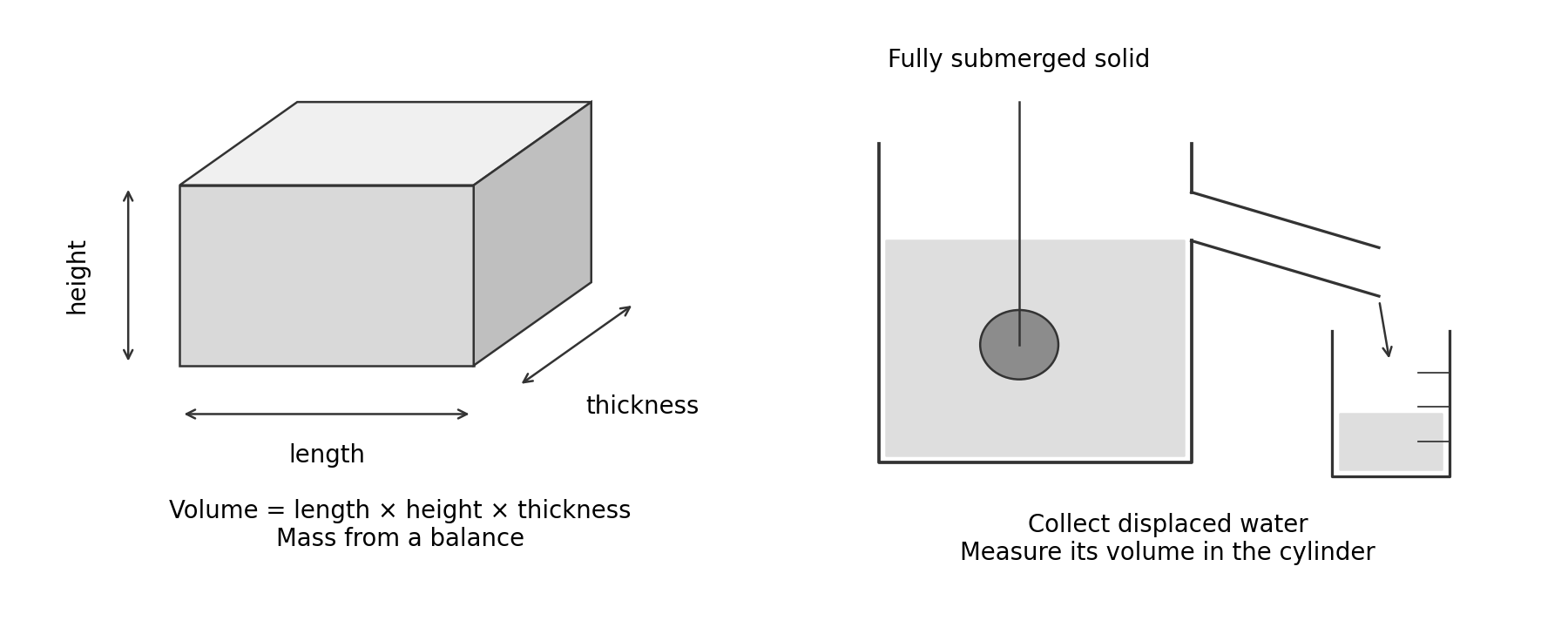


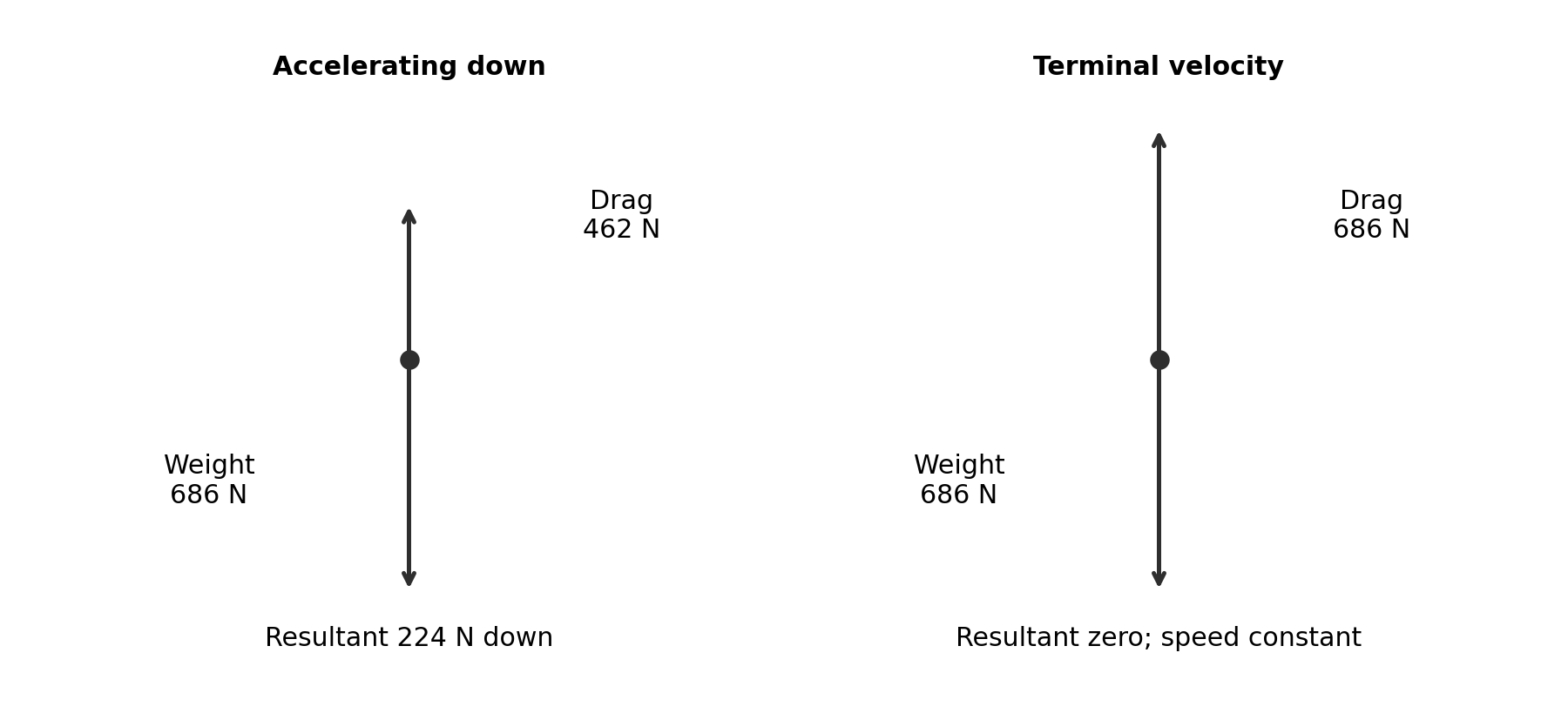


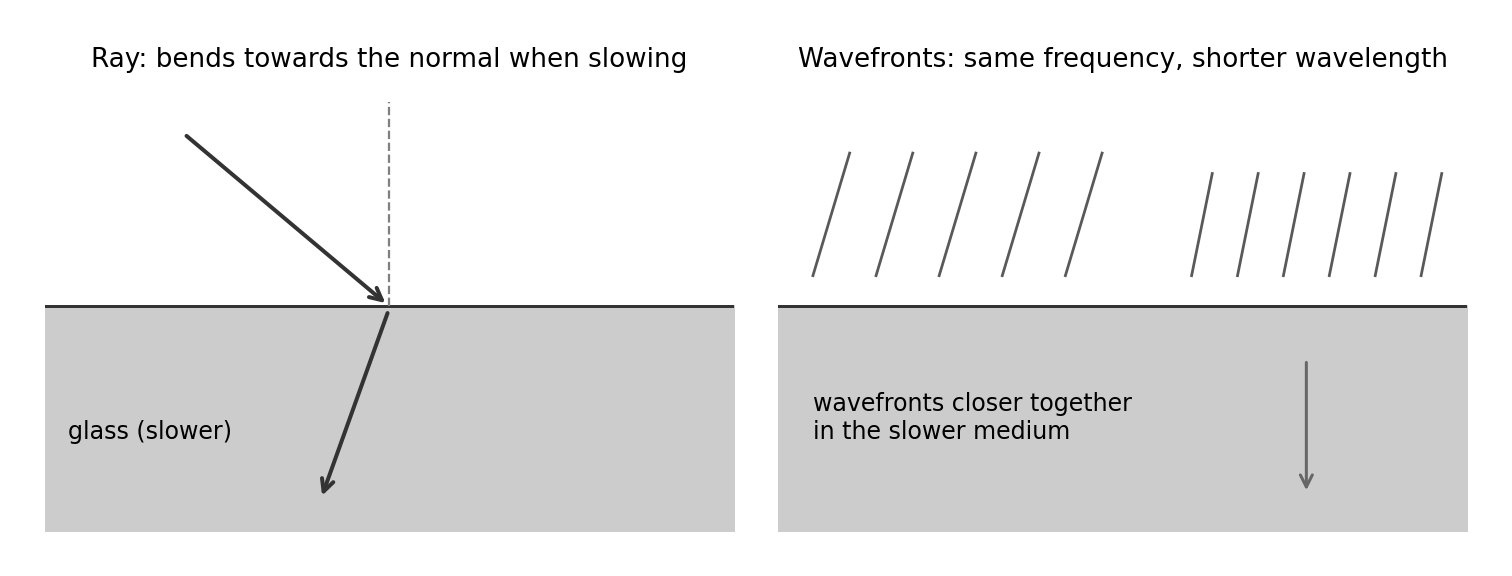


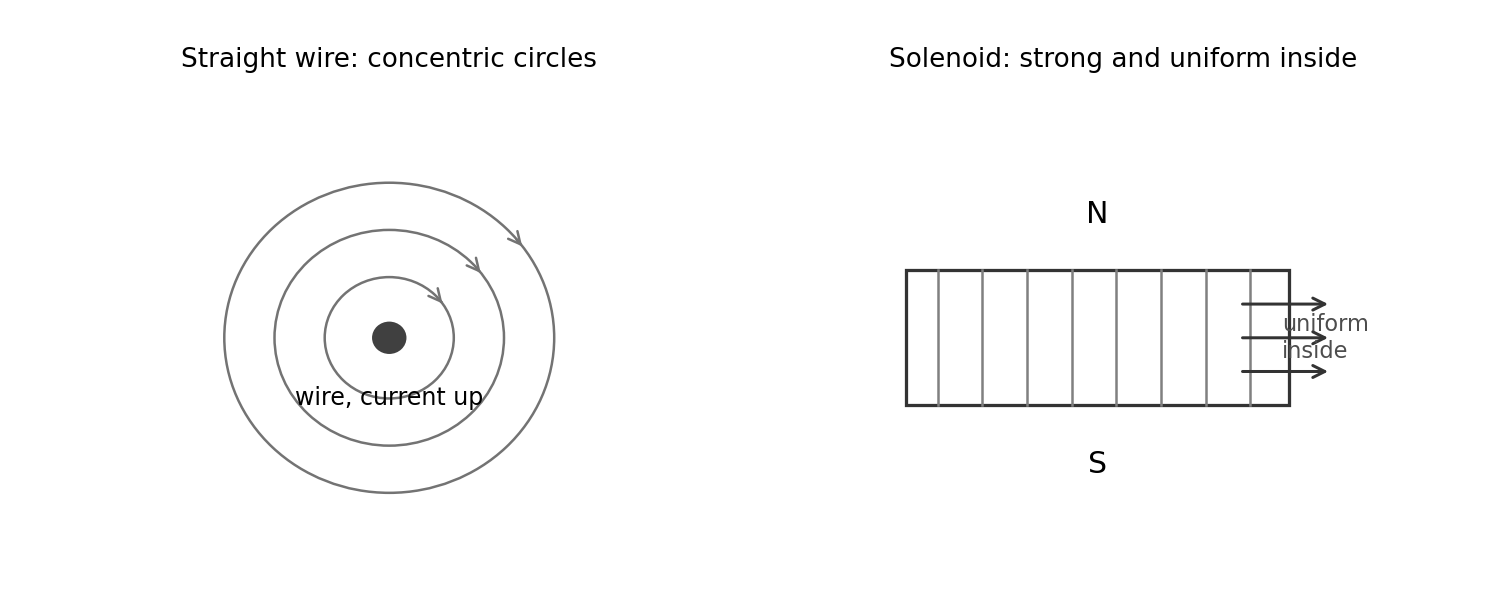
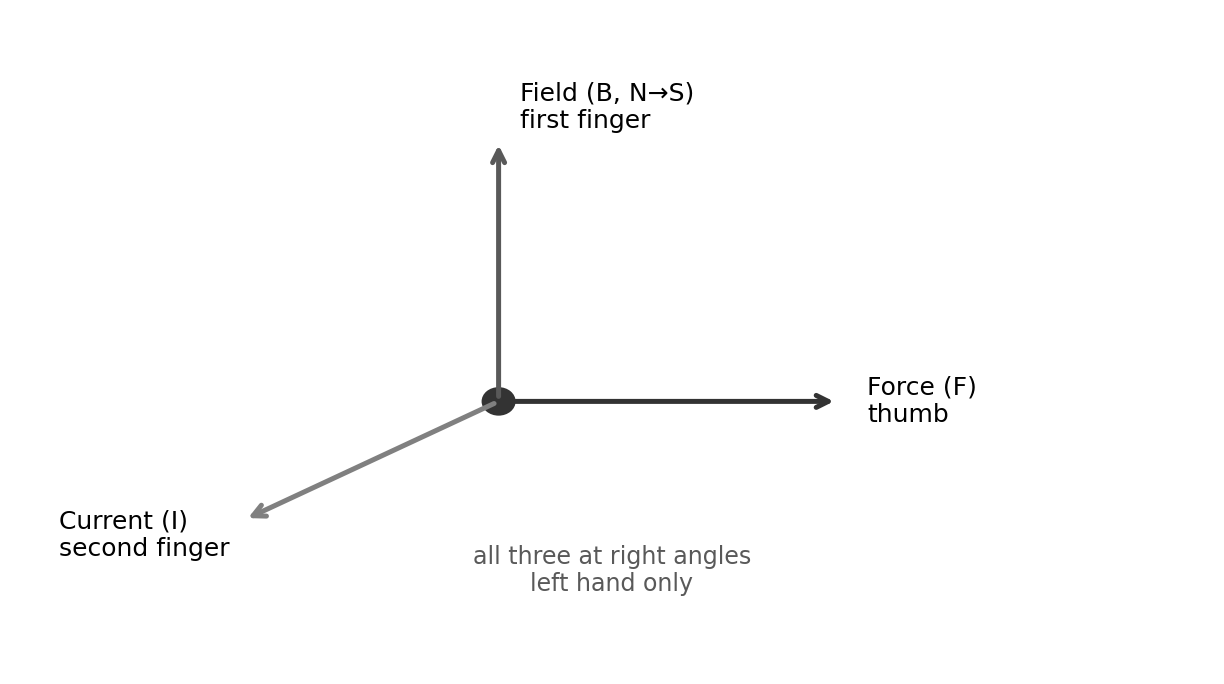
 A split-ring commutator reverses the current each half-turn so rotation continues.