هذا النجم بعيد بمئة تريليون كيلومتر. لن تلمسه أبداً. لن تزوره أبداً. ومع ذلك، من ضوئه الخافت وحده — فقط الضوء الذي…
English narration · English + 中文 subtitles burned in · سرد باللغة الإنجليزية · ترجمة مدمجة بالإنجليزية + الصينية
25.1
Luminosity and radiant flux intensity · اللمعان وشدة التدفق الإشعاعي
Syllabus · المنهج
English
understand the term luminosity as the total power of radiation emitted by a star
recall and use the inverse square law for radiant flux intensity$F$ in terms of the luminosity $L$ of the source $F = L / (4\pi d^2)$
understand that an object of known luminosity is called a standard candle
understand the use of standard candles to determine distances to galaxies
العربية
فهم مصطلح اللمعان باعتباره القدرة الكلية للإشعاع المنبعث من نجم
التذكر واستخدام قانون التربيع العكسي لـشدة التدفق الإشعاعي$F$ بدلالة اللمعان $L$ للمصدر $F = L / (4\pi d^2)$
فهم أن الجسم ذو اللمعان المعروف يسمى شمعة قياسية
فهم استخدام الشموع القياسية لتحديد مسافات المجرات
Source: Cambridge International syllabus · المصدر: منهج كامبريدج الدولي
English
The luminosity 光度$L$ of a star is the total power 功率 of radiation it gives out — the energy 能量 radiated per second in all directions. Unit: watt (W).
The one-mark definition.The luminosity of a star is the total power of radiation emitted by the star (or the total energy emitted per unit time). It is a property of the star alone; how bright it looks from the Earth depends also on how far away it is. Asked for two reasons why some stars appear brighter than others, give exactly those two: a greater luminosity, and a smaller distance (the flux falls as $1/d^{2}$).
At distance $d$, this power has spread over a sphere of area $4\pi d^{2}$. The radiant flux intensity 辐射通量密度$F$ (power per unit area) at distance $d$ is
$$F = \frac{L}{4\pi d^{2}}.$$
Worked example. The Sun's luminosity is $L = 3.8 \times 10^{26}\ \text{W}$. Find the radiant flux intensity at the Earth, a distance $d = 1.5 \times 10^{11}\ \text{m}$ away.
Unit: $\text{W m}^{-2}$. This is the inverse-square law 平方反比定律 for flux: doubling the distance cuts the flux to a quarter. A telescope measures $F$; if $L$ is known, the distance follows:
$$d = \sqrt{\frac{L}{4\pi F}}.$$
Reading the graph. A graph of $F$ against $1/d^{2}$ for one star is a straight line through the origin with gradient $L/4\pi$, so $L = 4\pi \times \text{gradient}$; a more luminous star gives a steeper line. A star whose galaxy is receding still obeys the inverse-square law, but the light we receive is redshifted, so the flux at each wavelength is shifted along the spectrum, and a detector sensitive to one band may see a different fraction of it.
Worked example. The Sun has radius $6.96 \times 10^{8}\ \text{m}$ and surface temperature $5780\ \text{K}$. A space probe carrying a $2.0\ \text{m}^{2}$ solar panel is $4.5 \times 10^{10}\ \text{m}$ from the Sun's centre. Find the power falling on the panel when it faces the Sun.
Luminosity: $L = 4\pi\sigma r^{2}T^{4} = 4\pi(5.67 \times 10^{-8})(6.96 \times 10^{8})^{2}(5780)^{4} = 3.85 \times 10^{26}\ \text{W}$. Flux at the probe: $F = L/(4\pi d^{2}) = 3.85 \times 10^{26}/[4\pi(4.5 \times 10^{10})^{2}] = 1.5 \times 10^{4}\ \text{W m}^{-2}$, eleven times the flux at the Earth. Power on the panel: $P = FA = 1.5 \times 10^{4} \times 2.0 = 3.0 \times 10^{4}\ \text{W}$. The flux is power per unit area perpendicular to the radiation; a tilted panel receives $FA\cos\theta$.
العربية
اللمعان$L$ للنجم هو إجمالي الطاقة المشعة التي يشعها — الطاقة المشعة في الثانية في جميع الاتجاهات. الوحدة: واط (W).
تعريف العلامة الواحدة.اللمعان (Luminosity) لنجم هو القدرة الكلية للإشعاع المنبعث من النجم (أو الطاقة الكلية المنبعثة لكل وحدة زمن). إنه خاصية للنجم وحده؛ كيف يبدو مضيئاً من الأرض يعتمد أيضاً على بعده. عند طلب سببين لظهور بعض النجوم أكثر إشراقاً من غيرها، اذكر هذين السببين بدقة: لمعان أكبر، ومسافة أصغر (يقل التدفق حسب $1/d^{2}$).
على مسافة $d$، قد انتشرت هذه القدرة فوق كرة مساحة $4\pi d^{2}$. شدة التدفق الإشعاعي$F$ (القدرة لكل وحدة مساحة) عند مسافة $d$ هي:
$$F = \frac{L}{4\pi d^{2}}.$$
مثال محلول. لمعان الشمس هو $L = 3.8 \times 10^{26}\ \text{W}$. أوجد شدة التدفق الإشعاعي عند الأرض، وهي على مسافة $d = 1.5 \times 10^{11}\ \text{m}$.
الوحدة: $\text{W m}^{-2}$. هذا هو قانون التربيع العكسي للتدفق: مضاعفة المسافة تقلل التدفق إلى الربع. يقيس التلسكوب $F$؛ إذا كان $L$ معروفاً، فإن المسافة تكون:
$$d = \sqrt{\frac{L}{4\pi F}}.$$
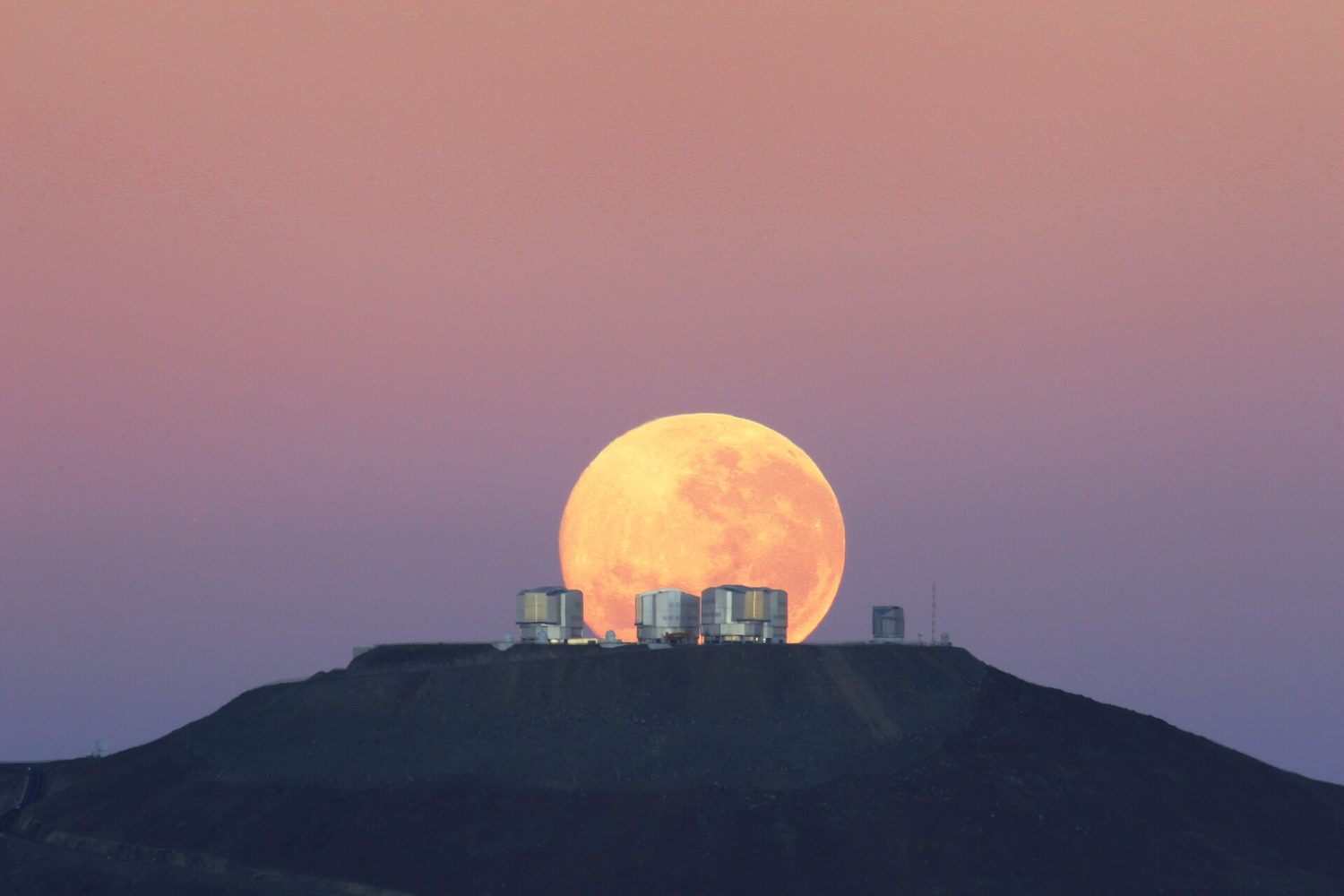
أربعة وحدات لتلسكوب Very Large Telescope التابع لـ ESO في تشيلي، تُستخدم لقياس التدفق من النجوم البعيدةتنتشر نفس القدرة على مساحة أكبر كلما زادت المسافة، لذا ينخفض التدفق حسب $1/d^{2}$ارسم $F$ مقابل $1/d^{2}$ ويصبح قانون التربيع العكسي خطاً مستقيماً يمر بنقطة الأصل؛ ميله هو $L/4\pi$
قراءة الرسم البياني. رسم بياني لـ $F$ مقابل $1/d^{2}$ لنجم واحد هو خط مستقيم يمر بنقطة الأصل بميل $L/4\pi$، لذا $L = 4\pi \times \text{gradient}$؛ النجم الأكثر لمعاناً يعطي خطاً أكثر انحداراً. نجم يكون مجلته مبتعداً لا يزال يخضع لقانون التربيع العكسي، لكن الضوء الذي نصلنا منه مُزاح نحو الأحمر، لذا يتحرك التدفق عند كل طول موجي على الطيف، وقد يرى كاشف حساس لنطاق معين جزءاً مختلفاً منه.
مثال محلول. للشمس نصف قطر $6.96 \times 10^{8}\ \text{m}$ ودرجة حرارة سطح $5780\ \text{K}$. مركبة فضائية تحمل لوحة شمسية مساحتها $2.0\ \text{m}^{2}$ تبعد $4.5 \times 10^{10}\ \text{m}$ عن مركز الشمس. أوجد القدرة الساقطة على اللوحة عندما تواجه الشمس.
اللمعان: $L = 4\pi\sigma r^{2}T^{4} = 4\pi(5.67 \times 10^{-8})(6.96 \times 10^{8})^{2}(5780)^{4} = 3.85 \times 10^{26}\ \text{W}$. التدفق عند المركبة: $F = L/(4\pi d^{2}) = 3.85 \times 10^{26}/[4\pi(4.5 \times 10^{10})^{2}] = 1.5 \times 10^{4}\ \text{W m}^{-2}$، وهو eleven times تدفق الأرض. القدرة على اللوحة: $P = FA = 1.5 \times 10^{4} \times 2.0 = 3.0 \times 10^{4}\ \text{W}$. التدفق هو قدرة لكل وحدة مساحة عمودية على الإشعاع؛ اللوحة المائلة تستقبل $FA\cos\theta$.
A standard candle 标准烛光 is an object whose luminosity is known from its type. Once you find one in a distant galaxy and measure the flux $F$ from it, you get its distance from $d = \sqrt{L/(4\pi F)}$.
Examples:
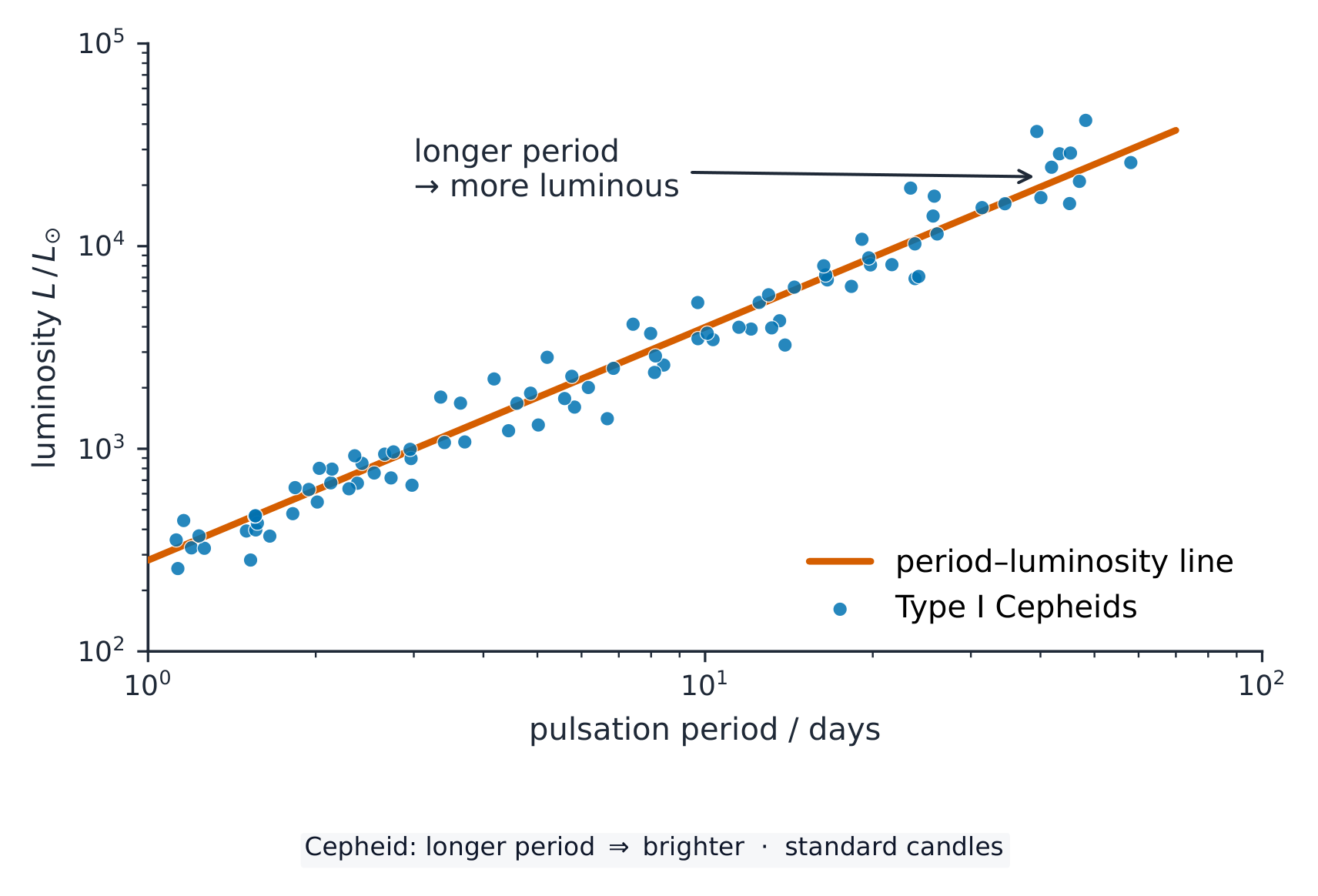
Cepheid variables 造父变星 (pulsating stars) — the pulsation period is tightly linked to the luminosity, so the period gives $L$.
Type Ia supernovae 超新星 — a white dwarf reaching a critical mass and exploding always has about the same peak luminosity.
A standard candle gives $L$ without first knowing the distance, so it reaches galaxies far beyond parallax 视差.
The definition.A standard candle is an object (a star or a supernova) of known luminosity. The luminosity is known because it is fixed by a property that can be measured from any distance: the pulsation period of a Cepheid variable, or the type of a supernova.
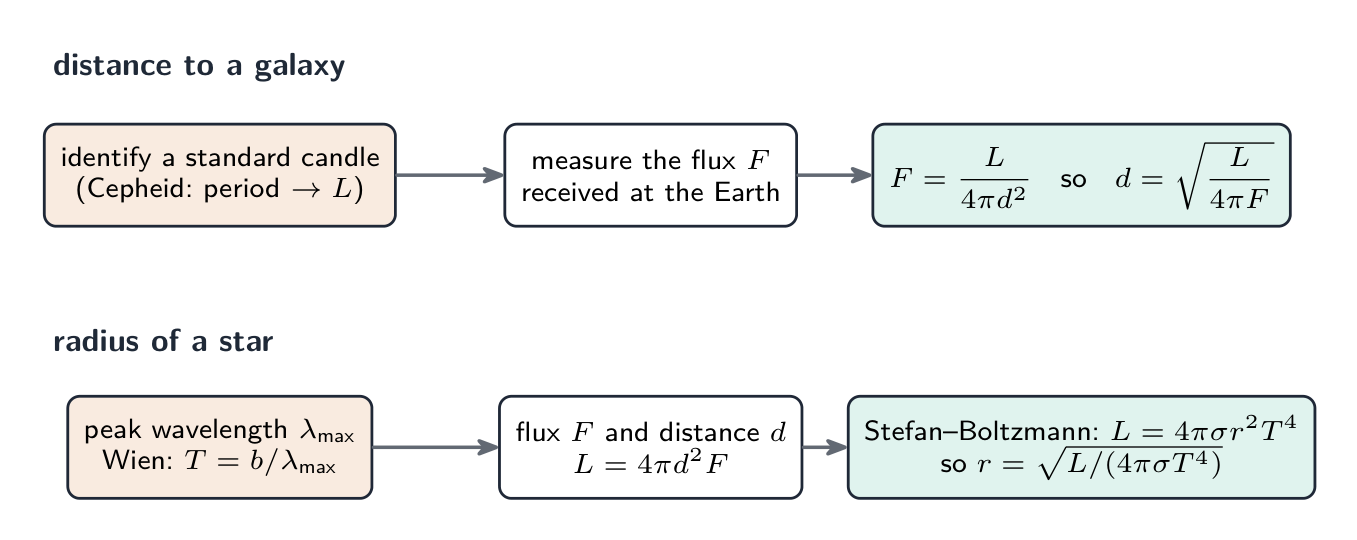
"Explain how a standard candle is used to determine the distance of a galaxy" (three marks). (1) A standard candle in the galaxy is identified (a Cepheid variable, whose period gives its luminosity, or a Type Ia supernova) so that its luminosity$L$ is known. (2) The radiant flux intensity$F$ of its light arriving at the Earth is measured. (3) The distance follows from the inverse-square law, $d = \sqrt{L/(4\pi F)}$. The order matters: the luminosity comes from the candle's type, not from the distance, which is the thing being found.
Worked example. A Type Ia supernova, luminosity $1.0 \times 10^{36}\ \text{W}$ at its peak, is observed with a peak flux of $2.0 \times 10^{-14}\ \text{W m}^{-2}$. How far away is its galaxy?
$d = \sqrt{L/(4\pi F)} = \sqrt{1.0 \times 10^{36}/(4\pi \times 2.0 \times 10^{-14})} = 6.3 \times 10^{24}\ \text{m}$, about $670$ million light years 光年 ($1\ \text{ly} = 9.5 \times 10^{15}\ \text{m}$). A Cepheid, with a luminosity of order $10^{30}\ \text{W}$, could not be seen at that distance; supernovae are the candles for the far Universe.
العربية
الشمعة القياسية هي جسم لمعانه معروف من نوعه. بمجرد العثور عليها في مجرة بعيدة وقياس التدفق $F$ منها، تحصل على مسافتها من $d = \sqrt{L/(4\pi F)}$.
أمثلة:
متغيرات سيفيد (نجوم نابضة) — فترة النبض مرتبطة ارتباطاً وثيقاً باللمعان، لذا تعطي الفترة $L$.
المستعرات العظمى من النوع Ia — قزم أبيض يصل إلى كتلة حرجة وينفجر له دائماً تقريباً نفس اللمعان الأقصى.
الشمعة القياسية تعطي $L$ دون الحاجة لمعرفة المسافة مسبقاً، لذا تصل إلى مجرات أبعد من التزيح الزاوي (Parallax).
التعريف.الشمعة القياسية هي جسم (نجمة أو مستعر عظيم) ذو لمعان معروف. يُعرف اللمعان لأنه ثابت بسبب خاصية يمكن قياسها من أي مسافة: فترة نبض متغير سيفيد، أو نوع المستعر العظمى.
وصفتان لهذا الموضوع: مسافة من شمعة قياسية، ونصف قطر من طيف وتدفق. كل حساب في الامتحان هو إحداهما، أو خطوة من إحداهما
"اشرح كيفية استخدام شمعة قياسية لتحديد مسافة مجرة (ثلاث علامات)." (1) يتم تحديد شمعة قياسية في المجرة (متغير سيفيد،whose period gives its luminosity, or a Type Ia supernova) بحيث يكون لمعانه$L$ معروفاً. (2) يتم قياس شدة التدفق الإشعاعي$F$ لضوئه arriving at the Earth. (3) تتبع المسافة من قانون التربيع العكسي، $d = \sqrt{L/(4\pi F)}$. الترتيب مهم: اللمعان يأتي من نوع الشمعة، ليس من المسافة، التي هي الشيء المطلوب إيجادها.
مثال محلول. مستعر عظيم من النوع Ia، لمعانه $1.0 \times 10^{36}\ \text{W}$ عند ذروته، رُصد بتدفق ذروة قدره $2.0 \times 10^{-14}\ \text{W m}^{-2}$. كم تبعد مجرته؟
$d = \sqrt{L/(4\pi F)} = \sqrt{1.0 \times 10^{36}/(4\pi \times 2.0 \times 10^{-14})} = 6.3 \times 10^{24}\ \text{m}$، حوالي $670$ مليون سنة ضوئية ($1\ \text{ly} = 9.5 \times 10^{15}\ \text{m}$). متغير سيفيد، بلمعان من رتبة $10^{30}\ \text{W}$، لم يكن ليُرى على تلك المسافة؛ المستعرات العظمى هي الشموع للكون البعيد.
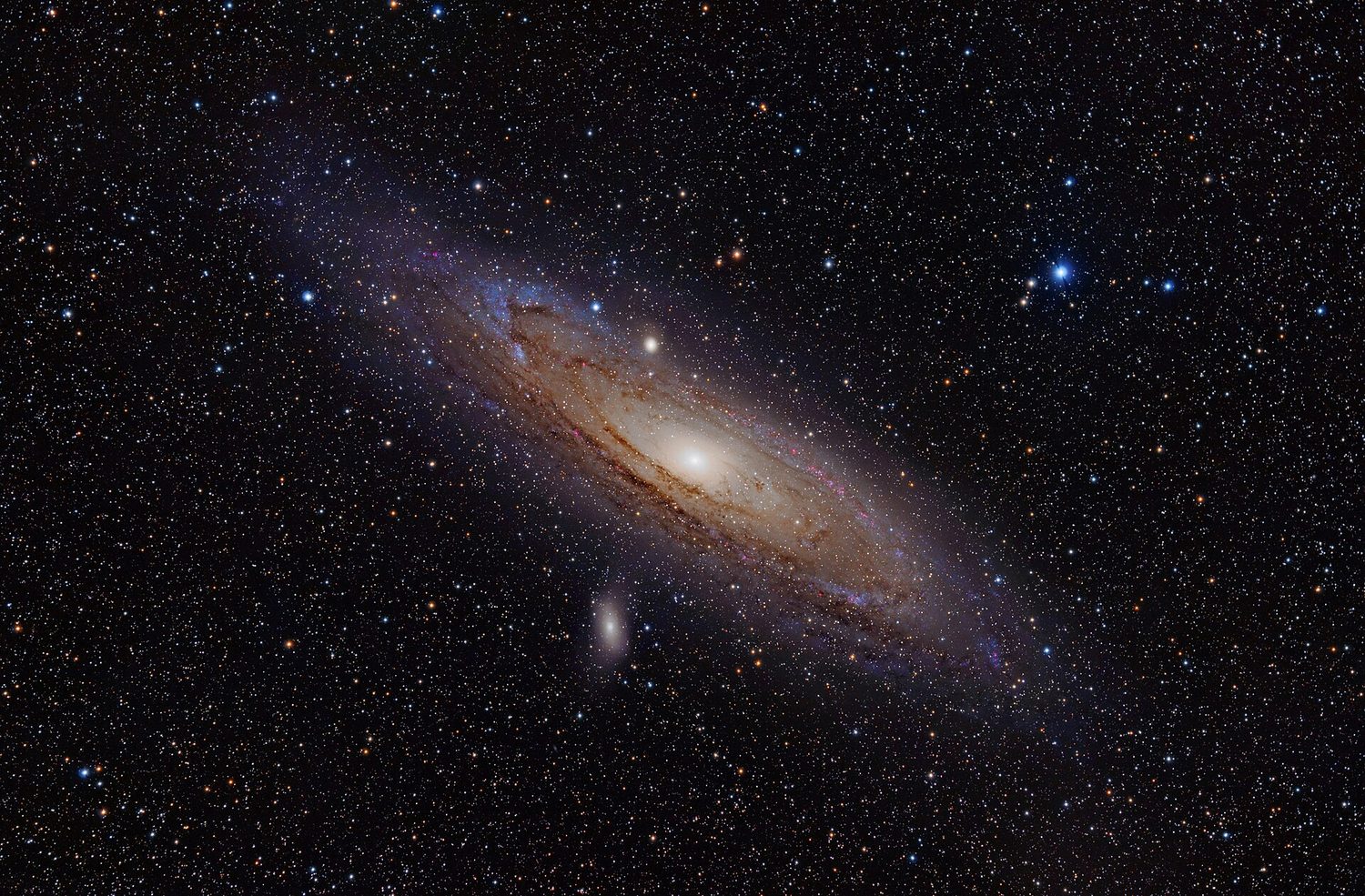
مجرة أندروميدا، أقرب مجرة كبيرة لنا، على بعد حوالي 2.5 مليون سنة ضوئية — متغيرات سيفيد فيها هي شموع قياسيةللمتغيرات سيفيد، تحدد فترة النبض اللمعان، مما يجعلها شموعاً قياسية
Explore · استكشف
Standard candle distance lab · مختبر مسافة الشمعة القياسية
brightness proportional to 1 / distance^2 · السطوع يتناسب عكسياً مع 1 / المسافة^2
Move distance and see why brightness falls quickly. · غيّر المسافة لترى لماذا تتلاشى السطوع بسرعة.
Stellar surface temperature · درجة حرارة سطح النجوم
Syllabus · المنهج
English
recall and use Wien’s displacement law$\lambda_{\text{max}} \propto 1/T$ to estimate the peak surface temperature of a star
use the Stefan–Boltzmann law$L = 4\pi\sigma r^2 T^4$
use Wien’s displacement law and the Stefan–Boltzmann law to estimate the radius of a star
العربية
التذكر واستخدام قانون ويان للإزاحة$\lambda_{\text{max}} \propto 1/T$ لتقدير درجة حرارة السطح القصوى لنجم
استخدام قانون ستيفان-بولتزمان$L = 4\pi\sigma r^2 T^4$
استخدام قانون إزاحة فين وقانون ستيفان-بولتزمان لتقدير نصف قطر نجم
Source: Cambridge International syllabus · المصدر: منهج كامبريدج الدولي
English
Wien's displacement law
A hot body gives out a continuous (blackbody 黑体) spectrum with a peak at a wavelength 波长$\lambda_{\text{max}}$ set by its temperature 温度. Wien's displacement law 维恩位移定律:
$$\lambda_{\text{max}} T = \text{constant}, \qquad b \approx 2.90 \times 10^{-3}\ \text{m K}.$$
Worked example. A star's blackbody spectrum peaks at $\lambda_{\text{max}} = 500\ \text{nm}$. Find its surface temperature. ($b = 2.90 \times 10^{-3}\ \text{m K}$.)
Hotter stars peak at shorter wavelengths: a cool red star ($\sim 3000\ \text{K}$) peaks in the infrared; the Sun ($\sim 5800\ \text{K}$) peaks near $500\ \text{nm}$; a hot blue-white star ($\sim 20{,}000\ \text{K}$) peaks in the ultraviolet. Measuring $\lambda_{\text{max}}$ gives the surface temperature.
"State Wien's displacement law" (two marks).The wavelength at which the intensity of the radiation from a black body is a maximum is inversely proportional to its thermodynamic temperature: $\lambda_{\text{max}} \propto 1/T$, or $\lambda_{\text{max}} T = \text{constant}$ ($2.90 \times 10^{-3}\ \text{m K}$). Say "wavelength of maximum intensity", not just "the wavelength", and the temperature must be in kelvin. The law describes the peak of the continuous black-body curve, not the spectral lines.
Stefan–Boltzmann law
A star, treated as a blackbody sphere of radius $r$ and surface temperature $T$, has luminosity
$$L = 4\pi \sigma r^{2} T^{4},$$
where $\sigma = 5.67 \times 10^{-8}\ \text{W m}^{-2}\ \text{K}^{-4}$ is the Stefan–Boltzmann constant 斯特藩-玻尔兹曼常量 (the Stefan–Boltzmann law 斯特藩-玻尔兹曼定律). Two strong dependences:
$L \propto r^{2}$ — twice the radius, four times the luminosity (same $T$).
$L \propto T^{4}$ — twice the temperature, sixteen times the luminosity (same $r$).
Worked example. A star has radius $r = 7.0 \times 10^{8}\ \text{m}$ and surface temperature $T = 5800\ \text{K}$. Find its luminosity. ($\sigma = 5.67 \times 10^{-8}\ \text{W m}^{-2}\ \text{K}^{-4}$.)
measure $\lambda_{\text{max}}$ → get $T$ from Wien's law.
find $L$ (e.g. from flux $F$ and distance $d$: $L = 4\pi d^{2} F$).
solve the Stefan–Boltzmann law for $r$: $r = \sqrt{L/(4\pi \sigma T^{4})}$.
This is how astronomers estimate radii of stars they cannot see as a disc.
Worked example (the radius of the Sun). The radiant flux intensity of sunlight at the Earth is $1370\ \text{W m}^{-2}$ at a distance of $1.50 \times 10^{11}\ \text{m}$, and the Sun's spectrum peaks at $500\ \text{nm}$. Estimate the radius of the Sun.
Luminosity: $L = 4\pi d^{2}F = 4\pi(1.50 \times 10^{11})^{2}(1370) = 3.87 \times 10^{26}\ \text{W}$. Temperature: $T = b/\lambda_{\text{max}} = 2.90 \times 10^{-3}/(500 \times 10^{-9}) = 5800\ \text{K}$. Radius: $r = \sqrt{L/(4\pi\sigma T^{4})} = \sqrt{3.87 \times 10^{26}/[4\pi(5.67 \times 10^{-8})(5800)^{4}]} = 6.9 \times 10^{8}\ \text{m}$. Three steps, each a one-line formula; keep the full precision of $L$ and $T$ until the end, because $T$ is raised to the fourth power.
Worked example. A star in a distant galaxy has a radiant flux intensity of $2.52 \times 10^{-8}\ \text{W m}^{-2}$ at the Earth, a distance of $4.16 \times 10^{17}\ \text{m}$ away, and a surface temperature of $9500\ \text{K}$. Find its radius.
$L = 4\pi d^{2}F = 4\pi(4.16 \times 10^{17})^{2}(2.52 \times 10^{-8}) = 5.48 \times 10^{28}\ \text{W}$. Then $r = \sqrt{5.48 \times 10^{28}/[4\pi(5.67 \times 10^{-8})(9500)^{4}]} = 3.1 \times 10^{9}\ \text{m}$, about four times the Sun's radius. Check the sense: a star $140$ times as luminous as the Sun but only $1.6$ times as hot must be considerably bigger, since $L \propto r^{2}T^{4}$.
Why $T^{4}$ matters so much. Two stars of the same radius at $3000\ \text{K}$ and $6000\ \text{K}$ differ in luminosity by $2^{4} = 16$ times; a small error in the temperature is a large error in the luminosity, which is why the peak wavelength must be read carefully and, for a receding galaxy, corrected for redshift (below).
العربية
قانون إزاحة فين
الجسم الساخن يشع طيفاً مستمراً (جسم أسود) بقمّة عند طول موجي$\lambda_{\text{max}}$ تحدد درجة حرارته. قانون إزاحة فين:
$$\lambda_{\text{max}} T = \text{constant}, \qquad b \approx 2.90 \times 10^{-3}\ \text{m K}.$$
مثال محلول. يمتد الطيف الأسود لنجم عند $\lambda_{\text{max}} = 500\ \text{nm}$. أوجد درجة حرارة سطحه. ($b = 2.90 \times 10^{-3}\ \text{m K}$.)
النجوم الأكثر سخونة تمتد عند أطوال موجية أقصر: نجم أحمر بارد ($\sim 3000\ \text{K}$) يمتد في الأشعة تحت الحمراء؛ الشمس ($\sim 5800\ \text{K}$) تمتد قرب $500\ \text{nm}$؛ نجم أزرق-أبيض ساخن ($\sim 20{,}000\ \text{K}$) يمتد في الأشعة فوق البنفسجية. قياس $\lambda_{\text{max}}$ يعطي درجة حرارة السطح.
"اذكر قانون إزاحة فين" (درجتان).الطول الموجي الذي تكون عنده شدة الإشعاع من جسم أسود في أقصى قيمة له يتناسب عكسياً مع درجة حرارته الديناميكية الحرارية: $\lambda_{\text{max}} \propto 1/T$، أو $\lambda_{\text{max}} T = \text{constant}$ ($2.90 \times 10^{-3}\ \text{m K}$). قل "الطول الموجي لـأقصى شدة" وليس فقط "الطول الموجي"، ويجب أن تكون الحرارة بـالكلفن. يصف القانون قمّة المنحنى المستمر للجسم الأسود، وليس خطوط الطيف.
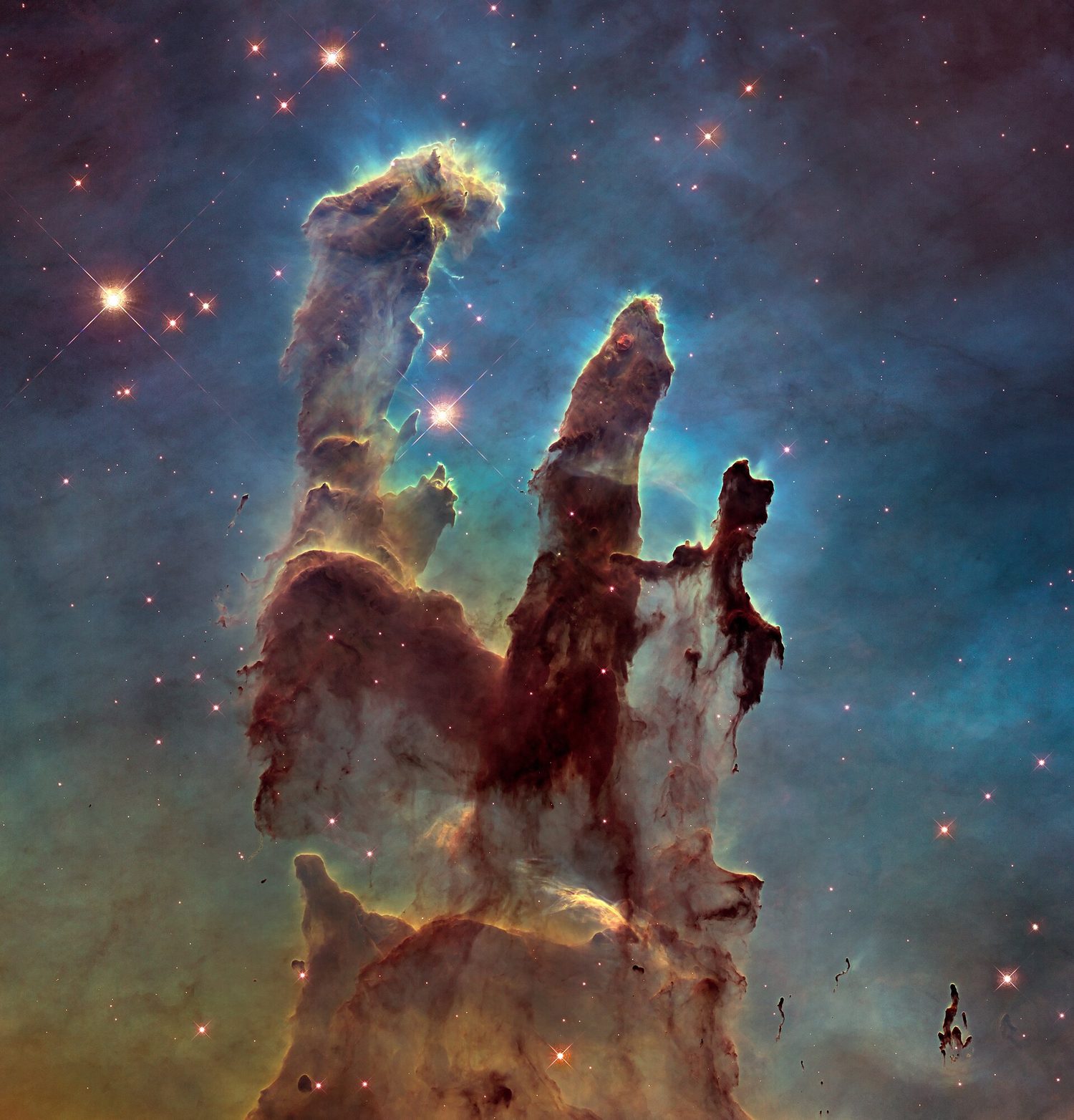
أبراج الخلق في مجرة النسر — سحابات من الغاز والغبار تضيئها نجوم ساخنة刚刚-formedالجسم الأسود الأسخن يشع أكثر، وينزاح طول موجي قمّته نحو الأزرق (قانون فين)
قانون ستيفان-بولتزمان
نجم يُعامل ككرة جسم أسود نصف قطرها $r$ ودرجة حرارة سطحها $T$، يكون لمعانه
$$L = 4\pi \sigma r^{2} T^{4},$$
حيث $\sigma = 5.67 \times 10^{-8}\ \text{W m}^{-2}\ \text{K}^{-4}$ هو ثابت ستيفان-بولتزمان- (قانون ستيفان-بولتزمان-). اعتمادان قويان:
$L \propto r^{2}$ — ضعف نصف القطر يعني أربعة أضعاف المعاناة (نفس $T$).
$L \propto T^{4}$ — ضعف الحرارة يعني ستة عشر ضعف المعاناة (نفس $r$).
مثال محلول. نجم له نصف قطر $r = 7.0 \times 10^{8}\ \text{m}$ ودرجة حرارة سطح $T = 5800\ \text{K}$. أوجد لمعانه. ($\sigma = 5.67 \times 10^{-8}\ \text{W m}^{-2}\ \text{K}^{-4}$.)
حل قانون ستيفان-بولتزمان بالنسبة لـ $r$: $r = \sqrt{L/(4\pi \sigma T^{4})}$.
بهذا الطريقة يقدر الفلكيون أنصاف أقطار النجوم التي لا يمكن رؤيتها كقرص.
مثال محلول (نصف قطر الشمس). شدة تدفق إشعاع ضوء الشمس على الأرض هي $1370\ \text{W m}^{-2}$ على مسافة $1.50 \times 10^{11}\ \text{m}$، والطيف الشمسي يمتد عند $500\ \text{nm}$. قدّر نصف قطر الشمس.
المعاناة: $L = 4\pi d^{2}F = 4\pi(1.50 \times 10^{11})^{2}(1370) = 3.87 \times 10^{26}\ \text{W}$. الحرارة: $T = b/\lambda_{\text{max}} = 2.90 \times 10^{-3}/(500 \times 10^{-9}) = 5800\ \text{K}$. نصف القطر: $r = \sqrt{L/(4\pi\sigma T^{4})} = \sqrt{3.87 \times 10^{26}/[4\pi(5.67 \times 10^{-8})(5800)^{4}]} = 6.9 \times 10^{8}\ \text{m}$. ثلاث خطوات، كل منها معادلة في سطر واحد؛ احتفظ بالدقة الكاملة لـ $L$ و$T$ حتى النهاية، لأن $T$ مرفوعة للأس الرابع.
مثال محلول. نجم في مجرة بعيدة له شدة تدفق إشعاعي قدرها $2.52 \times 10^{-8}\ \text{W m}^{-2}$ على الأرض، على مسافة $4.16 \times 10^{17}\ \text{m}$، ودرجة حرارة سطح $9500\ \text{K}$. أوجد نصف قطره.
$L = 4\pi d^{2}F = 4\pi(4.16 \times 10^{17})^{2}(2.52 \times 10^{-8}) = 5.48 \times 10^{28}\ \text{W}$. ثم $r = \sqrt{5.48 \times 10^{28}/[4\pi(5.67 \times 10^{-8})(9500)^{4}]} = 3.1 \times 10^{9}\ \text{m}$، بحوالي أربعة أضعاف نصف قطر الشمس. تحقق من المعنى: النجم الذي يكون $140$ مرة مشعاً كالمشمس ولكن درجة حرارته فقط $1.6$ مرات حرارة الشمس يجب أن يكون أكبر بكثير، لأن $L \propto r^{2}T^{4}$.
لماذا يُعد $T^{4}$ مهماً للغاية. نجمان لهما نفس نصف القطر عند $3000\ \text{K}$ و$6000\ \text{K}$ differs in luminosity by $2^{4} = 16$ times; a small error in the temperature is a large error in the luminosity, which is why the peak wavelength must be read carefully and, for a receding galaxy, corrected for redshift (below).
Explore · استكشف
A star's luminosity and radius · لمعان ونصف قطر النجم
L ∝ r²
For a given surface temperature, a star's luminosity grows with the SQUARE of its radius (Stefan's law). · لدرجة حرارة سطح معطاة، يزداد لمعان النجم مع مربع نصف قطره (قانون ستيفان).
Redshift, Hubble's law and the Big Bang · الانزياح الأحمر، قانون هابل والانفجار العظيم
Syllabus · المنهج
English
understand that the lines in the emission and absorption spectra from distant objects show an increase in wavelength from their known values
use $\Delta\lambda / \lambda \approx \Delta f / f \approx v / c$ for the redshift of electromagnetic radiation from a source moving relative to an observer
explain why redshift leads to the idea that the Universe is expanding
recall and use Hubble's law$v \approx H_0 d$ and explain how this leads to the Big Bang theory (candidates will only be required to use SI units)
العربية
فهم أن الخطوط في طيفي الانبعاث والامتصاص للأجسام البعيدة تظهر زيادة في الطول الموجي مقارنة بقيمها المعروفة
استخدام $\Delta\lambda / \lambda \approx \Delta f / f \approx v / c$ لحساب الاحمرار (redshift) للإشعاع الكهرومغناطيسي من مصدر يتحرك بالنسبة لمراقب
شرح سبب استنتاج الاحمرار لفكرة توسع الكون
تذكر واستخدام قانون هابل$v \approx H_0 d$ وشرح كيفية استنتاج نظرية الانفجار العظيم (سيُطلب من المرشحين فقط استخدام الوحدات الدولية)
Source: Cambridge International syllabus · المصدر: منهج كامبريدج الدولي
English
Cosmological redshift
The spectral lines 谱线 of light from distant galaxies are seen at longer wavelengths than their known laboratory values — the whole spectrum is stretched towards the red. This is redshift 红移.
Reading it as a Doppler shift, the galaxy is moving away. For $v \ll c$:
where $\Delta\lambda = \lambda_{\text{observed}} - \lambda_{\text{emitted}}$ and $v$ is the speed of recession 退行. Example: light emitted at $4.62 \times 10^{-7}\ \text{m}$ but seen at $4.91 \times 10^{-7}\ \text{m}$ gives $\Delta\lambda = 0.29 \times 10^{-7}\ \text{m}$ and
$$v \approx \frac{\Delta\lambda}{\lambda_{\text{em}}} c \approx 1.9 \times 10^{7}\ \text{m s}^{-1}.$$
Why redshift means an expanding Universe
Almost every distant galaxy is redshifted (a few near ones are blueshifted 蓝移 by local motion). So galaxies are, on average, moving apart — not just from us but from each other. The Universe is expanding, with the space between galaxies stretching. More distant galaxies are redshifted more.
"State what is meant by redshift."The observed wavelength of the radiation (its spectral lines) from a source is longer than the wavelength emitted, because the source is moving away from the observer. It is the Doppler effect 多普勒效应 for light: the fractional change in wavelength equals the fractional change in frequency and, for $v \ll c$, the ratio $v/c$.
Worked example. A hydrogen line measured in the laboratory at $656.3\ \text{nm}$ is observed in the light from a galaxy at $660.9\ \text{nm}$. Find the galaxy's speed of recession and, using $H_{0} = 2.3 \times 10^{-18}\ \text{s}^{-1}$, its distance.
$\Delta\lambda = 660.9 - 656.3 = 4.6\ \text{nm}$, so $v = c\,\Delta\lambda/\lambda = (3.00 \times 10^{8})(4.6/656.3) = 2.1 \times 10^{6}\ \text{m s}^{-1}$. Distance: $d = v/H_{0} = 2.1 \times 10^{6}/2.3 \times 10^{-18} = 9.1 \times 10^{23}\ \text{m}$ (about $100$ million light years). Divide by the emitted (laboratory) wavelength, and keep the nanometres consistent in the ratio.
Worked example (the other way round). A galaxy in Corona Borealis recedes at $21\,400\ \text{km s}^{-1}$. At what wavelength is its $656.3\ \text{nm}$ hydrogen line observed?
$\Delta\lambda = \lambda v/c = 656.3 \times (2.14 \times 10^{7}/3.00 \times 10^{8}) = 46.8\ \text{nm}$, so the line appears at $703\ \text{nm}$, moved from the red almost into the infrared. Every line and the whole continuous spectrum are stretched by the same factor $(1 + v/c) = 1.071$.
A trap the exam sets. If the peak wavelength of a receding galaxy's spectrum is fed straight into Wien's law, the temperature comes out too low, because the observed $\lambda_{\text{max}}$ is longer than the emitted one. Correct the peak first: $\lambda_{\text{emitted}} = \lambda_{\text{observed}}/(1 + v/c)$. Asked to sketch the observed spectrum on the same axes as the emitted one, draw the same shape shifted to longer wavelengths, peak included.
"Explain how redshift leads to the idea that the Universe is expanding" (three marks). (1) The spectral lines from (almost) all distant galaxies are shifted to longer wavelengths, so (2) by the Doppler effect the galaxies are moving away from us, and (3) the further away a galaxy is, the greater its redshift and so its speed: this is what would be seen from any galaxy if the space between all galaxies were expanding, so the Universe as a whole is expanding, not just moving away from the Earth.
Hubble's law
The link between recession speed $v$ and distance $d$ is Hubble's law 哈勃定律:
$$v \approx H_{0} \cdot d,$$
where $H_{0}$ is the Hubble constant 哈勃常数 ($\approx 2.3 \times 10^{-18}\ \text{s}^{-1}$). Always use SI units. Example: a galaxy receding at $1.9 \times 10^{7}\ \text{m s}^{-1}$ is at $d = v/H_{0} \approx 8.3 \times 10^{24}\ \text{m}$.
"State Hubble's law" (two marks).The speed of recession of a galaxy is (directly) proportional to its distance from the Earth (the observer): $v = H_{0}d$, where $v$ is the recession speed, $d$ the distance and $H_{0}$ the Hubble constant. Identify every symbol when asked. The value of $H_{0}$ is quoted in the exam in SI units ($\text{s}^{-1}$), so $v$ must be in $\text{m s}^{-1}$ and $d$ in metres, never kilometres per second per megaparsec.
Worked example. A star in a distant galaxy emits radiation whose intensity peaks at $4.62 \times 10^{-7}\ \text{m}$; the peak in the light received at the Earth is at $4.91 \times 10^{-7}\ \text{m}$. Find the star's surface temperature, the galaxy's recession speed, and its distance ($H_{0} = 2.3 \times 10^{-18}\ \text{s}^{-1}$).
Temperature from the emitted peak: $T = 2.90 \times 10^{-3}/4.62 \times 10^{-7} = 6300\ \text{K}$. Speed: $v = c\,\Delta\lambda/\lambda = (3.00 \times 10^{8})(0.29/4.62) = 1.9 \times 10^{7}\ \text{m s}^{-1}$, about $6\%$ of $c$. Distance: $d = v/H_{0} = 1.9 \times 10^{7}/2.3 \times 10^{-18} = 8.2 \times 10^{24}\ \text{m}$ (about $870$ million light years). Using the observed peak for the temperature would have given $5900\ \text{K}$, $400\ \text{K}$ too low.
From Hubble's law to the Big Bang
Hubble's law means the galaxies were once together. Running the expansion backwards, all distances shrink to zero at $t = -1/H_{0}$ — the Universe was once a tiny, hugely dense, hot point. This is the Big Bang 大爆炸. The age of the Universe (for steady expansion) is about
The expansion, the redshift of galaxies, the cosmic microwave background 宇宙微波背景, and the hydrogen/helium abundances are the main evidence for the Big Bang.
"Explain how Hubble's law leads to the Big Bang theory" (three marks). (1) Galaxies are receding with speeds proportional to their distances, so (2) if time is run backwards, every galaxy, at whatever distance, arrives at the same point at the same time, $t = d/v = 1/H_{0}$ ago; (3) so the Universe must have begun as a single point of enormous density and temperature that has been expanding ever since. The age estimate: $1/H_{0} = 1/(2.3 \times 10^{-18}) = 4.3 \times 10^{17}\ \text{s}$, and dividing by $3.16 \times 10^{7}\ \text{s}$ per year gives $1.4 \times 10^{10}$ years. This assumes the expansion rate has not changed; it is an estimate, not a measurement.
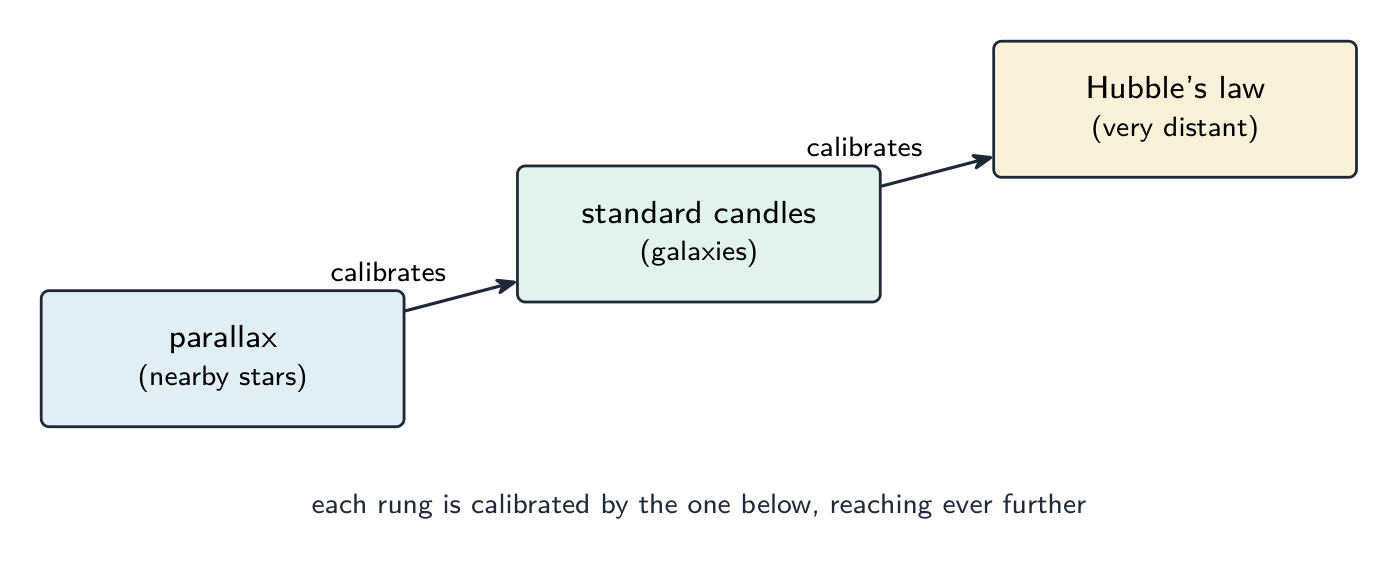
Distance ladder
Astronomers combine methods, each calibrated by the one below:
parallax — for nearby stars.
standard candles (Cepheids, Type Ia supernovae) — for galaxies.
Hubble's law ($d = v/H_{0}$, with $v$ from redshift) — for very distant galaxies.
العربية
الانزياح الكوني
خطوط الطيف للضوء من المجرات البعيدة تُرى عند أطوال موجية أطول من قيم المختبر المعروفة لها — الطيف كله يتمدد نحو الأحمر. هذا هو الانزياح الأحمر.
خطوط امتصاص الهيدروجين لنجم بعيد تنزاح إلى أطوال موجية أطول — انزياح أحمر
بقراءتها كازاحة دوبلر، فإن المجرة تتحرك بعيداً. لـ$v \ll c$:
حيث $\Delta\lambda = \lambda_{\text{observed}} - \lambda_{\text{emitted}}$ و$v$ هي سرعة التباعد. مثال: ضوء أُنتج عند $4.62 \times 10^{-7}\ \text{m}$ لكن رُوي عند $4.91 \times 10^{-7}\ \text{m}$ يعطي $\Delta\lambda = 0.29 \times 10^{-7}\ \text{m}$ و
$$v \approx \frac{\Delta\lambda}{\lambda_{\text{em}}} c \approx 1.9 \times 10^{7}\ \text{m s}^{-1}.$$
لماذا الانزياح الأحمر يعني كوناً متوسعاً
كل مجرة بعيدة تقريباً لها انزياح أحمر (بعض القريبة انزياح أزرق بالحركة المحلية). إذن المجرات، بشكل متوسط، تبتعد عن بعضها — ليس فقط عنا بل عن بعضها البعض. الكون متوسع، مع تمدد الفضاء بين المجرات. المجرات الأبعد لها انزياح أحمر أكبر.
"اذكر ما يُقصد بالانزياح الأحمر."الطول الموجي المراقب للإشعاع (خطوطه الطيفية) من مصدر أطول من الطول الموجي المنبعث، لأن المصدر يبتعد عن المراقب. إنه تأثير دوبلر للضوء: التغير النسبي في الطول الموجي يساوي التغير النسبي في التردد، ولـ$v \ll c$، نسبة $v/c$.
مثال محلول. خط هيدروجين قُيس في المختبر عند $656.3\ \text{nm}$ رُوي في ضوء مجرة عند $660.9\ \text{nm}$. أوجد سرعة تباعد المجرة، وباستخدام $H_{0} = 2.3 \times 10^{-18}\ \text{s}^{-1}$، مسافتها.
مثال محلول (عكس الاتجاه). مجرة في كوكبة التاج الشمالي تبتعد بسرعة $21\,400\ \text{km s}^{-1}$. عند أي طول موجي تُرصد خط هيدروجينها $656.3\ \text{nm}$؟
$\Delta\lambda = \lambda v/c = 656.3 \times (2.14 \times 10^{7}/3.00 \times 10^{8}) = 46.8\ \text{nm}$، لذا يظهر الخط عند $703\ \text{nm}$، مُزاحاً من الأحمر تقريباً نحو الأشعة تحت الحمراء. كل خط وطيف مستمر كامل يتمدد بنفس العامل $(1 + v/c) = 1.071$.
طيف المجرّة المبتعدة المستمر يحافظ على شكله لكن ينزلق نحو الأطوال الموجية الأطول. تطبيق قانون ويين على الذروة المرصودة يعطي درجة حرارة منخفضة جداً
فخ يضعه الامتحان. إذا تم إدخال طول موجي الذروة لطيف مجرة مبتعدة مباشرة في قانون ويين، ستكون النتيجة درجة حرارة منخفضة، لأن الذروة المرصودة $\lambda_{\text{max}}$ أطول من المُبعَثة. صحّح الذروة أولاً: $\lambda_{\text{emitted}} = \lambda_{\text{observed}}/(1 + v/c)$. عند طلب رسم الطيف المرصد على نفس المحاور مع المُبعَث، ارسم نفس الشكل مُزاحاً نحو الأطوال الموجية الأطول بما في ذلك الذروة.
"اشرح كيف يؤدي الانزياح الأحمر إلى فكرة تمدد الكون" (ثلاث علامات). (1) الخطوط الطيفية من (معظم) المجرات البعيدة مزاحة نحو أطوال موجية أطول، لذا (2) بتأثير دوبلر فإن المجرات تتباعد عنا، و(3) كلما كانت المجرة أبعد، كان أكبر انزياحها الأحمر وبالتالي سرعتها: هذا ما يُرى من أي مجرة لو كان الفضاء بين جميع المجرات يتمدد، لذا الكون بأكمله يتمدد، وليس مجرد الابتعاد عن الأرض.
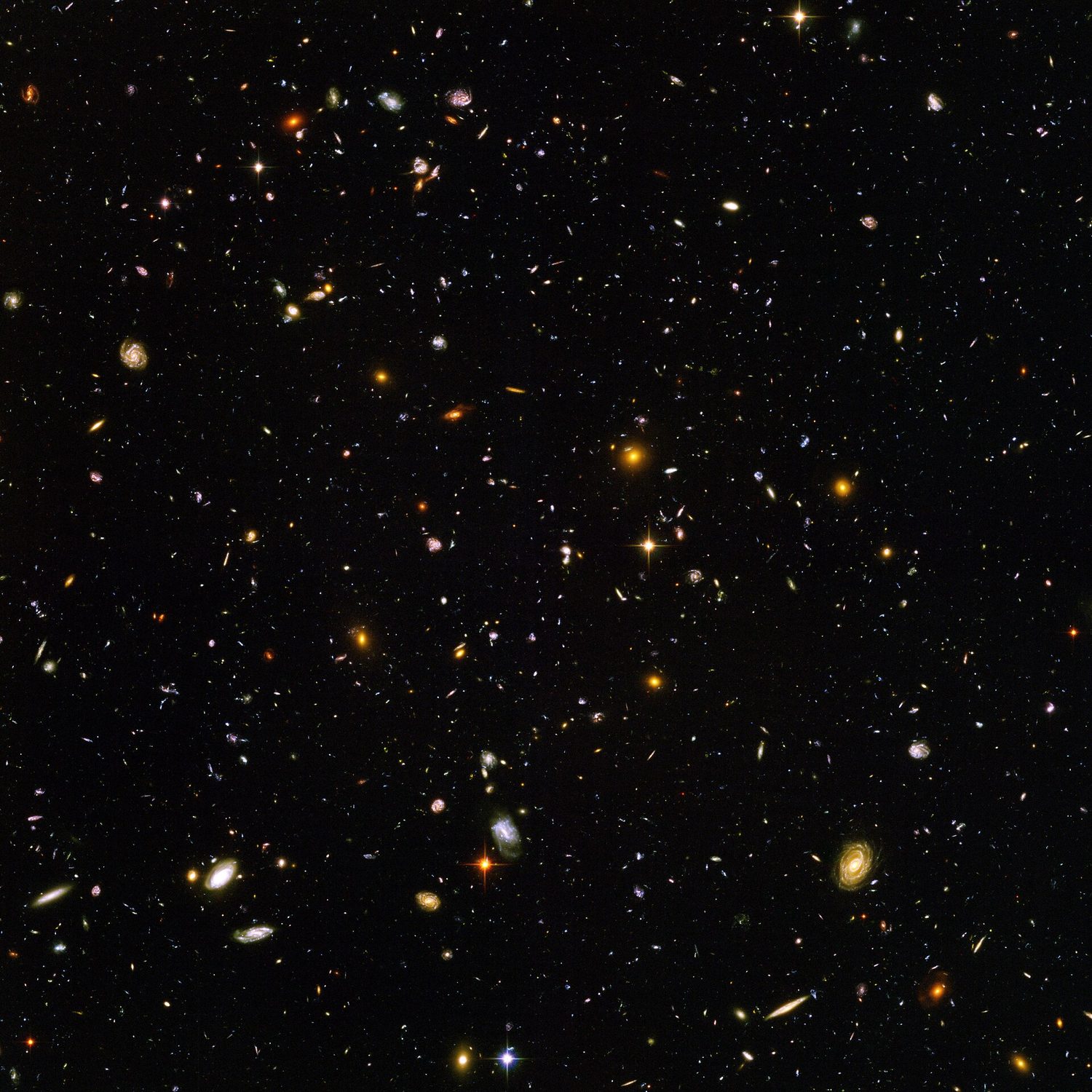
حقل ألترا ديبي هابل —gp almost every point of light is a whole galaxy, most of them redshifted and receding
قانون هابل
العلاقة بين سرعة الابتعاد $v$ والمسافة $d$ هي قانون هابل:
$$v \approx H_{0} \cdot d,$$
حيث $H_{0}$ هو ثابت هابل ($\approx 2.3 \times 10^{-18}\ \text{s}^{-1}$). استخدم دائماً الوحدات SI. مثال: مجرة تبتعد بسرعة $1.9 \times 10^{7}\ \text{m s}^{-1}$ تقع على مسافة $d = v/H_{0} \approx 8.3 \times 10^{24}\ \text{m}$.
"اذكر قانون هابل" (علامتان).سرعة ابتعاد المجرة تتناسب (طردياً) مع مسافتها عن الأرض (المراقب): $v = H_{0}d$، حيث $v$ هي سرعة الابتعاد، $d$ المسافة و$H_{0}$ ثابت هابل. حدد كل رمز عند الطلب. قيمة $H_{0}$ تُذكر في الامتحان بوحدات SI ($\text{s}^{-1}$)، لذا يجب أن تكون $v$ في $\text{m s}^{-1}$ و$d$ بالأمتار، لا بالمتر لكل ثانية لكل ميجابارسك.
مثال محلول. نجم في مجرة بعيدة يشع إشعاعاً تبلغ شدته ذروته $4.62 \times 10^{-7}\ \text{m}$؛ الذروة في الضوء المستلم على الأرض تقع عند $4.91 \times 10^{-7}\ \text{m}$. أوجد درجة حرارة سطح النجم، وسرعة ابتعاد المجرة، ومسافتها ($H_{0} = 2.3 \times 10^{-18}\ \text{s}^{-1}$).
درجة الحرارة من الذروة المُبعَثة: $T = 2.90 \times 10^{-3}/4.62 \times 10^{-7} = 6300\ \text{K}$. السرعة: $v = c\,\Delta\lambda/\lambda = (3.00 \times 10^{8})(0.29/4.62) = 1.9 \times 10^{7}\ \text{m s}^{-1}$، حوالي $6\%$ من $c$. المسافة: $d = v/H_{0} = 1.9 \times 10^{7}/2.3 \times 10^{-18} = 8.2 \times 10^{24}\ \text{m}$ (حوالي $870$ مليون سنة ضوئية). استخدام الذروة المرصودة لحساب درجة الحرارة كان سيعطي $5900\ \text{K}$، وهو $400\ \text{K}$ منخفض جداً.
قانون هابل: سرعة ابتعاد المجرة تتناسب طردياً مع مسافتها، $v = H_0 d$
من قانون هابل إلى الانفجار العظيم
قانون هابل يعني أن المجرات كانت يوماً ما معاً. بتتبع التمدد للخلف، تنكمش جميع المسافات إلى الصفر عند $t = -1/H_{0}$ — كان الكون يوماً نقطة صغيرة شديدة الكثافة والحرارة. هذا هو الانفجار العظيم. عمر الكون (للتمدد المنتظم) هو حوالي
التمدّد، وانزياح أحمر للمجرات، والخلفية الميكروية الكونية، ونسبات الهيدروجين والهيليوم هي الأدلة الرئيسية على الانفجار العظيم.
"اشرح كيف يؤدي قانون هابل إلى نظرية الانفجار العظيم" (ثلاث علامات). (1) المجرات تبتعد بسرعات تتناسب مع مسافاتها، لذا (2) إذا أعادنا الزمن للخلف، تصل كل مجرة، بغض النظر عن مسافتها، إلى نفس النقطة في نفس الوقت، $t = d/v = 1/H_{0}$ مضت؛ (3) لذا يجب أن بدأ الكون كنقطة واحدة ذات كثافة وحرارة هائلة ويتمدد منذ ذلك الحين. تقدير العمر: $1/H_{0} = 1/(2.3 \times 10^{-18}) = 4.3 \times 10^{17}\ \text{s}$، والقسم على $3.16 \times 10^{7}\ \text{s}$ في السنة يعطي $1.4 \times 10^{10}$ سنوات. هذا يفترض أن معدل التمدد لم يتغير؛ إنه تقدير، ليس قياساً.
سلم المسافات
يجمع الفلكيون بين طرق، كل طريقة معيارية بناءً على الطريقة التي تليها:
التزيح — للنجوم القريبة.
الشموع القياسية (القيفونيدات، مستعرات عظمى من النوع Ia) — للمجرات.
قانون هابل ($d = v/H_{0}$، مع $v$ من الانزياح الأحمر) — للمجرات البعيدة جداً.
سلم المسافات: كل طريقة معيارية بناءً على التي تليها وتمتد أبعد
Explore · استكشف
Hubble's law · قانون هابل
v = H₀·d
Recession speed is proportional to distance — the gradient is Hubble's constant. · سرعة الابتعاد تتناسب طرديًا مع المسافة — الميل هو ثابت هابل.
Definitions the examiner accepts · التعريفات التي يقبلها المصحح
English
A definition question is marked against fixed wording. Learn these exactly, and give one answer only.
Term
Definition
luminosity
the total power of radiation emitted by a star
radiant flux intensity
the power of radiation received per unit area (at right angles to the radiation), $F = L/(4\pi d^{2})$
standard candle
an object of known luminosity, from which a distance can be found by measuring the flux received
Wien's displacement law
the wavelength of maximum intensity of a black body is inversely proportional to its thermodynamic temperature, $\lambda_{\text{max}} T = \text{constant}$
Stefan–Boltzmann law
the luminosity of a black body of radius $r$ is $L = 4\pi\sigma r^{2}T^{4}$
redshift
the increase in the observed wavelength of radiation from a source moving away from the observer
Hubble's law
the speed of recession of a galaxy is proportional to its distance from the observer, $v = H_{0}d$
Hubble constant
the constant of proportionality in Hubble's law, in $\text{s}^{-1}$; $1/H_{0}$ estimates the age of the Universe
Big Bang theory
the Universe began from a single point of very high density and temperature and has been expanding since
العربية
تُصنّف أسئلة التعريف بناءً على صياغة ثابتة. احفظ هذه التعريفات بدقة، وقدم إجابة واحدة فقط.
مصطلح
تعريف
اللمعان
القدرة الكلية للإشعاع المنبعث من النجم
الشدة الإشعاعية
قدرة الإشعاع المستلمة لكل وحدة مساحة (عمودياً على اتجاه الإشعاع)، $F = L/(4\pi d^{2})$
شمعة قياسية
جسم ذو لمعان معروف، يمكن من خلاله تحديد المسافة بقياس الشدة المستلمة
قانون انزياح فين
الطول الموجي لشدة الإشعاع القصوى لجسم أسود يتناسب عكسياً مع درجة حرارته الديناميكية الحرارية، $\lambda_{\text{max}} T = \text{constant}$
قانون ستيفان-بولتزمان
إشراق جسم أسود نصف قطره $r$ يساوي $L = 4\pi\sigma r^{2}T^{4}$
الانزياح الأحمر
الزيادة في الطول الموجي المرصود للإشعاع الصادر عن مصدر يبتعد عن المراقب
قانون هابل
سرعة ابتعاد المجرة تتناسب طردياً مع مسافتها من المراقب، $v = H_{0}d$
ثابت هابل
ثابت التناسب في قانون هابل، بوحدة $\text{s}^{-1}$؛ مقلوبه $1/H_{0}$ يُقدّر عمر الكون
نظرية الانفجار العظيم
بدأ الكون من نقطة واحدة ذات كثافة وحرارة عاليتين جداً ويتوسع منذ ذلك الحين
25.3
Exam tips · نصائح للامتحان
English
Two recipes: distance = candle's $L$, measured $F$, $d = \sqrt{L/(4\pi F)}$; radius = $T$ from $\lambda_{\text{max}}$, $L$ from $F$ and $d$, $r$ from $L = 4\pi\sigma r^{2}T^{4}$. Write each step as its own formula.
$F$ is a flux (per square metre), $L$ a power; $L = 4\pi d^{2}F$ links them and $4\pi$ is part of both laws.
Wien: $\lambda_{\text{max}}$ in metres, $T$ in kelvin. Stefan–Boltzmann: $r^{2}$ and $T^{4}$; a $10\%$ error in $T$ is a $46\%$ error in $L$.
Redshift: $\Delta\lambda/\lambda_{\text{emitted}} = v/c$; then $d = v/H_{0}$ in SI units. Correct a receding galaxy's peak wavelength before using Wien's law.
The three "explain" answers (standard candle to distance, redshift to expansion, Hubble's law to the Big Bang) are marked point by point: three statements each, in order.
The age of the Universe is $1/H_{0}$, about $14$ billion years; state the assumption of a constant expansion rate.
Common mistakes
Defining luminosity as brightness, or as power per unit area; that is the flux.
Finding a standard candle's luminosity from its distance, which is circular; the luminosity comes from its type.
Using degrees Celsius in Wien's or Stefan's law, or forgetting the fourth power.
Dividing $\Delta\lambda$ by the observed wavelength instead of the emitted one, or mixing nanometres and metres in one ratio.
Using $H_{0}$ with $v$ in $\text{km s}^{-1}$; convert to $\text{m s}^{-1}$.
Feeding a redshifted peak wavelength into Wien's law and reporting a temperature that is too low.
Stating Hubble's law without "proportional" or without saying what $v$ and $d$ are.
Explaining the Big Bang without the backward-in-time argument that all galaxies were together at $t = 1/H_{0}$ ago.
العربية
وصفتان: المسافة = candle's $L$، مقاسة $F$، $d = \sqrt{L/(4\pi F)}$؛ النصف القطر = $T$ من $\lambda_{\text{max}}$، $L$ من $F$ و$d$، $r$ من $L = 4\pi\sigma r^{2}T^{4}$. اكتب كل خطوة كمعادلة مستقلة.
$F$ هو تدفق (لكل متر مربع)، $L$ قدرة؛ $L = 4\pi d^{2}F$ يربط بينهما و $4\pi$ جزء من كلا القانونين.
فين: $\lambda_{\text{max}}$ بالمتر، $T$ بالكلفن. ستيفان-بولتزمان: $r^{2}$ و $T^{4}$؛ خطأ $10\%$ في $T$ يسبب خطأ $46\%$ في $L$.
الانزياح الأحمر: $\Delta\lambda/\lambda_{\text{emitted}} = v/c$؛ ثم $d = v/H_{0}$ بوحدات SI. صحح الطول الموجي القصومي لمجرة مبتعدة قبل استخدام قانون فين.
إجابات "اشرح" الثلاثة (الشمعة القياسية للمسافة، الانزياح الأحمر للتوسع، قانون هابل للانفجار العظيم) تُصحح نقطة بنقطة: ثلاث عبارات لكل منها، بالترتيب.
عمر الكون هو $1/H_{0}$، حوالي $14$ مليار سنة؛ ذكر افتراض ثبات معدل التوسع.
أخطاء شائعة
تعريف الإشراق على أنه سطوع، أو قدرة لكل وحدة مساحة؛ أي التدفق.
إيجاد إشراق شمعة قياسية من مسافتها، وهو ما يدور حول نفسه؛ الأشراق يأتي من نوعها.
استخدام درجات مئوية في قانون فين أو ستيفان، أو نسيان الأس الرابع.
قسمة $\Delta\lambda$ على الطول الموجي المرصود بدلاً من المنبعث، أو خلط النانومترات والمتر في نفس النسبة.
استخدام $H_{0}$ مع $v$ في $\text{km s}^{-1}$؛ حول إلى $\text{m s}^{-1}$.
إدخال طول موجي قصومي منزاح نحو الأحمر في قانون فين وإبلاغ درجة حرارة منخفضة جداً.
ذكر قانون هابل دون كلمة "يتناسب" أو دون توضيح ما هما $v$ و $d$.
شرح الانفجار العظيم دون حجة العودة للزمن التي تثبت أن جميع المجرات كانت مجتمعة عند $t = 1/H_{0}$ مضت.
Interactive lessons on this topic · دروس تفاعلية حول هذا الموضوع
Work through it step by step, with instant-check exercises. · ا-working عليه خطوة بخطوة، مع تمارين تحقق فوري.
Pick one and the site follows you — notes, papers, videos and practice all open on it. · اختر واحدًا وسيتبعك الموقع — الملاحظات، الأوراق، الفيديوهات والتدريب جميعها تفتح عليه.
Type to search notes, lessons, code, vocabulary and past-paper questions across every subject. · اكتب للبحث عن ملاحظات، دروس، أكواد، مفردات وأسئلة امتحانات سابقة عبر جميع المواد.