كهرباء الحائط لديك غير ثابتة. خمسين مرة في كل ثانية — وأحياناً ستين — تعكس اتجاهها، فتتدفق نحو جهة ثم الأخرى. هذا هو…
English narration · English + 中文 subtitles burned in · سرد باللغة الإنجليزية · ترجمة مدمجة بالإنجليزية + الصينية
21.1
Alternating current basics · أساسيات التيار المتردد
Syllabus · المنهج
English
understand and use the terms period, frequency and peak value as applied to an alternating current or voltage
use equations of the form $x = x_0 \sin \omega t$ representing a sinusoidally alternating current or voltage
recall and use the fact that the mean power in a resistive load is half the maximum power for a sinusoidal alternating current
distinguish between root-mean-square (r.m.s.) and peak values and recall and use $I_{\text{r.m.s.}} = I_0 / \sqrt{2}$ and $V_{\text{r.m.s.}} = V_0 / \sqrt{2}$ for a sinusoidal alternating current
العربية
افهم واستخدم مصطلحات الدور، والتردد والقيمة القصوى كما تنطبق على تيار متردد أو جهد متردد
استخدم معادلات من الشكل $x = x_0 \sin \omega t$ تمثل تياراً أو جهداً متردداً جيhoaياً
استذكر واستخدم حقيقة أن المتوسط للطاقة في حمل مقاوم يساوي نصف الطاقة القصوى للتيار المتردد الجيhoa
(For a purely resistive load the voltage 电压 and current 电流 are in phase, which is the case in this syllabus.)
Key terms
period 周期$T$ — the time for one full cycle. Unit: s.
frequency 频率$f$ — cycles per second; $f = 1/T$. Mains is often $50\ \text{Hz}$ or $60\ \text{Hz}$.
angular frequency 角频率$\omega = 2\pi f = 2\pi/T$.
peak value 峰值$I_{0}$ or $V_{0}$ — the largest value in a cycle (also called the amplitude).
peak-to-peak value 峰峰值$2 I_{0}$ — from $+I_{0}$ to $-I_{0}$. Useful when reading an oscilloscope.
The two-mark definitions.The frequency of an alternating current is the number of complete cycles per unit time (say "per second" or "per unit time", and "complete cycles" or "oscillations"). The period is the time for one complete cycle, and the peak value is the maximum value of the current or voltage during a cycle. Note that the mean value of a sinusoidal current over a cycle is zero, which is exactly why the r.m.s. value is needed to describe it.
Reading the equation. In $V = V_{0} \sin(\omega t)$ the number in front is the peak value and the number multiplying $t$ is $\omega = 2\pi f$; the angle $\omega t$ is in radians 弧度, so set the calculator to radians before evaluating. A supply written with $\cos$ instead of $\sin$ is the same wave starting at its peak rather than at zero.
Worked example. The output of a supply is $V = 320 \sin(100\pi t)$ (volts, seconds). Find the peak value, the frequency, the period and the r.m.s. value, and the first time after $t = 0$ at which $V = 160\ \text{V}$.
Peak $V_{0} = 320\ \text{V}$. $\omega = 100\pi\ \text{rad s}^{-1}$, so $f = \omega/2\pi = 50\ \text{Hz}$ and $T = 1/f = 0.020\ \text{s}$. $V_{\text{r.m.s.}} = 320/\sqrt{2} = 226\ \text{V}$. For $V = 160\ \text{V}$: $\sin(100\pi t) = 0.5$, so $100\pi t = \pi/6$ and $t = 1/600 = 1.7 \times 10^{-3}\ \text{s}$. (For $V = 18\cos(40\pi t)$ the same reading gives $V_{0} = 18\ \text{V}$, $f = 20\ \text{Hz}$, $T = 50\ \text{ms}$, and a sketch that starts at $+18\ \text{V}$.)
Reading a CRO trace
Same as for any wave (Topic 7), using a cathode-ray oscilloscope 示波器:
horizontal divisions × time-base 时基 → period $T$, so $f = 1/T$.
vertical divisions × $y$-gain → peak voltage $V_{0}$ (measure centre to peak, or peak-to-peak then halve).
العربية
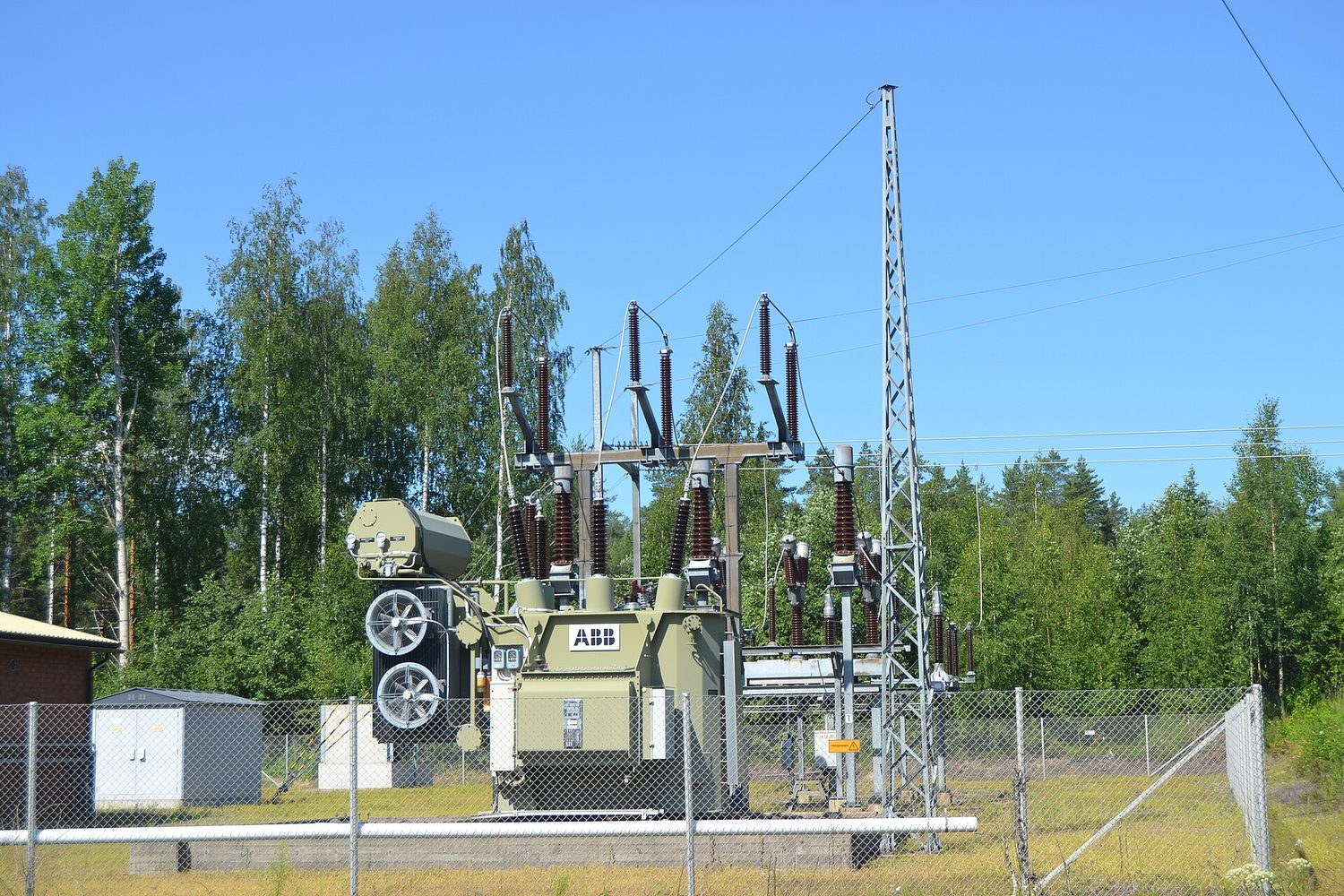
محولات المحطة الفرعية ترفع أو تخفض الجهد المتردد.
التيار المتردد (a.c.) يعيد الاتجاه باستمرار. إمداد الشبكة هو متردد جيبيا: $I$ أو $V$ يتبع موجة جيبية مع الزمن:
(للمحمل المقاوم النقي يكون الجهد والتيار في الطور، وهو الحال في هذا المنهج.)
تيار مستمر ثابت مقارنة بالتيار المتردد الجيبي بذروة $I_0$ ودورة $T$
مصطلحات رئيسية
الدورة$T$ — الوقت لدورة كاملة واحدة. الوحدة: ثانية (s).
التردد$f$ — دورة لكل ثانية؛ $f = 1/T$. غالباً ما تكون شبكة الكهرباء $50\ \text{Hz}$ أو $60\ \text{Hz}$.
التردد الزاوي$\omega = 2\pi f = 2\pi/T$.
قيمة الذروة$I_{0}$ أو $V_{0}$ — أكبر قيمة في الدورة (تسمى أيضاً السعة).
قيمة الذروة إلى الذروة$2 I_{0}$ — من $+I_{0}$ إلى $-I_{0}$. مفيدة عند قراءة راسم الإشارة.
تعريفات علامتين.تردد التيار المتردد هو عدد الدورات الكاملة لكل وحدة زمنية (قل "لكل ثانية" أو "لكل وحدة زمنية"، و"دورات كاملة" أو "تذبذبات"). الدورة هي الوقت لدورة كاملة واحدة، وقيمة الذروة هي القيمة القصوى للتيار أو الجهد خلال دورة. لاحظ أن المتوسط لتيار جيبي خلال دورة هو صفر، ولهذا السبب بالضبط نحتاج قيمة الجذر التربيعي للمتوسط المربع (r.m.s.) لوصفه.
قراءة المعادلة. في $V = V_{0} \sin(\omega t)$ الرقم الذي أمامها هو قيمة الذروة والرقم المضروب في $t$ هو $\omega = 2\pi f$؛ الزاوية $\omega t$ بـالراديان، لذا اضبط الآلة الحاسبة على الراديان قبل الحساب. إمداد مكتوب بـ $\cos$ بدلاً من $\sin$ هو نفس الموجة التي تبدأ من ذروتها بدلاً من الصفر.
مثال محلول. خرج إمداد هو $V = 320 \sin(100\pi t)$ (فولت، ثانية). أوجد قيمة الذروة، التردد، الدورة وقيمة r.m.s., والوقت الأول بعد $t = 0$ الذي يكون عنده $V = 160\ \text{V}$.
ذروة $V_{0} = 320\ \text{V}$. $\omega = 100\pi\ \text{rad s}^{-1}$، إذن $f = \omega/2\pi = 50\ \text{Hz}$ و$T = 1/f = 0.020\ \text{s}$. $V_{\text{r.m.s.}} = 320/\sqrt{2} = 226\ \text{V}$. بالنسبة لـ $V = 160\ \text{V}$: $\sin(100\pi t) = 0.5$، إذن $100\pi t = \pi/6$ و$t = 1/600 = 1.7 \times 10^{-3}\ \text{s}$. (بالنسبة لـ $V = 18\cos(40\pi t)$ نفس القراءة تعطي $V_{0} = 18\ \text{V}$، $f = 20\ \text{Hz}$، $T = 50\ \text{ms}$، ورسم يبدأ من $+18\ \text{V}$.).
قراءة أثر راسم الأشعة الكاثودية
نفس طريقة أي موجة (الموضوع 7)، باستخدام راسم إشارة الأشعة المهبطية (CRO):
تقاطع أفقية × قاعدة زمن → دورة $T$، إذن $f = 1/T$.
تقاطع عمودية × $y$-الكسب → جهد ذروة $V_{0}$ (قِس من المركز إلى الذروة، أو من ذروة إلى ذروة ثم نصف).
Explore · استكشف
Alternating current · التيار المتردد
I = a sin(bt)
AC is a sine wave — amplitude is the peak, b sets the frequency. · التيار المتردد هو موجة جيبية — السعة هي القيمة العظمى، وb تحدد التردد.
21.1
Power delivered to a resistor · القدرة المرسلة لمقاومة
English
For a resistive load $R$, the instant power 功率 is $P(t) = I(t)^{2} R$. With $I = I_{0}\sin(\omega t)$:
$$P(t) = I_{0}^{2} R \sin^{2}(\omega t).$$
This is always positive, with peak $I_{0}^{2} R$ and minimum zero, oscillating at twice the frequency of $I$. The mean of $\sin^{2}(\omega t)$ over a cycle is $\tfrac{1}{2}$, so the average power is
$$\langle P \rangle = \tfrac{1}{2} I_{0}^{2} R = \tfrac{1}{2} P_{\text{peak}}.$$
Average a.c. power in a resistor is half the peak power.
"Show by calculation that the mean power is half the peak power." A supply of peak value $12\ \text{V}$ drives a $680\ \Omega$ resistor. Peak power: $P_{0} = V_{0}^{2}/R = 12^{2}/680 = 0.212\ \text{W}$, the instantaneous power at the moment the voltage is at its peak. Mean power: use the r.m.s. value, $V_{\text{r.m.s.}} = 12/\sqrt{2} = 8.49\ \text{V}$, so $\langle P \rangle = V_{\text{r.m.s.}}^{2}/R = 8.49^{2}/680 = 0.106\ \text{W}$, exactly half. The two calculations must be shown separately; writing "$\tfrac{1}{2}$ of $0.212$" scores nothing, because that is the thing being shown. The $\tfrac{1}{2}$ is $(1/\sqrt{2})^{2}$: squaring the r.m.s. factor.
العربية
للمحمل المقاوم $R$، اللحظة القدرة هي $P(t) = I(t)^{2} R$. مع $I = I_{0}\sin(\omega t)$:
قدرة المقاومة تتذبذب؛ متوسطها نصف الذروة
$$P(t) = I_{0}^{2} R \sin^{2}(\omega t).$$
هذه دائماً موجبة، بذروة $I_{0}^{2} R$ وصفر أدنى، تتذبذب بمعدل ضعف تردد $I$. متوسط $\sin^{2}(\omega t)$ خلال دورة هو $\tfrac{1}{2}$، لذا متوسط القدرة هو
$$\langle P \rangle = \tfrac{1}{2} I_{0}^{2} R = \tfrac{1}{2} P_{\text{peak}}.$$
متوسط القدرة المتردد في مقاومة هو نصف القدرة الذروية.
"أثبت بالحساب أن متوسط القدرة هو نصف القدرة الذروية." إمداد بقيمة ذروة $12\ \text{V}$ يشغل مقاومة $680\ \Omega$. قدرة الذروة: $P_{0} = V_{0}^{2}/R = 12^{2}/680 = 0.212\ \text{W}$، القدرة اللحظية في اللحظة التي يكون فيها الجهد عند ذروته. متوسط القدرة: استخدم قيمة r.m.s.، $V_{\text{r.m.s.}} = 12/\sqrt{2} = 8.49\ \text{V}$، إذن $\langle P \rangle = V_{\text{r.m.s.}}^{2}/R = 8.49^{2}/680 = 0.106\ \text{W}$، نصف تماماً. يجب عرض الحسابين منفصلين؛ كتابة "$\tfrac{1}{2}$ من $0.212$" لا تحصل على نقاط، لأن هذا هو ما يُطلب إثباته. الـ$\tfrac{1}{2}$ هو $(1/\sqrt{2})^{2}$: تربيع عامل r.m.s.
The r.m.s. current $I_{\text{r.m.s.}}$ is the steady direct current that would give the same average power in the same resistance 电阻$R$. From $\langle P \rangle = I_{\text{r.m.s.}}^{2} R = \tfrac{1}{2} I_{0}^{2} R$:
The $\sqrt{2}$ comes from the name root-mean-square 均方根: $I_{\text{r.m.s.}} = \sqrt{\langle I^{2} \rangle}$ and $\langle \sin^{2}\rangle = \tfrac{1}{2}$. (Only the sinusoidal case is needed.)
The two-mark definition.The r.m.s. value of an alternating current is the value of the direct (steady) current that would dissipate the same (mean) power in the same resistor. "By reference to the heating effect" means exactly this sentence: same resistor, same power (or same heating), direct current. A definition that only says "$I_{0}/\sqrt{2}$" scores nothing, because that formula is true only for a sine wave.
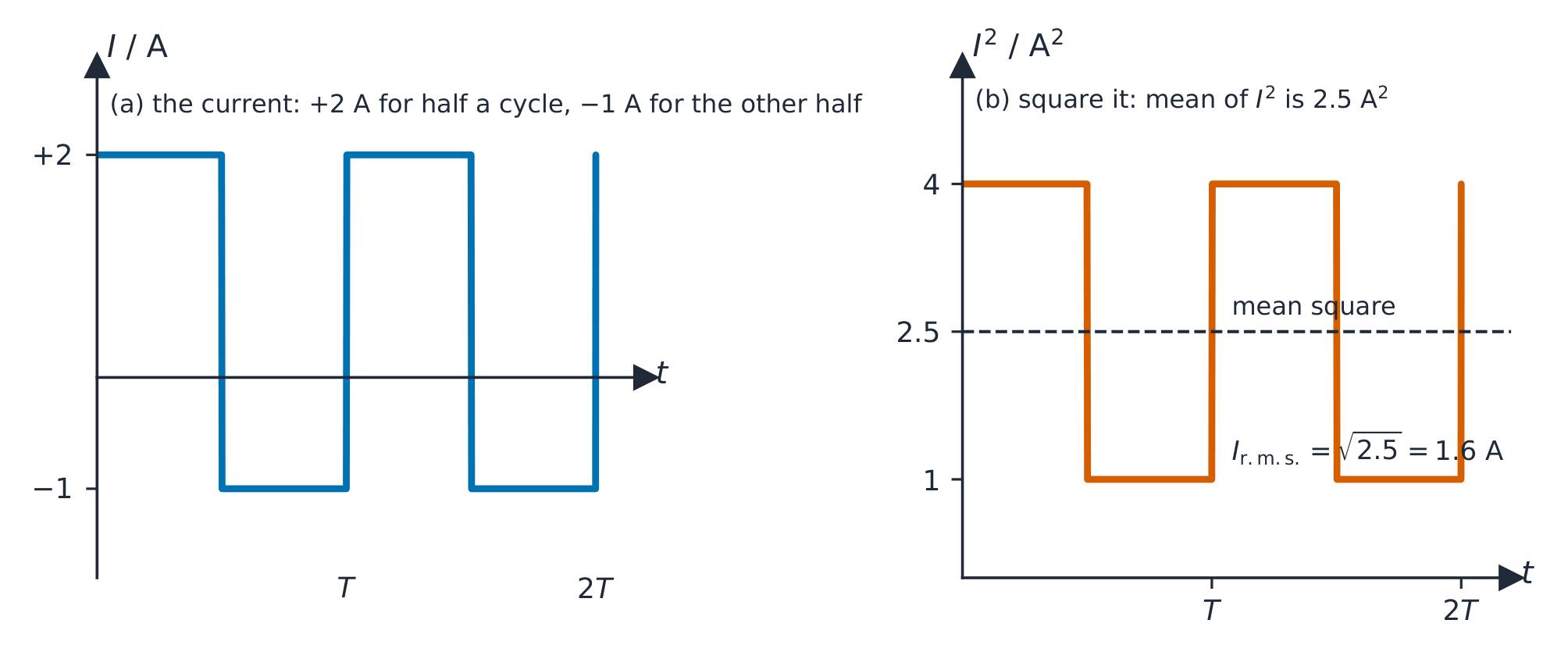
Worked example (non-sinusoidal). A current through a resistor is $+2.0\ \text{A}$ for the first half of each cycle and $-1.0\ \text{A}$ for the second half, a square wave 方波. Find its r.m.s. value and the mean power in a $10\ \Omega$ resistor.
Square the current: $4.0\ \text{A}^{2}$ for half the time and $1.0\ \text{A}^{2}$ for the other half, so the mean square is $(4.0 + 1.0)/2 = 2.5\ \text{A}^{2}$ and $I_{\text{r.m.s.}} = \sqrt{2.5} = 1.6\ \text{A}$. Mean power $= I_{\text{r.m.s.}}^{2} R = 2.5 \times 10 = 25\ \text{W}$. The sign of the current does not matter to the heating (it is squared away), and $I_{0}/\sqrt{2}$ would have given the wrong answer, $1.4\ \text{A}$: that shortcut is for sine waves only.
Why r.m.s. matters
Quoted a.c. values are r.m.s. values. "$230\ \text{V}$ mains" means $V_{\text{r.m.s.}} = 230\ \text{V}$, with peak $V_{0} = 230\sqrt{2} \approx 325\ \text{V}$. Components must be rated for the peak, not the r.m.s. Average power then takes the d.c. form:
$$\langle P \rangle = I_{\text{r.m.s.}}^{2} R = V_{\text{r.m.s.}}^{2} / R = V_{\text{r.m.s.}} I_{\text{r.m.s.}}.$$
Worked example. A heater of resistance $50\ \Omega$ is connected to the $230\ \text{V}$ r.m.s. mains. Find the r.m.s. current and the average power dissipated.
Worked example. A sinusoidal supply of r.m.s. value $4.2\ \text{V}$ and frequency $50\ \text{kHz}$ is connected across a $150\ \Omega$ resistor. Find the peak current, the mean power, and write down an equation for the current.
$V_{0} = 4.2\sqrt{2} = 5.9\ \text{V}$, so $I_{0} = V_{0}/R = 5.9/150 = 0.040\ \text{A}$ (or $I_{\text{r.m.s.}} = 4.2/150 = 0.028\ \text{A}$ and then $\times\sqrt{2}$). Mean power $= V_{\text{r.m.s.}}^{2}/R = 4.2^{2}/150 = 0.12\ \text{W}$. With $\omega = 2\pi f = 2\pi \times 5.0 \times 10^{4} = 3.1 \times 10^{5}\ \text{rad s}^{-1}$: $I = 0.040 \sin(3.1 \times 10^{5} t)$ (amps, seconds). Keep the two families apart: peak values go into the equation and into component ratings; r.m.s. values go into power.
العربية
تيار r.m.s. $I_{\text{r.m.s.}}$ هو التيار المستمر الثابت الذي سيمنح نفس متوسط القدرة في نفس المقاومة$R$. من $\langle P \rangle = I_{\text{r.m.s.}}^{2} R = \tfrac{1}{2} I_{0}^{2} R$:
يأتي $\sqrt{2}$ من اسم الجذر التربيعي للمتوسط الحسابي التربيعي: $I_{\text{r.m.s.}} = \sqrt{\langle I^{2} \rangle}$ و$\langle \sin^{2}\rangle = \tfrac{1}{2}$. (الحالة الجيبية فقط مطلوبة.)
تعريف العلامتين.قيمة تيار متردد الجذر الوسطي التربيعي (r.m.s.) هي قيمة التيار المستمر (الثابت) الذي سيبدد نفس (متوسط) القدرة في نفس المقاومة. "بالإشارة إلى تأثير التسخين" تعني هذه الجملة بالضبط: نفس المقاومة، نفس القدرة (أو نفس التسخين)، تيار مستمر. التعريف الذي يقول فقط "$I_{0}/\sqrt{2}$" لا يحصل على أي درجات، لأن تلك المعادلة صحيحة فقط لموجة جيبية.
الجذر الوسطي التربيعي، حرفياً: مربّع التيار، اجمع المربعات خلال دورة، خذ الجذر التربيعي. بالنسبة لتيار غير جيبي، هذا هو الطريق الوحيد؛ $I_0/\sqrt{2}$ ينطبق فقط على الموجة الجيبية
مثال محلول (غير جيبي). تيار يمر عبر مقاومة قيمته $+2.0\ \text{A}$ لنصف كل دورة و$-1.0\ \text{A}$ للنصف الآخر، وهي موجة مربعة. أوجد قيمتها r.m.s. ومتوسط القدرة في مقاومة $10\ \Omega$.
مربّع التيار: $4.0\ \text{A}^{2}$ لنصف الوقت و$1.0\ \text{A}^{2}$ للنصف الآخر، لذا فإن متوسط المربعات هو $(4.0 + 1.0)/2 = 2.5\ \text{A}^{2}$ و$I_{\text{r.m.s.}} = \sqrt{2.5} = 1.6\ \text{A}$. متوسط القدرة $= I_{\text{r.m.s.}}^{2} R = 2.5 \times 10 = 25\ \text{W}$. إشارة التيار لا تهم للتسخين (لأنها تُربَّع وتختفي)، و$I_{0}/\sqrt{2}$ كان سيعطي إجابة خاطئة، $1.4\ \text{A}$: هذا الاختصار خاص بالموجات الجيبية فقط.
لماذا r.m.s. مهمة
تُذكر قيم a.c. كقيم r.m.s. "$230\ \text{V}$ الكهرباء المنزلية" تعني $V_{\text{r.m.s.}} = 230\ \text{V}$، مع القيمة القصوى $V_{0} = 230\sqrt{2} \approx 325\ \text{V}$. يجب أن تكون المكونات مصممة للقيمة القصوى، وليس r.m.s. متوسط القدرة يأخذ بعد ذلك الشكل d.c.:
$$\langle P \rangle = I_{\text{r.m.s.}}^{2} R = V_{\text{r.m.s.}}^{2} / R = V_{\text{r.m.s.}} I_{\text{r.m.s.}}.$$
مثال محلول. سخان مقاومته $50\ \Omega$ متصل بمصدر كهرباء رئيسي بقيمة $230\ \text{V}$ r.m.s. أوجد تيار الـ r.m.s. والقدرة المتوسطة المستهلكة.
distinguish graphically between half-wave and full-wave rectification
explain the use of a single diode for the half-wave rectification of an alternating current
explain the use of four diodes (bridge rectifier) for the full-wave rectification of an alternating current
analyse the effect of a single capacitor in smoothing, including the effect of the values of capacitance and the load resistance
العربية
فرّق بيانياً بين تقويم نصف الموجة وتقويم كامل الموجة
اشرح استخدام ثنائي ثنائي واحد لتقويم نصف موجة للتيار المتردد
اشرح استخدام أربعة ثنائيات (قنطرة تقويم) لتقويم كامل موجة للتيار المتردد
حلل تأثير مكثف واحد في التنعيم، بما في ذلك تأثير قيم السعة الكهربائية ومقاومة الحمل
Source: Cambridge International syllabus · المصدر: منهج كامبريدج الدولي
English
Rectification 整流 turns an alternating voltage into a one-direction (d.c.-like) voltage, using diodes 二极管 (which conduct in only one direction).
"State what is meant by rectification."The conversion of an alternating current (or voltage) into a direct current (or voltage): one that flows in one direction only, however much it varies. A diode conducts only when it is forward-biased 正向偏置, that is, when its anode (the flat end of the symbol's triangle) is more positive than its cathode (the bar); otherwise it is reverse-biased and behaves like an open switch. Treat it as ideal: zero resistance one way, infinite the other.
Half-wave rectification
A single diode in series with the load passes only the positive half of each cycle; in the negative half the diode is reverse-biased 反向偏置 and no current flows. This is half-wave rectification 半波整流.
Output: positive half-waves with flat zero gaps. The mean output is $V_{0}/\pi \approx 0.32 V_{0}$. Drawback: half the input is wasted and the output is very uneven.
Completing the circuit. "Complete the diagram to produce half-wave rectification" needs one diode in series between the supply and the load, with the triangle pointing the way the output current must flow, and $V_{\text{OUT}}$ taken across the load. If a capacitor is to smooth the output it goes across the load (in parallel); a capacitor in series would block the d.c. altogether.
Full-wave rectification (bridge rectifier)
A bridge rectifier 桥式整流器 uses four diodes arranged so the current through the load always flows the same way, whichever a.c. terminal is positive — full-wave rectification 全波整流. On each half-cycle a different pair of diodes conducts, but the load always sees the same direction.
Explaining the bridge (the standard four-marker). When terminal P is positive, current leaves P, passes through the diode pointing away from P to the top of the load, flows down through the load and returns to Q through the diode pointing towards Q; the other two diodes are reverse-biased and carry nothing. When Q is positive the other pair conducts, but they are arranged so that the current still enters the load at the top: the load current is in the same direction in both half-cycles. Name the diodes in each half-cycle and say which end of the load is positive.
Completing a bridge. Given a bridge with diodes missing, remember the rule for every diode: conventional current flows through it in the direction of the triangle. Both diodes joined to the positive output terminal must point towards it; both joined to the negative output terminal must point away from it. A bridge with a diode the wrong way round either short-circuits the supply on one half-cycle or passes nothing.
Output: a continuous run of positive half-waves (no gaps), at twice the input frequency. The mean output is $2V_{0}/\pi \approx 0.64 V_{0}$ — double the half-wave value. It uses all the input and is smoother and easier to filter.
Drawing the diagrams
half-wave: a.c. source — single diode — load $R$, in series.
full-wave bridge: four diodes as the arms of a "diamond"; the a.c. input goes to one pair of opposite corners, the load $R$ across the other pair. The diode directions make the load terminals keep the same polarity for either input polarity.
"State the difference between half-wave and full-wave rectification." In half-wave rectification only one half of each input cycle appears at the output and the other half is blocked (the output is zero for half the time); in full-wave rectification both halves appear, one of them inverted, so there are no gaps and the output has twice the input frequency. A sketch should show, for half-wave, positive humps separated by flat zero sections of equal length; for full-wave, positive humps joined at the zero line.
العربية
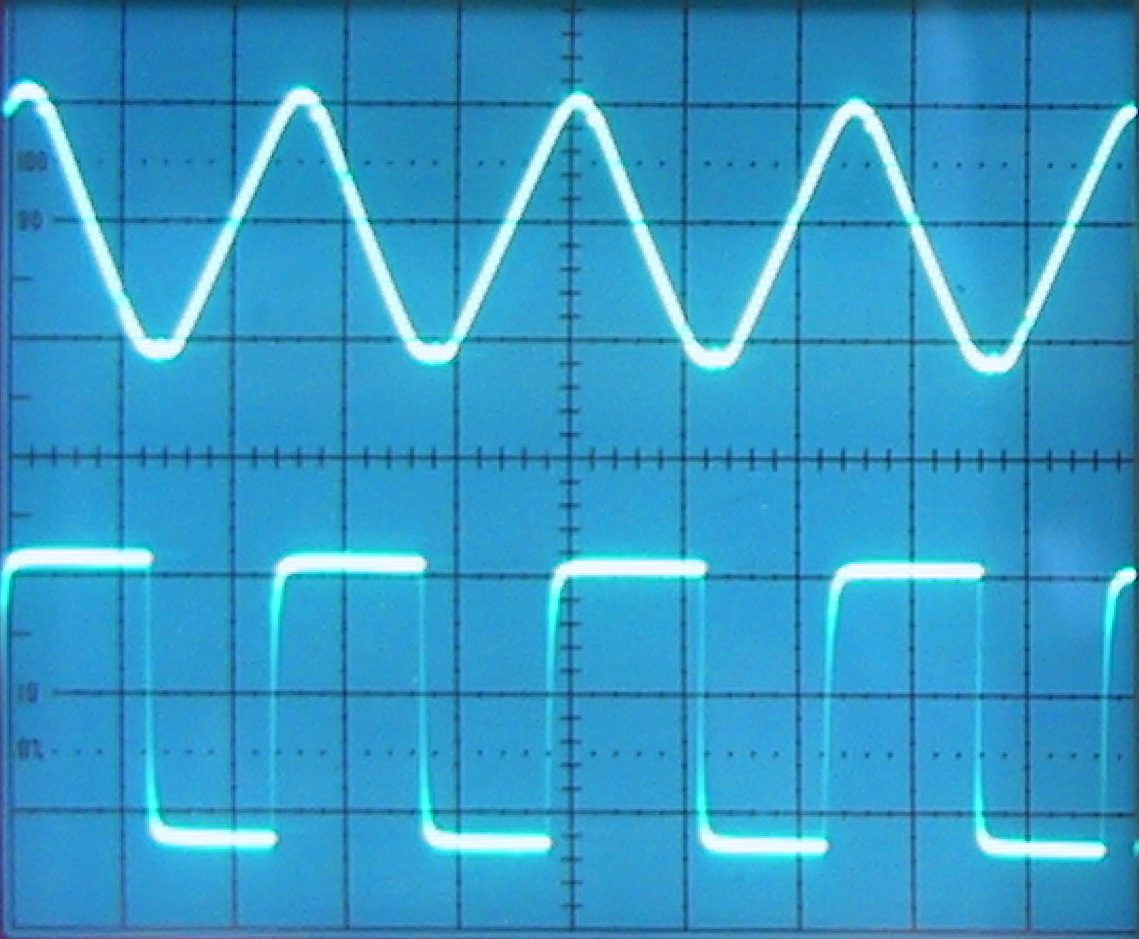
يرسم الأوسيلوسكوب كيف يتغير الجهد مع الزمن.
التقويم يحول جهداً مترادداً إلى جهد أحادي الاتجاه (يشبه d.c.)، باستخدام ثنائيات (التي تتدفق في اتجاه واحد فقط).
"اشرح ما يُقصد بالتقويم."تحويل تيار متردد (أو جهد) إلى تيار مستمر (أو جهد): وهو تيار يتدفق في اتجاه واحد فقط، بغض النظر عن مقدار تغيره. الثنائي يتدفق منه تيار فقط عندما يكون موجه للأمام، أي عندما يكون الأنود (الطرف المسطح من مثلث الرمز) أكثر إيجابية من الكاثود (الخط)؛ وإلا فهو موجه للخلف ويتصرف كمفتاح مفتوح. تعامل معه كمثالي: صفر مقاومة في اتجاه واحد، لا نهائية في الاتجاه الآخر.
تقويم نصف الموجة
ثنائي واحد على التوالي مع الحمل يمر فقط النصف الإيجابي من كل دورة؛ في النصف السالب يكون الثنائي موجهاً عكسياً ولا يمر تيار. هذا هو تقويم نصف الموجة.
المخرج: نصف موجات موجبة مع فراغات صفر مسطحة. المتوسط هو $V_{0}/\pi \approx 0.32 V_{0}$. العيب: نصف المدخلات ضائع والمخرج غير منتظم جداً.
في تقويم نصف الموجة، ثنائي واحد يمر فقط نصف الدورات الموجبةدائرة المقوّم نصف الموجة التي يُطلب منك رسمها في الامتحان: المصدر، الثنائي، الحمل على التوالي، المخرج عبر الحمل؛ مكثف التنعيم، إن أردته، يوضع على التوازي مع الحمل، لا على التوالي أبداً
إكمال الدائرة. "أكمل الرسم لإنتاج تقويم نصف الموجة" يتطلب ثنائياً واحداً على التوالي بين المصدر والحمل، بحيث يشير المثلث إلى الاتجاه الذي يجب أن يتدفق فيه تيار المخرج، مع أخذ $V_{\text{OUT}}$ عبر الحمل. إذا كان المكثف سيقوم بتنعيم المخرج، فيوضع عبر الحمل (على التوازي)؛ أما المكثف على التوالي فسيحجب الـ d.c. تماماً.
تقويم كامل الموجة (مقوّم الجسر)
يستخدم مقوّم الجسرأربعة ثنائيات مرتبة بحيث يتدفق تيار الحمل دائماً في نفس الاتجاه، بغض النظر عن أي طرف a.c. هو موجب — تقويم كامل الموجة. في كل نصف دورة، ثنائيان مختلفان يتدفق منهما تيار، لكن الحمل يرى دائماً نفس الاتجاه.
جسر الرباعي يرسل تيار الحمل في نفس الاتجاه بغض النظر عن أي طرف a.c. هو موجب
شرح الجسر (السؤال القياسي بأربع علامات). عندما يكون الطرف P موجباً، يغادر التيار P، ويمر عبر الثنائي الذي يشير بعيداً عن P إلى أعلى الحمل، ويتدفق أسفل عبر الحمل ويعود إلى Q عبر الثنائي الذي يشير نحو Q؛ الثنائيان الآخران موجهاان عكسياً ولا يمر منهما شيء. عندما يكون Q موجباً، الثنائيان الآخران يتدفق منهما تيار، لكنهما مرتبان بحيث يدخل التيار الحمل من الأعلى دائماً: تيار الحمل يكون في نفس الاتجاه في كلا نصفي الدورة. سمّ الثنائيين في كل نصف دورة وقب أي طرف للحمل هو الموجب.
إكمال قنطرة. عند وجود قنطرة تفتقر إلى بعض ثنائيات الجهد، تذكر القاعدة لكل ثنائي: التيار التقليدي يمر خلاله في اتجاه المثلث. يجب أن يشير كلا الثنائيين المتصلين بـ الطرف الموجب للخرج إلى داخله؛ وكلا الثنائيين المتصلين بـ الطرف السالب للخرج يجب أن يشيرا خارجه. القنطرة التي يكون فيها أحد الثنائيات معكوساً إما أن causing short-circuit للمصدر في نصف دورة أو تمرر شيئاً لا.
الخرج: سلسلة متصلة من نصف الموجات الموجبة (بدون فراغات)، بتردد ضعف تردد الدخل. المتوسط هو $2V_{0}/\pi \approx 0.64 V_{0}$ — ضعف قيمة نصف الموجة. يستخدم كامل الدخل وهو أكثر نعومة وأسهل في التصفية.
في تصحيح الموجة الكاملة، يُستخدم كل نصف دورة، مما يعطي سلسلة متصلة من النتوءات الموجبة
رسم المخططات
نصف الموجة: مصدر تيار متردد — ثنائي واحد — حمل $R$، على التوالي.
قنطرة موجة كاملة: أربعة ثنائيات كأذرع "الماس"؛ يدخل التيار المتردد إلى زوج من الزوايا المتقابلة، والحمل $R$ عبر الزوج الآخر. توجهات الثنائيات تجعل أطراف الحمل تحافظ على نفس الاستقطاب لأي استقطاب للدخل.
"اذكر الفرق بين تصحيح نصف الموجة وتصحيح الموجة الكاملة." في تصحيح نصف الموجة، يظهر فقط نصف واحد من كل دورة دخل في الخرج والنصف الآخر محظور (الخارج صفر لنصف الوقت)؛ في تصحيح الموجة الكاملة، يظهر كلا النصفين، أحدهما مقلوب، لذا لا توجد فراغات ويكون للخرج ضعف تردد الدخل. يجب أن يوضح الرسم التوضيحي، لتصحيح نصف الموجة، نتوءات موجبة مفصولة بفواصل مسطحة صفرية مساوية في الطول؛ ولتصحيح الموجة الكاملة، نتوءات موجبة متصلة عند خط الصفر.
Explore · استكشف
Rectifier and smoothing route · مسار التقويم والتنعيم
Watch alternating input become a smoother direct output. · راقب تحول المدخل المتردد إلى خرج مستمر أكثر نعومة.
A rectifier's output is still bumpy. To smooth it, put a capacitor 电容器$C$in parallel with the load$R$.
How it works
on the rising part of each pulse, the capacitor charges up to near the peak.
on the falling part (and any gap), the diodes are reverse-biased, so the capacitor discharges through the load, keeping current flowing. The voltage falls with time constant 时间常数$RC$ (Topic 19).
at the next peak, the capacitor charges again, and the cycle repeats.
The output now sits near the peak with small dips. The size of the dips is the ripple 纹波 (this whole step is called smoothing 平滑).
Worked example. A half-wave rectifier fed from a $50\ \text{Hz}$ supply has a $470\ \mu\text{F}$ capacitor across its $1.2\ \text{k}\Omega$load 负载. Estimate the fractional fall in the output between peaks, and say how it changes with a bridge rectifier.
The peaks are $T = 1/50 = 20\ \text{ms}$ apart (half-wave: one peak per cycle). The time constant is $RC = (1.2 \times 10^{3})(470 \times 10^{-6}) = 0.56\ \text{s}$. Between peaks the capacitor discharges to $V_{0} e^{-t/RC} = V_{0} e^{-0.020/0.56} = 0.965\,V_{0}$, a fall of about $3.5\%$. With full-wave rectification the peaks are $10\ \text{ms}$ apart, so the fall is only $1.8\%$; doubling the capacitance would halve it again. Because $t \ll RC$ the fall is approximately $V_{0}\, t/(RC)$: the ripple is proportional to the time between peaks and inversely proportional to both $R$ and $C$. (A network of capacitors across the output combines by the rules of Topic 19 before it is used here.)
What reduces the ripple
larger $C$ → more stored charge → smaller dip between peaks → smaller ripple.
higher rectified frequency (full-wave is twice the input) → less time to discharge between peaks → smaller ripple.
In short, a large $RC$ compared with the time between peaks gives a smoother output.
Sketching the smoothed output. Draw the unsmoothed humps faintly first. The smoothed curve touches each peak, then falls along a gentle curve (steepest just after the peak) until the next hump rises to meet it, where it turns sharply upwards and follows the hump to the peak. It never falls to zero, and it never rises above the peak. For half-wave rectification the decay has to last through the missing half-cycle as well, so the ripple is about twice that of full-wave for the same $RC$. If the question changes $C$ or $R$, redraw on the same axes: a larger $RC$ hugs the peak line more closely; a smaller $RC$ sags further.
Purpose in summary
The smoothing capacitor reduces the ripple, giving a steadier d.c. voltage suitable for sensitive electronics.
العربية
خرج مصحح الأمواج لا يزال متذبذباً. لتنعيمة، ضع مكثفاً$C$على التوازي مع الحمل$R$.
كيف يعمل
في الجزء الصاعد من كل نبضة، يتشحن المكثف ليصل تقريباً إلى الذروة.
في الجزء الهابط (وفراغ أي)، تكون الثنائيات عكسية الانحياز، لذا يفرغ المكثف عبر الحمل، مما يحافظ على تدفق التيار. ينخفض الجهد مع ثابت زمني$RC$ (الموضوع 19).
عند الذروة التالية، يتشحن المكثف مرة أخرى، ويتكرر الدورة.
يجلس الخرج الآن بالقرب من الذروة مع انخفاضات صغيرة. حجم الانخفاضات هو التذبذب (تُسمى هذه الخطوة بالكامل التنعيم).
مكثف عبر الحمل ينعم خرج الأمواج المصححة، تاركاً تذبذباً صغيراً فقطنفس المصدر المصحح مع ثابتات زمنية مختلفة: ثابت زمني $RC$ أكبر (سعة أكبر، أو مقاومة حمل أكبر) يتناقص أقل بين القمم، لذا يكون التذبذب أصغر
مثال محلول. مصحح نصف موجة مغذي من مصدر $50\ \text{Hz}$ يحتوي على مكثف $470\ \mu\text{F}$ عبر تحميله $1.2\ \text{k}\Omega$الحمل. قدّر الانخفاض الكسري في الخرج بين القمم، وقل كيف يتغير مع قنطرة تصحيح.
القمم تبعد $T = 1/50 = 20\ \text{ms}$ عن بعضها (نصف موجة: ذروة واحدة لكل دورة). الثابت الزمني هو $RC = (1.2 \times 10^{3})(470 \times 10^{-6}) = 0.56\ \text{s}$. بين القمم يفرغ المكثف إلى $V_{0} e^{-t/RC} = V_{0} e^{-0.020/0.56} = 0.965\,V_{0}$، بانخفاض قدره حوالي $3.5\%$. مع تصحيح الموجة الكاملة، القمم تبعد $10\ \text{ms}$ عن بعضها، لذا الانخفاض هو فقط $1.8\%$؛ مضاعفة السعة سي减半ه مرة أخرى. لأن $t \ll RC$ الانخفاض تقريباً $V_{0}\, t/(RC)$: التذبذب متناسب طردياً مع الزمن بين القمم وعكسياً مع كل من $R$ و $C$. (شبكة من المكثفات عبر الخرج تتجمع وفقاً لقواعد الموضوع 19 قبل استخدامها هنا.)
ما يقلل التذبذب
ثابت زمني $C$ أكبر → شحنة مخزنة أكثر → انخفاض أقل بين القمم → تذبذب أصغر.
ثابت زمني $R$ أكبر → تيار حمل أقل → تفريغ أبطأ → تذبذب أصغر.
تردد المصحح أعلى (موجة كاملة هي ضعف الدخل) → وقت أقل للتفريغ بين القمم → تذبذب أصغر.
باختصار، ثابت زمني $RC$ كبير مقارنة بالزمن بين القمم يعطي خرجاً أكثر نعومة.
رسم الخرج المنعوم. ارسم النتوءات غير المعومة خفيفة أولاً. المنحنى المعوم يلمس كل ذروة، ثم ينخفض على طول منحنى لطيف (الأكثر انحداراً مباشرة بعد الذروة) حتى ترتفع النبضة التالية لتلتقي به، حيث يلتوي حاداً للأعلى ويتبع النبضة إلى الذروة. لا ينخفض أبداً إلى الصفر، ولا يرتفع فوق الذروة. لتصحيح نصف الموجة، يجب أن يستمر التناقص خلال نصف الدورة المفقود أيضاً، لذا التذبذب يساوي تقريباً ضعف تصحيح الموجة الكاملة لنفس $RC$. إذا تغير السؤال $C$ أو $R$، أعد الرسم على نفس المحاور: ثابت زمني $RC$ أكبر يعانق خط الذروة بشكل أقرب؛ ثابت زمني $RC$ أصغر ينخفض أكثر.
Definitions the examiner accepts · التعريفات التي يقبلها المصحح
English
A definition question is marked against fixed wording. Learn these exactly, and give one answer only.
Term
Definition
alternating current
a current that reverses its direction periodically (varies sinusoidally with time about zero)
period
the time for one complete cycle
frequency
the number of complete cycles per unit time
peak value
the maximum value of the current or voltage in a cycle
r.m.s. value
the value of the direct (steady) current that would dissipate the same power in the same resistor
rectification
the conversion of an alternating current into a direct (one-direction) current
half-wave rectification
only one half of each cycle is passed to the output; the other half is blocked
full-wave rectification
both halves of each cycle appear at the output in the same direction
smoothing
using a capacitor across the load to reduce the variation (ripple) of a rectified output
العربية
تُصنّف أسئلة التعريف بناءً على صياغة ثابتة. احفظ هذه التعريفات بدقة، وقدم إجابة واحدة فقط.
مصطلح
تعريف
تيار متردد
تيار يعكس اتجاهه بشكل دوري (يتغير جيبياً مع الزمن حول الصفر)
الدور
الزمن لدورة واحدة كاملة
التردد
عدد الدورات الكاملة في وحدة الزمن
القيمة القصوى
القيمة العظمى للتيار أو الجهد في الدورة
القيمة الفعالة
قيمة التيار المستمر (الثابت) الذي سيستهلك نفس القدرة في نفس المقاومة
التصحيح
تحويل تيار متردد إلى تيار مستمر (ذو اتجاه واحد)
تقويم نصف الموجة
يُمرر نصف واحد فقط من كل دورة إلى المخرج؛ يتم حجب النصف الآخر
تقويم كامل الموجة
يظهر كلا نصفي كل دورة عند المخرج في نفس الاتجاه
التنعيم
استخدام مكثف عبر الحمل لتقليل التذبذب (التموج) في خرج مقوّم
21.2
Exam tips · نصائح للامتحان
English
$V = V_{0} \sin\omega t$ with $\omega = 2\pi f$ in radians per second: read $V_{0}$ and $\omega$ straight off the equation; radian mode for any time calculation.
$I_{\text{r.m.s.}} = I_{0}/\sqrt{2}$ and $V_{\text{r.m.s.}} = V_{0}/\sqrt{2}$ for a sine wave only; otherwise square, average, root. Quoted mains values are r.m.s.; components are rated for the peak.
Mean power in a resistor is $I_{\text{r.m.s.}}^{2}R = V_{\text{r.m.s.}}^{2}/R = \tfrac{1}{2} I_{0}^{2} R$, half the peak power; the mean current is zero, the mean power is not.
One diode in series gives half-wave rectification; a four-diode bridge gives full-wave, with the load current always in the same direction and the output at twice the input frequency.
Smoothing: capacitor across the load; ripple falls with a larger $C$, a larger $R$ (smaller load current) and a higher rectified frequency, because the decay between peaks is $V_{0}e^{-t/RC}$.
Sketches are marked on shape: humps that touch the peak line, a decay that never reaches zero, flat zero gaps for half-wave, none for full-wave.
Common mistakes
Using the peak value in a power calculation, or the r.m.s. value as the amplitude in $V = V_{0}\sin\omega t$.
Writing $\omega = f$ or $\omega = 2\pi/f$; it is $2\pi f = 2\pi/T$.
Defining the r.m.s. value as "the peak divided by $\sqrt{2}$", or leaving out "same power" and "same resistor".
Applying $I_{0}/\sqrt{2}$ to a square or triangular wave.
Drawing a diode backwards, or a bridge in which two diodes joined to the same output terminal point opposite ways.
Putting the smoothing capacitor in series with the load.
A smoothed output sketched falling to zero between peaks, or rising above the peak.
Saying a larger load resistance gives a larger ripple; a larger $R$ means a smaller current, a slower discharge and a smaller ripple.
Stating that full-wave rectification gives a steady d.c.; without a capacitor it is a series of humps with a large ripple.
العربية
$V = V_{0} \sin\omega t$ مع $\omega = 2\pi f$ بالراديان لكل ثانية: اقرأ $V_{0}$ و$\omega$ مباشرة من المعادلة؛ وضع الراديان لأي حساب زمني.
القدرة المتوسطة في مقاومة هي $I_{\text{r.m.s.}}^{2}R = V_{\text{r.m.s.}}^{2}/R = \tfrac{1}{2} I_{0}^{2} R$، أي نصف القدرة القصوى؛ التيار المتوسط يساوي صفراً، لكن القدرة المتوسطة لا تساوي صفراً.
دايود واحد على التوالي يعطي تقويم نصف موجة؛ جسر من أربعة دايودات يعطي تقويم كامل موجة، حيث يكون تيار الحمل دائماً في نفس الاتجاه والخرج بضعف تردد الدخل.
التنعيم: مكثف عبر الحمل؛ يتناقص التموج مع $C$ أكبر، و$R$ أكبر (تيار حمل أصغر)، وتردد مخرجات مقوّمة أعلى، لأن الانحلال بين القمم هو $V_{0}e^{-t/RC}$.
تُرسم الأشكال على الشكل: نتوءات تلمس خط القمة، انحلال لا يصل للصفر، فجوات صفر مسطحة لنصف الموجة، ولا توجد لكامل الموجة.
أخطاء شائعة
استخدام القيمة القصوى في حساب القدرة، أو قيمة r.m.s. كسعة في $V = V_{0}\sin\omega t$.
كتابة $\omega = f$ أو $\omega = 2\pi/f$؛ إنه $2\pi f = 2\pi/T$.
تعريف قيمة r.m.s. بأنها "القيمة القصوى مقسومة على $\sqrt{2}$"، أو حذف "نفس القدرة" و"نفس المقاومة".
تطبيق $I_{0}/\sqrt{2}$ على موجة مربعة أو مثلثة.
رسم دايود بعكس اتجاهه، أو جسر يتجه فيه دايودان متصلان بنفس طرف الخرج في اتجاهين متعاكسين.
وضع مكثف التنعيم على التوالي مع الحمل.
رسم خرج مُنعم ينخفض للصفر بين القمم، أو يرتفع فوق القمة.
القول إن مقاومة حمل أكبر تعطي تموجاً أكبر؛ $R$ أكبر يعني تياراً أصغر، وتفريغاً أبطأ وتموجاً أصغر.
stating أن تقويم كامل الموجة يعطي تيار مستمر ثابت؛ بدون مكثف هو سلسلة من النتوءات مع تموج كبير.
Interactive lessons on this topic · دروس تفاعلية حول هذا الموضوع
Work through it step by step, with instant-check exercises. · ا-working عليه خطوة بخطوة، مع تمارين تحقق فوري.
Pick one and the site follows you — notes, papers, videos and practice all open on it. · اختر واحدًا وسيتبعك الموقع — الملاحظات، الأوراق، الفيديوهات والتدريب جميعها تفتح عليه.
Type to search notes, lessons, code, vocabulary and past-paper questions across every subject. · اكتب للبحث عن ملاحظات، دروس، أكواد، مفردات وأسئلة امتحانات سابقة عبر جميع المواد.