مرتفعات القطبين، يتحول السماء إلى حياة — شرائح من الضوء الأخضر، تتراقص في الظلام. هذه هي الأضواء القطبية. سببها؟ كوكبنا مغناطيس عملاق. تيارات…
English narration · English + 中文 subtitles burned in · سرد باللغة الإنجليزية · ترجمة مدمجة بالإنجليزية + الصينية
20.1
The magnetic field · المجال المغناطيسي
Syllabus · المنهج
English
understand that a magnetic field is an example of a field of force produced either by moving charges or by permanent magnets
represent a magnetic field by field lines
العربية
افهم أن المجال المغناطيسي هو مثال على مجال قوى ينتج إما عن شحنات متحركة أو عن مغناطيس دائم
مثّل المجال المغناطيسي بـخطوط المجال
Source: Cambridge International syllabus · المصدر: منهج كامبريدج الدولي
English
A magnetic field 磁场 is a region where a moving charge (or a current 电流) feels a force 力. It is made by:
moving charges (usually a current in a wire), or
permanent magnets 永磁体 (where it comes from tiny atomic currents).
"State what is meant by a magnetic field."A region in which a force acts on a moving charge, a current-carrying conductor or a magnetic material. The mark scheme wants the word force and one of those three objects; "a region around a magnet" on its own scores nothing.
Field lines
field lines 场线 point from N to S outside a magnet, and S to N inside (so they form closed loops).
lines never cross; closer lines mean a stronger field.
Patterns to know:
bar magnet 条形磁铁 — curved lines from N to S outside, strongest near the poles.
long straight wire — circles around the wire; the direction comes from the right-hand grip rule 右手定则 (thumb along the current, fingers curl the way the field points).
flat circular coil — the field through the centre is at right angles to the coil; the coil acts like a small bar magnet.
long solenoid 螺线管 — the field inside is nearly uniform along the axis, like a stretched bar magnet; outside it falls off fast.
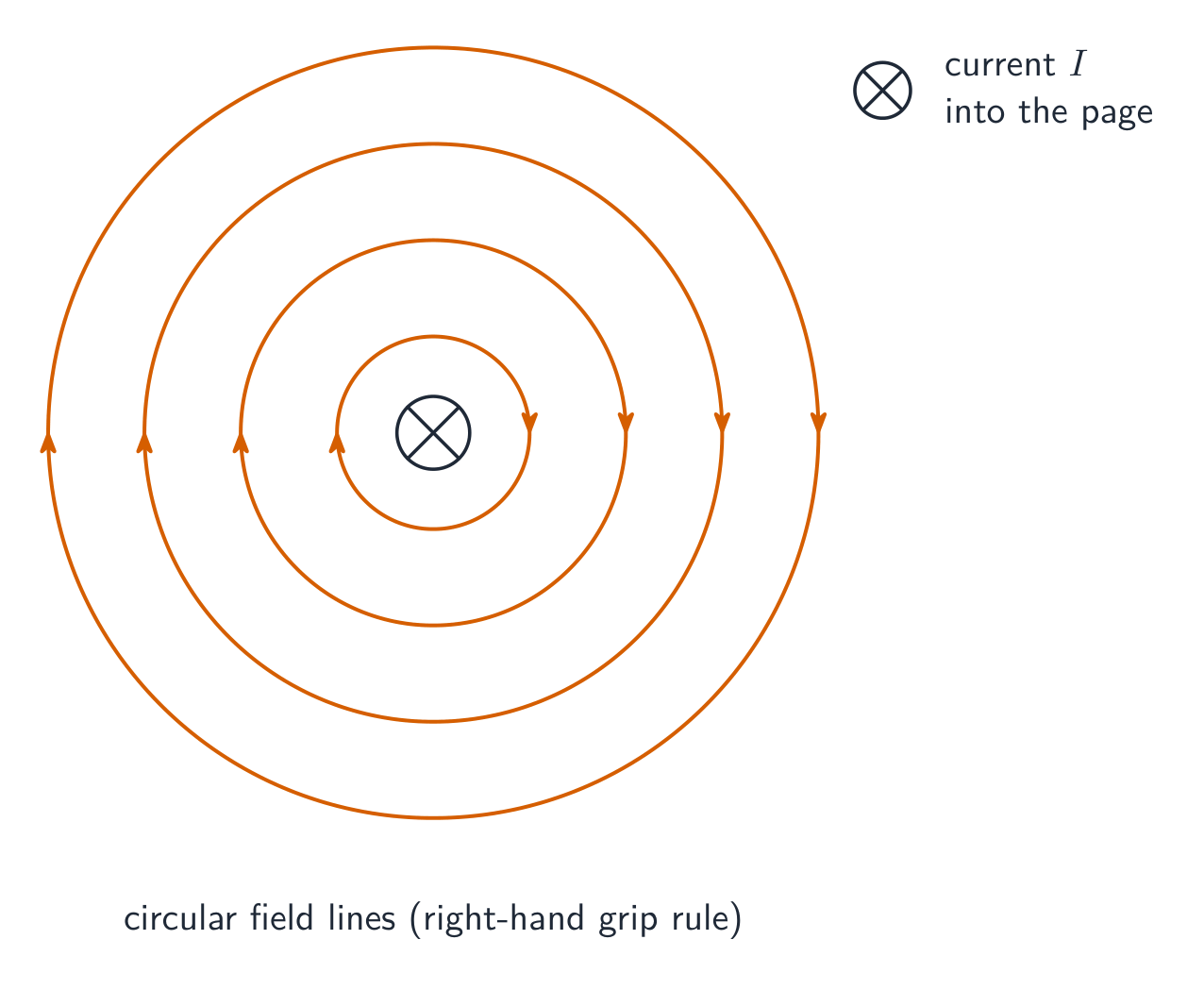
Drawing the wire's field. "Draw four field lines" around a straight wire is marked on three things: the lines are concentric circles centred on the wire; their spacing increases with distance (the field weakens with distance from the wire); and every line carries an arrow in the direction given by the right-hand grip rule (current into the page: clockwise; current out of the page: anticlockwise). Draw them as circles, not free-hand ovals.
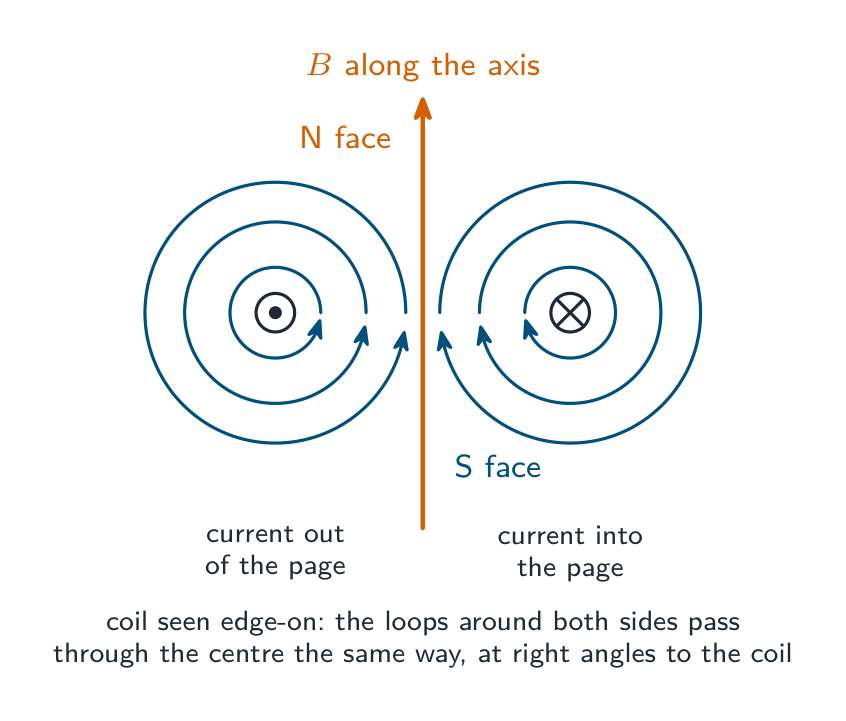
For a flat circular coil the loops around the two sides of the coil reinforce through the centre, so the field there is at right angles to the plane of the coil and strongest at the centre; seen from one face the coil is a north pole (the field leaves it), from the other a south pole. A long solenoid is many such coils in a row: the field inside is uniform and parallel to the axis, and the lines emerge from one end (its N end) and return outside to the other.
An iron core 铁芯 inside a solenoid greatly increases the field, because the iron's atomic magnets line up and add to it. This is why electromagnets 电磁铁 and transformers 变压器 have iron cores.
The syllabus calls this a ferrous 含铁的 core: iron, steel or another magnetic material. Asked why a core increases the field, say that the core becomes magnetised 被磁化 by the solenoid's field and that its own field adds to the field of the current.
العربية
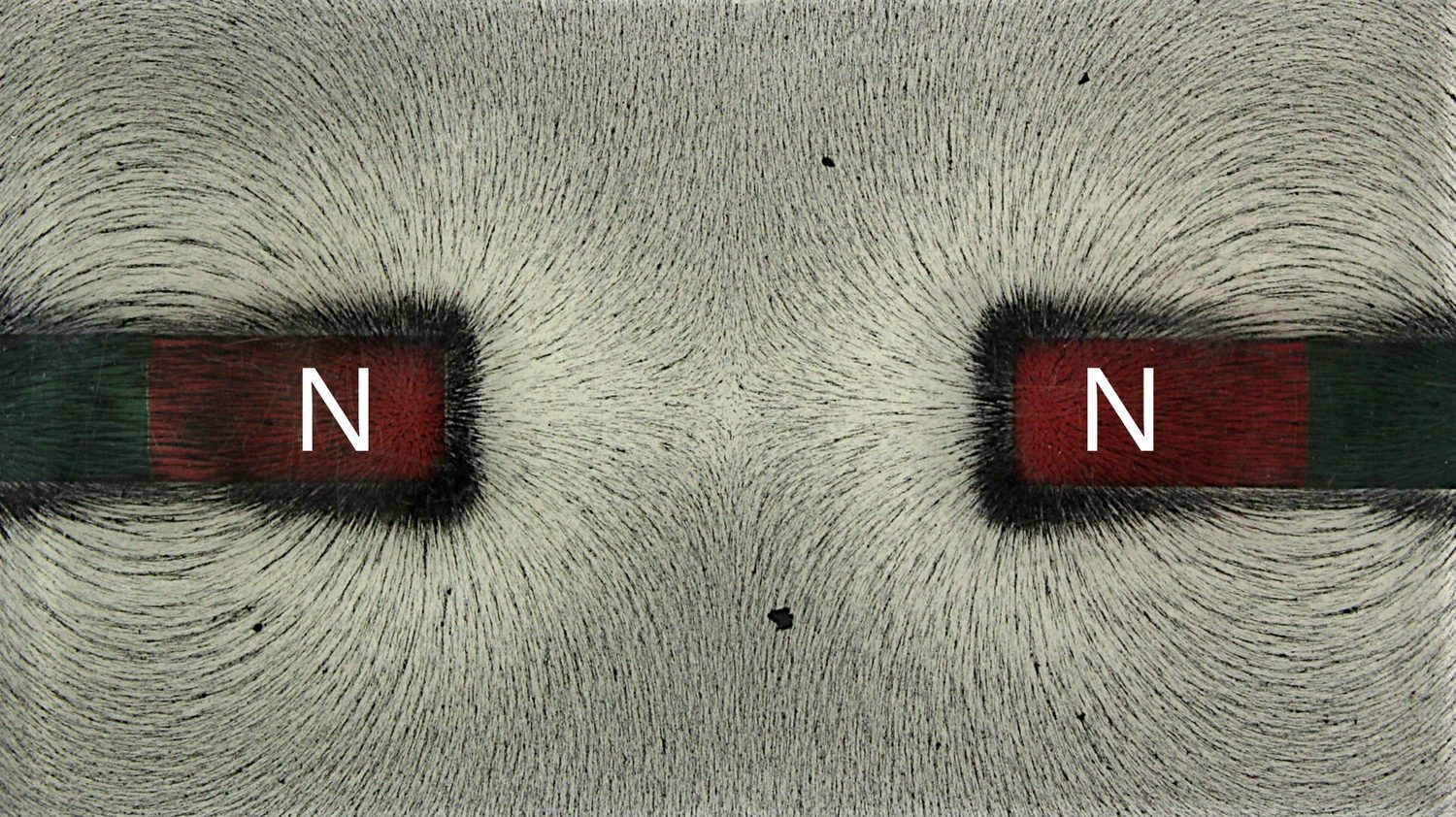
تتبع نظائر الحديد خطوط المجال حول المغناطيس المستطيل.
المجال المغناطيسي هو منطقة يشعر فيها شحنة متحركة (أو تيار) بـ قوة. يتكون من:
شحنات متحركة (عادة تيار في سلك)، أو
مغناطيس دائم (حيث يأتي من تيارات ذرية صغيرة).
"اذكر ماذا يقصَد بالمجال المغناطيسي." منطقة تُمارس فيها قوة على شحنة متحركة، موصل يحمل تياراً، أو مادة مغناطيسية. تريد خطة الإجابة كلمة قوة وأياً من تلك الأجسام الثلاثة؛ "منطقة حول مغناطيس" وحدها لا تمنح أي درجات.
خطوط الحقل
خطوط المجال تشير من N إلى S خارج المغناطيس، ومن S إلى N داخله (لذلك فهي حلقات مغلقة).
لا تتقاطع الخطوط أبداً؛ الخطوط المتقاربة تعني مجالاً أقوى.
مجال المغناطيس المستطيل: الخطوط تمتد من N إلى S، الأقوى بالقرب من الأقطابنظائر الحديد حول مغناطيس مستطيل تصطف على طول المجال، مما يظهر شكله الحقيقي
أنماط يجب معرفتها:
مغناطيس مستطيل — خطوط منحنية من N إلى S خارجاً، الأقوى بالقرب من الأقطاب.
سلك مستقيم طويل — دوائر حول السلك؛ الاتجاه يأتي من قاعدة قبضة اليد اليمنى (الإبهام على طول التيار، الأصابع تنحني في اتجاه يشير إليه المجال).
ملف دائري مسطح — المجال عبر المركز يكون عمودياً على الملف؛ يعمل الملف كمغناطيس مستطيل صغير.
ملف لولبي طويل — المجال داخله منتظم تقريباً على طول المحور، كمغناطيس مستطيل ممدود؛ خارجه يتناقص بسرعة.
المجال حول سلك مستقيم طويلمجال الملف اللولبي
رسم مجال السلك. "ارسم أربعة خطوط مجال" حول سلك مستقيم تُعطى درجات على ثلاثة أشياء: الخطوط دوائر متحدة المركز مركزها السلك؛ تباعدها يزداد مع المسافة (يضعف المجال مع المسافة عن السلك)؛ وكل خط يحمل سهم في الاتجاه المعطى بقاعدة قبضة اليد اليمنى (التيار إلى داخل الصفحة: عقارب الساعة؛ التيار خارج الصفحة: عكس عقارب الساعة). ارسمها كدوائر، ليس بيضاويات مرسومة يدوياً بحرية.
ملف دائري مسطح يُرى من الجانب: المجال يدور حول كل جانب من الملف ويمر عبر المركز عمودياً على مستوى الملف
بالنسبة لـ ملف دائري مسطح، تعزز الحلقات حول جانبي الملف بعضهما البعض عبر المركز، sehingga يكون المجال هناك عمودياً على مستوى الملف والأقوى في المركز؛ إذا نظرنا من وجه واحد، يكون الملف قطب شمال (يخرج منه المجال)، ومن الوجه الآخر قطب جنوب. الـ ملف اللولبي الطويل هو العديد من هذه الملفات في صف واحد: المجال بداخله منتظم وموازٍ للمحور، وتخرج الخطوط من أحد الطرفين (قطبه N) وتعود خارجه للطرف الآخر.
يؤدي النواة الحديدية داخل الملف اللولبي إلى زيادة المجال بشكل كبير، لأن المغناطيسات الذرية للحديد تتراصف وتضيف قوتها له. ولهذا السبب تحتوي المغناطيسات الكهربية والمحولات على نوى حديدية.
يُطلق المنهج الدراسي على هذا النوع اسم النواة الحديدية: وهي حديد أو فولاذ أو أي مادة مغناطيسية أخرى. عند السؤال عن سبب زيادة النواة للمجال، أجب بأن النواة تصبح مغناطيسية بفعل مجال الملف اللولبي، وأن مجالها الخاص يضاف إلى مجال التيار الكهربائي.
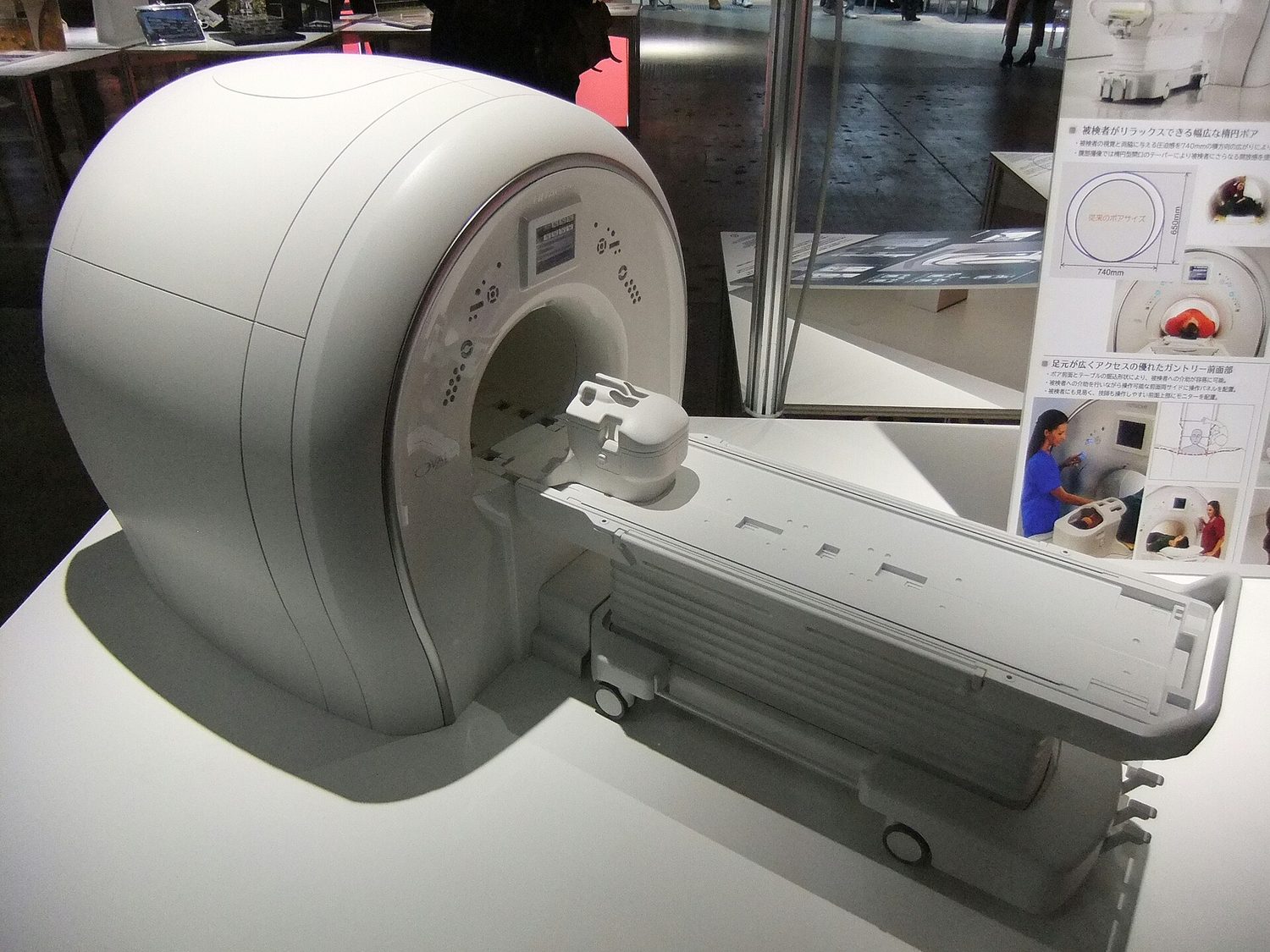
يتكون جهاز الرنين المغناطيسي حول مجال مغناطيسي قوي جداً ومتجانس — وهو ملف لولبي بحجم غرفة
Explore · استكشف
Magnetic field lab · مختبر المجال المغناطيسي
Move between magnetic arrangements and see how field patterns change. · انتقل بين الترتيبات المغناطيسية ولاحظ كيف تتغير أنماط المجال.
Explore · استكشف
Current field rule lab · عملية قاعدة حقل التيار
Connect current direction to the circular magnetic field around a wire. · ربط اتجاه التيار بالمجال المغناطيسي الدائري حول سلك.
Force on a current-carrying conductor · القوة المؤثرة على موصل يمر به تيار كهربائي
Syllabus · المنهج
English
understand that a force might act on a current-carrying conductor placed in a magnetic field
recall and use the equation $F = BIL \sin \theta$, with directions as interpreted by Fleming's left-hand rule
define magnetic flux density as the force acting per unit current per unit length on a wire placed at right-angles to the magnetic field
العربية
افهم أن قوة قد تؤثر على موصل يحمل تياراً موضوع في مجال مغناطيسي
استذكر واستخدم المعادلة $F = BIL \sin \theta$، مع الاتجاهات كما تُفسّر بواسطة قاعدة اليد اليسرى لفلمنج
عرّف الكثافة الفيضية المغناطيسية بأنها القوة المؤثرة لكل وحدة تيار لكل وحدة طول على سلك موضوع بشكل عمودي على المجال المغناطيسي
Source: Cambridge International syllabus · المصدر: منهج كامبريدج الدولي
English
A current $I$ in a wire of length $L$ in a magnetic field of flux density $B$ feels a force
$$F = B I L \sin\theta,$$
where $\theta$ is the angle between the wire and the field. The force is largest when the wire is at right angles to the field ($F = BIL$) and zero when the wire is along the field.
Worked example. A wire of length $0.20\ \text{m}$ carries a current of $3.0\ \text{A}$ at right angles to a magnetic field of flux density $0.50\ \text{T}$. Find the force on it.
Two conditions for a force. A copper wire in a magnetic field feels a force only if (1) it carries a current, and (2) the current is not parallel to the field (some part of the wire is at right angles to $B$). A wire with no current, or one lying along the field lines, feels nothing: $\sin\theta = 0$.
Worked example (the current balance). A horizontal wire of length $5.0\ \text{cm}$ lies at right angles to the field between the poles of a magnet standing on a top-pan balance. With no current the balance reads $102.30\ \text{g}$; with a current of $2.5\ \text{A}$ it reads $102.86\ \text{g}$. Find the flux density.
By Newton's third law the force on the wire is matched by an equal and opposite force on the magnet, so the balance reading changes by the magnetic force: $F = \Delta m\, g = (0.56 \times 10^{-3})(9.81) = 5.5 \times 10^{-3}\ \text{N}$. Then $B = F/(IL) = 5.5 \times 10^{-3}/(2.5 \times 0.050) = 4.4 \times 10^{-2}\ \text{T}$ ($44\ \text{mT}$). The reading rose, so the force on the magnet is downwards and the force on the wire is upwards; reversing the current would make the reading fall by the same amount.
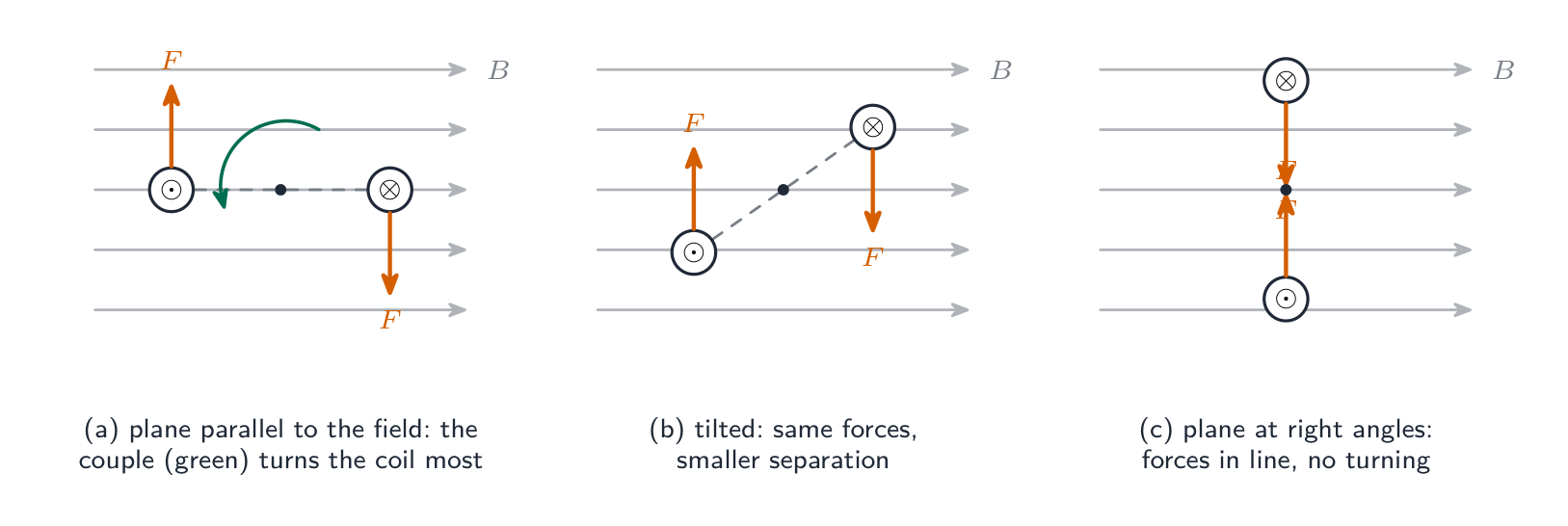
Worked example (forces on a coil). A rectangular coil PQRS with sides PS and QR of length $8.0\ \text{cm}$ carries a current of $1.2\ \text{A}$ in a horizontal field of $0.30\ \text{T}$, with the plane of the coil parallel to the field. Describe the forces on the coil.
Sides PS and QR are at right angles to the field, so each feels $F = BIL = 0.30 \times 1.2 \times 0.080 = 2.9 \times 10^{-2}\ \text{N}$; the currents in them run in opposite directions, so by Fleming's rule the forces are equal and opposite, one up and one down. Sides PQ and SR are parallel to the field and feel no force. The two forces form a couple 力偶 that turns the coil about its axis; as the coil turns the forces stay the same size but their perpendicular separation shrinks, so the turning effect falls to zero when the plane of the coil is at right angles to the field. This is the principle of the electric motor and of the moving-coil meter.
Magnetic flux density
This equation also defines the magnetic flux density 磁通密度$B$:
$$B = \frac{F}{IL} \quad\text{(wire at right angles to the field).}$$
So $B$ is the force per unit current per unit length on a wire at right angles to the field. Unit: tesla 特斯拉, $\text{T} = \text{N A}^{-1}\ \text{m}^{-1}$.
The two-mark definitions.Magnetic flux density is the force per unit current per unit length acting on a (straight) conductor placed at right angles to the field. Both "per unit current" and "per unit length" are needed, and so is "at right angles" (or "perpendicular"): without it the definition is false, because the force also depends on the angle. The tesla is the flux density that produces a force of one newton on one metre of conductor carrying a current of one ampere at right angles to the field: $1\ \text{T} = 1\ \text{N A}^{-1}\ \text{m}^{-1}$.
Direction — Fleming's left-hand rule
Use the left hand (Fleming's left-hand rule 弗莱明左手定则): first finger = Field, second finger = Current, thumb = force (thrust). Hold the three at right angles.
العربية
يمر تيار $I$ في سلك طوله $L$ ضمن مجال مغناطيسي بكثافة تدفق $B$، فيشعر بقوة
$$F = B I L \sin\theta,$$
حيث $\theta$ هو الزاوية بين السلك والمجال. تكون القوة عظمى عندما يكون السلك بزاوية قائمة على المجال ($F = BIL$) وتساوي صفراً عندما يكون السلك موازياً للمجال.
مثال محلول. سلك طوله $0.20\ \text{m}$ يمر فيه تيار مقداره $3.0\ \text{A}$ بزاوية قائمة على مجال مغناطيسي بكثافة تدفق $0.50\ \text{T}$. أوجد القوة المؤثرة عليه.
شرطان للقوة. يشعر سلك نحاسي في مجال مغناطيسي بالقوة فقط إذا (1) كان يمر به تيار، و(2) لم يكن التيار موازياً للمجال (جزء من السلك يكون بزاوية قائمة على $B$). لا يشعر السلك الذي لا يمر به تيار، أو السلك الممدود على طول خطوط المجال بأي قوة: $\sin\theta = 0$.
مثال محلول (ميزان التوازن للتيار). سلك أفقي طوله $5.0\ \text{cm}$ موضوع بزاوية قائمة على المجال بين قطبي مغناطيس واقف على ميزان كفتين. بدون تيار، يُظهر الميزان قراءة $102.30\ \text{g}$؛ مع مرور تيار مقداره $2.5\ \text{A}$، تُصبح القراءة $102.86\ \text{g}$. أوجد كثافة التدفق.
بحسب قانون نيوتن الثالث، القوة المؤثرة على السلك يقابلها قوة مساوية ومعاكسة على المغناطيس، لذا تتغير قراءة الميزان بمقدار القوة المغناطيسية: $F = \Delta m\, g = (0.56 \times 10^{-3})(9.81) = 5.5 \times 10^{-3}\ \text{N}$. إذن $B = F/(IL) = 5.5 \times 10^{-3}/(2.5 \times 0.050) = 4.4 \times 10^{-2}\ \text{T}$ ($44\ \text{mT}$). بما أن القراءة ارتفعت، فإن القوة المؤثرة على المغناطيس نحو الأسفل والقوة المؤثرة على السلك نحو الأعلى؛ وعكس اتجاه التيار سيؤدي إلى انخفاض القراءة بنفس المقدار.
*ملف مستطيل في مجال متجانس، يُرى من الجانب: القوتان المؤثرتان على الجانبين اللذين يعبران المجال تشكلان زوجاً دواراً يكون تأثيره الدوراني أعظماً عندما يكون مستوى الملف موازياً للمجال وصفرًا عندما يكون عمودياً عليه
مثال محلول (القوات المؤثرة على ملف). ملف مستطيل PQRS أطرافه PS وQR طولها $8.0\ \text{cm}$، يمر به تيار مقداره $1.2\ \text{A}$ في مجال أفقي شدته $0.30\ \text{T}$، مع توازي مستوى الملف مع المجال. صف القوات المؤثرة على الملف.
الأطراف PS وQR بزاوية قائمة على المجال، فكل منها يشعر بقوة $F = BIL = 0.30 \times 1.2 \times 0.080 = 2.9 \times 10^{-2}\ \text{N}$؛ وبما أن التيارات فيها تسير في اتجاهين متضادين، فإن according to Fleming's rule تكون القوتان متساويتين ومعاكستين، إحداهما للأعلى والأخرى للأسفل. أما الطرفان PQ وSR فهما موازيان للمجال ولا يشعان أي قوة. يشكل القوتان زوجاً دواراً يدير الملف حول محوره؛ ومع دوران الملف تظل القوى ثابتة المقدار لكن تباعدها العمودي يتقلص، فينخفض التأثير الدوراني حتى يصل إلى الصفر عندما يكون مستوى الملف بزاوية قائمة على المجال. وهذا هو مبدأ المحرك الكهربائي والعداد ذو الملف المتحرك.
كثافة التدفق المغناطيسي
تعطي هذه المعادلة أيضاً تعريفاً لكثافة التدفق المغناطيسي $B$:
$$B = \frac{F}{IL} \quad\text{(السلك بزاوية قائمة على المجال).}$$
إذن $B$ هي القوة لكل وحدة تيار لكل وحدة طول على سلك بزاوية قائمة على المجال. الوحدة: تيسلا، $\text{T} = \text{N A}^{-1}\ \text{m}^{-1}$.
التعريفان ذوا العلامتين.كثافة التدفق المغناطيسي هي القوة لكل وحدة تيار لكل وحدة طول تؤثر على (موصل مستقيم) موضوع بزاوية قائمة على المجال. كلا التعبيرين "لكل وحدة تيار" و"لكل وحدة طول" ضروريان، وكذلك عبارة "بزاوية قائمة" (أو "عمودية"): بدونها يكون التعريف خاطئاً، لأن القوة تعتمد أيضاً على الزاوية. التيسلا هي الكثافة التي تنتج قوة قدرها نيوتن واحد على متر واحد من الموصل يمر به تيار قدره أمبير واحد بزاوية قائمة على المجال: $1\ \text{T} = 1\ \text{N A}^{-1}\ \text{m}^{-1}$.
الاتجاه — قاعدة اليد اليسرى لفلمنج
استخدم اليد اليسرى (قاعدة Fleming لليد اليسرى)؛ الإصبع الأول = Field (المجال)، والإصبع الثاني = Current (التيار)، والإبهام = القوة (الدفع). امسك الثلاثة بزاوية قائمة.
قاعدة اليد اليسرى لفلمنج: الإبهام = القوة، الإصبع الأول = المجال، الإصبع الثاني = التيار
Explore · استكشف
Feel the force on the wire · اشعر بالقوة المؤثرة على السلك
A current in a magnetic field feels a force F = BIL at right angles to both — reverse the current or flip the magnet and the force jumps the other way. · يتعرض تيار في مجال مغناطيسي لقوة F = BIL عمودياً على كلاهما — عكس التيار أو قلب المغناطيس وستعكس القوة اتجاهها.
Force on a moving charge · القوة المؤثرة على شحنة متحركة
Syllabus · المنهج
English
determine the direction of the force on a charge moving in a magnetic field
recall and use $F = BQv \sin \theta$
understand the origin of the Hall voltage and derive and use the expression $V_{\text{H}} = BI / (ntq)$, where $t = \text{thickness}$
understand the use of a Hall probe to measure magnetic flux density
describe the motion of a charged particle moving in a uniform magnetic field perpendicular to the direction of motion of the particle
explain how electric and magnetic fields can be used in velocity selection
العربية
حدد اتجاه القوة المؤثرة على شحنة تتحرك في مجال مغناطيسي
استرجاع واستخدام $F = BQv \sin \theta$
افهم أصل الجهد الهالي واشتق واستخدم التعبير $V_{\text{H}} = BI / (ntq)$، حيث $t = \text{thickness}$
افهم استخدام مجس هالي لقياس الكثافة الفيضية المغناطيسية
صف حركة جسيم مشحون يتحرك في مجال مغناطيسي منتظم عمودي على اتجاه حركة الجسيم
اشرح كيف يمكن استخدام المجالات الكهربائية والمغناطيسية في اختيار السرعة
Source: Cambridge International syllabus · المصدر: منهج كامبريدج الدولي
English
A charge $Q$ moving at velocity 速度$v$ through a field feels
$$F = B Q v \sin\theta,$$
with $\theta$ the angle between $v$ and $B$. Same left-hand rule (the second finger is the motion of a positive charge — reverse it for a negative charge). The force is largest when $v$ is at right angles to $B$, and zero when $v$ is along $B$.
Two situations with no force. A charged particle in a magnetic field feels no force when it is stationary (no $v$) or when it moves parallel or antiparallel to the field ($\sin\theta = 0$). Contrast the electric field, which pushes a stationary charge just as hard: that difference is the whole point of the velocity selector below.
Circular motion in a uniform field
A charge moving at right angles to a uniform field 匀强场 feels a force at right angles to both $v$ and $B$. This force does no work (always at right angles to the motion), so the kinetic energy 动能 and speed stay constant — the particle moves in a circle. Set the magnetic force equal to the centripetal force 向心力:
$$B Q v = \frac{m v^{2}}{r}, \qquad r = \frac{m v}{B Q}.$$
Worked example. A proton (mass $1.7 \times 10^{-27}\ \text{kg}$, charge $1.6 \times 10^{-19}\ \text{C}$) moves at $2.0 \times 10^{6}\ \text{m s}^{-1}$ at right angles to a $0.50\ \text{T}$ field. Find the radius of its circular path.
So the radius depends on the momentum 动量$mv$. The period is
$$T = \frac{2\pi m}{B Q},$$
which does not depend on the speed — a faster particle goes in a bigger circle but takes the same time per turn. If $v$ also has a part along $B$, that part is unchanged, and the path is a helix 螺旋.
"Explain why the path is circular." The magnetic force is always at right angles to the velocity, so it changes the direction of motion but not the speed, and its magnitude $BQv$ is constant because $B$, $Q$ and $v$ are constant. A force of constant size that stays perpendicular to the velocity is exactly a centripetal force, so the path is a circle. Give all three ideas: perpendicular, constant magnitude, speed unchanged.
Worked example. Electrons moving at $1.7 \times 10^{7}\ \text{m s}^{-1}$ enter a uniform field of flux density $4.8\ \text{mT}$ at right angles to it. Find the radius of their path. The electrons are then replaced by positrons 正电子 (same mass, charge $+e$) moving at $3.4 \times 10^{7}\ \text{m s}^{-1}$ along the same initial line: describe how the path changes.
The positrons are deflected the opposite way (positive charge, so Fleming's rule with the second finger along the motion gives a force in the opposite direction), and since $r \propto v$ their radius is twice as large, $4.0\ \text{cm}$. Their period is the same ($T = 2\pi m/BQ$ has no $v$ in it): they go round a bigger circle at twice the speed.
Hall effect
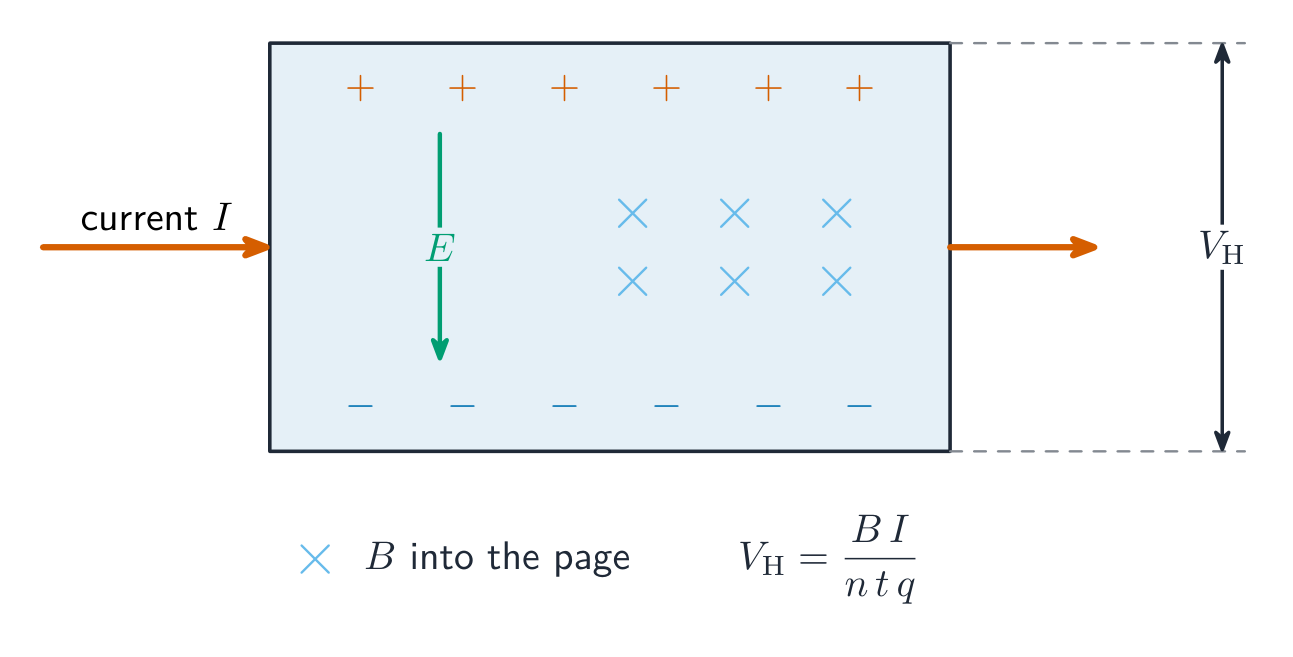
A slab of conductor carrying current $I$, in a field $B$ at right angles to the current, develops a voltage across its faces — the Hall voltage 霍尔电压$V_{\text{H}}$ (the Hall effect 霍尔效应).
The moving charges feel a magnetic force $BQv_{\text{d}}$ ($v_{\text{d}}$ is the drift velocity 漂移速度), so they build up on one face, making an electric field 电场$E$ that opposes more build-up. At steady state $eE = Bev_{\text{d}}$, so $E = B v_{\text{d}}$. With $V_{\text{H}} = E w$ and $I = n e v_{\text{d}} w t$:
$$V_{\text{H}} = \frac{B I}{n t q},$$
where $q$ is the carrier charge. A Hall probe 霍尔探头 uses this to measure $B$: pass a known current through a thin semiconductor 半导体 slab and read $V_{\text{H}}$ (largest when the slab is at right angles to $B$).
Deriving $V_{\text{H}} = BI/(ntq)$ (the exam asks for this in full). Take a slice of width $d$, across which the Hall voltage appears, and thickness $t$ along $B$, so the current passes through a cross-section $A = dt$. (1) At steady state the electric force on a carrier balances the magnetic force: $qE = Bqv$, so $E = Bv$. (2) The Hall field is uniform across the width, so $V_{\text{H}} = Ed = Bvd$. (3) The current is $I = nAvq = n\,dt\,vq$, so $v = I/(n\,dt\,q)$. Substituting: $V_{\text{H}} = Bd \cdot I/(n\,dt\,q) = BI/(ntq)$. Two things to notice: the voltage appears across the faces perpendicular to the magnetic force, not across the ends where the current enters; and it is larger for a semiconductor, whose number density $n$ is millions of times smaller than a metal's, which is why probes use a semiconductor slice.
Using a Hall probe. The reading is proportional to $B$ but also depends on the orientation: it is a maximum when the plane of the slice is at right angles to the field and zero when the field lies in the plane of the slice. So (1) rotate the probe until the reading is largest, and (2) calibrate 校准 it in a known field, since $V_{\text{H}} \propto B$ at fixed current.
Worked example. A Hall probe gives a maximum reading of $24\ \text{mV}$ in a uniform field of $32\ \text{mT}$. In a second field, with the probe again turned for a maximum, the reading is $15\ \text{mV}$. Find the second flux density.
$V_{\text{H}} \propto B$ (same probe, same current): $B = 32 \times 15/24 = 20\ \text{mT}$. If the probe had been left at some other angle the reading would be smaller and $B$ would be underestimated, which is why "rotate for a maximum" is part of the method.
Velocity selector
A velocity selector 速度选择器 uses crossed electric and magnetic fields to let through only one speed. With the electric force $qE$ and magnetic force $qvB$ set to oppose each other, the net force is zero only when
$$qE = qvB \quad\Rightarrow\quad v = \frac{E}{B}.$$
Particles at speed $E/B$ go straight through; faster or slower ones are deflected.
Deriving and explaining the selector. The magnetic force on a positive ion moving through the crossed fields is $BQv$, at right angles to its motion; the electric field is applied so that the electric force $QE$ is in the opposite direction (the plates must be arranged so that the field points against the magnetic force). For the ion to pass straight through, $QE = BQv$, so $v = E/B$, independent of the charge and the mass. A faster ion has a larger magnetic force and bends towards the magnetic-force side; a slower one is pushed the other way by the unchanged electric force. Asked "explain how an electric field can make the particle reach Z", say which direction the electric force must have, that it must equal the magnetic force in size, and give $E = Bv$. This is velocity selection 速度选择.
العربية
شحنة $Q$ تتحرك بسرعة السرعة$v$ خلال مجال تشعر بـ
$$F = B Q v \sin\theta,$$
حيث $\theta$ هي الزاوية بين $v$ و$B$. نفس قاعدة اليد اليسرى (الإصبع الثاني يمثل حركة الشحنة الموجبة — عكسه للشحنة السالبة). تكون القوة عظمى عندما $v$ بزاوية قائمة على $B$، وتساوي صفراً عندما $v$ على طول $B$.
حالتان لا توجد فيهما قوة. لا تشعر جسيم مشحون في مجال مغناطيسي بأي قوة عندما يكون ساكناً (لا يوجد $v$) أو عندما يتحرك موازياً أو مضاداً للمجال ($\sin\theta = 0$). نقارن ذلك بالمجال الكهربائي الذي يدفع الشحنة الساكنة بنفس القوة: هذا الفرق هو جوهر اختيار السرعة أدناه.
الحركة الدائرية في مجال متجانس
الشحنة التي تتحرك بزاوية قائمة على حقل منتظم تشعر بقوة بزاوية قائمة على كل من $v$ و$B$. هذه القوة لا تقوم بأي شغل (دائمًا بزاوية قائمة على الحركة)، لذا تبقى الطاقة الحركية والسرعة ثابتتين — الجسيم يتحرك في دائرة. نساوي القوة المغناطيسية مع القوة المركزية:
$$B Q v = \frac{m v^{2}}{r}, \qquad r = \frac{m v}{B Q}.$$
مثال محلول. بروتون (كتلته $1.7 \times 10^{-27}\ \text{kg}$، شحنته $1.6 \times 10^{-19}\ \text{C}$) يتحرك بسرعة $2.0 \times 10^{6}\ \text{m s}^{-1}$ بزاوية قائمة على حقل شدته $0.50\ \text{T}$. أوجد نصف قطر مساره الدائري.
إذن يعتمد نصف القطر على الزخم$mv$. الزمن الدوري هو
$$T = \frac{2\pi m}{B Q},$$
وهو لا يعتمد على السرعة — فالجسيم الأسرع يسير في دائرة أكبر لكنه يستغرق نفس الوقت لكل دورة. إذا كان $v$ يحتوي أيضًا على مركبة موازية لـ $B$، فإن هذه المركبة تظل دون تغيير، ويكون المسار حلزونيًا.
مسار دائري لجسيم مشحون في حقل مغناطيسي
"اشرح لماذا المسار دائري." القوة المغناطسية تكون دائماً عمودية على السرعة، لذا تغير اتجاه الحركة دون تغيير السرعة، ومقدارها $BQv$ يكون ثابتاً لأن $B$، $Q$ و$v$ ثابتة. والقوة ذات المقدار الثابت الذي يبقى عمودياً على السرعة هي تماماً قوة مركزية، لذا يكون المسار دائرة. قدّم الأفكار الثلاث: العمودية، ثبات المقدار، عدم تغير السرعة.
مثال محلول. إلكترونات تتحرك بسرعة $1.7 \times 10^{7}\ \text{m s}^{-1}$ تدخل حقلًا منتظمًا بكثافة تدفق $4.8\ \text{mT}$ بزاوية قائمة عليه. أوجد نصف قطر مسارها. ثم تُستبدل الإلكترونات بـ البوزيترونات (نفس الكتلة، شحنتها $+e$) تتحرك بسرعة $3.4 \times 10^{7}\ \text{m s}^{-1}$ على نفس الخط الأولي: صف كيف يتغير المسار.
البوزيترونات تنحرف نحو العكس (شحنة موجبة، لذا قاعدة فلمنغ بإصبع الثانية في اتجاه الحركة تعطي قوة في الاتجاه المعاكس)، وبما أن $r \propto v$ فإن نصف قطرها ضعف ما سبق، أي $4.0\ \text{cm}$. زمنها الدوري نفسه ($T = 2\pi m/BQ$ لا تحتوي على $v$ فيها): تدور في دائرة أكبر بسرعة ضعف.
تأثير هال
شريحة موصل يحمل تيارًا $I$، في حقل $B$ بزاوية قائمة على التيار، يطور فرق جهد بين وجهَيها — وهو جهد هال$V_{\text{H}}$ (تأثير هال).
الشحنات المتحركة تشعر بقوة مغناطيسية $BQv_{\text{d}}$ ($v_{\text{d}}$ هي سرعة الانجراف)، فتتراكم على أحد الوجهين، مما يُنشئ حقلًا كهربائيًا$E$ يعيق المزيد من التراكم. عند حالة الاستقرار $eE = Bev_{\text{d}}$، إذن $E = B v_{\text{d}}$. مع $V_{\text{H}} = E w$ و$I = n e v_{\text{d}} w t$:
$$V_{\text{H}} = \frac{B I}{n t q},$$
حيث $q$ هي شحنة حامل. يستخدم كاشف هال ذلك لقياس $B$: يمرر تيارًا معلومًا عبر شريحة نصف موصل رقيقة ويقرأ $V_{\text{H}}$ (أكبر ما يمكن عندما تكون الشريحة بزاوية قائمة على $B$).
تأثير هال
استنتاج $V_{\text{H}} = BI/(ntq)$ (المطلوب في الامتحان بالتفصيل). خذ شريحة بعرض $d$، يظهر عبره جهد هال، وسمك $t$ في اتجاه $B$، بحيث يمر التيار عبر مقطع عرضي $A = dt$. (1) عند حالة الاستقرار، تتوازن القوة الكهربائية على الحامل مع القوة المغناطيسية: $qE = Bqv$، إذن $E = Bv$. (2) حقل هال منتظم عبر العرض، إذن $V_{\text{H}} = Ed = Bvd$. (3) التيار هو $I = nAvq = n\,dt\,vq$، إذن $v = I/(n\,dt\,q)$. بالتعويض: $V_{\text{H}} = Bd \cdot I/(n\,dt\,q) = BI/(ntq)$. ملاحظتان: الجهد يظهر بين الوجهين عموديين على القوة المغناطيسية، وليس بين طرفي الشريحة الذي يدخل منهما التيار؛ وهو أكبر في نصف الموصل، whose كثرة عددية $n$ أصغر بملايين المرات من المعدن، ولهذا تستخدم الكواشف شريحة من نصف الموصل.
استخدام كاشف هال. القراءة متناسبة مع $B$ لكنها تعتمد أيضًا على الاتجاه: تكون عظمى عندما يكون مستوى الشريحة بزاوية قائمة على الحقل وصفرًا عندما يقع الحقل في مستوى الشريحة. لذا (1) أدرّ الكاشف حتى تكون القراءة عظمى، و(2) عايره في حقل معلوم، لأن $V_{\text{H}} \propto B$ ثابتة عند تيار معين.
مثال محلول. يعطي كاشف هال قراءة قصوى قدرها $24\ \text{mV}$ في حقل منتظم شدته $32\ \text{mT}$. في حقل ثانٍ، بعد إعادة تدوير الكاشف للحصول على أقص读数، كانت القراءة $15\ \text{mV}$. أوجد كثافة التدفق للحقل الثاني.
$V_{\text{H}} \propto B$ (نفس الكاشف، نفس التيار): $B = 32 \times 15/24 = 20\ \text{mT}$. لو تُرك الكاشف بزاوية أخرى لما كانت القراءة أقل ولتم تقدير $B$ بشكل ناقص، ولهذا "التدوير للحصول على أقصى قيمة" جزء من الطريقة.
مختار السرعة
مختار السرعة يستخدم حقولًا كهربائية ومغناطيسية متقاطعة لتمرير جسيمات بسرعة واحدة فقط. مع كون القوة الكهربائية $qE$ والقوة المغناطيسية $qvB$ مضادتين لبعضهما، يكون المحصلة صفرًا فقط عندما
$$qE = qvB \quad\Rightarrow\quad v = \frac{E}{B}.$$
الجسيمات بسرعة $E/B$ تمر مستقيمة؛ أما الأسرع أو الأبطأ فتنحرف.
مختار السرعة
استنتاج وتوضيح المصفاة. القوة المغناطيسية المؤثرة على أيون موجب يتحرك عبر المجالات المتقاطعة هي $BQv$، وتكون عمودية على حركته؛ يتم تطبيق المجال الكهربائي بحيث تكون القوة الكهربائية $QE$ في الاتجاه المعاكس (يجب ترتيب الصفائح بحيث يشير المجال عكس اتجاه القوة المغناطيسية). لكي يعبر الأيون بشكل مستقيم، $QE = BQv$، وبالتالي $v = E/B$، وهو مستقل عن شحنة الأيون وكتلته. الأيون الأسرع له قوة مغناطيسية أكبر وينحني نحو جانب القوة المغناطيسية؛ بينما الأيون الأبطأ يُدفع في الاتجاه الآخر بواسطة القوة الكهربائية الثابتة. عند السؤال "اشرح كيف يمكن للمجال الكهربائي أن يجعل الجسيم يصل إلى Z"، حدد اتجاه القوة الكهربائية، وأن تساوي القوة المغناطيسية في المقدار، وقدم $E = Bv$. هذا هو اختيار السرعة.
Explore · استكشف
Force on a moving charge · القوة المؤثرة على شحنة متحركة
F = BQv
The magnetic force on a charge is proportional to its speed (for a fixed field and charge). · القوة المغناطيسية على شحنة تتناسب طردياً مع سرعتها (لمجال وشحنة ثابتين).
Force between parallel currents · القوة بين تيارات متوازية
Syllabus · المنهج
English
sketch magnetic field patterns due to the currents in a long straight wire, a flat circular coil and a long solenoid
understand that the magnetic field due to the current in a solenoid is increased by a ferrous core
explain the origin of the forces between current-carrying conductors and determine the direction of the forces
العربية
ارسم أنماط المجالات المغناطيسية الناتجة عن التيارات في سلك مستقيم طويل، وملف دائري مسطح وملف لولبي طويل
افهم أن المجال المغناطيسي الناتج عن التيار في الملف اللولبي يزداد بوجود نواة حديدية
اشرح أصل القوى بين المواصلين الحاملين للتيار وحدد اتجاه هذه القوى
Source: Cambridge International syllabus · المصدر: منهج كامبريدج الدولي
English
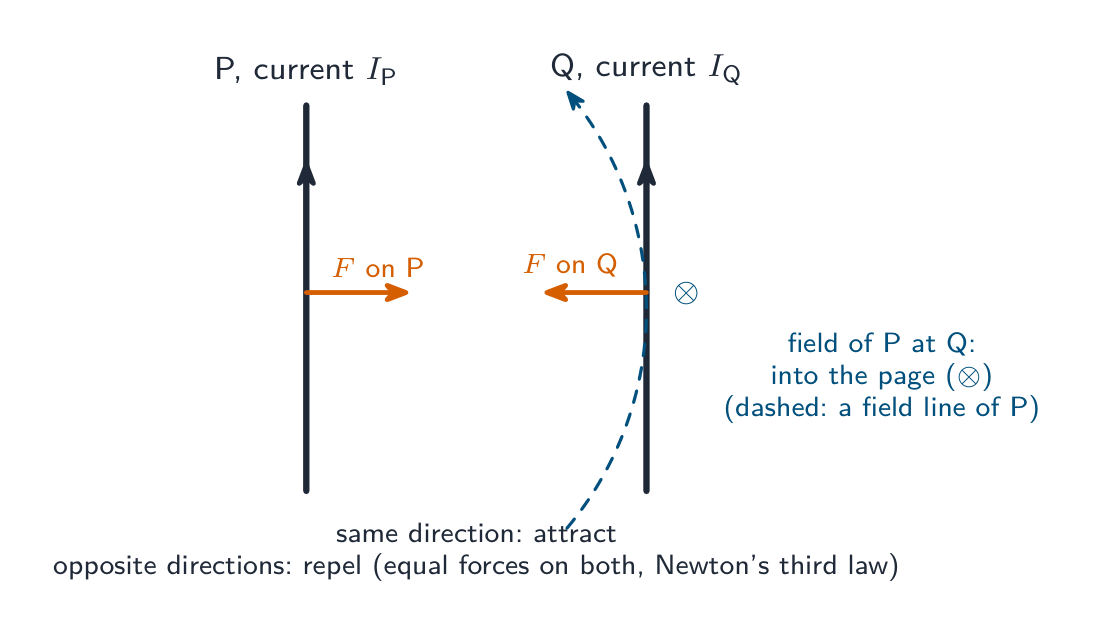
Two long parallel wires each sit in the other's magnetic field. Using Fleming's left-hand rule: parallel currents (same direction) attract; antiparallel currents (opposite directions) repel. This is the basis of the SI definition of the ampere.
Explaining the force (a standard three-marker). (1) The current in P produces a magnetic field around it (circles centred on P). (2) At Q this field is at right angles to the current in Q, so Q, a current-carrying conductor in a magnetic field, feels a force $BIL$. (3) Fleming's left-hand rule gives its direction: towards P for currents in the same direction, away for opposite currents. By Newton's third law the force on P is equal and opposite, so both wires attract (or both repel) with the same force. Doubling the current in one wire doubles the force on both: the force on Q rises because $I_{\text{Q}}$ has doubled, the force on P because the field it sits in has doubled.
العربية
يوجد سلكان طويلان ومتوازيان، يقع كل منهما في المجال المغناطيسي للآخر. باستخدام قاعدة اليد اليسرى لفلمنج: التيارات المتوازية (نفس الاتجاه) تتجاذب؛ التيارات المعاكسة (اتجاهات مختلفة) تتنافر. هذا هو أساس التعريف الدولي للوحدة SI للأمبير.
التيارات المتوازية تتجاذب: كل سلك يقع في مجال الآخر، وتعطي قاعدة اليد اليسرى لفلمنج قوة نحو السلك الآخر
توضيح القوة (سؤال قياسي من ثلاث علامات). (1) التيار في P ينتج مجالاً مغناطيسياً حوله (دوائر مركزها P). (2) عند Q يكون هذا المجال عمودياً على التيار في Q، لذا يشعر Q، كموصل يحمل تياراً في مجال مغناطيسي، بقوة $BIL$. (3) تعطي قاعدة اليد اليسرى لفلمنج اتجاهها: نحو P للتيارات في نفس الاتجاه، وبعيداً للتيارات في اتجاهات معاكسة. وبحسب قانون نيوتن الثالث، القوة المؤثرة على P مساوية ومعاكسة، لذا يتجاذب كلا السلكين (أو يتنافران معاً) بنفس القوة. مضاعفة التيار في إحدى السلكين تضاعف القوة المؤثرة على كلاهما: ترتفع القوة على Q لأن $I_{\text{Q}}$ قد ضُاعفت، وترتفع القوة على P لأن المجال الذي يقع فيه قد ضُاعف.
define magnetic flux as the product of the magnetic flux density and the cross-sectional area perpendicular to the direction of the magnetic flux density
recall and use $\Phi = BA$
understand and use the concept of magnetic flux linkage
understand and explain experiments that demonstrate: • that a changing magnetic flux can induce an e.m.f. in a circuit • that the induced e.m.f. is in such a direction as to oppose the change producing it • the factors affecting the magnitude of the induced e.m.f.
recall and use Faraday's and Lenz's laws of electromagnetic induction
العربية
عرّف الفيض المغناطيسي بأنه حاصل ضرب الكثافة الفيضية المغناطيسية ومساحة المقطع العمودي على اتجاه الكثافة الفيضية المغناطيسية
استرجاع واستخدام $\Phi = BA$
افهم واستخدم مفهوم الربط الفيضي المغناطيسي
افهم واشرح التجارب التي تثبت: • أن تغير الفيض المغناطيسي يمكن أن يحفز قوة دافعة كهربائية (e.m.f.) في دائرة • أن القوة الدافعة المحثوثة تكون في اتجاه يعارض التغيير الذي يسببها • العوامل المؤثرة على مقدار القوة الدافعة المحثوثة
Source: Cambridge International syllabus · المصدر: منهج كامبريدج الدولي
English
The transformer: turns ratioElectromagnetic induction
Magnetic flux
The magnetic flux 磁通量$\Phi$ through a flat area $A$ at right angles to $B$ is
$$\Phi = B A.$$
If the area's normal is at angle $\theta$ to $B$, use $\Phi = B A \cos\theta$. Unit: weber 韦伯, $\text{Wb} = \text{T m}^{2}$. For a coil 线圈 of $N$ turns, the flux linkage 磁链 is $N\Phi = N B A$.
The two-mark definitions.Magnetic flux is the product of the magnetic flux density and the area (of the circuit) perpendicular to the field.Flux linkage is the product of the flux and the number of turns of the coil, $N\Phi$, in weber-turns. Say "perpendicular" (or "normal to the field"): $\Phi = BA$ is only true for the component of the area at right angles to $B$.
Worked example. A small coil of 64 turns and cross-sectional area $0.71\ \text{cm}^{2}$ is placed inside a long solenoid, on its axis, where the flux density is $2.5\ \text{mT}$. Find the flux linkage of the coil.
The flux through the coil uses the coil's own area, not the solenoid's: $\Phi = BA = (2.5 \times 10^{-3})(0.71 \times 10^{-4}) = 1.8 \times 10^{-7}\ \text{Wb}$, so the flux linkage is $N\Phi = 64 \times 1.8 \times 10^{-7} = 1.1 \times 10^{-5}\ \text{Wb}$. When the solenoid's current changes, the e.m.f. induced in the small coil is the rate of change of this linkage.
Faraday's and Lenz's laws
When the flux linkage through a circuit changes, an electromotive force 电动势 (e.m.f.) is induced — this is electromagnetic induction 电磁感应.
Faraday's law 法拉第定律: the induced e.m.f. equals the rate of change of flux linkage:
$$|\varepsilon| = N\frac{d\Phi}{dt}.$$
Worked example. A coil of $200$ turns and area $0.010\ \text{m}^{2}$ sits with its plane at right angles to a $0.50\ \text{T}$ field. The field falls steadily to zero in $0.20\ \text{s}$. Find the average induced e.m.f.
The flux linkage changes from $N\Phi = NBA = 200 \times 0.50 \times 0.010 = 1.0\ \text{Wb}$ to zero, so
Lenz's law 楞次定律: the induced e.m.f. acts to oppose the change that makes it. This is conservation of energy 能量守恒 — if it reinforced the change, energy would come from nothing. Combined:
$$\varepsilon = -\frac{d(N\Phi)}{dt}.$$
What changes the flux?
changing $B$ (moving a magnet near a coil),
changing area$A$ (a rod sliding along rails),
changing orientation (a coil turning in a field — the a.c. generator, next topic).
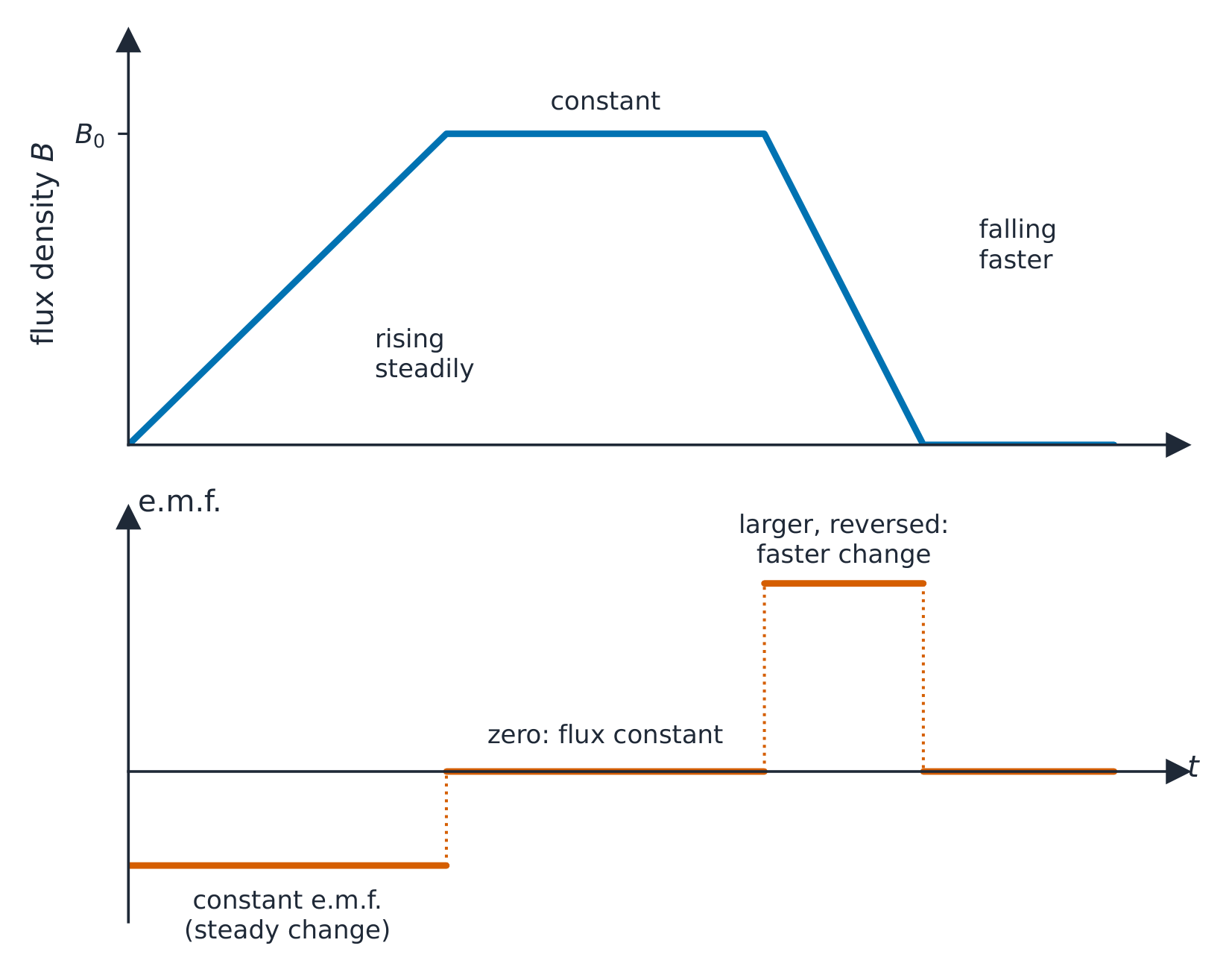
Reading an e.m.f. off a flux graph. The induced e.m.f. is the gradient of the flux-linkage graph (with a minus sign for Lenz). A steadily rising flux gives a constant e.m.f.; a constant flux gives zero e.m.f. however large the flux is; a faster fall gives a larger e.m.f. of the opposite sign. "Sketch the variation with time of the e.m.f." is answered by differentiating the flux graph by eye, section by section.
Worked example. The 64-turn coil above sits in a solenoid whose flux density rises uniformly from $0$ to $2.5\ \text{mT}$ in $40\ \text{ms}$ and is then held steady. Find the e.m.f. induced in the coil during the rise, and afterwards.
During the rise the flux linkage grows steadily to $1.1 \times 10^{-5}\ \text{Wb}$: $\varepsilon = \Delta(N\Phi)/\Delta t = 1.1 \times 10^{-5}/0.040 = 2.8 \times 10^{-4}\ \text{V}$ ($0.28\ \text{mV}$), constant while the rise lasts. Afterwards the flux linkage is constant, so the e.m.f. is zero, even though the coil is still in a strong field: it is the change that induces.
Worked example (flux cutting). An aircraft with a wingspan 翼展 of $60\ \text{m}$ flies horizontally at $250\ \text{m s}^{-1}$ where the vertical component of the Earth's field is $45\ \mu\text{T}$. Find the e.m.f. between the wingtips.
In time $\Delta t$ the wing sweeps out an area $L v \Delta t$, cutting flux $B L v \Delta t$, so $\varepsilon = BLv = (45 \times 10^{-6})(60)(250) = 0.68\ \text{V}$. Only the component of $B$perpendicular to the swept area counts (here the vertical one). There is a p.d. between the wingtips but no current, because there is no complete circuit; Fleming's rules give which tip is positive.
Demonstrations
moving a bar magnet into a coil deflects a galvanometer 检流计; the deflection reverses when the magnet is pulled out (Lenz's law), and is larger for faster motion (Faraday's law).
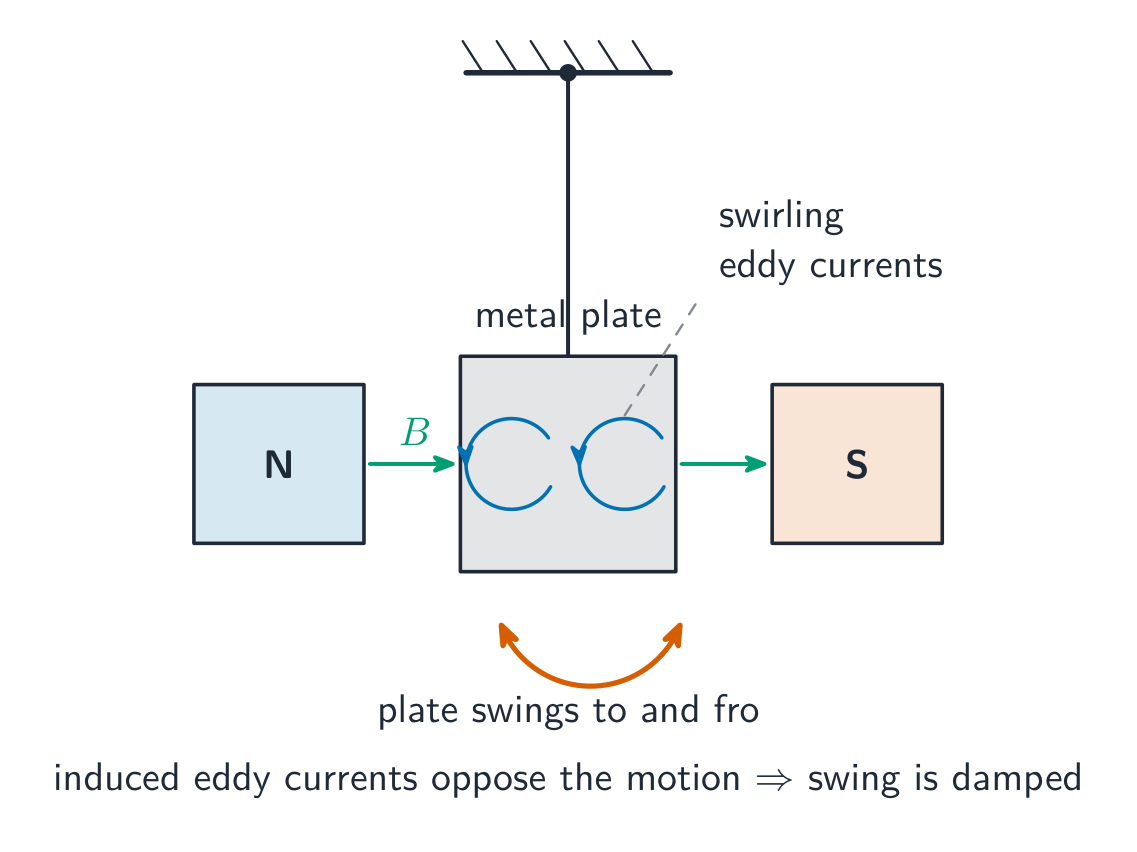
a copper disc swinging into a field is quickly slowed — eddy currents 涡流 are induced that oppose the motion.
Electromagnetic braking, explained with Lenz's law. A vehicle's aluminium disc rotates between the poles of an electromagnet. The disc cuts the field lines, so an e.m.f. is induced in it; the disc is a conductor, so eddy currents flow; by Lenz's law these currents produce forces that oppose the motion of the disc, slowing the vehicle. The kinetic energy is converted to thermal energy in the disc. The braking is stronger at high speed (a larger rate of flux cutting, so larger currents) and fades as the vehicle slows; it cannot hold a stationary vehicle, because no motion means no induced current.
A magnet oscillating in a coil. A bar magnet on a spring oscillates in and out of a coil connected to a resistor. The changing flux linkage induces an e.m.f.; with the circuit complete a current flows and, by Lenz's law, the coil's field opposes the magnet's motion, so the oscillation is damped: energy leaves the oscillation as heat in the resistor and the amplitude decays. Open the switch and the e.m.f. is still induced but no current flows, so the coil no longer damps the motion.
What makes the induced e.m.f. larger
From $\varepsilon = N\,d\Phi/dt$ with $\Phi = BA$: more turns $N$, a stronger $B$, a larger area $A$, or a faster change — each gives a larger induced e.m.f.
Finding the direction with Lenz's law. Push the N pole of a magnet towards a coil and the induced current makes the near face of the coil a north pole, to repel the approaching magnet; pull it away and the near face becomes a south pole, to attract it. In each case the person moving the magnet does work against that force, and that work is the source of the electrical energy: Lenz's law is conservation of energy in disguise. Two sentences to learn: the induced e.m.f. acts in such a direction as to produce effects that oppose the change producing it (Lenz), and the induced e.m.f. is proportional to the rate of change of flux linkage (Faraday).
العربية
المحول: نسبة اللفاتالحث الكهرومغناطيسي
التدفق المغناطيسي
التدفق المغناطيسي$\Phi$ خلال مساحة مسطحة $A$ عمودية على $B$ هو
$$\Phi = B A.$$
إذا كان عمود المساحة بزاوية $\theta$ مع $B$، استخدم $\Phi = B A \cos\theta$. الوحدة: ويبر، $\text{Wb} = \text{T m}^{2}$. بالنسبة لـ ملف يحتوي على $N$ لفة، يكون ربط التدفق هو $N\Phi = N B A$.
تعريفات علامتين.التدفق المغناطيسي هو حاصل ضرب كثافة التدفق المغناطيسي والمساحة (لدائرة الدائرة) العمودية على المجال.ربط التدفق هو حاصل ضرب التدفق وعدد لفات الملف، $N\Phi$، بالويبر-لفة. قل "عمودي" (أو "عمود على المجال"): $\Phi = BA$ صحيح فقط لمركبة المساحة التي تكون عمودية على $B$.
مثال محلول. ملف صغير عدد لفاته 64 ولونه المستعرض $0.71\ \text{cm}^{2}$ موضوع داخل حلزون طويل، على محوره، حيث كثافة التدفق هي $2.5\ \text{mT}$. أوجد ربط تدفق الملف.
يتم حساب التدفق عبر الملف باستخدام مساحة الملف نفسه، وليس مساحة الحلزون: $\Phi = BA = (2.5 \times 10^{-3})(0.71 \times 10^{-4}) = 1.8 \times 10^{-7}\ \text{Wb}$، لذا ربط التدفق هو $N\Phi = 64 \times 1.8 \times 10^{-7} = 1.1 \times 10^{-5}\ \text{Wb}$. عندما يتغير تيار الحلزون، فإن القوة الدافعة الكهربائية المحثودة في الملف الصغير هي معدل تغير هذا الربط.
قوانين فاراداي ولينز
عندما يتغير ربط التدفق خلال دائرة، تُولد قوة دافعة كهربائية (c.d.ك): هذا هو الحث الكهرومغناطيسي.
قانون فاراداي: القوة الدافعة الكهربائية المحثودة تساوي معدل تغير ربط التدفق:
$$|\varepsilon| = N\frac{d\Phi}{dt}.$$
مثال محلول. ملف عدد لفاته $200$ ومساحته $0.010\ \text{m}^{2}$ موضوع مستواه عمودياً على مجال $0.50\ \text{T}$. ينخفض المجال بانتظام حتى يصبح صفراً في $0.20\ \text{s}$. أوجد متوسط القوة الدافعة الكهربائية المحثودة.
يتغير ربط التدفق من $N\Phi = NBA = 200 \times 0.50 \times 0.010 = 1.0\ \text{Wb}$ إلى الصفر، لذا
قانون لينز: القوة الدافعة الكهربائية المحثودة تعمل على معارضة التغيير الذي تسببه. هذا هو حفظ الطاقة — لو أنها عززت التغيير، لكانت الطاقة قد جاءت من العدم. مدمجتين معاً:
$$\varepsilon = -\frac{d(N\Phi)}{dt}.$$
ما الذي يغير التدفق؟
تغيير $B$ (تحريك مغناطيس قرب ملف)،
تغيير المساحة$A$ ( قضيب ينزلق على قضبان)،
تغيير التوجه (ملف يدور في مجال — مولد التيار المتردد، الموضوع التالي).
القوة الدافعة الكهربائية المحثودة هي سالب ميل رسم ربط التدفق: ثابتة أثناء تغير التدفق بانتظام، وصفر أثناء ثباته، وأكبر ومعكوسة عندما ينخفض التدفق بسرعة أكبر
قراءة القوة الدافعة الكهربائية من رسم التدفق. القوة الدافعة الكهربائية المحثودة هي ميل رسم ربط التدفق (مع إشارة سالبة لقانون لينز). ارتفاع التدفق بانتظام يعطي قوة دافعة كهربائيةثابتة؛ التدفق الثابت يعطي صفر القوة الدافعة الكهربائية بغض النظر عن حجم التدفق؛ الانخفاض السريع يعطي قوة دافعة كهربائية أكبر بإشارة معاكسة. "ارسم تغير القوة الدافعة الكهربائية مع الزمن" يُجاب عنه بالتفاضل البصري لرسم التدفق، جزءًا تلو الآخر.
مثال محلول. ملف الـ 64 لفة المذكور سابقاً موضوع داخل حلزون يرتفع فيه التدفق المغناطيسي بانتظام من $0$ إلى $2.5\ \text{mT}$ في $40\ \text{ms}$ ثم يبقى ثابتًا. أوجد القوة الدافعة الكهربائية المحثودة في الملف أثناء الارتفاع، وبعدها.
أثناء الارتفاع، يتزايد الربط الفيضي بشكل مستمر ليصل إلى $1.1 \times 10^{-5}\ \text{Wb}$: $\varepsilon = \Delta(N\Phi)/\Delta t = 1.1 \times 10^{-5}/0.040 = 2.8 \times 10^{-4}\ \text{V}$ ($0.28\ \text{mV}$)، ويبقى ثابتًا طوال فترة الارتفاع. وبعدها يصبح الربط الفيضي ثابتًا، لذا تكون القوة الدافعة الكهربائية صفرًا، على الرغم من أن الملف لا يزال في مجال قوي؛ فالحركة وحدها هي التي تُحدث الحث.
مثال محلول (قطع التدفق). طائرة لها جناح بطول $60\ \text{m}$ تحلق أفقياً بسرعة $250\ \text{m s}^{-1}$ حيث يكون المكون الرأسي لمجال الأرض هو $45\ \mu\text{T}$. أوجد القوة الدافعة الكهربائية بين طرفي الجناحين.
في الزمن $\Delta t$، يمسح الجناح مساحة $L v \Delta t$، قاطعًا الفيض $B L v \Delta t$، وبالتالي $\varepsilon = BLv = (45 \times 10^{-6})(60)(250) = 0.68\ \text{V}$. يُحسب فقط المكون من $B$العمودي على المساحة الممسوحة (هنا المكون الرأسي). توجد فرق جهد بين طرفي الجناح ولكن لا يوجد تيار، لأنه لا توجد دائرة كاملة؛ وتحدد قواعد فleming أي الطرف موجب.
تجارب توضيحية
إدخال قضيب مغناطيسي في ملف يسبب انحرافًا في الجلفانومتر; وينعكس الانحراف عند سحب المغناطيس (قانون لنز)، ويكون أكبر للحركة الأسرع (قانون فاراداي).
إظهار الحث الكهرومغناطيسي
قرص نحاسي يتأرجح داخل مجال ينجمد بسرعة — تُحث تيارات دوامية تعاكس الحركة.
تخميد التيارات الدوامية
فرملة كهرومغناطيسية، مفسرة بقانون لنز. يدور قرص ألومنيوم في المركبة بين قطبي مكهرب. يقطع القرص خطوط المجال، فتُحث فيه قوة دافعة كهربائية؛ وبما أنه موصل، فإن تيارات دوامية تتدفق؛ وبحسب قانون لنز، تُنتج هذه التيارات قوى تعاكس حركة القرص، مما يبطئ المركبة. تتحول الطاقة الحركية إلى طاقة حرارية في القرص. تكون الفرملة أقوى عند السرعة العالية (معدل قطع فيض أكبر، لذا تيارات أكبر) وتتلاشى مع بطء المركبة؛ ولا يمكنها إبقاء مركبة ساكنة،因为没有 motion means no induced current.
مغناطيس يتذبذب داخل ملف. مغناطيس قضيب مثبت بنابض يتذبذب داخل وخارج ملف متصل بمقاومة. الربط الفيضي المتغير يحث قوة دافعة كهربائية؛ ومع اكتمال الدائرة يتدفق تيار، وبحسب قانون لنز، يعاكس مجال الملف حركة المغناطيس، لذا تكون التذبذبات مخمدت: تخرج الطاقة كحرارة في المقاومة ويقل السعة. افتح المفتاح وستُحث القوة الدافعة الكهربائية لكن لا يتدفق تيار، فلا يخمد الملف الحركة بعد ذلك.
ما الذي يجعل القوة الدافعة الكهربائية المحثّة أكبر
من $\varepsilon = N\,d\Phi/dt$ مع $\Phi = BA$: عدد لفات أكبر $N$، مجال أقوى $B$، مساحة أكبر $A$، أو تغير أسرع — كل منها يعطي قوة دافعة كهربائية محثّة أكبر.
إيجاد الاتجاه بقانون لنز. ادفع القطب الشمالي للمغناطيس نحو ملف، فيصبح الوجه القريب للملف قطبًا شمالياً لتنافر المغناطيس الوارد; واسحبه للخلف ليصبح الوجه القريب قطبًا جنوبيًا لجذبه. في كل حالة يبذل الشخص الذي يحرك المغناطيس شغلًا ضد هذا القوة، وهذا الشغل هو مصدر الطاقة الكهربائية: قانون لنز هو تحفظ الطاقة بتجلٍّ مخفي. جملتان للحفظ: القوة الدافعة الكهربائية المحثّة تعمل في اتجاه ينتج تأثيرات تعاكس التغيير الذي تسببته (لنز)، و القوة الدافعة الكهربائية المحثّة متناسبة مع معدل تغير الربط الفيضي (فاراداي).
Explore · استكشف
Electromagnetic induction · الحث الكهرومغناطيسي
Move the magnet through the coil — a current is induced only while the field is changing. Faster gives more current; flip the magnet to reverse it. · حرك المغناطيس عبر الملف — يتولد تيار فقط أثناء تغير المجال. السرعة الأعلى تعطي تياراً أكبر؛ قلب المغناطيس لعكسه.
Definitions the examiner accepts · التعريفات التي يقبلها المصحح
English
A definition question is marked against fixed wording. Learn these exactly, and give one answer only.
Term
Definition
magnetic field
a region in which a force acts on a moving charge, a current-carrying conductor or a magnetic material
magnetic flux density
the force per unit current per unit length on a straight conductor placed at right angles to the field
tesla
the flux density producing a force of 1 N on 1 m of conductor carrying 1 A at right angles to the field
magnetic flux
the product of the flux density and the area perpendicular to the field, $\Phi = BA$
flux linkage
the product of the flux through a coil and its number of turns, $N\Phi$
weber
one tesla metre squared
Faraday's law
the induced e.m.f. is proportional to the rate of change of flux linkage
Lenz's law
the induced e.m.f. acts in such a direction as to produce effects that oppose the change producing it
Hall voltage
the p.d. that develops across a current-carrying slice in a magnetic field, $V_{\text{H}} = BI/(ntq)$
العربية
تُصنّف أسئلة التعريف بناءً على صياغة ثابتة. احفظ هذه التعريفات بدقة، وقدم إجابة واحدة فقط.
مصطلح
تعريف
المجال المغناطيسي
منطقة تؤثر فيها قوة على شحنة متحركة، موصل يحمل تيارًا، أو مادة مغناطيسية
كثافة الفيض المغناطيسي
القوة لكل وحدة تيار لكل وحدة طول على موصل مستقيم موضوع عموديًا على المجال
تسلا
كثافة الفيض التي تُنتج قوة مقدارها 1 نيوتن على 1 متر من الموصل يحمل 1 أمبير عموديًا على المجال
الفيض المغناطيسي
حاصل ضرب كثافة الفيض في المساحة العمودية على المجال، $\Phi = BA$
الربط الفيضي
حاصل ضرب الفيض المار في الملف في عدد لفاته، $N\Phi$
ويبر
واحد تسلا متر مربع
قانون فاراداي
القوة الدافعة الكهربائية المحثّة متناسبة مع معدل تغير الربط الفيضي
قانون لنز
القوة الدافعة الكهربائية المحثّة تعمل في اتجاه ينتج تأثيرات تعاكس التغيير الذي تسببته
جهد هول
فرق الجهد الذي يتطور عبر شريحة تحمل تياراً في مجال مغناطيسي، $V_{\text{H}} = BI/(ntq)$
20.5
Exam tips · نصائح للامتحان
English
Force on a current $F = BIL\sin\theta$; on a moving charge $F = BQv\sin\theta$; direction from Fleming's left-hand rule with the second finger along the conventional current (reverse it for an electron).
A charge moving at right angles to $B$ moves in a circle: $BQv = mv^{2}/r$, so $r = mv/(BQ)$ and $T = 2\pi m/(BQ)$, independent of speed. A component of $v$ along $B$ is unchanged: a helix.
Crossed fields: $v = E/B$ passes undeflected. Hall probe: $V_{\text{H}} = BI/(ntq)$, largest with the slice at right angles to $B$; semiconductor because $n$ is small.
Induction: e.m.f. $=$ rate of change of flux linkage$N\Phi$ (Faraday); its direction opposes the change (Lenz). On a flux–time graph the e.m.f. is the gradient: constant change gives a constant e.m.f., no change gives zero.
Flux cutting: $\varepsilon = BLv$ for a conductor of length $L$ moving at $v$ at right angles to $B$ (area swept per second times $B$).
Definitions carry the words "per unit current per unit length", "at right angles", "area perpendicular to the field" and "rate of change of flux linkage": each is a mark.
Common mistakes
Leaving "at right angles to the field" out of the definition of flux density, or defining the tesla without the 1 N, 1 m, 1 A.
Using the right hand for the force on a current (the left-hand rule), or pointing the second finger along the electron's motion instead of the conventional current.
Saying a stationary charge feels a magnetic force, or that a charge moving along the field lines does.
Explaining circular motion without saying the force is perpendicular to the velocity and constant in size; or claiming the magnetic force changes the speed.
Using the solenoid's area instead of the small coil's when finding its flux linkage.
Saying "a large flux induces an e.m.f.": only a changing flux linkage does. A coil at rest in a steady field has no e.m.f.
Quoting Lenz's law as "the current opposes the magnet" without "the change producing it", or Faraday's law without "rate of change" or without "flux linkage".
Drawing straight-wire field lines as evenly spaced circles or without arrows; drawing a solenoid's field lines crossing inside it.
Forgetting that doubling the current in one of two parallel wires doubles the force on both (Newton's third law).
العربية
القوة على تيار $F = BIL\sin\theta$؛ على شحنة متحركة $F = BQv\sin\theta$؛ الاتجاه من قاعدة فleming اليسرى بإصبع الثاني على طول التيار التقليدي (عكسه للإلكترون).
شحنة تتحرك عموديًا على $B$ تتحرك في دائرة: $BQv = mv^{2}/r$، إذن $r = mv/(BQ)$ و$T = 2\pi m/(BQ)$، مستقلة عن السرعة. مركبة من $v$ موازية لـ $B$ لا تتغير: حلزون.
حقول متقاطعة: $v = E/B$ يمر دون انحراف. مجس هال: $V_{\text{H}} = BI/(ntq)$، الأكبر عندما تكون الشريحة عمودية على $B$؛ شبه موصل لأن $n$ صغير.
الحث: القوة الدافعة الكهربائية $=$ معدل تغير الربط الفيضي$N\Phi$ (فاراداي); اتجاهها يعاكس التغيير (لنز). على رسم بياني للفيض-الزمن، القوة الدافعة الكهربائية هي الميل: تغير ثابت يعطي قوة دافعة كهربائية ثابتة، وعدم وجود تغير يعطي صفرًا.
قطع الفيض: $\varepsilon = BLv$ لموصل طوله $L$ يتحرك بسرعة $v$ عموديًا على $B$ (المساحة الممسوحة في الثانية مضروبة في $B$).
التعريفات تحتوي على كلمات "لكل وحدة تيار لكل وحدة طول"، "عموديًا"، "مساحة عمودية على المجال" و"معدل تغير الربط الفيضي": كل واحدة منها درجة.
أخطاء شائعة
حذف "عموديًا على المجال" من تعريف كثافة الفيض، أو تعريف التسلا بدون 1 نيوتن، 1 متر، 1 أمبير.
استخدام اليد اليمنى لقوة التيار (قاعدة اليد اليسرى)، أو توجيه الإصبع الثاني على طول حركة الإلكترون بدلاً من التيار التقليدي.
قول إن شحنة ساكنة تشعر بقوة مغناطيسية، أو أن شحنة تتحرك على طول خطوط المجال تفعل ذلك.
شرح الحركة الدائرية دون ذكر أن القوة عمودية على السرعة وثابتة المقدار؛ أو الادعاء بأن القوة المغناطيسية تغير السرعة.
استخدام مساحة الملف الكهرومغناطيسي (السلينويد) بدلاً من الملف الصغير عند إيجاد ربط التدفق.
قول "تدفق كبير يحفز ق.ك.ه.": فقط ربط التدفق المتغير هو الذي يفعل ذلك. ملف ثابت في مجال مستقر لا يحتوي على ق.ك.ه.
استcitation قانون لنز كـ"يُعاق التيار بالمغناطيس" بدون "التغير الناتج عنه"، أو قانون فاراداي بدون "معدل التغير" أو بدون "ربط التدفق".
رسم خطوط مجال السلك المستقيم بدوائر متساوية المسافات أو بدون أسهم؛ رسم خطوط مجال السلينويد تتقاطع داخله.
نسيان أن مضاعفة التيار في أحد سلكين متوازيين يضاعف القوة المؤثرة على كلاهما (قانون نيوتن الثالث).
Interactive lessons on this topic · دروس تفاعلية حول هذا الموضوع
Work through it step by step, with instant-check exercises. · ا-working عليه خطوة بخطوة، مع تمارين تحقق فوري.
Pick one and the site follows you — notes, papers, videos and practice all open on it. · اختر واحدًا وسيتبعك الموقع — الملاحظات، الأوراق، الفيديوهات والتدريب جميعها تفتح عليه.
Type to search notes, lessons, code, vocabulary and past-paper questions across every subject. · اكتب للبحث عن ملاحظات، دروس، أكواد، مفردات وأسئلة امتحانات سابقة عبر جميع المواد.