عميقاً داخل سحابة عاصفة، تتراكم الشحنة. تتجمع شحنة سالبة في القاعدة، وشحنة موجبة على الأرض أدناه. بينهما، في الهواء الفارغ، وجود…
English narration · English + 中文 subtitles burned in · سرد باللغة الإنجليزية · ترجمة مدمجة بالإنجليزية + الصينية
18.1
Electric fields · المجالات الكهربائية
Syllabus · المنهج
English
understand that an electric field is an example of a field of force and define electric field as force per unit positive charge
recall and use $F = qE$ for the force on a charge in an electric field
represent an electric field by means of field lines
العربية
فهم أن المجال الكهربائي مثال على مجال قوة وتعريف المجال الكهربائي بأنه القوة لكل وحدة شحنة موجبة
التذكر واستخدام $F = qE$ لقوة تأثيرها على شحنة في مجال كهربائي
تمثيل المجال الكهربائي بواسطة خطوط المجال
Source: Cambridge International syllabus · المصدر: منهج كامبريدج الدولي
English
An electric field 电场 is a region where a charge feels a force 力 from other charges. The electric field strength 电场强度$E$ at a point is the force per unit positive charge on a small positive test charge 检验电荷 placed there:
$$E = \frac{F}{q}.$$
Unit: $\text{N C}^{-1}$ (the same as $\text{V m}^{-1}$, as we will see). $E$ is a vector 矢量, pointing the way the force acts on a positive charge. The force on a charge $q$ is
$$F = qE,$$
opposite to the field if $q$ is negative.
The two-mark definition.Electric field strength at a point is the force per unit positive charge acting on a small (test) charge placed at that point. Three words carry the marks: force per unit charge (not "force on a charge"), positive (which fixes the direction), and small or test (so the charge does not disturb the field it is measuring). The multiple-choice version offers "force per unit charge acting on a small mass" and "force per unit mass" as distractors: a field is defined by a charge, never by a mass.
Worked example. A proton accelerates at $2.00\ \text{m s}^{-2}$ in an electric field, with no other force acting. Find the field strength. ($m_{\text{p}} = 1.67 \times 10^{-27}\ \text{kg}$, $e = 1.60 \times 10^{-19}\ \text{C}$.)
The same rearrangement the other way round gives the acceleration of an electron in a field of $1500\ \text{V m}^{-1}$: $a = eE/m_{\text{e}} = (1.60 \times 10^{-19})(1500)/(9.11 \times 10^{-31}) = 2.6 \times 10^{14}\ \text{m s}^{-2}$, enormous because the electron's mass is so small. Gravity ($9.81\ \text{m s}^{-2}$) is negligible beside it, which is why exam questions about electrons between plates ignore weight.
Field lines
field lines 场线 point the way the force acts on a positive test charge.
lines start on positive charges and end on negative charges (or go to infinity).
lines never cross; closer lines mean a stronger field.
every line carries an arrow; lines meet the surface of a conductor at right angles.
What a field line represents. Asked "state what is represented by an electric field line", give both halves: its direction shows the direction of the force on a positive charge placed there, and the spacing of the lines shows the strength of the field (closer lines, stronger field). A sketch is marked on exactly these points: arrows drawn, lines not crossing, even spacing where the field is uniform, and radial lines for a point charge or a sphere.
Examples: a positive point charge 点电荷 has radial lines pointing out; a negative one has lines pointing in; two opposite charges (a dipole 偶极子) have lines curving from + to −; two parallel charged plates give a uniform field 匀强场 of equally spaced parallel lines.
A charged conducting sphere
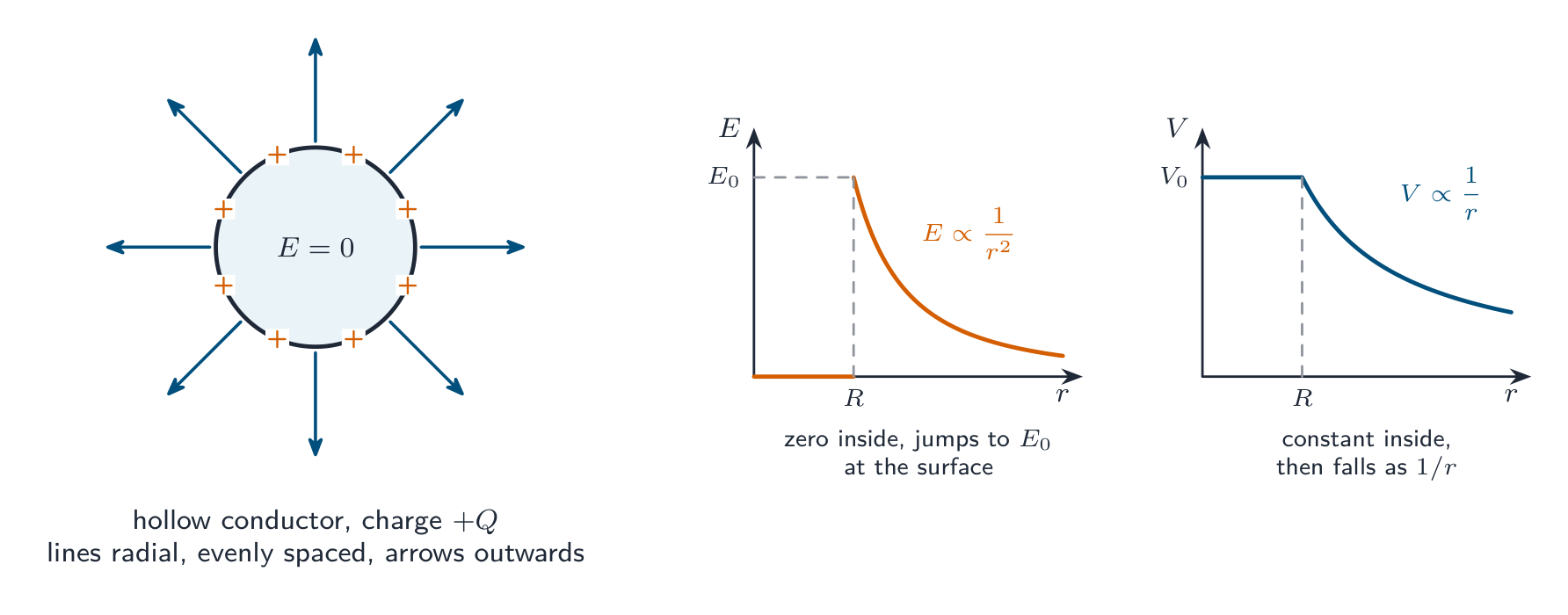
The charge on an isolated 孤立的conductor 导体 sits on its outer surface, spread evenly when the sphere is on its own. Outside the sphere the field lines are radial, evenly spaced and pointing outwards (for positive charge), exactly the pattern of a point charge at the centre. Inside a hollow (or solid) conductor the field is zero: the fields of all the surface charges cancel everywhere inside, so no field line enters. Two graphs follow, and both are exam favourites. The field strength $E$ is zero out to the radius $R$, jumps to its surface value $E_0$ and then falls as $1/r^{2}$; the potential $V$ is constant inside (a zero field means a zero potential gradient) and then falls as $1/r$.
Reading the graphs. Given an $E$–$x$ graph for a charged sphere, the radius is the distance at which $E$ jumps from zero, and the charge comes from any point on the curve: $Q = 4\pi\varepsilon_{0} r^{2} E$. Given "$E_0$ at the surface", the value at $2R$ is $E_0/4$ and at $3R$ is $E_0/9$: sketch the curve through those points, starting at $E_0$ on the surface line, never from the origin.
العربية
البرق هو شرارة عملاقة تقودها مجال كهربائي هائل.
المجال الكهربائي هو منطقة يشعر فيها الشحنة بـ قوة من الشحنات الأخرى. شدة المجال الكهربائي$E$ عند نقطة ما هي القوة لكل وحدة شحنة موجبة لشحنة اختبار موجبة صغيرة موضوعة هناك:
$$E = \frac{F}{q}.$$
الوحدة: $\text{N C}^{-1}$ (نفس $\text{V m}^{-1}$ كما سنرى). $E$ هو متجه، يشير في اتجاه عمل القوة على شحنة موجبة. القوة المؤثرة على شحنة $q$ هي
$$F = qE,$$
معاكسة للمجال إذا كان $q$ سالباً.
تعريف علامتين.شدة المجال الكهربائي عند نقطة هي القوة لكل وحدة شحنة موجبة مؤثرة على شحنة صغيرة (شحنة اختبار) موضوعة عند تلك النقطة. ثلاث كلمات تحمل العلامات: القوة لكل وحدة شحنة (وليس "القوة على شحنة")، موجبة (والتي تحدد الاتجاه)، وصغيرة أو اختبار (لكي لا تشوه الشحنة المجال الذي تقيسه). في النسخة متعددة الخيارات، يتم تقديم "القوة لكل وحدة شحنة مؤثرة على كتلة صغيرة" و"القوة لكل وحدة كتلة" كمشتتات: المجال يُعرَّف بالشحنة، لا بالكتلة أبدًا.
مثال محلول. يتسارع بروتون بمقدار $2.00\ \text{m s}^{-2}$ في مجال كهربائي، دون وجود قوى أخرى مؤثرة. أوجد شدة المجال. ($m_{\text{p}} = 1.67 \times 10^{-27}\ \text{kg}$، $e = 1.60 \times 10^{-19}\ \text{C}$.)
نفس إعادة الترتيب بطريقة عكسية تعطي تسارع الإلكترون في مجال مقدارها $1500\ \text{V m}^{-1}$: $a = eE/m_{\text{e}} = (1.60 \times 10^{-19})(1500)/(9.11 \times 10^{-31}) = 2.6 \times 10^{14}\ \text{m s}^{-2}$، كبير جداً لأن كتلة الإلكترون صغيرة للغاية. الجاذبية ($9.81\ \text{m s}^{-2}$) مهملة مقارنة به، ولهذا تتجاهل أسئلة الامتحانات وزن الإلكترونات بين الصفائح.
خطوط الحقل
خطوط المجال تشير إلى اتجاه القوة المؤثرة على شحنة اختبار موجبة.
تبدأ الخطوط من الشحنات الموجبة وتنتهي عند الشحنات السالبة (أو تمتد إلى ما لا نهاية).
لا تتقاطع الخطوط أبداً؛ الخطوط المتقاربة تعني مجالاً أقوى.
كل خط يحمل سهماً؛ تتقاطع خطوط المجال مع سطح الموصل بزاوية قائمة.
ماذا يمثل خط المجال. عند السؤال "اذكر ما يمثله خط المجال الكهربائي"، قدم كلا الجزأين: اتجاهه يشير إلى اتجاه القوة المؤثرة على شحنة موجبة موضوعة هناك، وتباعد الخطوط يشير إلى شدة المجال (خطوط أقرب، مجال أقوى). يتم تقييم الرسم التخطيطي بناءً على هذه النقاط بالضبط: رسم الأسهم، عدم تقاطع الخطوط، تباعد منتظم حيث يكون المجال متجانساً، وخطوط شعاعية لشحنة نقطية أو كرة.
أمثلة: الشحنة النقطية الموجبة لها خطوط شعاعية تتجه للخارج؛ السالبة لها خطوط تتجه للداخل؛ شحنتان متعاكستان (ثنائي قطب) لهما خطوط منحنية من + إلى −؛ صفائح مشحونة متوازية تعطيان مجالاً متجانساً consisting of lines متساوية التباعد ومتوازية.
أنماط خطوط المجال للصفيحات المتوازية، ثنائي القطب، الشحنة النقطية، والكرة المشحورة فوق صفيحة موصولة بالأرضموصل مجوف مشحور: المجال خارجه هو مجال شحنة نقطية في المركز؛ داخله، المجال صفر والجهد ثابت
كرة موصلة مشحورة
تستقر الشحنة على موصل معزول على سطحه الخارجي، موزعة بانتظام عندما تكون الكرة وحدها. خارج الكرة تكون خطوط المجال شعاعية، متساوية التباعد وتتجه للخارج (للشحنة الموجبة)، تماماً بنمط شحنة نقطية في المركز. داخل موصل مجوف (أو صلب) يكون المجال صفراً: تلغي حقول جميع شحنات السطح بعضها البعض في كل مكان داخله، لذا لا يدخل أي خط مجال. يتبع ذلك بيانهان، وكلاهما مفضلان في الامتحانات. شدة المجال $E$ تساوي صفرًا حتى نصف القطر $R$، تقفز إلى قيمتها السطحية $E_0$ ثم تنخفض كـ $1/r^{2}$؛ الجهد $V$ يكون ثابتاً داخله (المجال الصفري يعني تدرج جهد صفري) ثم ينخفض كـ $1/r$.
قراءة البيانات. مع بيانه $E$–$x$ لكرة مشحورة، نصف القطر هو المسافة التي تقفز عندها $E$ من الصفر، والشحنة تُحسب من أي نقطة على المنحنى: $Q = 4\pi\varepsilon_{0} r^{2} E$. مع "$E_0$ عند السطح"، القيمة عند $2R$ هي $E_0/4$ وعند $3R$ هي $E_0/9$: ارسم المنحنى عبر تلك النقاط، بدءاً من $E_0$ على خط السطح، وليس من نقطة الأصل أبداً.
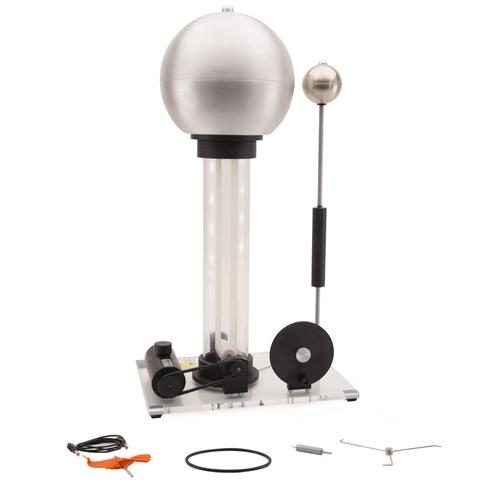
مولد فان دي غراف يخزن شحنة ساكنة كبيرة على قبته المعدنية، مما يولد مجالاً كهربائياً قوياً حوله
Explore · استكشف
Electric fields · المجالات الكهربائية
E ∝ Q / r²
A charge sets up a radial field — out for +, in for −, obeying the inverse-square law. · الشحنة تُنشئ مجالاً شعاعياً — للخارج لـ +، وللدخل لـ −، ممتثلاً لقانون التربيع العكسي.
Uniform electric fields · المجالات الكهربائية المتجانسة
Syllabus · المنهج
English
recall and use $E = \Delta V / \Delta d$ to calculate the field strength of the uniform field between charged parallel plates
describe the effect of a uniform electric field on the motion of charged particles
العربية
التذكر和使用 $E = \Delta V / \Delta d$ لحساب شدة المجال للمجال الموحود بين ألواح متوازية مشحونة
وصف تأثير المجال الكهربائي الموحد على حركة الجسيمات المشحونة
Source: Cambridge International syllabus · المصدر: منهج كامبريدج الدولي
English
Between two parallel plates a distance $d$ apart with potential difference 电势差$V$ between them, the field is uniform (apart from edge effects) with size
$$E = \frac{V}{d}.$$
It points from the higher-potential plate to the lower one. The unit $\text{V m}^{-1}$ comes straight from this and equals $\text{N C}^{-1}$.
Worked example. Two parallel plates $5.0\ \text{mm}$ apart have a p.d. of $200\ \text{V}$ between them. Find the field strength, and the force on an electron in the gap. ($e = 1.6 \times 10^{-19}\ \text{C}$.)
Which changes the field? Two things only: $E = V/d$ rises if the p.d. is increased or the plates are moved closer. A resistor in series with the supply changes nothing: no current flows once the plates are charged, so there is no p.d. across the resistor and the plates sit at the full supply voltage. Between plates at $+800\ \text{V}$ and $+1300\ \text{V}$ the field points from the higher potential to the lower; two positive potentials change nothing about the direction rule.
A charged particle in a uniform field
A charge $q$ in a uniform field feels a constant force$F = qE$, so a constant acceleration$a = qE/m$ — just like a mass in a uniform gravitational field.
released at rest, it speeds up along the field (positive charge) or against it (negative charge), gaining kinetic energy 动能.
entering at right angles to the field, it follows a parabolic 抛物线 path — like a projectile 抛体 in gravity. This is how a cathode-ray tube 阴极射线管 used to steer its beam.
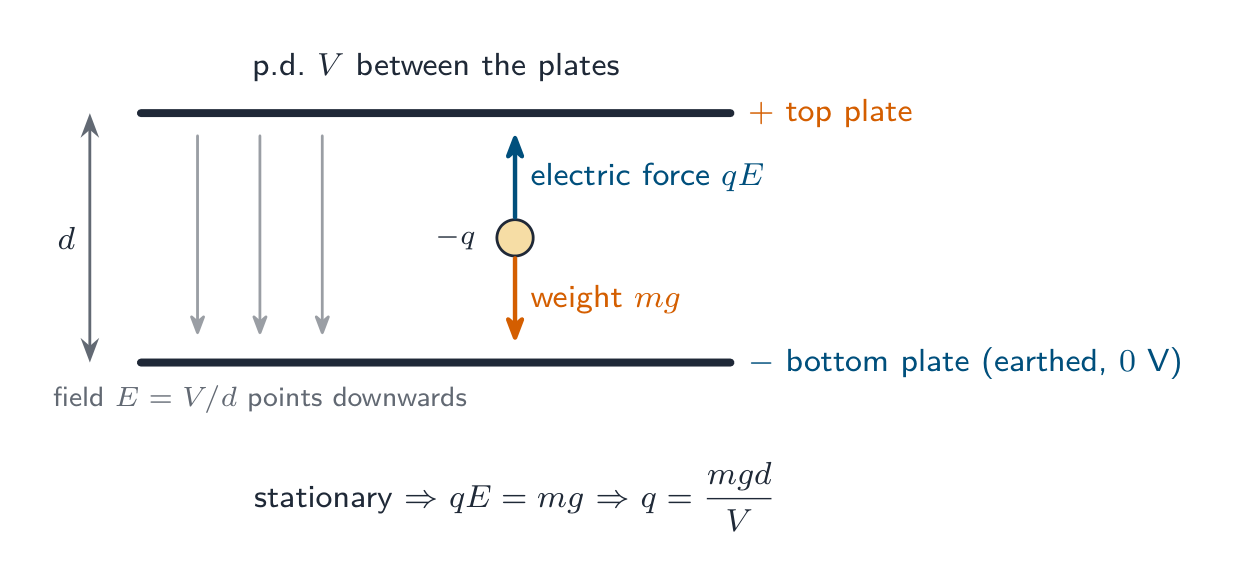
Two forces, not one. A charged oil drop "held stationary" between horizontal plates is the exam's favourite equilibrium 平衡: both an electric force and its weight act on it (the multiple-choice distractor is "electric force only"), and they are equal and opposite. For a negative drop the electric force is opposite to the field, so the top plate must be positive to hold it up.
Worked example. An oil drop of mass $2.6 \times 10^{-15}\ \text{kg}$ carries a charge of $-4.8 \times 10^{-19}\ \text{C}$ and is held stationary in a vacuum between horizontal plates $2.0\ \text{cm}$ apart. Find the p.d. between the plates, and say which plate is positive.
The drop is negative, so the force on it is against the field; for the force to be upwards the field must point down, so the top plate is positive. Notice that the charge is $3e$, three excess electrons, which is how Millikan showed that charge comes in multiples of $e$.
Worked example. Two parallel plates in a vacuum are $0.041\ \text{m}$ apart with a p.d. of $250\ \text{V}$ between them. An electron is released from rest at the negative plate. Find (a) the field strength, (b) the force on the electron and its acceleration, (c) the time it takes to reach the positive plate, (d) its kinetic energy on arrival. ($m_{\text{e}} = 9.11 \times 10^{-31}\ \text{kg}$.)
Worked example (deflection). An electron travelling horizontally at $2.0 \times 10^{7}\ \text{m s}^{-1}$ enters the field between two horizontal plates $18\ \text{mm}$ apart with a p.d. of $400\ \text{V}$. The plates are $30\ \text{mm}$ long. Find the deflection 偏转 of the electron by the time it leaves the field.
The horizontal motion is unaffected: time in the field $t = 0.030/(2.0 \times 10^{7}) = 1.5 \times 10^{-9}\ \text{s}$. Vertically, $a = eE/m_{\text{e}} = eV/(m_{\text{e}} d) = (1.60 \times 10^{-19})(400)/[(9.11 \times 10^{-31})(0.018)] = 3.9 \times 10^{15}\ \text{m s}^{-2}$, so the deflection is $y = \tfrac{1}{2} a t^{2} = \tfrac{1}{2}(3.9 \times 10^{15})(1.5 \times 10^{-9})^{2} = 4.4 \times 10^{-3}\ \text{m}$, less than the half-gap of $9\ \text{mm}$, so the electron does leave the field. Its vertical velocity on exit is $at = 5.9 \times 10^{6}\ \text{m s}^{-1}$, so it leaves at $\tan\theta = 5.9/20$, about $16°$; the path is a parabola, and after the plates (no field) it travels in a straight line in the direction it had on exit.
العربية
بين صفيحتين متوازيتين على مسافة $d$ بينهما فرق جهد$V$، يكون المجال متجانساً (باستثناء تأثيرات الحواف) ومقداره
بين الصفيحات المتوازية يكون المجال متجانساً، E = V/d
$$E = \frac{V}{d}.$$
يتجه من الصفيحة ذات الجهد الأعلى إلى الأخرى. الوحدة $\text{V m}^{-1}$ مستمدة مباشرة من هذا وتساوي $\text{N C}^{-1}$.
مثال محلول. صفيحتان متوازيتان على مسافة $5.0\ \text{mm}$ بينهما فرق جهد قدره $200\ \text{V}$. أوجد شدة المجال والقوة المؤثرة على إلكترون في الفراغ. ($e = 1.6 \times 10^{-19}\ \text{C}$.)
أي شيء يغير المجال؟ شيئين فقط: $E = V/d$ يرتفع إذا تم زيادة فرق الجهد أو تحريك الصفائح أقرب. المقاومة الموصولة على التوالي مع المصدر لا تغير شيئاً: لا يمر تيار بمجرد شحن الصفائح، لذا لا يوجد فرق جهد عبر المقاومة وتكون الصفائح عند فولتية المصدر الكاملة. بين صفيحتين عند $+800\ \text{V}$ و$+1300\ \text{V}$ يتجه المجال من الجهد الأعلى إلى الأدنى؛ شحنتان موجبتان لا تغيران شيئاً في قاعدة الاتجاه.
جسيم مشحور في مجال متجانس
الشحنة $q$ في مجال متجانس تشعر بـ قوة ثابتة$F = qE$، وبالتالي تسارع ثابت$a = qE/m$ — تماماً مثل الكتلة في مجال جاذبية متجانس.
عند إطلاقها من السكون، تتسارع على طول المجال (الشحنة الموجبة) أو ضده (الشحنة السالبة)، مكتسبة طاقة حركية.
عند دخولها بزاوية قائمة للمجال، تتبع مساراً قطعياً — مثل قذيفة في الجاذبية. هكذا كانت أنبوب الأشعة الكاثودية يُستخدم لتوجيه شعاعه.
شحنة تدخل مجالاً متجانساً بزاوية قائمة تتبع مساراً قطعياً، مثل القذيفةقطرة زيت مشحونة ثابتة في مكانها بين صفائح أفقية: القوة الكهربائية توازن الوزن، لذا q = mgd/V
قوتان، وليست واحدة. قطرة الزيت المشحونة "المثبتة في مكانها" بين الصفائح الأفقية هي التوازن المفضل في الامتحانات: تؤثر عليها كل من قوة كهربائية ووزنها (الخيار الخاطئ الشائع هو "القوة الكهربائية فقط")، وهما متساويتان ومتقابلتان. بالنسبة للقطرة السالبة، تكون القوة الكهربائية معاكسة للمجال، لذا يجب أن تكون الصفيحة العلوية موجبة لتثبيتها.
مثال محلول. قطرة زيت كتلتها $2.6 \times 10^{-15}\ \text{kg}$ تحمل شحنة مقدارها $-4.8 \times 10^{-19}\ \text{C}$ وهي مثبتة في مكانها في فراغ بين صفائح أفقية تبعد $2.0\ \text{cm}$ عن بعضها. أوجد فرق الجهد بين الصفيحتين، وأشر إلى أي الصفيحتين موجبة.
القطرة سالبة، لذا فإن القوة المؤثرة عليها عكس اتجاه المجال؛ ولكي تكون القوة لأعلى، يجب أن يشير المجال لأسفل، مما يعني أن الصفيحة العليا موجبة. لاحظ أن الشحنة تساوي $3e$، وهي ثلاثة إلكترونات فائضة، وهذا هو الدليل الذي استخدمه ميليكمان لإثبات أن الشحنة تأتي مضاعفات لـ $e$.
مثال محلول. صفيحتان متوازيتان في الفراغ تبعدان $0.041\ \text{m}$ عن بعضهما، وفرق الجهد بينهما $250\ \text{V}$. أُطلق إلكترون من السكون عند الصفيحة السالبة. أوجد: (أ) شدة المجال، (ب) القوة المؤثرة على الإلكترون وتسارعه، (ج) الوقت المستغرق للوصول إلى الصفيحة الموجبة، (د) طاقته الحركية عند الوصول. ($m_{\text{e}} = 9.11 \times 10^{-31}\ \text{kg}$.)
مثال محلول (انحراف). إلكترون يتحرك أفقيًا بسرعة $2.0 \times 10^{7}\ \text{m s}^{-1}$ يدخل المجال بين صفيحتين أفقيتين تبعدان $18\ \text{mm}$ عن بعضهما وفرق الجهد بينهما $400\ \text{V}$. طول الصفائح $30\ \text{mm}$. أوجد الانحراف للإلكترون بحلول خروجه من المجال.
الحركة الأفقية غير متأثرة: الزمن في المجال $t = 0.030/(2.0 \times 10^{7}) = 1.5 \times 10^{-9}\ \text{s}$. عموديًا، $a = eE/m_{\text{e}} = eV/(m_{\text{e}} d) = (1.60 \times 10^{-19})(400)/[(9.11 \times 10^{-31})(0.018)] = 3.9 \times 10^{15}\ \text{m s}^{-2}$، لذا الانحراف هو $y = \tfrac{1}{2} a t^{2} = \tfrac{1}{2}(3.9 \times 10^{15})(1.5 \times 10^{-9})^{2} = 4.4 \times 10^{-3}\ \text{m}$، وهو أقل من نصف المسافة الفاصلة $9\ \text{mm}$، لذا يترك الإلكترون المجال. سرعته العمودية عند الخروج هي $at = 5.9 \times 10^{6}\ \text{m s}^{-1}$، لذا يخرج بزاوية $\tan\theta = 5.9/20$، تقدر بـ $16°$؛ المسار عبارة عن قطع مكافئ، وبعد الصفائح (بدون مجال) يسير في خط مستقيم في الاتجاه الذي كان عليه عند الخروج.
Explore · استكشف
Uniform electric field lab · معمل المجال الكهربائي المنتظم
Follow how a charge behaves between parallel plates. · تابع سلوك الشحنة بين الصفيحتين المتوازيتين.
18.3
Coulomb's law · قانون كولوم
Syllabus · المنهج
English
understand that, for a point outside a spherical conductor, the charge on the sphere may be considered to be a point charge at its centre
recall and use Coulomb’s law$F = Q_1Q_2 / (4\pi\varepsilon_0 r^2)$ for the force between two point charges in free space
العربية
فهم أنه بالنسبة لنقطة خارج موصّل كروي، يمكن اعتبار الشحنة الموجودة على الكرة وكأنها شحنة نقطية في مركزه
التذكر واستخدام قانون كولوم$F = Q_1Q_2 / (4\pi\varepsilon_0 r^2)$ للقوة بين شحنتين نقطيتين في الفراغ
Source: Cambridge International syllabus · المصدر: منهج كامبريدج الدولي
English
For two point charges $Q_{1}$ and $Q_{2}$ a distance $r$ apart in free space, each feels a force of size
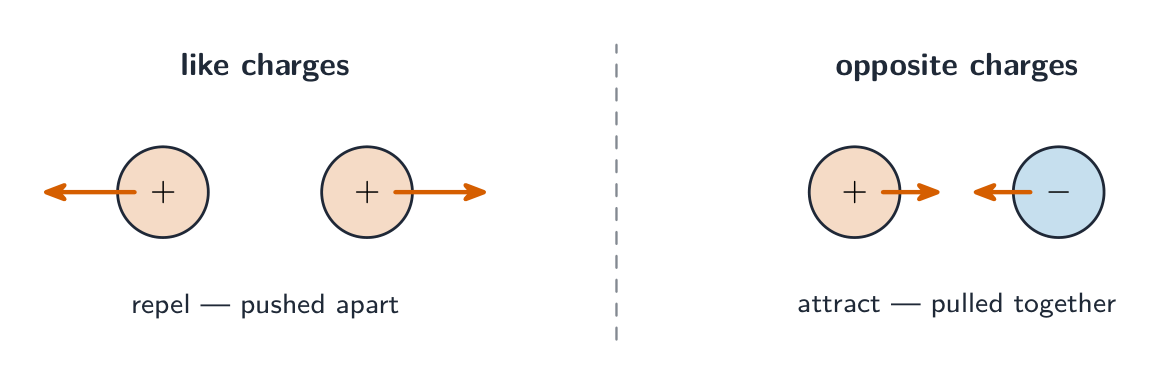
This is Coulomb's law 库仑定律. Here $\varepsilon_{0} = 8.85 \times 10^{-12}\ \text{F m}^{-1}$ is the permittivity of free space 真空电容率, and $1/(4\pi\varepsilon_{0}) \approx 9.0 \times 10^{9}\ \text{N m}^{2}\ \text{C}^{-2}$. The force is along the line joining the charges: repulsive for like charges, attractive for opposite charges.
Stating the law in words. "State Coulomb's law" wants a sentence, not a formula: the (electric) force between two point charges is directly proportional to the product of the charges and inversely proportional to the square of their separation. Both proportionalities are needed, and the charges must be point charges (or spheres treated as point charges at their centres) in a vacuum.
Worked example. Find the electrostatic force between point charges of $+2.0\ \text{nC}$ and $+3.0\ \text{nC}$ placed $4.0\ \text{cm}$ apart. ($1/(4\pi\varepsilon_{0}) = 9.0 \times 10^{9}\ \text{N m}^{2}\ \text{C}^{-2}$.)
Worked example. In a hydrogen atom the proton and the electron may be treated as point charges $120\ \text{pm}$ apart. Find the electric force between them, and compare it with their gravitational attraction. ($m_{\text{p}} = 1.67 \times 10^{-27}\ \text{kg}$, $m_{\text{e}} = 9.11 \times 10^{-31}\ \text{kg}$, $G = 6.67 \times 10^{-11}\ \text{N m}^{2}\ \text{kg}^{-2}$.)
Gravity: $F_{\text{G}} = G m_{\text{p}} m_{\text{e}}/r^{2} = (6.67 \times 10^{-11})(1.67 \times 10^{-27})(9.11 \times 10^{-31})/(1.20 \times 10^{-10})^{2} = 7.0 \times 10^{-48}\ \text{N}$, about $10^{39}$ times smaller. Inside atoms, gravity is irrelevant.
Worked example. Two identical oil droplets in a vacuum have their centres $3.8 \times 10^{-6}\ \text{m}$ apart. Each carries the same charge, and they repel with a force of $1.0 \times 10^{-15}\ \text{N}$. Find the charge on each droplet, and the number of excess electrons it carries.
that is $1.3 \times 10^{-18}/1.60 \times 10^{-19} \approx 8$ electrons. Identical objects with the same sign of charge always repel; do not write "attract" for the direction.
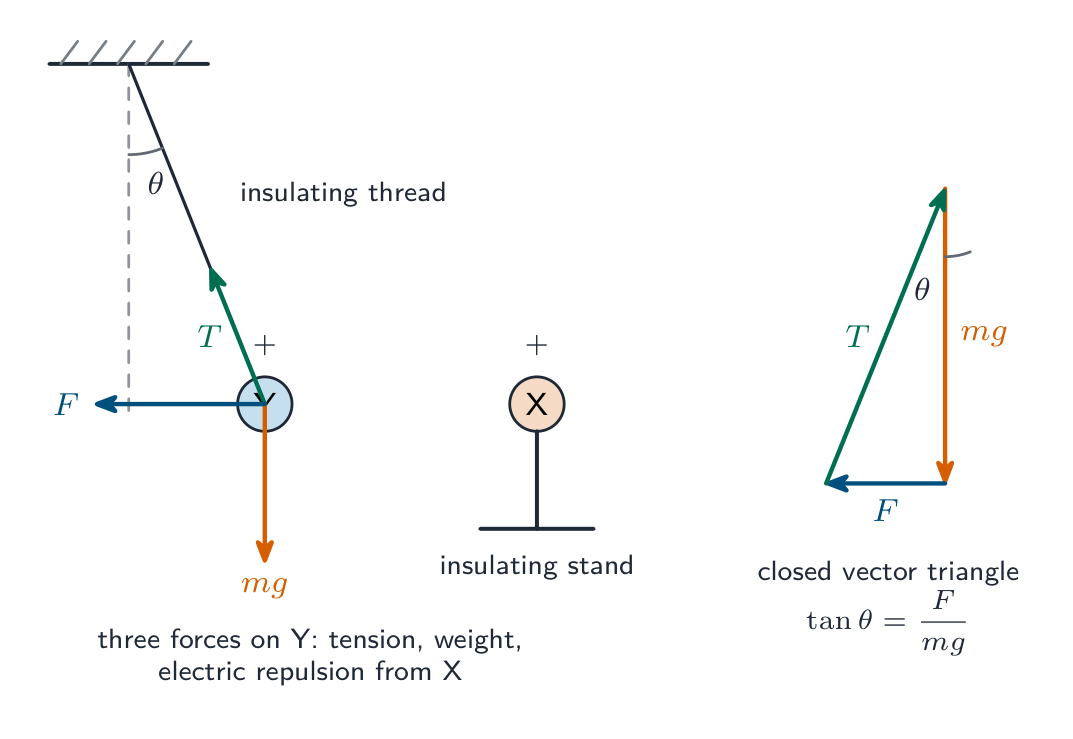
Worked example. A charged sphere X is fixed on an insulating stand. A second sphere Y, of mass $2.0\ \text{g}$, hangs beside it on an insulating thread and settles in equilibrium with the thread at $12°$ to the vertical, its centre $5.0\ \text{cm}$ from the centre of X on the same horizontal level. Find the electric force on Y and, if the spheres carry equal charges, the charge on each.
Three forces act on Y: its weight $mg$ (down), the tension 张力$T$ (along the thread) and the electric force $F$ (horizontal, away from X because like charges repel). Resolving, $T\cos\theta = mg$ and $T\sin\theta = F$, so
Then $F = Q^{2}/(4\pi\varepsilon_{0} r^{2})$ gives $Q = \sqrt{4\pi\varepsilon_{0} F r^{2}} = \sqrt{(4.2 \times 10^{-3})(0.050)^{2}/(8.99 \times 10^{9})} = 3.4 \times 10^{-8}\ \text{C}$. A closed vector triangle of the three forces is an equally good method; the exam accepts either, but it must show all three forces.
Worked example (helium). A helium atom may be modelled as a nucleus of charge $+2e$ with two electrons in diametrically opposite circular orbits of radius $170\ \text{pm}$. Find the resultant force 合力 on one electron, and hence its orbital speed.
Two forces act on the electron: attraction to the nucleus, at distance $r$, and repulsion from the other electron, at distance $2r$ on the far side:
towards the nucleus. This resultant is the centripetal force, $F = m_{\text{e}} v^{2}/r$, so $v = \sqrt{F r/m_{\text{e}}} = \sqrt{(1.4 \times 10^{-8})(1.70 \times 10^{-10})/(9.11 \times 10^{-31})} = 1.6 \times 10^{6}\ \text{m s}^{-1}$. The trap is to forget the second electron, or to put it at distance $r$ rather than $2r$.
Spheres treated as point charges
A spherical conductor with total charge $Q$ gives, at any point outside, the same field as a point charge $Q$ at its centre (measure $r$ from the centre). Inside a hollow charged conductor the field is zero, so the conductor is an equipotential 等势面.
العربية
بالنسبة لشحنتين نقطيتين $Q_{1}$ و$Q_{2}$ تبعدان مسافة $r$ في الفضاء الحر، تشعر كل منهما بقوة مقدارها
هذا هو قانون كولوم. هنا $\varepsilon_{0} = 8.85 \times 10^{-12}\ \text{F m}^{-1}$ هو السماحية الكهربية للفراغ، و$1/(4\pi\varepsilon_{0}) \approx 9.0 \times 10^{9}\ \text{N m}^{2}\ \text{C}^{-2}$. القوة تكون على امتداد الخط الواصل بين الشحنتين: تنافر للشحنات المتشابهة، تجاذب للشحنات المختلفة.
صياغة القانون بالكلمات. طلب "صغ قانون كولوم" يعني جملة وليس معادلة: القوة (الكهربائية) بين شحنتين نقطيتين تتناسب طرديًا مع حاصل ضرب الشحنتين وتتناسب عكسيًا مع مربع بُعدهما. كلا التناسبين مطلوبان، ويجب أن تكون الشحنات نقاط (أو كرات تُعامل كشحنات نقطية في مراكزها) في الفراغ.
الشحنات المتشابهة تتنافر؛ الشحنات المختلفة تتجاذب — والقوة تكون على امتداد الخط الواصل بينهما
مثال محلول. أوجد القوة الكهروستاتيكية بين شحنتين نقطيتين مقدارهما $+2.0\ \text{nC}$ و$+3.0\ \text{nC}$ موضوعتين على بُعد $4.0\ \text{cm}$ عن بعضهما. ($1/(4\pi\varepsilon_{0}) = 9.0 \times 10^{9}\ \text{N m}^{2}\ \text{C}^{-2}$.)
الجاذبية: $F_{\text{G}} = G m_{\text{p}} m_{\text{e}}/r^{2} = (6.67 \times 10^{-11})(1.67 \times 10^{-27})(9.11 \times 10^{-31})/(1.20 \times 10^{-10})^{2} = 7.0 \times 10^{-48}\ \text{N}$، أصغر بحوالي $10^{39}$ مرة. داخل الذرات، الجاذبية مهملة.
مثال محلول. قطرتا زيت متطابقتان في الفراغ تبعد مراكزهما $3.8 \times 10^{-6}\ \text{m}$ عن بعضهما. تحمل كل منهما نفس الشحنة، وتتنافران بقوة مقدارها $1.0 \times 10^{-15}\ \text{N}$. أوجد الشحنة لكل قطرة وعدد الإلكترونات الفائضة التي تحملها.
أي $1.3 \times 10^{-18}/1.60 \times 10^{-19} \approx 8$ إلكترون. الأجسام المتطابقة ذات نفس نوع الشحنة دائماً تتنافر؛ لا تكتب "تتجاذب" للاتجاه.
مثال محلول. كرة مشحونة X مثبتة على حامل عازل. كرة ثانية Y كتلتها $2.0\ \text{g}$، معلقة بجانبها بخيط عازل وتستقر في حالة توازن بحيث يكون الخيط بزاوية $12°$ مع الرأس، ومركزها على بُعد $5.0\ \text{cm}$ من مركز X على نفس المستوى الأفقي. أوجد القوة الكهربائية المؤثرة على Y، وإذا كانت الكرتان تحملان شحنات متساوية، أوجد شحنة كل منهما.
كرة مشحونة معلقة قرب كرة مشحونة: ثلاث قوى تتوازن، الشد على طول الخيط، والوزن، والتنافر الكهربائي الأفقي، لذا tan θ = F/mg
ثلاث قوى تؤثر على Y: وزنها $mg$ (لأسفل)، الشد$T$ (على طول الخيط) والقوة الكهربائية $F$ (أفقي، مبتعدًا عن X لأن الشحنات المتشابهة تتنافر). بالتحليل، $T\cos\theta = mg$ و$T\sin\theta = F$، لذا
ثم $F = Q^{2}/(4\pi\varepsilon_{0} r^{2})$ تعطي $Q = \sqrt{4\pi\varepsilon_{0} F r^{2}} = \sqrt{(4.2 \times 10^{-3})(0.050)^{2}/(8.99 \times 10^{9})} = 3.4 \times 10^{-8}\ \text{C}$. مثلث مغلق للمتجهات للقوى الثلاث هو طريقة جيدة أيضًا؛ يقبل الامتحان كليهما، لكن يجب إظهار الثلاث قوى.
مثال محلول (الهيليوم). يمكن نمذجة ذرة الهيليوم كنواة شحنتها $+2e$ وإلكترونين في مدارات دائرية متقابلة قطريًا بنصف قطر $170\ \text{pm}$. أوجد القوة المحصلة المؤثرة على أحد الإلكترونات، ومنه سرته المدارية.
قوتان تؤثران على الإلكترون: قوة جذب نحو النواة، على مسافة $r$، وقوة تنافر من الإلكترون الآخر، على مسافة $2r$ في الجهة البعيدة:
نحو النواة. هذا المحصل هو القوة الجاذبة المركزية، $F = m_{\text{e}} v^{2}/r$، إذن $v = \sqrt{F r/m_{\text{e}}} = \sqrt{(1.4 \times 10^{-8})(1.70 \times 10^{-10})/(9.11 \times 10^{-31})} = 1.6 \times 10^{6}\ \text{m s}^{-1}$. الفخ يكمن في نسيان الإلكترون الثاني، أو وضعه على مسافة $r$ بدلاً من $2r$.
كرات معاملة كشحنات نقطية
موصل كروي يحمل شحنة كلية $Q$ يعطي، عند أي نقطة خارجه، نفس المجال الذي يعطيه شحنة نقطية $Q$ في مركزه (القياس $r$ من المركز). داخل موصل كروي مجوف مشحون يكون المجال صفراً، لذا فإن الموصل متساوي الجهد.
Explore · استكشف
Coulomb's law · قانون كولوم
F ∝ Qq / r²
Like charges repel, unlike attract — and the force follows 1/r². · الشحنات المتماثلة تتنافر، والشحنات المختلفة تتجاذب — والقوة تتبع 1/r².
Electric field due to a point charge · مجال كهربائي ناتج عن شحنة نقطية
Syllabus · المنهج
English
recall and use $E = Q / (4\pi\varepsilon_0 r^2)$ for the electric field strength due to a point charge in free space
العربية
التذكر和使用 $E = Q / (4\pi\varepsilon_0 r^2)$ لـشدة المجال الكهربائي الناتجة عن شحنة نقطية في الفراغ
Source: Cambridge International syllabus · المصدر: منهج كامبريدج الدولي
English
Coulomb's law gives the force between two charges. Divide it by the test charge ($E = F/q$) and you are left with the field of the source charge $Q$alone. The field at distance $r$ from a point charge $Q$ is
$$E = \frac{Q}{4\pi\varepsilon_{0} r^{2}}.$$
It points out from a positive $Q$, in towards a negative $Q$, and falls as $1/r^{2}$ — just like gravitational field 重力场 strength, except gravity is always attractive. For several charges, add the fields as a vector sum 矢量和.
Worked example. The Earth may be treated as a uniform conducting sphere of radius $6.37 \times 10^{6}\ \text{m}$ carrying a total charge of $-4.80 \times 10^{5}\ \text{C}$ spread over its surface. Find the electric field strength at the surface, and compare it with the gravitational field strength there. ($M_{\text{E}} = 5.98 \times 10^{24}\ \text{kg}$.)
directed towards the centre (the charge is negative). Gravity: $g = GM/R^{2} = 9.83\ \text{N kg}^{-1}$, so $E/g \approx 11$; in symbols $E/g = Q/(4\pi\varepsilon_{0} G M)$, which shows that the ratio depends only on the charge-to-mass ratio of the sphere. A charged sphere of mass $m$ and charge $q$ would need $qE = mg$ to float in this field: $q/m = g/E = 0.093\ \text{C kg}^{-1}$.
Worked example. Point charges of $+4.0\ \text{nC}$ and $+1.0\ \text{nC}$ are $30\ \text{cm}$ apart. Where on the line joining them is the resultant field zero?
Between the charges the two fields point in opposite directions; call the distance from the $4.0\ \text{nC}$ charge $x$. Zero resultant needs equal magnitudes:
twice as far from the larger charge. For opposite charges the fields between them point the same way and never cancel: the zero lies outside, beyond the smaller charge.
العربية
تعطيك قانون كولوم القوة بين شحنتين. قسّمها على شحنة الاختبار ($E = F/q$) ويتبقى لك مجال الشحنة المصدر $Q$وحدها. المجال على مسافة $r$ من شحنة نقطية $Q$ هو
$$E = \frac{Q}{4\pi\varepsilon_{0} r^{2}}.$$
يتجه للخارج من شحنة موجبة $Q$، وي指向 للداخل نحو شحنة سالبة $Q$، ويتناقص مع $1/r^{2}$ — تماماً مثل مجال الجاذبية، باستثناء أن الجاذبية دائماً جاذبة. لعدة شحنات، اجمع المجالات كـ مجموع متجهي.
مثال محلول. يمكن اعتبار الأرض ككرة موصلة موحدة نصف قطرها $6.37 \times 10^{6}\ \text{m}$ تحمل شحنة كلية قدرها $-4.80 \times 10^{5}\ \text{C}$ موزعة على سطحها. أوجد شدة المجال الكهربائي عند السطح، ومقارنتها بشدة مجال الجاذبية هناك. ($M_{\text{E}} = 5.98 \times 10^{24}\ \text{kg}$.)
موجهة نحو المركز (الشحنة سالبة). الجاذبية: $g = GM/R^{2} = 9.83\ \text{N kg}^{-1}$، لذا $E/g \approx 11$؛ بالرموز $E/g = Q/(4\pi\varepsilon_{0} G M)$، مما يوضح أن النسبة تعتمد فقط على نسبة الشحنة إلى الكتلة للكرة. كرة مشحونة كتلتها $m$ وشحنتها $q$ ستحتاج إلى $qE = mg$ لتطفو في هذا المجال: $q/m = g/E = 0.093\ \text{C kg}^{-1}$.
مثال محلول. الشحنات النقطية مقدارها $+4.0\ \text{nC}$ و$+1.0\ \text{nC}$ تبعد عن بعضها مسافة $30\ \text{cm}$. أين على الخط الواصل بينهما يكون المحصل صفراً؟
بين الشحنتين يتجه المجالان في اتجاهين متعاكسين؛ ليكن المسافة من شحنة $4.0\ \text{nC}$ هي $x$. تحتاج المحصلة للصفر إلى تساوي المقادير:
أبعد مرتين عن الشحنة الأكبر. بالنسبة للشحنات المختلفة في الإشارة، يتجه المجالان بينهما في نفس الاتجاه ولا يلغيان بعضهما أبداً: النقطة التي يساوي فيها المحصل الصفر تقع خارج المنطقة، خلف الشحنة الأصغر.
Explore · استكشف
Field around a point charge · المجال حول شحنة نقطية
Change the charge. Field lines point away from positive and toward negative, and crowd together where the field is strongest. · غيّر الشحنة. تتجه خطوط المجال خارجاً من الموجب وباتجاه السالب، وتتقارب حيث يكون المجال الأقوى.
18.5
Electric potential · الجهد الكهربائي
Syllabus · المنهج
English
define electric potential at a point as the work done per unit positive charge in bringing a small test charge from infinity to the point
recall and use the fact that the electric field at a point is equal to the negative of potential gradient at that point
use $V = Q / (4\pi\varepsilon_0 r)$ for the electric potential in the field due to a point charge
understand how the concept of electric potential leads to the electric potential energy of two point charges and use $E_P = Qq / (4\pi\varepsilon_0 r)$
العربية
تعريف الجهد الكهربائي عند نقطة معينة بأنه الشغل المبذول لكل وحدة شحنة موجبة في إحضار شحنة اختبار صغيرة من اللانهاية إلى تلك النقطة
التذكر وحقيقة أن المجال الكهربائي عند نقطة معينة يساوي سالب تدرج الجهد عند تلك النقطة
استخدام $V = Q / (4\pi\varepsilon_0 r)$ للجهد الكهربائي في المجال الناتج عن شحنة نقطية
فهم كيف يؤدي مفهوم الجهد الكهربائي إلى الطاقة الكامنة الكهربائية لشحنتين نقطيتين واستخدام $E_P = Qq / (4\pi\varepsilon_0 r)$
Source: Cambridge International syllabus · المصدر: منهج كامبريدج الدولي
English
Electric potential 电势$V$ at a point is the work done per unit positive charge in bringing a small positive test charge from infinity 无穷远 to that point:
$$V = \frac{W}{q}.$$
Unit: $\text{V}$. The potential is zero at infinity. For a positive source charge $V > 0$ everywhere outside; for a negative source charge $V < 0$.
The two-mark definition.Electric potential at a point is the work done per unit positive charge in bringing a small test charge from infinity to the point. The marks are for work done per unit (positive) charge and from infinity to the point. The potential of a positive charge is positive because work must be done on a positive test charge to push it in against the repulsion; near a negative charge the field does the work, so the potential is negative. "Explain why the potential near an isolated proton is positive" is answered in exactly those words.
Potential due to a point charge
$$V = \frac{Q}{4\pi\varepsilon_{0} r}.$$
Note the $1/r$ here (compared with $1/r^{2}$ for the field). $V$ is a scalar 标量; for several charges, add the potentials (with sign).
Worked example. Find the electric potential $4.0\ \text{cm}$ from a point charge of $+3.0\ \text{nC}$. ($1/(4\pi\varepsilon_{0}) = 9.0 \times 10^{9}\ \text{N m}^{2}\ \text{C}^{-2}$.)
Because potential is a scalar, the potential from several charges is simply their sum (each with its own sign) — no directions to resolve.
Two charged spheres on a line
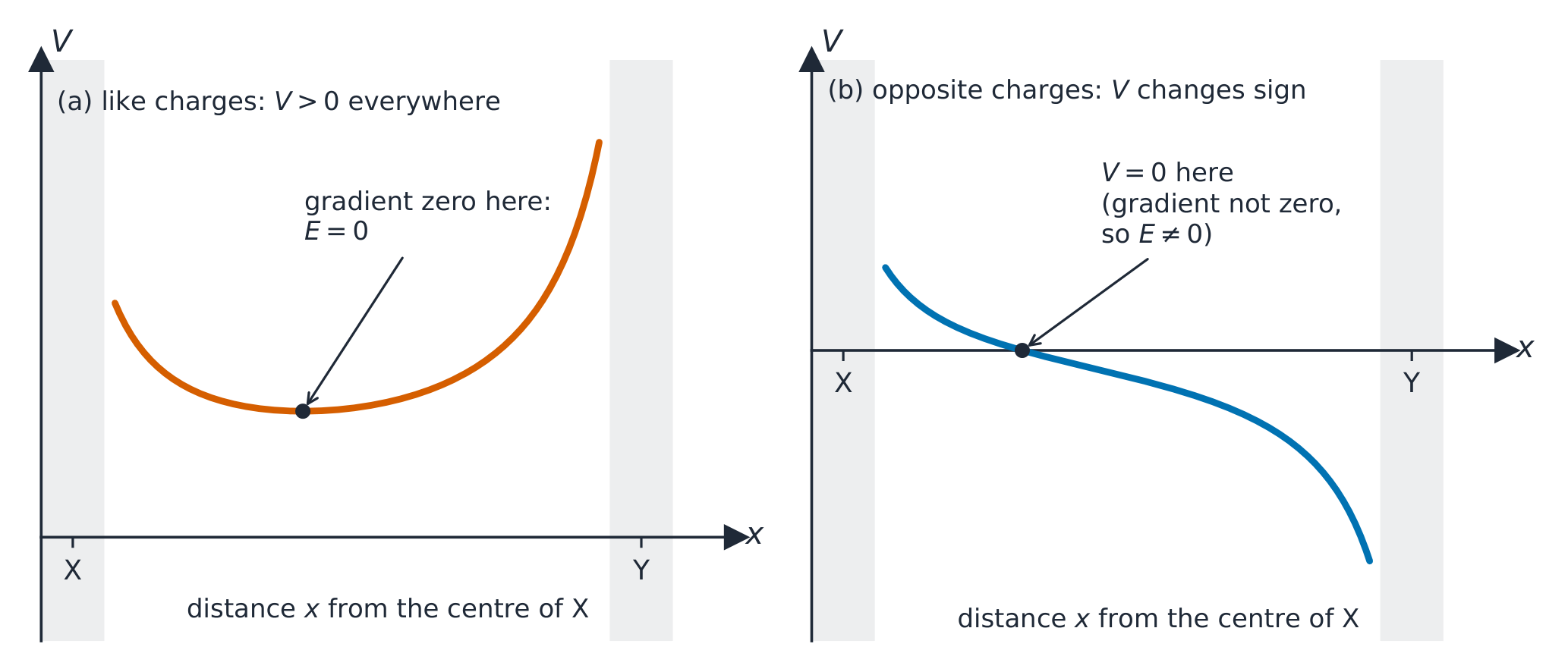
The exam's favourite structured question puts two charged spheres X and Y some distance apart and draws the potential $V$ along the line joining their centres (or asks you to reason from it). Everything follows from two facts: potential is a scalar that adds with sign, and the field is the negative gradient of the graph.
Sign of the charges. If $V$ is positive along the whole line, both charges are positive; if $V$ changes sign, the charges are opposite (positive near the positive sphere).
Where the field is zero. Where the curve has a minimum (gradient zero). For like charges this lies between them, closer to the smaller charge: $Q_{\text{X}}/x^{2} = Q_{\text{Y}}/(d - x)^{2}$. For opposite charges there is no such point between them: the curve crosses zero there, but its gradient is not zero, so the field is not.
Ratio of the charges. Where $V = 0$ between opposite charges, $Q_{\text{X}}/x = Q_{\text{Y}}/(d - x)$: the distances give the ratio directly. For like charges use the minimum instead (the square root of the field condition).
Force on a charge placed at P. Read the gradient at P by drawing a tangent 切线; then $E$ is minus the gradient, and $F = qE$.
Worked example. Two isolated charged metal spheres X and Y have their centres $1.2\ \text{m}$ apart in a vacuum. The potential along the line between them is positive everywhere and has a minimum at $x = 0.50\ \text{m}$ from the centre of X. State three conclusions, and then find the force on a proton held at $x = 0.60\ \text{m}$, where the gradient of the graph is $+180\ \text{V m}^{-1}$.
Conclusions: (1) both spheres are positively charged, because the potential is positive everywhere; (2) the electric field is zero at $x = 0.50\ \text{m}$, where the gradient is zero; (3) the charge on Y is larger, because the zero-field point lies closer to X; in fact $Q_{\text{Y}}/Q_{\text{X}} = (0.70/0.50)^{2} = 2.0$. At $x = 0.60\ \text{m}$: $E = -180\ \text{V m}^{-1}$ (pointing towards X, since $V$ rises towards Y), so $F = eE = (1.60 \times 10^{-19})(180) = 2.9 \times 10^{-17}\ \text{N}$ towards X. Released, the proton accelerates towards X, its acceleration increasing as the gradient steepens; it needs an external force to hold it still.
Describing the motion. "A positively charged particle is placed at P and released. Describe and explain its motion." The examiner wants: the direction (towards lower potential, down the slope of the $V$ graph); that the force, and so the acceleration, is not constant (it follows the gradient, which changes along the line); and that the particle speeds up throughout, since the force stays in the direction of motion. If P is the zero-field point the particle stays at rest, in unstable equilibrium: a nudge either way sends it off.
Link between field and potential
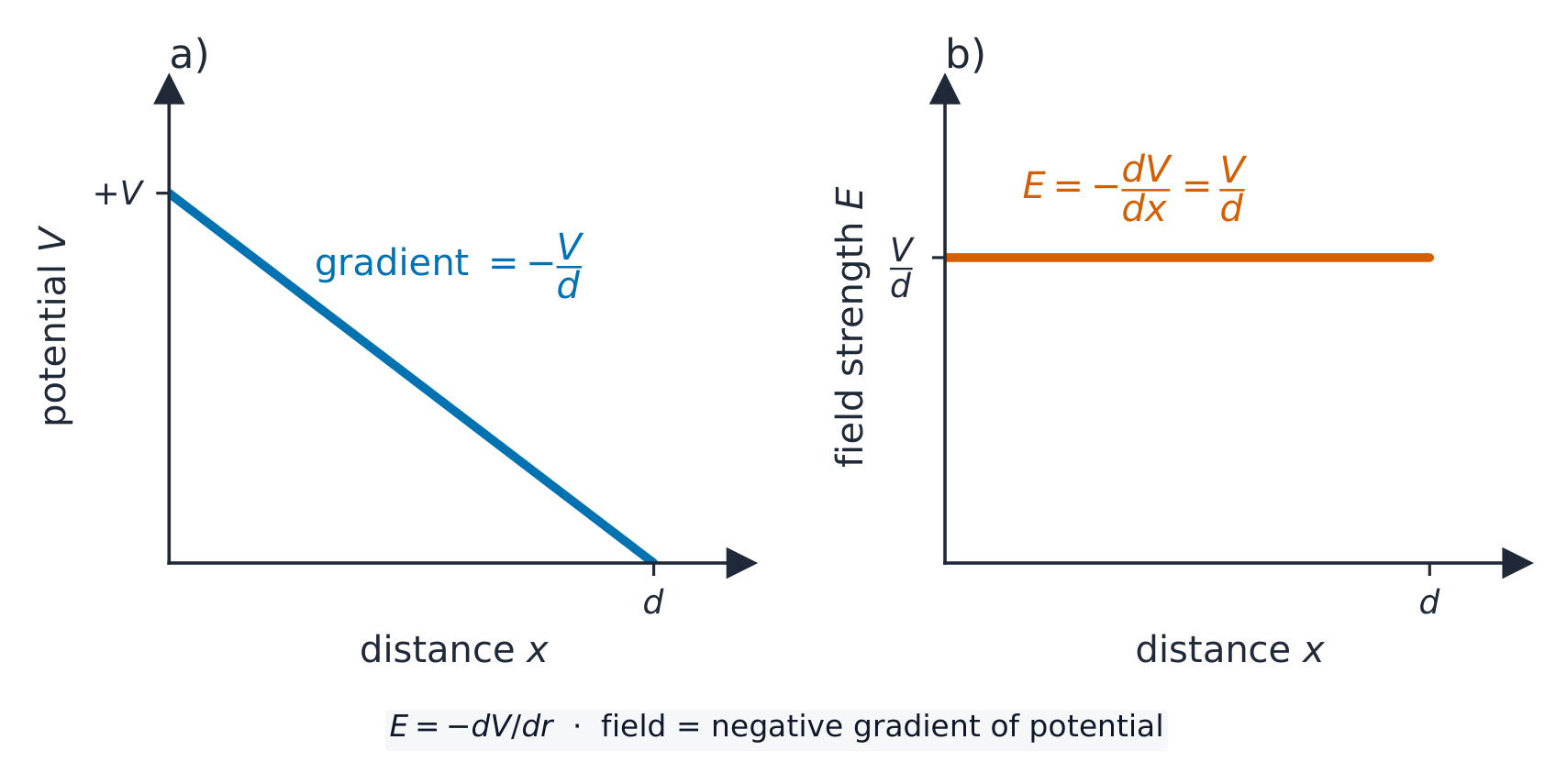
The field equals the negative potential gradient 电势梯度:
$$E = -\frac{dV}{dx}.$$
Between parallel plates $V$ changes evenly with position, giving $E = V/d$ as before. The minus sign means the field points towards lower potential. For a point charge, $-\dfrac{dV}{dr} = \dfrac{Q}{4\pi\varepsilon_{0} r^{2}} = E$.
The one-line relationship. "State the relationship between electric field and electric potential": the field strength is equal to the negative of the potential gradient, $E = -\Delta V/\Delta x$. On a $V$–$x$ graph $E$ is minus the gradient of a tangent; on a $V$–$r$ graph for a point charge the gradient is steepest close to the charge, where the field is strongest, and the sign of $E$ is fixed by "the field points towards lower potential". The uniform-field version $E = V/d$ is the same statement with a constant gradient.
Equipotentials. An equipotential surface joins points of equal potential; no work is done moving a charge along it, so the field is always at right angles to it. Around a point charge the equipotentials are concentric spheres, growing further apart as $V$ falls; between parallel plates they are planes parallel to the plates. The surface of a conductor is an equipotential, which is why field lines meet it at right angles.
Electric potential energy
A charge $q$ at a point of potential $V$ has electric potential energy 电势能$E_{\text{P}} = qV$. For two point charges $Q$ and $q$ a distance $r$ apart:
like charges: $E_{\text{P}} > 0$ — stored energy that would be released if they flew apart.
opposite charges: $E_{\text{P}} < 0$ — a bound 束缚 system; energy must be supplied to separate them.
In both cases $E_{\text{P}} \to 0$ as $r \to \infty$.
Worked example. The proton and the electron in a hydrogen atom are $5.3 \times 10^{-11}\ \text{m}$ apart. Find the electric potential energy of the pair.
The negative sign is part of the answer: the charges are opposite, so energy ($4.3 \times 10^{-18}\ \text{J}$) must be supplied to pull them apart to infinity. (The electron also has kinetic energy of half that size, so the energy needed to ionise 电离 the atom is $13.6\ \text{eV}$; the "worked-example pattern" below shows why.)
Charge through a p.d. A charge $q$ moved through a potential difference $V$ changes its potential energy by $qV$, which is why an electron accelerated from rest through $250\ \text{V}$ arrives with $250\ \text{eV}$ of kinetic energy whatever the shape of the field. For an MCQ about "moving P a distance $x$ along the field lines", the work done is $qEx$, and its potential energy falls if it moves the way the force pushes it.
Worked-example pattern
An electron 电子 orbits a nucleus 原子核 of charge $+Ze$ at distance $r$. The Coulomb attraction provides the centripetal force 向心力:
The minus sign in the gravitational potential 引力势 reflects that gravity is always attractive; the electric potential takes the sign of the source charge.
Similarity and difference (a standard two-marker). Both potentials are proportional to $1/r$, both are zero at infinity, and both are scalars; but gravitational potential is always negative (the force is always attractive) whereas electric potential takes the sign of the charge and can be positive. For the fields: both obey an inverse-square law and both are drawn as radial lines around a point source, but gravitational field lines only ever point inwards (attraction), while electric field lines point outwards from a positive charge and inwards to a negative one.
العربية
الجهد الكهربائي$V$ عند نقطة هو الشغل المبذول لكل وحدة شحنة موجبة في إحضار شحنة اختبار موجبة صغيرة من ما لا نهاية إلى تلك النقطة:
$$V = \frac{W}{q}.$$
الوحدة: $\text{V}$. الجهد صفر عند اللانهاية. بالنسبة لشحنة مصدر موجبة $V > 0$ في كل مكان خارجي؛ وبشحنة مصدر سالبة $V < 0$.
تعريف علامتين.الجهد الكهربائي عند نقطة هو الشغل المبذول لكل وحدة شحنة موجبة في إحضار شحنة اختبار صغيرة من ما لا نهاية إلى النقطة. العلامتان مخصصتان لـ الشغل المبذول لكل وحدة (موجبة) شحنة و من ما لا نهاية إلى النقطة. جهد الشحنة الموجبة موجب لأن الشغل يجب أن يُبذل على شحنة اختبار موجبة لدفعها داخلًا ضد التنافر؛ قرب الشحنة السالبة يقوم المجال بالشغل، لذا الجهد سالب. "اشرح لماذا يكون الجهد قريباً من بروتون منعزل موجباً" يُجاب عنه بنفس هذه الكلمات بالضبط.
الجهد الناتج عن شحنة نقطية
$$V = \frac{Q}{4\pi\varepsilon_{0} r}.$$
لاحظ الأس $1/r$ هنا (مقارنة مع $1/r^{2}$ للمجال). $V$ هو كمية قياسية؛ لعدة شحنات، اجمع الجهود (مع الإشارة).
مثال محلول. أوجد الجهد الكهربائي $4.0\ \text{cm}$ الناتج عن شحنة نقطية مقدارها $+3.0\ \text{nC}$. ($1/(4\pi\varepsilon_{0}) = 9.0 \times 10^{9}\ \text{N m}^{2}\ \text{C}^{-2}$.)
بما أن الجهد كمية قياسية، فإن الجهد الناتج عن عدة شحنات هو ببساطة مجموعها (كل منها بإشارته الخاصة) — بدون الحاجة لتحليل الاتجاهات.
الجهد على الخط بين كرتين مشحونتين: الشحنات المتشابهة تعطي حداً أدنى (المجال صفر هناك)؛ الشحنات المختلفة تعطي تقاطعاً مع الصفر
كرتان مشحونتان على خط مستقيم
السؤال الهيكلي المفضل في الامتحانات يضع كرتين مشحونتين X و Y على مسافة معينة ويرسم الجهد $V$ على الخط الواصل بين مركزيهما (أو يطلب منك الاستنتاج منه). كل شيء يتبع من حقيقتين: الجهد هو كمية قياسية تُجمع مع الإشارات، والمجال هو التدرج السالب للرسم البياني.
إشارة الشحنات. إذا كان $V$ موجباً على طول الخط كله، فالشحنتان موجبتان؛ إذا كانت $V$ تتغير إشارتها، فالشحنتان مختلفتان (موجبة靠近 الكرة الموجبة).
حيث يكون المجال صفراً. حيث يكون للمنحنى حد أدنى (تدرج صفر). للشحنات المتشابهة يقع هذا الحد بينهما، أقرب للشحنة الأصغر: $Q_{\text{X}}/x^{2} = Q_{\text{Y}}/(d - x)^{2}$. للشحنات المختلفة لا يوجد مثل هذه النقطة بينهما: المنحنى يعبر الصفر هناك، لكن تدرجه ليس صفراً، لذا المجال ليس صفراً.
نسبة الشحنات. حيث $V = 0$ بين الشحنات المختلفة، $Q_{\text{X}}/x = Q_{\text{Y}}/(d - x)$: المسافات تعطيك النسبة مباشرة. للشحنات المتشابهة استخدم الحد الأدنى بدلاً من ذلك (الجذر التربيعي لحالة المجال).
القوة على شحنة موضوعة عند P. اقرأ التدرج عند P برسم مماس؛ ثم $E$ هو سالب التدرج، و$F = qE$.
مثال محلول. كرتان معدنيتان معزولتان مشحونتان X و Y مركزاهما $1.2\ \text{m}$ متباعدة في فراغ. الجهد على الخط بينهما موجب في كل مكان وله حد أدنى عند $x = 0.50\ \text{m}$ من مركز X. استنتج ثلاث استنتاجات، ثم أوجد القوة المؤثرة على بروتون مثبت عند $x = 0.60\ \text{m}$، حيث تدرج الرسم البياني هو $+180\ \text{V m}^{-1}$.
الاستنتاجات: (1) كلا الكرتين مشحونتان بشحنة موجبة، لأن الجهد موجب في كل مكان؛ (2) المجال الكهربائي يصل إلى الصفر عند $x = 0.50\ \text{m}$، حيث يكون التدرج صفراً؛ (3) الشحنة على Y أكبر، لأن نقطة انعدام المجال تقع أقرب إلى X؛ في الواقع $Q_{\text{Y}}/Q_{\text{X}} = (0.70/0.50)^{2} = 2.0$. عند $x = 0.60\ \text{m}$: $E = -180\ \text{V m}^{-1}$ (متجه نحو X، بما أن $V$ يتزايد نحو Y)، لذا $F = eE = (1.60 \times 10^{-19})(180) = 2.9 \times 10^{-17}\ \text{N}$ نحو X. عند إطلاقه، يسارع البروتون نحو X، ويزداد تسارعه كلما زادت حدة التدرج؛ ويحتاج إلى قوة خارجية لإبقائه ثابتاً.
وصف الحركة. "تم وضع جسيم مشحون بشحنة موجبة عند P وأُطلق سراحه. صِف واشرح حركته." يريد المصحح: الاتجاه (نحو الجهد الأدنى، نزولاً على منحنى $V$)؛ أن القوة، وبالتالي التسارع، ليست ثابتة (تتبع التدرج الذي يتغير على طول الخط)؛ وأن الجسيم يزداد سرعته طوال الوقت، لأن القوة تظل في اتجاه الحركة. إذا كان P هو نقطة انعدام المجال يبقى الجسيم ساكناً، في توازن غير مستقر: أي دفعة لأحد الاتجاهين تدفعه للابتعاد.
يتغير الجهد قرب الشحنة النقطية按比例 مع 1/r — موجب للشحنة الموجبة، وسالب للسالبة
العلاقة بين المجال والجهد
المجال يساوي سالب تدرج الجهد:
$$E = -\frac{dV}{dx}.$$
بين الصفائح المتوازية $V$ تتغير بانتظام مع الموقع، مما يعطي $E = V/d$ كما سبق. الإشارة السالبة تعني أن المجال يتجه نحو الجهد الأدنى. بالنسبة لشحنة نقطية، $-\dfrac{dV}{dr} = \dfrac{Q}{4\pi\varepsilon_{0} r^{2}} = E$.
العلاقة في سطر واحد. "اذكر العلاقة بين المجال الكهربائي والجهد الكهربائي": قوة المجال تساوي سالب تدرج الجهد، $E = -\Delta V/\Delta x$. على منحنى $V$–$x$$E$ هو سالب ميل المماس; على منحنى $V$–$r$ للشحنة النقطية يكون الميل أشد حدة بالقرب من الشحنة، حيث يكون المجال الأقوى، وإشارة $E$ ثابتة بواسطة "المجال يتجه نحو الجهد الأدنى". نسخة المجال المنتظم $E = V/d$ هي نفس العبارة بميل ثابت.
خطوطLEVELs الجهد. سطح مساوٍ للجهد يربط نقاطاً متساوية في الجهد؛ لا يُبذل شغل لنقل شحنة عليه، لذا يكون المجال دائماً عمودياً عليه. حول شحنة نقطية تكون أسطح مساوية للجهد كرات متحدة المركز، وتتباعد كلما انخفض $V$; بين الصفائح المتوازية تكون مستويات موازية للصفائح. سطح الموصل هو سطح مساوٍ للجهد، ولهذا تتقاطع خطوط المجال معه بزاوية قائمة.
في المجال المنتظم ينخفض الجهد بانتظام مع المسافة، لذا فإن قوة المجال $V/d$ تكون ثابتة
الطاقة الكامنة الكهربائية
شحنة $q$ عند نقطة جهد $V$ تمتلك طاقة كامنة كهربائية$E_{\text{P}} = qV$. بالنسبة لشحنتين نقطيتين $Q$ و$q$ على مسافة $r$ بينهما:
الإشارة السالبة جزء من الإجابة: الشحنات متعاكسة، لذا الطاقة ($4.3 \times 10^{-18}\ \text{J}$) يجب أن تُزَوَّد لفصلهما إلى ما لا نهاية. (الإلكترون يمتلك أيضاً طاقة حركية نصف هذه القيمة، لذا الطاقة اللازمة لـ إيونايز الذرة هي $13.6\ \text{eV}$؛ يُظهر النمط أدناه لماذا.)
الشحنة عبر فرق الجهد. شحنة $q$ نُقلت عبر فرق جهد $V$ تتغير طاقتها الكامنة بمقدار $qV$، ولهذا يصل إلكترون مُسرَّع من السكون عبر $250\ \text{V}$ بطاقة حركة $250\ \text{eV}$ بغض النظر عن شكل المجال. في سؤال خيارات متعددة حول "تحريك P مسافة $x$ على طول خطوط المجال"، الشغل المبذول هو $qEx$، وتتناقص طاقته الكامنة إذا تحرك في اتجاه الدفع.
طاقة PE الكهربائية لشحنتين: موجبة للشحنات المتماثلة، وبئر سالب للشحنات المتعاكسة
نمط المثال المحلول
يدور إلكترون حول نواة شحنتها $+Ze$ على مسافة $r$. قوة التجاذب الكولومبية توفر القوة المركزية:
يعكس إشارة السالب في الجهد الكهروستاتيكي أن الجاذبية دائماً تجاذبية؛ بينما يأخذ الجهد الكهربائي إشارة الشحنة المصدر.
التشابه والاختلاف (سؤال قياسي من علامتين). كلا الجهدَين متناسبان مع $1/r$، وكلاهما يساوي صفراً عند اللانهاية، وكلاهما كميات قياسية؛ لكن الجهد الجاذبي يكون سالباً دائماً (لأن القوة دائماً تجاذبية)، بينما يأخذ الجهد الكهربائي إشارة الشحنة ويمكن أن يكون موجباً. أما بالنسبة للمجالات: كلاهما يخضع لقانون التربيع العكسي وكلاهما يُرسم بخطوط شعاعية حول مصدر نقطي، لكن خطوط المجال الجاذبي تتجه دائماً للداخل (تجاذب)، بينما تتجه خطوط المجال الكهربائي للخارج من شحنة موجبة وللداخل نحو شحنة سالبة.
Explore · استكشف
Electric potential · الجهد الكهربائي
V = kQ / r
Potential ∝ 1/r around a charge — steep near it, flattening out. · الجهد ∝ 1/r حول الشحنة — حاد قريباً منها، ثم يساوي.
electric potential energy/ɪˈlektrɪk pəˈtenʃl ˈenədʒi/
طاقة الجهد الكهربائي
bound/baʊnd/
مرتبط
ionise/ˈaɪənaɪz/
تأين
gravitational potential/ˌɡrævɪˈteɪʃənl pəˈtenʃl/
الجهد الجاذبي
18.5
Definitions the examiner accepts · التعريفات التي يقبلها المصحح
English
A definition question is marked against fixed wording. Learn these exactly, and give one answer only.
Term
Definition
electric field
a region in which a charge experiences an (electric) force
electric field strength
the force per unit positive charge acting on a small (test) charge placed at the point
electric field line
a line whose direction shows the direction of the force on a positive charge; the spacing of the lines shows the field strength
Coulomb's law
the force between two point charges is directly proportional to the product of the charges and inversely proportional to the square of their separation
electric potential
the work done per unit positive charge in bringing a small test charge from infinity to the point
field and potential
the electric field strength is equal to the negative of the potential gradient: $E = -\Delta V/\Delta x$
electric potential energy (of two charges)
the work done in bringing the charges from infinity to their separation; $Qq/(4\pi\varepsilon_{0} r)$
equipotential
a surface (or line) on which every point has the same potential; the field is at right angles to it
uniform field
a field with the same strength and direction at every point, shown by parallel, evenly spaced field lines
العربية
تُصنّف أسئلة التعريف بناءً على صياغة ثابتة. احفظ هذه التعريفات بدقة، وقدم إجابة واحدة فقط.
مصطلح
تعريف
المجال الكهربائي
منطقة يخضع فيها شحنة لقوة (كهربائية)
شدة المجال الكهربائي
القوة المؤثرة على وحدة شحنة موجبة واحدة作用于 على شحنة اختبار صغيرة موضوعة عند النقطة
خط المجال الكهربائي
خط يشير اتجاهه إلى اتجاه القوة المؤثرة على شحنة موجبة؛ وتُظهر المسافات بين الخطوط شدة المجال
قانون كولوم
القوة بين شحنتين نقطيتين تتناسب طردياً مع حاصل ضرب الشحنتين وعكسياً مع مربع تباعدهما
الجهد الكهربائي
الشغل المبذول لإحضار شحنة اختبار صغيرة من اللانهاية إلى النقطة لكل وحدة شحنة موجبة
الشغل المبذول في إحضار الشحنتين من اللانهاية إلى تباعدهما الحالي؛ $Qq/(4\pi\varepsilon_{0} r)$
سطح متساوي الجهد
سطح (أو خط) يكون فيه لكل نقطة نفس الجهد؛ ويكون المجال عمودياً عليه
مجال منتظم
مجال له نفس الشدة والاتجاه عند كل نقطة، ويُمثل بخطوط مجال متوازية ومتساوية المسافات
18.5
Exam tips · نصائح للامتحان
English
Four formulae, two with $r^{2}$ and two with $r$: $F = Q_1 Q_2 / 4\pi\varepsilon_0 r^{2}$ and $E = Q/4\pi\varepsilon_0 r^{2}$ (inverse square), $V = Q/4\pi\varepsilon_0 r$ and $E_{\text{P}} = Qq/4\pi\varepsilon_0 r$. Decide which one before you write.
Distinguish a uniform field ($E = V/d$, between plates) from a radial field ($E = Q/4\pi\varepsilon_0 r^{2}$, outside a point charge or a sphere); $r$ for a sphere is measured from the centre, not the surface.
The field points from high to low potential and $E$ is minus the potential gradient: draw a tangent on a $V$–$x$ graph to find it.
Field is a vector (add components, subtract opposing ones); potential is a scalar (add with sign). Between like charges there is a zero-field point; between opposite charges a zero-potential point.
A charged particle in a uniform field: $F = qE$, $a = qE/m$, $E_{\text{k}} = qV$; along the field it is the vertical half of projectile motion, and motion at right angles to the field is unaffected.
The data sheet gives both $\varepsilon_0 = 8.85 \times 10^{-12}\ \text{F m}^{-1}$ and $1/(4\pi\varepsilon_0) = 8.99 \times 10^{9}\ \text{m F}^{-1}$; either works, do not mix them up.
Common mistakes
Defining field strength as "the force on a charge" or "force per unit mass". It is the force per unit positive charge on a small positive charge.
Forgetting to square $r$ in Coulomb's law and in the field, or squaring it in the potential ($V \propto 1/r$).
Using the diameter, or the distance from the surface of a sphere, instead of the centre-to-centre distance.
Sketching $E$ for a sphere from the origin. It is zero inside and starts at $E_0$ on the surface; $V$ is constant inside, not zero.
Field lines without arrows, crossing, or unevenly spaced in a uniform field; lines not at right angles to a conductor.
Dropping the negative sign on the potential energy of opposite charges, or taking the direction of $E$ from the sign of $V$ instead of from its gradient.
Forgetting the second electron in the helium atom, or placing it at distance $r$ rather than $2r$.
Using $E = V/d$ for a point charge, or $E = Q/4\pi\varepsilon_0 r^{2}$ between plates.
Giving an electron weight, or using the proton's mass for an electron; in electrons-between-plates questions the weight is negligible.
Leaving out the weight in an "oil drop held stationary" question, or getting the polarity of the top plate backwards.
العربية
أربعة صيغ، اثنتان تحتويان على $r^{2}$ واثنتان على $r$: $F = Q_1 Q_2 / 4\pi\varepsilon_0 r^{2}$ و$E = Q/4\pi\varepsilon_0 r^{2}$ (تربيع عكسي)، $V = Q/4\pi\varepsilon_0 r$ و$E_{\text{P}} = Qq/4\pi\varepsilon_0 r$. حدد أي الصيغ تستخدم قبل كتابتها.
التمييز بين المجال المنتظم ($E = V/d$، بين الصفيحتين) والمجال الشعاعي ($E = Q/4\pi\varepsilon_0 r^{2}$، خارج شحنة نقطية أو كرة)؛ يُقاس $r$ للكرة من المركز، وليس من السطح.
يتجه المجال من الجهد العالي إلى المنخفض، و$E$ يساوي سالب تدرج الجهد: ارسم مماساً على بيانية $V$–$x$ لإيجاده.
المجال كمية متجهة (جمع المركبات، طرح المتعاكسة)؛ والجهد كمية قياسية (جمع مع الإشارة). بين شحنتين متماثلتين توجد نقطة انعدام المجال؛ وبين شحنتين مختلفتين توجد نقطة انعدام الجهد.
جسيم مشحون في مجال منتظم: $F = qE$، $a = qE/m$، $E_{\text{k}} = qV$؛ على طول المجال يمثل النصف العمودي لحركة المقذوفات، والحركة عمودية على المجال لا تتأثر.
يعطي ورقة البيانات كل من $\varepsilon_0 = 8.85 \times 10^{-12}\ \text{F m}^{-1}$ و$1/(4\pi\varepsilon_0) = 8.99 \times 10^{9}\ \text{m F}^{-1}$؛ أي منهما يعمل، فلا تخلط بينهما.
أخطاء شائعة
تعريف شدة المجال بـ "القوة على شحنة" أو "القوة لكل وحدة كتلة". هي القوة لكل وحدة شحنة موجبة على شحنة اختبار موجبة صغيرة.
نسيان تربيع $r$ في قانون كولوم وفي المجال، أو تربيعه في الجهد ($V \propto 1/r$).
استخدام القطر، أو المسافة من سطح الكرة، بدلاً من مسافة المركز إلى المركز.
رسم $E$ للكرة من نقطة الأصل. يساوي صفراً من الداخل ويبدأ من $E_0$ على السطح؛ $V$ ثابت من الداخل، ليس صفراً.
خطوط مجال بدون أسهم، أو تتقاطع، أو غير متساوية المسافات في مجال منتظم؛ أو خطوط ليست عمودية على موصل.
إنزال إشارة السالب من طاقة كامنة الشحنتين المختلفتين، أو تحديد اتجاه $E$ من إشارة $V$ بدلاً من من ميلانه.
نسيان الإلكترون الثاني في ذرة الهيليوم، أو وضعه على مسافة $r$ بدلاً من $2r$.
استخدام $E = V/d$ لشحنة نقطية، أو $E = Q/4\pi\varepsilon_0 r^{2}$ بين الصفيحتين.
إعطاء الإلكترون وزناً، أو استخدام كتلة البروتون للإلكترون؛ في مسائل الإلكترونات بين الصفيحتين يكون الوزن مهملاً.
إهمال الوزن في مسألة "قطرة زيت معلقة ساكنة"، أو عكس قطبية الصفيحة العلوية.
Interactive lessons on this topic · دروس تفاعلية حول هذا الموضوع
Work through it step by step, with instant-check exercises. · ا-working عليه خطوة بخطوة، مع تمارين تحقق فوري.
Pick one and the site follows you — notes, papers, videos and practice all open on it. · اختر واحدًا وسيتبعك الموقع — الملاحظات، الأوراق، الفيديوهات والتدريب جميعها تفتح عليه.
Type to search notes, lessons, code, vocabulary and past-paper questions across every subject. · اكتب للبحث عن ملاحظات، دروس، أكواد، مفردات وأسئلة امتحانات سابقة عبر جميع المواد.