understand and use the terms displacement, amplitude, period, frequency, angular frequency and phase difference in the context of oscillations, and express the period in terms of both frequency and angular frequency
understand that simple harmonic motion occurs when acceleration is proportional to displacement from a fixed point and in the opposite direction
use $a = -\omega^2 x$ and recall and use, as a solution to this equation, $x = x_0 \sin \omega t$
use the equations $v = v_0 \cos \omega t$ and $v = \pm \omega \sqrt{x_0^2 - x^2}$
analyse and interpret graphical representations of the variations of displacement, velocity and acceleration for simple harmonic motion
العربية
فهم واستخدام مصطلحات الإزاحة، السعة، الدورة الزمنية، التردد، التردد الزاوي وفرق الطور في سياق الاهتزازات، والتعبير عن الدورة الزمنية بدلالة كل من التردد والتردد الزاوي
فهم أن الحركة التوافقية البسيطة تحدث عندما تكون العجلة متناسبة طردياً مع الإزاحة من نقطة ثابتة وفي الاتجاه المعاكس لها
استخدام $a = -\omega^2 x$ والتذكر واستخدام $x = x_0 \sin \omega t$ كحل لهذه المعادلة
Source: Cambridge International syllabus · المصدر: منهج كامبريدج الدولي
English
SHM: spring, circle and graph in phase
A particle moves with simple harmonic motion 简谐运动 (SHM) when its acceleration 加速度 is:
proportional to its displacement from a fixed equilibrium 平衡 point, and
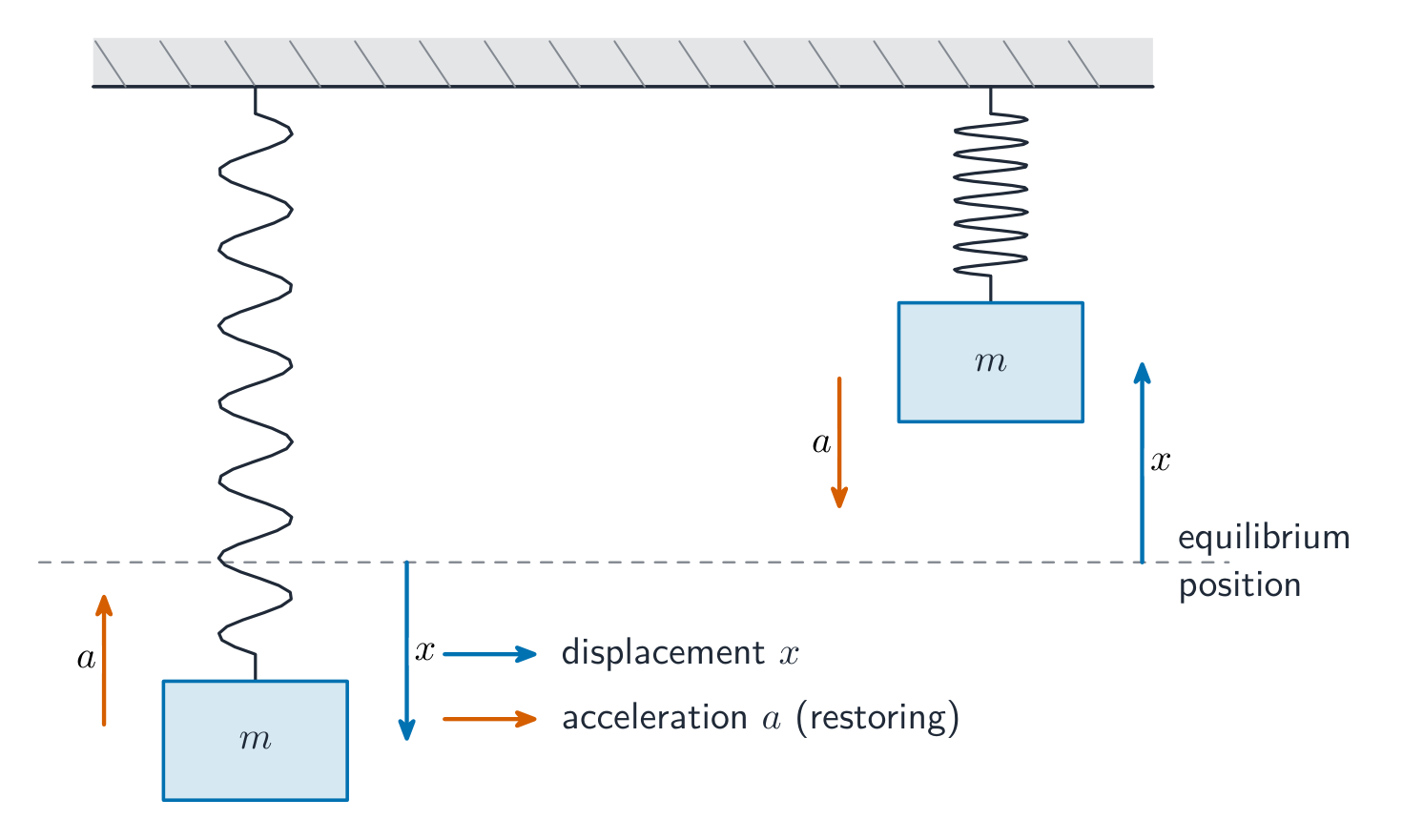
directed back towards that point — opposite in sign to the displacement.
The defining equation is
$$a = -\omega^{2} x,$$
where $x$ is the displacement 位移 from equilibrium and $\omega$ is a positive constant, the angular frequency 角频率. The minus sign means "directed back towards equilibrium".
The two-mark definition.Simple harmonic motion is motion in which the acceleration is proportional to the displacement from a fixed point and is always directed towards that point (in the opposite direction to the displacement). Both halves are needed. "The significance of the minus sign": the acceleration is in the opposite direction to the displacement — always towards the equilibrium position. "State what is meant by the frequency of the oscillations": the number of complete oscillations per unit time.
Many systems do this near a stable equilibrium: a mass on a spring 弹簧, a pendulum 单摆 (small swing), a floating block pushed down, the charge on a capacitor 电容器 in an LC circuit, atoms in a solid.
Key terms
displacement$x$ — distance from equilibrium at a moment (a vector along the line of motion).
amplitude 振幅$x_{0}$ — the largest displacement from equilibrium. Always positive.
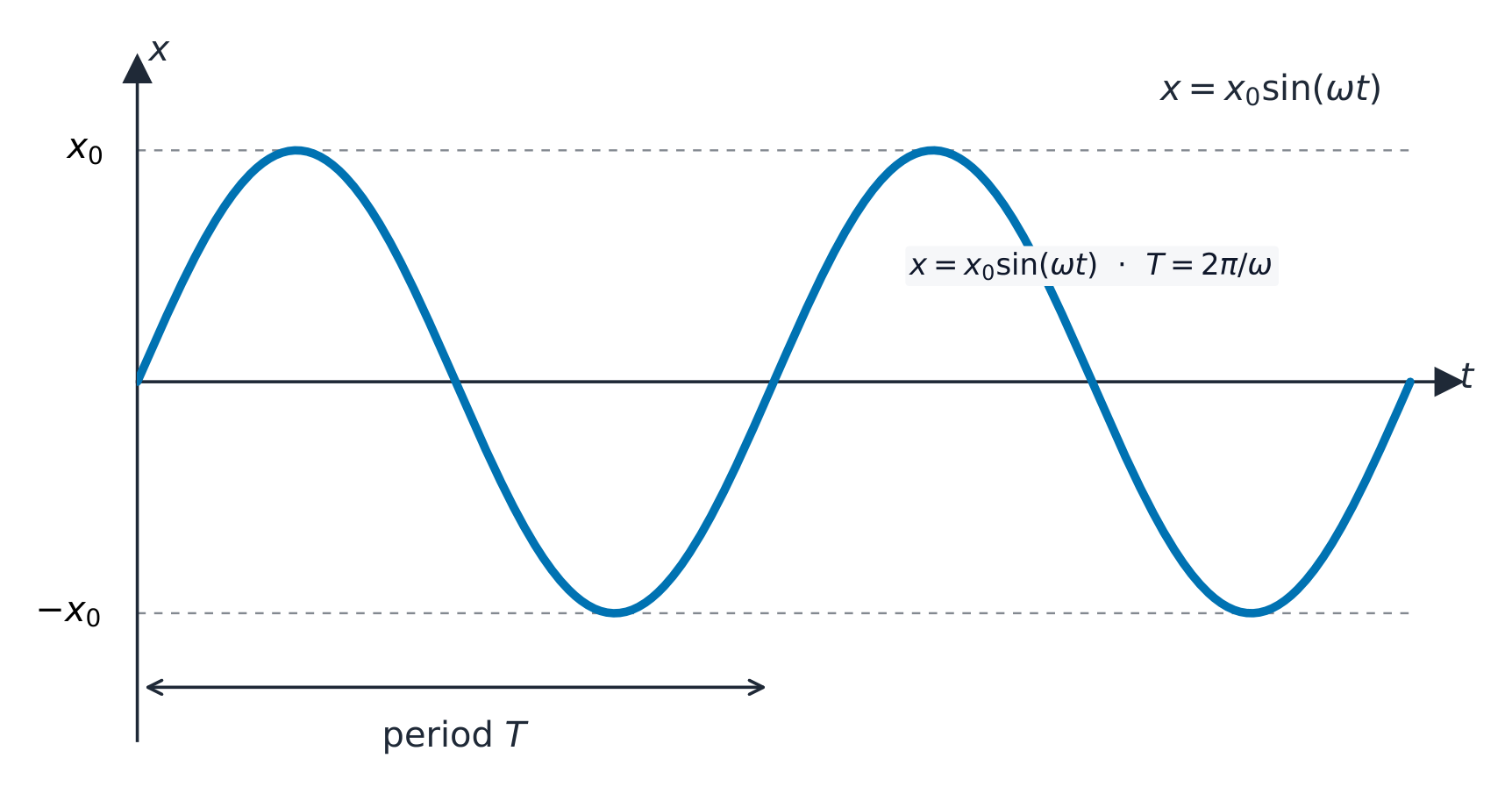
period 周期$T$ — the time for one full oscillation.
frequency 频率$f$ — the number of oscillations per second; $f = 1/T$. Unit: Hz.
phase difference 相位差 — the fraction of a cycle (in radians) by which one oscillation leads or lags another. A quarter-cycle apart is a phase difference of $\pi/2$.
So $T = 2\pi/\omega$ and $f = \omega/(2\pi)$ — given any one of $\omega$, $f$, $T$ you can find the others.
Worked example. A mass on a spring oscillates with SHM of amplitude $0.050\ \text{m}$ and frequency $2.5\ \text{Hz}$. Find its maximum acceleration.
The angular frequency is $\omega = 2\pi f = 2\pi \times 2.5 = 15.7\ \text{rad s}^{-1}$. The acceleration is largest at the extremes, where $|a| = \omega^{2}x_{0}$:
The exam's favourite four-mark derivation, and the recipe is always the same: (1) displace the object by $x$ from equilibrium; (2) find the resultant restoring force, which comes out as $F = -(\text{constant}) \times x$; (3) apply Newton's second law, $a = F/m = -(\text{constant}/m)\,x$; (4) this has the form $a = -\omega^{2}x$, so the motion is simple harmonic with $\omega^{2} = \text{constant}/m$, and $T = 2\pi/\omega$. Say in words why the force points back towards equilibrium and why it is proportional to $x$ — those are the marks, not the algebra.
Worked example. A mass $m$ hangs from a spring of spring constant $k$. Show that, when displaced and released, it moves with simple harmonic motion, and find the period.
At equilibrium the spring tension balances the weight. Displace the mass a distance $x$ downwards: the tension increases by $kx$ (Hooke's law), so there is a resultant force $kx$upwards, towards equilibrium. Newton's second law: $a = -\dfrac{k}{m}x$. This is $a = -\omega^{2}x$ with $\omega^{2} = k/m$, so the motion is simple harmonic and $T = 2\pi/\omega = 2\pi\sqrt{m/k}$. (A trolley held between two identical springs has both pulling it back, $F = -2kx$, so $\omega^{2} = 2k/m$.)
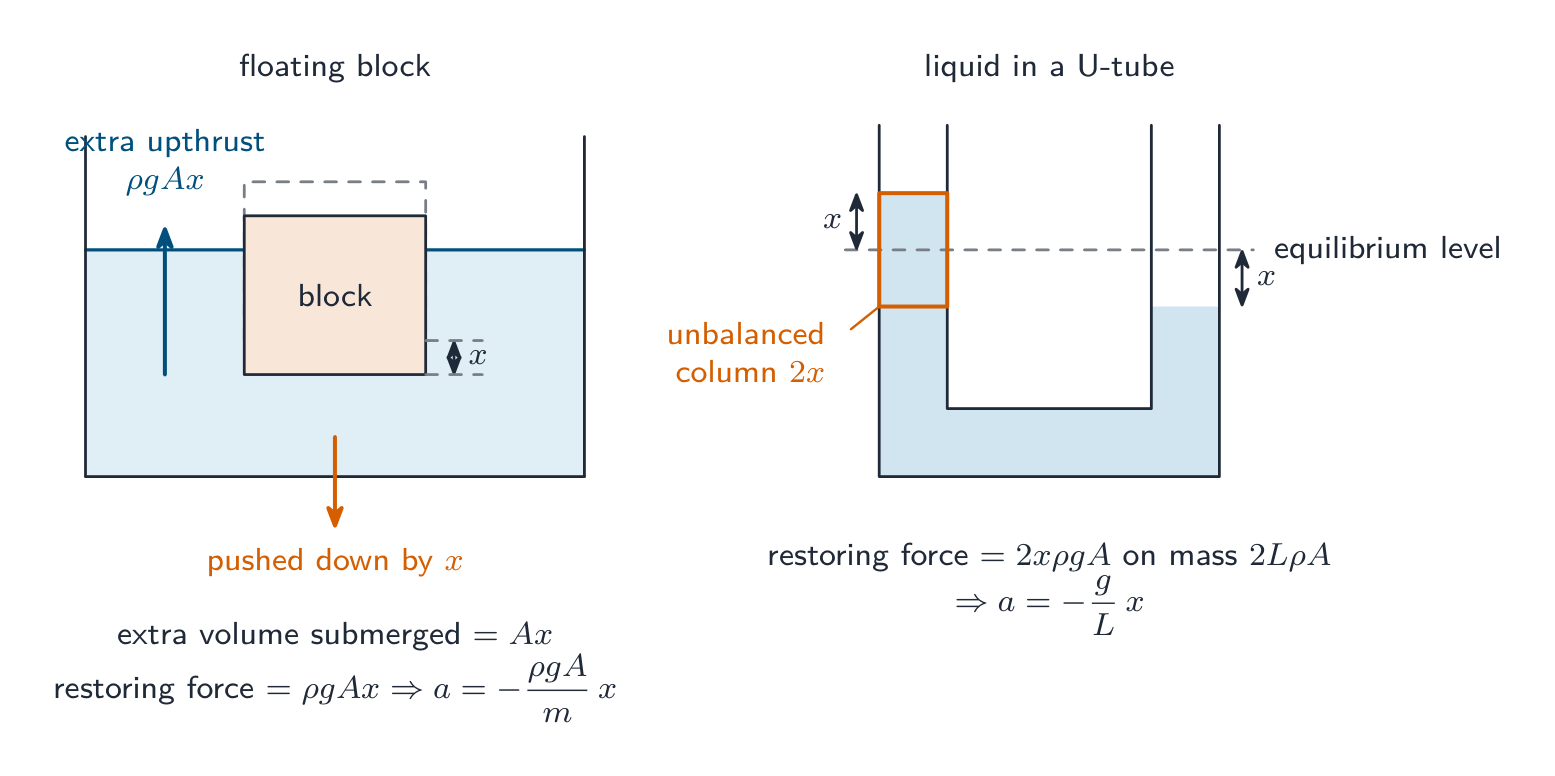
Worked example. A cuboidal block of cross-sectional area $A$ and mass $m$ floats in a liquid of density $\rho$ with its base a depth $h$ below the surface. It is pushed down a small distance $x$ and released. Show that it oscillates with simple harmonic motion and find the period in terms of $h$ and $g$.
When the block is pushed down by $x$ an extra volume $Ax$ is submerged, so the upthrust 浮力 increases by the weight of that extra liquid, $\rho g A x$; this extra force acts upwards, towards the equilibrium position. Hence $a = -\dfrac{\rho g A}{m}x$: proportional to $x$ and opposite in direction, so the motion is simple harmonic with $\omega^{2} = \rho g A/m$. At equilibrium the upthrust on the submerged volume $Ah$ equals the weight, $\rho g A h = mg$, so $m = \rho A h$ and $\omega^{2} = g/h$: $T = 2\pi\sqrt{h/g}$ — the same form as a pendulum of length $h$.
Worked example. A U-tube of cross-sectional area $A$ contains liquid of density $\rho$; the column in each arm has length $L$. The liquid is displaced so that one surface is $x$ above its equilibrium level and the other $x$ below. Show that the liquid oscillates with simple harmonic motion.
The two surfaces now differ in height by $2x$, so a column of liquid of height $2x$ is unbalanced: the restoring force on the liquid is the weight of that column, $2x\rho g A$, directed so as to level the surfaces. The mass being moved is the whole liquid, $2L\rho A$. So $a = -\dfrac{2x\rho g A}{2L\rho A} = -\dfrac{g}{L}x$: simple harmonic, with $\omega^{2} = g/L$ and $T = 2\pi\sqrt{L/g}$. Note that $\rho$ and $A$ cancel — the period depends on neither the liquid nor the tube.
العربية
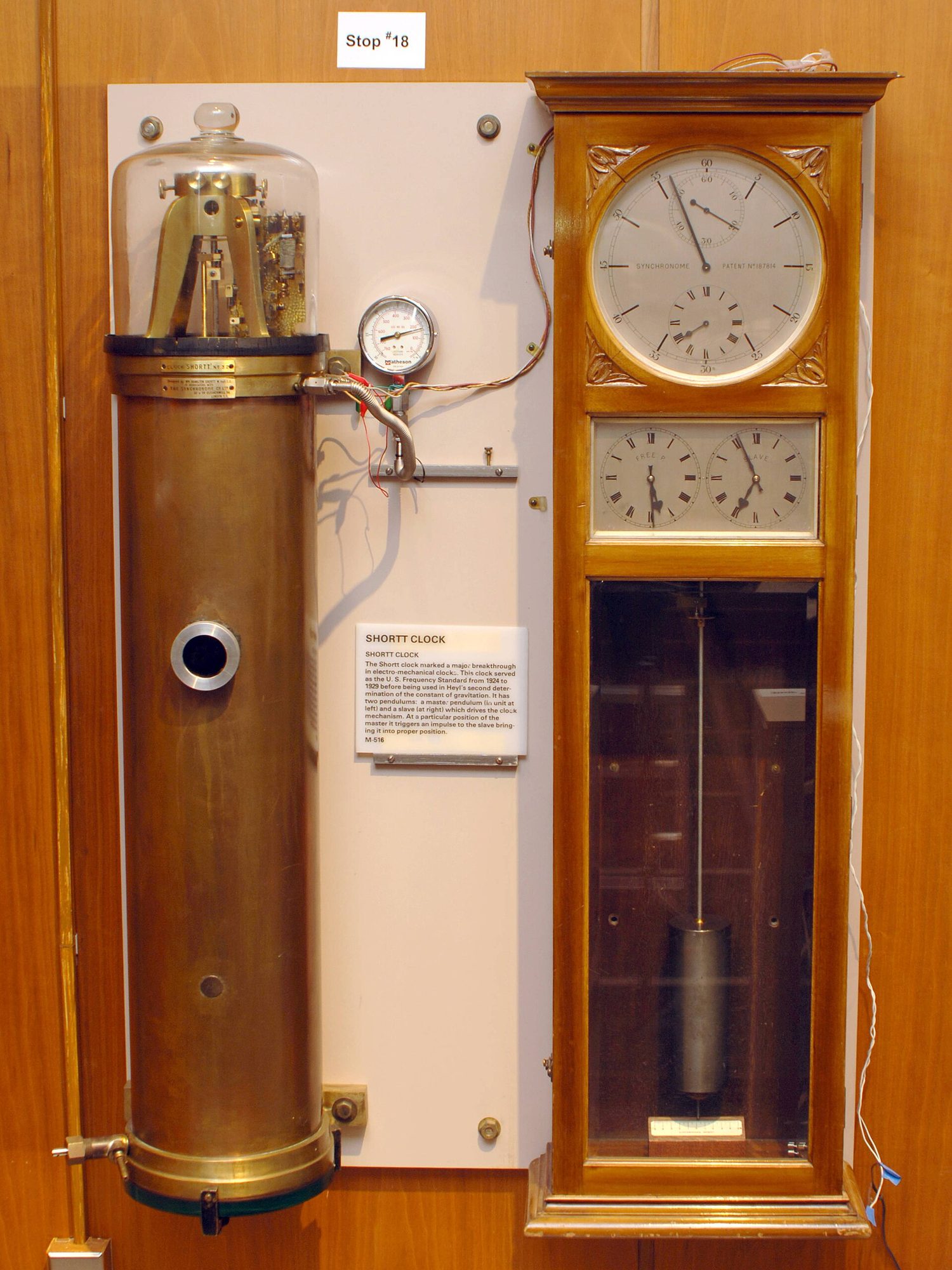
HSM: نابض، دائرة ومخطط في الطورتحتفظ الساعة البندولية بالوقت باستخدام الحركة التوافقية البسيطة.
يتحرك جسيم بـ الحركة التوافقية البسيطة (HSM) عندما تكون تسارعه:
متناسباً مع إزاحته من نقطة اتزان ثابتة، و
موجهاً نحو تلك النقطة — معاكساً للإشارة بالنسبة للإزاحة.
المعادلة المحددة هي
$$a = -\omega^{2} x,$$
حيث $x$ هي الإزاحة عن الاتزان و$\omega$ ثابت موجب، هو التردد الزاوي. الإشارة السالبة تعني "موجهة نحو الاتزان".
تعريف درجتين.الحركة التوافقية البسيطة هي حركة يتناسب فيها التسارع مع الإزاحة عن نقطة ثابتة ويكون موجهاً دائماً نحو تلك النقطة (في الاتجاه المعاكس للإزاحة). كلا الجزئين ضروريان. "معنى الإشارة السالبة": التسارع في الاتجاه المعاكس للإزاحة — دائماً نحو وضع الاتزان. "اذكر ما يعنيه تردد الاهتزازات": عدد الاهتزازات الكاملة في وحدة الزمن.
العديد من الأنظمة تقوم بذلك بالقرب من اتزان مستقر: كتلة على نابض، بندول (اهتزاز صغير)، كتلة عائمة تُدفع للأسفل، الشحنة على مكثف في دائرة LC، ذرات في صلب.
يتجه التسارع دائماً نحو التوازن، عكس اتجاه الإزاحة
مصطلحات رئيسية
الإزاحة$x$ — المسافة عن نقطة التوازن عند لحظة معينة (متجه على طول خط الحركة).
السعة$x_{0}$ — أكبر إزاحة من نقطة التوازن. دائماً موجبة.
الزمن الدوري$T$ — الزمن اللازم لإكمال اهتزاز كامل واحد.
التردد$f$ — عدد الاهتزازات في الثانية؛ $f = 1/T$. الوحدة: هرتز (Hz).
المشتق المفضل للامتحان بأربع درجات، والقاعدة دائماً واحدة: (1) أزح الجسم بمقدار $x$ عن التوازن؛ (2) أوجد قوة الاستعادة المحصلة، والتي تكون $F = -(\text{constant}) \times x$؛ (3) طبق قانون نيوتن الثاني، $a = F/m = -(\text{constant}/m)\,x$؛ (4) هذا يأخذ الشكل $a = -\omega^{2}x$، إذن الحركة توافقية بسيطة بـ $\omega^{2} = \text{constant}/m$، و$T = 2\pi/\omega$. اشرح بكلمات لماذا تتجه القوة نحو التوازن ولماذا تتناسب طردياً مع $x$ — هذه هي الدرجات، وليس الجبر.
تنسيقات "أثبت أنها حركة توافقية بسيطة": أوجد القوة الإضافية عندما يُزاح النظام بمقدار $x$، وأثبت أنها تتناسب طردياً مع $x$ وتتجه نحو الخلف
مثال محلول. كتلة $m$ معلّقة بنابرة ثابتها $k$. أثبت أنه عند الإزاحة والإفلات، تتحرك بحركة توافقية بسيطة، وأوجد الزمن الدوري.
عند الاتزان، يوازن شد النابض الوزن. زوّج الكتلة مسافة $x$ لأسفل: يزداد الشد بمقدار $kx$ (قانون هوك)، فيكون هناك قوة محصلة $kx$لأعلى، نحو نقطة الاتزان. قانون نيوتن الثاني: $a = -\dfrac{k}{m}x$. هذا هو $a = -\omega^{2}x$ مع $\omega^{2} = k/m$، لذا الحركة توافقية بسيطة و$T = 2\pi/\omega = 2\pi\sqrt{m/k}$. (عربة ممسوكة بين نابضين متطابقين يسحبها كلاهما للخلف، $F = -2kx$، لذا $\omega^{2} = 2k/m$.)
مثال محلول. مكعب مستطيل مساحة مقطعه $A$ وكتلته $m$ يطفو في سائل كثافته $\rho$ بحيث يكون قاعدته على عمق $h$ تحت السطح. يُدفع لمسافة صغيرة $x$ ويُفلَت. أثبت أنه يهتز بحركة توافقية بسيطة وأوجد الزمن الدوري بدلالة $h$ و$g$.
عند دفع المكعب بمقدار $x$، يُغمور حجم إضافي $Ax$، فتزداد قوة الدفع بوزن ذلك السائل الإضافي، $\rho g A x$؛ تعمل هذه القوة الإضافية لأعلى، نحو موضع التوازن. ومن ثم $a = -\dfrac{\rho g A}{m}x$: متناسبة مع $x$ وعكسية الاتجاه، إذن الحركة توافقية بسيطة بـ $\omega^{2} = \rho g A/m$. عند التوازن، قوة الدفع على الحجم المغمور $Ah$ تساوي الوزن، $\rho g A h = mg$، لذا $m = \rho A h$ و$\omega^{2} = g/h$: $T = 2\pi\sqrt{h/g}$ — نفس شكل البندول بطول $h$.
مثال محلول. أنبوب U مساحة مقطعه $A$ يحتوي سائلاً كثافته $\rho$؛ طول العمود في كل ذراع هو $L$. يُزاح السائل بحيث يرتفع سطح واحد بمقدار $x$ عن مستوى توازنه وينخفض الآخر بمقدار $x$. أثبت أن السائل يهتز بحركة توافقية بسيطة.
الآن differs السطحان في الارتفاع بمقدار $2x$، لذا عمود سائل بطول $2x$ غير متوازن: قوة الاستعادة المؤثرة على السائل هي وزن ذلك العمود، $2x\rho g A$، موجهة لتسوية السطوح. الكتلة المُحرَّكة هي السائل كاملاً، $2L\rho A$. إذن $a = -\dfrac{2x\rho g A}{2L\rho A} = -\dfrac{g}{L}x$: توافقية بسيطة، بـ $\omega^{2} = g/L$ و$T = 2\pi\sqrt{L/g}$. لاحظ أن $\rho$ و$A$ يلغي بعضهما — الزمن الدوري لا يعتمد ни على السائل nor الأنبوب.
Explore · استكشف
Swing a pendulum · أرج نواسًا
Set it swinging, then change the start angle — the time for one swing stays the same (that is what makes it a good clock). Now make the string longer, or move to the Moon, and watch the period change. · اجعله يتأرجح، ثم غيّر زاوية البداية — الوقت لارجاع واحد يبقى كما هو (هذا ما يجعله ساعة جيدة). الآن اجعل الحبل أطول، أو انتقل إلى القمر، وشاهد تغير الدور.
which is the SHM defining equation again. (If the particle instead starts at the extreme position $x = x_{0}$ at $t = 0$, use $x = x_{0} \cos(\omega t)$. Choose the one that fits the start conditions.)
Velocity in terms of displacement
A useful relation that does not use time:
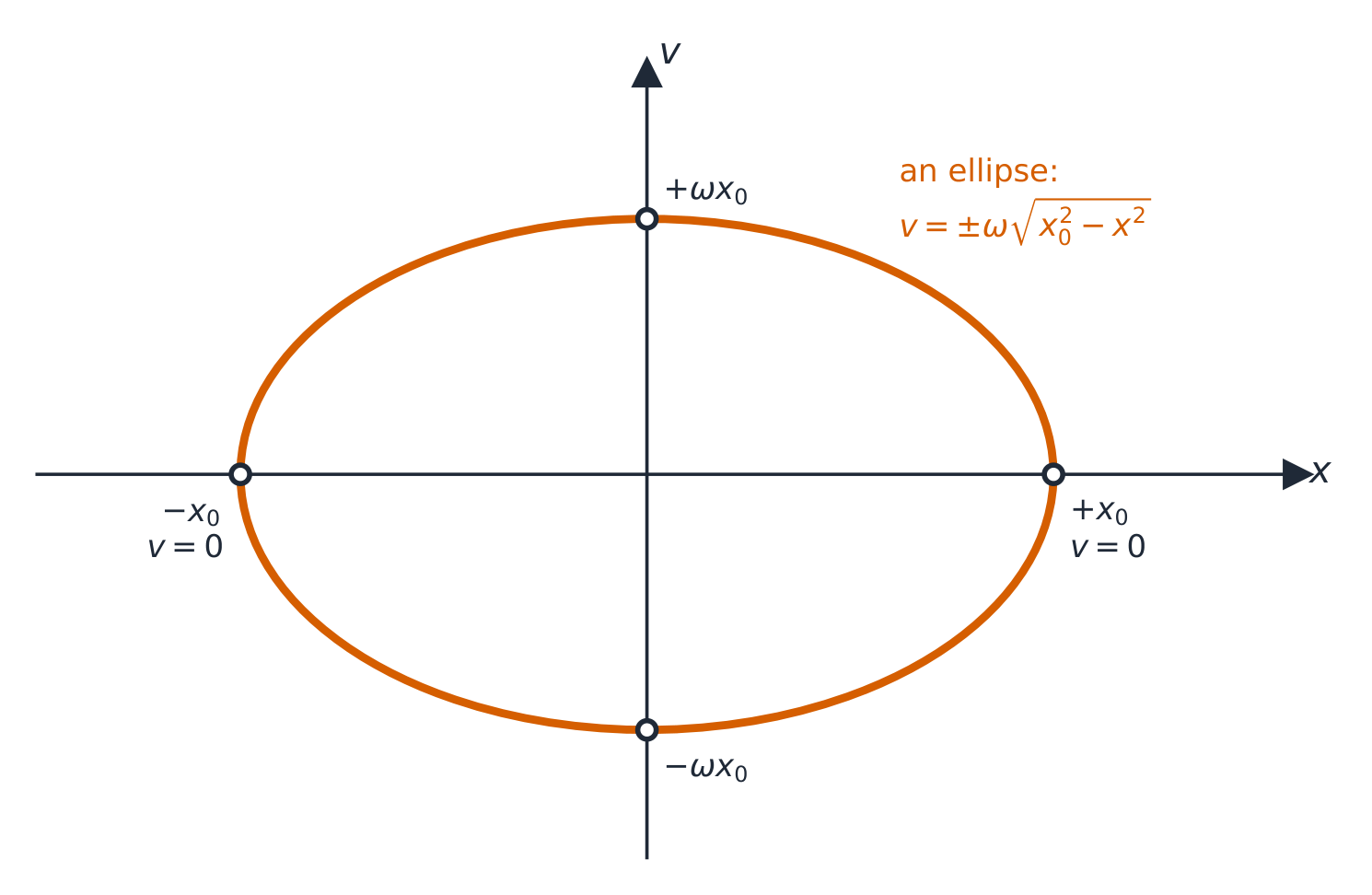
$$v = \pm \omega \sqrt{x_{0}^{2} - x^{2}}.$$
at equilibrium ($x = 0$): $v = \pm \omega x_{0}$ (maximum speed). Both signs, because the particle passes through equilibrium twice each cycle.
at the extremes ($x = \pm x_{0}$): $v = 0$ (at rest for an instant).
Worked example. The same oscillation has amplitude $x_{0} = 0.050\ \text{m}$ and angular frequency $\omega = 15.7\ \text{rad s}^{-1}$. Find the speed when the displacement is $x = 0.030\ \text{m}$.
Reading the $v$–$x$ graph. Its width gives the amplitude ($x = \pm x_{0}$ where $v = 0$) and its height the maximum speed ($v = \pm\omega x_{0}$ at $x = 0$), so $\omega = v_{0}/x_{0}$ and the period follows. Asked to sketch $a$ against $x$ on the same axes, draw the straight line through the origin with negative gradient $-\omega^{2}$, reaching $\mp\omega^{2}x_{0}$ at $x = \pm x_{0}$.
Worked example. The velocity of an oscillating block varies with time as $v = 0.56\sin(5.1t)$, with $v$ in $\text{m s}^{-1}$ and $t$ in seconds. Find the amplitude, the period and the maximum acceleration.
Compare with $v = v_{0}\sin\omega t$: $v_{0} = 0.56\ \text{m s}^{-1}$ and $\omega = 5.1\ \text{rad s}^{-1}$. Since $v_{0} = \omega x_{0}$, the amplitude is $x_{0} = 0.56/5.1 = 0.11\ \text{m}$; $T = 2\pi/\omega = 1.2\ \text{s}$; $a_{\text{max}} = \omega^{2}x_{0} = \omega v_{0} = 5.1 \times 0.56 = 2.9\ \text{m s}^{-2}$. (Because this $v$ is a sine, the block was at an extreme at $t = 0$: its displacement is a cosine.)
SHM as the shadow of circular motion. A ball moving round a circle of radius $R$ at angular speed $\omega$, lit from the side, casts a shadow that moves back and forth with simple harmonic motion of amplitude $R$ and the same $\omega$: the shadow's displacement is $x = R\cos\omega t$ (if it starts at an extreme), its maximum speed is $R\omega$ and its maximum acceleration $R\omega^{2}$. For a circle of diameter $0.46\ \text{m}$ and $\omega = 1.9\ \text{rad s}^{-1}$ the shadow has amplitude $0.23\ \text{m}$, $v_{0} = 0.44\ \text{m s}^{-1}$ and $a_{\text{max}} = 0.83\ \text{m s}^{-2}$ — greatest in size at the two ends of its path and always directed back towards the centre.
Graphs against time
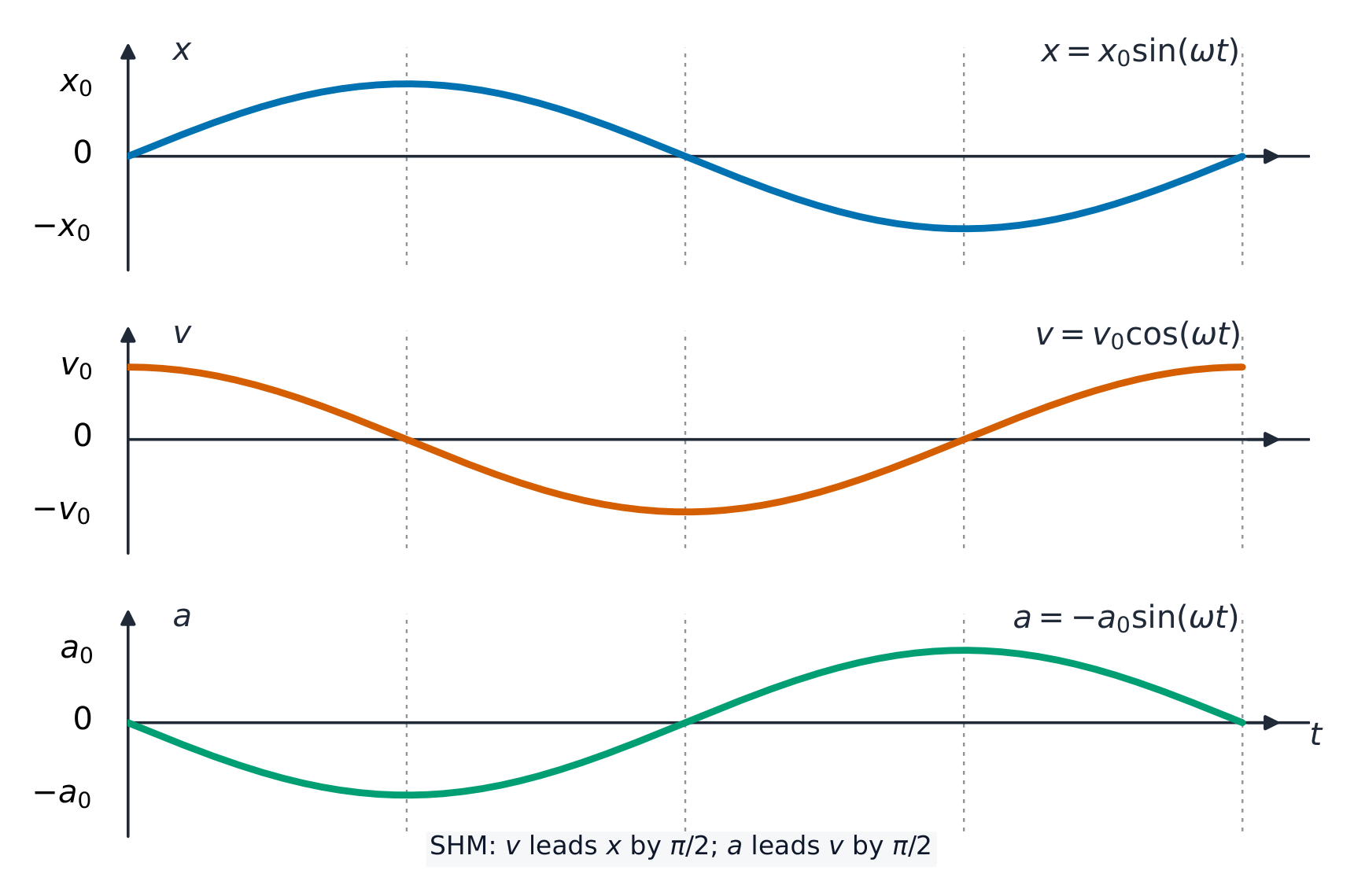
For $x = x_{0}\sin\omega t$:
$x$ vs $t$ — a sine curve, amplitude $x_{0}$, period $T = 2\pi/\omega$.
$v$ vs $t$ — a cosine curve, leading $x$ by $\pi/2$, amplitude $\omega x_{0}$.
$a$ vs $t$ — a negative sine curve, out of phase with $x$ by $\pi$ (180°), amplitude $\omega^{2} x_{0}$.
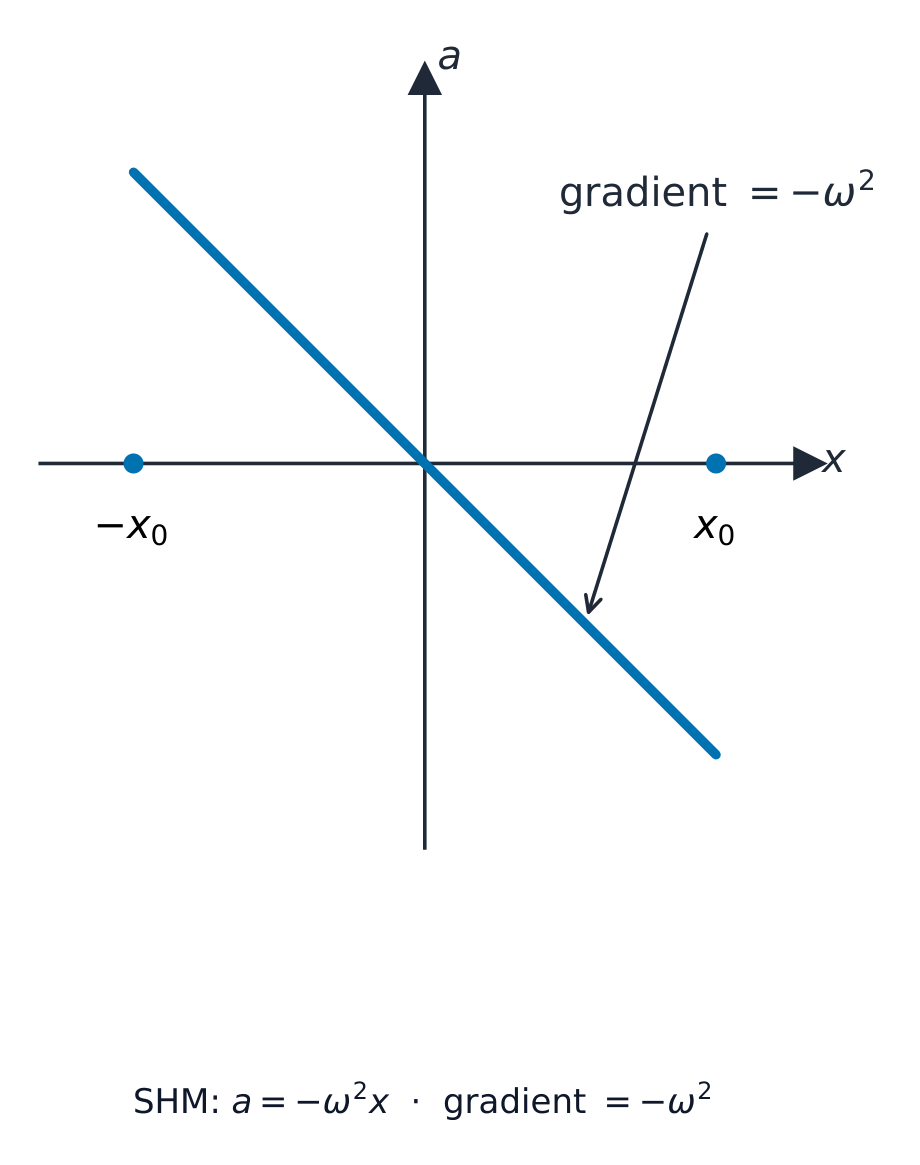
Graph of $a$ against $x$
A straight line through the origin with negative gradient$-\omega^{2}$. So you can read $\omega$ from the graph: gradient $= -\omega^{2}$, so $\omega = \sqrt{|\text{gradient}|}$, then $T = 2\pi / \omega$. This is a common exam pattern.
Worked example. A graph of the height $h$ of an object of mass $36\ \text{kg}$ undergoing vertical simple harmonic motion shows $h$ varying between $2\ \text{m}$ and $10\ \text{m}$, with one complete oscillation every $4.0\ \text{s}$. Find the amplitude, the angular frequency, the maximum speed, the maximum acceleration and the maximum kinetic energy.
Amplitude $x_{0} = (10 - 2)/2 = 4.0\ \text{m}$ (half the peak-to-peak range; the equilibrium height is $6\ \text{m}$). $\omega = 2\pi/T = 2\pi/4.0 = 1.57\ \text{rad s}^{-1}$. $v_{\text{max}} = \omega x_{0} = 6.3\ \text{m s}^{-1}$; $a_{\text{max}} = \omega^{2}x_{0} = 9.9\ \text{m s}^{-2}$; $E_{\text{K,max}} = \tfrac{1}{2}mv_{\text{max}}^{2} = \tfrac{1}{2} \times 36 \times 6.28^{2} = 7.1 \times 10^{2}\ \text{J}$. Reading the amplitude as the full height range instead of half of it is the commonest slip here.
Worked example. A small object rests on a horizontal platform that oscillates vertically with simple harmonic motion of amplitude $6.0\ \text{mm}$. Find the highest frequency at which the object stays in contact with the platform throughout, and state where in the motion contact is first lost.
The object leaves the platform when the platform's downward acceleration exceeds $g$ — at the top of the oscillation, where the acceleration is greatest and directed downwards: the platform then falls away faster than the object can. The limit is $\omega^{2}x_{0} = g$: $\omega = \sqrt{9.81/0.0060} = 40\ \text{rad s}^{-1}$, so $f = \omega/2\pi = 6.4\ \text{Hz}$. Below this the normal contact force at the top is small but positive; above it, zero.
العربية
إذا بدأت الجسيم عند $x = 0$ متحركاً في الاتجاه الموجب عند $t = 0$، فإن
وهو معادلة تعريف الحركة التوافقية البسيطة مجدداً. (إذا بدأ الجسيم بدلاً من ذلك عند الموضع الأقصى $x = x_{0}$ عند $t = 0$، استخدم $x = x_{0} \cos(\omega t)$. اختر ما يناسب شروط البداية.)
السرعة بدلالة الإزاحة
علاقة مفيدة لا تستخدم الزمن:
$$v = \pm \omega \sqrt{x_{0}^{2} - x^{2}}.$$
عند التوازن ($x = 0$): $v = \pm \omega x_{0}$ (السرعة القصوى). الإشارة المزدوجة، لأن الجسيم يمر عبر التوازن مرتين في كل دورة.
مثال محلول. نفس الاهتزاز له سعة $x_{0} = 0.050\ \text{m}$ وتردد زاوي $\omega = 15.7\ \text{rad s}^{-1}$. أوجد السرعة عندما تكون الإزاحة $x = 0.030\ \text{m}$.
السرعة مقابل الإزاحة هي بيضاوية: $v = 0$ عند الأطراف و$v = \pm\omega x_{0}$ عبر نقطة الاتزان — اقرأ $x_{0}$ و$v_{0}$ من نقاط تقاطعه مع المحاور، ثم $\omega = v_{0}/x_{0}$
قراءة الرسم البياني $v$–$x$. يعطي عرضه السعة ($x = \pm x_{0}$ حيث $v = 0$) ويعلوه السرعة القصوى ($v = \pm\omega x_{0}$ عند $x = 0$)، لذا $\omega = v_{0}/x_{0}$ وتتبع منها الدور. طُلب رسم $a$ مقابل $x$ على نفس المحاور، ارسم الخط المستقيم المار بنقطة الأصل بميل سالب $-\omega^{2}$، ليصل إلى $\mp\omega^{2}x_{0}$ عند $x = \pm x_{0}$.
مثال محلول. تتغير سرعة كتلة تهتز بدلالة الزمن كالتالي $v = 0.56\sin(5.1t)$، مع $v$ بوحدة $\text{m s}^{-1}$ و$t$ بالثواني. أوجد السعة، والدورة، والتسارع الأقصى.
قارن مع $v = v_{0}\sin\omega t$: $v_{0} = 0.56\ \text{m s}^{-1}$ و$\omega = 5.1\ \text{rad s}^{-1}$. بما أن $v_{0} = \omega x_{0}$، فإن السعة هي $x_{0} = 0.56/5.1 = 0.11\ \text{m}$؛ $T = 2\pi/\omega = 1.2\ \text{s}$؛ $a_{\text{max}} = \omega^{2}x_{0} = \omega v_{0} = 5.1 \times 0.56 = 2.9\ \text{m s}^{-2}$. (لأن هذا $v$ هو دالة جايب، كانت الكتلة عند طرفي الاهتزاز عند $t = 0$: إزاحتها هي دالة جيب تمام).
الحركة التوافقية البسيطة كظل الحركة الدائرية. كرة تتحرك حول دائرة نصف قطرها $R$ بسرعة زاوية $\omega$، تُضاء من الجانب، تُسقط ظلًا يتحرك ذهابًا وإيابًا بحركة توافقية بسيطة بسعة $R$ ونفس $\omega$: إزاحة الظل هي $x = R\cos\omega t$ (إذا بدأت من طرف)، وسرعتها القصوى $R\omega$ وتسارعها الأقصى $R\omega^{2}$. لدائرة قطرها $0.46\ \text{m}$ و$\omega = 1.9\ \text{rad s}^{-1}$ يكون للظل سعة $0.23\ \text{m}$، و$v_{0} = 0.44\ \text{m s}^{-1}$، و$a_{\text{max}} = 0.83\ \text{m s}^{-2}$ — أكبر ما يمكن في طرفي مساره دائمًا وموجه نحو المركز.
الرسوم البيانية بدلالة الزمن
لـ $x = x_{0}\sin\omega t$:
$x$ مقابل $t$ — منحنى جايب، سعة $x_{0}$، دورة $T = 2\pi/\omega$.
$a$ مقابل $t$ — منحنى جايب سالب، خارج الطور مع $x$ بمقدار $\pi$ (180°)، السعة $\omega^{2} x_{0}$.
تتغير الإزاحة جيبيًا مع الزمن في الحركة التوافقية البسيطةالسرعة تتقدم الإزاحة بربع دورة؛ التسارع خارج طور تمامًا عن الإزاحة
رسم بياني لـ $a$ بدلالة $x$
خط مستقيم يمر بنقطة الأصل بـميل سالب$-\omega^{2}$. لذا يمكنك قراءة $\omega$ من الرسم: الميل $= -\omega^{2}$، وبالتالي $\omega = \sqrt{|\text{gradient}|}$، ثم $T = 2\pi / \omega$. هذا نمط امتحان شائع.
رسم التسارع-الإزاحة هو خط مستقيم يمر بنقطة الأصل بميل $-\omega^{2}$
مثال محلول. يوضح رسم بياني لارتفاع $h$ لجسم كتلته $36\ \text{kg}$ يخضع لحركة توافقية بسيطة عمودية تغيرات $h$ بين $2\ \text{m}$ و$10\ \text{m}$، مع اهتزاز كامل واحد كل $4.0\ \text{s}$. أوجد السعة، والتردد الزاوي، والسرعة القصوى، والتسارع الأقصى، والطاقة الحركية القصوى.
السعة $x_{0} = (10 - 2)/2 = 4.0\ \text{m}$ (نصف نطاق القمة إلى القمة؛ الارتفاع المتزن هو $6\ \text{m}$). $\omega = 2\pi/T = 2\pi/4.0 = 1.57\ \text{rad s}^{-1}$. $v_{\text{max}} = \omega x_{0} = 6.3\ \text{m s}^{-1}$؛ $a_{\text{max}} = \omega^{2}x_{0} = 9.9\ \text{m s}^{-2}$؛ $E_{\text{K,max}} = \tfrac{1}{2}mv_{\text{max}}^{2} = \tfrac{1}{2} \times 36 \times 6.28^{2} = 7.1 \times 10^{2}\ \text{J}$. قراءة السعة على أنها النطاق الكامل للارتفاع بدلاً من نصفها هو الخطأ الأكثر شيوعًا هنا.
مثال محلول. جسم صغير يستقر على منصة أفقية تهتز عموديًا بحركة توافقية بسيطة بسعة $6.0\ \text{mm}$. أوجد أعلى تردد يبقى فيه الجسم على اتصال بالمنصة طوال الوقت، وأشر إلى أين في الحركة يفقد الاتصال أول مرة.
يغادر الجسم المنصة عندما يتجاوز تسارع المنصة للأسفل $g$ — في القمة للهتزاز، حيث يكون التسارع أعظمًا وموجهًا للأسفل: تسقط المنصة بعد ذلك أسرع مما يستطيع الجسم فعله. الحد الأقصى هو $\omega^{2}x_{0} = g$: $\omega = \sqrt{9.81/0.0060} = 40\ \text{rad s}^{-1}$، وبالتالي $f = \omega/2\pi = 6.4\ \text{Hz}$. أسفله تكون قوة التلامس العمودية في القمة صغيرة ولكنها موجبة؛ فوقه، صفر.
Energy in simple harmonic motion · الطاقة في الحركة التوافقية البسيطة
Syllabus · المنهج
English
describe the interchange between kinetic and potential energy during simple harmonic motion
recall and use $E = \frac{1}{2}m\omega^2x_0^2$ for the total energy of a system undergoing simple harmonic motion
العربية
وصف التبديل بين الطاقة الحركية والطاقة الكامنة أثناء الحركة التوافقية البسيطة
التذكر和使用 $E = \frac{1}{2}m\omega^2x_0^2$ لـالطاقة الكلية لنظام يخضع لحركة توافقية بسيطة
Source: Cambridge International syllabus · المصدر: منهج كامبريدج الدولي
English
A simple harmonic oscillator keeps swapping energy between two forms:
kinetic energy 动能$E_{\text{K}} = \tfrac{1}{2} m v^{2}$.
potential energy$E_{\text{P}}$ (elastic for a spring, gravitational for a pendulum).
With no damping 阻尼, the total energy is constant (this is conservation of energy 能量守恒).
Maximum and minimum
at equilibrium ($x = 0$): $v$ is largest, so $E_{\text{K}}$ is largest and $E_{\text{P}}$ is smallest (zero, by choice).
at the extremes ($x = \pm x_{0}$): $v = 0$, so $E_{\text{K}} = 0$ and $E_{\text{P}}$ is largest.
Total energy
Using $v_{\text{max}} = \omega x_{0}$:
$$E_{\text{total}} = \tfrac{1}{2} m v_{\text{max}}^{2} = \tfrac{1}{2} m \omega^{2} x_{0}^{2}.$$
Two key facts: the total energy is proportional to the square of the amplitude (doubling $x_{0}$ gives four times the energy), and to $\omega^{2}$.
Energy against displacement
Using $v^{2} = \omega^{2}(x_{0}^{2} - x^{2})$:
$$E_{\text{K}} = \tfrac{1}{2} m \omega^{2} (x_{0}^{2} - x^{2}), \qquad E_{\text{P}} = \tfrac{1}{2} m \omega^{2} x^{2}.$$
So $E_{\text{K}}$ is a downward parabola (peak at $x = 0$, zero at $x = \pm x_{0}$) and $E_{\text{P}}$ is an upward parabola (zero at $x = 0$, largest at $x = \pm x_{0}$). Their sum is constant.
Worked example. A $0.20\ \text{kg}$ mass oscillates with amplitude $x_{0} = 0.050\ \text{m}$ and angular frequency $\omega = 15.7\ \text{rad s}^{-1}$. Find the total energy of the oscillation.
The total energy equals the maximum kinetic energy, as the mass passes through $x = 0$ at $v_{\text{max}} = \omega x_{0}$:
This stays constant, swapping between kinetic and potential form twice each cycle.
Describing the interchange without calculation. At an extreme of the motion the oscillator is momentarily at rest: its kinetic energy is zero and its potential energy is a maximum. As it moves towards equilibrium the restoring force does work on it, so potential energy is converted to kinetic energy; at the equilibrium position the kinetic energy is a maximum and the potential energy a minimum. Beyond it the kinetic energy is converted back to potential energy until the other extreme. The total stays constant, and the exchange happens twice per oscillation, so the energy graphs against time have twice the frequency of the displacement graph.
Worked example. A pendulum bob of mass $0.81\ \text{kg}$ swings with small oscillations of amplitude $32\ \text{mm}$ and period $1.9\ \text{s}$. Find the total energy of the oscillation, and state what happens to it if the amplitude falls to $16\ \text{mm}$.
$\omega = 2\pi/1.9 = 3.31\ \text{rad s}^{-1}$; $E = \tfrac{1}{2}m\omega^{2}x_{0}^{2} = \tfrac{1}{2} \times 0.81 \times 3.31^{2} \times 0.032^{2} = 4.5 \times 10^{-3}\ \text{J}$. Halving the amplitude quarters the energy ($E \propto x_{0}^{2}$), to $1.1 \times 10^{-3}\ \text{J}$; the difference has been dissipated as thermal energy by air resistance.
العربية
المهتز التوافقي البسيط يستمر في تبديل الطاقة بين شكلين:
الطاقة الحركية$E_{\text{K}} = \tfrac{1}{2} m v^{2}$.
الطاقة الكامنة$E_{\text{P}}$ (مرنة لنابض، جاذبية لرجل بندول).
بدون تخميد، تكون الطاقة الكلية ثابتة (هذا هو حفظ الطاقة).
القيم العظمى والصغرى
عند التوازن ($x = 0$): $v$ هو الأكبر، لذا $E_{\text{K}}$ هو الأكبر و$E_{\text{P}}$ هو الأصغر (صفر، باختيارنا).
عند الأطراف ($x = \pm x_{0}$): $v = 0$، لذا $E_{\text{K}} = 0$ و$E_{\text{P}}$ هي الأكبر.
الطاقة الكلية
باستخدام $v_{\text{max}} = \omega x_{0}$:
$$E_{\text{total}} = \tfrac{1}{2} m v_{\text{max}}^{2} = \tfrac{1}{2} m \omega^{2} x_{0}^{2}.$$
حقيتان رئيسيتان: الطاقة الكلية متناسبة مع مربع السعة (مضاعفة $x_{0}$ تعطي أربعة أضعاف الطاقة)، ومتناسبة مع $\omega^{2}$.
الطاقة بدلالة الإزاحة
باستخدام $v^{2} = \omega^{2}(x_{0}^{2} - x^{2})$:
$$E_{\text{K}} = \tfrac{1}{2} m \omega^{2} (x_{0}^{2} - x^{2}), \qquad E_{\text{P}} = \tfrac{1}{2} m \omega^{2} x^{2}.$$
لذا $E_{\text{K}}$ هو قطع مكافئ هابط (ذروته عند $x = 0$، صفر عند $x = \pm x_{0}$) و$E_{\text{P}}$ هو قطع مكافئ صاعد (صفر عند $x = 0$، الأكبر عند $x = \pm x_{0}$). مجموعهما ثابت.
تتبادل الطاقة الحركية والكامنة خلال دورة واحدة بينما تظل الطاقة الكلية ثابتة
مثال محلول. كتلة $0.20\ \text{kg}$ تهتز بسعة $x_{0} = 0.050\ \text{m}$ وتردد زاوي $\omega = 15.7\ \text{rad s}^{-1}$. أوجد الطاقة الكلية للاهتزاز.
تساوي الطاقة الكلية أقصى طاقة حركية، عندما تمر الكتلة عبر $x = 0$ عند $v_{\text{max}} = \omega x_{0}$:
تبقى هذه القيمة ثابتة، وتتبادل بين الشكلين الحركي والكامني مرتين في كل دورة.
وصف التبادل دون حساب. عند نقطة قصوى للحركة، يكون المهتز ساكنًا لحظيًا: طاقته الحركية صفر وطاقته الكامنة في أقصى قيمة لها. أثناء تحركه نحو وضع التوازن، يقوم قوة الإرجاع بعمل عليه، فتتحول الطاقة الكامنة إلى طاقة حركية؛ وعند موضع التوازن تكون الطاقة الحركية في أقصى قيمتها والطاقة الكامنة في أدنى قيمتها. وما وراء ذلك تتحول الطاقة الحركية مرة أخرى إلى طاقة كامنة حتى تصل إلى النقطة القصوى الأخرى. تظل الطاقة الكلية ثابتة، ويحدث التبادل مرتين في كل اهتزاز، لذا فإن تردد منحنيات الطاقة بالنسبة للزمن ضعف تردد منحنى الإزاحة.
مثال محلول. ثقل نواس كتلته $0.81\ \text{kg}$ يتأرجح بهزات صغيرة سعتها $32\ \text{mm}$ ودورها $1.9\ \text{s}$. أوجد الطاقة الكلية للاهتزاز، واذكر ما يحدث لها إذا انخفضت السعة لتصبح $16\ \text{mm}$.
$\omega = 2\pi/1.9 = 3.31\ \text{rad s}^{-1}$؛ $E = \tfrac{1}{2}m\omega^{2}x_{0}^{2} = \tfrac{1}{2} \times 0.81 \times 3.31^{2} \times 0.032^{2} = 4.5 \times 10^{-3}\ \text{J}$. نصف السعة يُربّع الطاقة ($E \propto x_{0}^{2}$)، لتصبح $1.1 \times 10^{-3}\ \text{J}$؛ وقد تم تبديد الفرق على شكل طاقة حرارية بفعل مقاومة الهواء.
Explore · استكشف
Energy in SHM · الطاقة في الحركة التوافقية البسيطة
Watch energy swap between kinetic and potential as the oscillator moves — fastest (max KE) at the centre, still (max PE) at the ends. · شاهد تبادل الطاقة بين الحركية والجهدية أثناء حركة المذبذب — الأسرع (أقصى KE) في المنتصف، الساكن (أقصى PE) عند الأطراف.
understand that a resistive force acting on an oscillating system causes damping
understand and use the terms light, critical and heavy damping and sketch displacement–time graphs illustrating these types of damping
understand that resonance involves a maximum amplitude of oscillations and that this occurs when an oscillating system is forced to oscillate at its natural frequency
العربية
فهم أن القوة المقاومة المؤثرة على نظام مهتز تسبب التخميد
فهم واستخدام مصطلحات التخميد الخفيف، الحرج والثقل ورسم منحنيات بيانية للإزاحة–الزمن توضح هذه الأنواع من التخميد
فهم أن الرنين يتضمن سعة اهتزاز قصوى ويحدث عندما يُجبر نظام مهتز على الاهتزاز بـتردده الطبيعي
Source: Cambridge International syllabus · المصدر: منهج كامبريدج الدولي
English
A resistive force (friction 摩擦力, drag 阻力, air resistance 空气阻力) causes damping — the amplitude shrinks over time as energy is lost as heat. Three named cases:
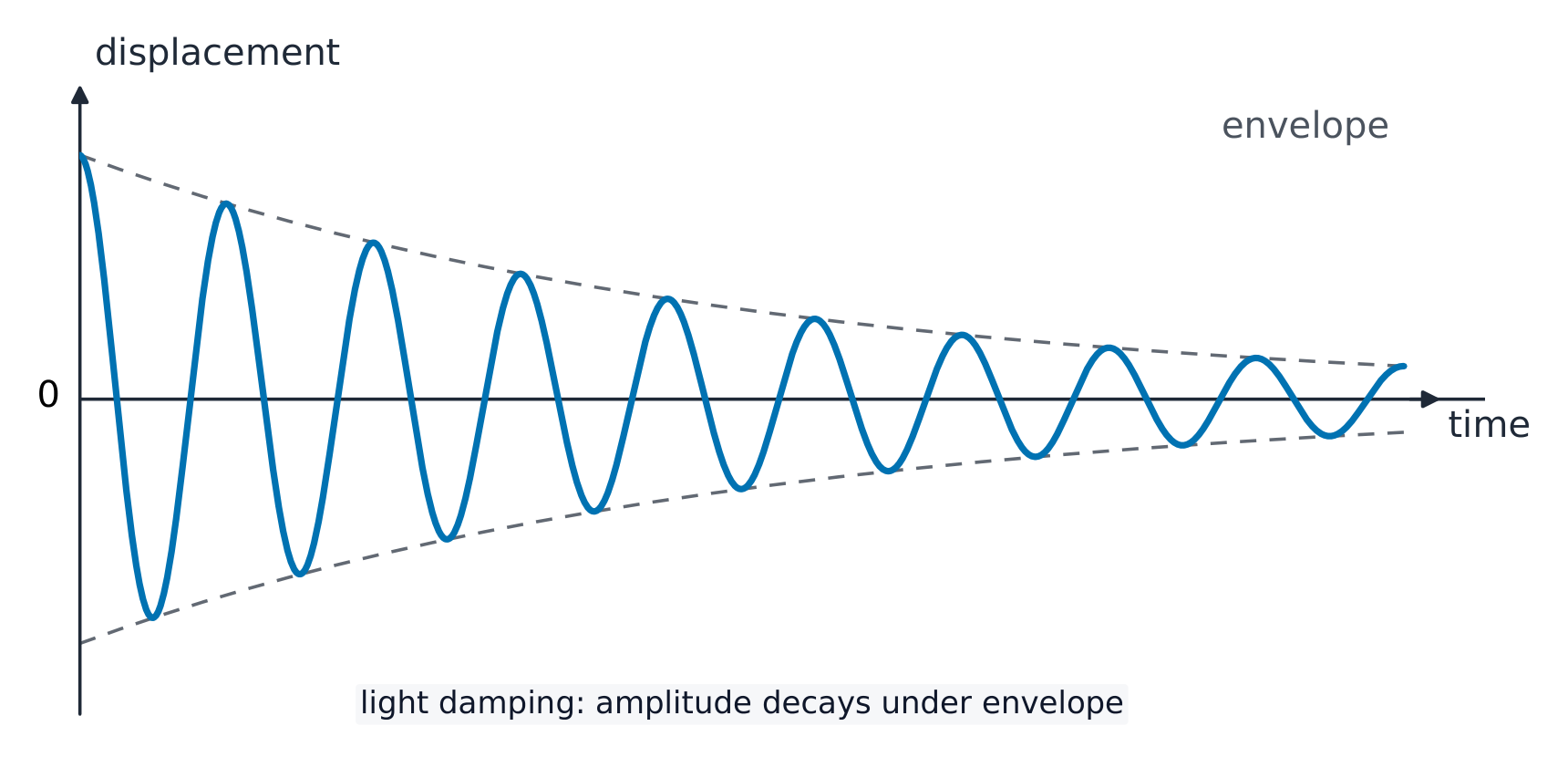
Light damping
The amplitude shrinks slowly over many cycles (a light damping 轻阻尼 case). The system still oscillates near its natural frequency, but each cycle is smaller than the last. A car's suspension is light-to-medium damped, so bumps die away but the ride stays smooth.
Critical damping
The least damping that brings the system back to equilibrium without overshooting and without oscillating — a critical damping 临界阻尼 case. It returns in the shortest time. A galvanometer 检流计 or analogue voltmeter 电压表 is critically damped so the needle settles quickly.
Heavy damping
So much resistance that the system returns slowly, with no oscillation, but more slowly than the critical case — a heavy damping 过阻尼 case. A door with a strong closer is heavily damped.
On a displacement–time graph: light damping is a wave whose size dies away smoothly; critical damping returns quickly with no overshoot; heavy damping returns slowly.
As the exam asks it.Damping is the decrease in the amplitude of an oscillation caused by a resistive force that dissipates the oscillator's energy. In light damping the system oscillates with an amplitude that decreases gradually (exponentially) with time; the period is almost unchanged. In critical damping the system returns to equilibrium in the shortest possible time without oscillating. In heavy damping it returns to equilibrium slowly, without oscillating. Sketching them: the light-damping curve is a sine wave inside a shrinking envelope; the critical and heavy curves both fall to zero without crossing the axis, the heavy one more slowly.
Worked example. A bar magnet hangs from a spring with one pole inside a coil that is connected through a switch to a resistor. The magnet is set oscillating. Explain why the oscillations die away more quickly when the switch is closed.
The moving magnet changes the magnetic flux linking the coil, so an e.m.f. is induced (Faraday's law); with the switch closed a current flows through the resistor and dissipates energy as heat. By Lenz's law the induced current opposes the motion of the magnet — an extra resistive force. That energy comes from the oscillation, so the amplitude decreases faster: the circuit adds damping. With the switch open there is an e.m.f. but no current, so no extra energy loss.
العربية
قوة مقاومة (احتكاك، مقاومة مائع، مقاومة الهواء) تُسبب التخميد — حيث تنكمش السعة مع مرور الوقت بسبب فقدان الطاقة على شكل حرارة. ثلاثة حالات مسماة:
تخميد خفيف
تنكمش السعة ببطء عبر دورات عديدة (حالة تخميد خفيف). لا يزال النظام يهتز بالقرب من تردده الطبيعي، لكن كل دورة أصغر من التي تسبقها. نظام تعليق السيارة يخمد بدرجة خفيفة إلى متوسطة، sehingga تتلاشى الصدمات ويبقى المقعد سلسًا.
في التخميد الخفيف تنعدم السعة ببطء عبر دورات عديدة
التخميد الحرج
أقل قدر من التخميد يُعيد النظام إلى وضع التوازن دون تجاوز دون اهتزاز — حالة تخميد حرج. يعود أقصر وقت ممكن. الـ جالفانومتر أو الفولتميتر التناظري مخمد بحرج حتى تستقر الإبرة بسرعة.
التخميد الثقيل
المقاومة كبيرة جداً لدرجة أن النظام يعود ببطء، دون اهتزاز، لكن أبطأ من الحالة الحرجة — حالة تخميد ثقيل. باب مزود بقابض قوي هو مخمد ثقيل.
على رسم بياني للإزاحة–الزمن: التخميد الخفيف موجة تتلاشى حجمها بنعومة؛ التخميد الحرج يعود بسرعة دون تجاوز؛ التخميد الثقيل يعود ببطء.
التخميد الحرج يعود للتوازن بأسرع وقت دون تجاوز؛ الفائق التخميد يعود ببطء
كما يطرح الامتحان السؤال.التخميد هو انخفاض سعة الاهتزاز الناتج عن قوة مقاومة تبديد طاقة المهتز. في التخميد الخفيف يهتز النظام بسعة تقل تدريجياً (أُسيوياً) مع الزمن؛ والدور يتغير几乎ً. في التخميد الحرج يعود النظام إلى التوازن في أقصر وقت ممكن دون اهتزاز. في التخميد الثقيل يعود ببطء، دون اهتزاز. ترسيمها: منحنى التخميد الخفيف هو موجة جيبية داخل غلاف متناقص؛ كلا المنحنيين الحرج والثقيل ينزلان للصفر دون تقاطع المحور، والثاني أبطأ.
مثال محلول. قضيب مغناطيسي معلّق من زنبرك، أحد قطبيه داخل ملف متصل عبر مفتاح بمقاومة. أُعطيت المغناطيس اهتزازاً. اشرح لماذا تتلاشى الاهتزازات أسرع عند إغلاق المفتاح.
يتغير الماغنطيكي المتصل بالملف بسبب حركة المغناطيس، فيُستحث e.m.f. (قانون فاراداي); مع إغلاق المفتاح يمر تيار عبر المقاومة ويبدي الطاقة كحرارة. وفقاً لقانون لنز، التيار المُستحث يعاكس حركة المغناطيس — قوة مقاومة إضافية. تأتي هذه الطاقة من الاهتزاز، فتقل السعة بشكل أسرع: الدائرة تضيف التخميد. مع فتح المفتاح يوجد e.m.f. لكن لا تيار، فلا فقدان طاقة إضافي.
Forced oscillations and resonance · الاهتزازات المجبرة والرنين
English
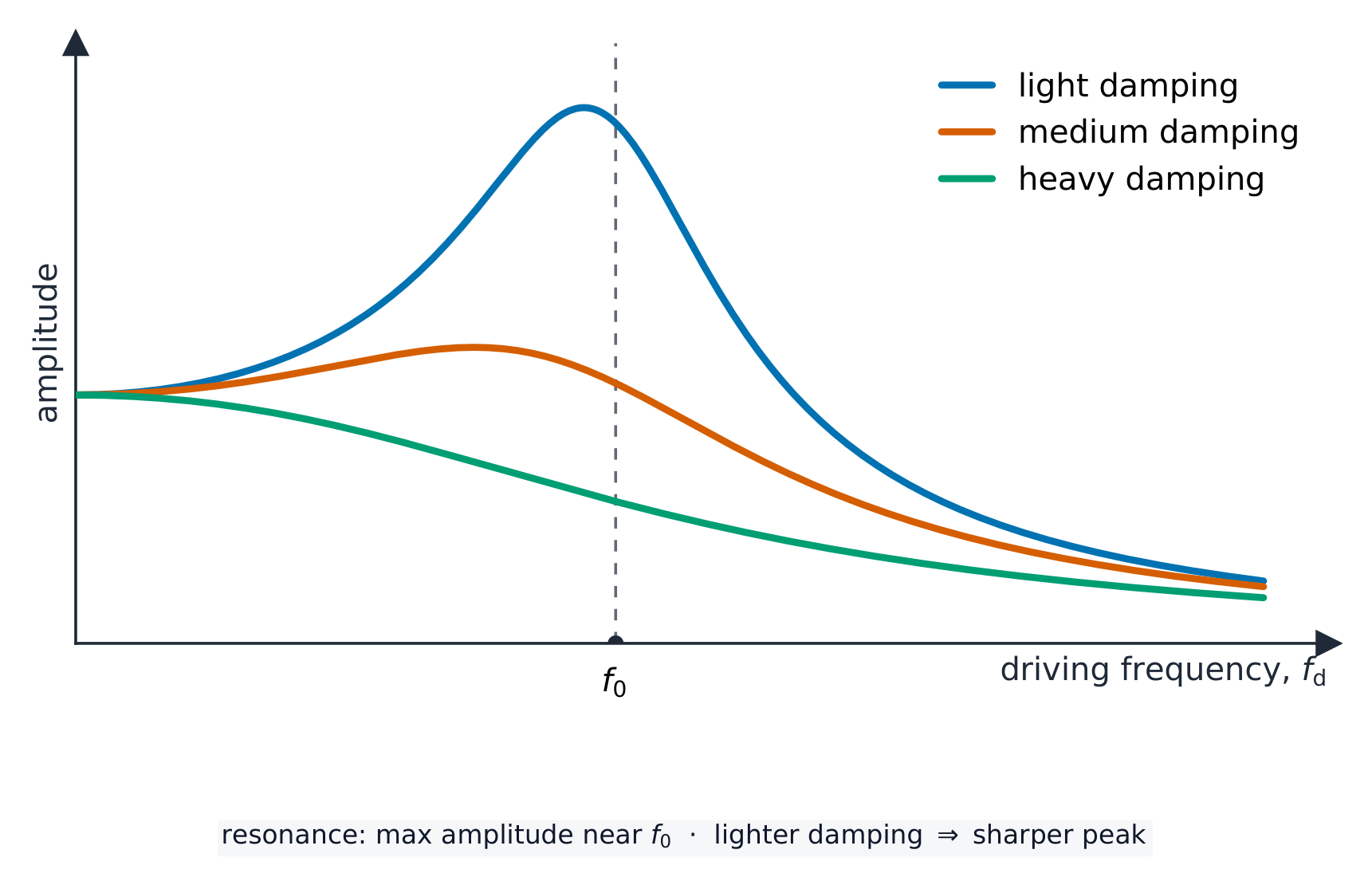
A forced oscillation 受迫振动 is driven by an outside periodic force at a frequency $f_{\text{d}}$ chosen by the experimenter. The system then oscillates at this driving frequency 驱动频率$f_{\text{d}}$, not at its own natural frequency. A plot of amplitude against $f_{\text{d}}$ is a resonance curve 共振曲线 with a peak.
Resonance
Resonance 共振 happens when the driving frequency equals the system's natural frequency 固有频率$f_{0}$. At resonance the amplitude is largest and the energy transfer from the driver is most efficient.
Examples:
a swing pushed at the right rate builds up a large amplitude.
a wine glass broken by a sound at its natural ringing frequency.
a building shaken by an earthquake whose frequency matches a natural frequency — engineers design buildings so their natural frequencies avoid the main earthquake range.
The peak's shape depends on damping: lighter damping → a sharper, higher peak; heavier damping → a broader, lower peak, shifted slightly to lower frequency.
The two-mark definition.Resonance is the condition in which a system is forced to oscillate at its natural frequency, and the amplitude of the oscillation is a maximum (the transfer of energy from the driver is greatest). Both parts — driving frequency equal to natural frequency, and maximum amplitude — are needed.
Worked example. A ball on a stretched string has a natural frequency of $4.0\ \text{Hz}$. The string is driven by a vibration generator whose frequency is increased slowly from $0$ to $10\ \text{Hz}$. Sketch the variation of the amplitude of the ball with the driving frequency, and state the effect of adding damping.
The curve starts at a small, non-zero amplitude at low frequency, rises to a sharp peak at $4.0\ \text{Hz}$, and falls away towards zero at high frequency; the peak is at the natural frequency, and only there is the amplitude a maximum. More damping makes the peak lower and broader and shifts it slightly to a lower frequency; the amplitude far from resonance hardly changes.
العربية
وتر جيتار مُصْطَر يهتز بتردداته الرنينية.
الاهتزاز المجبر مدفوع بقوة خارجية دورية بتردد $f_{\text{d}}$ يختاره الباحث. يهتز النظام بعد ذلك بـ تردد القيادة$f_{\text{d}}$، وليس بتردده الطبيعي الخاص به. مخطط السعة مقابل $f_{\text{d}}$ هو منحنى رنين له ذروة.
الرنين
الرنين يحدث عندما يساوي تردد القيادة التردد الطبيعي للنظام $f_{0}$. عند الرنين تكون السعة أكبر وتكون نقل الطاقة من المصدر أكثر كفاءة.
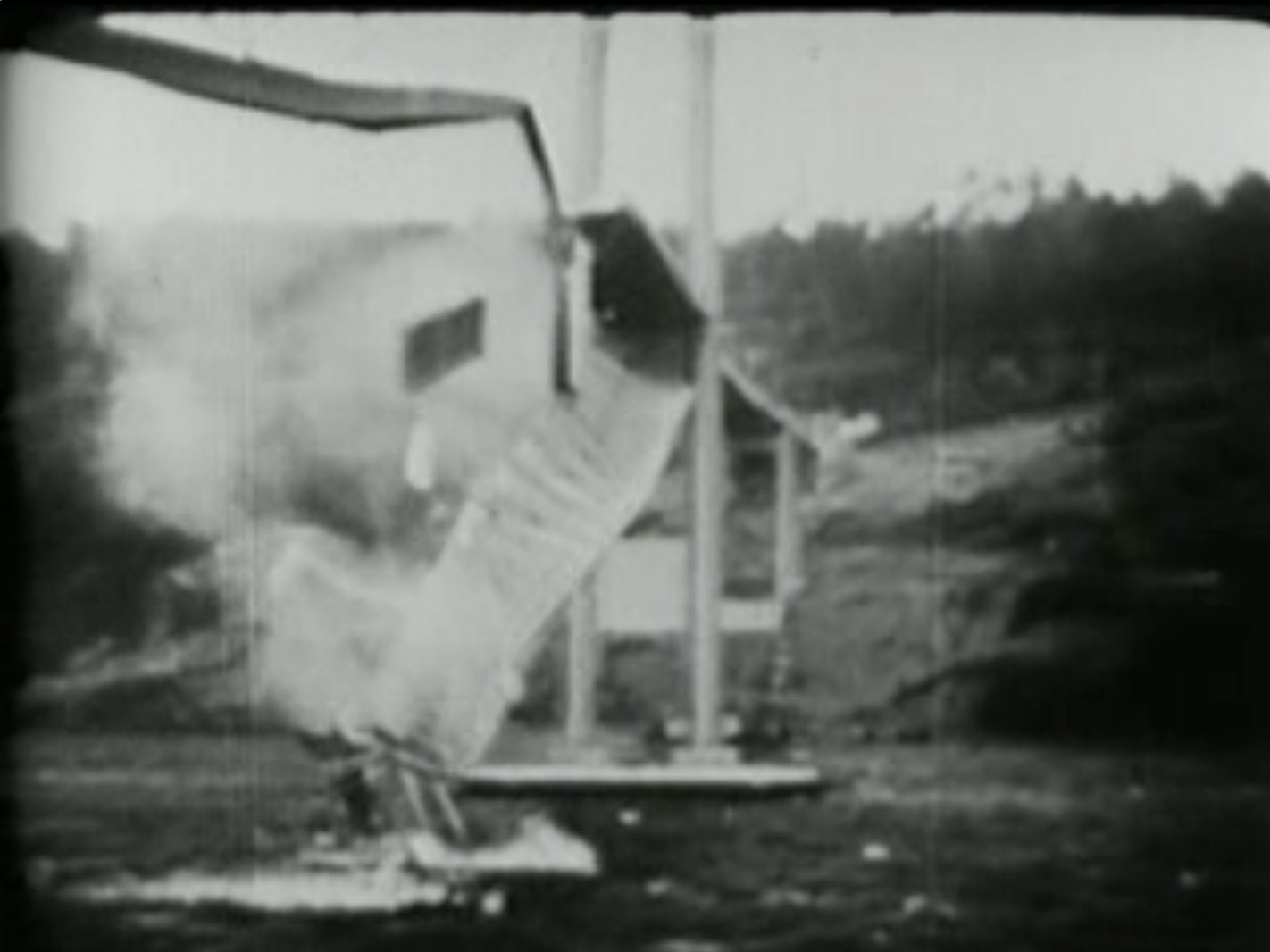
تصل سعة الاهتزاز المجبر إلى ذروتها عند الرنين، عندما يساوي تردد القيادة التردد الطبيعيالرنين قد يكون مدمرًا. في عام 1940، دفع الرياح جسر تاcoma Narrows ليقترب من تردده الطبيعي؛ وبقليل من التخميد، تزايد الالتواء حتى تمزق الجسر. يصفّح المهندسون الآن الجدران والمباني بحيث تتجنب تردداتها الطبيعية تلك القوى المحركة
أمثلة:
التأرجح الذي يُدفع بمعدل مناسب يبني سعة كبيرة.
كاس نبيذ ينكسر بسبب صوت بتردده الرنيني الطبيعي.
مبنى يرتجف بسبب زلزال يتطابق تردده مع تردد طبيعي — يصفّح المهندسون المباني بحيث تتجنب تردداتها الطبيعية النطاق الرئيسي للزلزال.
يعتمد شكل الذروة على التخميد: تخميد أخف → ذروة حادة أعلى؛ تخميد أثقل → ذروة أعرض وأقل، منزاحة قليلاً نحو التردد الأقل.
تعريف علامتين.الرنين هو الحالة التي يُجبر فيها نظام على الاهتزاز بتردده الطبيعي، وتكون سعة الاهتزاز في أقصى حد لها (انتقال الطاقة من المصدر المحرك يكون الأعظم). كلا الجزأين — تردد المحرك يساوي التردد الطبيعي، والسعة القصوى — ضروريان.
مثال محلول. كرة على وتر مشدود لها تردد طبيعي $4.0\ \text{Hz}$. يُدرَّ الوتر بواسطة مولد اهتزازات تُزداد تردده ببطء من $0$ إلى $10\ \text{Hz}$. ارسم تغير سعة الكرة بدلالة تردد المحرك، واذكر تأثير إضافة التخميد.
تبدأ المنحنى بسعة صغيرة غير صفرية عند الترددات المنخفضة، ثم ترتفع إلى ذروة حادة عند $4.0\ \text{Hz}$، وتنخفض نحو الصفر عند الترددات العالية؛ الذروة تقع عند التردد الطبيعي، وهناك فقط تكون السعة قصوى. زيادة التخميد تجعل الذروة أقل وعرضة وتزيحها قليلاً نحو تردد أقل؛ لا تتغير السعة بعيدًا عن الرنين تقريبًا.
Explore · استكشف
Resonance · الرنين
Drive the swing at different frequencies. Far from its natural frequency it barely moves; tune them to match and the amplitude explodes — resonance, the same effect that can shake a bridge apart. · ادفع التأرجح بترددات مختلفة. بعيداً عن تردده الطبيعي لا يتحرك تقريباً؛ ضبط الترددات لتتطابق يجعل السعة تنفجر — الرنين، نفس التأثير الذي يمكن أن يهدم جسراً.
Definitions the examiner accepts · التعريفات التي يقبلها المصحح
English
A definition question is marked against fixed wording. Learn these exactly, and give one answer only.
Term
Definition
simple harmonic motion
motion in which the acceleration is proportional to the displacement from a fixed point and is always directed towards that point
amplitude
the maximum displacement from the equilibrium position
period
the time for one complete oscillation
frequency
the number of complete oscillations per unit time
angular frequency
$\omega = 2\pi f = 2\pi/T$; the rate at which the phase of the oscillation changes
phase difference
the fraction of a cycle, expressed as an angle, by which one oscillation leads or lags another
damping
the reduction in amplitude of an oscillation caused by a resistive force that dissipates its energy
critical damping
the damping that returns a displaced system to equilibrium in the shortest time without oscillation
natural frequency
the frequency at which a system oscillates when displaced and left to oscillate freely
resonance
the forced oscillation of a system at its natural frequency, at which the amplitude is a maximum
العربية
تُصنّف أسئلة التعريف بناءً على صياغة ثابتة. احفظ هذه التعريفات بدقة، وقدم إجابة واحدة فقط.
مصطلح
تعريف
حركة توافقية بسيطة
حركة تكون فيها التسارع متناسبًا مع الإزاحة عن نقطة ثابتة وموجهًا دائمًا نحو تلك النقطة
السعة
أقصى إزاحة عن وضع الاتزان
الدورة
الزمن اللازم لإكمال اهتزاز واحد كامل
التردد
عدد الاهتزازات الكاملة لكل وحدة زمن
التردد الزاوي
$\omega = 2\pi f = 2\pi/T$؛ معدل تغير طور الاهتزاز
فرق الطور
جزء من دورة، يُعبَّر عنه بزاوية، بمقدار ما يسبق أو يتأخر اهتزاز عن آخر
التخميد
انخفاض سعة الاهتزاز الناتج عن قوة مقاومة تبديدها الطاقة
التخميد الحرج
التخميد الذي يعيد النظام المزاح إلى وضع الاتزان في أقصر وقت دون اهتزاز
التردد الطبيعي
التردد الذي يهتز به النظام عند إزاحته وتركه ليهتز بحرية
الرنين
الاهتزاز المجبر لنظام بتردده الطبيعي، حيث تكون السعة في أقصى حد لها
17.3
Exam tips · نصائح للامتحان
English
The SHM condition is $a = -\omega^2 x$ (acceleration proportional to displacement, directed back to equilibrium); to show a motion is SHM, find the restoring force, show it is proportional to $x$ and directed back, and read off $\omega^{2}$.
Learn $x = x_0\sin\omega t$ (or cos), $v_{max} = \omega x_0$, $a_{max} = \omega^2 x_0$ and $v = \pm\omega\sqrt{x_0^2 - x^2}$; KE and PE interchange with the total energy constant, $E = \tfrac{1}{2}m\omega^{2}x_{0}^{2} \propto x_{0}^{2}$.
Velocity is zero at the extremes and maximum at the centre; acceleration is greatest at the extremes and zero at the centre.
The amplitude is half the peak-to-peak range of a displacement graph; $\omega$ comes from the period, or from the gradient of $a$–$x$, or from $v_{0}/x_{0}$.
Resonance occurs when the driving frequency equals the natural frequency; damping lowers and broadens the peak.
Common mistakes
Defining SHM as "oscillation about an equilibrium position". The mark scheme wants acceleration proportional to displacement and directed towards the fixed point.
Saying the minus sign means the acceleration is negative. It means the acceleration is opposite in direction to the displacement.
Sketching $v$ against $x$ as a straight line. It is an ellipse; $a$ against $x$ is the straight line.
Taking the amplitude as the whole range of the displacement. It is half the range.
Defining resonance as "a large amplitude". It is forced oscillation at the natural frequency, giving the maximum amplitude.
Calling critical damping "no damping", or heavy damping "the fastest return". Critical damping is the fastest return without oscillation; heavy damping is slower.
العربية
شرط الحركة التوافقية البسيطة هو $a = -\omega^2 x$ (التسارع متناسب مع الإزاحة، وموجه نحو الاتزان)؛ لإثبات أن حركة ما هي حركة توافقية بسيطة، أوجد القوة الاستعادة، وأثبت أنها متناسبة مع $x$ وموجهة عائدة، واستنتج $\omega^{2}$.
احفظ $x = x_0\sin\omega t$ (أو cos)، $v_{max} = \omega x_0$، $a_{max} = \omega^2 x_0$ و$v = \pm\omega\sqrt{x_0^2 - x^2}$؛ تتبادل الطاقة الحركية والطاقة الكامنة مع ثبات الطاقة الكلية$E = \tfrac{1}{2}m\omega^{2}x_{0}^{2} \propto x_{0}^{2}$.
السرعة صفر عند الأطراف وأقصى قيمة في المركز؛ التسارع أكبر عند الأطراف وصفر في المركز.
السعة هي نصف نطاق القمة إلى القاع في رسم بياني للإزاحة؛ $\omega$ يُستنتج من الدورة، أو من ميل $a$–$x$، أو من $v_{0}/x_{0}$.
يحدث الرنين عندما يساوي تردد المحرك التردد الطبيعي؛ يقلل التخميد ارتفاع الذروة ويجعلها أعرض.
أخطاء شائعة
تعريف الحركة التوافقية البسيطة بأنها "اهتزاز حول وضع اتزان". يركز مفتاح الإجابة على أن التسارع متناسب مع الإزاحة وموجه نحو النقطة الثابتة.
القول بأن الإشارة السالبة تعني أن التسارع سالب. بل تعني أن التسارع معاكس لاتجاه الإزاحة.
رسم $v$ بدلالة $x$ كخط مستقيم. إنه بيضاوي؛ رسم $a$ بدلالة $x$ هو الخط المستقيم.
اعتبار السعة هو النطاق الكامل للإزاحة. بل هي نصف النطاق.
تعريف الرنين بأنه "سعة كبيرة". بل هو اهتزاز مجبر عند التردد الطبيعي، مما يعطي أقصى سعة.
تسمية التخميد الحرج بـ "بدون تخميد"، أو التخميد الثقيل بـ "الأعلى سرعة في العودة". التخميد الحرج هو أعلى سرعة في العودة دون اهتزاز؛ التخميد الثقيل أبطأ.
Interactive lessons on this topic · دروس تفاعلية حول هذا الموضوع
Work through it step by step, with instant-check exercises. · ا-working عليه خطوة بخطوة، مع تمارين تحقق فوري.
Pick one and the site follows you — notes, papers, videos and practice all open on it. · اختر واحدًا وسيتبعك الموقع — الملاحظات، الأوراق، الفيديوهات والتدريب جميعها تفتح عليه.
Type to search notes, lessons, code, vocabulary and past-paper questions across every subject. · اكتب للبحث عن ملاحظات، دروس، أكواد، مفردات وأسئلة امتحانات سابقة عبر جميع المواد.