امسك كأس ماء واحد. يبدو الأمر بسيطًا بما يكفي. لكن بداخله جزيئات أكثر مما يمكنك عدها أبدًا. مول واحد من الماء — مجرد ثمانية عشر جرامًا، وهو…
English narration · English + 中文 subtitles burned in · سرد باللغة الإنجليزية · ترجمة مدمجة بالإنجليزية + الصينية
15.1
The mole · المول
Syllabus · المنهج
English
understand that amount of substance is an SI base quantity with the base unit mol
use molar quantities where one mole of any substance is the amount containing a number of particles of that substance equal to the Avogadro constant$N_{\text{A}}$
العربية
فهم أن كمية المادة هي كمية أساسية في النظام الدولي للوحدات ووحدتها الأساسية هي مول
استخدام الكميات المولية حيث يمثل مول واحد من أي مادة الكمية التي تحتوي على عدد من جسيمات تلك المادة يساوي ثابت أفوجادرو$N_{\text{A}}$
Source: Cambridge International syllabus · المصدر: منهج كامبريدج الدولي
English
Amount of substance 物质的量 is an SI base quantity. Its unit is the mole 摩尔 (mol) — one of the seven SI base units, with the kilogram, metre, second, ampere and kelvin 开尔文 from Topic 1.
One mole of any substance has a number of particles equal to the Avogadro constant 阿伏伽德罗常量:
A "particle" means whatever you are counting — atoms 原子 for a monatomic 单原子 element like helium, molecules 分子 for $\text{O}_{2}$ or $\text{H}_{2}\text{O}$. Always say what you are counting.
For $n$ moles, the number of particles is $N = n N_{\text{A}}$.
The molar mass 摩尔质量$M_{\text{m}}$ is the mass of one mole ($\text{kg mol}^{-1}$ or $\text{g mol}^{-1}$). Mass of $n$ moles is $M = n M_{\text{m}}$. Mass of one particle is $m_{0} = M_{\text{m}} / N_{\text{A}}$.
The examiner's wording.The Avogadro constant is the number of atoms (or molecules) in one mole of a substance — one mark; adding "in $0.012\ \text{kg}$ of carbon-12" is accepted but not needed. Asked for "the relationship between $N_{\text{A}}$, $R$ and $k$", write $k = R/N_{\text{A}}$ (or $R = N_{\text{A}}k$).
Worked example. Oxygen has a molar mass of $32\ \text{g mol}^{-1}$. Find the mass of one oxygen molecule, and the number of molecules in $8.0\ \text{g}$ of oxygen.
$m_{0} = \dfrac{M_{\text{m}}}{N_{\text{A}}} = \dfrac{0.032}{6.02 \times 10^{23}} = 5.3 \times 10^{-26}\ \text{kg}$. $8.0\ \text{g}$ is $n = 8.0/32 = 0.25\ \text{mol}$, so $N = nN_{\text{A}} = 1.5 \times 10^{23}$ molecules. Keep molar masses in $\text{kg mol}^{-1}$ when the answer is in kilograms — the factor of $1000$ is the usual slip.
العربية
كمية المادة هي كمية أساسية في النظام الدولي. وحدتها هي المول (mol) — واحدة من الوحدات الأساسية السبعة في النظام الدولي، مع الكيلوغرام والمتر والثانية والأمبير والكلفن من الموضوع 1.
يحتوي مول واحد على عدد أفوجادرو من الجسيمات
مول واحد من أي مادة يحتوي على عدد من الجسيمات يساوي ثابت أفوجادرو:
كلمة "جسيم" تعني أي شيء تقوم بعدّه — ذرات لعنصر ذري أحادي مثل الهيليوم، أو جزيئات لـ $\text{O}_{2}$ أو $\text{H}_{2}\text{O}$. always اذكر دائماً ما تقوم بعدّه.
بالنسبة لـ $n$ مول، يكون عدد الجسيمات هو $N = n N_{\text{A}}$.
الكتلة المولية$M_{\text{m}}$ هي كتلة مول واحد ($\text{kg mol}^{-1}$ أو $\text{g mol}^{-1}$). كتلة $n$ مول تساوي $M = n M_{\text{m}}$. كتلة الجسيم الواحد تساوي $m_{0} = M_{\text{m}} / N_{\text{A}}$.
صيغة المصحح.ثابت أفوجادرو هو عدد الذرات (أو الجزيئات) في مول واحد من المادة — درجة واحدة؛ إضافة "في $0.012\ \text{kg}$ من الكربون-12" مقبولة لكنها غير ضرورية. عند طلب "العلاقة بين $N_{\text{A}}$ و$R$ و$k$"، اكتب $k = R/N_{\text{A}}$ (أو $R = N_{\text{A}}k$).
مثال محلول. الأكسجين له كتلة مولية قدرها $32\ \text{g mol}^{-1}$. أوجد كتلة جزيء أكسجين واحد، وعدد الجزيئات في $8.0\ \text{g}$ من الأكسجين.
$m_{0} = \dfrac{M_{\text{m}}}{N_{\text{A}}} = \dfrac{0.032}{6.02 \times 10^{23}} = 5.3 \times 10^{-26}\ \text{kg}$. $8.0\ \text{g}$ هي $n = 8.0/32 = 0.25\ \text{mol}$، لذا فإن $N = nN_{\text{A}} = 1.5 \times 10^{23}$ جزيئات. احتفظ بالكتل المولية بـ$\text{kg mol}^{-1}$ عندما يكون الجواب بالكيلوجرام — عامل $1000$ هو الخطأ الشائع.
Explore · استكشف
Mole particle count lab · مختبر عدد جسيمات المول
particles = n x Avogadro constant · الجسيمات = n × ثابت أفوجادرو
Change amount of substance and see particle number scale directly. · غيّر كمية المادة وسترى أن عدد الجسيمات يتناسب طردياً معها.
Equation of state of an ideal gas · معادلة حالة الغاز المثالي
Syllabus · المنهج
English
understand that a gas obeying $pV \propto T$, where $T$ is the thermodynamic temperature, is known as an ideal gas
recall and use the equation of state for an ideal gas expressed as $pV = nRT$, where $n =$ amount of substance (number of moles) and as $pV = NkT$, where $N =$ number of molecules
recall that the Boltzmann constant$k$ is given by $k = R/N_{\text{A}}$
العربية
فهم أن الغاز الذي يخضع لـ $pV \propto T$، حيث $T$ هو درجة الحرارة الديناميكية الحرارية، يُعرف بـالغاز المثالي
التذكر واستخدام معادلة الحالة للغاز المثالي المُعبَّرة عن $pV = nRT$، حيث $n =$ كمية المادة (عدد المولات) و$pV = NkT$، حيث $N =$ عدد الجزيئات
التذكر أن ثابت بولتزمان$k$ يُعطى بالعلاقة $k = R/N_{\text{A}}$
Source: Cambridge International syllabus · المصدر: منهج كامبريدج الدولي
English
An ideal gas 理想气体 obeys $pV \propto T$ exactly, where $T$ is the thermodynamic temperature 热力学温度.
The equation of state 状态方程 can be written two equal ways:
$$p V = n R T \qquad\text{or}\qquad p V = N k T.$$
Here:
$p$ — pressure 压强 (Pa).
$V$ — volume 体积 (m³).
$T$ — thermodynamic temperature in kelvin (never °C).
Since $N = n N_{\text{A}}$, we get $k = R/N_{\text{A}}$: $k$ is the gas constant per molecule, as $R$ is per mole.
The two-mark definition.An ideal gas is one that obeys $pV = nRT$ (or $pV \propto T$, with $T$ the thermodynamic temperature) at all values of pressure, volume and temperature. Both marks need the equation (or the proportionality with $T$ named as thermodynamic) and "at all values" or "for all $p$, $V$ and $T$". Asked to "state the meaning of each symbol in $pV = NkT$": $p$ is the pressure, $V$ the volume, $N$ the number of molecules, $k$ the Boltzmann constant and $T$ the thermodynamic temperature — a real gas is nearly ideal at low pressure and high temperature, where its molecules are far apart.
Using the equation of state
List the variables you have, find the unknown, and choose the form that matches your "amount" (moles → $nRT$; molecules → $NkT$). Always use SI units: Pa, m³, K.
Worked example. A cylinder of volume $0.020\ \text{m}^{3}$ holds gas at $27\ ^{\circ}\text{C}$ and a pressure of $2.0 \times 10^{5}\ \text{Pa}$. How many moles of gas are there? ($R = 8.31\ \text{J mol}^{-1}\ \text{K}^{-1}$.)
Convert to kelvin: $T = 27 + 273 = 300\ \text{K}$. Then from $pV = nRT$,
Worked example. A fixed mass of gas at $300\ \text{K}$ occupies $0.50\ \text{m}^{3}$. It is heated to $450\ \text{K}$ at constant pressure. Find the new volume.
Worked example. A sealed vessel of volume $0.0500\ \text{m}^{3}$ contains $0.0424\ \text{kg}$ of an ideal gas at $227\ ^{\circ}\text{C}$ and $1.37 \times 10^{5}\ \text{Pa}$. Find the amount of gas, the mass of one molecule, and the mean-square speed of its molecules.
$T = 227 + 273 = 500\ \text{K}$. $n = \dfrac{pV}{RT} = \dfrac{1.37 \times 10^{5} \times 0.0500}{8.31 \times 500} = 1.65\ \text{mol}$. The molar mass is $0.0424/1.65 = 0.0257\ \text{kg mol}^{-1}$, so one molecule has mass $0.0257/(6.02 \times 10^{23}) = 4.3 \times 10^{-26}\ \text{kg}$. From $\tfrac{1}{2}m\langle c^{2}\rangle = \tfrac{3}{2}kT$, $\langle c^{2}\rangle = \dfrac{3kT}{m} = \dfrac{3 \times 1.38 \times 10^{-23} \times 500}{4.27 \times 10^{-26}} = 4.8 \times 10^{5}\ \text{m}^{2}\ \text{s}^{-2}$ (an r.m.s. speed of about $700\ \text{m s}^{-1}$).
Worked example. Cylinder X (volume $0.0260\ \text{m}^{3}$, $0.740\ \text{mol}$) and cylinder Y (volume $0.0180\ \text{m}^{3}$, $0.320\ \text{mol}$) contain ideal gas and are in thermal equilibrium with each other at $290\ \text{K}$. Find the pressure in each, and explain what happens to the number of molecules in each cylinder if a tap joining them is opened.
$p_{\text{X}} = \dfrac{nRT}{V} = \dfrac{0.740 \times 8.31 \times 290}{0.0260} = 6.86 \times 10^{4}\ \text{Pa}$ and $p_{\text{Y}} = \dfrac{0.320 \times 8.31 \times 290}{0.0180} = 4.28 \times 10^{4}\ \text{Pa}$. Gas flows from the higher pressure (X) to the lower (Y) until the pressures are equal; the temperature is unchanged, so the final pressure is $p = \dfrac{(n_{\text{X}} + n_{\text{Y}})RT}{V_{\text{X}} + V_{\text{Y}}} = 5.8 \times 10^{4}\ \text{Pa}$, and X ends with $n_{\text{X}} = pV_{\text{X}}/RT = 0.63\ \text{mol}$ — it loses about $0.11\ \text{mol}$ to Y.
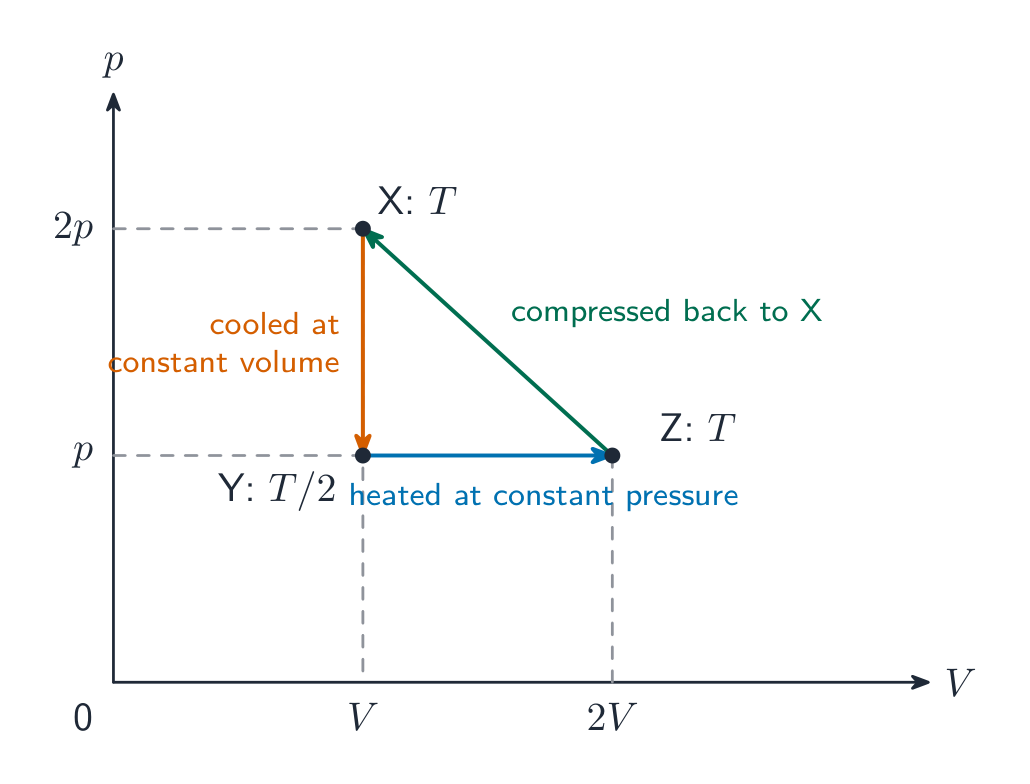
Worked example. A fixed amount of ideal gas at temperature $T$ is in state X, with pressure $2p$ and volume $V$. It is cooled at constant volume to state Y, where its pressure is $p$; then heated at constant pressure to state Z, where its volume is $2V$; then returned to X. Find the temperatures at Y and Z, and describe how the internal energy changes round the cycle.
X to Y is at constant volume, so $p/T$ is constant: halving the pressure halves the temperature, $T_{\text{Y}} = T/2$. Y to Z is at constant pressure, so $V/T$ is constant: doubling the volume doubles the temperature, $T_{\text{Z}} = T$. The internal energy of an ideal gas depends only on temperature, so it falls from X to Y (by $\tfrac{3}{2}nR \cdot T/2$), rises by the same amount from Y to Z, and is unchanged from Z back to X. Read each leg off the diagram before writing an equation: vertical means constant $V$, horizontal means constant $p$.
Special cases:
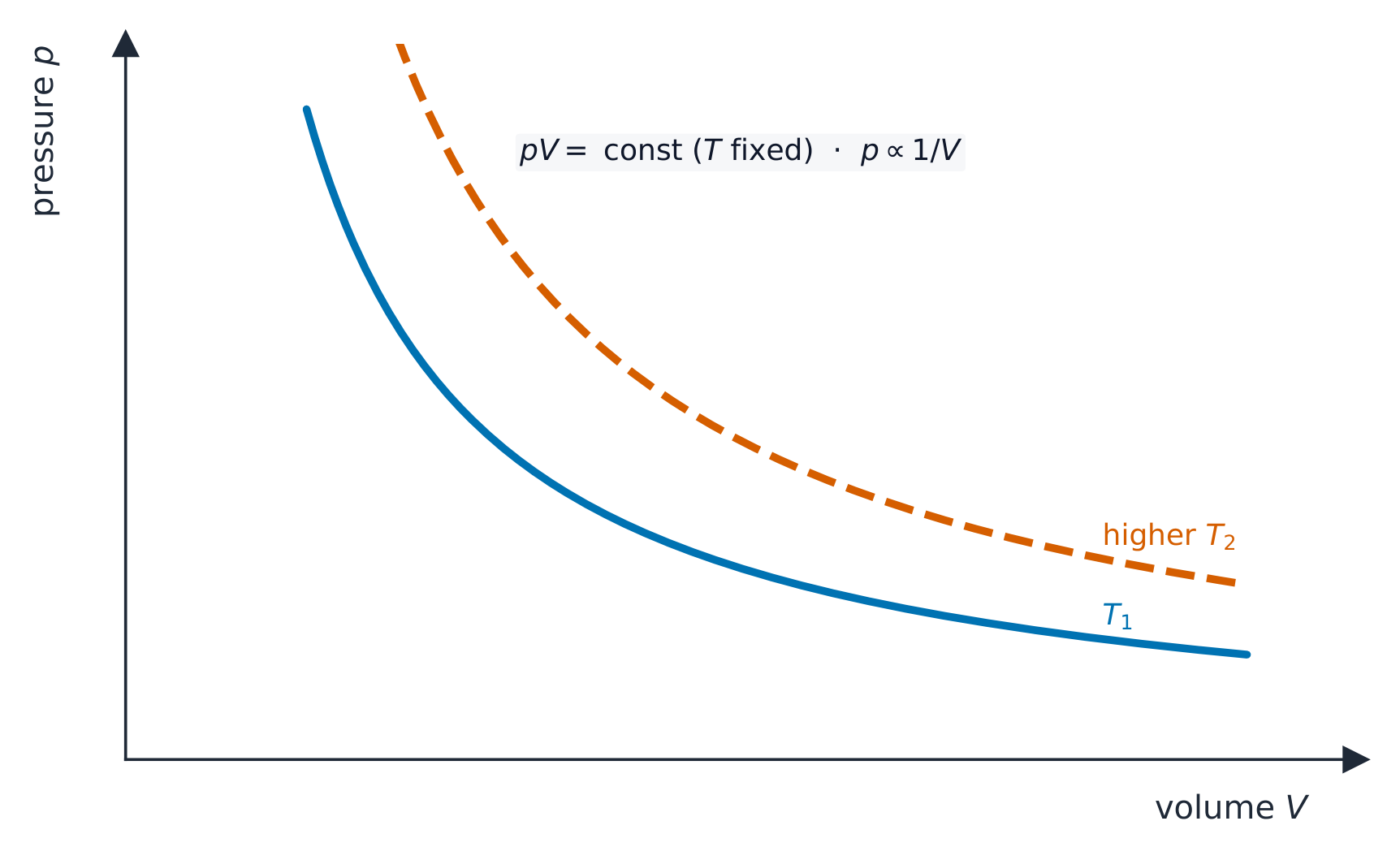
constant temperature (Boyle's law 玻意耳定律): $p_{1} V_{1} = p_{2} V_{2}$.
constant pressure (Charles's law 查理定律): $V / T = \text{constant}$.
constant volume (pressure law 气体压强定律): $p / T = \text{constant}$.
A common mistake is using °C instead of K — $pV \propto T$ only holds with $T$ in kelvin.
العربية
تخزن أسطوانات الغاز المضغوط كتلة ثابتة من الغاز عند ضغط عالٍ.
يتبع الغاز المثالي$pV \propto T$ بدقة، حيث $T$ هي درجة الحرارة الديناميكية.
يمكن كتابة معادلة الحالة بطريقتين متساويتين:
$$p V = n R T \qquad\text{or}\qquad p V = N k T.$$
حيث:
$p$ — الضغط (Pa).
$V$ — الحجم (m³).
$T$ — درجة الحرارة الديناميكية بالكلفن (لا تستخدم °C أبداً).
بما أن $N = n N_{\text{A}}$، نحصل على $k = R/N_{\text{A}}$: $k$ هو ثابت الغاز لكل جزيء، كما أن $R$ هو لكل مول.
تعريف درجتين.الغاز المثالي هو غاز يخضع لـ $pV = nRT$ (أو $pV \propto T$، مع $T$ كدرجة الحرارة الديناميكية الحرارية) عند جميع قيم الضغط والحجم ودرجة الحرارة. يتطلب كل من العلامتين المعادلة (أو التناسب مع $T$ المسمى ديناميكا حرارية) و "عند جميع القيم" أو "لجميع $p$، $V$ و $T$". عند الطلب "اشرح معنى كل رمز في $pV = NkT$": $p$ هو الضغط، $V$ الحجم، $N$ عدد الجزيئات، $k$ ثابت بولتزمان و $T$ درجة الحرارة الديناميكية الحرارية — الغاز الحقيقي يكون مثالياً تقريباً عند ضغط منخفض ودرجة حرارة عالية، حيث تكون جزيئاته متباعدة.
استخدام معادلة الحالة
أدرج المتغيرات التي لديك، حدد المجهول، واختر الصيغة التي تتناسب مع "كمية" المادة (مولات → $nRT$؛ جزيئات → $NkT$). استخدم دائماً الوحدات SI: باسكال، متر مكعب، كلفن.
مثال محلول. أسطوانة حجمها $0.020\ \text{m}^{3}$ تحتوي على غاز عند $27\ ^{\circ}\text{C}$ وضغط قدره $2.0 \times 10^{5}\ \text{Pa}$. كم عدد مولات الغاز؟ ($R = 8.31\ \text{J mol}^{-1}\ \text{K}^{-1}$.)
حول إلى الكلفن: $T = 27 + 273 = 300\ \text{K}$. ثم من $pV = nRT$،
مثال محلول. الأسطوانة X (حجمها $0.0260\ \text{m}^{3}$، $0.740\ \text{mol}$) والأسطوانة Y (حجمها $0.0180\ \text{m}^{3}$، $0.320\ \text{mol}$) تحتويان على غاز مثالي وهما في توازن حراري مع بعضهما البعض عند $290\ \text{K}$. أوجد الضغط في كل منهما، واشرح ما يحدث لعدد الجزيئات في كل أسطوانة إذا تم فتح صنبور يربط بينهما.
$p_{\text{X}} = \dfrac{nRT}{V} = \dfrac{0.740 \times 8.31 \times 290}{0.0260} = 6.86 \times 10^{4}\ \text{Pa}$ و$p_{\text{Y}} = \dfrac{0.320 \times 8.31 \times 290}{0.0180} = 4.28 \times 10^{4}\ \text{Pa}$. يتدفق الغاز من الضغط الأعلى (X) إلى الضغط الأدنى (Y) حتى تتساوى الضغوط؛ وبما أن درجة الحرارة لم تتغير، فإن الضغط النهائي هو $p = \dfrac{(n_{\text{X}} + n_{\text{Y}})RT}{V_{\text{X}} + V_{\text{Y}}} = 5.8 \times 10^{4}\ \text{Pa}$، وتنتهي X بـ$n_{\text{X}} = pV_{\text{X}}/RT = 0.63\ \text{mol}$ — تفقد حوالي $0.11\ \text{mol}$ إلى Y.
دورة على مخطط $p$–$V$: الخط الرأسي يمثل حجماً ثابتاً، والخط الأفقي يمثل ضغطاً ثابتاً، و $pV/T$ ثابت عند كل حالة
مثال محلول. كمية ثابتة من غاز مثالي عند درجة حرارة $T$ تكون في الحالة X، بضغط $2p$ وحجم $V$. تُبرّد عند حجم ثابت إلى الحالة Y، حيث يكون ضغطها $p$؛ ثم تُسخّن عند ضغط ثابت إلى الحالة Z، حيث يكون حجمها $2V$؛ ثم تُعاد إلى X. أوجد درجات الحرارة عند Y و Z، وصف كيف يتغير الطاقة الداخلية حول الدورة.
من X إلى Y عند حجم ثابت، لذا $p/T$ ثابت: ضعف الضغط ينصف درجة الحرارة، $T_{\text{Y}} = T/2$. من Y إلى Z عند ضغط ثابت، لذا $V/T$ ثابت: ضعف الحجم يضاعف درجة الحرارة، $T_{\text{Z}} = T$. تعتمد الطاقة الداخلية للغاز المثالي فقط على درجة الحرارة، لذا تنخفض من X إلى Y (بنسبة $\tfrac{3}{2}nR \cdot T/2$)، وترتفع بنفس المقدار من Y إلى Z، ولا تتغير من Z إلى X. اقرأ كل جزء من الرسم البياني قبل كتابة المعادلة: الرأسي يعني ثبات $V$، والأفقي يعني ثبات $p$.
حالات خاصة:
درجة حرارة ثابتة (قانون بويل): $p_{1} V_{1} = p_{2} V_{2}$.
ضغط ثابت (قانون تشارلز): $V / T = \text{constant}$.
حجم ثابت (قانون الضغط): $p / T = \text{constant}$.
خطأ شائع هو استخدام درجة مئوية بدلاً من كلفن — $pV \propto T$ صالح فقط مع $T$ بالكلفن.
قانون بويل: عند درجة حرارة ثابتة $pV$ ثابت، لذا الرسم البياني لـ $p$–$V$ هو دالة طرديةعند ضغط ثابت يرتفع حجم الغاز خطياً مع درجة الحرارة، ليصل إلى الصفر عند الصفر المطلق (قانون تشارلز)
Explore · استكشف
The ideal gas (Boyle) · الغاز المثالي (بويل)
p = k / V
At constant temperature p ∝ 1/V — squeeze the volume and pressure rises. · عند درجة حرارة ثابتة، p ∝ 1/V — اضغط على الحجم ويزداد الضغط.
Kinetic theory of gases · النظرية الحركية للغازات
Syllabus · المنهج
English
state the basic assumptions of the kinetic theory of gases
explain how molecular movement causes the pressure exerted by a gas and derive and use the relationship $pV = \frac{1}{3}Nm\langle c^2 \rangle$, where $\langle c^2 \rangle$ is the mean-square speed (a simple model considering one-dimensional collisions and then extending to three dimensions using $\frac{1}{3}\langle c^2 \rangle = \langle c_x^2 \rangle$ is sufficient)
understand that the root-mean-square speed$c_{\text{r.m.s.}}$ is given by $\sqrt{\langle c^2 \rangle}$
compare $pV = \frac{1}{3}Nm\langle c^2 \rangle$ with $pV = NkT$ to deduce that the average translational kinetic energy of a molecule is $\frac{3}{2}kT$, and recall and use this expression
العربية
ذكر الافتراضات الأساسية لـالنظرية الحركية للغازات
شرح كيف يسبب الحركة الجزيئية الضغط الذي يمارسه الغاز، واشتقاق وعلاقة $pV = \frac{1}{3}Nm\langle c^2 \rangle$، حيث $\langle c^2 \rangle$ هو متوسط مربع السرعة (نموذج بسيط يراعي الاصطدامات أحادية البعد ثم يتم التوسع في ثلاثة أبعاد باستخدام $\frac{1}{3}\langle c^2 \rangle = \langle c_x^2 \rangle$ يعتبر كافياً)
فهم أن جذر متوسط مربع السرعة$c_{\text{r.m.s.}}$ يُعطى بالعلاقة $\sqrt{\langle c^2 \rangle}$
مقارنة $pV = \frac{1}{3}Nm\langle c^2 \rangle$ بـ $pV = NkT$ لاستنتاج أن متوسط الطاقة الحركية الانتقالية للجزيء هو $\frac{3}{2}kT$، والتذكر واستخدام هذه الصيغة
Source: Cambridge International syllabus · المصدر: منهج كامبريدج الدولي
English
Kinetic theory: gas pressure
The kinetic theory 分子动理论 explains a gas's large-scale behaviour from the random motion 无规则运动 of its molecules.
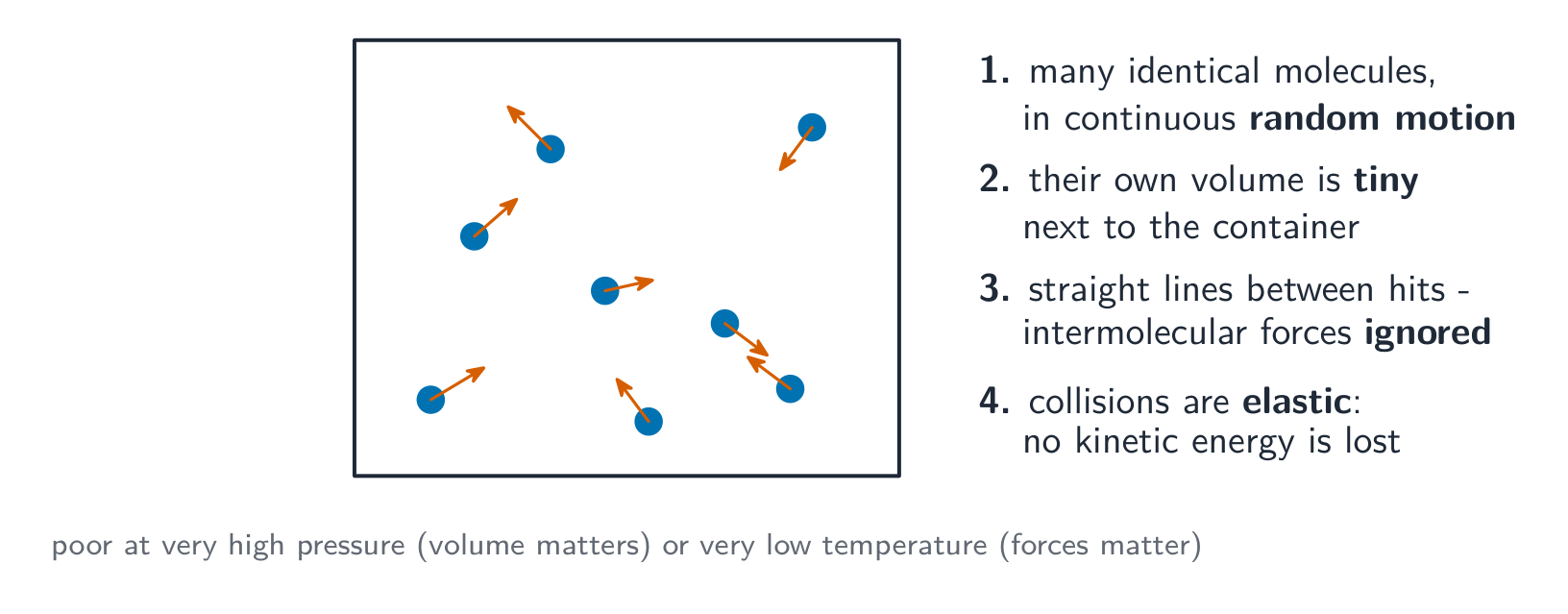
Assumptions
For an ideal gas:
a large number of identical molecules in continuous random motion.
the molecules' own volume is too small to matter compared with the container.
the time of each collision is too short to matter compared with the time between collisions.
intermolecular 分子间 forces are ignored except during collisions (molecules go in straight lines between them).
collisions (with the walls and with each other) are elastic — an elastic collision 弹性碰撞 loses no kinetic energy, so the gas does not cool down by itself.
Newton's laws apply.
These assumptions become poor at very high pressure (molecular volume matters) or very low temperature (intermolecular forces matter).
As the exam asks it. "State two (or three) basic assumptions of the kinetic theory": choose from the molecules are in continuous random motion; the volume of the molecules is negligible compared with the volume of the gas; there are no forces between the molecules except during collisions; the collisions are perfectly elastic; the time of a collision is negligible compared with the time between collisions. "State what is meant by an elastic collision": one in which the total kinetic energy is conserved (as well as momentum). "Use the assumptions to suggest why the gas at the surface of a star, at very high pressure, is not ideal": the molecules are so close together that their own volume is not negligible compared with the gas volume, and intermolecular forces act between them — the two assumptions that fail when a gas is compressed.
Worked example. A balloon contains $0.40\ \text{mol}$ of hydrogen ($m = 3.34 \times 10^{-27}\ \text{kg}$ per molecule) in $9.8 \times 10^{-3}\ \text{m}^{3}$. Estimate the average separation of the molecules, the gravitational force between neighbouring molecules, and comment on the kinetic-theory assumption this tests.
$N = 0.40 \times 6.02 \times 10^{23} = 2.4 \times 10^{23}$ molecules, so each occupies $V/N = 4.1 \times 10^{-26}\ \text{m}^{3}$ and the average separation is $d = (V/N)^{1/3} = 3.4 \times 10^{-9}\ \text{m}$. The gravitational force between two molecules is $F = \dfrac{Gm^{2}}{d^{2}} = \dfrac{6.67 \times 10^{-11} \times (3.34 \times 10^{-27})^{2}}{(3.4 \times 10^{-9})^{2}} = 6 \times 10^{-47}\ \text{N}$ — some $10^{20}$ times smaller than a molecule's own weight ($mg = 3.3 \times 10^{-26}\ \text{N}$). Forces between molecules really are negligible except during collisions, as the theory assumes.
Pressure of a gas — outline of the derivation
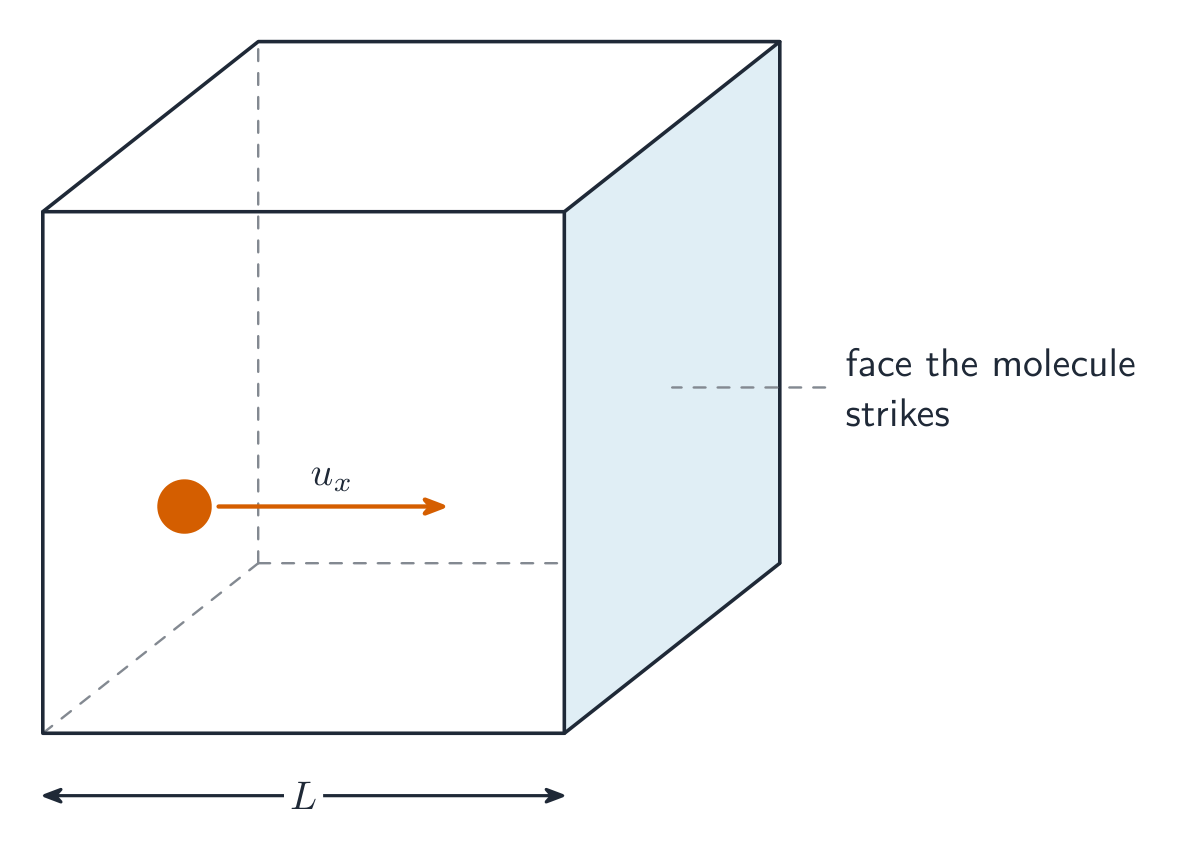
Take a cubic box of side $L$ with $N$ molecules, each of mass $m$. Look at one molecule moving along the $x$-axis with velocity $u_{1}$.
one collision with the right wall: velocity reverses to $-u_{1}$, change in momentum 动量$\Delta p_{x} = -2 m u_{1}$. By Newton's third law the wall gets an impulse 冲量 of $+2 m u_{1}$.
time between hits on that wall: travel $2L$ there and back, so $\Delta t = 2L/u_{1}$.
average force from this molecule: $F_{1} = \Delta p / \Delta t = m u_{1}^{2} / L$.
add over all molecules: $F = (Nm/L)\langle u_{x}^{2} \rangle$, where $\langle u_{x}^{2} \rangle$ is the mean square 均方 of the $x$-velocity.
pressure: $p = F/L^{2} = N m \langle u_{x}^{2} \rangle / V$.
In 3-D, by symmetry $\langle u_{x}^{2} \rangle = \tfrac{1}{3} \langle c^{2} \rangle$, where $\langle c^{2} \rangle$ is the mean-square speed 均方速率. So
$$p V = \tfrac{1}{3} N m \langle c^{2} \rangle.$$
"Explain how molecular movement causes the pressure exerted by a gas" (3 marks). The molecules move randomly and collide with the walls of the container; at each collision a molecule's momentum changes (it rebounds), so by Newton's second law the wall exerts a force on it, and by the third law it exerts an equal force on the wall; the very many collisions each second produce a steady total force on the wall, and the pressure is that force per unit area. The syllabus phrase "a simple model considering one-dimensional collisions" means the derivation above: it is sufficient to follow one molecule bouncing between two opposite faces and then average.
The density form. Since $Nm$ is the total mass of the gas and $Nm/V$ is its density $\rho$, the same result reads $p = \tfrac{1}{3}\rho\langle c^{2}\rangle$ — the version to use when a question gives a density instead of $N$ and $m$.
Worked example. An ideal gas at a pressure of $1.6 \times 10^{5}\ \text{Pa}$ has a density of $1.9\ \text{kg m}^{-3}$. Show that the r.m.s. speed of its molecules is about $500\ \text{m s}^{-1}$.
$\langle c^{2}\rangle = \dfrac{3p}{\rho} = \dfrac{3 \times 1.6 \times 10^{5}}{1.9} = 2.53 \times 10^{5}\ \text{m}^{2}\ \text{s}^{-2}$, so $c_{\text{r.m.s.}} = \sqrt{2.53 \times 10^{5}} = 503\ \text{m s}^{-1} \approx 500\ \text{m s}^{-1}$. In a "show that", keep an extra figure ($503$) before comparing with the value given.
Root-mean-square speed
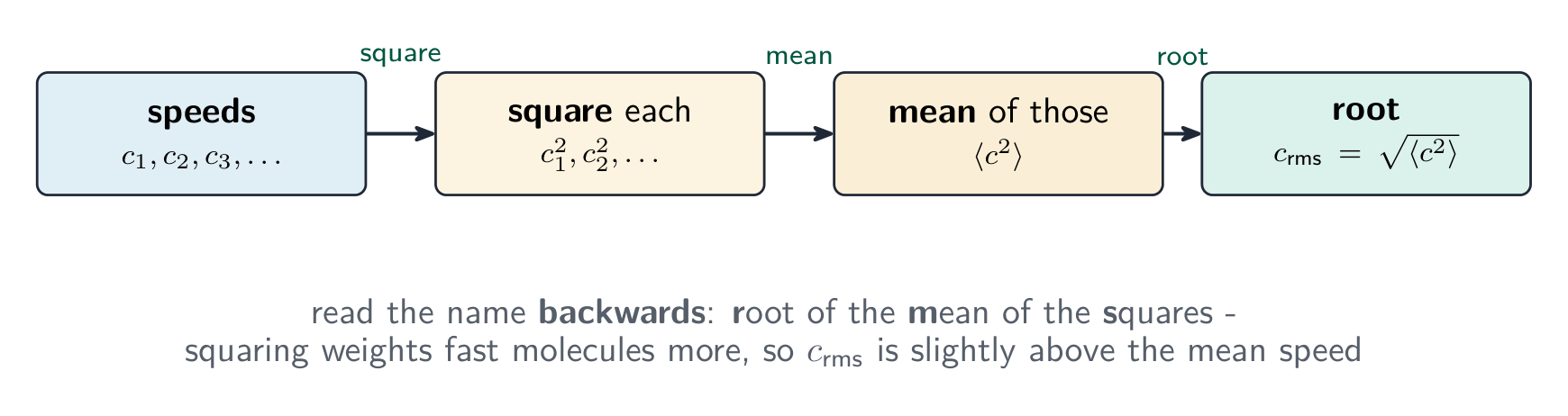
The square root of $\langle c^{2} \rangle$ is the root-mean-square 均方根 (r.m.s.) speed:
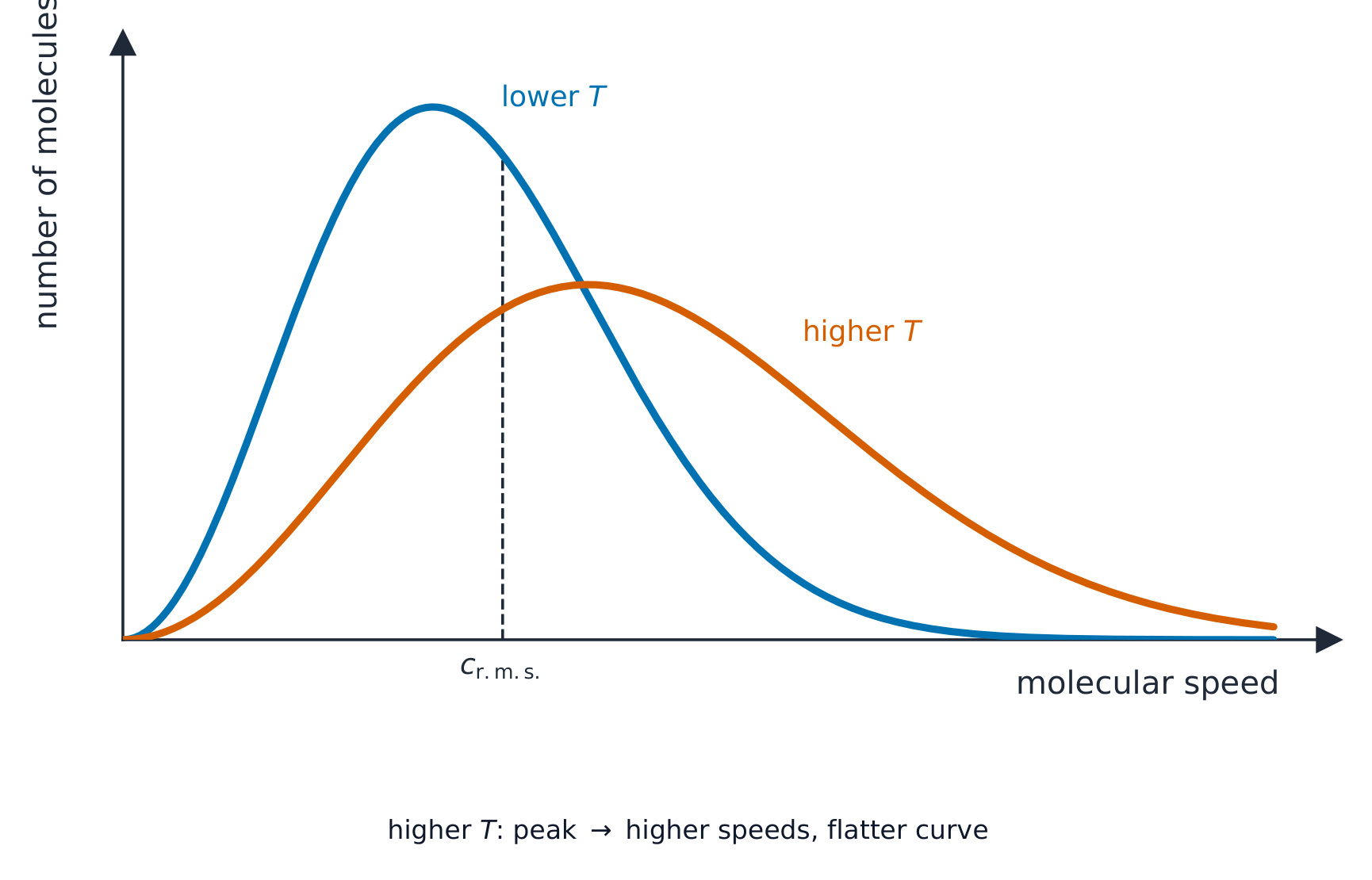
It is a useful single measure of how fast the molecules move, slightly larger than the mean speed (squaring weights fast molecules more).
العربية
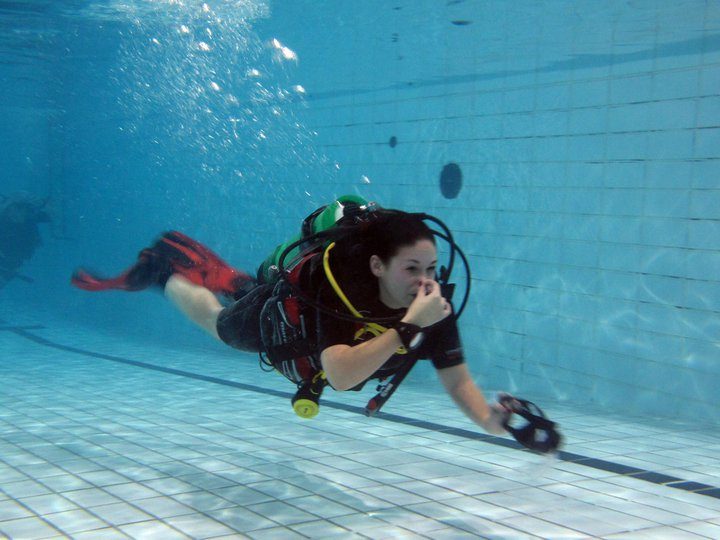
النظرية الحركية: ضغط الغازغواص الغوص يتنفس غازاً مضغوطاً؛ ضغطه وحجمه ودرجة حرارته مرتبطة ببعضها.
تشرح النظرية الحركية السلوك العام للغاز من خلال الحركة العشوائية لجزيئاته.
الافتراضات
بالنسبة للغاز المثالي:
عدد كبير من الجزيئات المتطابقة في حركة عشوائية مستمرة.
حجم الجزيئات نفسه صغير جداً مقارنة بالحجم الذي يشغله الحاوية.
وقت كل تصادم قصير جداً مقارنة بالزمن بين التصادمات.
قوى بين الجزيئات مهملة إلا أثناء التصادمات (الجزيئات تنتقل في خطوط مستقيمة بينها).
التصادمات (مع الجدران ومع بعضها البعض) مرنة — التصادم المرن لا يفقد طاقة حركية، لذا لا يبرد الغاز بنفسه.
قوانين نيوتن تطبق.
الافتراضات الرئيسية للنظرية الحركية للغاز المثالي
تصبح هذه الافتراضات غير دقيقة عند ضغوط عالية جداً (حيث يكون حجم الجزيئات مهماً) أو درجات حرارة منخفضة جداً (حيث تكون القوى بين الجزيئات مهمة).
"كما يطلب الامتحان: "اذكر افتراضين (أو ثلاثة) أساسيين لنظرية الحركة": اختر من الجزيئات في حركة عشوائية مستمرة؛ حجم الجزيئات مهملاً مقارنة بحجم الغاز؛ لا توجد قوى بين الجزيئات إلا أثناء التصادمات؛ التصادمات مرنة تماماً؛ زمن التصادم مهملاً مقارنة بالزمن بين التصادمات. "اذكر ما يعنيه بالتصادم المرن": ما هو الذي تتحرر فيه الطاقة الحركية الكلية (بالإضافة إلى الزخم). "استخدم الافتراضات لتقترح لماذا لا يكون الغاز عند سطح نجم، عند ضغط عالٍ جداً، مثالياً": الجزيئات متقاربة لدرجة أن حجمها الخاص ليس مهملاً مقارنة بحجم الغاز، وتعمل قوى بين جزيئية بينها — وهما الافتراضان اللذان يفشلان عند انضغاط الغاز.
مثال محلول. يحتوي البالون على $0.40\ \text{mol}$ من الهيدروجين ($m = 3.34 \times 10^{-27}\ \text{kg}$ لكل جزيء) في $9.8 \times 10^{-3}\ \text{m}^{3}$. قدر المسافة المتوسطة بين الجزيئات، والقوة الجاذبة بين الجزيئات المجاورة، وعلق على افتراض نظرية الحركة الذي يختبره ذلك.
$N = 0.40 \times 6.02 \times 10^{23} = 2.4 \times 10^{23}$ جزيء، لذا يشغل كل منها $V/N = 4.1 \times 10^{-26}\ \text{m}^{3}$ والمسافة المتوسطة هي $d = (V/N)^{1/3} = 3.4 \times 10^{-9}\ \text{m}$. القوة الجاذبة بين جزيئين هي $F = \dfrac{Gm^{2}}{d^{2}} = \dfrac{6.67 \times 10^{-11} \times (3.34 \times 10^{-27})^{2}}{(3.4 \times 10^{-9})^{2}} = 6 \times 10^{-47}\ \text{N}$ — وهي أصغر بمقدار $10^{20}$ مرات تقريباً من وزن الجزيء نفسه ($mg = 3.3 \times 10^{-26}\ \text{N}$). القوى بين الجزيئات حقاً مهملة إلا أثناء التصادمات، كما تفترض النظرية.
ضغط الغاز — مسودة الاستنتاج
خذ صندوقاً مكعباً طول ضلعه $L$ يحتوي على $N$ جزيء، كتلة كل منها $m$. انظر إلى جزيء يتحرك على طول المحور $x$ بسرعة $u_{1}$.
يأخذ استنتاج الضغط بعين الاعتبار المكون $u_x$ من سرعة الجزيء العمودي على وجه لمكعب من الغاز
تصادم واحد مع الجدار الأيمن: تنعكس السرعة لتصبح $-u_{1}$، والتغير في الزخم$\Delta p_{x} = -2 m u_{1}$. وفقاً لقانون نيوتن الثالث، يحصل الجدار على دفع مقداره $+2 m u_{1}$.
الزمن بين ضربات ذلك الجدار: يسافر مسافة $2L$ ذهاباً وإياباً، لذا $\Delta t = 2L/u_{1}$.
متوسط القوة من هذا الجزيء: $F_{1} = \Delta p / \Delta t = m u_{1}^{2} / L$.
جمعها لجميع الجزيئات: $F = (Nm/L)\langle u_{x}^{2} \rangle$، حيث $\langle u_{x}^{2} \rangle$ هو متوسط مربعات سرعة $x$.
الضغط: $p = F/L^{2} = N m \langle u_{x}^{2} \rangle / V$.
في 3-D، بالتناظر $\langle u_{x}^{2} \rangle = \tfrac{1}{3} \langle c^{2} \rangle$، حيث $\langle c^{2} \rangle$ هي متوسط مربع السرعة. لذا
$$p V = \tfrac{1}{3} N m \langle c^{2} \rangle.$$
"اشرح كيف يسبب حركة الجزيئات الضغط الذي يبذله الغاز" (3 علامات). تتحرك الجزيئات بشكل عشوائي وتتصادم مع جدران الوعاء؛ في كل تصادم يتغير زخم الجزيء (يرتد)، لذا according to قانون نيوتن الثاني يبذل الجدار قوة عليه، ووفقاً للقانون الثالث يبذل قوة مساوية على الجدار؛ عدد كبير جداً من التصادمات كل ثانية ينتج عنه قوة كلية ثابتة على الجدار، والضغط هو تلك القوة لكل وحدة مساحة. عبارة المنهج "نموذج بسيط ي考虑 تصادمات أحادية البعد" تعني الاستنتاج أعلاه: يكفي تتبع جزيء يرتد بين وجهين متقابلين ثم أخذ المتوسط.
الصيغة الكثافة. بما أن $Nm$ هي الكتلة الكلية للغاز و$Nm/V$ هي كثافته $\rho$، فإن نفس النتيجة تُقرأ $p = \tfrac{1}{3}\rho\langle c^{2}\rangle$ — الصيغة التي يجب استخدامها عندما تعطيك سؤالاً كثافة بدلاً من $N$ و$m$.
مثال محلول. غاز مثالي عند ضغط $1.6 \times 10^{5}\ \text{Pa}$ له كثافة $1.9\ \text{kg m}^{-3}$. بيّن أن السرعة الجذرية لمتوسط مربعات لجزيئاته تساوي تقريباً $500\ \text{m s}^{-1}$.
$\langle c^{2}\rangle = \dfrac{3p}{\rho} = \dfrac{3 \times 1.6 \times 10^{5}}{1.9} = 2.53 \times 10^{5}\ \text{m}^{2}\ \text{s}^{-2}$، لذا $c_{\text{r.m.s.}} = \sqrt{2.53 \times 10^{5}} = 503\ \text{m s}^{-1} \approx 500\ \text{m s}^{-1}$. في "بيّن أن"، احتفظ برقم إضافي ($503$) قبل المقارنة مع القيمة المعطاة.
السرعة الجذرية لمتوسط مربعات
الجذر التربيعي لـ $\langle c^{2} \rangle$ هو السرعة الجذرية لمتوسط مربعات (r.m.s.):
إنه مقياس مفرد مفيد لكيفية سرعة حركة الجزيئات، أكبر قليلاً من متوسط السرعة (التربيع يُعطى أوزاناً أكبر للجزيئات السريعة).
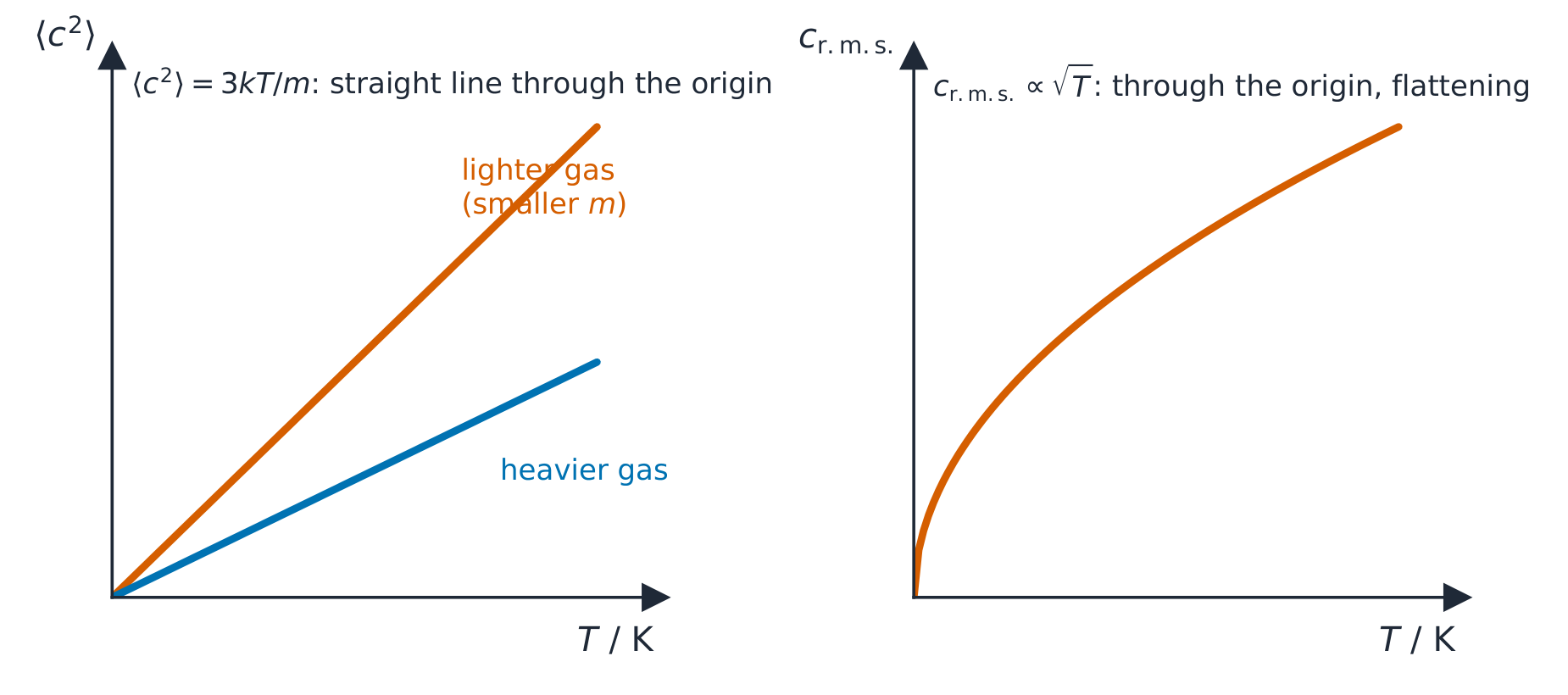
السرعة الجذرية لمتوسط مربعات: تربّع كل سرعة، خذ المتوسط، ثم الجذر التربيعيانتشار سرعات الجزيئات: درجة حرارة أعلى توسع المنحنى وتحركه نحو سرعات أسرعالرسمان اللذان يطلبهما الامتحان: $\langle c^{2}\rangle \propto T$ هو خط مستقيم يمر بنقطة الأصل، لذا $c_{\text{r.m.s.}}$ ترتفع كـ $\sqrt{T}$
Explore · استكشف
Boyle's law · قانون بويل
p ∝ 1/V
At constant temperature, pressure is inversely proportional to volume — squash the gas and the pressure rises. · عند درجة حرارة ثابتة، الضغط يتناسب عكسياً مع الحجم — اضغط على الغاز ترتفع الضغط.
Average translational kinetic energy · متوسط الطاقة الحركية الانتقالية
English
Compare the two expressions for $pV$:
$$p V = N k T \quad\text{and}\quad p V = \tfrac{1}{3} N m \langle c^{2} \rangle.$$
Set them equal, cancel $N$, and multiply by $\tfrac{3}{2}$:
$$\tfrac{3}{2} k T = \tfrac{1}{2} m \langle c^{2} \rangle.$$
The right side is the average translational kinetic energy 平动动能$\langle E_{\text{k}} \rangle$ of one molecule. So
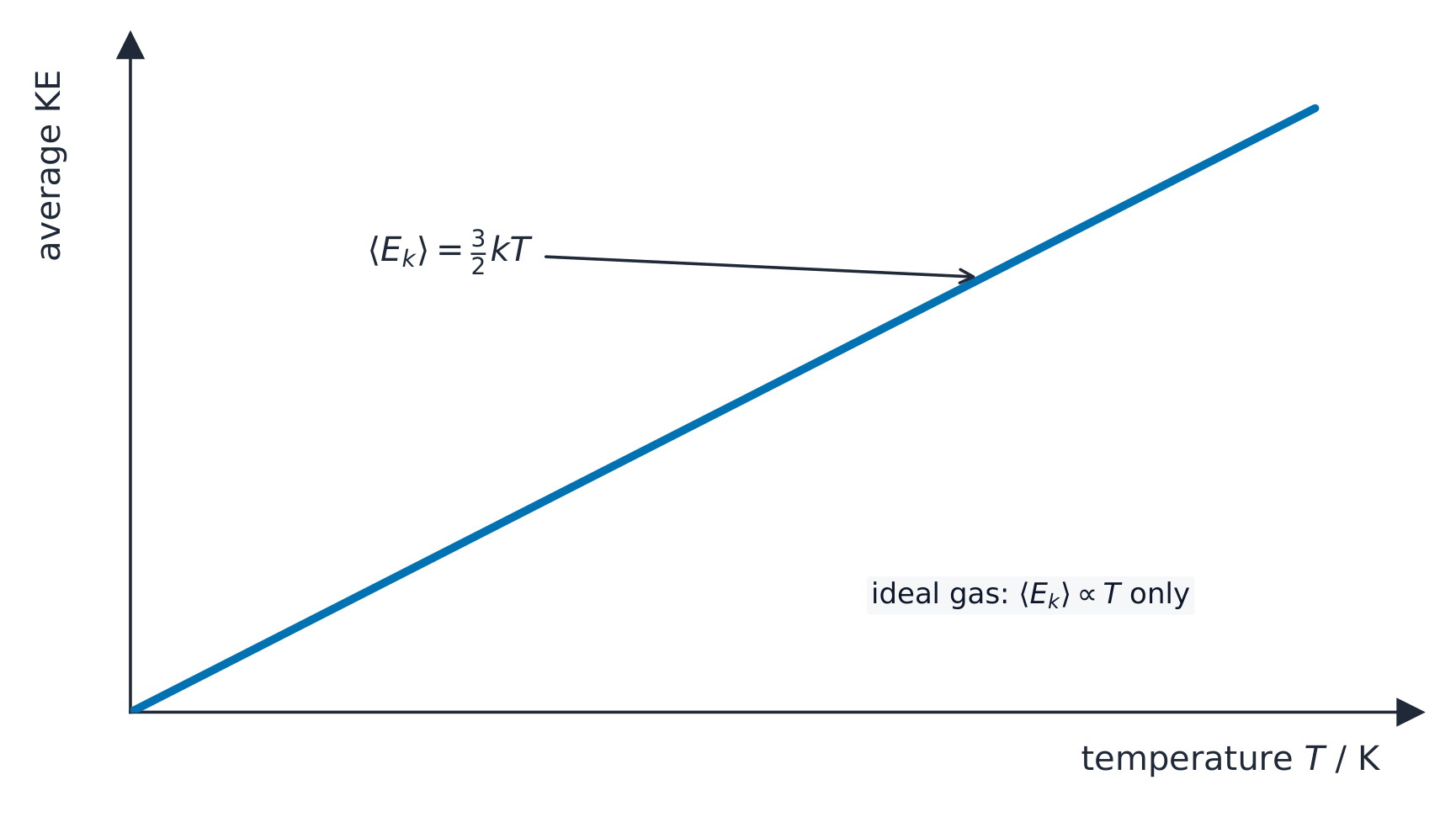
$$\langle E_{\text{k}} \rangle = \tfrac{1}{2} m \langle c^{2} \rangle = \tfrac{3}{2} k T.$$
This is a key result: the average translational kinetic energy of an ideal-gas molecule depends only on the thermodynamic temperature, not on the type of gas or its pressure.
Worked example. Find the root-mean-square speed of oxygen molecules at $300\ \text{K}$. (Mass of one $\text{O}_{2}$ molecule $= 5.3 \times 10^{-26}\ \text{kg}$, $k = 1.38 \times 10^{-23}\ \text{J K}^{-1}$.)
From $\tfrac{1}{2}m\langle c^{2}\rangle = \tfrac{3}{2}kT$, the mean-square speed is $\langle c^{2}\rangle = 3kT/m$:
Worked example. The surface of the Moon reaches about $400\ \text{K}$ in sunlight. Calculate the r.m.s. speed of hydrogen molecules ($m = 3.34 \times 10^{-27}\ \text{kg}$) at this temperature, and use the Moon's escape speed of $2.4\ \text{km s}^{-1}$ to suggest why the Moon has no hydrogen atmosphere.
$c_{\text{r.m.s.}} = \sqrt{\dfrac{3kT}{m}} = \sqrt{\dfrac{3 \times 1.38 \times 10^{-23} \times 400}{3.34 \times 10^{-27}}} = 2.2 \times 10^{3}\ \text{m s}^{-1}$. This r.m.s. speed is close to the escape speed, and the speeds are spread widely about it, so a large fraction of the molecules move faster than $2.4\ \text{km s}^{-1}$ at any moment and escape; over time the hydrogen is lost.
Worked example. The gas at the surface of a star is mainly hydrogen atoms ($m = 1.67 \times 10^{-27}\ \text{kg}$) with an r.m.s. speed of $9300\ \text{m s}^{-1}$. Find the temperature of the surface.
Worked example. For a fixed sample of gas, a graph of $pV$ against $kT$ is a straight line through the origin of gradient $7.2 \times 10^{22}$. When $pV = 270\ \text{J}$ the r.m.s. speed of the molecules is $1900\ \text{m s}^{-1}$. Find the number of molecules and the mass of one molecule in u.
From $pV = NkT$ the gradient is $N = 7.2 \times 10^{22}$. From $pV = \tfrac{1}{3}Nm\langle c^{2}\rangle$: $m = \dfrac{3pV}{N\langle c^{2}\rangle} = \dfrac{3 \times 270}{7.2 \times 10^{22} \times 1900^{2}} = 3.1 \times 10^{-27}\ \text{kg} = \dfrac{3.1 \times 10^{-27}}{1.66 \times 10^{-27}} = 1.9\ \text{u}$ — hydrogen molecules, within the rounding.
Comparing gases and samples. At the same temperature every gas has the same average kinetic energy per molecule, so $\langle c^{2}\rangle \propto 1/m$: hydrogen ($M_{\text{m}} = 2$) and oxygen ($M_{\text{m}} = 32$) have $\dfrac{c_{\text{H}}}{c_{\text{O}}} = \sqrt{\dfrac{32}{2}} = 4$. Two samples at the same $T$ — X with $N$ molecules of mass $m$ in volume $V$, Y with $2N$ molecules of mass $2m$ in volume $2V$ — have the same pressure ($p = NkT/V$ and both $N$ and $V$ double), the same average kinetic energy per molecule, but Y's molecules have half the mean-square speed ($3kT/2m$) and Y has twice the internal energy (twice as many molecules).
Consequences
doubling the absolute temperature doubles the average KE of each molecule, so $\langle c^{2} \rangle$ doubles and $c_{\text{r.m.s.}}$ grows by $\sqrt{2}$.
for two gases at the same temperature, the lighter gas has a larger $\langle c^{2} \rangle$. Hydrogen molecules move faster on average than oxygen molecules in the same room.
total translational KE of $N$ molecules: $\tfrac{3}{2} N k T = \tfrac{3}{2} n R T$.
Internal energy of an ideal gas
For an ideal gas the molecules are point particles with no intermolecular potential energy and (in this simple model) no rotation or vibration. So the internal energy 内能 is just the total kinetic energy 动能:
$$U = \tfrac{3}{2} N k T = \tfrac{3}{2} n R T.$$
So the internal energy of an ideal gas is proportional to the thermodynamic temperature — doubling $T$ doubles $U$.
As the exam asks it. "Use one of the basic assumptions to explain what can be deduced about the potential energy of the molecules": there are no forces between the molecules (except in collisions), so there is no potential energy associated with their separation — the random-motion energy is entirely kinetic. "Explain why the internal energy of an ideal gas is directly proportional to thermodynamic temperature" (2 marks): the internal energy is the sum of the kinetic and potential energies of the molecules; the potential energy is zero (no intermolecular forces), and the average kinetic energy of a molecule is $\tfrac{3}{2}kT$, proportional to $T$; so the total, $U = \tfrac{3}{2}NkT$, is proportional to $T$. "Derive $\tfrac{3}{2}kT$" (2 marks): equate $pV = NkT$ with $pV = \tfrac{1}{3}Nm\langle c^{2}\rangle$, cancel $N$, and rearrange to $\tfrac{1}{2}m\langle c^{2}\rangle = \tfrac{3}{2}kT$ — show the cancelling and the factor of $\tfrac{3}{2}$.
Worked example. A sample of $0.26\ \text{m}^{3}$ of an ideal gas is at $2.0 \times 10^{5}\ \text{Pa}$ and $290\ \text{K}$. Find the number of molecules, the average translational kinetic energy of a molecule, and the internal energy of the gas.
Doubling $p$ at fixed $T$ (by squeezing the gas to half its volume) does not change $\langle E_{\text{k}} \rangle$ — that depends only on $T$. There are more wall collisions per second, but each molecule has the same average kinetic energy.
العربية
قارن التعبيرين لـ $pV$:
$$p V = N k T \quad\text{and}\quad p V = \tfrac{1}{3} N m \langle c^{2} \rangle.$$
ساوِ بينهما، اختصر $N$، واضرب في $\tfrac{3}{2}$:
$$\tfrac{3}{2} k T = \tfrac{1}{2} m \langle c^{2} \rangle.$$
الجانب الأيمن هو متوسط الطاقة الحركية الانتقالية$\langle E_{\text{k}} \rangle$ لجزيء واحد. لذا
$$\langle E_{\text{k}} \rangle = \tfrac{1}{2} m \langle c^{2} \rangle = \tfrac{3}{2} k T.$$
هذه نتيجة جوهرية: متوسط الطاقة الحركية الانتقالية لجزيء الغاز المثالي يعتمد فقط على درجة الحرارة الديناميكية، وليس على نوع الغاز أو ضغطه.
متوسط الطاقة الحركية للجزيئات يتناسب طردياً مع درجة الحرارة الديناميكية: $\langle E_k \rangle = \tfrac32 kT$
مثال محلول. أوجد السرعة الجذرية لمتوسط المربعات لجزيئات الأكسجين عند $300\ \text{K}$. (كتلة الجزيء الواحد $\text{O}_{2}$$= 5.3 \times 10^{-26}\ \text{kg}$، $k = 1.38 \times 10^{-23}\ \text{J K}^{-1}$.)
من $\tfrac{1}{2}m\langle c^{2}\rangle = \tfrac{3}{2}kT$، فإن متوسط مربع السرعة هو $\langle c^{2}\rangle = 3kT/m$:
مثال محلول. تصل سطح القمر إلى حوالي $400\ \text{K}$ في ضوء الشمس. احسب السرعة الجذرية لمتوسط المربعات لجزيئات الهيدروجين ($m = 3.34 \times 10^{-27}\ \text{kg}$) عند هذه الدرجة الحرارية، واستخدم سرعة الهروب للقمر وهي $2.4\ \text{km s}^{-1}$ لتوضيح سبب عدم وجود غلاف جوي للهيدروجين على القمر.
$c_{\text{r.m.s.}} = \sqrt{\dfrac{3kT}{m}} = \sqrt{\dfrac{3 \times 1.38 \times 10^{-23} \times 400}{3.34 \times 10^{-27}}} = 2.2 \times 10^{3}\ \text{m s}^{-1}$. هذه السرعة الجذرية لمتوسط المربعات قريبة من سرعة الهروب، وتنتشر السرعات بشكل واسع حولها، لذا فإن جزءاً كبيراً من الجزيئات تتحرك بسرعة أكبر من $2.4\ \text{km s}^{-1}$ في أي لحظة وتهرب؛ ومع مرور الوقت يتم فقدان الهيدروجين.
مثال محلول. الغاز عند سطح النجم يتكون أساساً من ذرات الهيدروجين ($m = 1.67 \times 10^{-27}\ \text{kg}$) بسرعة جذرية لمتوسط المربعات تبلغ $9300\ \text{m s}^{-1}$. أوجد درجة حرارة السطح.
مثال محلول. لعينة ثابتة من الغاز، الرسم البياني لـ$pV$ مقابل $kT$ هو خط مستقيم يمر بنقطة الأصل بميل $7.2 \times 10^{22}$. عندما $pV = 270\ \text{J}$ تكون سرعة جذر متوسط مربع للجزيئات $1900\ \text{m s}^{-1}$. أوجد عدد الجزيئات وكتلة الجزيء الواحد بوحدة u.
من $pV = NkT$ الميل هو $N = 7.2 \times 10^{22}$. من $pV = \tfrac{1}{3}Nm\langle c^{2}\rangle$: $m = \dfrac{3pV}{N\langle c^{2}\rangle} = \dfrac{3 \times 270}{7.2 \times 10^{22} \times 1900^{2}} = 3.1 \times 10^{-27}\ \text{kg} = \dfrac{3.1 \times 10^{-27}}{1.66 \times 10^{-27}} = 1.9\ \text{u}$ — جزيئات الهيدروجين، ضمن حدود التقريب.
مقارنة الغازات والعينات. عند نفس درجة الحرارة، لكل غاز نفس متوسط الطاقة الحركية للجزيء الواحد، لذا $\langle c^{2}\rangle \propto 1/m$: الهيدروجين ($M_{\text{m}} = 2$) والأكسجين ($M_{\text{m}} = 32$) لهما $\dfrac{c_{\text{H}}}{c_{\text{O}}} = \sqrt{\dfrac{32}{2}} = 4$. عيتان عند نفس $T$ — X تحتوي على $N$ جزيئات كتلتها $m$ في حجم $V$، Y تحتوي على $2N$ جزيئات كتلتها $2m$ في حجم $2V$ — لهما نفس الضغط ($p = NkT/V$ وكلاهما $N$ ومضاعف $V$)، ونفس متوسط الطاقة الحركية للجزيء الواحد، لكن جزيئات Y لها نصف متوسط مربع السرعة ($3kT/2m$) ولها Y ضعف الطاقة الداخلية (ضعف عدد الجزيئات).
العواقب
تضاعف درجة الحرارة المطلقة يضاعف متوسط الطاقة الحركية لكل جزيء، لذا $\langle c^{2} \rangle$ يتضاعف و$c_{\text{r.m.s.}}$ يزيد بمقدار $\sqrt{2}$.
لغازين عند نفس درجة الحرارة، يكون للغاز الأخف قيمة $\langle c^{2} \rangle$ أكبر. تتحرك جزيئات الهيدروجين بشكل أسرع من جزيئات الأكسجين في نفس الغرفة.
إجمالي الطاقة الحركية الانتقالية لـ $N$ جزيئات: $\tfrac{3}{2} N k T = \tfrac{3}{2} n R T$.
الطاقة الداخلية للغاز المثالي
بالنسبة للغاز المثالي، الجزيئات هي جسيمات نقطية لا توجد بينها طاقة وضع بين جزيئية، وفي هذا النموذج البسيط لا يوجد دوران أو اهتزاز. لذا فإن الطاقة الداخلية هي ببساطة إجمالي الطاقة الحركية:
$$U = \tfrac{3}{2} N k T = \tfrac{3}{2} n R T.$$
لذا فإن الطاقة الداخلية للغاز المثالي تتناسب طردياً مع درجة الحرارة الديناميكية — تضاعف $T$ يؤدي إلى مضاعفة $U$.
كما يطرحها الامتحان. "استخدم أحد الافتراضات الأساسية لتفسير ما يمكن استنتاجه حول الطاقة الكامنة للجزيئات": لا توجد قوى بين الجزيئات (إثناء الاصطدامات)، لذا لا توجد طاقة كامنة مرتبطة بفصلها — طاقة الحركة العشوائية حركية بالكامل. "اشرح لماذا الطاقة الداخلية لغاز مثالي طردية طردياً مع درجة الحرارة الديناميكية" (2 درجات): الطاقة الداخلية هي مجموع الطاقات الحركية والكامنة للجزيئات؛ الطاقة الكامنة تساوي صفراً (لا توجد قوى بين الجزيئات)، ومتوسط الطاقة الحركية للجزيء هو $\tfrac{3}{2}kT$، وهي طردية طردياً مع $T$؛ لذا فإن المجموع الكلي، $U = \tfrac{3}{2}NkT$، هو طرد طردي مع $T$. "استنتج $\tfrac{3}{2}kT$" (2 درجات): مساوِ $pV = NkT$ بـ$pV = \tfrac{1}{3}Nm\langle c^{2}\rangle$، اختصر $N$، وأعد الترتيب للحصول على $\tfrac{1}{2}m\langle c^{2}\rangle = \tfrac{3}{2}kT$ — اعرض عملية الاختصار وعامل $\tfrac{3}{2}$.
مثال محلول. عينة مقدارها $0.26\ \text{m}^{3}$ من غاز مثالي عند درجة حرارة $2.0 \times 10^{5}\ \text{Pa}$ وضغط $290\ \text{K}$. أوجد عدد الجزيئات، ومتوسط الطاقة الحركية الانتقالية للجزيء الواحد، والطاقة الداخلية للغاز.
تضاعف $p$ عند ثبات $T$ (عن طريق ضغط الغاز لنصف حجمه) لا يغير $\langle E_{\text{k}} \rangle$ — ذلك يعتمد فقط على $T$. هناك تصادمات أكثر مع الجدران في الثانية الواحدة، لكن كل جزيء له نفس متوسط الطاقة الحركية.
15.3
Definitions the examiner accepts · التعريفات التي يقبلها المصحح
English
A definition question is marked against fixed wording. Learn these exactly, and give one answer only.
Term
Definition
mole
the amount of substance containing a number of particles equal to the Avogadro constant
Avogadro constant
the number of atoms or molecules in one mole of a substance, $6.02 \times 10^{23}\ \text{mol}^{-1}$
ideal gas
a gas that obeys $pV = nRT$ (equivalently $pV \propto T$, $T$ thermodynamic) at all values of $p$, $V$ and $T$
Boltzmann constant
the gas constant per molecule, $k = R/N_{\text{A}}$
elastic collision
a collision in which the total kinetic energy is conserved
mean-square speed
the mean of the squares of the speeds of the molecules, $\langle c^{2}\rangle$
root-mean-square speed
the square root of the mean-square speed, $c_{\text{r.m.s.}} = \sqrt{\langle c^{2}\rangle}$
average translational kinetic energy of a molecule
$\tfrac{1}{2}m\langle c^{2}\rangle = \tfrac{3}{2}kT$, depending only on thermodynamic temperature
internal energy of an ideal gas
the total kinetic energy of its molecules, $\tfrac{3}{2}NkT$, since there is no potential energy
العربية
تُصنّف أسئلة التعريف بناءً على صياغة ثابتة. احفظ هذه التعريفات بدقة، وقدم إجابة واحدة فقط.
مصطلح
تعريف
مول
كمية المادة التي تحتوي على عدد من الجسيمات يساوي ثابت أفوجادرو
ثابت أفوجادرو
عدد الذرات أو الجزيئات في مول واحد من مادة ما، $6.02 \times 10^{23}\ \text{mol}^{-1}$
غاز مثالي
غاز يخضع لـ $pV = nRT$ (أو مكافئ لـ $pV \propto T$، $T$ الديناميكية الحرارية) عند جميع قيم $p$، $V$ و$T$
ثابت بولتزمان
ثابت الغاز لكل جزيء، $k = R/N_{\text{A}}$
تصادم مرن
تصادم يحافظ فيه إجمالي الطاقة الحركية
متوسط مربع السرعة
متوسط مربعات سرعات الجزيئات، $\langle c^{2}\rangle$
السرعة الجذرية لمتوسط المربعات
الجذر التربيعي لمتوسط مربع السرعة، $c_{\text{r.m.s.}} = \sqrt{\langle c^{2}\rangle}$
متوسط الطاقة الحركية الانتقالية للجزيء
$\tfrac{1}{2}m\langle c^{2}\rangle = \tfrac{3}{2}kT$، تعتمد فقط على درجة الحرارة الديناميكية
الطاقة الداخلية للغاز المثالي
إجمالي الطاقة الحركية لجزيئاته، $\tfrac{3}{2}NkT$، لأنه لا توجد طاقة وضع
15.3
Exam tips · نصائح للامتحان
English
Use $pV = nRT$ ($n$ in mol) or $pV = NkT$ ($N$ molecules), with temperature in kelvin and volume in $\text{m}^{3}$ ($1\ \text{cm}^{3} = 10^{-6}\ \text{m}^{3}$).
Learn the kinetic-theory assumptions word for word (random motion, negligible molecular volume, no intermolecular forces except in collisions, elastic collisions, negligible collision time), and know which two fail at high pressure.
Mean translational KE $= \frac{3}{2}kT$ — it depends only on temperature; at the same $T$ a lighter molecule is faster, $\langle c^{2}\rangle \propto 1/m$.
For a "show that" about pressure, give the chain: collisions with the wall, change of momentum, force (Newton's second and third laws), force per unit area.
$p = \tfrac{1}{3}\rho\langle c^{2}\rangle$ when a density is given; $U = \tfrac{3}{2}NkT = \tfrac{3}{2}pV$ when the internal energy is asked.
Common mistakes
Using °C in $pV = nRT$ or in $\langle E_{\text{k}}\rangle = \tfrac{3}{2}kT$. Convert first; a temperature ratio only works in kelvin.
Defining an ideal gas by "obeys $pV = nRT$" alone. Add "at all values of $p$, $V$ and $T$".
Confusing $n$ (moles) with $N$ (molecules), or $R$ with $k$. $N = nN_{\text{A}}$ and $k = R/N_{\text{A}}$.
Giving "molecules move randomly" as the reason for pressure. The mark is for the change of momentum at the wall and the resulting force per unit area.
Sketching $c_{\text{r.m.s.}}$ against $T$ as a straight line. $\langle c^{2}\rangle$ is linear in $T$; $c_{\text{r.m.s.}}$ rises as $\sqrt{T}$.
Saying a molecule's kinetic energy changes when the pressure is doubled at constant temperature. Only the number of collisions per second changes.
العربية
استخدم $pV = nRT$ ($n$ بالمول) أو $pV = NkT$ ($N$ جزيئات)، مع درجة الحرارة بـ كلفن والحجم بـ $\text{m}^{3}$ ($1\ \text{cm}^{3} = 10^{-6}\ \text{m}^{3}$).
احفظ افتراضات النظرية الحركية حرفياً (الحركة العشوائية، حجم الجزيئات مهملاً، لا قوى بين جزيئية ما عدا في التصادمات، تصادمات مرنة، وقت التصادم مهملاً)، واعرف أي اثنين يفشلان عند الضغط العالي.
متوسط الطاقة الحركية الانتقالية $= \frac{3}{2}kT$ — إنه يعتمد فقط على درجة الحرارة؛ عند نفس $T$، الجزيء الأخف يكون أسرع، $\langle c^{2}\rangle \propto 1/m$.
لإثبات علاقة الضغط، اذكر التسلسل: التصادمات مع الجدار، التغير في الزخم، القوة (قانون نيوتن الثاني والثالث)، القوة لكل وحدة مساحة.
$p = \tfrac{1}{3}\rho\langle c^{2}\rangle$ عند إعطاء الكثافة؛ $U = \tfrac{3}{2}NkT = \tfrac{3}{2}pV$ عند طلب الطاقة الداخلية.
أخطاء شائعة
استخدام درجة مئوية (°C) في $pV = nRT$ أو في $\langle E_{\text{k}}\rangle = \tfrac{3}{2}kT$. قُم بالتحويل أولاً؛ لا يعمل نسبة درجات الحرارة إلا بوحدة كلفن.
تعريف الغاز المثالي بأنه "يخضع لـ $pV = nRT$" وحده. أضف "عند جميع قيم $p$، $V$ و $T$".
الخلط بين $n$ (المول) و $N$ (الجزيئات)، أو بين $R$ و $k$. $N = nN_{\text{A}}$ و $k = R/N_{\text{A}}$.
تقديم "تتحرك الجزيئات عشوائياً" كسبب للضغط. العلامة تُمنح للتغير في الزخم عند الجدار والقوة الناتجة لكل وحدة مساحة.
رسم $c_{\text{r.m.s.}}$ بدلالة $T$ كخط مستقيم. $\langle c^{2}\rangle$ يتناسب طردياً مع $T$؛ يرتفع $c_{\text{r.m.s.}}$ كلما زادت $\sqrt{T}$.
القول بأن الطاقة الحركية للجزيء تتغير عندما يُضاعف الضغط عند ثبوت درجة الحرارة. يتغير فقط عدد التصادمات في الثانية.
Interactive lessons on this topic · دروس تفاعلية حول هذا الموضوع
Work through it step by step, with instant-check exercises. · ا-working عليه خطوة بخطوة، مع تمارين تحقق فوري.
Pick one and the site follows you — notes, papers, videos and practice all open on it. · اختر واحدًا وسيتبعك الموقع — الملاحظات، الأوراق، الفيديوهات والتدريب جميعها تفتح عليه.
Type to search notes, lessons, code, vocabulary and past-paper questions across every subject. · اكتب للبحث عن ملاحظات، دروس، أكواد، مفردات وأسئلة امتحانات سابقة عبر جميع المواد.