انظر إلى جسر معلّق عظيم. كابلها الضخم ليس شكلاً عشوائياً — بل يتدلى في قطع مكافئ مثالي، منحنٍ يمكنك كتابته بمعادلة واحدة. الـ…
English narration · English + 中文 subtitles burned in · سرد باللغة الإنجليزية · ترجمة مدمجة بالإنجليزية + الصينية
English
This handout covers Topic 1: Pure Mathematics 纯数学 1. It is the algebra 代数 and calculus 微积分 core of the course. Each ## section is one syllabus subtopic.
العربية
يتناول هذا الملف الموضوع 1: الرياضيات البحتة 1. إنه الجوهر الجبري والتفاضلي للتخصص. كل قسم ## هو موضوع فرعي في المنهج الدراسي.
1.1
Quadratics · المعادلات التربيعية
Syllabus · المنهج
English
Candidates should be able to:
Notes and examples
carry out the process of completing the square for a quadratic polynomial $ax^2 + bx + c$ and use a completed square form
e.g. to locate the vertex of the graph of $y = ax^2 + bx + c$ or to sketch the graph
find the discriminant of a quadratic polynomial $ax^2 + bx + c$ and use the discriminant
e.g. to determine the number of real roots of the equation $ax^2 + bx + c = 0$. Knowledge of the term ‘repeated root’ is included.
solve quadratic equations, and quadratic inequalities, in one unknown
By factorising, completing the square and using the formula.
solve by substitution a pair of simultaneous equations of which one is linear and one is quadratic
e.g. $x + y + 1 = 0$ and $x^2 + y^2 = 25$, $2x + 3y = 7$ and $3x^2 = 4 + 4xy$.
recognise and solve equations in $x$ which are quadratic in some function of $x$.
Source: Cambridge International syllabus · المصدر: منهج كامبريدج الدولي
English
Completing the square finds the vertex
A quadratic 二次式 is an expression of the form $ax^2 + bx + c$, where $a \neq 0$. The letters $a$, $b$, $c$ are the coefficients 系数 (the fixed numbers). Much of this section is about solving the equation$ax^2 + bx + c = 0$.
Completing the square
To complete the square 配方 means to write the quadratic in the form
$$a(x + p)^2 + q.$$
This form is useful: it shows the vertex 顶点 (turning point) of the curve at $(-p,\ q)$, and it gives a quick way to solve the equation.
Worked example. Write $9x^2 - 36x + 8$ in the form $p(x + q)^2 + r$.
Take the factor $9$ out of the first two terms, then complete the square inside:
Factorise: $(k - 4)(k - 16) > 0$, so $k < 4$ or $k > 16$. You also need $a \neq 0$, so $k \neq 0$.
Quadratic equations and inequalities
To solve a quadratic equation 二次方程, factorise, complete the square, or use the formula
$$x = \frac{-b \pm \sqrt{b^2 - 4ac}}{2a}.$$
To solve a quadratic inequality 二次不等式 such as $(k - 4)(k - 16) > 0$, find the two roots, then decide which side of each root makes the statement true. A sketch of the parabola 抛物线 helps: the curve is above the $x$-axis (positive) outside the roots and below it (negative) between them.
Simultaneous equations
To solve a pair of simultaneous equations 联立方程 where one is linear and one is quadratic, use substitution 代入: rearrange the linear equation for one letter, then put that into the quadratic. This gives a single quadratic to solve.
Equations that are quadratic in disguise
Some equations are quadratic in some function of$x$. For example $x^4 - 5x^2 + 4 = 0$ is quadratic in $x^2$: let $u = x^2$, solve $u^2 - 5u + 4 = 0$, then go back to $x$. You will use this idea again in trigonometry.
العربية
إكمال المربع يجد الرأسجسر معلق: الكابل الرئيسي يتدلى على شكل قطع مكافئ.
التربيعية هي تعبير من الشكل $ax^2 + bx + c$، حيث $a \neq 0$. الأحرف $a$، $b$، $c$ هي المعاملات (الأرقام الثابتة). جزء كبير من هذا القسم يتعلق بحل المعادلة$ax^2 + bx + c = 0$.
إكمال المربع
يعني إكمال المربع كتابة التربيعية على الشكل
$$a(x + p)^2 + q.$$
هذا الشكل مفيد: فهو يُظهر الرأس (نقطة الانعطاف) للمنحنى عند $(-p,\ q)$، ويعطي طريقة سريعة لحل المعادلة.
مثال محلول. اكتب $9x^2 - 36x + 8$ على الشكل $p(x + q)^2 + r$.
خذ العامل $9$ خارج الحدين الأولين، ثم أكمل المربع داخل القوسين:
حلل: $(k - 4)(k - 16) > 0$، إذن $k < 4$ أو $k > 16$. تحتاج أيضًا $a \neq 0$، إذن $k \neq 0$.
المعادلات والتفاوتات التربيعية
لحل معادلة تربيعية، قم بتحليلها، أو أكمل المربع، أو استخدم الصيغة
$$x = \frac{-b \pm \sqrt{b^2 - 4ac}}{2a}.$$
لحل تفاوت تربيعي مثل $(k - 4)(k - 16) > 0$، أوجد الجذرين، ثم حدد أي جانب من كل جذر يجعل العبارة صحيحة. يساعد رسم بياني للقطع المكافئ: المنحنى فوق محور $x$ (موجب) خارج الجذور وأسفله (سالب) بينهما.
المعادلات المتزامنة
لحل زوج من المعادلات المتزامنة حيث واحدة خطية والأخرى تربيعية، استخدم التعويض: أعد ترتيب المعادلة الخطية لإحدى الحروف، ثم ضع ذلك في التربيعية. هذا يعطي معادلة تربيعية واحدة للحل.
المعادلات التي هي تربيعية بشكل خفي
بعض المعادلات هي تربيعية في بعض دوال$x$. على سبيل المثال $x^4 - 5x^2 + 4 = 0$ هي تربيعية في $x^2$: دع $u = x^2$، حل $u^2 - 5u + 4 = 0$، ثم عد إلى $x$. ستستخدم هذه الفكرة مجددًا في حساب المثلثات.
Explore · استكشف
The shape of a quadratic · شكل الدالة التربيعية
y = ax² + bx + c
Drag a, b and c. Watch the vertex, the line of symmetry and the roots (where it cuts the x-axis) move as the coefficients change. · اسحب a وb وc. راقب حركة الرأس، وخط التماثل والجذور (حيث يقطع محور x) مع تغير المعاملات.
understand the terms function, domain, range, one-one function, inverse function and composition of functions
identify the range of a given function in simple cases, and find the composition of two given functions
e.g. range of $f : x \mapsto \frac{1}{x}$ for $x \geqslant 1$ and range of $g : x \mapsto x^2 + 1$ for $x \in \mathbb{R}$. Including the condition that a composite function $gf$ can only be formed when the range of $f$ is within the domain of $g$.
determine whether or not a given function is one-one, and find the inverse of a one-one function in simple cases
e.g. finding the inverse of $h : x \mapsto (2x + 3)^2 - 4$ for $x < -\frac{3}{2}$.
illustrate in graphical terms the relation between a one-one function and its inverse
Sketches should include an indication of the mirror line $y = x$.
understand and use the transformations of the graph of $y = f(x)$ given by $y = f(x) + a$, $y = f(x + a)$, $y = af(x)$, $y = f(ax)$ and simple combinations of these.
Including use of the terms ‘translation’, ‘reflection’ and ‘stretch’ in describing transformations. Questions may involve algebraic or trigonometric functions, or other graphs with given features.
تحديد النطاق لدالة معطاة في الحالات البسيطة، وإيجاد تركيب دالتين معطاتين
مثلاً نطاق $f : x \mapsto \frac{1}{x}$ لـ $x \geqslant 1$ ونطاق $g : x \mapsto x^2 + 1$ لـ $x \in \mathbb{R}$. شمل الشرط الذي ينص على أنه لا يمكن تكوين دالة مركبة $gf$ إلا عندما يكون نطاق $f$ ضمن مجال $g$.
تحديد ما إذا كانت الدالة المعطاة أحادية One-one أم لا، وإيجاد العكس لدالة أحادية One-one في الحالات البسيطة
مثلاً إيجاد العكس لـ $h : x \mapsto (2x + 3)^2 - 4$ لـ $x < -\frac{3}{2}$.
توضيح العلاقة بيانياً بين الدالة الأحادية One-one وعكسها
يجب أن تشمل الرسومات تلميحا لخط الانعكاس $y = x$.
فهم واستخدام التحويلات لمنحنى $y = f(x)$ المعطاة بواسطة $y = f(x) + a$، $y = f(x + a)$، $y = af(x)$، $y = f(ax)$ والمجموعات البسيطة منها.
شمل استخدام المصطلحات 'الإزاحة' و'الانعكاس' و'التمدد' في وصف التحويلات. قد تتضمن الأسئلة دوال جبرية أو مثلثية، أو منحنيات أخرى بخصائص معطاة.
Source: Cambridge International syllabus · المصدر: منهج كامبريدج الدولي
English
Transforming graphs: shift and stretch
A function 函数 is a rule that sends each input to exactly one output. Write it as $f(x)$. The composition of functions 复合函数$fg(x)$ means apply $g$ first, then apply $f$ to the result.
The domain 定义域 is the set of allowed inputs $x$.
The range 值域 is the set of outputs the function actually produces.
A function is one-one 一一对应 if different inputs always give different outputs. (No output is repeated.) Only a one-one function has an inverse function 反函数$f^{-1}$, which reverses the rule.
The composition 复合 of two functions means doing one after the other. $fg(x)$ means "do $g$ first, then $f$": $fg(x) = f(g(x))$. The composite function $fg$ exists only when the range of $g$ lies inside the domain of $f$.
Finding an inverse
To find $f^{-1}$: write $y = f(x)$, make $x$ the subject, then swap letters.
Worked example. The function $f(x) = (x + 3)^2 - 12$ is defined for $x \geqslant 0$. Find $f^{-1}(x)$.
Write $y = (x + 3)^2 - 12$ and solve for $x$:
$$(x + 3)^2 = y + 12 \;\Rightarrow\; x + 3 = \sqrt{y + 12} \;\Rightarrow\; x = \sqrt{y + 12} - 3.$$
You take the positive square root because $x \geqslant 0$ means $x + 3 \geqslant 3 > 0$. So
$$f^{-1}(x) = \sqrt{x + 12} - 3.$$
Graphs of inverses and transformations
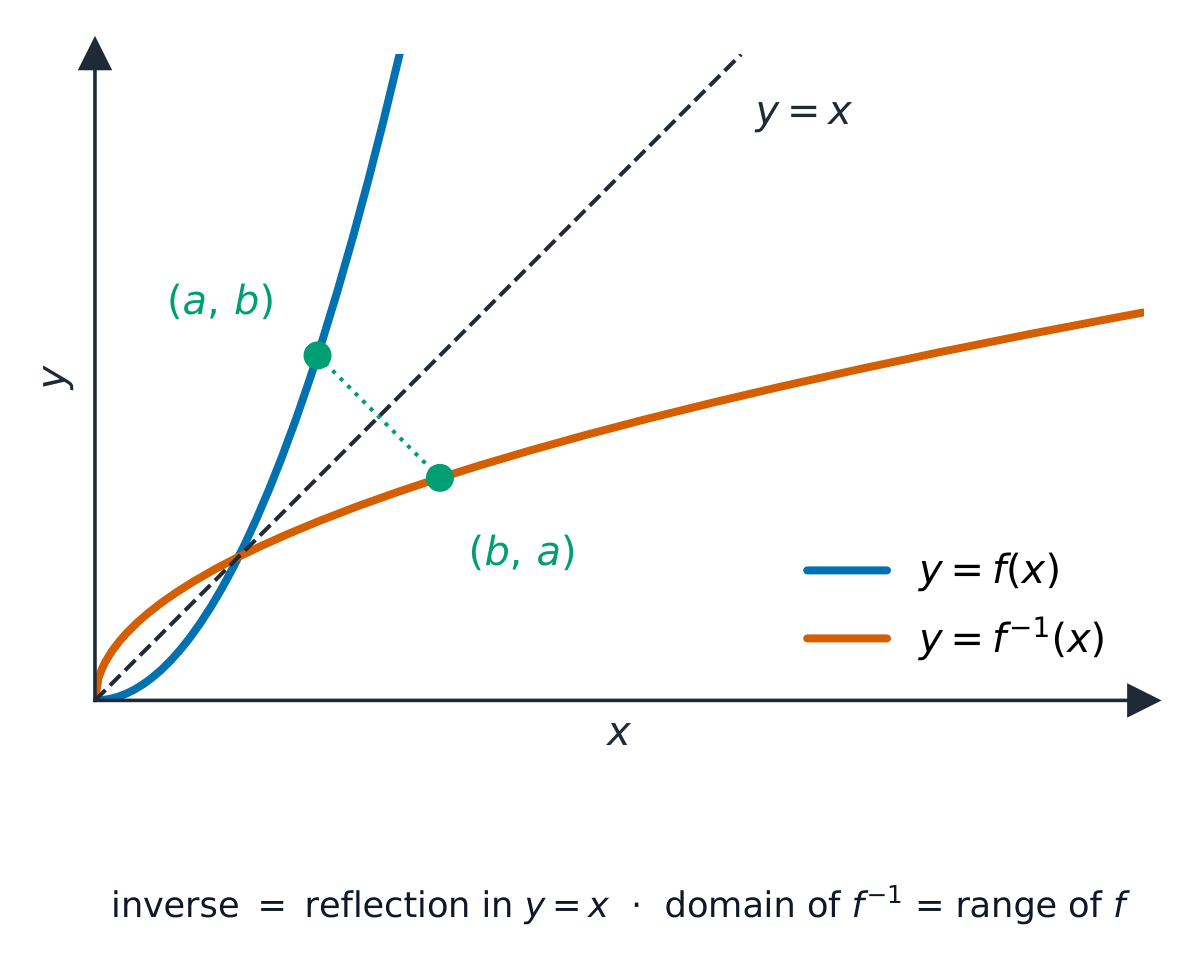
The graph of $y = f^{-1}(x)$ is the reflection 反射 of $y = f(x)$ in the line $y = x$.
You should know these transformations 变换 of $y = f(x)$:
New equation
Effect on the graph
$y = f(x) + a$
translation 平移 up by $a$
$y = f(x + a)$
translation left by $a$
$y = a\,f(x)$
stretch 伸缩 in the $y$-direction, scale factor $a$
$y = f(ax)$
stretch in the $x$-direction, scale factor $\tfrac{1}{a}$
When two transformations are combined, the order can matter. State each one fully (type, direction, and amount).
العربية
تحويل الرسوم البيانية: الإزالة والتمدد
الدالة function هي قاعدة ترسل كل مدخل إلى مخرج واحد بالضبط. اكتبها كـ $f(x)$. تركيب الدوال$fg(x)$ يعني تطبيق $g$ أولاً، ثم تطبيق $f$ على النتيجة.
المجال هو مجموعة المدخلات المسموحة $x$.
المدى هو مجموعة النواتج التي تنتجها الدالة فعلياً.
الدالة تكون واحدة لواحد إذا كانت المدخلات المختلفة تعطي دائماً نواتج مختلفة. (لا يتم تكرار أي ناتج.) فقط الدالة الواحدة لواحد لها دالة عكسية$f^{-1}$، والتي تعكس القاعدة.
تركيب دالتين يعني القيام بإحداهما بعد الأخرى. $fg(x)$ تعني "افعل $g$ أولاً، ثم $f$": $fg(x) = f(g(x))$. توجد الدالة المركبة $fg$ فقط عندما يكون مدى $g$ داخل مجال $f$.
إيجاد الدالة العكسية
لإيجاد $f^{-1}$: اكتب $y = f(x)$، اجعل $x$ موضوع المعادلة، ثم استبدل الأحرف.
مثال محلول. الدالة $f(x) = (x + 3)^2 - 12$ معرفة لـ $x \geqslant 0$. أوجد $f^{-1}(x)$.
اكتب $y = (x + 3)^2 - 12$ وحل من أجل $x$:
$$(x + 3)^2 = y + 12 \;\Rightarrow\; x + 3 = \sqrt{y + 12} \;\Rightarrow\; x = \sqrt{y + 12} - 3.$$
أنت تأخذ الجذر التربيعي الموجب لأن $x \geqslant 0$ تعني $x + 3 \geqslant 3 > 0$. لذا
$$f^{-1}(x) = \sqrt{x + 12} - 3.$$
رسوم بيانية للدوال العكسية والتحويلات
الرسم البياني لـ $y = f^{-1}(x)$ هو انعكاس لـ $y = f(x)$ في الخط $y = x$.
انعكاس $y=f(x)$ في الخط $y=x$ يعطي دالتها العكسية؛ النقطة $(a,b)$ تصبح $(b,a)$.
يجب أن تعرف هذه التحويلات لـ $y = f(x)$:
معادلة جديدة
التأثير على الرسم البياني
$y = f(x) + a$
إزاحة لأعلى بمقدار $a$
$y = f(x + a)$
إزاحة لليسار بمقدار $a$
$y = a\,f(x)$
تمدّد في اتجاه $y$، معامل القياس $a$
$y = f(ax)$
تمدد في اتجاه $x$، عامل مقياس $\tfrac{1}{a}$
عند دمج تحويلين، قد يهم الترتيب. حدد كل تحويل بالكامل (النوع، الاتجاه، والكمية).
إضافة للمخرجات أو المدخلات تُزيح المنحنى؛ المضروب يمدده.
Explore · استكشف
Explore a function · استكشف دالة
y = ax³ + bx² + cx + d
A function turns each input into exactly one output — drag the coefficients and watch where the curve rises and falls. · تحول الدالة كل مدخل إلى خرج واحد بالضبط — اسحب المعاملات ولاحظ أين يرتفع المنحنى وينخفض.
find the equation of a straight line given sufficient information
e.g. given two points, or one point and the gradient.
interpret and use any of the forms $y = mx + c$, $y - y_1 = m(x - x_1)$, $ax + by + c = 0$ in solving problems
Including calculations of distances, gradients, midpoints, points of intersection and use of the relationship between the gradients of parallel and perpendicular lines.
understand that the equation $(x - a)^2 + (y - b)^2 = r^2$ represents the circle with centre $(a, b)$ and radius $r$
Including use of the expanded form $x^2 + y^2 + 2gx + 2fy + c = 0$.
use algebraic methods to solve problems involving lines and circles
Including use of elementary geometrical properties of circles, e.g. tangent perpendicular to radius, angle in a semicircle, symmetry. Implicit differentiation is not included.
understand the relationship between a graph and its associated algebraic equation, and use the relationship between points of intersection of graphs and solutions of equations.
e.g. to determine the set of values of $k$ for which the line $y = x + k$ intersects, touches or does not meet a quadratic curve.
العربية
يجب أن يكون المرشحون قادرين على:
ملاحظات وأمثلة
إيجاد معادلة الخط المستقيم عند توفر معلومات كافية
مثلاً عند إعطاء نقطتين، أو نقطة واحدة وميل.
تفسير واستخدام أي من الصيغ $y = mx + c$، $y - y_1 = m(x - x_1)$، $ax + by + c = 0$ في حل المسائل
شمل حسابات المسافات، الميل، نقاط المنتصف، نقاط التقاطع واستخدام العلاقة بين الميل لـالخطوط المتوازية والخطوط العمودية.
فهم أن المعادلة $(x - a)^2 + (y - b)^2 = r^2$ تمثل الدائرة ذات المركز $(a, b)$ ونصف القطر $r$
شمل استخدام الصورة الموسعة $x^2 + y^2 + 2gx + 2fy + c = 0$.
استخدام الطرق الجبرية لحل المسائل الخطوط والدوائر
شمل استخدام الخصائص الهندسية الأولية للدوائر، مثلاً المماس عمودي على نصف القطر، الزاوية في نصف الدائرة، التناظر. لا يُشمل الاشتقاق الضمني.
فهم العلاقة بين المنحنى ومعادلته الجبرية المرتبطة بها، واستخدام العلاقة بين نقاط تقاطع المنحنيات وحلول المعادلات.
مثلاً لتحديد مجموعة قيم $k$ التي تجعل الخط $y = x + k$ يقطع المنحنى التربيعي أو يلمسه أو لا يلقاه.
Source: Cambridge International syllabus · المصدر: منهج كامبريدج الدولي
English
Coordinate geometry 坐标几何 studies lines and circles using their equations.
Straight lines
The gradient 斜率 (steepness) of the line joining $(x_1, y_1)$ and $(x_2, y_2)$ is
$$m = \frac{y_2 - y_1}{x_2 - x_1}.$$
You can write the equation of a straight line 直线方程 in any of these forms:
$$y = mx + c, \qquad y - y_1 = m(x - x_1), \qquad ax + by + c = 0.$$
Two lines are parallel 平行 when their gradients are equal, and perpendicular 垂直 (at right angles) when the product of their gradients is $-1$.
Circles
The circle 圆 with centre 圆心$(a, b)$ and radius 半径$r$ has equation
$$(x - a)^2 + (y - b)^2 = r^2.$$
An expanded form like $x^2 + y^2 - 6x + 10y - 27 = 0$ is the same circle: complete the square in $x$ and in $y$ to find the centre and radius.
A tangent 切线 to a circle touches it at one point and is perpendicular to the radius at that point. This right-angle fact solves most circle problems.
Worked example. The points $P(1, 1)$ and $Q(7, 11)$ are the ends of a diameter 直径 of a circle. Find the equation of the circle.
understand the definition of a radian, and use the relationship between radians and degrees
use the formulae $s = r\theta$ and $A = \frac{1}{2}r^2\theta$ in solving problems concerning the arc length and sector area of a circle.
Including calculation of lengths and angles in triangles and areas of triangles.
العربية
يجب أن يكون المرشحون قادرين على:
ملاحظات وأمثلة
فهم تعريف الراديان، واستخدام العلاقة بين الراديان والدرجات
استخدام الصيغ $s = r\theta$ و $A = \frac{1}{2}r^2\theta$ في حل المسائل المتعلقة بـ طول القوس و مساحة القطاع للدائرة.
بما في ذلك حساب الأطوال والزوايا في المثلثات ومساحاتها.
Source: Cambridge International syllabus · المصدر: منهج كامبريدج الدولي
English
What is a radian?
Radians
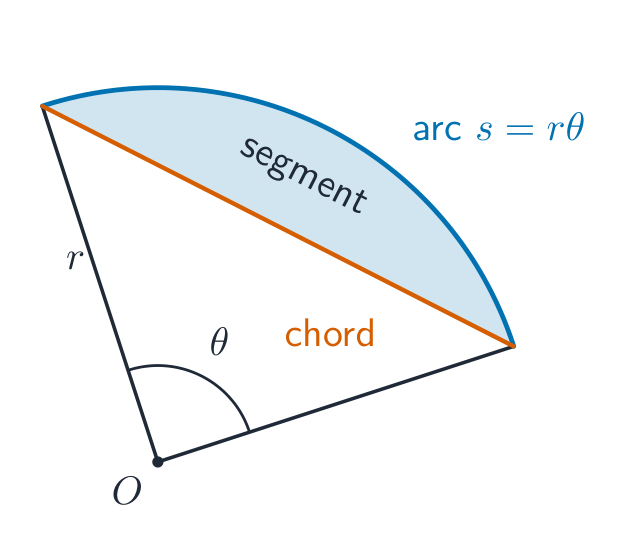
A radian 弧度 is another way to measure angles. One radian is the angle at the centre of a circle that cuts off an arc 弧 equal in length to the radius. The link between radians and degrees 度 is
$$\pi \text{ radians} = 180^\circ.$$
So to change degrees to radians, multiply by $\dfrac{\pi}{180}$; to change radians to degrees, multiply by $\dfrac{180}{\pi}$.
Arc length and sector area
For a sector 扇形 with radius $r$ and angle $\theta$in radians:
$$\text{arc length} = s = r\theta, \qquad \text{sector area} = A = \tfrac12 r^2 \theta.$$
A chord 弦 cuts the sector into a triangle and a segment 弓形. The segment area is the sector minus the triangle:
Worked example. A sector has centre $O$ and the angle at $O$ is $\tfrac{2}{3}\pi$ radians. Show that the segment cut off by the chord has area about $0.614 r^2$.
الراديان هو طريقة أخرى لقياس الزوايا. الراديان الواحد هو الزاوية في مركز الدائرة التي تقطع قوساً طوله يساوي نصف القطر. العلاقة بين الراديان والدرجات هي
$$\pi \text{ radians} = 180^\circ.$$
لذا لتحويل الدرجات إلى راديان، اضرب في $\dfrac{\pi}{180}$؛ ولتحويل الراديان إلى درجات، اضرب في $\dfrac{180}{\pi}$.
راديان واحد: الزاوية التي يساوي قوسها نصف القطر
طول القوس ومساحة القطاع
بالنسبة لـقطاع نصف قطره $r$ وزاويته $\theta$بالراديان:
$$\text{arc length} = s = r\theta, \qquad \text{sector area} = A = \tfrac12 r^2 \theta.$$
الوتر يقسم القطاع إلى مثلث وجزء مقطع. مساحة الجزء المقطع هي القطاع ناقص المثلث:
Radians, arcs and sectors · الدرجات القوسية والقوس والمقطع الدائري
Change the angle (in radians) and radius. See the arc length$s = r\theta$ and the sector area$\tfrac12 r^2\theta$ update. · غيّر الزاوية (بالدرجات القوسية) ونصف القطر. شاهد تحديث طول القوس$s = r\theta$ ومساحة المقطع الدائري$\tfrac12 r^2\theta$.
sketch and use graphs of the sine, cosine and tangent functions (for angles of any size, and using either degrees or radians)
Including e.g. $y = 3 \sin x$, $y = 1 - \cos 2x$, $y = \tan(x + \frac{1}{4}\pi)$.
use the exact values of the sine, cosine and tangent of $30^\circ$, $45^\circ$, $60^\circ$, and related angles
e.g. $\cos 150^\circ = -\frac{1}{2}\sqrt{3}$, $\sin \frac{3}{4}\pi = \frac{1}{\sqrt{2}}$.
use the notations $\sin^{-1} x$, $\cos^{-1} x$, $\tan^{-1} x$ to denote the principal values of the inverse trigonometric relations
No specialised knowledge of these functions is required, but understanding of them as examples of inverse functions is expected.
use the identities $\frac{\sin \theta}{\cos \theta} \equiv \tan \theta$ and $\sin^2 \theta + \cos^2 \theta \equiv 1$
e.g. in proving identities, simplifying expressions and solving equations.
find all the solutions of simple trigonometrical equations lying in a specified interval (general forms of solution are not included).
e.g. solve $3 \sin 2x + 1 = 0$ for $-\pi < x < \pi$, $3 \sin^2 \theta - 5 \cos \theta - 1 = 0$ for $0^\circ \leqslant \theta \leqslant 360^\circ$.
العربية
يجب أن يكون المرشحون قادرين على:
ملاحظات وأمثلة
رسم واستخدام بيانيات دالتي الجيب و جيب التمام و ظل الزاوية (لزوايا من أي حجم، باستخدام الدرجات أو الراديان)
بما في ذلك على سبيل المثال $y = 3 \sin x$، $y = 1 - \cos 2x$، $y = \tan(x + \frac{1}{4}\pi)$.
استخدام القيم الدقيقة لـ جيب الزاوية و جيب تامة الزاوية و ظل الزاوية عند $30^\circ$، $45^\circ$، $60^\circ$، والزاويات ذات الصلة
على سبيل المثال $\cos 150^\circ = -\frac{1}{2}\sqrt{3}$، $\sin \frac{3}{4}\pi = \frac{1}{\sqrt{2}}$.
استخدام الرموز $\sin^{-1} x$، $\cos^{-1} x$، $\tan^{-1} x$ للإشارة إلى القيم الأساسية لعلاقات المقلوب المثلثاتي
لا يُشترط معرفة متخصصة بهذه الدوال، لكن يُتوقع فهمها كأمثلة على الدوال العكسية.
استخدام المتطابقات $\frac{\sin \theta}{\cos \theta} \equiv \tan \theta$ و $\sin^2 \theta + \cos^2 \theta \equiv 1$
على سبيل المثال في إثبات المتطابقات، وتبسيط التعبيرات وحل المعادلات.
إيجاد جميع حلول المعادلات المثلثية البسيطة الواقعة في مجال محدد (لا تُشمل الأشكال العامة للحلول).
على سبيل المثال: حل $3 \sin 2x + 1 = 0$ عندما $-\pi < x < \pi$، و$3 \sin^2 \theta - 5 \cos \theta - 1 = 0$ عندما $0^\circ \leqslant \theta \leqslant 360^\circ$.
Source: Cambridge International syllabus · المصدر: منهج كامبريدج الدولي
English
Amplitude, period and midline of a sine curveThe unit circle draws the sine curve
Graphs and exact values
You must know the shape of the graphs of the sine 正弦, cosine 余弦 and tangent function 正切 (written $\sin$, $\cos$, $\tan$). The sine and cosine graphs wave between $-1$ and $1$ and repeat every $360^\circ$ ($2\pi$). Learn these exact values:
$\theta$
$30^\circ$
$45^\circ$
$60^\circ$
$\sin\theta$
$\tfrac12$
$\tfrac{1}{\sqrt2}$
$\tfrac{\sqrt3}{2}$
$\cos\theta$
$\tfrac{\sqrt3}{2}$
$\tfrac{1}{\sqrt2}$
$\tfrac12$
$\tan\theta$
$\tfrac{1}{\sqrt3}$
$1$
$\sqrt3$
The notations $\sin^{-1}x$, $\cos^{-1}x$, $\tan^{-1}x$ mean the inverse angle (the principal value 主值).
Identities
An identity 恒等式 is true for every value of the angle. The two you must know are
$\sin\theta = -\tfrac12$: $\theta = -30^\circ$ or $\theta = -150^\circ$.
The four solutions are $\theta = -150^\circ,\ -30^\circ,\ 41.8^\circ,\ 138.2^\circ$.
العربية
السعة، الدورة، والخط الوسطى لمنحنى الجيبالدائرة الوحدة ترسم منحنى الجيبعجلة عجيبة: نقطة على الحافة ترتفع وتنخفض كمنحنى جيب.
الرسوم البيانية والقيم الدقيقة
يجب أن تعرف شكل الرسوم البيانية لـالجيب، جيب التمام وظل الدالة (تُكتب $\sin$، $\cos$، $\tan$). رسوم الجيب وجيب التمام تتذبذب بين $-1$ و $1$ وتتكرر كل $360^\circ$ ($2\pi$). احفظ هذه القيم الدقيقة:
$\theta$
$30^\circ$
$45^\circ$
$60^\circ$
$\sin\theta$
$\tfrac12$
$\tfrac{1}{\sqrt2}$
$\tfrac{\sqrt3}{2}$
$\cos\theta$
$\tfrac{\sqrt3}{2}$
$\tfrac{1}{\sqrt2}$
$\tfrac12$
$\tan\theta$
$\tfrac{1}{\sqrt3}$
$1$
$\sqrt3$
في دورة واحدة $\sin$ و $\cos$ يبقى بين $-1$ و $1$؛ $\tan$ يهرب عند $90^\circ$ و $270^\circ$.
الرموز $\sin^{-1}x$، $\cos^{-1}x$، $\tan^{-1}x$ تعني زاوية عكسية (الـقيمة الرئيسية).
المتطابقات
المتطابقة صحيحة لكل قيمة للزاوية. المتطابقتان اللتان يجب أن تعرفهما هما:
$\sin\theta = -\tfrac12$: $\theta = -30^\circ$ أو $\theta = -150^\circ$.
الحلول الأربعة هي $\theta = -150^\circ,\ -30^\circ,\ 41.8^\circ,\ 138.2^\circ$.
Explore · استكشف
Sine & cosine graphs · منحنيات الجيب وجيب التمام
Drag the amplitude, period and shifts of y = a·sin(bx + c) + d and watch the curve change against the base wave. · اسحب السعة والدورة والإزاحات لـ y = a·sin(bx + c) + d ولاحظ تغير المنحنى مقابل الموجة الأساسية.
Explore · استكشف
Sine and cosine on the unit circle · الجيب وجيب التمام على دائرة الوحدة
Drag the angle round the unit circle. The height is $\sin\theta$, the across-distance is $\cos\theta$ — that's where the graphs come from. · اسحب الزاوية حول دائرة الوحدة. الارتفاع هو $\sin\theta$ والمسافة الأفقية هي $\cos\theta$ — ومن هنا تأتي الرسوم البيانية.
use the expansion of $(a + b)^n$, where $n$ is a positive integer
Including the notations $\begin{pmatrix} n \\ r \end{pmatrix}$ and $n!$ Knowledge of the greatest term and properties of the coefficients are not required.
recognise arithmetic and geometric progressions
use the formulae for the $n$th term and for the sum of the first $n$ terms to solve problems involving arithmetic or geometric progressions
Including knowledge that numbers $a$, $b$, $c$ are 'in arithmetic progression' if $2b = a + c$ (or equivalent) and are 'in geometric progression' if $b^2 = ac$ (or equivalent). Questions may involve more than one progression.
use the condition for the convergence of a geometric progression, and the formula for the sum to infinity of a convergent geometric progression.
العربية
يجب أن يكون المرشحون قادرين على:
ملاحظات وأمثلة
استخدام مفكوك $(a + b)^n$، حيث $n$ عدد صحيح موجب
بما في ذلك الرموز $\begin{pmatrix} n \\ r \end{pmatrix}$ و $n!$. لا يُشترط معرفة الحد الأكبر وخصائص المعاملات.
التعرف على التسلسلات الحسابية و التسلسلات الهندسية
استخدام صيغ الحد الـ $n$ والمجموع للحدود الـ $n$ الأولى لحل مسائل تتعلق بـ التسلسلات الحسابية أو الهندسية
بما في ذلك المعرفة بأن الأعداد $a$، $b$، $c$ تكون 'في تسلسل حسابي' إذا $2b = a + c$ (أو ما يكافئها)، وهي 'في تسلسل هندسي' إذا $b^2 = ac$ (أو ما يكافئها). قد تتضمن الأسئلة أكثر من تسلسل واحد.
استخدام شرط تقاربالتسلسل الهندسي، وصيغة المجموع اللانهائي لـ التسلسل الهندسي المتقارب.
Source: Cambridge International syllabus · المصدر: منهج كامبريدج الدولي
English
Pascal's triangle gives the coefficientsSum to infinity fills the square
The binomial expansion
For a positive integer $n$, the binomial expansion 二项展开式 is
A progression 数列 (sequence) is a list of terms following a rule.
An arithmetic progression 等差数列 (AP) adds a fixed common difference 公差$d$ each step. The $n$th term 项 is $u_n = a + (n - 1)d$, and the sum of the first $n$ terms is $S_n = \tfrac{n}{2}\big(2a + (n - 1)d\big)$.
A geometric progression 等比数列 (GP) multiplies by a fixed common ratio 公比$r$ each step. The $n$th term is $u_n = ar^{\,n-1}$, and $S_n = \dfrac{a(1 - r^n)}{1 - r}$.
A GP is convergent — it converges 收敛 (settles to a limit) — when $|r| < 1$. Then it has a sum to infinity 无穷和
$$S_\infty = \frac{a}{1 - r}.$$
Worked example. The third term of a GP is $18$ and the sum of the first three terms is $26$. The common ratio is negative. Find the sum to infinity.
From $ar^2 = 18$ you get $a = \dfrac{18}{r^2}$. Put this into $a(1 + r + r^2) = 26$:
المتتالية (Sequence) هي قائمة من الحدود تتبع قاعدة معينة.
المتتالية الحسابية (AP) تضيف فرقاً ثابتاً$d$ في كل خطوة. الـ$n$th حد هو $u_n = a + (n - 1)d$، ومجموع أول $n$ حدود هو $S_n = \tfrac{n}{2}\big(2a + (n - 1)d\big)$.
المتتالية الهندسية (GP) تضرب في نسبة ثابتة$r$ في كل خطوة. الـ$n$th حد هو $u_n = ar^{\,n-1}$، و$S_n = \dfrac{a(1 - r^n)}{1 - r}$.
تصعد AP بخطوات متساوية؛ خطوات GP تنمو بنفس النسبة
متتالية هندسية متقاربة — تتقارب (تستقر عند حد) — عندما $|r| < 1$. حينها يكون لها مجموع إلى ما لا نهاية
$$S_\infty = \frac{a}{1 - r}.$$
مثال محلول. الحد الثالث لمتتالية هندسية هو $18$ ومجموع أول ثلاثة حدود هو $26$. النسبةCOMMON ratio سالبة. أوجد المجموع إلى ما لا نهاية.
من $ar^2 = 18$ تحصل على $a = \dfrac{18}{r^2}$. ضع هذا في $a(1 + r + r^2) = 26$:
متتالية هندسية متقاربة: الأعمدة تتناقص نحو الصفر بينما المجموع التراكمي يقترب من S infinity = a/(1-r)
Explore · استكشف
Arithmetic and geometric sequences · السلاسل الحسابية والهندسية
Switch between an arithmetic (add d) and a geometric (multiply by r) sequence and watch the terms and their sum build up. · التبديل بين سلسلة حسابية (جمع d) وسلسلة هندسية (ضرب r) وراقب بناء الحدود ومجموعها.
understand the gradient of a curve at a point as the limit of the gradients of a suitable sequence of chords, and use the notations $f'(x)$, $f''(x)$, $\frac{\text{d}y}{\text{d}x}$, and $\frac{\text{d}^2y}{\text{d}x^2}$ for first and second derivatives
Only an informal understanding of the idea of a limit is expected. e.g. includes consideration of the gradient of the chord joining the points with $x$ coordinates $2$ and $(2 + h)$ on the curve $y = x^3$. Formal use of the general method of differentiation from first principles is not required.
use the derivative of $x^n$ (for any rational $n$), together with constant multiples, sums and differences of functions, and of composite functions using the chain rule
e.g. find $\frac{\text{d}y}{\text{d}x}$, given $y = \sqrt{2x^3 + 5}$.
apply differentiation to gradients, tangents and normals, increasing and decreasing functions and rates of change
Including connected rates of change, e.g. given the rate of increase of the radius of a circle, find the rate of increase of the area for a specific value of one of the variables.
locate stationary points and determine their nature, and use information about stationary points in sketching graphs.
Including use of the second derivative for identifying maxima and minima; alternatives may be used in questions where no method is specified. Knowledge of points of inflexion is not included.
العربية
يجب أن يكون المرشحون قادرين على:
ملاحظات وأمثلة
فهم ميل المنحنى عند نقطة على أنه نهاية أقطار متسلسلة مناسبة من الأوتار، واستخدام الرموز $f'(x)$، $f''(x)$، $\frac{\text{d}y}{\text{d}x}$، و $\frac{\text{d}^2y}{\text{d}x^2}$ للاشتقاق الأول والثاني
يُتوقع فقط فهم غير رسمي لمفهوم النهاية. على سبيل المثال: يشمل دراسة ميل الوتر الذي يربط النقطتين ذات الإحداثيات $x$$2$ و $(2 + h)$ على المنحنى $y = x^3$. لا يُشترط الاستخدام الرسمي للطريقة العامة للاشتقاق من المبادئ الأولى.
استخدام مشتقة$x^n$ (أي عدد ناطق $n$)، جنباً إلى جنب المضاعفات الثابتة ومجموعات و farks الدوال، والدوال المركبة باستخدام قاعدة السلسلة
على سبيل المثال: إيجاد $\frac{\text{d}y}{\text{d}x}$، مع给定 $y = \sqrt{2x^3 + 5}$.
تطبيق الاشتقاق على الأقطار و المماسات و الأعمدة العمودية والدوال المتزايدة والمتناقصة و معدلات التغير
بما في ذلك معدلات التغير المرتبطة، على سبيل المثال: مع给定 معدل زيادة نصف قطر دائرة، إيجاد معدل زيادة مساحتها لقيمة محددة لأحد المتغيرات.
تحديد النقاط الثابتة وتحديد طبيعتها، واستخدام المعلومات حول النقاط الثابتة في رسم البيانات.
بما في ذلك استخدام المشتقة الثانية لتحديد القيم العظمى والصغرى؛ يمكن استخدام بدائل في الأسئلة التي لم يتم فيها تحديد طريقة. لا يُشمل معرفة نقاط الانعطاف.
Source: Cambridge International syllabus · المصدر: منهج كامبريدج الدولي
English
Differentiation from first principles
Differentiation 微分 finds the gradient of a curve 曲线斜率 at each point. The gradient is the limit 极限 of the gradients of shorter and shorter chords, called the derivative 导数.
The rules
Write the derivative as $f'(x)$ or $\dfrac{dy}{dx}$. The basic rule is
$$\frac{d}{dx}\left(x^n\right) = n x^{n-1} \quad \text{for any rational } n.$$
Differentiate sums term by term, and use the chain rule 链式法则 for a function inside a function:
$$\frac{d}{dx}\,f(g(x)) = f'(g(x)) \cdot g'(x).$$
Differentiating again gives the second derivative 二阶导数$f''(x)$ or $\dfrac{d^2y}{dx^2}$.
Using the derivative
Tangent and normal. The gradient of the curve at a point is the gradient of the tangent there. The normal 法线 is perpendicular to the tangent, so its gradient is $-\dfrac{1}{\text{(tangent gradient)}}$.
Increasing or decreasing. The function is an increasing function 增函数 where $\dfrac{dy}{dx} > 0$, and a decreasing function 减函数 where $\dfrac{dy}{dx} < 0$.
Rate of change. A derivative is a rate of change 变化率. Linked rates use the chain rule, e.g. $\dfrac{dy}{dt} = \dfrac{dy}{dx}\cdot\dfrac{dx}{dt}$.
Stationary points
A stationary point 驻点 is where $\dfrac{dy}{dx} = 0$. Test its nature with the second derivative: $f''(x) > 0$ gives a minimum point 极小值点, and $f''(x) < 0$ gives a maximum point 极大值点. When $f''(x) = 0$ the test is inconclusive: the point may be a point of inflexion 拐点, where the curve changes concavity (the way it bends) – check the sign of $\dfrac{dy}{dx}$ just before and after to decide.
Worked example. The curve $y = 4x^{1/2} - x$ has a maximum point at $x = a$. Find $a$.
الاشتقاق يجد ميل المنحنى عند كل نقطة. الميل هو الحد لميل الوتر القصير والمتناقص، يسمى المشتقة.
القواعد
اكتب المشتقة كـ $f'(x)$ أو $\dfrac{dy}{dx}$. القاعدة الأساسية هي:
$$\frac{d}{dx}\left(x^n\right) = n x^{n-1} \quad \text{for any rational } n.$$
اشتق المجاميع حداً تلو الآخر، واستخدم قاعدة السلسلة لدالة داخل دالة:
$$\frac{d}{dx}\,f(g(x)) = f'(g(x)) \cdot g'(x).$$
الاشتقاق مرة أخرى يعطي المشتقة الثانية$f''(x)$ أو $\dfrac{d^2y}{dx^2}$.
استخدام المشتقة
المماس والعمودي. ميل المنحنى عند نقطة هو ميل المماس هناك. العمودي عمودي على المماس، لذا ميله هو $-\dfrac{1}{\text{(tangent gradient)}}$.
التزايد أو التناقص. الدالة دالة متزايدة حيث $\dfrac{dy}{dx} > 0$، ودالة متناقصة حيث $\dfrac{dy}{dx} < 0$.
معدل التغير. المشتقة هي معدل تغير. معدلات مرتبطة تستخدم قاعدة السلسلة، مثلاً $\dfrac{dy}{dt} = \dfrac{dy}{dx}\cdot\dfrac{dx}{dt}$.
النقاط الثابتة
النقطة الثابتة هي حيث $\dfrac{dy}{dx} = 0$. اختبر طبيعتها باستخدام المشتقة الثانية: $f''(x) > 0$ يعطي نقطة صغرى، و$f''(x) < 0$ يعطي نقطة عظمى. عندما $f''(x) = 0$ الاختبار غير حاسم: قد تكون النقطة نقطة انعطاف، حيث يتغير تقعر المنحنى (طريقة انحنائه) — تحقق من إشارة $\dfrac{dy}{dx}$ قبل وبعد لتحديد ذلك.
عند العظمى أو الصغرى يكون المماس مسطحاً، لذا $\frac{dy}{dx}=0$.
مثال محلول. المنحنى $y = 4x^{1/2} - x$ له نقطة عظمى عند $x = a$. أجد $a$.
Slide the point along the curve. The tangent shows the gradient $\frac{dy}{dx}$ there — steeper where the curve bends more. · اسحب النقطة على طول المنحنى. يظهر المماس الانحدار $\frac{dy}{dx}$ هناك — حيث يكون أكثر انحداراً كلما انحنى المنحنى أكثر.
equation of a straight line/ɪˈkweɪʒn əvə streɪt laɪn/
معادلة الخط المستقيم
parallel/ˈpærəlel/
التوازي
perpendicular/ˌpɜːpənˈdɪkjʊlə/
عمودية
stationary point/ˈsteɪʃənəri pɔɪnt/
نقطة ثابتة
minimum point/ˈmɪnɪməm pɔɪnt/
نقطة صغرى
maximum point/ˈmæksɪməm pɔɪnt/
نقطة عظمى
point of inflexion/pɔɪnt ɒv ɪnˈflekʃn/
نقطة انعطاف
Integration/ˌɪntɪˈɡreɪʃn/
التكامل
constant of integration/ˈkɒnstənt ɒv ˌɪntɪˈɡreɪʃn/
ثابت التكامل
definite integral/ˈdefɪnət ˈɪntɪɡrəl/
تكامل محدد
region/ˈriːdʒn/
منطقة
improper integral/ɪmˈprɒpə ˈɪntɪɡrəl/
التكامل غير الصحيح
volume of revolution/ˈvɒljuːm ɒv ˌrevəˈluːʃn/
حجم الدوران
algebra/ˈældʒɪbrə/
الجبر
calculus/ˈkælkjʊləs/
التفاضل والتكامل
coefficient/ˌkəʊɪˈfɪʃənt/
المعامل
1.8
Integration · التكامل
Syllabus · المنهج
English
Candidates should be able to:
Notes and examples
understand integration as the reverse process of differentiation, and integrate $(ax + b)^n$ (for any rational $n$ except $-1$), together with constant multiples, sums and differences
solve problems involving the evaluation of a constant of integration
e.g. to find the equation of the curve through $(1, -2)$ for which $\frac{\text{d}y}{\text{d}x} = \sqrt{2x + 1}$.
evaluate definite integrals
Including simple cases of 'improper' integrals, such as $\int_{0}^{1} x^{-\frac{1}{2}} \text{d}x$ and $\int_{1}^{\infty} x^{-2} \text{d}x$.
use definite integration to find: - the area of a region bounded by a curve and lines parallel to the axes, or between a curve and a line or between two curves - a volume of revolution about one of the axes.
A volume of revolution may involve a region not bounded by the axis of rotation, e.g. the region between $y = 9 - x^2$ and $y = 5$ rotated about the $x$-axis.
العربية
يجب أن يكون المرشحون قادرين على:
ملاحظات وأمثلة
فهم التكامل كعملية عكسية للاشتقاق، وتكامل $(ax + b)^n$ (أي عدد ناطق $n$ باستثناء $-1$)، جنباً إلى جنب المضاعفات الثابتة والمجموع والفرك
على سبيل المثال $\int (2x^3 - 5x + 1) \text{d}x$، $\int \frac{1}{(2x + 3)^2} \text{d}x$.
حل المسائل التي تتضمن تقييم ثابت التكامل
على سبيل المثال لإيجاد معادلة المنحنى المار بنقطة $(1, -2)$ حيث $\frac{\text{d}y}{\text{d}x} = \sqrt{2x + 1}$.
تقييم التكاملات المحددة
بما في ذلك الحالات البسيطة من التكاملات 'غير الصحيحة'، مثل $\int_{0}^{1} x^{-\frac{1}{2}} \text{d}x$ و $\int_{1}^{\infty} x^{-2} \text{d}x$.
استخدام التكامل المحدد لإيجاد: - المساحة لمنطقة محصورة بمنحنى وخطوط موازية للمحاور، أو بين منحنى وخط أو بين منحنيين - حجم الدوران حول أحد المحورين.
قد يتضمن حجم الدوران منطقة غير محصورة بمحور الدوران، على سبيل المثال المنطقة بين $y = 9 - x^2$ و $y = 5$ تدور حول محور $x$.
Source: Cambridge International syllabus · المصدر: منهج كامبريدج الدولي
English
Integration as area: Riemann rectangles
Integration 积分 is the reverse of differentiation. Reversing the power rule gives
The area of the region 区域 between a curve and the $x$-axis, from $x = p$ to $x = q$, is $\displaystyle\int_p^q y \, dx$. For the area between two curves, integrate (top curve $-$ bottom curve).
Worked example. The curve $y = 4x^{1/2} - x$ meets the $x$-axis again at $x = 16$. Find the area between the curve and the $x$-axis from $x = 0$ to $x = 4$.
and $\displaystyle\int_0^{1}x^{-1/2}\, dx=\left[2x^{1/2}\right]_0^{1}=2$, which is finite even though the integrand blows up at $x=0$.
Volume of revolution
When a region is turned all the way around an axis it sweeps out a solid. The volume of revolution 旋转体体积 about the $x$-axis is
$$V = \pi \int_p^q y^2 \, dx,$$
and about the $y$-axis it is $V = \pi \displaystyle\int x^2 \, dy$. For example, the region under $y = \sqrt{x}$ from $x = 0$ to $x = 4$, turned about the $x$-axis, has volume $\pi\displaystyle\int_0^4 x\, dx = \pi\big[\tfrac{x^2}{2}\big]_0^4 = 8\pi$.
مساحة المنطقة بين منحنى ومحور $x$، من $x = p$ إلى $x = q$، هي $\displaystyle\int_p^q y \, dx$. بالنسبة للمساحة بين منحنيين، اشتق (المنحنى العلوي $-$ المنحنى السفلي).
التكامل المحدد $\int_0^4 y\,dx$ هو المساحة المظللة تحت المنحنى.
مثال محلول. المنحنى $y = 4x^{1/2} - x$ يقطع محور $x$ مرة أخرى عند $x = 16$. أجد المساحة بين المنحنى ومحور $x$ من $x = 0$ إلى $x = 4$.
و $\displaystyle\int_0^{1}x^{-1/2}\, dx=\left[2x^{1/2}\right]_0^{1}=2$، وهو عدد محدود على الرغم من أن الدالة المكاملة تتجه إلى اللانهاية عند $x=0$.
حجم الدوران
عند تدوير منطقة حول محور بشكل كامل، فإنها تحدد مجسماً. حجم الدوران حول محور $x$ هو
$$V = \pi \int_p^q y^2 \, dx,$$
وحول محور $y$ تكون $V = \pi \displaystyle\int x^2 \, dy$. على سبيل المثال، المنطقة تحت $y = \sqrt{x}$ من $x = 0$ إلى $x = 4$، عند تدويرها حول محور $x$، يكون حجمها $\pi\displaystyle\int_0^4 x\, dx = \pi\big[\tfrac{x^2}{2}\big]_0^4 = 8\pi$.
تدوير المنطقة تحت المنحنى حول محور $x$ يُحدد مجسماً؛ كل شريحة رقيقة هي قرص مساحته $\pi y^2$، لذا $V = \pi\int y^2\,dx$
Explore · استكشف
Area under a curve · المساحة تحت المنحنى
y = ax³ + bx² + cx + d
Drag the limits. The definite integral is the shaded area between the curve and the x-axis. · اسحب الحدود. التكامل المحدد هو المساحة المظللة بين المنحنى ومحور x.
1.8
Exam tips · نصائح للامتحان
English
Show every line of algebra — method marks are lost by jumping steps; use the discriminant$b^2 - 4ac$ to decide the number of real roots.
Work in radians for circular measure (arc $= r\theta$, sector area $= \frac{1}{2}r^2\theta$) and for calculus of trig functions.
For differentiation, set $\frac{dy}{dx} = 0$ for stationary points and use the second derivative to classify them.
For integration, add $+ c$ to an indefinite integral and use limits for area; an area below the axis gives a negative integral.
العربية
أظهر كل سطر من الحساب الجبري — تُفقد علامات الطريقة عند تخطي الخطوات؛ استخدم المميز$b^2 - 4ac$ لتحديد عدد الجذور الحقيقية.
اعمل بـ الدرجات الزاوية للقياس الدائري (قوس $= r\theta$، مساحة المقطع $= \frac{1}{2}r^2\theta$) ولتفاضل دوال المثلثات.
بالنسبة لـ التفاضل، ضع $\frac{dy}{dx} = 0$ لإيجاد النقاط الثابتة واستخدم المشتقة الثانية لتصنيفها.
بالنسبة لـ التكامل، أضف $+ c$ للتكامل غير المحدد واستخدم الحدود لحساب المساحة؛ المساحة أسفل المحور تعطي تكاملاً سالباً.
Interactive lessons on this topic · دروس تفاعلية حول هذا الموضوع
Work through it step by step, with instant-check exercises. · ا-working عليه خطوة بخطوة، مع تمارين تحقق فوري.
Pick one and the site follows you — notes, papers, videos and practice all open on it. · اختر واحدًا وسيتبعك الموقع — الملاحظات، الأوراق، الفيديوهات والتدريب جميعها تفتح عليه.
Type to search notes, lessons, code, vocabulary and past-paper questions across every subject. · اكتب للبحث عن ملاحظات، دروس، أكواد، مفردات وأسئلة امتحانات سابقة عبر جميع المواد.