إليك مشكلة. ملعقة صغيرة واحدة من الماء تحتوي على حوالي مئة وعشرين ألف مليار مليار جزيء. لن تتمكن أبداً من عدّها — ليس في عمر كامل، ولا…
English narration · English + 中文 subtitles burned in · سرد باللغة الإنجليزية · ترجمة مدمجة بالإنجليزية + الصينية
2.1
Relative masses of atoms and molecules · الكتل النسبية للذرات والجزيئات
Syllabus · المنهج
English
define the unified atomic mass unit as one twelfth of the mass of a carbon-12 atom
define relative atomic mass, $A_r$, relative isotopic mass, relative molecular mass, $M_r$, and relative formula mass in terms of the unified atomic mass unit
العربية
عرّف وحدة الكتلة الذوية الموحدة بأنها ثلث عشر كتلة ذرة الكربون-12
Source: Cambridge International syllabus · المصدر: منهج كامبريدج الدولي
English
Atoms 原子 are far too light to weigh in grams, so we compare every mass to one standard. The standard is the unified atomic mass unit 统一原子质量单位 (symbol u), defined as exactly one twelfth of the mass of one carbon-12 atom.
Using this unit, we state masses as simple numbers:
the relative atomic mass 相对原子质量$A_r$ of an element is the average mass of its atoms compared with $\tfrac{1}{12}$ of a carbon-12 atom. It is an average over all the isotopes 同位素, weighted by how common each one is.
the relative isotopic mass 相对同位素质量 is the mass of one atom of a single isotope, compared with $\tfrac{1}{12}$ of a carbon-12 atom.
the relative molecular mass 相对分子质量$M_r$ of a molecule 分子 is the sum of the relative atomic masses of all its atoms.
the relative formula mass 相对式量 is the same idea for a substance that is not made of molecules (such as an ionic compound). Add up the relative atomic masses shown in the formula.
To find $A_r$ from isotope data, multiply each isotope mass by its percentage, add these up, and divide by 100.
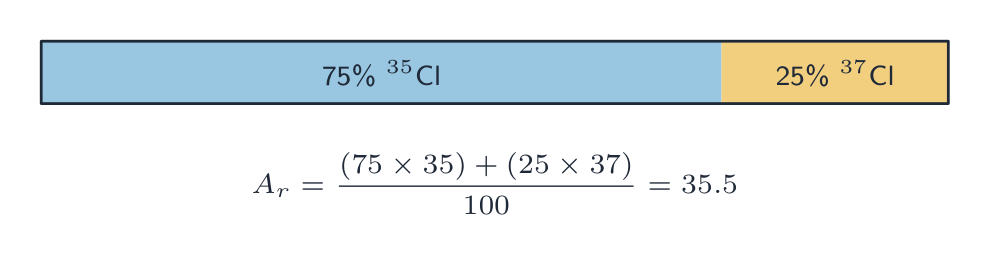
Worked example. Chlorine is $75\%$${}^{35}\text{Cl}$ and $25\%$${}^{37}\text{Cl}$. Find its relative atomic mass.
الذرات خفيفة جداً بحيث لا يمكن وزنها بالجيرومات، لذا نقارن كل كتلة بمعايير واحد. المعيار هو وحدة الكتلة الذرية الموحدة (رمزها u)، والمعرفة بأنها بالضبط أحد عشر جزء من كتلة ذرة واحدة من الكربون-12.
باستخدام هذه الوحدة، نصيغ الكتل كأرقام بسيطة:
الكتلة الذرية النسبية$A_r$ للعنصر هي متوسط كتلة ذراته مقارنة بـ $\tfrac{1}{12}$ من ذرة كربون-12. إنه متوسط لجميع النظائر، موزون حسب انتشار كل منها.
الكتلة النظيرية النسبية هي كتلة ذرة واحدة من نظير محدد، مقارنة بـ $\tfrac{1}{12}$ من ذرة كربون-12.
الكتلة الجزيئية النسبية$M_r$ لـ الجزيء هي مجموع الكتل الذرية النسبية لكل ذراته.
الكتلة الصيغية النسبية هي نفس المفهوم بالنسبة لمادة لا تتكون من جزيئات (مثل المركب الأيوني). اجمع الكتل الذرية النسبية الموضحة في الصيغة.
الكتلة الذرية النسبية هي متوسط مرجح: نظائر الكلور الاثنين (75% ³⁵Cl، 25% ³⁷Cl) تعطي متوسطاً قدره Aᵣ = 35.5
لإيجاد $A_r$ من بيانات النظائر، اضرب كتلة كل نظير في نسبته المئوية، اجمع النتائج، واقسم على 100.
مثال محلول. الكلور هو $75\%$${}^{35}\text{Cl}$ و$25\%$${}^{37}\text{Cl}$. أوجد كتلته الذرية النسبية.
unified atomic mass unit/ˈjuːnɪfaɪd əˈtɒmɪk mæs ˈjuːnɪt/
وحدة الكتلة الذرية الموحدة
relative atomic mass/ˈrelətɪv əˈtɒmɪk mæs/
الكتلة الذرية النسبية
isotope/ˈaɪsətəʊp/
النظائر
relative isotopic mass/ˈrelətɪv ˌaɪsəˈtɒpɪk mæs/
الكتلة النظيرية النسبية
relative molecular mass/ˈrelətɪv məˈlekjʊlə mæs/
الكتلة الجزيئية النسبية
molecule/ˈmɒlɪkjuːl/
جزيء
relative formula mass/ˈrelətɪv ˈfɔːmjʊlə mæs/
الكتلة الصيغةية النسبية
2.2
The mole and the Avogadro constant · المول وثابت أفوجادرو
Syllabus · المنهج
English
define and use the term mole in terms of the Avogadro constant
العربية
عرّف واستخدم مصطلح المول بدلالة ثابت أفوجادرو
Source: Cambridge International syllabus · المصدر: منهج كامبريدج الدولي
English
Chemists count particles in groups called moles, just as we count eggs in dozens.
One mole 摩尔 (symbol mol) is the amount of substance that contains the same number of particles as there are atoms in exactly 12 g of carbon-12. That number is the Avogadro constant 阿伏伽德罗常量:
$$N_A = 6.02 \times 10^{23}\ \text{mol}^{-1}$$
So one mole of anything contains $6.02 \times 10^{23}$ particles. The particles may be atoms, molecules or ions 离子 — always say which.
The mass of one mole in grams equals the relative mass ($A_r$ or $M_r$). This is the molar mass 摩尔质量, with units $\text{g mol}^{-1}$. The key equation is:
$$n = \frac{m}{M}$$
where $n$ is the amount in moles, $m$ is the mass in grams, and $M$ is the molar mass.
Worked example. How many moles are in $8.0\ \text{g}$ of methane, $\text{CH}_4$? ($A_r$: C $= 12$, H $= 1$.)
The molar mass is $M = 12 + 4(1) = 16\ \text{g mol}^{-1}$, so
write formulas of ionic compounds from ionic charges and oxidation numbers (shown by a Roman numeral), including: (a) the prediction of ionic charge from the position of an element in the Periodic Table (b) recall of the names and formulas for the following ions: $\text{NO}_3^-$, $\text{CO}_3^{2-}$, $\text{SO}_4^{2-}$, $\text{OH}^-$, $\text{NH}_4^+$, $\text{Zn}^{2+}$, $\text{Ag}^+$, $\text{HCO}_3^-$, $\text{PO}_4^{3-}$
(a) write and construct equations (which should be balanced), including ionic equations (which should not include spectator ions) (b) use appropriate state symbols in equations
define and use the terms empirical and molecular formula
understand and use the terms anhydrous, hydrated and water of crystallisation
calculate empirical and molecular formulas, using given data
العربية
اكتب صيغ المركبات الأيونية من الشحنات الأيونية وأعداد الأكسدة (الموضحة برقم روماني)، بما في ذلك: (أ) توقع الشحنة الأيونية من موضع العنصر في الجدول الدوري (ب) استرجاع أسماء وصيغ الأيونات التالية: $\text{NO}_3^-$، $\text{CO}_3^{2-}$، $\text{SO}_4^{2-}$، $\text{OH}^-$، $\text{NH}_4^+$، $\text{Zn}^{2+}$، $\text{Ag}^+$، $\text{HCO}_3^-$، $\text{PO}_4^{3-}$
(أ) اكتب وحقق المعادلات (والتي يجب أن تكون موزونة)، بما في ذلك المعادلات الأيونية (التي لا يجب أن تتضمن أيونات المتفرج) (ب) استخدم رموز الحالة المناسبة في المعادلات
عرّف واستخدم مصطلحي الصيغة الأولية والصيغة الجزيئية
افهم واستخدم مصطلحات غير مائية وهيدراتية وماء التبلور
احسب الصيغ الأولية والجزيئية باستخدام البيانات المعطاة
Source: Cambridge International syllabus · المصدر: منهج كامبريدج الدولي
English
A compound 化合物 is a substance made of two or more elements chemically joined.
Charges and formulas of ionic compounds
In an ionic compound 离子化合物 the total positive charge balances the total negative charge, so the compound is neutral overall.
You can predict the charge of many ions from the element's position in the Periodic Table:
Group
1
2
13
15
16
17
Usual ion charge
$+1$
$+2$
$+3$
$-3$
$-2$
$-1$
Hydrogen forms $\text{H}^+$, and the Group 18 noble gases do not normally form ions.
Some ions you must know by name and formula:
Name
Formula
nitrate
$\text{NO}_3^{-}$
carbonate
$\text{CO}_3^{2-}$
sulfate
$\text{SO}_4^{2-}$
hydroxide
$\text{OH}^{-}$
ammonium
$\text{NH}_4^{+}$
zinc
$\text{Zn}^{2+}$
silver
$\text{Ag}^{+}$
hydrogencarbonate
$\text{HCO}_3^{-}$
phosphate
$\text{PO}_4^{3-}$
For a metal that can have more than one charge, a Roman numeral shows the oxidation number 氧化数. For example, iron(II) is $\text{Fe}^{2+}$ and iron(III) is $\text{Fe}^{3+}$. To write a formula, balance the charges: iron(III) oxide is $\text{Fe}_2\text{O}_3$, because two $\text{Fe}^{3+}$ balance three $\text{O}^{2-}$.
Equations and state symbols
A chemical equation must be balanced 配平 — the same number of each kind of atom on both sides. Add state symbols 状态符号 to show the state of each species: (s) solid, (l) liquid, (g) gas, and (aq) aqueous 水溶液 (dissolved in water).
An ionic equation 离子方程式 shows only the ions and molecules that actually change. The ions that do not change are spectator ions 旁观离子, and you leave them out. For example, the reaction that forms silver chloride is:
The empirical formula 实验式 is the simplest whole-number ratio of the atoms of each element in a compound. The molecular formula 分子式 shows the actual number of atoms of each element in one molecule.
For example, ethane has empirical formula $\text{CH}_3$ but molecular formula $\text{C}_2\text{H}_6$.
Hydrated and anhydrous solids
Some solids hold water inside their crystals. This water is the water of crystallisation 结晶水. A solid that contains it is hydrated 水合的; the same solid with the water removed is anhydrous 无水的.
For example, hydrated copper(II) sulfate is $\text{CuSO}_4 \cdot 5\text{H}_2\text{O}$. Heating it drives off the water to leave anhydrous $\text{CuSO}_4$.
Calculating empirical and molecular formulas
To find the empirical formula from masses (or percentages by mass):
divide each element's mass by its $A_r$ to get the moles.
divide all the mole values by the smallest one.
round to the nearest whole numbers — that ratio is the empirical formula.
To get the molecular formula, you also need $M_r$. Find how many times the empirical formula mass fits into $M_r$, then multiply the formula by that number.
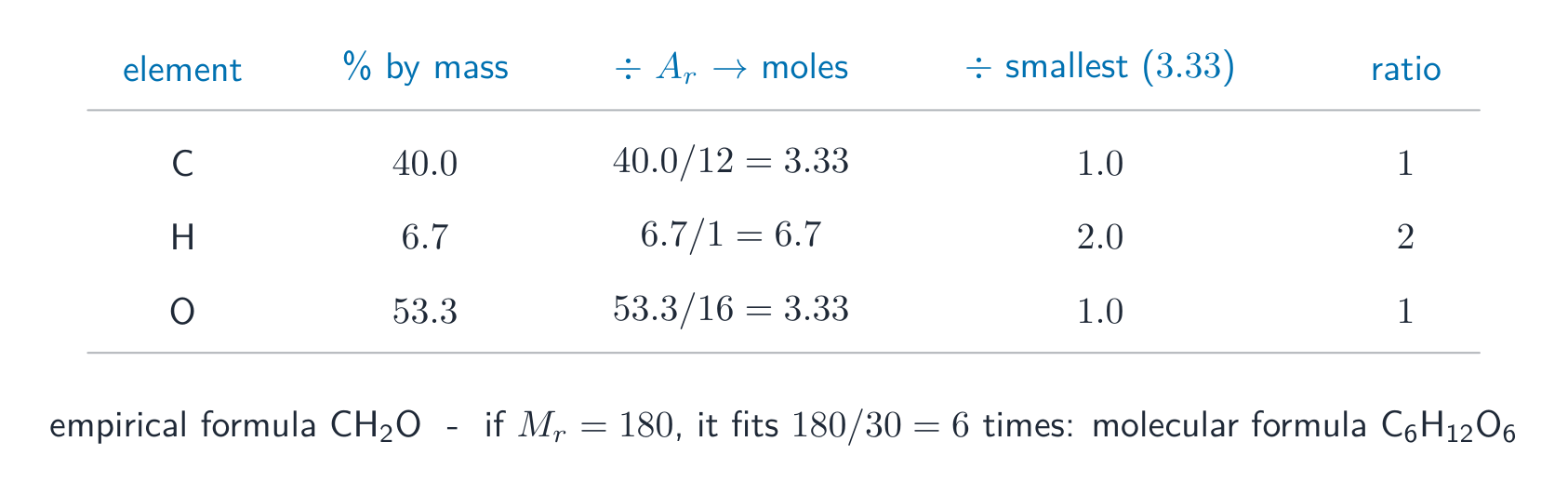
Worked example. A compound is $40.0\%$ carbon, $6.7\%$ hydrogen and $53.3\%$ oxygen by mass. Find its empirical formula. ($A_r$: C $= 12$, H $= 1$, O $= 16$.)
Take $100\ \text{g}$ and divide each mass by its $A_r$ to get moles: C $= 40.0/12 = 3.33$, H $= 6.7/1 = 6.7$, O $= 53.3/16 = 3.33$. Dividing through by the smallest ($3.33$) gives a ratio C : H : O $= 1 : 2 : 1$, so the empirical formula is $\text{CH}_2\text{O}$.
العربية
المركب هو مادة تتكون من عنصرين أو أكثر مرتبطة كيميائياً.
الشحنات وصيغ المركبات الأيونية
في المركب الأيوني، تتوازن الشحنة الكلية الموجبة مع الشحنة الكلية السالبة، ليكون المركب متعادلاً بشكل عام.
يمكنك توقع شحنة العديد من الأيونات من موقع العنصر في الجدول الدوري:
المجموعة
1
2
13
15
16
17
شحنة الأيون المعتادة
$+1$
$+2$
$+3$
$-3$
$-2$
$-1$
يتكون الهيدروجين من $\text{H}^+$، ولا تشكل غازات المجموعة 18 النبيلة أيونات عادةً.
بعض الأيونات يجب أن تعرفها باسمها وصيغتها:
الاسم
الصيغة
نترات
$\text{NO}_3^{-}$
كربونات
$\text{CO}_3^{2-}$
كبريتات
$\text{SO}_4^{2-}$
هيدروكسيد
$\text{OH}^{-}$
أمونيوم
$\text{NH}_4^{+}$
زنك
$\text{Zn}^{2+}$
فضة
$\text{Ag}^{+}$
بيكربونات
$\text{HCO}_3^{-}$
فوسفات
$\text{PO}_4^{3-}$
بالنسبة للمعدن الذي يمكن أن يكون له أكثر من شحنة، يشير الرقم الروماني إلى عدد الأكسدة. على سبيل المثال، الحديد(II) هو $\text{Fe}^{2+}$ والحديد(III) هو $\text{Fe}^{3+}$. لكتابة صيغة، توازن الشحنات: أكسيد الحديد(III) هو $\text{Fe}_2\text{O}_3$، لأن اثني $\text{Fe}^{3+}$ يوازن ثلاثة $\text{O}^{2-}$.
المعادلات ورموز الحالة
يجب أن تكون المعادلة الكيميائية موزونة — نفس عدد كل نوع من الذرات على كلا الجانبين. أضف رموز الحالة لإظهار حالة كل نوع: (s) صلب، (l) سائل، (g) غاز، و(aq) محلول مائي (مذاب في الماء).
المعادلة الأيونية تُظهر فقط الأيونات والجزيئات التي تتغير فعلياً. الأيونات التي لا تتغير تسمى أيونات المشاهد، وتتركها جانباً. على سبيل المثال، التفاعل الذي يشكل كلوريد الفضة هو:
الصيغة الأولية هي أبسط نسبة أعداد صحيحة لذرات كل عنصر في مركب ما. الصيغة الجزيئية تظهر العدد الفعلي لذرات كل عنصر في جزيء واحد.
على سبيل المثال، الإيثان له صيغة أولية $\text{CH}_3$ وصيغة جزيئية $\text{C}_2\text{H}_6$.
المواد الصلبة المائية واللا المائية
بعض المواد الصلبة تحتفظ بالماء داخل بلوراتها. هذا الماء هو ماء التبلور. المادة الصلبة التي تحتوي عليه تكون مائية؛ نفس المادة الصلبة بعد إزالة الماء تكون لا مائية.
على سبيل المثال، كبريتات النحاس(II) المائية هي $\text{CuSO}_4 \cdot 5\text{H}_2\text{O}$. عند تسخينها يطرد الماء لتترك كبريتات النحاس(II) اللامائية $\text{CuSO}_4$.
حساب الصيغ الأولية والجزيئية
لإيجاد الصيغة الأولية من الكتل (أو النسب المئوية بالكتلة):
قسّم كتلة كل عنصر على كتلته الذرية النسبية $A_r$ للحصول على عدد المولات.
قسّم جميع قيم المولات على أصغر قيمة.
قم بالتقريب إلى أقرب أعداد صحيحة — هذه النسبة هي الصيغة الأولية.
للحصول على الصيغة الجزيئية، تحتاج أيضاً إلى $M_r$. أوجد كم مرة تكرر صيغة الكتلة الأولية في $M_r$، ثم اضرب الصيغة في هذا العدد.
مثال محلول. مركب يحتوي على $40.0\%$ كربون، $6.7\%$ هيدروجين و$53.3\%$ أكسجين بالكتلة. أوجد صيغته الأولية. ($A_r$: C $= 12$، H $= 1$، O $= 16$.)
خذ $100\ \text{g}$ واقسم كل كتلة على كتلتها الذرية $A_r$ للحصول على عدد المولات: C $= 40.0/12 = 3.33$، H $= 6.7/1 = 6.7$، O $= 53.3/16 = 3.33$. بالقسمة جميع القيم على أصغر قيمة ($3.33$) نحصل على نسبة C : H : O $= 1 : 2 : 1$، لذا الصيغة الأولية هي $\text{CH}_2\text{O}$.
وصفة الصيغة الأولية: قسّم على Ar، قسّم على الأصغر، استنتج النسبة
Explore · استكشف
Equation balancing route · مسار موازنة المعادلة
Follow atoms through a chemical equation so both sides match. · تابع الذرات عبر المعادلة الكيميائية حتى تتساوى كلا الجانبين.
Reacting masses and volumes · الكتل والحجوم المتفاعلة
Syllabus · المنهج
English
perform calculations including use of the mole concept, involving: (a) reacting masses (from formulas and equations) including percentage yield calculations (b) volumes of gases (e.g. in the burning of hydrocarbons) (c) volumes and concentrations of solutions (d) limiting reagent and excess reagent (When performing calculations, candidates’ answers should reflect the number of significant figures given or asked for in the question. When rounding up or down, candidates should ensure that significant figures are neither lost unnecessarily nor used beyond what is justified (see also Mathematical requirements section).) (e) deduce stoichiometric relationships from calculations such as those in 2.4.1(a)–(d)
العربية
قم بالحسابات بما في ذلك استخدام مفهوم المول، وتشمل: (أ) الكتل المتفاعلة (من الصيغ والمعادلات) بما في ذلك حسابات نسبة الاسترداد (ب) أحجام الغازات (مثل احتراق الهيدروكربونات) (ج) أحجام وتركيزات المحاليل (د) العامل المحدد والعامل الزائد (عند إجراء الحسابات، يجب أن تعكس إجابات المرشحين عدد الأرقام المعنوية المعطاة أو المطلوبة في السؤال. عند التقريب لأعلى أو لأسفل، يجب على المرشحين التأكد من عدم ضياع الأرقام المعنوية بشكل غير ضروري أو استخدامها ما وراء ما يبرره (انظر أيضاً قسم المتطلبات الرياضية).) (هـ) استنتج العلاقات الستوكيومترية من الحسابات مثل تلك الواردة في 2.4.1(أ)–(د)
Source: Cambridge International syllabus · المصدر: منهج كامبريدج الدولي
English
Reacting masses and percentage yield
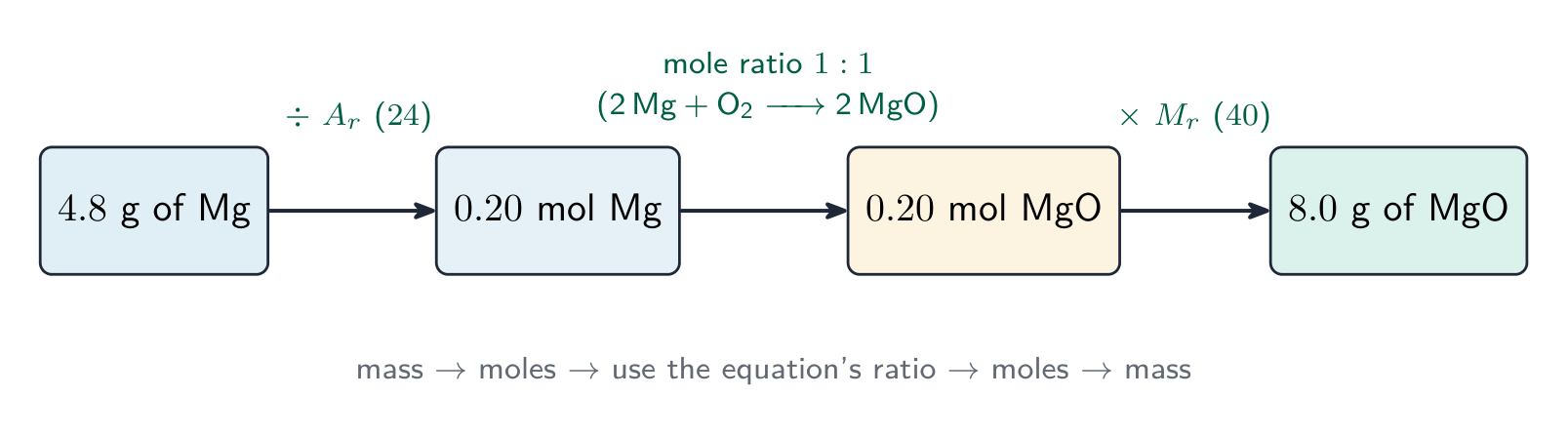
The numbers in front of each species in a balanced equation give the mole ratio — this is the stoichiometry 化学计量. To find a reacting mass: change the known mass to moles, use the mole ratio to find the moles you want, then change back to mass.
Worked example. What mass of magnesium oxide forms when $4.8\ \text{g}$ of magnesium burns completely? $2\text{Mg} + \text{O}_2 \rightarrow 2\text{MgO}$. ($A_r$: Mg $= 24$, O $= 16$.)
Moles of Mg $= 4.8/24 = 0.20\ \text{mol}$. The ratio Mg : MgO is $1 : 1$, so $0.20\ \text{mol}$ of MgO forms. Its molar mass is $24 + 16 = 40\ \text{g mol}^{-1}$, so
$$m = nM = 0.20 \times 40 = 8.0\ \text{g}.$$
In real reactions you usually get less product than the maximum. The percentage yield 产率 compares the amount you actually made with the most you could make:
$$\text{percentage yield} = \frac{\text{actual amount of product}}{\text{maximum possible amount}} \times 100\%$$
Limiting and excess reagent
When two reactants are mixed, one usually runs out first. The limiting reagent 限量试剂 is the one that runs out — it decides how much product forms. The other is the excess reagent 过量试剂, because there is more than enough of it. Always base the calculation on the limiting reagent.
To find it: work out the moles of each reactant, divide each by its number in the equation, and the smallest result is the limiting reagent.
Volumes of gases
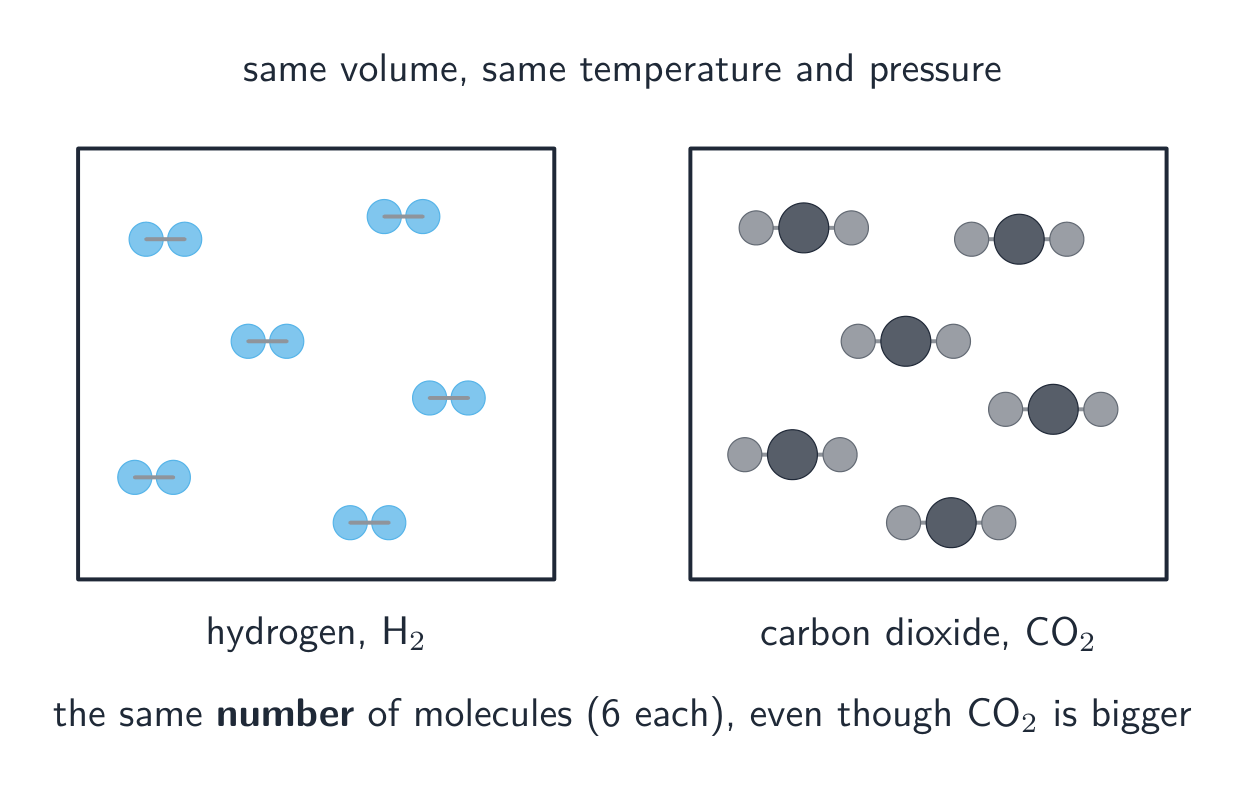
At the same temperature and pressure, equal volumes of any gases contain equal numbers of molecules. At room temperature and pressure (r.t.p.), one mole of any gas takes up $24.0\ \text{dm}^3$, so:
$$n = \frac{V}{24.0}\qquad (V \text{ in } \text{dm}^3 \text{ at r.t.p.})$$
This is used when burning hydrocarbons 碳氢化合物 (compounds of only carbon and hydrogen), where you compare gas volumes.
Volumes and concentrations of solutions
The concentration 浓度 of a solution is the amount of solute 溶质 in each cubic decimetre of solution 溶液, measured in $\text{mol dm}^{-3}$:
$$n = c \times V$$
where $c$ is the concentration and $V$ is the volume in $\text{dm}^3$. Remember that $1000\ \text{cm}^3 = 1\ \text{dm}^3$.
Worked example. In a titration, $25.0\ \text{cm}^3$ of sodium hydroxide solution is exactly neutralised by $20.0\ \text{cm}^3$ of $0.100\ \text{mol dm}^{-3}$ hydrochloric acid: $\text{NaOH} + \text{HCl} \rightarrow \text{NaCl} + \text{H}_2\text{O}$. Find the concentration of the sodium hydroxide.
Moles of HCl $= cV = 0.100 \times \dfrac{20.0}{1000} = 2.00 \times 10^{-3}\ \text{mol}$. The ratio is $1 : 1$, so there are $2.00 \times 10^{-3}\ \text{mol}$ of NaOH in $25.0\ \text{cm}^3$:
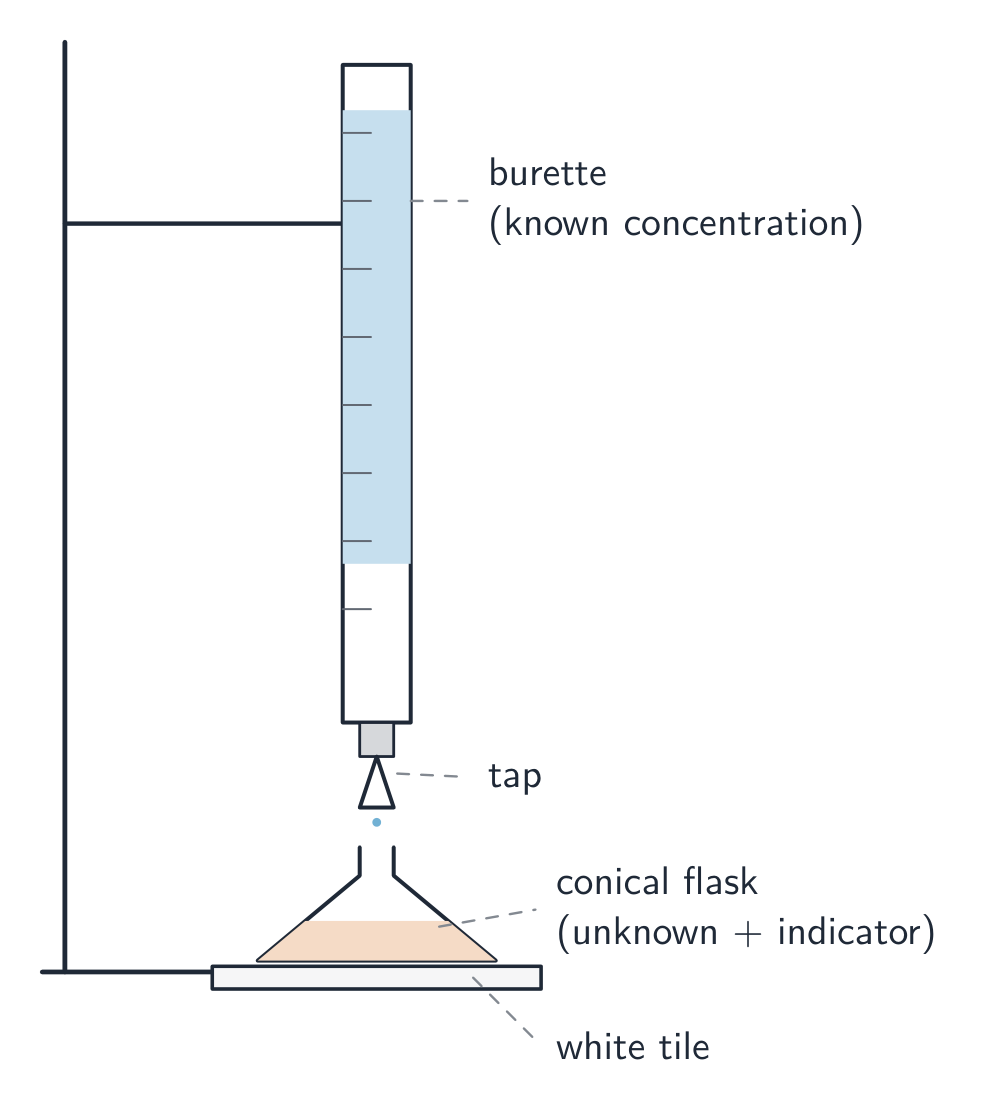
This is the basis of a titration 滴定, where you find an unknown concentration by reacting it with a solution whose concentration you already know.
Significant figures
Give your answer to a sensible number of significant figures 有效数字 — usually match the data in the question. Do not write more digits than the data supports, and do not round so early that you lose accuracy.
العربية
تجد المعايرة الحجوم المتفاعلة بدقة.
الكتل المتفاعلة ونسبة العائد المئوية
الأرقام التي تسبق كل نوع في المعادلة الموزونة تعطي نسبة المولات — وهذا هو الحساب الستوكيومتري. لإيجاد كتلة متفاعلة: حول الكتلة المعلومة إلى مولات، استخدم نسبة المولات لإيجاد عدد المولات المطلوبة، ثم حوّل مرة أخرى إلى كتلة.
مثال محلول. ما كتلة أكسيد المغنيسيوم التي تتكون عندما يحترق $4.8\ \text{g}$ من المغنيسيوم كلياً؟ $2\text{Mg} + \text{O}_2 \rightarrow 2\text{MgO}$. ($A_r$: Mg $= 24$، O $= 16$.)
مولات Mg $= 4.8/24 = 0.20\ \text{mol}$. النسبة Mg : MgO هي $1 : 1$، لذا $0.20\ \text{mol}$ من MgO تتكون. كتلتها المولية هي $24 + 16 = 40\ \text{g mol}^{-1}$، لذا
$$m = nM = 0.20 \times 40 = 8.0\ \text{g}.$$
جسر المول: من الكتلة إلى المولات، ثم النسبة، ثم العودة إلى الكتلة
في التفاعلات الحقيقية عادةً ما تحصل على منتج أقل من الحد الأقصى. نسبة العائد المئوية تقارن الكمية التي صنعت فعلياً بأكثر ما يمكن أن تصنعه:
$$\text{percentage yield} = \frac{\text{actual amount of product}}{\text{maximum possible amount}} \times 100\%$$
المادة المحددة والتفاعلات الزائدة
عند خلط مادتين متفاعلتين، عادةً ما تنفد إحداهما أولاً. المادة المحددة هي التي تنفد — وهي التي تحدد كمية المنتج المتشكلة. أما الأخرى فهي المادة الزائدة، لأن الكافية منها أكبر مما هو مطلوب. استند دائماً في الحسابات إلى المادة المحددة.
لإيجادها: احسب مولات كل متفاعل، واقسم كل منها على عددها في المعادلة، والنتيجة الأصغر هي المادة المحددة.
المادة المحددة تنفد أولاً وتحدد كمية المنتج المتشكلة؛ المتفاعل المتبقي يكون زائداً
أحجام الغازات
عند نفس درجة الحرارة والضغط، تحتوي الأحجام المتساوية من أي غازات على أعداد متساوية من الجزيئات. عند درجة حرارة الغرفة وضغطها (r.t.p.)، يشغل مول واحد من أي غاز $24.0\ \text{dm}^3$، لذا:
$$n = \frac{V}{24.0}\qquad (V \text{ in } \text{dm}^3 \text{ at r.t.p.})$$
أحجام الغازات المتساوية عند نفس درجة الحرارة والضغط تحمل أعداداً متساوية من الجزيئات، بغض النظر عن نوع الغاز
يُستخدم هذا عند احتراق الهيدروكربونات (مركبات تتكون من كربون وهيدروجين فقط)، حيث تقارن أحجام الغازات.
أحجام وحلول التركيز
التركيز للمحلول هو كمية المذاب في كل ديسيمتر مكعب من المحلول، ويقاس بـ $\text{mol dm}^{-3}$:
$$n = c \times V$$
حيث $c$ هو التركيز و$V$ هو الحجم بـ $\text{dm}^3$. تذكر أن $1000\ \text{cm}^3 = 1\ \text{dm}^3$.
مثال محلول. في المعايرة، $25.0\ \text{cm}^3$ من محلول هيدروكسيد الصوديوم يُعاد تماماً بواسطة $20.0\ \text{cm}^3$ من حمض الهيدروكلوريك بتركيز $0.100\ \text{mol dm}^{-3}$: $\text{NaOH} + \text{HCl} \rightarrow \text{NaCl} + \text{H}_2\text{O}$. أوجد تركيز هيدروكسيد الصوديوم.
مولات HCl $= cV = 0.100 \times \dfrac{20.0}{1000} = 2.00 \times 10^{-3}\ \text{mol}$. النسبة هي $1 : 1$، لذا يوجد $2.00 \times 10^{-3}\ \text{mol}$ من NaOH في $25.0\ \text{cm}^3$:
هذا هو أساس المعايرة، حيث تجد تركيزاً مجهولاً بتفاعله مع محلول تركيزه معلوم بالفعل.
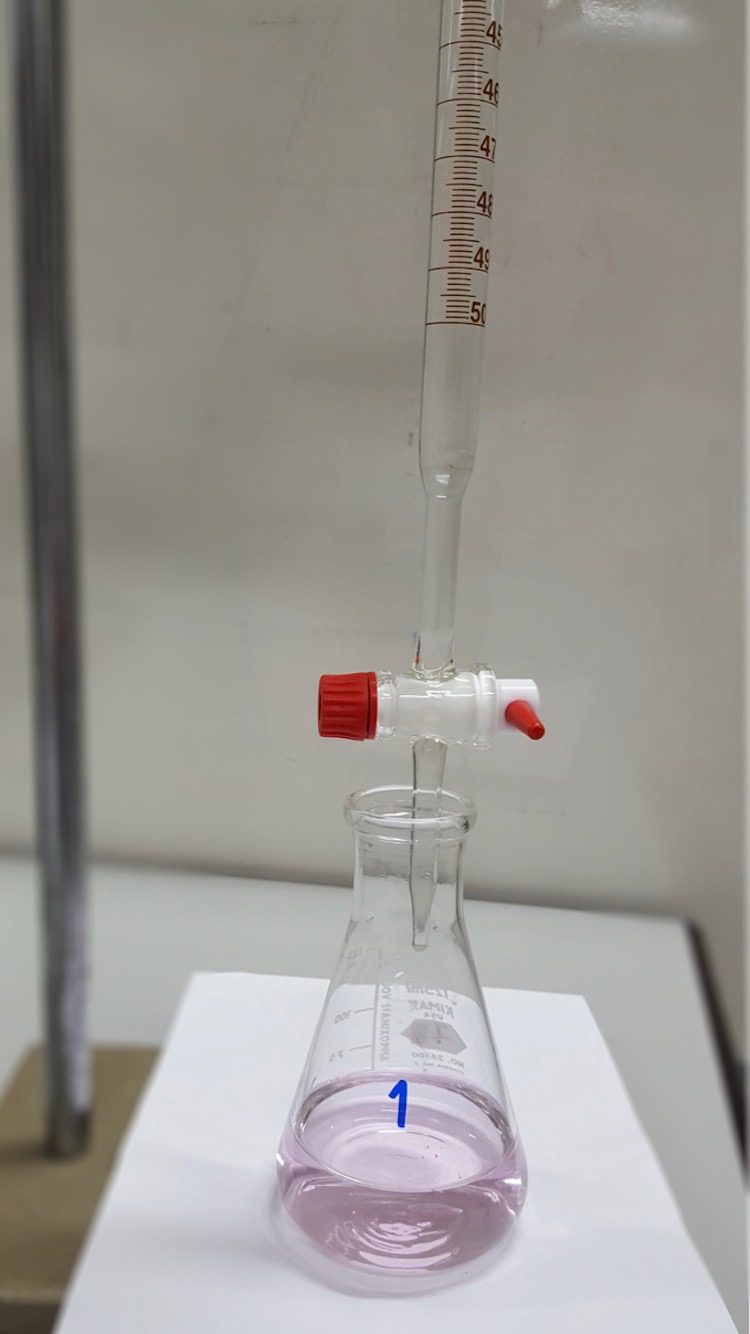
في المعايرة يضيف البيربت محلاً ذا تركيز معلوم إلى المجهول في الدورق المخروطي حتى يتغير المؤشر
الأرقام المعنوية
قدم إجابتك بعدد مناسب من الأرقام المعنوية — عادةً طابق البيانات في السؤال. لا تكتب المزيد من الأرقام مما تدعمه البيانات، ولا تقرب مبكراً جداً لدرجة تفقد فيها الدقة.
Explore · استكشف
Reacting mass route · مسار كتل المتفاعلات
Follow a balanced equation from known mass to predicted product mass. · اتبع معادلة موزونة من كتلة معلومة إلى كتلة ناتج متوقعة.
Explore · استكشف
Gas volume lab · مختبر حجم الغاز
n = V / 24 dm3
Change gas volume and see moles scale at room conditions. · غيّر حجم الغاز وانظر كيف تتناسب المولات في ظروف الغرفة.
Convert volumes to $\text{dm}^3$before using concentration ($25.0\ \text{cm}^3 = 0.0250\ \text{dm}^3$); the missing $\div 1000$ is the most common titration error.
Use the balancing numbers as the mole ratio between species — never the $M_r$ values.
Empirical formula: divide each mass/percentage by $A_r$, then by the smallest, then scale to whole numbers; use $M_r$ to reach the molecular formula.
For gases at r.t.p. use $\text{volume} = \text{moles} \times 24\ \text{dm}^3$; quote the equation you use every time.
Give the answer to the same significant figures as the data (usually 3) and always include units.
العربية
حول الأحجام إلى $\text{dm}^3$قبل استخدام التركيز ($25.0\ \text{cm}^3 = 0.0250\ \text{dm}^3$)؛ النسيان لـ $\div 1000$ هو خطأ المعايرة الأكثر شيوعاً.
استخدم الأرقام الموازنة كنسبة مولات بين الأنواع — لا تستخدم قيم $M_r$ أبداً.
الصيغة الأولية: قسّم كل كتلة/نسبة مئوية على $A_r$، ثم على الأصغر، ثم اضرب لتصل إلى أعداد صحيحة؛ استخدم $M_r$ للوصول إلى الصيغة الجزيئية.
للغازات عند r.t.p. استخدم $\text{volume} = \text{moles} \times 24\ \text{dm}^3$؛ اذكر المعادلة التي تستخدمها في كل مرة.
قدم الإجابة بنفس الأرقام المعنوية للبيانات (عادةً 3) وادخل الوحدات دائماً.
Interactive lessons on this topic · دروس تفاعلية حول هذا الموضوع
Work through it step by step, with instant-check exercises. · ا-working عليه خطوة بخطوة، مع تمارين تحقق فوري.
Pick one and the site follows you — notes, papers, videos and practice all open on it. · اختر واحدًا وسيتبعك الموقع — الملاحظات، الأوراق، الفيديوهات والتدريب جميعها تفتح عليه.
Type to search notes, lessons, code, vocabulary and past-paper questions across every subject. · اكتب للبحث عن ملاحظات، دروس، أكواد، مفردات وأسئلة امتحانات سابقة عبر جميع المواد.