Relative frequency and expected frequency · 相对频率与期望频率
| English | 中文 | Pinyin · 拼音 |
|---|---|---|
| bias/ˈbaɪəs/ | 偏倚 | piān yǐ |
| relative frequency/ˈrelətɪv ˈfriːkwənsi/ | 相对频率 | xiāng duì pín lǜ |
| expected frequency/ekˈspektɪd ˈfriːkwənsi/ | 期望频数 | qī wàng pín shuò |
Is the coin fair?
- You flip a coin 100 times and get 60 heads. Is the coin biased 偏倚?
- Theoretical probability says $\dfrac{1}{2}$. Experimental probability (the relative frequency 相对频率) says $\dfrac{60}{100} = 0.6$. More flips usually give a more stable estimate, but no finite experiment proves the probability with certainty.
Relative frequency
- When outcomes are not equally likely, run an experiment:
- More trials → a better estimate of the true probability.
- A fair object gives equal chances; one with bias does not.
A drawing pin is dropped 200 times and lands point-up $84$ times. Relative frequency of point-up $= \dfrac{84}{200} = 0.42$.
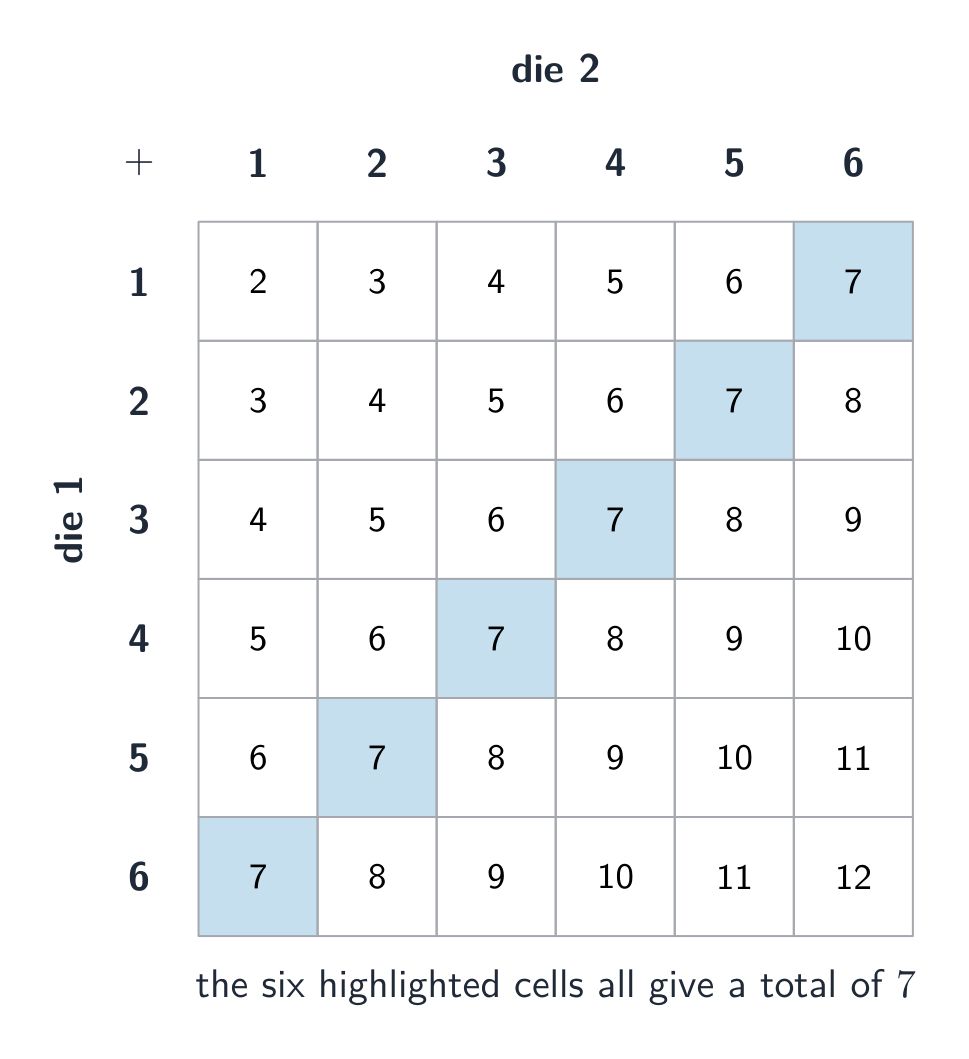
A sample space diagram lists every outcome; for two dice there are $36$ equally likely totals
Two-dice probability · 两颗骰子的概率
Roll the two dice many times: the bars start jumpy but settle into the theoretical triangle peaking at 7 — experimental probability closing in on theory. · 多次掷这两颗骰子:柱开始时跳动,但稳定成在 7 处达到顶峰的理论三角形——实验概率逼近理论。
Relative frequency is calculated as: · 相对频率的计算方式是:
Relative frequency = successes ÷ number of trials. · 相对频率 = 成功数 ÷ 试验数。
Relative frequency becomes a better estimate as the number of trials increases. · 随着试验次数增加,相对频率成为一个更好的估计。
More trials → the relative frequency converges to the true probability. · 更多试验 → 相对频率收敛到真实概率。
A drawing pin is dropped 200 times and lands point-up 84 times. The relative frequency of point-up is (to 2 dp): · 一颗图钉被掉落 200 次,尖朝上落地 84 次。尖朝上的相对频率是(到 2 位小数):
84/200 = 0.42. · 84/200 = 0.42。
Expected frequency 期望频数
- How many times you expect an event in $n$ trials:
Expected ≠ guaranteed. An expected frequency of $50$ sixes in $300$ rolls doesn't mean you'll get exactly $50$. It's the average over many sets of $300$ rolls.
The probability of rolling a six is 1/6. How many sixes are expected in 300 rolls? · 掷出一个六的概率是 1/6。在 300 次掷中期望多少个六?
(1/6) × 300 = 50. · (1/6) × 300 = 50。
An event has probability 0.2. How many times is it expected in 50 trials? · 一个事件有概率 0.2。在 50 次试验中期望多少次?
0.2 × 50 = 10. · 0.2 × 50 = 10。
Expected frequency = P(event) × number of ______. · 期望频率 = P(事件) × ______ 数。
Expected frequency = probability × number of trials. · 期望频率 = 概率 × 试验次数。
Worked example
- $\text{P}(\text{six}) = \dfrac{1}{6}$. In $300$ rolls: expected $= \dfrac{1}{6} \times 300 = 50$ sixes.
- $\text{P}(\text{rain}) = 0.2$. In $50$ days: expected $= 0.2 \times 50 = 10$ rainy days.
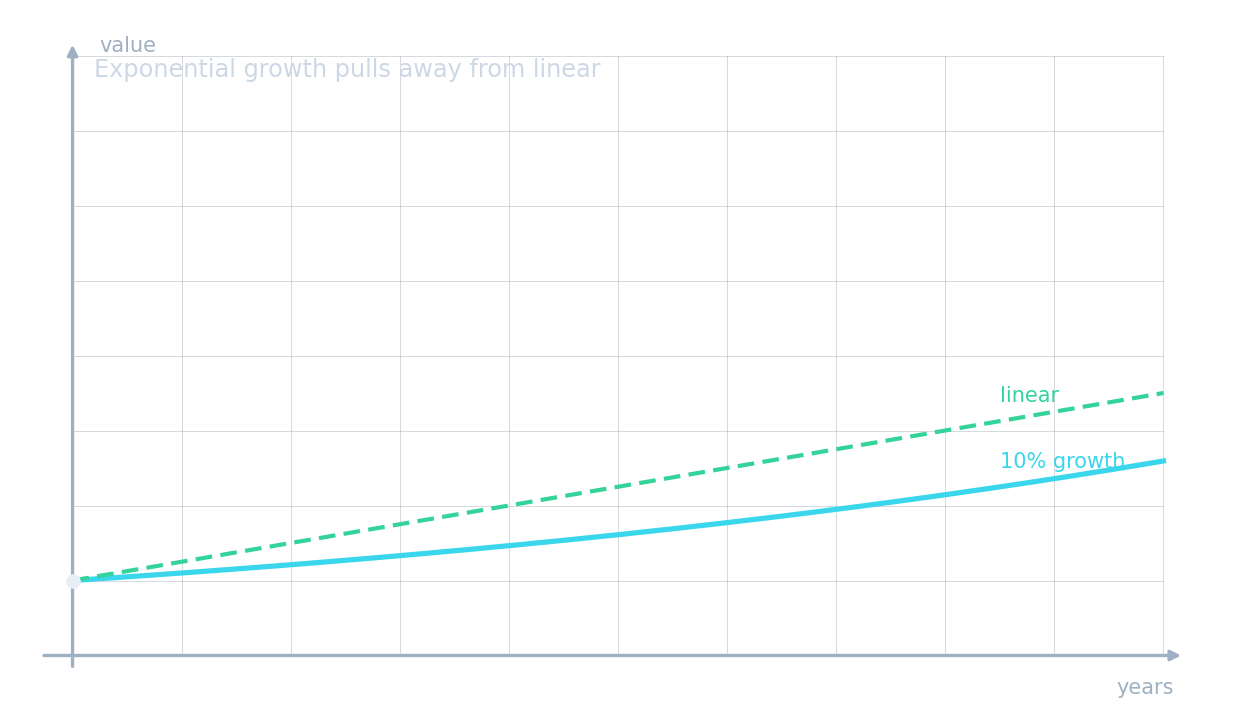
Expected frequency grows linearly with trials: double the trials, double the expected count.
You've got it
- relative frequency $= \dfrac{\text{times happened}}{\text{total trials}}$ — improves with more trials
- expected frequency $= \text{P}(\text{event}) \times n$
- $\dfrac{1}{6} \times 300 = 50$ expected sixes