The sine and cosine rules · 正弦定理与余弦定理
| English | 中文 | Pinyin · 拼音 |
|---|---|---|
| sine rule/saɪn ruːl/ | 正弦定理 | zhèng xián dìng lǐ |
| cosine rule/ˈkəʊsaɪn ruːl/ | 余弦定理 | yú xián dìng lǐ |
| included angle/ɪnˈkluːdɪd ˈæŋɡl/ | 夹角 | jiā jiǎo |
When the triangle isn't right-angled
- Pythagoras and SOH-CAH-TOA only work for right-angled triangles.
- For any other triangle, you need the sine rule 正弦定理 or the cosine rule 余弦定理.
当三角形不是直角时
- 勾股定理和 SOH-CAH-TOA 只对直角三角形有效。
- 对任何其他三角形,你需要正弦定理(sine rule)或余弦定理(cosine rule)。
The sine rule
- For any triangle with sides $a, b, c$ opposite angles $A, B, C$:
- Use it when you know: a side and its opposite angle, plus one other piece.
$a = 10$, $A = 30^{\circ}$, $B = 50^{\circ}$: $\;\dfrac{10}{\sin 30^{\circ}} = \dfrac{b}{\sin 50^{\circ}} \Rightarrow b = \dfrac{10 \sin 50^{\circ}}{0.5} = 15.3$.
$y=\sin x$ and $y=\cos x$ are smooth waves between $-1$ and $1$; cosine is sine shifted left by $90^\circ$
正弦定理
- 对任何边为 $a, b, c$、对角为 $A, B, C$ 的三角形:
- 当你知道:一条边和它的对角,加上另一条信息时使用它。
$a = 10$, $A = 30^{\circ}$, $B = 50^{\circ}$: $\;\dfrac{10}{\sin 30^{\circ}} = \dfrac{b}{\sin 50^{\circ}} \Rightarrow b = \dfrac{10 \sin 50^{\circ}}{0.5} = 15.3$.

$y=\sin x$ 和 $y=\cos x$ 是 $-1$ 和 $1$ 之间的平滑波;余弦是正弦向左移动 $90^\circ$
Sine & cosine rule · 正弦与余弦定理
Two sides and the angle between them fix the triangle: the cosine rule finds the third side, the sine rule the other angles.
What sin and cos mean · sin 与 cos 的含义
Spin the angle on the unit circle: the horizontal leg is cos θ and the vertical leg is sin θ — the same ratios the sine and cosine rules use.
You know all three sides and want an angle. Which rule do you use?
With three sides (or two sides and the included angle), use the cosine rule.
The sine rule requires a side and its opposite angle to be known.
You need at least one side paired with its opposite angle to apply the sine rule.
In a triangle, a = 10, A = 30°, B = 50°. Using the sine rule, b = 10 sin 50° / sin 30°. Find b (1 dp).
b = 10 × sin 50° / 0.5 = 10 × 0.766 / 0.5 = 15.3.
The cosine rule
- Use it when you know: two sides and the included angle 夹角 (to find the third side), or all three sides (to find an angle).
Included angle only. The angle $A$ in the cosine rule must be the angle between sides $b$ and $c$. If it's not the included angle, the formula doesn't apply directly.
In any triangle, sides $a,b,c$ lie opposite angles $A,B,C$; the sine and cosine rules use these
余弦定理
- 当你知道:两条边和夹角(求第三条边),或所有三条边(求一个角)时使用它。
只有夹角。 余弦定理中的角 $A$ 必须是边 $b$ 和 $c$ 之间的角。如果它不是夹角,公式不直接适用。

在任何三角形中,边 $a,b,c$ 位于角 $A,B,C$ 对面;正弦和余弦定理使用这些
A triangle has b = 7, c = 8 and the angle between them A = 40°. Using a² = 49 + 64 − 2(7)(8)cos40° ≈ 27.2, find a (1 dp).
a = √27.2 ≈ 5.2 cm.
In the cosine rule a² = b² + c² − 2bc cos A, the angle A must be the ______ angle between sides b and c.
A must be the included angle (the angle between sides b and c).
Area of any triangle
- This works for any triangle (not just right-angled ones), using two sides and the included angle.
任何三角形的面积
- 这对任何三角形有效(不只是直角的),使用两条边和夹角。
The area of any triangle (two sides a, b with angle C between them) is:
Area = ½ab sin C uses two sides and the included angle.
Worked example
- $b = 7$, $c = 8$, included angle $A = 40^{\circ}$.
- $a^2 = 7^2 + 8^2 - 2(7)(8)\cos 40^{\circ} = 49 + 64 - 85.8 = 27.2$, so $a = 5.2$ cm.
The cosine rule generalises Pythagoras: when $A = 90^{\circ}$, $\cos A = 0$ and you get $a^2 = b^2 + c^2$.
示例
- $b = 7$,$c = 8$,夹角 $A = 40^{\circ}$。
- $a^2 = 7^2 + 8^2 - 2(7)(8)\cos 40^{\circ} = 49 + 64 - 85.8 = 27.2$,所以 $a = 5.2$ cm。
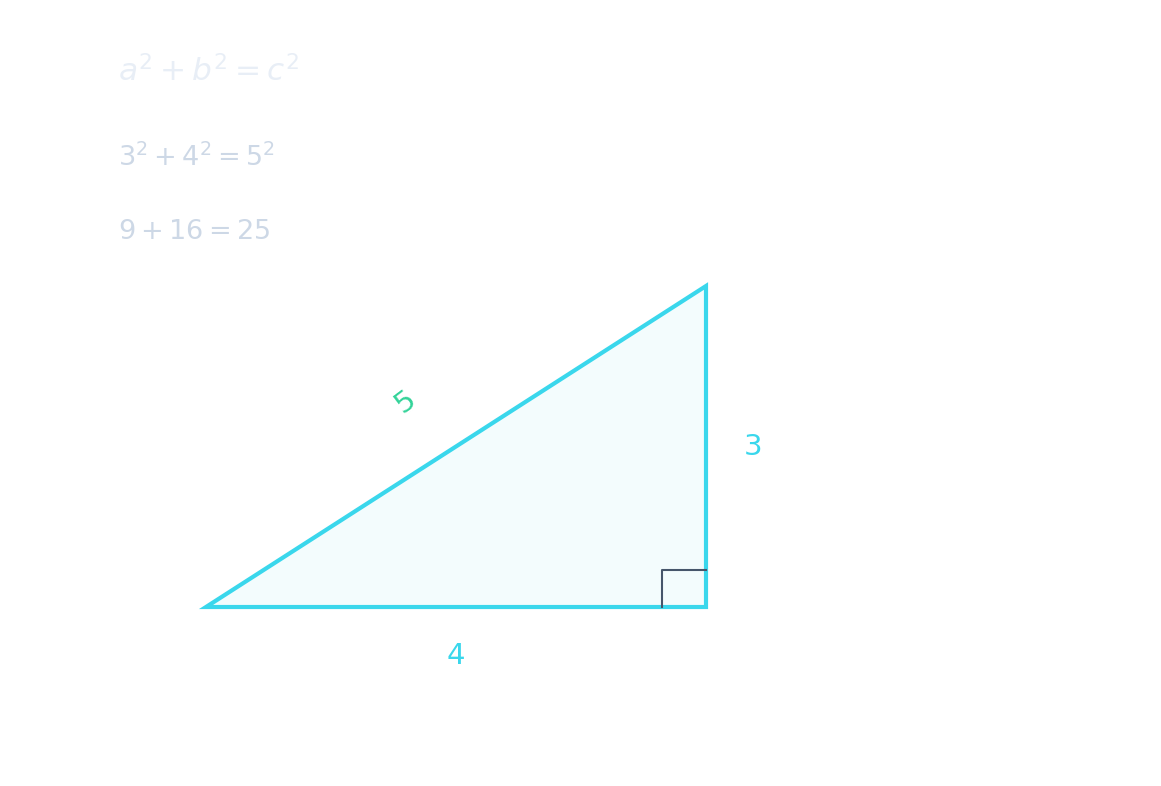
余弦定理推广勾股定理:当 $A = 90^{\circ}$ 时,$\cos A = 0$,你得到 $a^2 = b^2 + c^2$。
Sides a = 5, b = 7, c = 8. Find angle A opposite a, to 1 dp.
cos A = (49+64−25)/112 = 11/14, so A ≈ 38.2°.
Finding an angle and checking the other possibility
- With sides $a=5,b=7,c=8$, use $\cos A=(b^2+c^2-a^2)/(2bc)=(49+64-25)/112=11/14$. Thus $A=\cos^{-1}(11/14)\approx38.2^{\circ}$.
- In a sine-rule question, $a=10,A=30^{\circ},b=12$ gives $\sin B=b\sin A/a=0.6$. Both $B\approx36.9^{\circ}$ and $143.1^{\circ}$ leave a positive third angle, so two triangles are possible. Use any extra condition, such as B being obtuse, to choose.
求角度并验证另一种可能性
- 已知边长$a=5,b=7,c=8$,使用$\cos A=(b^2+c^2-a^2)/(2bc)=(49+64-25)/112=11/14$。因此$A=\cos^{-1}(11/14)\approx38.2^{\circ}$。
- 在正弦定理题目中,$a=10,A=30^{\circ},b=12$得出$\sin B=b\sin A/a=0.6$。$B\approx36.9^{\circ}$和$143.1^{\circ}$均能构成正的第三个角,因此可能存在两个三角形。利用额外条件(如B为钝角)进行选择。
Two sides 7 cm and 8 cm include 40°. Find the area to 1 dp in cm².
Area = ½ × 7 × 8 × sin 40° ≈ 18.0 cm².
Area with an included angle
- Two sides 7 cm and 8 cm include $40^{\circ}$. Use $K=\frac12bc\sin A=\frac12(7)(8)\sin40^{\circ}\approx18.0\text{ cm}^2$.
- The angle must lie between the two sides used. Keep degree mode and full trigonometric values until the final rounding.
含夹角面积计算
- 两边分别为7 cm和8 cm,其夹角为$40^{\circ}$。使用公式$K=\frac12bc\sin A=\frac12(7)(8)\sin40^{\circ}\approx18.0\text{ cm}^2$。
- 该角必须位于所取两边之间。保持度数模式,并在最终四舍五入前保留完整的三角函数值。
You've got it
- sine rule: $\dfrac{a}{\sin A} = \dfrac{b}{\sin B}$ — side + its opposite angle
- cosine rule: $a^2 = b^2 + c^2 - 2bc\cos A$ — two sides + included angle (or three sides)
- area of any triangle $= \dfrac{1}{2}ab\sin C$
你掌握了
- 正弦定理:$\dfrac{a}{\sin A} = \dfrac{b}{\sin B}$——边 + 它的对角
- 余弦定理:$a^2 = b^2 + c^2 - 2bc\cos A$——两条边 + 夹角(或三条边)
- 任何三角形的面积 $= \dfrac{1}{2}ab\sin C$