Trigonometry in right-angled triangles · 直角三角形中的三角学
| English | 中文 | Pinyin · 拼音 |
|---|---|---|
| trigonometry/ˌtrɪɡəˈnɒmətri/ | 三角学 | sān jiǎo xué |
| opposite/ˈɒpəzɪt/ | 对边 | duì biān |
| adjacent/əˈdʒeɪsənt/ | 邻边 | lín biān |
| angle of elevation/ˈæŋɡl ɒv ˌelɪˈveɪʃn/ | 仰角 | yǎng jiǎo |
| angle of depression/ˈæŋɡl ɒv dɪˈpreʃn/ | 俯角 | fǔ jiǎo |
How tall is that tree?
- You can't climb it with a tape measure. But standing $10$ m away and looking up at $50^{\circ}$, trigonometry 三角学 gives you the height: $10 \times \tan 50^{\circ} \approx 11.9$ m.
- Trigonometry measures the unmeasurable — using angles and one known length.
那棵树有多高?
- 你无法用卷尺爬上它。但站在 $10$ m 外以 $50^{\circ}$ 向上看,三角学给你高度:$10 \times \tan 50^{\circ} \approx 11.9$ m。
- 三角学(trigonometry)测量不可测量的——使用角和一个已知的长度。
Naming the sides
- In a right-angled triangle, name the sides relative to the angle $\theta$:
- Opposite 对边 (O): the side across from $\theta$.
- Adjacent 邻边 (A): the side next to $\theta$ (not the hypotenuse).
- Hypotenuse (H): the longest side, opposite the right angle.
SOH-CAH-TOA: the three ratios that connect angles to side lengths in right-angled triangles.
命名边
- 在一个直角三角形中,相对于角 $\theta$ 命名边:
- 对边(Opposite,O):$\theta$ 对面的边。
- 邻边(Adjacent,A):$\theta$ 旁边的边(不是斜边)。
- 斜边(Hypotenuse,H):最长的边,对着直角。
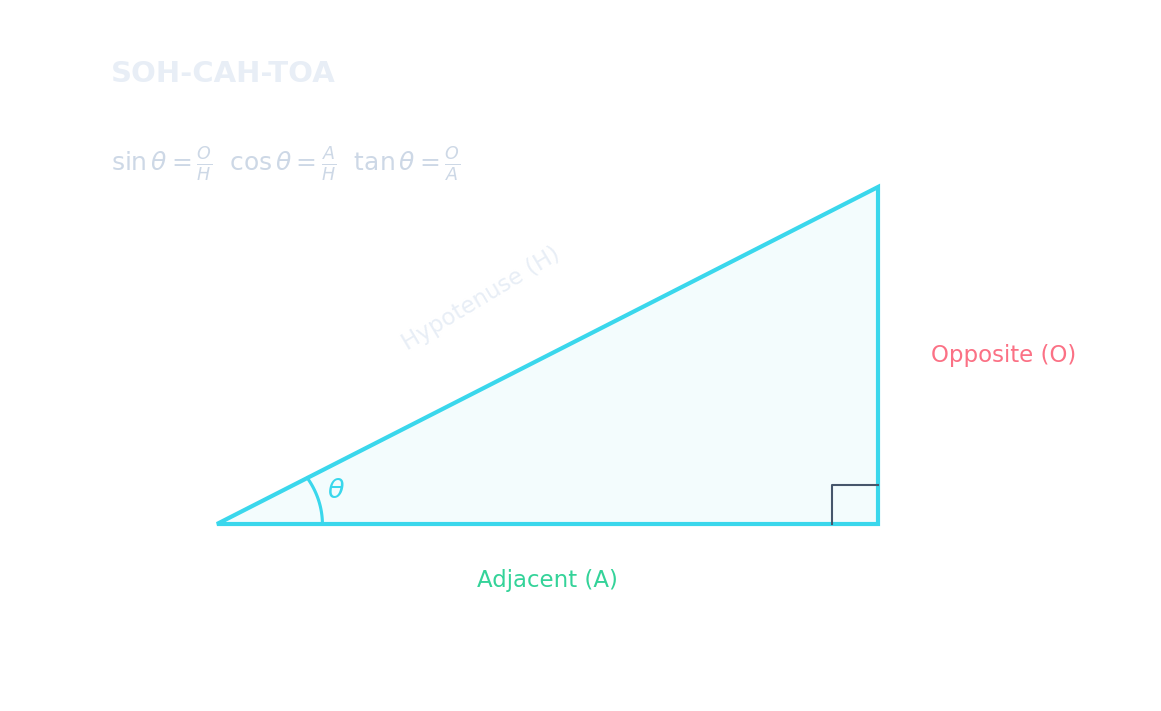
SOH-CAH-TOA:在直角三角形中把角连接到边长的三个比。
Right-angled trig · 直角三角学
(cos θ, sin θ)
SOHCAHTOA comes from this circle — sin, cos and tan of the angle. · SOHCAHTOA 来自这个圆——角的 sin、cos 和 tan。
The three ratios — SOH CAH TOA
- To find a side: use the ratio and multiply/divide.
- To find an angle: use the inverse ($\sin^{-1}$, $\cos^{-1}$, $\tan^{-1}$).
Opposite $4$, adjacent $3$: $\;\tan\theta = \dfrac{4}{3}$, so $\theta = \tan^{-1}\!\left(\dfrac{4}{3}\right) = 53.1^{\circ}$.
Looking up at a tower involves an angle of elevation 仰角
三个比——SOH CAH TOA
- 要求一条边:使用这个比并乘/除。
- 要求一个角:使用反($\sin^{-1}$、$\cos^{-1}$、$\tan^{-1}$)。
对边 $4$,邻边 $3$:$\;\tan\theta = \dfrac{4}{3}$,所以 $\theta = \tan^{-1}\!\left(\dfrac{4}{3}\right) = 53.1^{\circ}$。
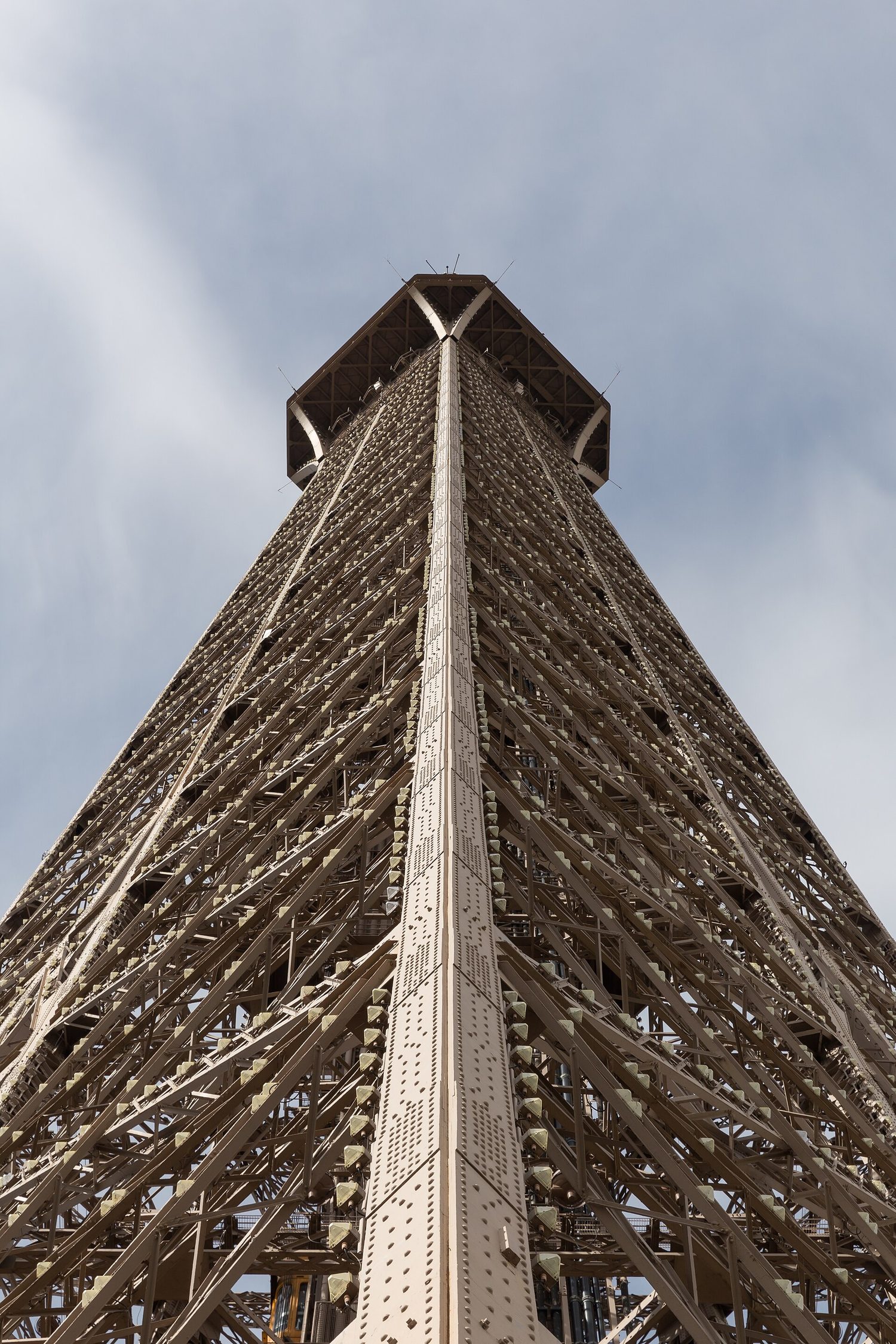
向上看一座塔涉及一个仰角
In a right-angled triangle the hypotenuse is 10 cm and the angle is 30°. The opposite side = 10 × sin 30°. Find it (cm). · 在一个直角三角形中斜边是 10 cm 且角是 30°。对边 = 10 × sin 30°。求它(cm)。
10 × sin 30° = 10 × 0.5 = 5 cm. · 10 × sin 30° = 10 × 0.5 = 5 cm。
The opposite side is 4 cm and the adjacent side is 3 cm. Find the angle (degrees, 1 dp). · 对边是 4 cm,邻边是 3 cm。求角(度,1 位小数)。
tan θ = 4/3, so θ = tan⁻¹(4/3) = 53.1°. · tan θ = 4/3,所以 θ = tan⁻¹(4/3) = 53.1°。
The adjacent side is 8 cm and the angle is 60°. The hypotenuse = 8 / cos 60°. Find it (cm). · 邻边是 8 cm 且角是 60°。斜边 = 8 / cos 60°。求它(cm)。
cos 60° = 0.5, so hyp = 8 / 0.5 = 16 cm. · cos 60° = 0.5,所以斜边 = 8 / 0.5 = 16 cm。
In SOH CAH TOA, sin θ = opposite / ______. · 在 SOH CAH TOA 中,sin θ = 对边 / ______。
SOH: sin θ = Opposite / Hypotenuse. · SOH:sin θ = 对边 / 斜边。
Angles of elevation and depression (Extended)
- Angle of elevation: looking up from the horizontal.
- Angle of depression 俯角: looking down from the horizontal.
- Both are measured from the horizontal, not from the vertical.
From the horizontal, always. The angle of elevation/depression is measured from the horizontal line, not from the vertical. This is the most common error in these problems.
Name the sides from the angle $\theta$: the opposite is across from it, the adjacent next to it, the hypotenuse opposite the right angle (SOH-CAH-TOA)
仰角和俯角(扩展)
- 仰角(angle of elevation):从水平向上看。
- 俯角(angle of depression):从水平向下看。
- 两者都从水平测量,不是从竖直。
从水平,总是。 仰角/俯角从水平线测量,不是从竖直。这是这些问题中最常见的错误。

从角 $\theta$ 命名边:对边在它对面,邻边在它旁边,斜边对着直角(SOH-CAH-TOA)
From 50 m away, the angle of elevation to a tower top is 40°. Height = 50 × tan 40°. Find it (m, 1 dp). · 从 50 m 外,到一座塔顶的仰角是 40°。高度 = 50 × tan 40°。求它(m,1 位小数)。
50 × tan 40° = 50 × 0.839 = 42.0 m. · 50 × tan 40° = 50 × 0.839 = 42.0 m。
The angle of elevation is measured from the vertical. · 仰角从竖直测量。
Angles of elevation and depression are both measured from the horizontal, not the vertical. · 仰角和俯角都从水平测量,不是从竖直。
Worked example
- $50$ m from a tower, elevation $40^{\circ}$:
- $h=d\tan\theta=50\tan40^{\circ}\approx42.0$ m. Keep the full calculator value of the tangent before rounding.
The angle of elevation looks up from the horizontal; the angle of depression looks down
示例
- 距一座塔 $50$ m,仰角 $40^{\circ}$:
- $h=d\tan\theta=50\tan40^{\circ}\approx42.0$ m。在四舍五入前保留计算器显示的完整正切值。
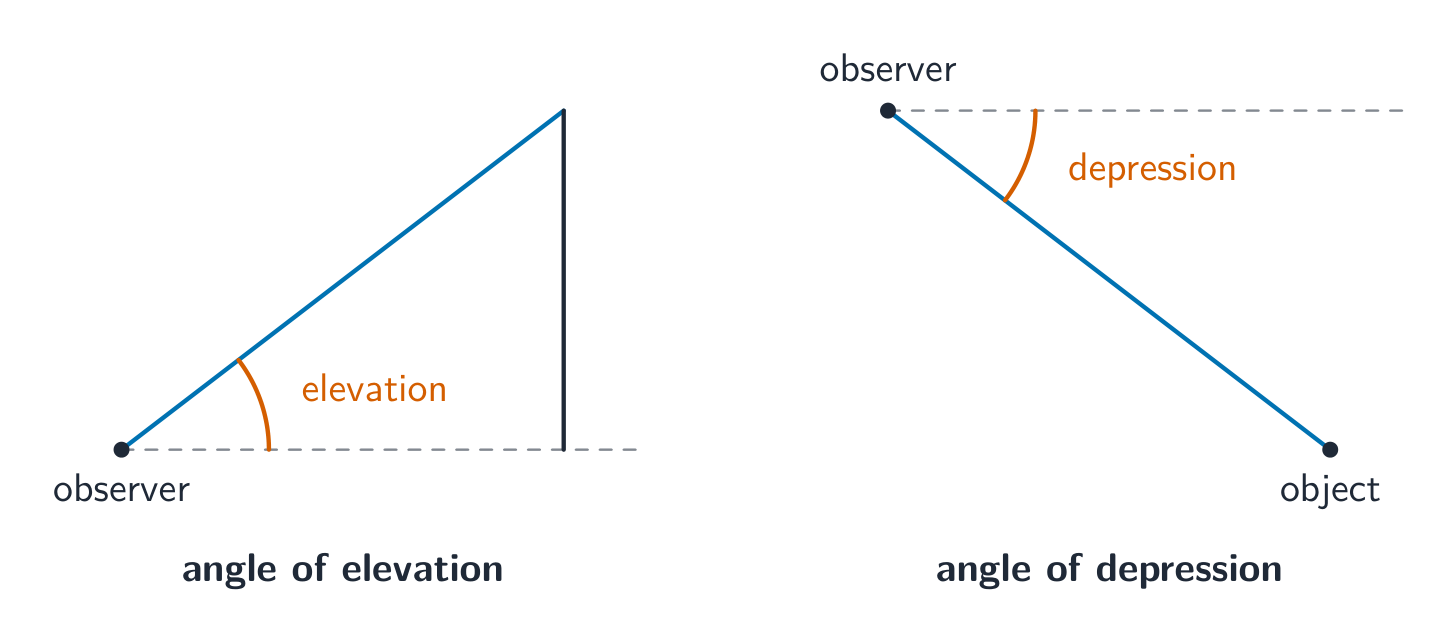
仰角从水平向上看;俯角向下看
You've got it
- SOH: $\sin\theta = \dfrac{\text{opp}}{\text{hyp}}$; CAH: $\cos\theta = \dfrac{\text{adj}}{\text{hyp}}$; TOA: $\tan\theta = \dfrac{\text{opp}}{\text{adj}}$
- use the inverse ($\tan^{-1}$ etc.) to find an angle
- elevation looks up, depression looks down — both from the horizontal
你掌握了
- SOH:$\sin\theta = \dfrac{\text{opp}}{\text{hyp}}$;CAH:$\cos\theta = \dfrac{\text{adj}}{\text{hyp}}$;TOA:$\tan\theta = \dfrac{\text{opp}}{\text{adj}}$
- 使用反($\tan^{-1}$ 等)求一个角
- 仰角向上看,俯角向下看——两者都从水平