Perimeter and area of basic shapes · 基本图形的周长与面积
| English | 中文 | Pinyin · 拼音 |
|---|---|---|
| area/ˈeərɪə/ | 面积 | miàn jī |
| perimeter/pəˈrɪmɪtə/ | 周长 | zhōu cháng |
| perpendicular height/ˌpɜːpənˈdɪkjʊlə haɪt/ | 垂直高度 | chuí zhí gāo dù |
How big is your garden?
- Estate agents quote floor area 面积 in square metres. A "50 m² flat" is one whose floor covers 50 squares, each 1 m on a side.
- Finding area is one of the most practical things mathematics does — and it starts with a few key formulas.
你的花园有多大?
- 房地产经纪人以平方米报价楼面面积。一个"50 m² 的公寓"是其楼面覆盖 50 个方格、每个边长 1 m 的公寓。
- 求面积是数学做的最实用的事情之一——而它从几个关键的公式开始。
Area scaling lab · 面积缩放实验
area = side^2 · 面积 = 边长^2
Change side length and see why area grows quadratically. · 改变边长并观察面积为何呈二次增长。
Perimeter 周长
- Perimeter = the distance all the way round the outside of a shape.
- Rectangle: $P = 2(\text{length} + \text{width})$.
A rectangle $8\text{ cm} \times 5\text{ cm}$: $P = 2(8 + 5) = 26\text{ cm}$.
Area of the basic shapes; $b$ is the base, $h$ the perpendicular height 垂直高度, and $a$, $b$ the parallel sides of a trapezium
周长
- 周长(perimeter)= 绕一个形状外侧一整圈的距离。
- 矩形:$P = 2(\text{length} + \text{width})$。
一个 $8\text{ cm} \times 5\text{ cm}$ 的矩形:$P = 2(8 + 5) = 26\text{ cm}$。

基本形状的面积;$b$ 是底,$h$ 是垂直高,而 $a$、$b$ 是一个梯形的平行边
A rectangle is 8 cm by 5 cm. Find its perimeter (cm). · 一个矩形长 8 cm,宽 5 cm。求其周长(cm)。
Perimeter = 2(8 + 5) = 26 cm. · 周长 = 2(8 + 5) = 26 cm。
Match each shape to its area formula. · 将每种形状与其面积公式匹配。
Each shape has its own area rule; the trapezium averages the parallel sides. · 每种形状都有其自身的面积规则;梯形取平行边的平均值。
Area formulas
| Shape | Area | Notes |
|---|---|---|
| rectangle | $\text{length} \times \text{width}$ | |
| triangle | $\dfrac{1}{2} \times b \times h$ | $h$ is perpendicular height |
| parallelogram | $b \times h$ | $h$ is perpendicular height |
| trapezium | $\dfrac{1}{2}(a+b)h$ | $a, b$ are the parallel sides |
Perpendicular height, not slant height. For triangles and parallelograms, $h$ must be measured at right angles to the base. Using the slant side gives the wrong answer.
Common solids and the dimensions used in their volume and surface-area formulas
面积公式
| 形状 | 面积 | 注释 |
|---|---|---|
| 矩形 | $\text{length} \times \text{width}$ | |
| 三角形 | $\dfrac{1}{2} \times b \times h$ | $h$ 是垂直高 |
| 平行四边形 | $b \times h$ | $h$ 是垂直高 |
| 梯形 | $\dfrac{1}{2}(a+b)h$ | $a, b$ 是平行边 |
垂直高,不是斜高。 对三角形和平行四边形,$h$ 必须以底的直角测量。使用斜边给出错误的答案。
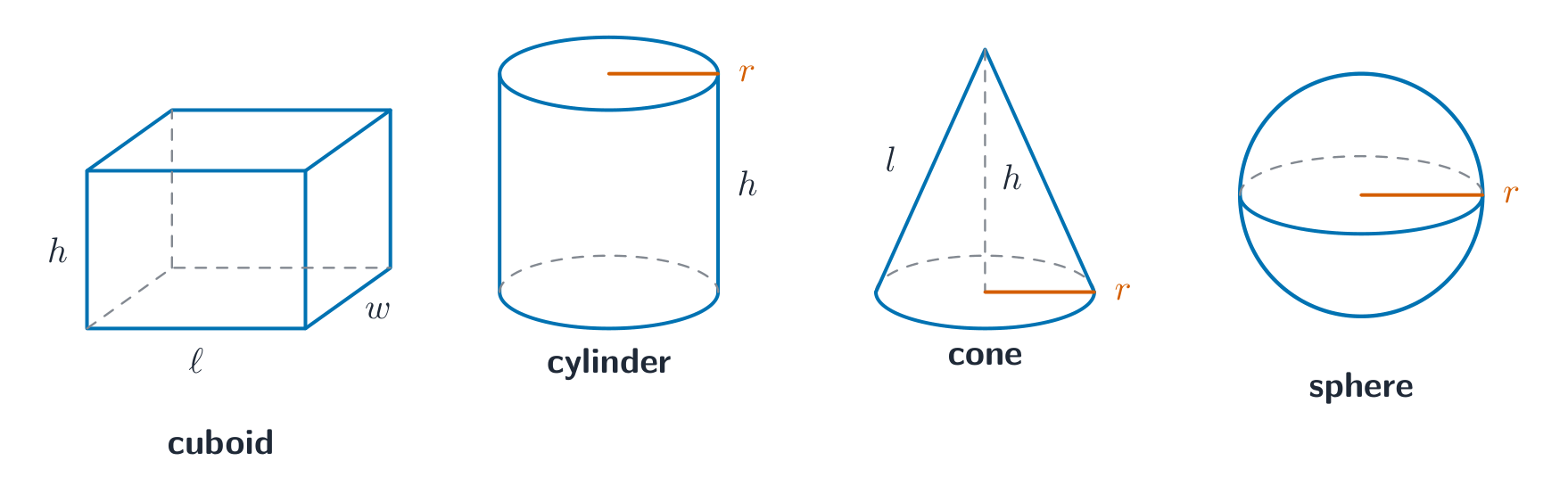
常见的立体和它们的体积和表面积公式中使用的尺寸
A triangle has base 10 cm and height 6 cm. Find its area (cm²). · 一个三角形的底为 10 cm,高为 6 cm。求其面积(cm²)。
½ × 10 × 6 = 30 cm². · ½ × 10 × 6 = 30 cm²。
A parallelogram has base 12 cm and perpendicular height 7 cm. Find its area (cm²). · 一个平行四边形的底为 12 cm,垂高为 7 cm。求其面积(cm²)。
Area = b × h = 12 × 7 = 84 cm². · 面积 = 底 × 高 = 12 × 7 = 84 cm²。
In the triangle area formula, h is the slant height of the triangle. · 在三角形面积公式中,h 是三角形的斜高。
h must be the perpendicular height (at 90° to the base), not the slant side. · h 必须是垂高(与底边成 90°),而非斜边。
A rectangle is 8 cm by 5 cm. Find its area (cm²). · 一个矩形长 8 cm,宽 5 cm。求其面积(cm²)。
Area = length × width = 8 × 5 = 40 cm². · 面积 = 长 × 宽 = 8 × 5 = 40 cm²。
Worked example — trapezium
- Parallel sides $6\text{ cm}$ and $10\text{ cm}$, height $4\text{ cm}$.
- Area $= \dfrac{1}{2}(6+10) \times 4 = \dfrac{1}{2} \times 16 \times 4 = 32\text{ cm}^2$.
A triangle's area uses the perpendicular height — the height at $90^{\circ}$ to the base, not the slant side.
例题——梯形
- 平行边 $6\text{ cm}$ 和 $10\text{ cm}$,高 $4\text{ cm}$。
- 面积 $= \dfrac{1}{2}(6+10) \times 4 = \dfrac{1}{2} \times 16 \times 4 = 32\text{ cm}^2$。
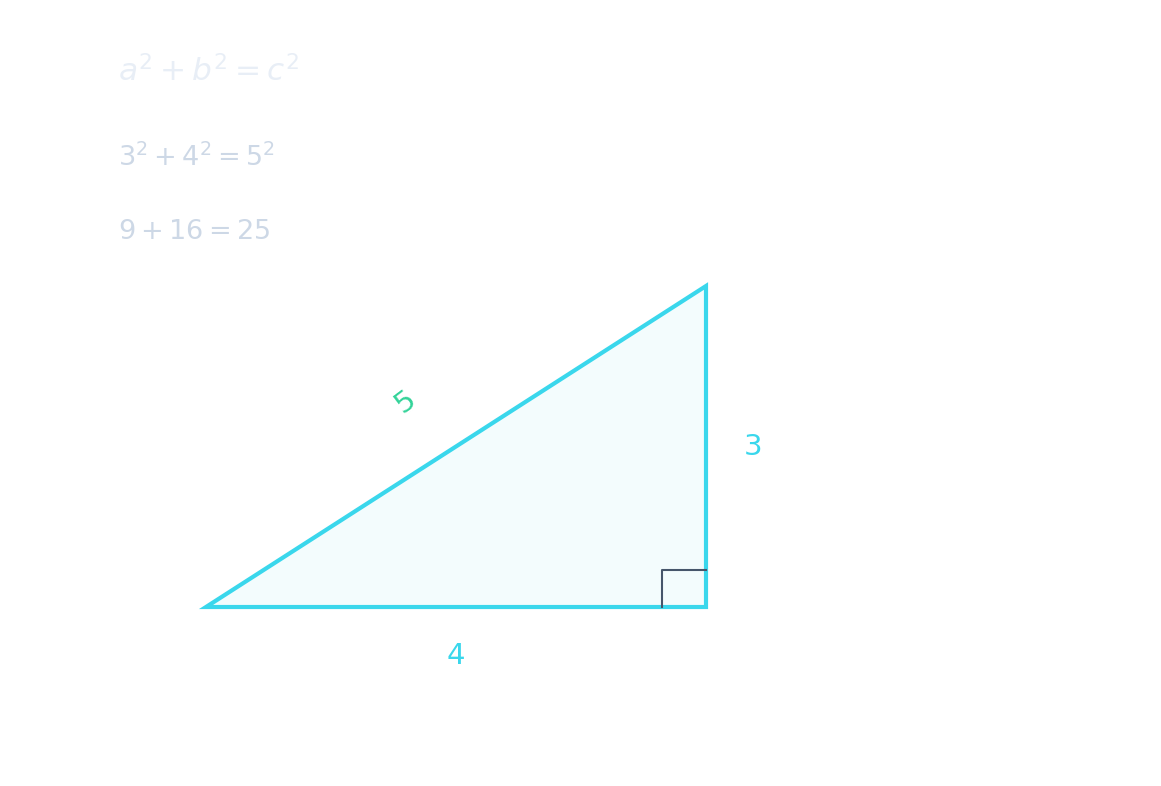
一个三角形的面积使用垂直高——与底成 $90^{\circ}$ 的高,不是斜边。
A trapezium has parallel sides 6 cm and 10 cm and height 4 cm. Find its area (cm²). · 一个梯形的平行边分别为 6 cm 和 10 cm,高为 4 cm。求其面积(cm²)。
½(6 + 10) × 4 = ½ × 16 × 4 = 32 cm². · ½(6 + 10) × 4 = ½ × 16 × 4 = 32 cm²。
Why does the triangle formula work?
- Any triangle is exactly half of a parallelogram with the same base and height.
- That's why the formula has the $\dfrac{1}{2}$ — it's half the parallelogram's area.
为什么三角形公式有效?
- 任何三角形恰好是有相同底和高的一个平行四边形的一半。
- 这就是为什么公式有 $\dfrac{1}{2}$——它是平行四边形面积的一半。
You've got it
- rectangle area $= l \times w$; triangle $= \dfrac{1}{2}bh$; parallelogram $= bh$
- trapezium $= \dfrac{1}{2}(a+b)h$ ($a, b$ are the parallel sides)
- $h$ is always the perpendicular height
你掌握了
- 矩形面积 $= l \times w$;三角形 $= \dfrac{1}{2}bh$;平行四边形 $= bh$
- 梯形 $= \dfrac{1}{2}(a+b)h$($a, b$ 是平行边)
- $h$ 总是垂直高