The equation of a straight line · 直线的方程
| English | 中文 | Pinyin · 拼音 |
|---|---|---|
| intercept/ˌɪntəˈsept/ | 截距 | jié jù |
| line of best fit/laɪn ɒv best fɪt/ | 最佳拟合线 | zuì jiā nǐ hé xiàn |
Reading a line like a barcode
- Every straight line has a unique "signature" — its equation.
- If you can read the equation, you can tell the gradient, the intercept 截距, and where the line crosses every axis — without drawing it.
- The signature is just three letters: $y = mx + c$.
像读条形码一样读一条线
- 每条直线都有一个独特的"签名"——它的方程。
- 如果你能读方程,你就能说出斜率、截距,以及线穿过每个轴的地方——无需画它。
- 这个签名只是三个字母:$y = mx + c$。
The form $y = mx + c$
- $m$ is the gradient (how steep the line is).
- $c$ is the $y$-intercept (where the line crosses the $y$-axis — the point $(0, c)$).
- Together, they completely describe a straight line.
In $y = 3x - 1$: the gradient $m = 3$ and the intercept $c = -1$. The figure shows both.
形式 $y = mx + c$
- $m$ 是斜率(gradient,线有多陡)。
- $c$ 是 $y$ 截距(y-intercept,线穿过 $y$ 轴的地方——点 $(0, c)$)。
- 它们一起完全描述一条直线。
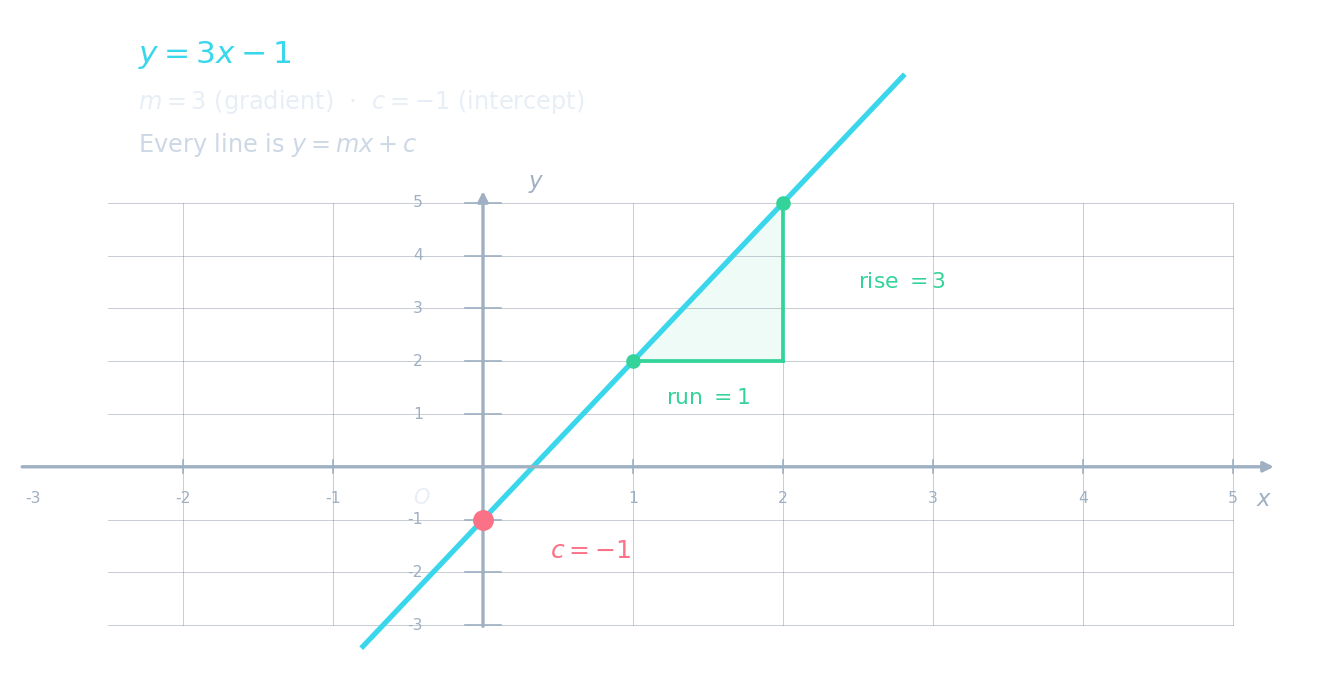
在 $y = 3x - 1$ 中:斜率 $m = 3$ 而截距 $c = -1$。图显示两者。
The straight line · 直线
y = ax + b
Every line has a gradient a and a y-intercept b. · 每条线都有一个斜率 a 和一个 y 截距 b。
In y = mx + c, the letter m stands for the: · 在 y = mx + c 中,字母 m 代表:
m is the gradient (steepness); c is the y-intercept. · m 是斜率(陡度);c 是 y 截距。
Reading $m$ and $c$ from an equation
- When the equation is already in $y = mx + c$ form, just read off the values:
- $y = 5x + 2$ → $m = 5$, $c = 2$.
- $y = -\dfrac{1}{2}x + 4$ → $m = -\dfrac{1}{2}$, $c = 4$.
- $y = 3x$ → $m = 3$, $c = 0$ (the line passes through the origin).
Not in $y =$ form? You must rearrange first. $5x + 4y = 8$ looks tricky, but: $4y = -5x + 8$, so $y = -\dfrac{5}{4}x + 2$ — gradient $-\dfrac{5}{4}$, intercept $2$.
For $y=mx+c$ the line crosses the $y$-axis at $c$, and the gradient $m$ is the rise divided by the run
从一个方程读 $m$ 和 $c$
- 当方程已经是 $y = mx + c$ 形式时,只需读出值:
- $y = 5x + 2$ → $m = 5$,$c = 2$。
- $y = -\dfrac{1}{2}x + 4$ → $m = -\dfrac{1}{2}$,$c = 4$。
- $y = 3x$ → $m = 3$,$c = 0$(线通过原点)。
不是 $y =$ 形式? 你必须先重排。$5x + 4y = 8$ 看起来棘手,但:$4y = -5x + 8$,所以 $y = -\dfrac{5}{4}x + 2$——斜率 $-\dfrac{5}{4}$,截距 $2$。
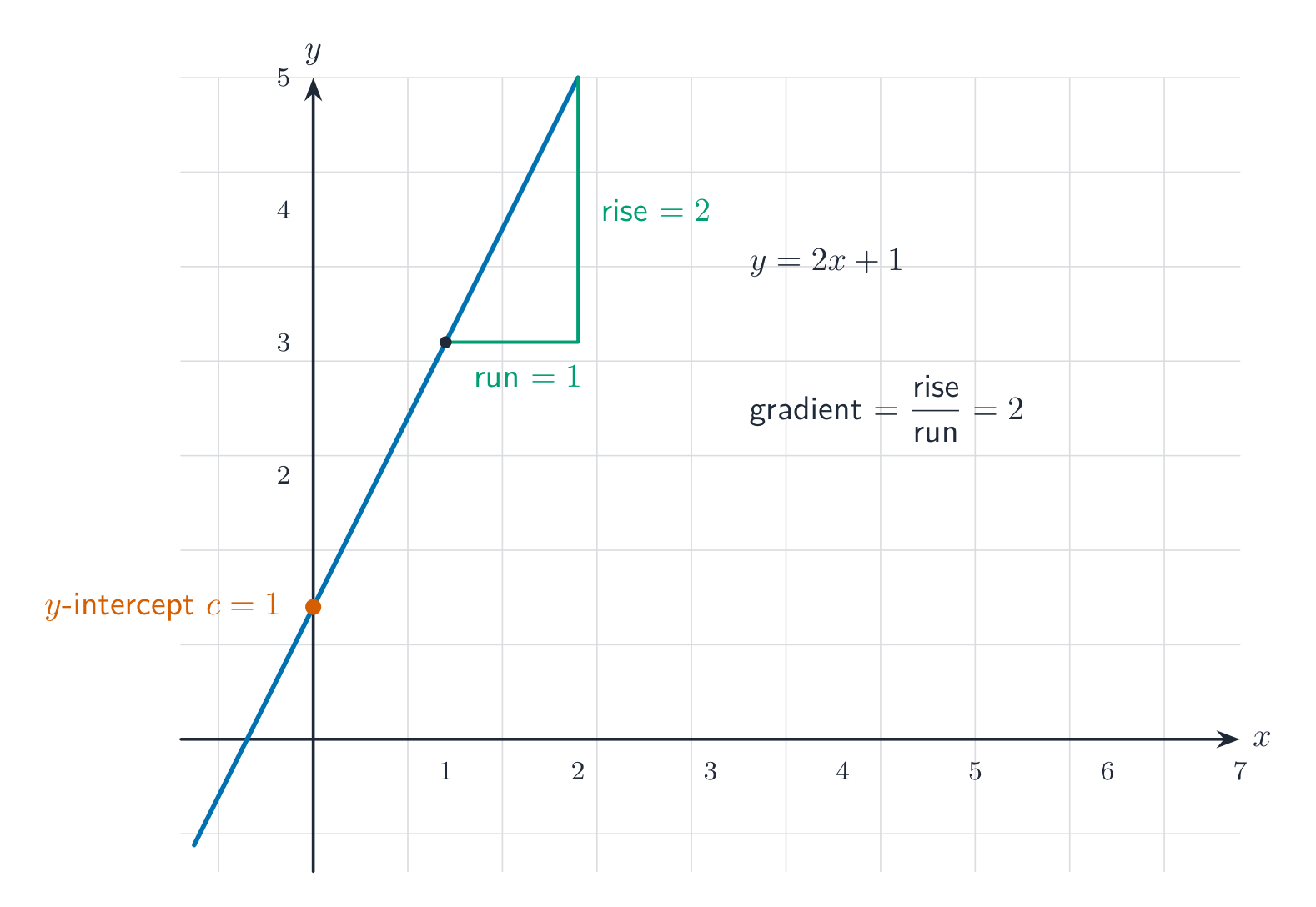
对 $y=mx+c$,线在 $c$ 处穿过 $y$ 轴,而斜率 $m$ 是上升除以水平距离
Finding the equation from a point and gradient
- Know the gradient $m$ and one point? Substitute into $y = mx + c$ and solve for $c$.
- Example: gradient $3$ through $(1, 2)$:
- $2 = 3(1) + c \Rightarrow c = 2 - 3 = -1$.
- The equation is $y = 3x - 1$.
From two points. Through $(2, 5)$ and $(4, 11)$: first find $m = \dfrac{11-5}{4-2} = \dfrac{6}{2} = 3$. Then $5 = 3(2) + c \Rightarrow c = -1$. Equation: $y = 3x - 1$.
从一个点和斜率求方程
- 知道斜率 $m$ 和一个点?代入 $y = mx + c$ 并解出 $c$。
- 例子:斜率 $3$ 通过 $(1, 2)$:
- $2 = 3(1) + c \Rightarrow c = 2 - 3 = -1$。
- 方程是 $y = 3x - 1$。
从两个点。 通过 $(2, 5)$ 和 $(4, 11)$:先求 $m = \dfrac{11-5}{4-2} = \dfrac{6}{2} = 3$。然后 $5 = 3(2) + c \Rightarrow c = -1$。方程:$y = 3x - 1$。
A line has gradient 3 and passes through (1, 2). In y = 3x + c, what is c? · 一条线有斜率 3 且通过 (1, 2)。在 y = 3x + c 中,c 是多少?
2 = 3(1) + c, so c = 2 − 3 = −1; the line is y = 3x − 1. · 2 = 3(1) + c,所以 c = 2 − 3 = −1;线是 y = 3x − 1。
A line has gradient 2 and passes through (3, 1). Its equation is: · 一条线有斜率 2 且通过 (3, 1)。它的方程是:
1 = 2(3) + c → c = 1 − 6 = −5. So y = 2x − 5. · 1 = 2(3) + c → c = 1 − 6 = −5。所以 y = 2x − 5。
A line is perpendicular to y = 2x + 3 and passes through (4, 1). In y = mx + c, what is c? · 一条线垂直于 y = 2x + 3 且通过 (4, 1)。在 y = mx + c 中,c 是多少?
Perpendicular gradient = −1/2. So 1 = −(1/2)(4) + c → 1 = −2 + c → c = 3. · 垂直斜率 = −1/2。所以 1 = −(1/2)(4) + c → 1 = −2 + c → c = 3。
Rearranging to $y = mx + c$
- Exams love giving equations like $ax + by = c$ and asking for the gradient.
- Step 1: isolate $y$ — move $ax$ to the other side, then divide by $b$.
- Step 2: read off $m$ and the intercept.
- Example: $2x + 3y = 12 \Rightarrow 3y = -2x + 12 \Rightarrow y = -\dfrac{2}{3}x + 4$.
- Gradient $= -\dfrac{2}{3}$; $y$-intercept $= 4$.
重排成 $y = mx + c$
- 考试喜欢给出像 $ax + by = c$ 这样的方程并要求斜率。
- 第 1 步:孤立 $y$——把 $ax$ 移到另一边,然后除以 $b$。
- 第 2 步:读出 $m$ 和截距。
- 例子:$2x + 3y = 12 \Rightarrow 3y = -2x + 12 \Rightarrow y = -\dfrac{2}{3}x + 4$。
- 斜率 $= -\dfrac{2}{3}$;$y$ 截距 $= 4$。
Rearrange 5x + 4y = 8 into y = mx + c. What is c (the y-intercept)? · 把 5x + 4y = 8 重排成 y = mx + c。c(y 截距)是多少?
4y = −5x + 8, so y = −(5/4)x + 2; the intercept is 2. · 4y = −5x + 8,所以 y = −(5/4)x + 2;截距是 2。
Rearrange 2x + 3y = 12 into y = mx + c. What is the gradient m? · 把 2x + 3y = 12 重排成 y = mx + c。斜率 m 是多少?
3y = −2x + 12, so y = −(2/3)x + 4. The gradient is −2/3 ≈ −0.667. · 3y = −2x + 12,所以 y = −(2/3)x + 4。斜率是 −2/3 ≈ −0.667。
Rearrange 3x − y = 7 into y = mx + c. What is the y-intercept? · 把 3x − y = 7 重排成 y = mx + c。y 截距是多少?
−y = −3x + 7, so y = 3x − 7. The y-intercept is −7. · −y = −3x + 7,所以 y = 3x − 7。y 截距是 −7。
The line of best fit 最佳拟合线
- In science experiments, data points rarely fall on a perfect line.
- Scientists draw a line of best fit through the scatter — and its equation $y = mx + c$ summarises the whole experiment in one sentence.
- The gradient tells you the rate (e.g. how fast temperature rises per minute); the intercept tells you the starting value.
最佳拟合线
- 在科学实验中,数据点很少落在一条完美的线上。
- 科学家在散点中画一条最佳拟合线(line of best fit)——而它的方程 $y = mx + c$ 用一句话总结整个实验。
- 斜率告诉你速率(例如温度每分钟上升多快);截距告诉你起始值。
Match each equation to its property. · 把每个方程匹配到它的性质。
y = 4x + 1: m = 4. y = −x + 3: c = 3. y = 2x: c = 0, so it passes through (0,0). y = 5x − 1 has gradient 5, same as y = 5x + 7, so they are parallel. · y = 4x + 1:m = 4。y = −x + 3:c = 3。y = 2x:c = 0,所以它通过 (0,0)。y = 5x − 1 有斜率 5,与 y = 5x + 7 相同,所以它们平行。
You've got it
- $y = mx + c$ — $m$ is the gradient, $c$ is the $y$-intercept
- rearrange $ax + by = c$ into $y = mx + c$ before reading off $m$ and $c$
- gradient $3$ through $(1, 2)$ → $c = -1$ → equation $y = 3x - 1$
- from two points: find $m$ first, then substitute one point to find $c$
你掌握了
- $y = mx + c$——$m$ 是斜率,$c$ 是 $y$ 截距
- 在读出 $m$ 和 $c$ 之前把 $ax + by = c$ 重排成 $y = mx + c$
- 斜率 $3$ 通过 $(1, 2)$ → $c = -1$ → 方程 $y = 3x - 1$
- 从两个点:先求 $m$,然后代入一个点求 $c$