Coordinates and the coordinate plane · 坐标与坐标平面
| English | 中文 | Pinyin · 拼音 |
|---|---|---|
| coordinate plane/kəʊˈɔːdɪnət pleɪn/ | 坐标平面 | zuò biāo píng miàn |
| origin/ˈɒrɪdʒɪn/ | 原点 | yuán diǎn |
| quadrants/ˈkwɒdrənts/ | 象限 | xiàng xiàn |
| coordinates/kəʊˈɔːdɪnəts/ | 坐标 | zuò biāo |
A city, a battleship, a treasure map
- A friend says: "Walk 3 blocks east, then 2 blocks south." You can find the spot exactly — because you have two directions.
- A single number ("go 3 blocks") leaves you on a whole circle. Two numbers pin you to a single point.
- That is the whole idea behind the coordinate plane 坐标平面: every point gets a unique address.
The coordinate plane
- Two perpendicular number lines — the $x$-axis (horizontal) and the $y$-axis (vertical) — meet at the origin 原点 $O = (0, 0)$.
- The axes split the plane into four quadrants 象限 (I, II, III, IV).
- Any point is described by its coordinates 坐标 $(x, y)$ — the $x$-value first, then the $y$-value.
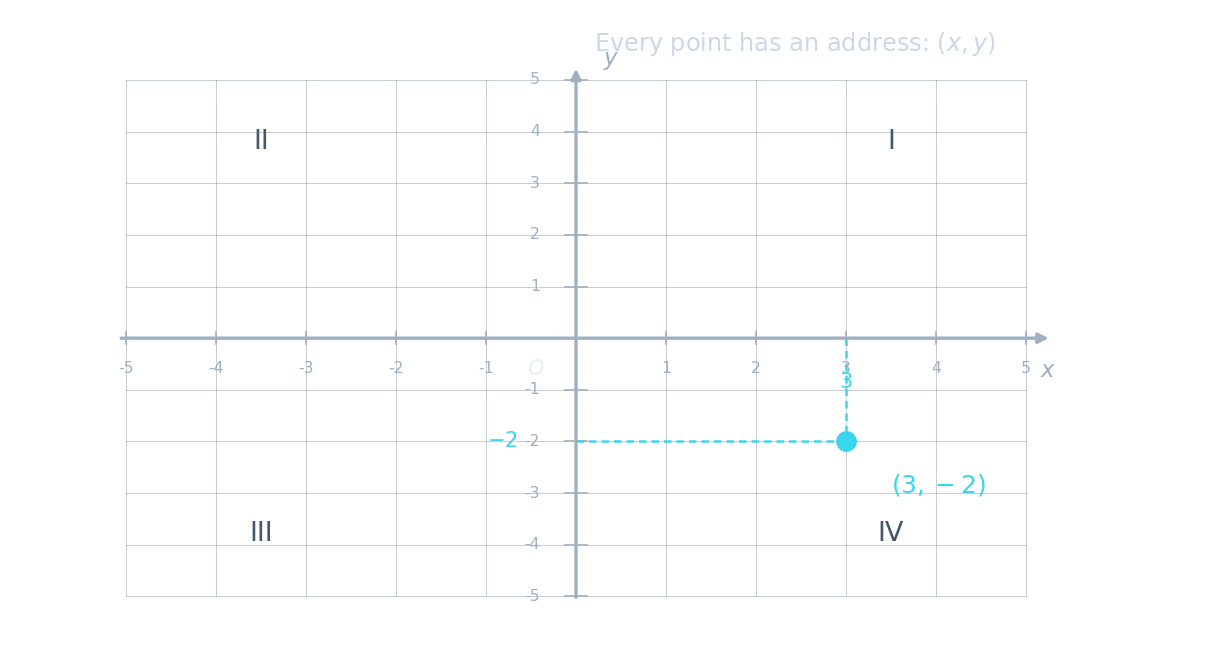
The axes meet at the origin; $(3, -2)$ means 3 right, then 2 down — fourth quadrant.
The coordinate plane · 坐标平面
y = mx + c
Every point has an (x, y) coordinate. A straight line is the set of points where y depends on x in a fixed way. · 每个点都有一个 (x, y) 坐标。一条直线是 y 以一种固定的方式依赖于 x 的点的集合。
The point where the $x$-axis and $y$-axis cross is called the . · $x$ 轴和 $y$ 轴交叉的点被称为。
The origin is the point $(0, 0)$ where the two axes meet. · 原点是两轴相遇的点 $(0, 0)$。
Match each point to its quadrant. · 把每个点匹配到它的象限。
Quadrant I: both positive. II: $x$ negative, $y$ positive. III: both negative. IV: $x$ positive, $y$ negative. · 第 I 象限:都为正。II:$x$ 负,$y$ 正。III:都为负。IV:$x$ 正,$y$ 负。
Reading a point
- Start at the origin. Read the $x$-value by going across (right is positive, left is negative).
- Then read the $y$-value by going up (positive) or down (negative).
- The point $(3, -2)$: go $3$ right, then $2$ down. It sits in quadrant IV.
The order matters. $(3, -2)$ and $(-2, 3)$ are completely different points. Always read across first, then up/down — like walking along a street before climbing stairs.

A city street grid: every place is fixed by its coordinates
The point $(-4, 3)$ is in which quadrant? · 点 $(-4, 3)$ 在哪个象限?
Negative · 否定 $x$ (left) and positive $y$ (up) → quadrant II (top-left). · 负的 $x$(左)和正的 $y$(上)→ 第 II 象限(左上)。
A point starts at $(2, 5)$. It moves $5$ right and $2$ down. What is its new $y$-coordinate? · 一个点从 $(2, 5)$ 开始。它移动 $5$ 向右和 $2$ 向下。它新的 $y$ 坐标是多少?
New position: $(2+5,\; 5-2) = (7, 3)$. The $y$-coordinate is $3$. · 新位置:$(2+5,\; 5-2) = (7, 3)$。$y$ 坐标是 $3$。
The points $(3, -2)$ and $(-2, 3)$ are the same point. · 点 $(3, -2)$ 和 $(-2, 3)$ 是同一个点。
Coordinates are ordered: $(x, y)$. $(3, -2)$ is in quadrant IV; $(-2, 3)$ is in quadrant II — completely different locations. · 坐标是有序的:$(x, y)$。$(3, -2)$ 在第 IV 象限;$(-2, 3)$ 在第 II 象限——完全不同的位置。
Drawing a straight-line graph
- Most lines are $y = mx + c$. The quickest way to draw one:
- Method 1 — mark the intercept $c$ on the $y$-axis, then step using the gradient $m$.
- Method 2 — make a table of values: pick a few $x$-values, calculate $y$, plot the points, and join them.
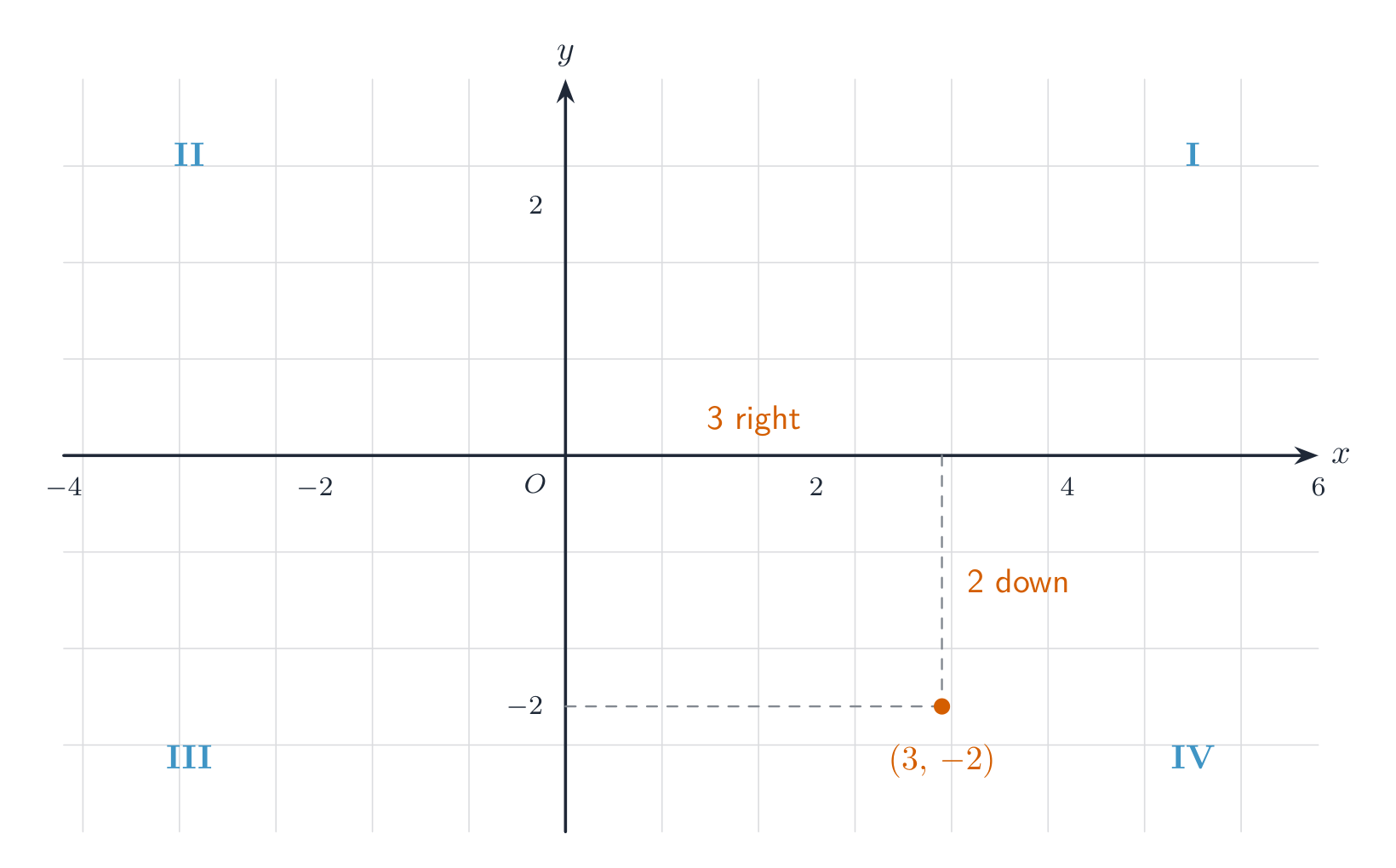
The axes meet at the origin $O$ and split the plane into four quadrants; $(3,-2)$ means 3 right and 2 down
Worked example — table of values
- Draw $y = 2x + 1$.
| $x$ | $y = 2x + 1$ |
|---|---|
| $0$ | $1$ |
| $1$ | $3$ |
| $2$ | $5$ |
- Plot $(0, 1)$, $(1, 3)$, $(2, 5)$ and join with a straight line.
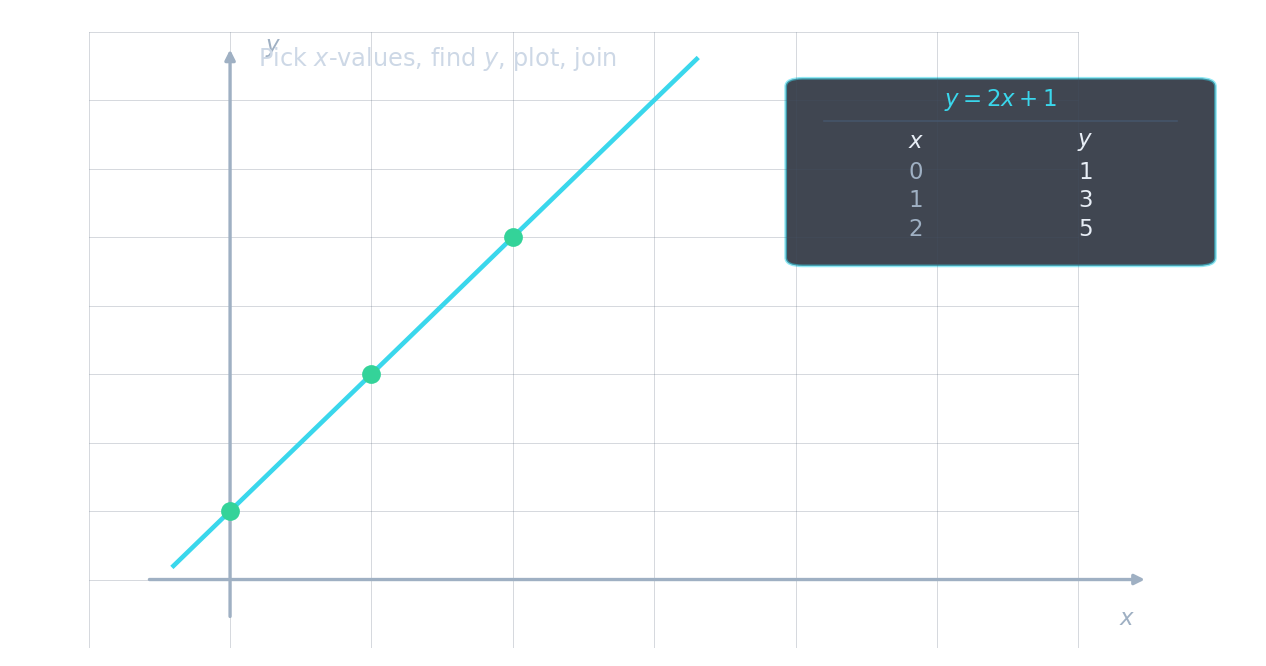
Pick $x$-values, find $y$, plot the points, and join — the table guarantees accuracy.
Special lines. $x = k$ is a vertical line (fixed $x$ for every $y$); $y = k$ is a horizontal line (fixed $y$ for every $x$). A horizontal line has $m=0$ and fits $y=mx+c$; a vertical line does not.
Which equation gives a horizontal line? · 哪个方程给出一条水平线?
$y = k$ fixes the $y$-value for every $x$, giving a horizontal line. $x = k$ is vertical. · $y = k$ 对每个 $x$ 固定 $y$ 值,给出一条水平线。$x = k$ 是竖直的。
Fun fact
- The coordinate plane is named after René Descartes (1596–1650), who — legend has it — invented it while lying in bed watching a fly on the ceiling and wondering how to describe its exact position.
You've got it
- a point is $(x, y)$ — across first, then up/down; the axes meet at the origin $(0, 0)$
- the four quadrants are numbered I (top-right) → IV (bottom-right) anti-clockwise
- $(3, -2)$ → 3 right, 2 down (quadrant IV); $(-2, 3)$ is a different point entirely
- draw $y = mx + c$ by marking $c$ on the $y$-axis, then stepping with the gradient — or use a table of values