Algebraic fractions · 代数分式
| English | 中文 | Pinyin · 拼音 |
|---|---|---|
| algebraic fractions/ˌældʒɪˈbreɪɪk ˈfrækʃnz/ | 代数分式 | dài shù fēn shì |
| factorise/ˈfæktəraɪz/ | 因式分解 | yīn shì fēn jiě |
| cancel/ˈkænsl/ | 约分 | yuē fēn |
| common denominator/ˈkɒmən dɪˈnɒmɪneɪtə/ | 公分母 | gōng fēn mǔ |
| reciprocal/rɪˈsɪprəkl/ | 倒数 | dào shǔ |
When fractions have letters
- A baker halves a recipe, then thirds it again — that's $\dfrac{1}{2} \times \dfrac{1}{3} = \dfrac{1}{6}$ of the original.
- Algebraic fractions 代数分式 work exactly the same way, but the numbers are replaced by expressions. The rules don't change.
当分母中含有字母时
- 一位面包师将食谱减半,再取其中的三分之一——这相当于原始食谱的 $\dfrac{1}{2} \times \dfrac{1}{3} = \dfrac{1}{6}$。
- 代数分式 的运算规则完全相同,只是数字被表达式替代。规则本身不变。
Algebraic fraction route · 代数分式路径
Simplify algebraic fractions by factorising before cancelling. · 通过先因式分解再约分来化简代数分式。
Simplifying algebraic fractions
- Factorise 因式分解 the numerator and denominator, then cancel 约分 any common factors.
- $\dfrac{x^2 - 2x}{x^2 - 5x + 6} = \dfrac{x(x-2)}{(x-2)(x-3)} = \dfrac{x}{x-3}$.
Factorise first, then cancel. You cannot cancel individual terms: $\dfrac{x+2}{x+3} \neq \dfrac{2}{3}$. The $+2$ and $+3$ are not factors — they are terms inside a sum.
Expanding a bracket with an area model
化简代数分式
- 先对分子和分母进行因式分解,然后约去所有公因式。
- $\dfrac{x^2 - 2x}{x^2 - 5x + 6} = \dfrac{x(x-2)}{(x-2)(x-3)} = \dfrac{x}{x-3}$.
先因式分解,再约分。 你不能单独约去各项:$\dfrac{x+2}{x+3} \neq \dfrac{2}{3}$。$+2$和$+3$不是因式——它们是和中的项。

用一个面积模型展开一个括号
Simplify (x² − 2x)/(x² − 5x + 6). · 化简 (x² − 2x)/(x² − 5x + 6)。
Factorise: x(x−2) / [(x−2)(x−3)], cancel (x−2) → x/(x−3). · 因式分解:x(x−2) / [(x−2)(x−3)],约去 (x−2) → x/(x−3)。
(x + 2)/(x + 3) simplifies to 2/3. · (x + 2)/(x + 3) 化简为 2/3。
You can only cancel common FACTORS, not terms in a sum. x+2 and x+3 share no common factor. · 你只能约去公因数,而不能约去和中的项。x+2 和 x+3 没有公因数。
Adding and subtracting
- Find a common denominator 公分母, just as with ordinary fractions.
- $\dfrac{x}{3} + \dfrac{x-4}{2} = \dfrac{2x}{6} + \dfrac{3(x-4)}{6} = \dfrac{2x + 3x - 12}{6} = \dfrac{5x - 12}{6}$.
Expand carefully. $3(x-4) = 3x - 12$ (not $3x - 4$). Every term inside the bracket must be multiplied.
加减法
- 寻找公分母,就像普通分数一样。
- $\dfrac{x}{3} + \dfrac{x-4}{2} = \dfrac{2x}{6} + \dfrac{3(x-4)}{6} = \dfrac{2x + 3x - 12}{6} = \dfrac{5x - 12}{6}$.
仔细展开。 $3(x-4) = 3x - 12$(而非$3x - 4$)。括号内的每一项都必须相乘。
Add x/3 + (x−4)/2 over a common denominator of 6. · 将x/3 + (x−4)/2通分到公分母6。
2x/6 + 3(x−4)/6 = (2x + 3x − 12)/6 = (5x − 12)/6.
To add algebraic fractions, you must first find a common . · 要添加代数分式,必须先找到公。
Just like with numeric fractions, you need a common denominator before adding or subtracting. · 就像处理数值分数一样,在加减之前需要通分。
Multiplying and dividing
- Multiply: tops × tops, bottoms × bottoms — same as ordinary fractions.
- Divide: multiply by the reciprocal 倒数 of the second fraction.
- $\dfrac{x+1}{x-2} \div \dfrac{x+3}{x} = \dfrac{x+1}{x-2} \times \dfrac{x}{x+3} = \dfrac{x(x+1)}{(x-2)(x+3)}$.
乘除法
- 乘法:分子×分子,分母×分母——与普通分数相同。
- 除法:乘以第二个分数的倒数。
- $\dfrac{x+1}{x-2} \div \dfrac{x+3}{x} = \dfrac{x+1}{x-2} \times \dfrac{x}{x+3} = \dfrac{x(x+1)}{(x-2)(x+3)}$.
To divide algebraic fractions, multiply by the reciprocal of the second one. · 除以代数分式等于乘以第二个分式的倒数。
Division by a fraction is multiplication by its reciprocal, just as with numbers. · 分数的除法等同于乘以其倒数,就像普通数字一样。
Worked example
- Simplify $\dfrac{x^2 - 9}{x^2 + 5x + 6}$.
- Factorise: numerator $= (x+3)(x-3)$, denominator $= (x+2)(x+3)$.
- Cancel $(x+3)$: result $= \dfrac{x-3}{x+2}$.
Factorising is the key to both solving quadratics and simplifying algebraic fractions.
示例
- 化简$\dfrac{x^2 - 9}{x^2 + 5x + 6}$。
- 因式分解:分子$= (x+3)(x-3)$,分母$= (x+2)(x+3)$。
- 约分$(x+3)$:结果$= \dfrac{x-3}{x+2}$。
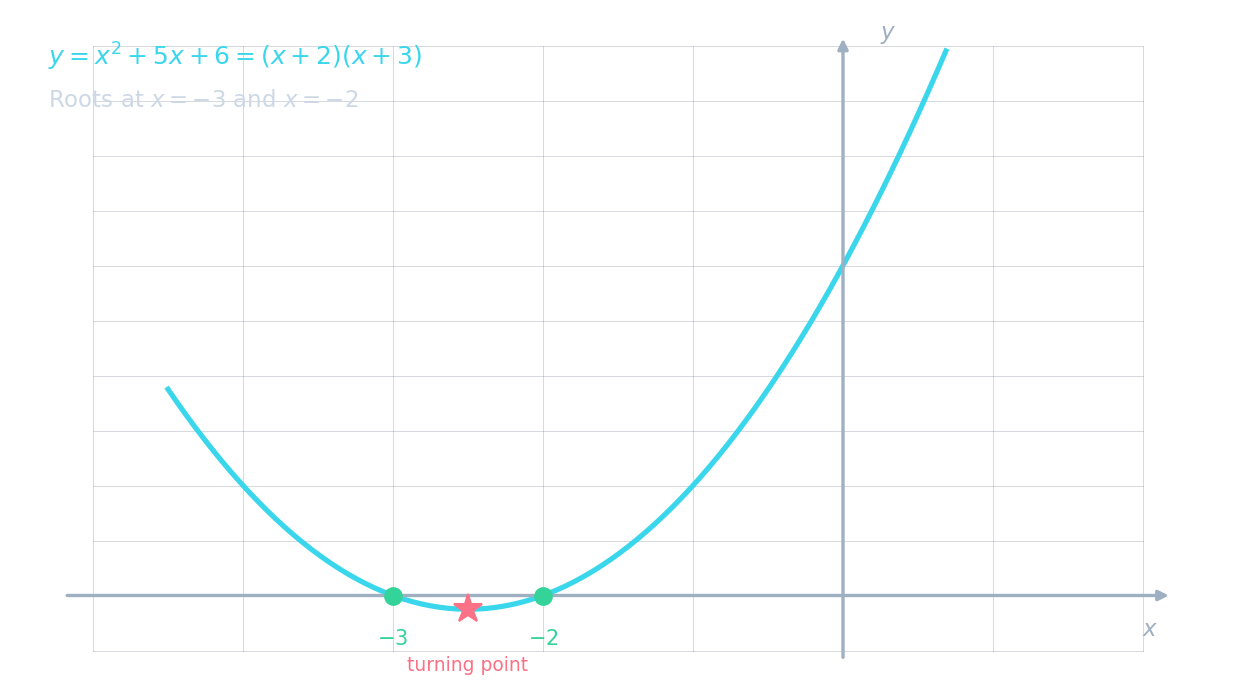
因式分解是解二次方程和简化代数分数的关键。
Simplify (x² − 9)/(x² + 5x + 6). · 化简 (x² − 9)/(x² + 5x + 6)。
(x+3)(x−3) / [(x+2)(x+3)], cancel (x+3) → (x−3)/(x+2). · (x+3)(x−3) / [(x+2)(x+3)],约去 (x+3) → (x−3)/(x+2)。
Keep the excluded values
- Cancelling a factor does not restore a forbidden input. $x(x-2)/((x-2)(x-3))=x/(x-3)$, but the original still excludes $x=2$ and $x=3$.
- For $(x+1)/(x-2)\div((x+3)/x)$, exclude $x=2,0$ because of denominators, and $x=-3$ because the divisor is zero. Write these restrictions before cancelling.
保留排除值
- 约去一个因式并不会恢复被禁止的输入。$x(x-2)/((x-2)(x-3))=x/(x-3)$,但原式仍排除$x=2$和$x=3$。
- 对于$(x+1)/(x-2)\div((x+3)/x)$,因分母需排除$x=2,0$,因除数为零需排除$x=-3$。在约分前写出这些限制条件。
For (x² − 9)/(x² + 5x + 6), which excluded input besides −2 must remain after cancelling? · 对于(x² − 9)/(x² + 5x + 6),除了−2之外,约分后还需保留哪个排除值?
The original denominator is (x+2)(x+3), so x = −3 stays excluded. · 原分母为(x+2)(x+3),因此x = −3仍被排除。
You've got it
- simplify: factorise top and bottom, cancel common brackets
- add/subtract: find a common denominator, combine numerators
- multiply/divide: as with ordinary fractions (divide = × the reciprocal)
- never cancel terms inside a sum — only cancel factors
你掌握了
- 化简:分子分母因式分解,约去公因式括号
- 加/减:找公分母,合并分子
- 乘/除:与普通分数相同(除法 = × 倒数)
- 切勿约去和中的项——只能约去因式