Ratio, proportion and rates · 比、比例与速率
| English | 中文 | Pinyin · 拼音 |
|---|---|---|
| ratio/ˈreɪʃɪəʊ/ | 比 | bǐ |
| direct proportion/daɪˈrekt prəˈpɔːʃn/ | 正比例 | zhèng bǐ lì |
| rate/reɪt/ | 比率 | bǐ lǜ |
| average speed/ˈævrɪdʒ spiːd/ | 平均速度 | píng jūn sù dù |
Splitting a pizza fairly
- You and a friend share a pizza in ratio 比 $3:5$. You get $\dfrac{3}{8}$, your friend gets $\dfrac{5}{8}$.
- Ratios are about fair sharing — splitting a total into parts that keep a fixed relationship.
公平地分一个披萨
- 你和一个朋友按比 $3:5$ 分一个披萨。你得到 $\dfrac{3}{8}$,你的朋友得到 $\dfrac{5}{8}$。
- 比(ratio)是关于公平分享——把一个总数分成保持一个固定关系的部分。
What is a ratio?
- A ratio $a:b$ compares two quantities — "for every $a$ of one thing, there are $b$ of the other".
- Simplify by dividing both parts by their HCF: $20:30 = 2:3$.
- Ratios have no units — $3\text{ cm}:5\text{ cm}$ is just $3:5$.
Ratios ≠ fractions. The ratio $3:5$ does NOT mean "$\dfrac{3}{5}$ of the total". It means the total is split into $3+5=8$ parts: one gets $\dfrac{3}{8}$, the other $\dfrac{5}{8}$.
什么是比?
- 一个比(ratio)$a:b$ 比较两个量——"对于一样东西的每 $a$,有另一样的 $b$"。
- 通过把两部分都除以它们的 HCF 来简化:$20:30 = 2:3$。
- 比没有单位——$3\text{ cm}:5\text{ cm}$ 只是 $3:5$。
比 ≠ 分数。 比 $3:5$ 不意味着"总数的 $\dfrac{3}{5}$"。它意味着总数被分成 $3+5=8$ 部分:一个得到 $\dfrac{3}{8}$,另一个 $\dfrac{5}{8}$。
Direct proportion · 正比例
y = ax
Direct proportion is a straight line through the origin — double x and you double y.
What is the ratio 24:36 in its simplest form?
HCF of 24 and 36 is 12. 24÷12 = 2, 36÷12 = 3. Simplest form: 2:3.
The ratio 3:5 means one person gets 3/5 of the total.
3:5 means 3+5 = 8 parts total. One gets 3/8, the other gets 5/8 — not 3/5.
Sharing in a ratio
- Method: add the parts, divide the total, multiply back.
- Share 48 in the ratio $3:5$:
- Total parts $= 3 + 5 = 8$. One part $= 48 \div 8 = 6$.
- Shares: $3 \times 6 = 18$ and $5 \times 6 = 30$. Check: $18 + 30 = 48$. ✓
Bar model: split the total into equal parts, then group them by the ratio.
按比分享
- 方法:把部分相加,除以总数,乘回去。
- 把 48 按比 $3:5$ 分享:
- 总部分 $= 3 + 5 = 8$。一部分 $= 48 \div 8 = 6$。
- 份额:$3 \times 6 = 18$ 和 $5 \times 6 = 30$。检查:$18 + 30 = 48$。✓
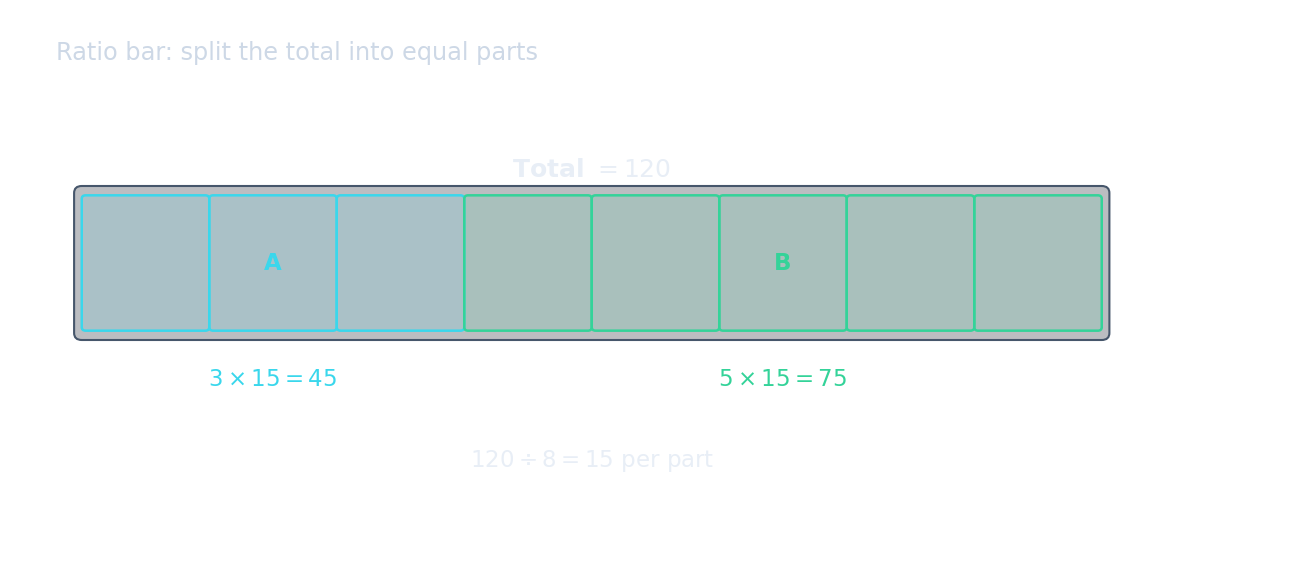
条形模型:把总数分成相等的部分,然后按比把它们分组。
Share 48 in the ratio 3:5. What is the larger share?
8 parts, one part = 48/8 = 6, so the larger share is 5 × 6 = 30.
Share 120 in the ratio 1:3. What is the smaller share?
4 parts, one part = 120/4 = 30. Smaller share = 1 × 30 = 30.
Direct proportion 正比例
- Two quantities are in direct proportion if they increase at the same rate 比率.
- If 3 pens cost 1.80, then 1 pen costs $1.80 \div 3 = 0.60$, so 7 pens cost $7 \times 0.60 = 4.20$.
- The key idea: find the cost of one, then scale up.
Recipe scaling. A cake for 4 people needs 200 g flour. For 10 people: flour per person $= 50$ g, so $10 \times 50 = 500$ g.
正比例
- 两个量在正比例(direct proportion)中,如果它们以相同的速率增加。
- 如果 3 支笔花 1.80,那么 1 支笔花 $1.80 \div 3 = 0.60$,所以 7 支笔花 $7 \times 0.60 = 4.20$。
- 关键想法:找到一个的成本,然后放大。
配方缩放。 一个给 4 个人的蛋糕需要 200 g 面粉。给 10 个人:每人面粉 $= 50$ g,所以 $10 \times 50 = 500$ g。
If 3 pens cost 1.80, what do 7 pens cost?
One pen = 1.80/3 = 0.60, so 7 pens = 7 × 0.60 = 4.20.
Rates and speed
- A rate compares two different quantities: price per kg, km per hour, words per minute.
- Average speed 平均速度 $= \dfrac{\text{total distance}}{\text{total time}}$.
- 45 km in 3 hours 45 minutes $= 45 \div 3.75 = 12$ km/h.
速率与速度
- 一个速率(rate)比较两个不同的量:每 kg 的价格、每小时的 km、每分钟的字数。
- 平均速度(average speed)$= \dfrac{\text{total distance}}{\text{total time}}$。
- 45 千米用 3 小时 45 分钟完成,速度为 $= 45 \div 3.75 = 12$ 千米/小时。
A cyclist travels 45 km in 3 hours 45 minutes. What is the average speed in km/h?
3 h 45 min = 3.75 hours. Average speed = 45 ÷ 3.75 = 12 km/h.
Rates beyond speed
- Compare equal quantities for best value: 3 kg for 18 yuan costs $c=18/3=6$ yuan per kg; 5 kg for 28 yuan costs $c=28/5=5.6$ yuan per kg, so the larger pack is cheaper per kg.
- A tap at 12 litres per minute fills 90 litres in $t=V/r=90/12=7.5$ min. If density is given as $\rho=m/V$, then 90 g in $30\text{ cm}^3$ gives $\rho=90/30=3\text{ g/cm}^3$. For average speed include stops in the time.
速率及其他应用
- 比较等量商品以获得最佳性价比:3 千克售价 18 元,单价为 $c=18/3=6$ 元/千克;5 千克售价 28 元,单价为 $c=28/5=5.6$ 元/千克,因此大包装每千克更便宜。
- 水龙头流速为 12 升/分钟,$t=V/r=90/12=7.5$ 分钟内可注满 90 升水。若密度给出为 $\rho=m/V$,则 90 克物质占据 $30\text{ cm}^3$ 体积,对应 $\rho=90/30=3\text{ g/cm}^3$。计算平均速度时需将停留时间计入总时长。
At 12 litres per minute, how many minutes are needed for 90 litres?
Time = volume / rate = 90 / 12 = 7.5 minutes.
You've got it
- simplify a ratio by the HCF; share by counting parts (add, divide, multiply back)
- proportion: find the cost of one, then scale up
- average speed $= \text{distance} \div \text{time}$ (convert time to decimal hours first)
- ratio $3:5$ means $\dfrac{3}{8}$ and $\dfrac{5}{8}$ of the total — not $\dfrac{3}{5}$
你掌握了
- 用 HCF 简化一个比;通过数部分分享(相加、除、乘回去)
- 比例:找到一个的成本,然后放大
- 平均速度 $= \text{distance} \div \text{time}$(先把时间转换成十进制小时)
- 比 $3:5$ 意味着总数的 $\dfrac{3}{8}$ 和 $\dfrac{5}{8}$——不是 $\dfrac{3}{5}$