Standard form · 科学记数法
| English | 中文 | Pinyin · 拼音 |
|---|---|---|
| standard form/ˈstændəd fɔːm/ | 科学记数法 | kē xué jì shù fǎ |
| integer/ˈɪntɪdʒə/ | 整数 | zhěng shù |
From atoms to galaxies
- The width of a hydrogen atom is about $0.000\,000\,000\,106$ metres.
- The distance to the nearest star is about $40\,000\,000\,000\,000$ metres.
- Writing numbers like that is painful — and error-prone. Standard form 科学记数法 fixes both problems.
Standard form route · 科学记数法路径
Follow a large or small number into a x 10^n form. · 将大数或小数转换为 A × 10^n 形式。
The format $A \times 10^n$
- Standard form writes any number as $A \times 10^n$, where:
- $1 \leq A < 10$ (the "front number" has exactly one digit before the decimal point),
- $n$ is an integer 整数 (positive for big numbers, negative for small ones).
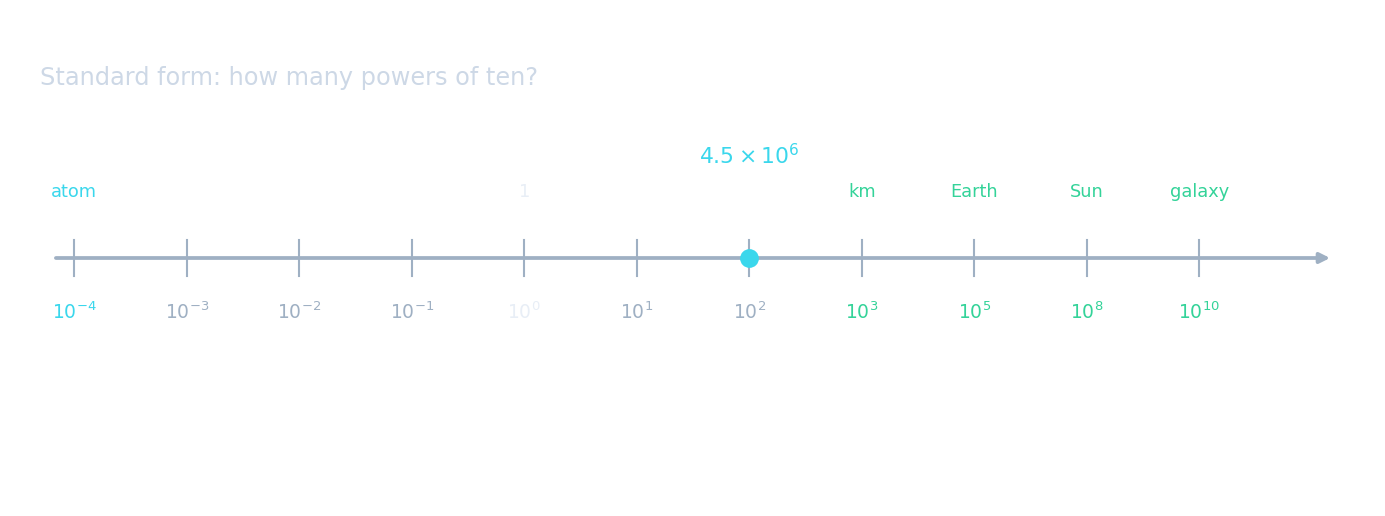
Each tick is ten times bigger than the last. Standard form tells you which tick a number sits near.
In standard form, the front number A must satisfy 1 ≤ A < 10. · 在科学记数法中,前面的数字 A 必须满足 1 ≤ A < 10。
By definition, A is between 1 (inclusive) and 10 (exclusive) — exactly one digit before the decimal point. · 根据定义,A 介于 1(含)和 10(不含)之间——小数点前恰好有一位数字。
Converting big and small numbers
- Big numbers: count how many places the decimal moves left → positive power.
- $4\,500\,000 = 4.5 \times 10^6$ (point moves 6 places left).
- Small numbers (less than 1): count how many places the decimal moves right → negative power.
- $0.000\,72 = 7.2 \times 10^{-4}$ (point moves 4 places right).
Quick method. Write the first non-zero digit, then a decimal point, then the remaining significant digits. Count the places you moved: that's $n$.

A galaxy: huge distances are written compactly in standard form
Write 4 500 000 as A × 10ⁿ. What is the power n? · 将 4 500 000 写成 A × 10ⁿ。n 的幂次是多少?
4 500 000 = 4.5 × 10⁶, so n = 6. · 4 500 000 = 4.5 × 10⁶,因此 n = 6。
Write 0.00072 in standard form A × 10ⁿ. What is n? · 将 0.00072 写成科学记数法 A × 10ⁿ。n 是多少?
0.00072 = 7.2 × 10⁻⁴, so n = −4. · 0.00072 = 7.2 × 10⁻⁴,因此 n = −4。
Calculating in standard form
- Multiply: multiply the fronts, add the powers.
- $(3 \times 10^5) \times (2 \times 10^{-2}) = 6 \times 10^3$.
- Divide: divide the fronts, subtract the powers.
- $(8 \times 10^7) \div (4 \times 10^3) = 2 \times 10^4$.
Adjust if needed. After multiplying, the front number might be $\geq 10$. Adjust: $15 \times 10^3 = 1.5 \times 10^4$.
(3 × 10⁵) × (2 × 10⁻²) = A × 10³. What is A? · (3 × 10⁵) × (2 × 10⁻²) = A × 10³。A 是多少?
3 × 2 = 6 and 10⁵ × 10⁻² = 10³, so the answer is 6 × 10³. · 3 × 2 = 6 且 10⁵ × 10⁻² = 10³,因此答案是 6 × 10³。
(8 × 10⁷) ÷ (4 × 10³) = A × 10ⁿ. What is n? · (8 × 10⁷) ÷ (4 × 10³) = A × 10ⁿ。n 是多少?
8 ÷ 4 = 2 and 10⁷ ÷ 10³ = 10⁴, so n = 4. · 8 ÷ 4 = 2 且 10⁷ ÷ 10³ = 10⁴,因此 n = 4。
Which is 5 × 10³ × 3 × 10² in correct standard form? · 5 × 10³ × 3 × 10² 的正确科学记数法形式是什么?
5 × 3 = 15 and 10³ × 10² = 10⁵, giving 15 × 10⁵. Adjust: 1.5 × 10⁶. · 5 × 3 = 15 且 10³ × 10² = 10⁵,得到 15 × 10⁵。调整:1.5 × 10⁶。
Why scientists love standard form
- The speed of light: $3.0 \times 10^8$ m/s — three hundred million metres every second.
- A DNA helix width: $2.0 \times 10^{-9}$ m — two billionths of a metre.
- Compare like quantities with the same units. A length of $2.0\times10^{-6}$ m is $1000$ times a length of $2.0\times10^{-9}$ m; speed cannot be compared with width.
Adding needs a common power
- For addition, first write both numbers with the same power of ten: $3.2\times10^5+7\times10^4=(3.2+0.7)10^5=3.9\times10^5$.
- Renormalise after calculating: $(8\times10^3)(4\times10^2)=32\times10^5=3.2\times10^6$. Core calculations in standard form are on calculator Paper 3.
Calculate (3.2 × 10⁵ + 7 × 10⁴) / 10⁵. · 计算(3.2 × 10⁵ + 7 × 10⁴) / 10⁵。
Use the same power: 3.2 + 0.7 = 3.9. · 使用相同幂次:3.2 + 0.7 = 3.9。
You've got it
- standard form $= A \times 10^n$ with $1 \leq A < 10$
- big numbers → positive $n$; small numbers $(< 1)$ → negative $n$
- multiply: fronts $\times$, powers $+$; divide: fronts $\div$, powers $-$
- $4\,500\,000 = 4.5 \times 10^6$; $\;0.000\,72 = 7.2 \times 10^{-4}$