Market failure · 市场失灵
| English | 中文 | Pinyin · 拼音 |
|---|---|---|
| market failure/ˈmɑːkɪt ˈfeɪlɪə/ | 市场失灵 | shì chǎng shī líng |
| merit goods/ˈmerɪt ɡʊdz/ | 有益物品 | yǒu yì wù pǐn |
| demerit goods/ˈdemərɪt ɡʊdz/ | 有害物品 | yǒu hài wù pǐn |
| externality/ekˈstɜːnælɪti/ | 外部性 | wài bù xìng |
| third party/θɜːd ˈpɑːti/ | 第三方 | dì sān fāng |
| negative externality/ˈneɡətɪv ekˈstɜːnælɪti/ | 负外部性 | fù wài bù xìng |
| positive externality/ˈpɒzɪtɪv ekˈstɜːnælɪti/ | 正外部性 | zhèng wài bù xìng |
| public goods/ˈpʌblɪk ɡʊdz/ | 公共物品 | gōng gòng wù pǐn |
| monopoly/məˈnɒpəli/ | 垄断 | lǒng duàn |
When markets get it wrong
- A factory makes cheap goods but pumps smoke over a town. The price tag never mentions the dirty air.
- That gap — costs the market ignores — is market failure 市场失灵.
当市场出错时
- 一个工厂制造便宜的物品,但把烟排到一个城镇上。价格标签从不提及肮脏的空气。
- 那个差距——市场忽略的成本——是市场失灵(market failure)。
Market failure occurs when: · 市场失灵发生在:
It is an inefficient allocation — too much or too little is produced. · 它是一个低效的配置——生产太多或太少。
What market failure is
- Market failure = when a free market allocates resources inefficiently — too much or too little is produced.
- The market's prices don't capture the full costs or benefits to society.
Merit goods 有益物品 are under-consumed and demerit goods 有害物品 over-consumed, because of information failure
市场失灵是什么
- 市场失灵 = 当一个自由市场低效地配置资源时——生产太多或太少。
- 市场的价格不捕捉对社会的全部成本或收益。

优值物品消费不足而劣值物品消费过度,因为信息失灵
Demand & supply · 需求与供给
Market failure · 市场失灵: the free-market crossing isn't always best for society. · 市场失灵:自由市场的交点并不总是对社会最好。
Air pollution from a factory is an example of a: · 来自一个工厂的空气污染是以下的一个例子:
It imposes a cost on third parties — a negative externality. · 它把一个成本强加给第三方——一个负外部性。
Education creates a positive externality, benefiting society beyond the student. · 教育创造一个正外部性,使学生之外的社会受益。
A more educated workforce benefits everyone — a positive externality. · 一支更有教育的劳动力使每个人受益——一个正外部性。
Externalities
- An externality 外部性 is a cost or benefit that falls on a third party 第三方 not involved in the trade.
- Negative externality 负外部性: pollution, congestion. Positive externality 正外部性: education, vaccination.
With a negative externality, true social cost lies above private cost, so the market over-produces.
外部性
- 一个外部性(externality)是落在不参与交易的第三方(third party)身上的一个成本或收益。
- 负外部性:污染、拥堵。正外部性:教育、疫苗接种。
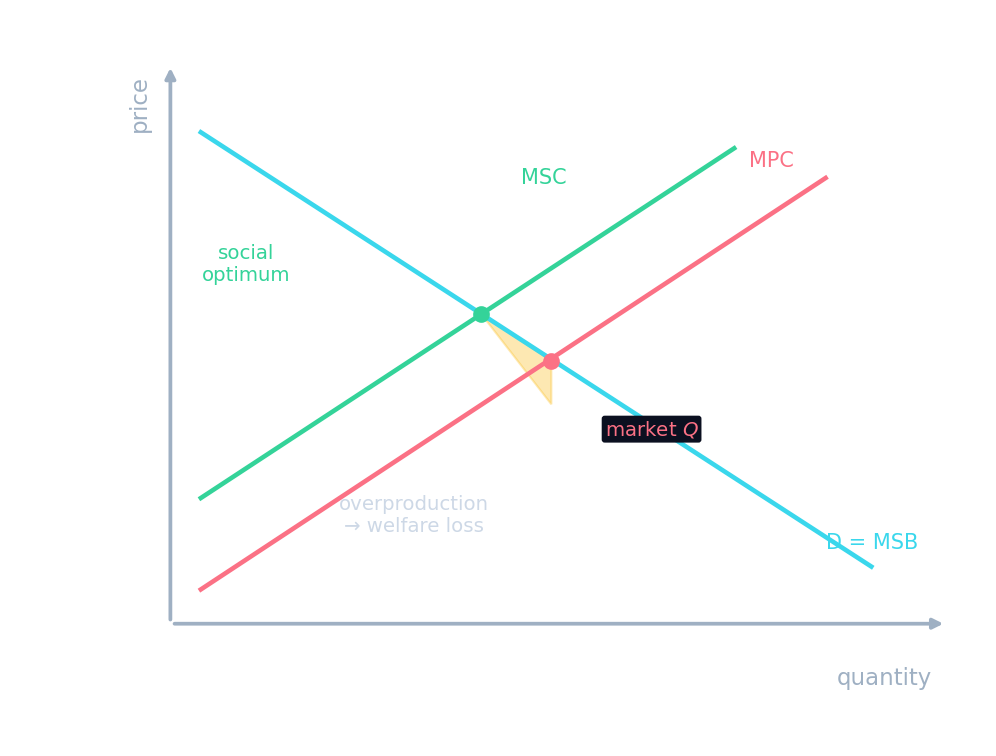
在一个负外部性下,真实的社会成本位于私人成本之上,所以市场过度生产。
A good with a negative externality tends to be: · 一个有负外部性的物品倾向于被:
The market ignores the external cost, so it makes too much. · 市场忽略外部成本,所以它制造太多。
Street lighting, which markets under-provide, is an example of a ______ good. · 街道照明,市场对其提供不足,是一个______物品的例子。
Public goods are non-excludable, so markets under-provide them. · 公共物品是非排他的,所以市场对它们提供不足。
Other types of market failure
- Public goods 公共物品 (street lighting, defence) — markets under-provide them; no one will pay for what they can get free.
A private good is rival and excludable, so firms supply it; a public good is neither, so the market under-provides it
- Merit / demerit goods, monopoly 垄断 power, and missing information all cause failure too.
Over- and under-production both count. Negative externalities → the market makes too much; positive externalities and public goods → it makes too little. Both are failures.
其他类型的市场失灵
- 公共物品(public goods,街道照明、国防)——市场提供不足;没有人会为他们能免费得到的东西付款。

私人物品是竞争性和排他性的,所以企业供应它;公共物品两者都不是,所以市场提供不足
- 优值/劣值物品(merit / demerit goods)、垄断(monopoly)势力,以及缺失的信息也都造成失灵。
过度生产和生产不足都算。 负外部性 → 市场制造太多;正外部性和公共物品 → 它制造太少。两者都是失灵。
You've got it
- market failure = inefficient allocation; prices miss true social costs/benefits
- a negative externality (pollution) → over-production; a positive one → under-production
- public goods and monopoly are further sources of failure
你掌握了
- 市场失灵 = 低效的配置;价格错过真实的社会成本/收益
- 一个负外部性(污染)→ 过度生产;一个正的 → 生产不足
- 公共物品和垄断是失灵的更多来源