Price elasticity of demand (PED) · 需求价格弹性(PED)
| English | 中文 | Pinyin · 拼音 |
|---|---|---|
| price elasticity of demand/praɪs ɪlæˈstɪsɪti ɒv dɪˈmænd/ | 需求价格弹性 | xū qiú jià gé tán xìng |
| elastic/ɪˈlæstɪk/ | 富有弹性 | fù yǒu tán xìng |
| inelastic/ɪnɪˈlæstɪk/ | 缺乏弹性 | quē fá tán xìng |
| luxuries/ˈlʌkʃəriz/ | 奢侈品 | shē chǐ pǐn |
| substitutes/ˈsʌbstɪtjuːts/ | 替代品 | tì dài pǐn |
| necessities/nəˈsesɪtiz/ | 必需品 | bì xū pǐn |
| revenue/ˈrevənjuː/ | 收益 | shōu yì |
How much does price really matter?
- Cut the price of salt by half and you won't buy much more — you only need so much. Cut the price of one airline's seats and bookings soar.
- Price elasticity of demand 需求价格弹性 measures exactly how sensitive buyers are.
价格真正有多重要?
- 把盐的价格减半,你不会买多很多——你只需要那么多。把一家航空公司座位的价格削减,预订就飙升。
- 需求价格弹性(price elasticity of demand)精确地衡量买方有多敏感。
Price rises 10% and quantity demanded falls 30%. What is the size of PED? · 价格上升 10% 而需求量下降 30%。PED 的大小是多少?
PED = 30% / 10% = 3 (ignoring the sign) — elastic. · PED = 30% / 10% = 3(忽略符号)——富有弹性。
Defining PED
- PED = how much quantity demanded responds to a price change.
- $\text{PED} = \dfrac{\%\ \text{change in quantity demanded}}{\%\ \text{change in price}}$ — usually negative, so we read the size.
Worked example. Price rises 10% and quantity demanded falls 20%. $\text{PED} = \dfrac{-20\%}{+10\%} = -2$. Demand is elastic 富有弹性 (responsive).
定义 PED
- PED = 需求量对一个价格变化反应多少。
- $\text{PED} = \dfrac{\%\ \text{change in quantity demanded}}{\%\ \text{change in price}}$——通常是负的,所以我们读它的大小。
例题。 价格上升 10% 而需求量下降 20%。$\text{PED} = \dfrac{-20\%}{+10\%} = -2$。需求是富有弹性的(elastic,反应灵敏)。
Elasticity & total revenue · 弹性与总收入
PED is the % change in quantity over the % change in price; whether it is above or below 1 decides how total revenue moves. · 需求价格弹性是数量变化百分比除以价格变化百分比;它大于还是小于 1 决定总收入如何变动。
Demand & supply · 需求与供给
Elasticity of demand is the steepness of the curve. · 需求的弹性是曲线的陡峭程度。
Demand is elastic when: · 需求在以下情况富有弹性:
Elastic demand (PED > 1) responds strongly to price. · 富有弹性的需求(PED > 1)对价格反应强烈。
Necessities such as salt tend to have inelastic demand. · 像盐这样的必需品倾向于有缺乏弹性的需求。
Few substitutes and a small budget share make necessities inelastic. · 很少的替代品和小的预算份额使必需品缺乏弹性。
A good with many close substitutes tends to have ______ demand. · 一个有许多近似替代品的物品倾向于有______需求。
Substitutes let buyers switch easily, so demand is price-responsive. · 替代品让买方容易转换,所以需求对价格反应灵敏。
Elastic vs inelastic 缺乏弹性
- Elastic (PED > 1): quantity changes a lot — luxuries 奢侈品, goods with close substitutes 替代品.
- Inelastic (PED < 1): quantity barely changes — necessities 必需品, addictive goods.
Steep = inelastic (quantity barely moves); shallow = elastic (quantity moves a lot).
富有弹性对缺乏弹性
- 富有弹性(elastic,PED > 1):数量变化很多——奢侈品、有近似替代品的物品。
- 缺乏弹性(inelastic,PED < 1):数量几乎不变——必需品、成瘾的物品。

陡峭 = 缺乏弹性(数量几乎不动);平缓 = 富有弹性(数量动很多)。
If demand is inelastic, raising the price will: · 如果需求缺乏弹性,提高价格将:
With inelastic demand, quantity falls little, so revenue rises. · 在缺乏弹性的需求下,数量下降很少,所以收入上升。
Why firms care: revenue 收益
- If demand is inelastic, raising price raises total revenue (buyers can't avoid it).
- If demand is elastic, raising price lowers total revenue (buyers desert the good).
Ignore the minus sign when judging size. PED is normally negative; a PED of $-2$ is "more elastic" than $-0.5$. Compare the magnitude (2 vs 0.5), not the sign.
Inelastic vs elastic demand
为什么企业关心:收入
- 如果需求缺乏弹性,提高价格提高总收入(买方无法避免它)。
- 如果需求富有弹性,提高价格降低总收入(买方抛弃这个物品)。
判断大小时忽略负号。 PED 通常是负的;一个 $-2$ 的 PED 比 $-0.5$ "更富有弹性"。比较大小(2 对 0.5),不是符号。
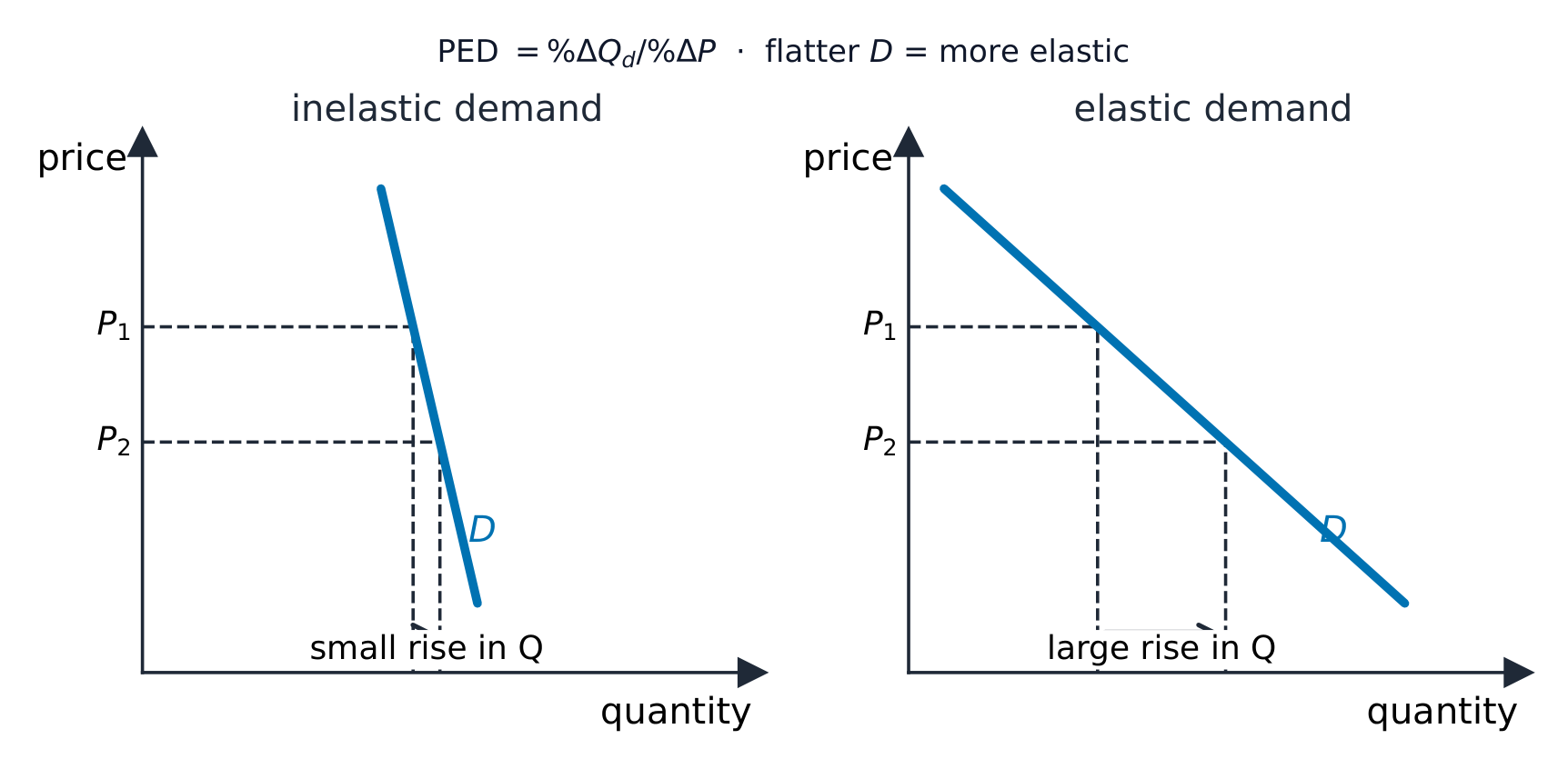
缺乏弹性对富有弹性的需求
You've got it
- $\text{PED} = \dfrac{\%\Delta Q_d}{\%\Delta P}$ — its size measures responsiveness
- elastic (>1) = responsive (luxuries); inelastic (<1) = unresponsive (necessities)
- inelastic → raise price to raise revenue; elastic → the opposite
你掌握了
- $\text{PED} = \dfrac{\%\Delta Q_d}{\%\Delta P}$——它的大小衡量反应灵敏度
- 富有弹性(>1)= 反应灵敏(奢侈品);缺乏弹性(<1)= 反应不灵敏(必需品)
- 缺乏弹性 → 提高价格以提高收入;富有弹性 → 相反