The development life cycle and design tools · 开发生命周期与设计工具
| English | 中文 | Pinyin · 拼音 |
|---|---|---|
| program development life cycle/ˈprəʊɡræm dɪˈveləpmənt laɪf ˈsaɪkl/ | 程序开发生命周期 | chéng xù kāi fā shēng mìng zhōu qī |
| design/dɪˈzaɪn/ | 设计 | shè jì |
| analysis/əˈnæləsɪs/ | 分析 | fēn xī |
| coding/ˈkəʊdɪŋ/ | 编码 | biān mǎ |
| testing/ˈtestɪŋ/ | 测试 | cè shì |
| abstraction/əbˈstrækʃn/ | 抽象 | chōu xiàng |
| decomposition/ˌdiːkɒmpəˈzɪʃn/ | 分解 | fēn jiě |
| flowchart/ˈfləʊtʃɑːt/ | 流程图 | liú chéng tú |
| pseudocode/ˈsuːdəʊkəʊd/ | 伪代码 | wěi dài mǎ |
Building a program
- A program is built in stages — the program development life cycle 程序开发生命周期.
- We plan it with design 设计 tools, then write the algorithm.
- Every algorithm breaks into input → processing → output.
构建一个程序
- 一个程序分阶段构建——程序开发生命周期(program development life cycle)。
- 我们用设计工具(design tools)规划它,然后写算法。
- 每个算法分解为输入 → 处理 → 输出。
The four stages
- Analysis 分析 — study the problem and work out what's needed.
- Design — plan how the program will work.
- Coding 编码 — write the code, testing 测试 small parts as you go (iterative testing).
- Testing — run the finished program with test data to find errors.
- Two analysis skills: abstraction 抽象 (keep only the important details) and decomposition 分解 (break a big problem into smaller parts).
The four stages of program development; testing feeds back to fix and refine the design.
四个阶段
- 分析(analysis)——研究问题并弄清需要什么。
- 设计(design)——规划程序将如何工作。
- 编码(coding)——写代码,随着进行测试小的部分(迭代测试,iterative testing)。
- 测试(testing)——用测试数据运行完成的程序以找到错误。
- 两个分析技能:抽象(abstraction,只保留重要的细节)和分解(decomposition,把一个大问题分成更小的部分)。

程序开发的四个阶段;测试反馈以修复和改进设计。
The program development life cycle · 程序开发生命周期
Step through the stages every project follows — work out what's needed, plan it, build it, then check it. Getting analysis right first saves a lot of rework later. · 逐步看每个项目遵循的阶段——弄清需要什么、规划它、构建它,然后检查它。先把分析做对能节省以后大量的返工。
Put the development life cycle stages in order. · 把开发生命周期阶段按顺序排列。
Analysis (what is needed) → design (plan) → coding (write) → testing (check). · 分析(需要什么)→ 设计(规划)→ 编码(写)→ 测试(检查)。
Abstraction means: · 抽象意味着:
Abstraction simplifies; decomposition breaks a problem into parts. · 抽象简化;分解把一个问题分成部分。
Match each design concept to what it means. · 把每个设计概念匹配到它的含义。
Abstraction simplifies, decomposition splits up, pseudocode plans the steps, and IPO is the overall flow. · 抽象简化,分解拆分,伪代码规划步骤,而 IPO 是整体流程。
Design tools
- A structure diagram — shows the parts of a system and how they fit together.
- A flowchart 流程图 — boxes and arrows showing the steps in order.
- Pseudocode 伪代码 — steps in simple, code-like English (not a real language).
Software is written by programmers who follow the development life cycle.
设计工具
- 一个结构图(structure diagram)——显示一个系统的部分以及它们如何组合在一起。
- 一个流程图(flowchart)——按顺序显示步骤的方框和箭头。
- 伪代码(pseudocode)——用简单的、像代码的英语写的步骤(不是一种真正的语言)。

软件由遵循开发生命周期的程序员编写。
Pseudocode is: · 伪代码是:
Pseudocode describes an algorithm in readable, code-like English without being a real language. · 伪代码用可读的、像代码的英语描述一个算法,而不是一种真正的语言。
Input, processing, output
- Every algorithm decomposes into input (the data in), processing (the work done), and output (the result).
- e.g. "average of three marks": input the 3 marks → add them and divide by 3 → output the average.
A program flowchart sets out the steps and decisions of a program during the design stage.
输入、处理、输出
- 每个算法分解为输入(input,进来的数据)、处理(processing,完成的工作),和输出(output,结果)。
- 例如"三个分数的平均":输入 3 个分数 → 把它们相加并除以 3 → 输出平均。
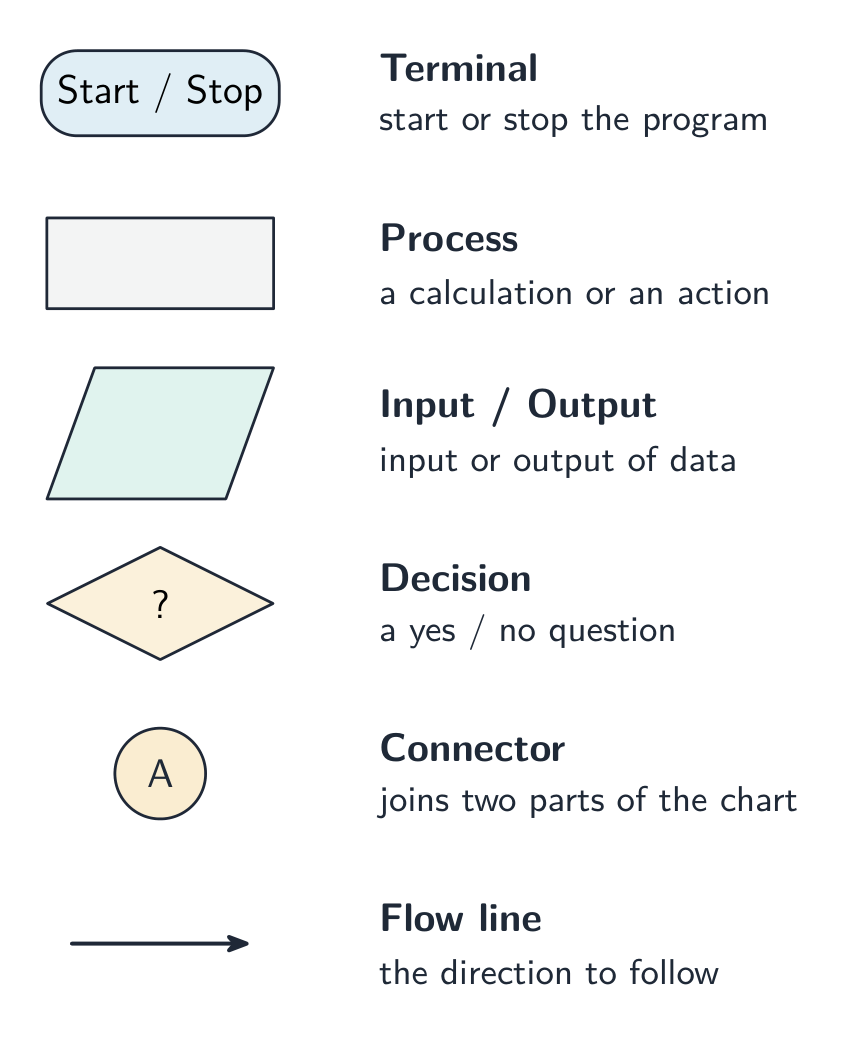
一张程序流程图在设计阶段列出一个程序的步骤和决定。
Every algorithm can be decomposed into: · 每个算法能被分解为:
Input (data in) → processing (the work) → output (the result). · 输入(进来的数据)→ 处理(工作)→ 输出(结果)。
You've got it
- life cycle: analysis → design → coding → testing
- abstraction = keep what matters; decomposition = break into parts
- design tools: structure diagram, flowchart, pseudocode
- every algorithm = input → processing → output
你掌握了
- 生命周期:分析 → 设计 → 编码 → 测试
- 抽象 = 保留重要的;分解 = 分成部分
- 设计工具:结构图、流程图、伪代码
- 每个算法 = 输入 → 处理 → 输出