Alloys and their properties · 合金及其性质
| English | 中文 | Pinyin · 拼音 |
|---|---|---|
| alloy/ˈælɔɪ/ | 合金 | hé jīn |
| steel/stiːl/ | 钢 | gāng |
| brass/bræs/ | 黄铜 | huáng tóng |
| bronze/brɒnz/ | 青铜 | qīng tóng |
| stainless steel/ˈsteɪnləs stiːl/ | 不锈钢 | bù xiù gāng |
Mixing metals for strength
- Pure metals are often too soft or weak for the job.
- Mixing them makes alloys 合金 — usually stronger and more useful than the pure metal.
混合金属以求强度
- 纯金属对工作来说常常太软或太弱。
- 混合它们制造合金(alloys)——通常比纯金属更强更有用。
Alloy property lab · 合金性质实验
See why mixing atoms changes metal properties. · 观察混合原子如何改变金属性质。
An alloy is: · 合金是:
Alloys are mixtures based on a metal. · 合金是以金属为基础的混合物。
Steel is an alloy of iron and: · 钢是铁和:
Steel is iron + carbon. · 钢是铁加碳。
Brass is an alloy of copper and ______. · 黄铜是铜和 ______ 的合金。
Brass = copper + zinc. · 黄铜 = 铜 + 锌。
What an alloy is
- An alloy is a mixture of a metal with one or more other elements.
- Examples: steel 钢 (iron + carbon), brass 黄铜 (copper + zinc), bronze 青铜 (copper + tin).
Different-sized atoms in an alloy stop the layers sliding, so it is harder
一个合金是什么
- 一个合金是一种金属与一种或更多其他元素的混合物。
- 例子:钢(铁 + 碳)、黄铜(铜 + 锌)、青铜(铜 + 锡)。
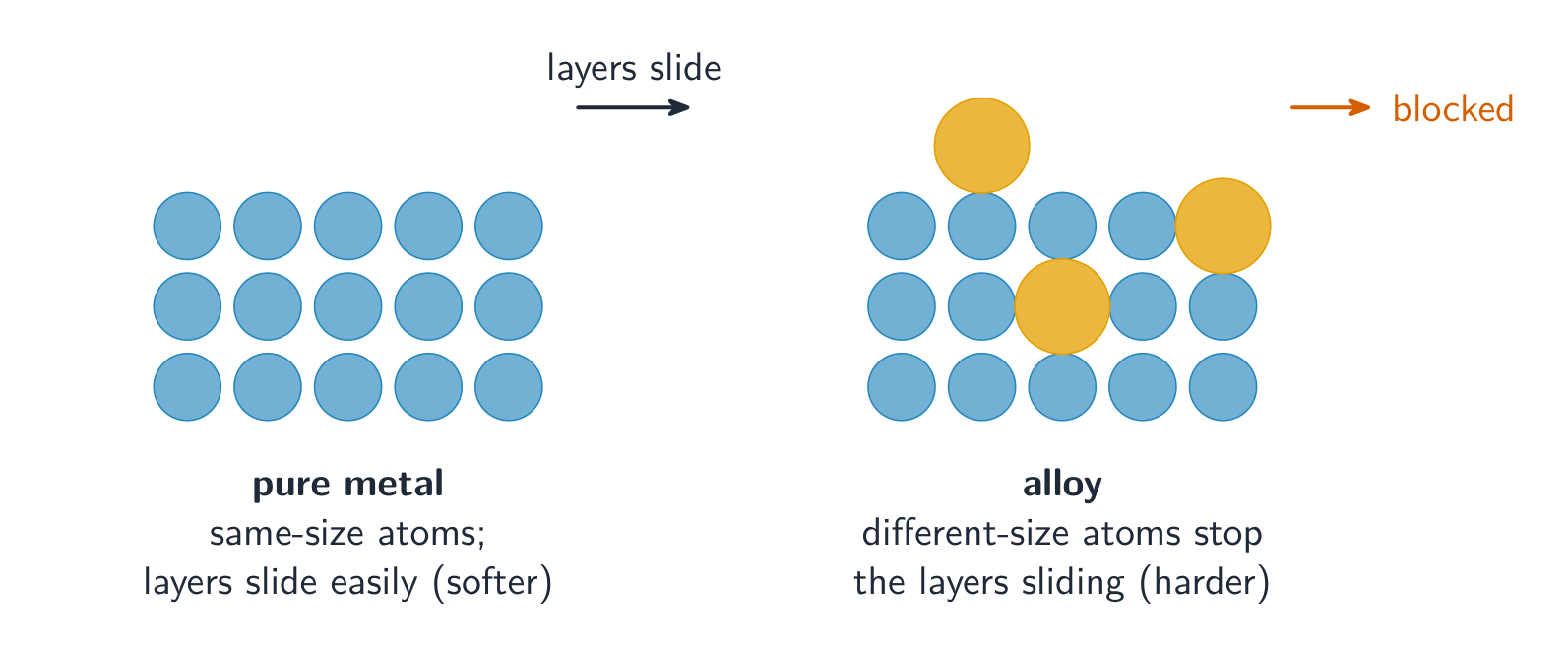
一个合金中不同大小的原子阻止层滑动,所以它更硬
Alloys are harder than pure metals because the different-sized atoms: · 合金比纯金属硬,因为大小不同的原子:
Disrupted layers cannot slide, so the alloy is harder. · 原子层被扰乱无法滑动,因此合金更硬。
Why alloys are harder
- In a pure metal, layers of identical atoms slide easily, making it soft.
- Different-sized atoms in an alloy disrupt the layers, so they can't slide — making it harder.
为什么合金更硬
- 在一种纯金属中,相同原子的层容易滑动,使它软。
- 一个合金中不同大小的原子打乱层,所以它们不能滑动——使它更硬。
Stainless steel contains chromium, which helps it resist rusting. · 不锈钢含有铬,有助于防锈。
Chromium gives corrosion resistance. · 铬赋予耐腐蚀性。
Tailoring properties
- Alloying lets us tune properties: strength, hardness, corrosion resistance.
- Stainless steel 不锈钢 (with chromium) resists rust; this is why it's used for cutlery.
Worked example. Pure iron is soft and bends easily. Adding a little carbon to make steel disrupts the atom layers, making it much harder and stronger — ideal for construction.
定制性质
- 合金化让我们调整性质:强度、硬度、抗腐蚀性。
- 不锈钢(stainless steel,带铬)抗锈;这就是为什么它被用于餐具。
例题。 纯铁软且容易弯曲。加一点碳来制造钢打乱原子层,使它硬得多强得多——对建筑理想。
You've got it
- an alloy is a metal mixed with other elements (steel, brass, bronze)
- different-sized atoms disrupt the layers, so alloys are harder than pure metals
- alloying tailors strength, hardness and corrosion resistance
你掌握了
- 一个合金是一种金属与其他元素混合(钢、黄铜、青铜)
- 不同大小的原子打乱层,所以合金比纯金属更硬
- 合金化定制强度、硬度和抗腐蚀性