Ions and ionic bonds · 离子与离子键
| English | 中文 | Pinyin · 拼音 |
|---|---|---|
| ion/ˈaɪɒn/ | 离子 | lí zi |
| cation/ˈkætaɪən/ | 阳离子 | yáng lí zi |
| anion/ˈænaɪən/ | 阴离子 | yīn lí zi |
| ionic bond/aɪˈɒnɪk bɒnd/ | 离子键 | lí zi jiàn |
Atoms that gain or lose electrons
- Atoms are happiest with a full outer shell. Many achieve this by giving away or taking electrons.
- An atom that has gained or lost electrons becomes a charged ion 离子.
获得或失去电子的原子
- 原子在有一个满的外层时最快乐。许多通过给出或拿取电子实现这一点。
- 一个已经获得或失去电子的原子变成一个带电的离子(ion)。
When a metal atom forms an ion, it: · 当一个金属原子形成一个离子时,它:
Metals lose electrons, becoming positive. · 金属失去电子,变成正的。
A non-metal atom gains electrons to form a ______ ion. · 一个非金属原子获得电子以形成一个______离子。
Extra electrons give a negative charge. · 额外的电子给出一个负电荷。
Forming ions
- A metal atom loses outer electrons to form a positive ion (cation 阳离子).
- A non-metal atom gains electrons to form a negative ion (anion 阴离子).
Sodium gives its outer electron to chlorine; both reach full outer shells and the opposite charges attract
形成离子
- 一个金属原子失去外层电子以形成一个正离子(阳离子,cation)。
- 一个非金属原子获得电子以形成一个负离子(阴离子,anion)。
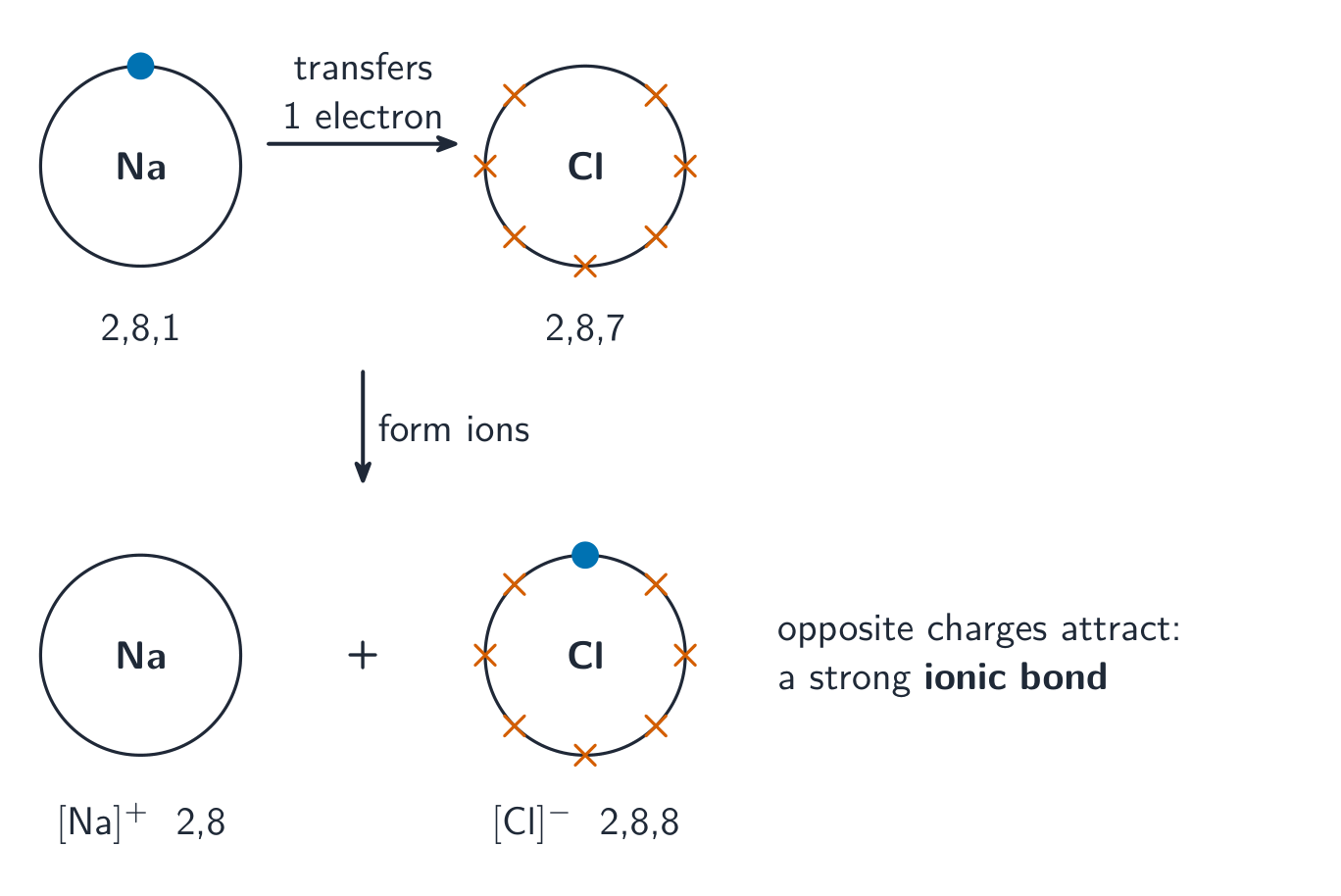
钠把它的外层电子给氯;两者都达到满的外层,而相反的电荷吸引
Forming an ionic bond (NaCl) · 形成一个离子键(NaCl)
Step through it. A metal hands its outer electron to a non-metal; the oppositely charged ions then attract and pack into a giant lattice. · 逐步看。一个金属把它的外层电子交给一个非金属;带相反电荷的离子然后吸引并排列成一个巨型晶格。
Ionic bonding (electron transfer) · 离子键合(电子转移)
Step through it: the metal hands its outer electron(s) to the non-metal, both reach full shells, and the resulting + and − ions attract — an ionic bond. · 逐步看:金属把它的外层电子交给非金属,两者都达到满壳层,生成的正离子和负离子吸引——一个离子键。
An ionic bond is the attraction between: · 一个离子键是以下之间的吸引:
Oppositely charged ions attract. · 带相反电荷的离子吸引。
In ionic bonding, electrons are transferred from the metal to the non-metal. · 在离子键合中,电子从金属转移到非金属。
The metal loses and the non-metal gains. · 金属失去而非金属获得。
Ionic bonding 离子键
- An ionic bond is the strong attraction between oppositely charged ions.
- Electrons transfer from the metal to the non-metal, and the ions then attract.
Worked example. Sodium (2,8,1) gives its 1 outer electron to chlorine (2,8,7). Sodium becomes Na⁺ and chlorine becomes Cl⁻. The opposite charges attract — an ionic bond in sodium chloride.
离子键合
- 一个离子键(ionic bond)是带相反电荷的离子之间的强吸引。
- 电子从金属转移到非金属,然后离子吸引。
例题。 钠(2,8,1)把它的 1 个外层电子给氯(2,8,7)。钠变成 Na⁺ 而氯变成 Cl⁻。相反的电荷吸引——氯化钠中的一个离子键。
An element in Group I forms an ion with a charge of: · 第 I 族的一个元素形成一个带以下电荷的离子:
Group I loses 1 electron → +1. · 第 I 族失去 1 个电子 → +1。
Working out the charge
- The charge equals how many electrons are lost or gained.
- Group I → +1, Group II → +2; Group VII → −1, Group VI → −2.
Metals lose, non-metals gain. Losing electrons leaves more protons than electrons → a positive ion. Gaining electrons gives more electrons than protons → a negative ion.
算出电荷
- 电荷等于失去或获得多少电子。
- 第 I 族 → +1,第 II 族 → +2;第 VII 族 → −1,第 VI 族 → −2。
金属失去,非金属获得。 失去电子留下比电子更多的质子 → 一个正离子。获得电子给出比质子更多的电子 → 一个负离子。
You've got it
- an ion is a charged atom that has lost or gained electrons to fill its outer shell
- metals lose → positive ions; non-metals gain → negative ions
- an ionic bond is the attraction between oppositely charged ions
你掌握了
- 一个离子是一个已经失去或获得电子以填满它外层的带电原子
- 金属失去 → 正离子;非金属获得 → 负离子
- 一个离子键是带相反电荷的离子之间的吸引