Electronic configuration and the Periodic Table · 电子排布与元素周期表
| English | 中文 | Pinyin · 拼音 |
|---|---|---|
| electronic configuration/ɪlekˈtrɒnɪk kənˌfɪɡjəˈreɪʃn/ | 电子排布 | diàn zi pái bù |
| group/ɡruːp/ | 族 | zú |
| period/ˈpɪərɪəd/ | 周期 | zhōu qī |
How electrons are arranged
- Electrons aren't scattered randomly — they fill up shells around the nucleus in a set order.
- This arrangement explains the whole shape of the Periodic Table.
电子如何排列
- 电子不是随机分散的——它们以一个确定的顺序填满原子核周围的壳层。
- 这个排列解释了元素周期表的整个形状。
What is the maximum number of electrons in the first (innermost) shell? · 第一(最内)层壳层中电子的最大数量是多少?
The first shell holds up to 2 electrons. · 第一层壳层容纳多达 2 个电子。
Filling the shells
- Electrons fill the innermost shell first, then the next.
- The shells hold up to 2, then 8, then 8 electrons (at this level).
An atom has a tiny nucleus of protons and neutrons, with electrons in shells around it
填满壳层
- 电子先填最内层的壳层,然后下一个。
- 壳层容纳多达 2,然后 8,然后 8 个电子(在这个层次)。
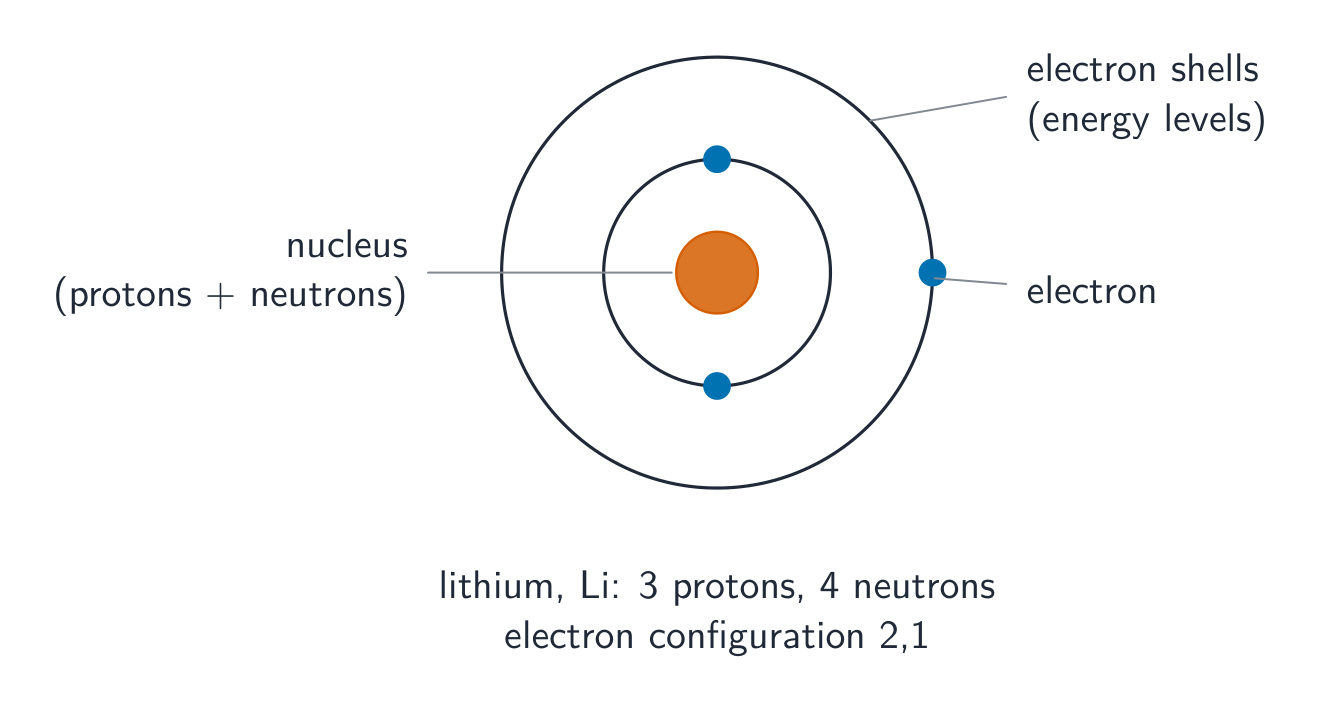
一个原子有一个由质子和中子构成的微小原子核,电子在它周围的壳层中
The electronic configuration of sodium (11 electrons) is: · 钠(11 个电子)的电子排布是:
Fill inner shells first: 2, 8, then 1. · 先填内层壳层:2,8,然后 1。
Chlorine has 17 electrons, giving the configuration 2, 8, ______. · 氯有 17 个电子,给出排布 2, 8, ______。
2 + 8 + 7 = 17 electrons. · 2 + 8 + 7 = 17 个电子。
Writing the configuration
- The electronic configuration 电子排布 lists how many electrons are in each shell.
- Example: sodium (11 electrons) is 2, 8, 1.
Worked example. Chlorine has 17 electrons. Fill the shells: 2, then 8, then the remaining 7 → configuration 2, 8, 7. The 7 outer electrons place it in Group 族 VII.
写出排布
- 电子排布(electronic configuration)列出每个壳层中有多少电子。
- 例子:钠(11 个电子)是 2, 8, 1。
例题。 氯有 17 个电子。填满壳层:2,然后 8,然后剩余的 7 → 排布 2, 8, 7。那 7 个外层电子把它放在第 VII 族。
Fill the electron shells · 填满电子壳层
Electrons fill the inner shell first (max 2), then the next (max 8). The number in the OUTER shell is the group number — chlorine's 2,8,7 puts it in Group VII. · 电子先填内层壳层(最多 2),然后下一个(最多 8)。外层中的数量是族序数——氯的 2,8,7 把它放在第 VII 族。
An element with 7 electrons in its outer shell is in: · 一个外层有 7 个电子的元素在:
Outer electrons = group number, so 7 → Group VII. · 外层电子 = 族序数,所以 7 → 第 VII 族。
The number of electron shells an atom uses equals its period number. · 一个原子使用的电子壳层数量等于它的周期序数。
Period = number of occupied shells. · 周期 = 被占用壳层的数量。
Link to the Periodic Table
- The number of outer-shell electrons = the group number.
- The number of shells used = the period 周期 number.
The outer shell decides the chemistry. Elements in the same group have the same number of outer electrons, so they react in similar ways. That's why the group number is so important.
与元素周期表的联系
- 外层电子的数量 = 族(group)序数。
- 使用的壳层数量 = 周期(period)序数。
外层决定化学性质。 同一族的元素有相同数量的外层电子,所以它们以相似的方式反应。那就是为什么族序数如此重要。
You've got it
- electrons fill shells from the inside out: 2, 8, 8
- the electronic configuration lists electrons per shell (e.g. sodium 2,8,1)
- outer electrons = group number; number of shells = period number
你掌握了
- 电子从内向外填满壳层:2, 8, 8
- 电子排布列出每壳层的电子(例如钠 2,8,1)
- 外层电子 = 族序数;壳层数量 = 周期序数