Diffusion · 扩散
| English | 中文 | Pinyin · 拼音 |
|---|---|---|
| diffusion/dɪˈfjuːʒn/ | 扩散 | kuò sàn |
| concentration/ˌkɒnsənˈtreɪʃn/ | 浓度 | nóng dù |
Spreading out by themselves
- Open a bottle of perfume and soon the whole room smells of it — without any fan.
- The particles spread out on their own. This is diffusion 扩散.
自己扩散开来
- 打开一瓶香水,很快整个房间都闻到它——没有任何风扇。
- 粒子自己扩散开来。这是扩散(diffusion)。
Diffusion is the movement of particles from a region of: · 扩散是粒子从一个以下区域的移动:
Particles spread down the concentration gradient. · 粒子沿浓度梯度向下扩散。
What diffusion is
- Diffusion is the spreading of particles from a region of high concentration 浓度 to a region of low concentration.
- It happens because particles are constantly moving and mixing.
Particles move down the concentration gradient until evenly spread.
扩散是什么
- 扩散是粒子从一个高浓度区域扩散到一个低浓度区域。
- 它发生是因为粒子不断运动和混合。
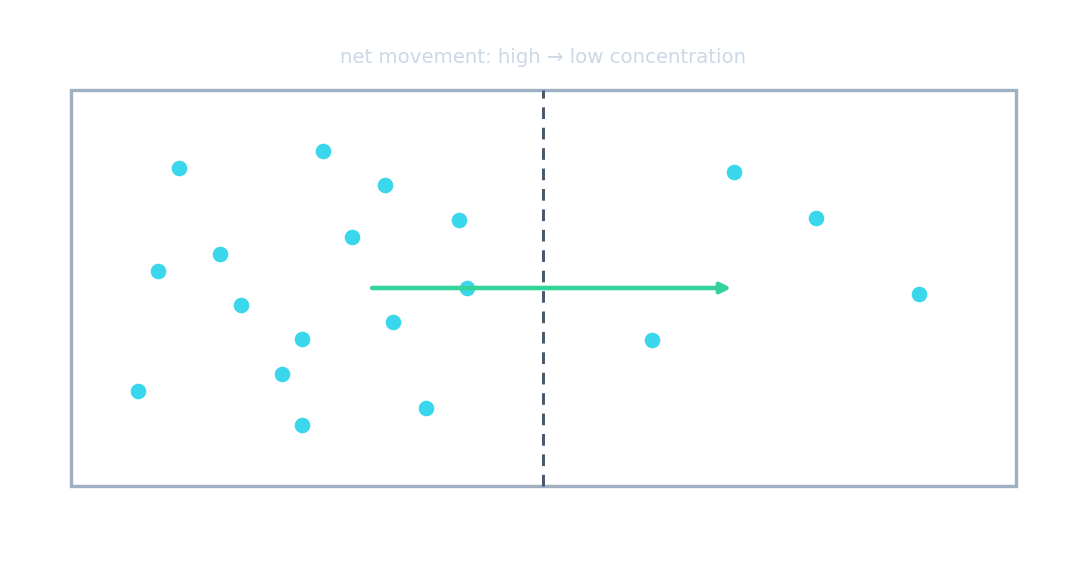
粒子沿浓度梯度向下移动,直到均匀扩散。
Watch particles diffuse · 观察粒子扩散
Set up a concentration difference and watch the particles spread out. Diffusion is the net movement of particles from where they are crowded to where they are not — driven by their own random motion, no stirring needed. · 建立一个浓度差,看粒子扩散开来。扩散是粒子从它们拥挤之处到它们不拥挤之处的净移动——由它们自己的随机运动驱动,不需要搅拌。
Diffusion · 扩散
Release the cloud and the particles spread on their own from the crowded corner until they fill the box evenly — diffusion, sped up by heat. · 释放云,粒子自己从拥挤的角落扩散,直到它们均匀填满盒子——扩散,由热加快。
Diffusion happens faster when the temperature is: · 当温度以下时扩散发生更快:
Hotter particles move faster, so they diffuse faster. · 更热的粒子移动更快,所以它们扩散更快。
Which particles diffuse faster? · 哪种粒子扩散更快?
Lighter particles move faster, so they diffuse faster. · 更轻的粒子移动更快,所以它们扩散更快。
What affects the rate
- Higher temperature → faster diffusion (particles move faster).
- Lighter (lower mass) particles diffuse faster than heavier ones.
Ammonia is lighter, so it diffuses faster and further; the white ring forms nearer the HCl end
什么影响速率
- 更高的温度 → 更快的扩散(粒子移动更快)。
- 更轻(更低质量)的粒子比更重的扩散更快。
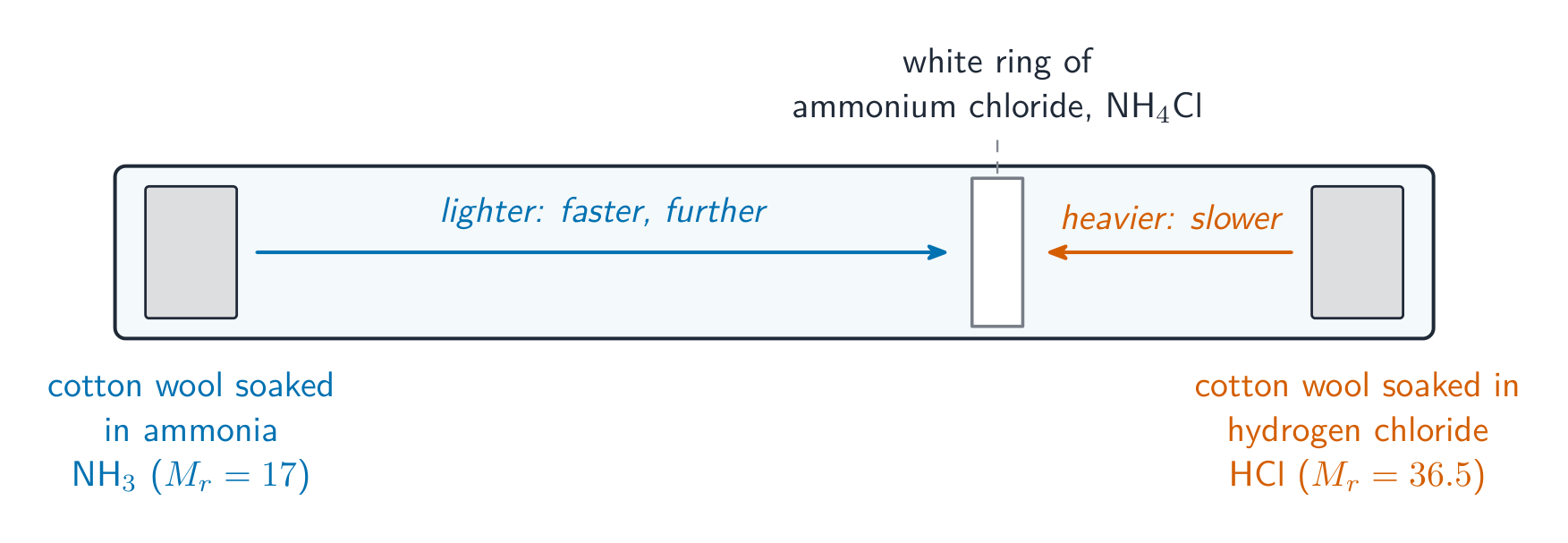
氨更轻,所以它扩散更快更远;白环形成在更靠近 HCl 端
Diffusion is evidence that particles are in constant random motion. · 扩散是粒子处于持续随机运动的证据。
They mix without any outside force. · 它们在没有任何外力的情况下混合。
Diffusion is fastest in a ______, where particles are far apart and fast. · 扩散在一个______中最快,那里粒子相距很远且快。
Gases diffuse fastest; solids barely at all. · 气体扩散最快;固体几乎不。
Diffusion shows particles move
- Diffusion is evidence that particles are in constant random motion.
- Gases diffuse fastest (particles far apart and fast); liquids more slowly; solids barely at all.
Worked example. Two gases released at opposite ends of a tube meet closer to the heavier gas's end — because the lighter gas diffuses faster. Diffusion rate depends on particle mass.
扩散显示粒子运动
- 扩散是粒子处于持续随机运动的证据。
- 气体扩散最快(粒子相距远且快);液体更慢;固体几乎不。
例题。 在一根管子相反两端释放的两种气体在更靠近更重气体的一端相遇——因为更轻的气体扩散更快。扩散速率取决于粒子质量。
You've got it
- diffusion = particles spreading from high to low concentration
- rate increases with higher temperature and lighter particles
- diffusion is evidence that particles are in constant random motion
你掌握了
- 扩散 = 粒子从高到低浓度扩散
- 速率随更高的温度和更轻的粒子增加
- 扩散是粒子处于持续随机运动的证据