Solids, liquids and gases · 固体、液体与气体
| English | 中文 | Pinyin · 拼音 |
|---|---|---|
| particles/ˈpɑːtɪklz/ | 粒子 | lì zi |
| particle model/ˈpɑːtɪkl ˈmɒdl/ | 粒子模型 | lì zi mó xíng |
| vibrate/vaɪˈbreɪt/ | 振动 | zhèn dòng |
| solid/ˈsɒlɪd/ | 固体 | gù tǐ |
| liquid/ˈlɪkwɪd/ | 液体 | yè tǐ |
| gas/ɡæs/ | 气体 | qì tǐ |
Everything is made of particles 粒子
- Ice, water and steam look completely different, yet they're all the same stuff — water.
- The difference is how their tiny particles are arranged. This is the particle model 粒子模型 of matter.
一切都由粒子构成
- 冰、水和蒸汽看起来完全不同,然而它们都是同样的东西——水。
- 区别是它们微小的粒子(particles)如何排列。这是物质的粒子模型(particle model)。
In a solid, the particles: · 在一个固体中,粒子:
Solids have closely packed, vibrating particles. · 固体有紧密排列的、振动的粒子。
The idea that all matter is made of tiny moving particles is the ______ model. · 所有物质由微小运动粒子构成的想法是______模型。
The particle model explains the three states. · 粒子模型解释这三种状态。
Solids 固体
- In a solid, particles are packed closely in a fixed, regular pattern.
- They only vibrate 振动 in place, so a solid has a fixed shape and volume.
Particles are packed and regular in a solid, close and random in a liquid 液体, and far apart in a gas 气体
固体
- 在一个固体中,粒子以一个固定的、规则的图案紧密排列。
- 它们只在原处振动,所以一个固体有固定的形状和体积。
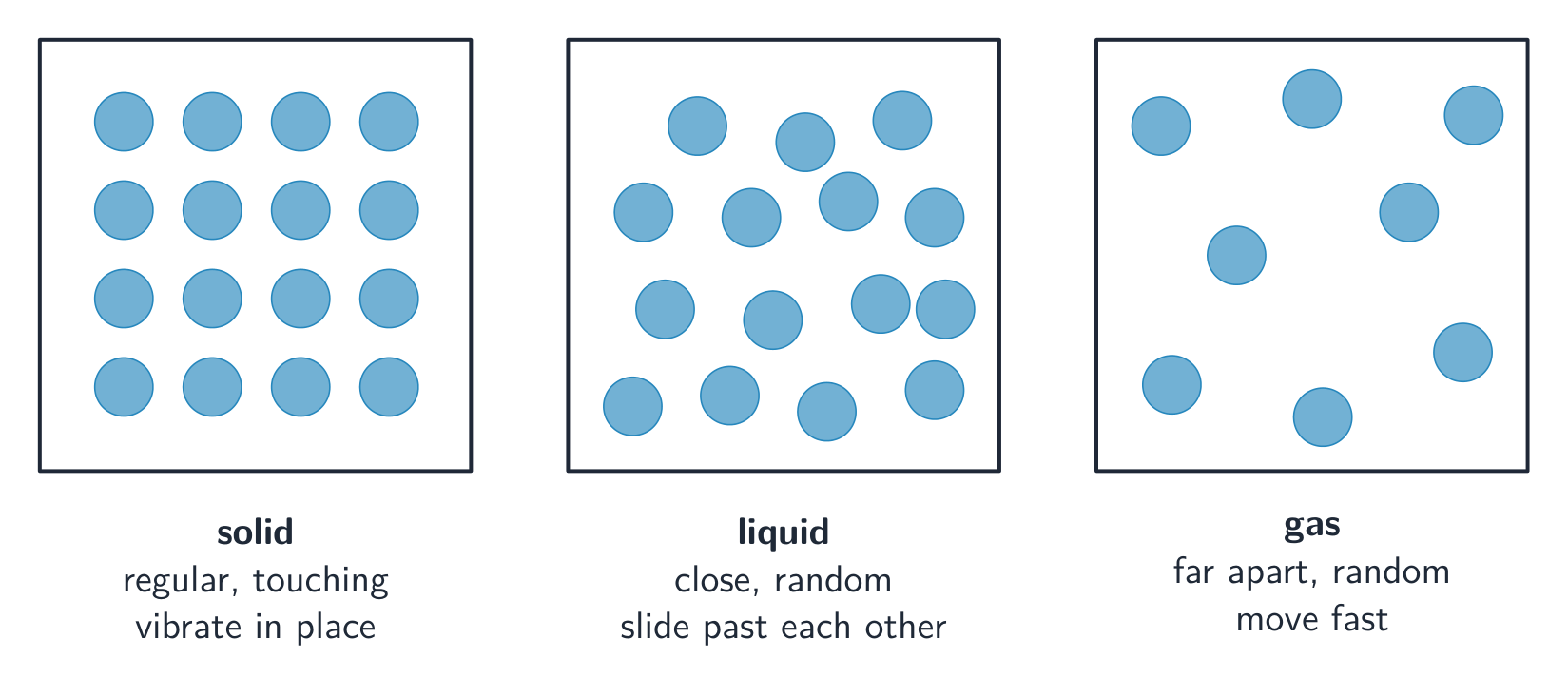
粒子在固体中紧密且规则,在液体中接近且随机,在气体中相距很远
States of matter · 物质的状态
Heat the box and watch the particles break free: a vibrating solid melts to a flowing liquid, then spreads out as a gas. Same particles — just more energy. · 加热盒子,看粒子挣脱:一个振动的固体熔化成一个流动的液体,然后作为一个气体扩散开来。相同的粒子——只是更多的能量。
A liquid takes the shape of its container because its particles: · 一个液体采取它容器的形状,因为它的粒子:
Liquid particles slide, so liquids flow. · 液体粒子滑动,所以液体流动。
Liquids
- In a liquid, particles are still close but not in a fixed pattern.
- They can slide past each other, so a liquid flows and takes the shape of its container.
Warmed solid iodine turns straight into a purple gas (sublimation)
液体
- 在一个液体中,粒子仍然接近但不在一个固定的图案中。
- 它们能互相滑过,所以一个液体流动并采取它容器的形状。
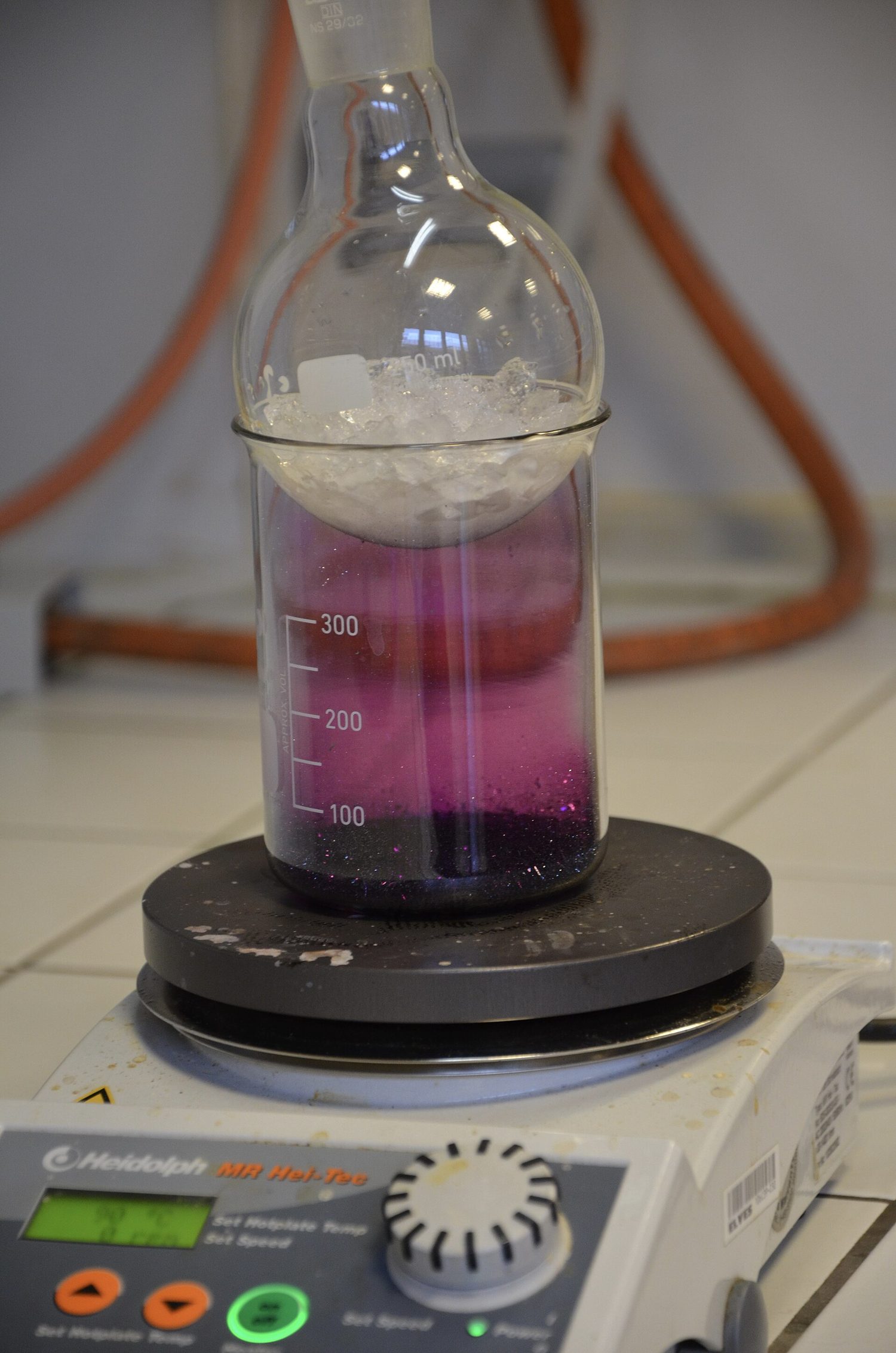
被加热的固体碘直接变成一种紫色气体(升华)
A gas spreads to fill its container because its particles are: · 一个气体扩散填满它的容器,因为它的粒子:
Fast, widely spaced particles fill the available space. · 快速的、宽间隔的粒子填满可用的空间。
Ice, water and steam are made of the same particles. · 冰、水和蒸汽由相同的粒子构成。
Only the arrangement and energy differ, not the substance. · 只有排列和能量不同,物质不变。
Gases
- In a gas, particles are far apart and move quickly in all directions.
- A gas spreads out to fill any container and can be compressed.
It's the same particles in all three states. Melting ice doesn't change the water particles — only how they are arranged and how much energy they have. The substance is identical.
气体
- 在一个气体中,粒子相距很远并向所有方向快速移动。
- 一个气体扩散开来填满任何容器并能被压缩。
在所有三种状态中是相同的粒子。 熔化的冰不改变水粒子——只改变它们如何排列以及它们有多少能量。物质是相同的。
You've got it
- the particle model: matter is made of tiny moving particles
- solid = closely packed, fixed, vibrating; liquid = close, sliding, flows; gas = far apart, fast, fills space
- the same particles make all three states — only arrangement and energy differ
你掌握了
- 粒子模型:物质由微小的运动粒子构成
- 固体 = 紧密排列、固定、振动;液体 = 接近、滑动、流动;气体 = 相距远、快速、填满空间
- 相同的粒子构成所有三种状态——只是排列和能量不同